Timothy Freriks's Blog, page 6
September 23, 2015
Renaissance, a fiction thriller
This is about my newest novel, Renaissance. Renaissance is not about the Renaissance; it’s about a man—and a world—that undergoes a renaissance, a rebirth. This book is of a mixed genre but mostly an adventure, a thriller flavored with financial and political seasoning; it is tightly plotted and engagingly intricate, but interwoven with philosophical undertones. […]
The post Renaissance, a fiction thriller appeared first on Timothy Freriks.


August 25, 2015
Renaissance - a novel
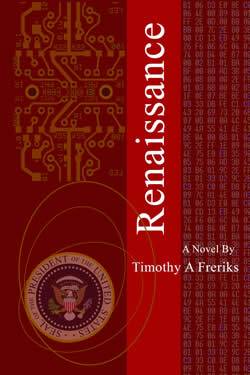
In this political thriller, Robert Curry is unexpectedly put in a position to save the world from imminent nuclear destruction. Given the task of returning to the past and rewriting history, he must first gain enough financial and political power to be able to prevent the series of accidents and manipulations that led to the apocalypse. But he isn’t the only power trying to affect the outcome. In an epic battle, competing energies of cosmic strengths collide in a complex and electrifying weave of plot twists and turns. This wild ride finally explodes in a climax you will not see coming.
Renaissance is fast-paced thriller with unexpected twists and turns, threads that keep weaving themselves into a tapestry of intrigue, power, betrayal, and courage. It’s also a love story that spans three lifetimes: the same lifetimes, three times.
Robert Curry developed a theory about the origin of life: existence is the mind of the intelligent cosmic matter that expanded in the original “Big Bang” to form the current universe. Everything that is, was. Not only is the tangible world a re-configured state of the original Matter, but the intangible world is as well: intangibles such as love, hate, jealousy, and competition—the things that make humans, humans. The probability is, he continues, that the original matter was a community of beings, Master Entities, and those entities still function. We are them, and they are us.
One day, as the world spirals toward nuclear destruction, a Master Entity stops time and instructs Curry to return to the past and re-build the world so that his world—the world he created from his portion of the original matter—would not be destroyed. Curry cleverly uses his knowledge of the future to gain financial and political power. Along the way his adventures, missteps, successes and failures keep this book active and alive. His search for love—to re-gain his only true love who died in the war that was about to consume his world—drives him as well. There is heartbreak and joy, challenge and triumph, winning and losing
In the explosive ending, we discover the Master Entity’s true nature and motivation, which is… Sorry. You’ll have to buy the book to find that out.
Learn more
Buy eBook
RENAISSANCE – my newest novel
In this political thriller, Robert Curry is unexpectedly put in a position to save the world from imminent nuclear destruction. Given the task of returning to the past and rewriting history, he must first gain enough financial and political power to be able to prevent the series of accidents and manipulations that led to the […]
The post RENAISSANCE – my newest novel appeared first on Timothy Freriks.
August 18, 2015
URGENCY – Foundation of a saleable product
A lot of articles talk about ‘creating’ urgency in order to sell your product. However, I don’t think you can base your product’s salability on hoping marketing and sales manipulations will create a motivated customer. If your target customer does not already have some urgency in finding a solution to the problem he has, it will be hard to pump up urgency to a point where a prospect becomes a customer.
The customer who is prepared to take money out of his pocket and give it to you is a motivated customer; he is motivated to find a solution to a problem he knows he has. Motivation drives sales—an unmotivated prospect will not become a customer. The ease with which you create that actionable level of motivation is a direct function of urgency: more urgency, more motivation.
Urgency is used to judge how easy it will be to sell your product. Really easy is good; it means you don’t have to work too hard to make the sale. I’m not saying it is good to be lazy, I’m saying that you can make more profit with X number of marketing/sales dollars than you can if you have to spend hours and XXXX dollars to convince people they should buy the product. It’s just a matter of efficiency.
If you start with a product that inherently evokes a high sense of urgency, things will be easier. If you start with a product in which nobody seems to care much about buying, you will have a very hard time. Most products are somewhere in between.
Urgency also serves to narrow down the available market to the probable market, the ones that will probably buy your product.
Urgency is a function of Frequency and Intensity.
Let’s say you make an expensive headache remedy and you are trying to find the quickest and easiest sales path. There is a huge available market: everybody has a headache at some point in their lives. If you look at one classification—people that have an intense headache once a year—you’ll see intensity but no frequency. If you look at another classification—people that have a ‘tiny’ headache every morning—you’ll see frequency but no intensity. Neither of these groups have enough actionable urgency to find a remedy, especially an expensive one. So, who do you sell to? Answer: the people who have an intense headache every day. You really don’t have to sell very hard, do you? They will rip it out of your hands and shove money in your pocket if it will work for them.
Now, how big is that market? If you remember my Three Critical Questions, you’ll remember that the first question is: Do a lot of people really have the problem you think they do? You can use the urgency test to answer the lot of people part of the question. Out of the total available market, how many have intense headaches every day? That question can only be answered by a strong Customer Investigation process: you ASK a lot of people! If you find that only a handful of people have a level of urgency sufficient to establish a high enough motivation to purchase, maybe the product needs to be re-thought.
Looking at the market in terms of urgency can clarify the prospects for success. Now, I know what you’re thinking: what about Twitter? Who could have projected the level of urgency that would cause millions of people to write 142-character notes to each other all day long? Some urgencies are hidden really deep—and people are still a mystery.
What about Popcorn in a Can, however? If you’ve never heard of that product, there’s a good reason: priced at $3.50, a small can wouldn’t even make a dent in the popcorn craving of one person. You’d have to spend $14.00 to equal the serving you get from a typical microwave bag at $3.49. There may be urgency to have popcorn, but people apply other filters to create Actionable Urgency.
There is just not enough Value in “Popcorn in a Can”.
VALUE = BENEFIT/COST
With Twitter, the Benefits far exceed the Cost.
With Popcorn in a Can, the Cost far exceeds the Benefits. And, no amount of urgency can overcome that. This goes to the third question of the Three Critical Questions: Does your product offer a compelling solution to their problem? Redenbacher just offers a better solution.
The bottom is this: whether you have a struggling product or are thinking through a new product, try to determine the customer’s urgency level in finding a solution. The higher the urgency, the easier the sale and the more revenues you can generate. If very few people have any urgency to buy at all, no amount of slick marketing is going to create a successful product.
The post URGENCY – Foundation of a saleable product appeared first on Timothy Freriks.
July 30, 2015
First, Get A Product You Can Sell–Part 1
I have been consolidating and prioritizing my messages for early-stage entrepreneurs. I think that success starts with one simple task: coming up with a product that people will buy. I often talk about bringing ambition and commitment to the table, and that is critical as well, but no amount of ambition or commitment is going to overcome the lack of a product that people, people other than yourself, will see VALUE.
You probably have a product or service idea you want to build into a business; otherwise you might not be reading this. Whether you’re starting a physical-product business, a consulting business, or a retail store, the most important question you have to answer is this: will people give you money for it? Remember: without revenue from paying customers, you won’t have a product to build a business around. So, before you invest a lot of time in building a business plan or developing the final product, the challenge is to make sure your product will provide a substantial value to a lot of people, value sufficient to induce them to part with their money in exchange for it.
How do you create sufficient value? Value is a function of benefit divided by cost; the wider the spread between benefit and cost, the stronger the value. The stronger the value, the more likely it will be that you can create a motivated customer. “Cost” can be much more easily calculated than “Benefit”. Benefit is a tricky word; not everybody will see the benefit in your product solution. To use a well-worn cliché, Eskimos would see less value in having a refrigerator than would someone living in Panama. Basically, the bigger the problem that a certain set of people have, the more benefit the product that solves it will offer—and the more likely they are to purchase your product.
There’s another qualifier: the size of the market. If your product is only attractive to left-handed, blond, male Eskimos between the ages of 10 and 12, you might not have many prospects. However, if your product offers a powerful solution to a very wide swath of the population, you may really have something.
It comes down to the three critical questions:
Are there a lot of people who really have the problem your product is trying to solve? (stress the words ‘lot of’ and ‘really’)
Do they have an urgent need to solve the problem? (stress the word ‘urgent’)
Does your product offer a compelling solution to their problem? (stress the word ‘compelling’)
You may be the only person in the world that thinks the problem your product solves is a significant problem. What if the vast majority of your target customers really don’t care, really don’t recognize the issue as being up to ‘problem’ status? Then, there’s no basis for needing a solution.
Now, you may have identified a problem that a lot of people have, but none of them really think it important to find a solution; it simply isn’t ‘urgent’ enough. Urgency is a critical component: it drives the foundation for the motivation to pay for a solution. Little or no urgency will not produce motivated customers; there simply is not enough perceived value.
You may have identified a problem that is shared by a lot of people and you have determined that customers indeed have a strong degree of urgency to find a solution, but your product sucks. A product can fail because: it doesn’t work, the cost is higher than the perceived benefit, it is too hard to use (the ‘effort’ part of cost is too high), or a competitor simply does it better.
If you don’t have a good answer to all three questions, you may be ready for a new idea. In Part 2, we’ll talk about how to get definitive answers to these questions and determine whether or not you have a product worthy of further development.
The post First, Get A Product You Can Sell–Part 1 appeared first on Timothy Freriks.
May 19, 2015
Idea dating. Shiny Objects Syndrome.
Few people succeed by bouncing around from cool idea to cool idea. If you’re an inventor like me, you have a couple “great” ideas a day. Cool ideas have a life span; some live longer than others. A successful business is based on a cool idea to which you dedicate your energies, committing your time […]
The post Idea dating. Shiny Objects Syndrome. appeared first on Timothy Freriks.
May 11, 2015
7 Traits of Successful Entrepreneurs
I’ve been, and I’ve known a lot of, successful entrepreneurs. When thinking through why some made it and some didn’t, seven personal characteristics appeared to be consistent with success. Invest in Yourself. I’m not talking so much about money, but rather about time and energy and passion and commitment. If you invest in yourself, it […]
The post 7 Traits of Successful Entrepreneurs appeared first on Timothy Freriks.
April 26, 2015
Entrepreneur mistakes I made – Part Deux
I invented NOAH, an animated character technology for online applications. It was very effective and successful for online training projects, bridging the gap between instructor-led and pure online coursework. We adapted it to work on our website, a cute little avatar flying around and pointing at things and explaining benefits and action items, popping up […]
The post Entrepreneur mistakes I made – Part Deux appeared first on Timothy Freriks.
April 20, 2015
Working out Your Competitive Advantage
There are very few unique ideas in the world; don’t think you are the first person in the billions of people in the world to think of it. The difference between success and failure relies on a lot of factors, like management and customer service, but every successful product has some distinguishing characteristic, some competitive […]
The post Working out Your Competitive Advantage appeared first on Timothy Freriks.
April 18, 2015
Pitching is a Sales Process – Part 1
By popular demand (OK, a couple people asked) I’m writing a follow-up to my post a couple weeks ago about pitching your idea. I’ve been working with corporate clients for 15 years, developing interactive training programs built with my SoundLearningX© system. Because of the nature of the program, I got involved in a lot of sales-related […]
The post Pitching is a Sales Process – Part 1 appeared first on Timothy Freriks.