
Maggie Estep's Blog, page 9
April 15, 2013
Some readings, three.
Some readings coming up in NYC (also Hudson, NY and Seattle, but those are a ways off).
May 13, 2013 (I think, though there is some talk of it being May 12) @ City Reliquary, Brooklyn. This is for the Henry Miller Festival and in conjunction with PARACHUTE, the Coney Island Festival. I’m working on an essay for this one, something that ties together Coney Island, Henry Miller, the fire eater from the sideshow circa 1990′s and possibly the writer Neil Gaiman who seems to be ending up in the essay. More details on times, other readers, and admission as they are fed to me.
June 1st 2013 Tomkins Square Park, NYC – The HOWL Festival. Again, details when I get them and….
June 25th 2013 St Marks Bookshop, I’ll be doing something brief as one of several contributors to Akashic Books’ THE MARIJUANA CHRONICLES. It will be a festive night. I won’t be stoned, but I’ll be reading about zombie hookers so that’s even better.


April 7, 2013
New things.
Just to keep life interesting, I’m going to start posting short excerpts from the book I’m working on. Maybe once a week or so. Herewith, first few pages of chapter one.
ME
1. The Messiah Horse
Polly Jean was standing over the man, nudging his shoulder with her bare foot.
“Get up,” she said.
He had passed out on her floor the previous night, and though he wasn’t dead, he wasn’t waking up either.
Polly Jean didn’t know his name.
She nudged his shoulder again.
Finally, he opened his yellow coyote eyes.
“You have to get out of here.” Polly Jean said.
“That’s not nice,” he said.
“Probably not.” Polly Jean said.
She noticed his teeth were mossy. Also, there was a network of gin blossoms around his nose.
Polly Jean turned her back to the man and shuffled three steps sideways to the kitchen area. She put the teakettle on. Birdy, Polly Jean’s 76-pound rust-colored dog, let out one low bark that Polly Jean understood perfectly: Birdy wanted the stranger out same as Polly Jean did.
“I know,” said Polly Jean, rubbing Birdy’s crinkled forehead.
“Where’s the can?” The man had gotten to his feet and come to stand too close to Polly Jean. She felt like a tower. She saw white flakes of dandruff in his dark, oily hair.
“Right there,” Polly Jean pointed to a narrow door.
He made a sound like a garden gnome choking on a rake handle and went into the WC.
She wished he’d told her the nature of his appetites before she’d let him pick her up at the Safeway in the strip mall that fringed the town of Deerhound, Maryland. But this was often the way. Polly Jean was tall with shoulders broader than her hips. Some people called her handsome, no one called her pretty. Polly Jean had never been entirely sure why these physical characteristics attracted masochistic men, but they did. She’d had seven lovers, two of these husbands, and they’d all been masochists. Which is why she hadn’t been with anyone for sixteen months until the small goateed man had accosted her at Safeway. After some half-hearted small talk about a town in Canada known for its artichoke production, the man had asked Polly Jean if she wanted to come to his place. She’d insisted they go to hers
“I have to feed my dog,” she’d said.
After getting over his fear of Birdy, the man had made a fuss about Polly Jean’s trailer, saying how nice and homey it was
“Yes, it’s fine, it reminds me of the circus.”
“You work in the circus?”
“No. But I like the feeling of circuses even though I don’t approve of circuses with corrosive animal training methods and have boycotted them for the last twelve years.”
The man hadn’t volunteered his name and Polly Jean hadn’t asked. It wasn’t characteristic of her to care so little about a man she was about to bed. But that was fine. Polly Jean wanted to change.
Polly Jean had excused herself and gone into the bathroom. When she’d emerged, the man had been completely naked, his thin, cheap clothes shed like snakeskins on the floor. He had almost no body hair and his half-erect penis was enormous.
“Could you please squeeze it?” he had asked.
Polly Jean had tentatively squeezed.
“No no,’ he had said impatiently, “harder, much harder.”
Polly Jean didn’t require a great deal of wooing and had always been easily aroused, but this was not fun. She withdrew her hand.
“Spank me?” The man had asked.
When she refused to hit him, he asked for a drink and, not wanting to seem cold, she gave him one. Then another. He was possibly in the late stages of alcoholism and didn’t hold his liquor well. Polly Jean asked him to leave. He got up to walk to the door but he was too drunk. He fell down and passed out.
Now, he came out of the bathroom with water dripping from his goatee. “I guess I’ll be going.” “I guess you will.” Polly Jean said. “Goodbye,” she added as she locked the door behind him.
She watched through the front window as he got into his large yellow car and drove away.
“Breakfast?” Polly Jean turned to her dog.
February 19, 2013
The Killing Type
The folks at Akashic Books asked me to write a piece of FLASH fiction. This FLASH appellation has nothing to do with Flash Gordon as Neal Pollack seems to believe, but instead refers to brevity (generally under 750 words, so it can be read in one long inhale).
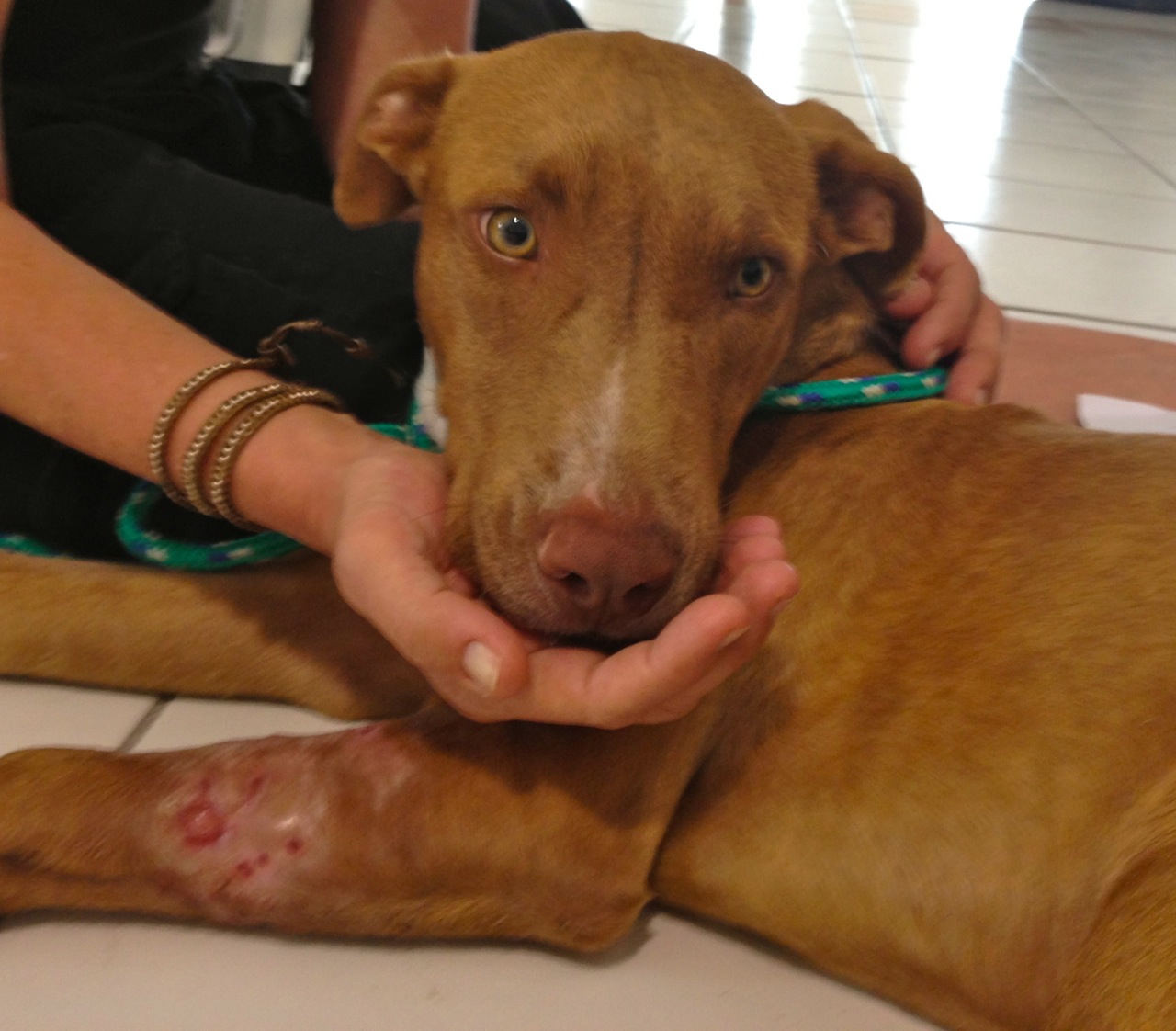
It was harder than I thought, but extremely satisfying. While the title is a nod to Amanda Palmer, and fits the piece perfectly, alternate titles might be “The Untrue Story of How I Got A Second Dog” or “A Pit Bull Advocate’s Wet Dream”. The results can be found herewith, on Akashic’s site: The Killing Type
February 12, 2013
Mutts unite
In light of the Westminster Dog Show, a good time to post the brilliant Amy Hempel’s story “A Full Service Shelter”.
Warning: May cause weeping.
A Full-Service Shelter by Amy Hempel
They knew me as one who shot reeking crap out of cages with a hose—and liked it. And would rather do that than go to a movie or have dinner with a friend. They knew me as one who came two nights a week, who came at four and stayed till after ten, and knew it was not enough, because there was no such thing as enough at the animal shelter in Spanish Harlem that was run by the city, which kept cutting the funds.
They knew us as the ones who checked the day’s euth list for the names of the dogs scheduled to be killed the next morning, who came to take the death-row dogs, who were mostly pit bulls, for a last long walk, brought them good dinners, cleaned out their kennels, and made their beds with beach towels and bath mats and torn sheets and Scooby-Doo fleece blankets still warm from industrial dryers. They knew me as one who made their beds less neatly over the course of a difficult evening, who thought of the artist whose young daughter came to visit his studio, pointed to the painting she liked, and asked, “Why didn’t you make them all good?”
They knew us as the ones who put pigs’ ears on their pillows, like a chocolate in a good hotel. They knew us as vocal vegetarians who brought them cooked meat—roast turkey, rare roast beef, and honey-glazed ham— to top off the canned food we supplied that was still better than what they were fed there. They knew us as the ones who fed them when they were awake, instead of waking them at 2:00 AM for feeding, the way the overnight staff had been ordered by a director who felt they did not have enough to do.
They knew me as one who spoke no Spanish, who could say only “Si, si” when someone said about a dog I was walking, “Que lindo!” And when a thuggish guy approached too fast, then said, “That’s a handsome dude,” look how we exploded another stereotype in a neighborhood recovering from itself.
They knew us as the ones who had no time for the argument that caring about animals means you don’t also care about people; one of us did! Evelyne, a pediatrician who treated abused children.
They knew us as the ones who got tetanus shots and rabies shots—the latter still a series but no longer in the stomach—and who closed the bites and gashes on our arms with Krazy glue—not the medical grade, but the kind you find at hardware stores—instead of going to the ER for stitches, where we would have had to report the dog, who would then be put to death.
They knew us as the ones who argued the names assigned at Intake, saying, “Who will adopt a dog named Nixon?” And when Nixon’s name was changed—changed to Dahmer—we ragged on them again, then just let it go when the final name assigned was O.G., Original Gangster. There was always a “Baby” on one of the wards so that staff could write on the kennel card, “No one puts Baby in the corner,” and they finally stopped using “Precious” after a senior kennel worker said of a noble, aged Rottie, “I fucking hate this name, but this is a good dog.” (Though often they got it right: they named the cowboy-colored pocket pit who thought he was a big stud, Man Man).
They knew me as one who did not bother wearing latex gloves or gauzy scrubs to handle the dogs in sick ward, who wore gloves only when a dog had swallowed his rabies tag, and I had to feel for it in feces. They knew me as one who gave a pit bull a rawhide chew stick swirled in peanut butter, then, after he spit it up and wanted it back, cleaned it off and gave it to him so he could have… closure.
They knew us as the ones who put our fingers in mouths to retrieve a watch, a cell phone, a red bicycle reflector that a dog sucked on like a lozenge.
They knew me as one who shot reeking crap out of cages with a hose,
who scoured metal walls and perforated metal floors with Trifectant, the syrupy, yellow chemical wash that foamed into the mess, and then towel- dried the kennel and liked the tangible improvement—like mowing a lawn or ironing a shirt—that reduced their anxiety by even that much.
They knew me as one who, early on, went to tell a vet tech the good news that three dogs had been rescued from that morning’s list of twelve, to which the tech said, “That blows—I already filled twelve syringes.”
They knew us as the ones who repeatedly thanked the other vet tech, the one who was reprimanded for refusing to kill Charlie, the pit bull who licked his hand when the tech went to inject him. And Charlie was adopted less than twenty-four hours later by a family who sent us photos of their five-year-old daughter asleep atop Charlie, the whole story like a children’s book, or maybe a German children’s book. And we kept thanking the vet tech, until he was fired for killing two of the wrong dogs, their six-digit ID numbers one digit off. He didn’t catch the mistake, but neither had the kennel worker who brought him the wrong dogs, and who still has his job.
They knew us as those who found them magnificent with their wide- spaced eyes and powerfully muscled bodies, their sense of humor and spirit, the way they were “first to the dance and last to leave,” even in a House of Horrors, the way stillness would take them over as they pushed their heads into our stomachs while sitting in our laps. They knew us as those whose enthusiasm for them was palpable, Rebecca falling in love with them “at first sight, second sight, third sight,” and Yolanda tending to them with broken fingers still in a cast, and Joy and the rest with their surpassing competence and compassion. They knew us as those who
would sometimes need to take out a Chihuahua—“like walking an ant,” Laurie said—for a break. They knew us as those who didn’t mind when they back-washed our coffee, when they licked the paper cup the moment we looked away. They knew us as the ones who worked for free, who felt that an hour stroking a blanket-wrapped dog whose head never left your lap and who was killed the next morning was time well spent.
They knew me as the least knowledgeable one there, whose mistakes were witnessed by those who knew better.
They knew me as one who liked to apply the phrase, “the ideal version of”—as in “Cure Chanel’s mange and you’ll see the ideal version of herself”—but did not like the term “comfort zone,” and thought one should try to move beyond it.
They knew me as one who was unsure of small dogs, having grown up with large breeds and knowing how to read them, but still afraid of the Presa Canarios, the molossers bred in the Canary Islands, with their dark bulk and bloodshot bedroom eyes, since I had lived in San Francisco when a pair of them loose in a tony apartment house had killed a friend of mine who had stopped to get her mail and could not get her door unlocked before the attack began.
They knew me as one who called one of their number a dick when he knocked me over and I slammed into a steel bolt that left me bleeding from just above an eye. They knew me as one who guided them to step over the thick coiled hose in the packed garage that was being used weekly by a member of the board of directors to wash his car the city paid for. He never went inside the building.
They knew us as the ones who attached a life-size plastic horse’s
head to a tree in the fenced-in junkyard backyard, where the dogs could be taken to run off leash one at a time, and to sniff the horse’s head before lifting a leg against it. They knew us as those who circulated photos of two pit littermates dive-bombing each other under the blankets of a bed to get closer to the large-hearted woman who had adopted them both.
They knew us as the ones who took them out, those rated “no concern” and “mild,” also “moderate,” and even “severe,” though never the red-stamped “caution” dogs. Although some of the sweetest dogs were the ones rated “moderate,” which was puzzling until we realized that behavior testing was done when a stray was brought in by police or a dog surrendered by his owner, when they were most scared. “Fearful” is the new “moderate.” And how do you think a starving dog will score on “resources guarding” when you try to take away a bowl of food! They knew me as one who never handled the “questionable” dogs, because that meant they could turn on you in an instant, you wouldn’t know what was coming, and some of us got enough of that outside the shelter.
They knew me as one whom Enrique had it in for, the kennel worker who had asked me to take out a one-hundred-fifty-pound Cane Corso, and when I said, “Isn’t he ‘severe’?” said, “Naw, he’s a good boy,” and when I looked up his card he was not only “severe,” he was also DOH-HB hold— Department of Health hold for Human Bite. He had bitten his owner.
They knew me as one who forgave Enrique when he slipped on the newly installed floor while subduing a frightened mastiff, fell, and punctured a lung. After voting to spend nearly fifty thousand dollars to replace the facility’s floor, the board then had to allocate funds to bring in a crew with sanders to rough up the pricey new floor. The allocated funds
were diverted from Supplies, so kennel staff had to ask us, the volunteers, for food when they ran out because feeding the dogs had not factored into the board’s decision.
They knew me as one who held the scarred muzzle of a long-nosed mutt in sick ward and sang, “There is a nose in Spanish Harlem” until he slept.
They knew me as one who refused to lock the padlocks on their kennels, the locks a new requirement after someone stole a puppy from Small Dog Adoptions, and which guarantee the dogs will die in the event the place catches fire.
They knew me as one who asked them stupid questions—How did you get so cute?—and answered the questions stupidly, saying on behalf of the giddy dog, “I was born cute and kept getting cuter.” They knew me as one who talked baby talk to the babies, and spoke in a normal voice about current events to those who enjoyed this sort of discourse during their one-on-ones. I told an elderly pittie about the World War II hero who died in his nineties this year in a Florida hospital after having been subdued while in emotional distress by the use of a metal cage that was fixed in place over his bed. The Posey Cage had been outlawed in Eastern Europe, yet was still somehow available in Florida. Caged in the space of his bed, “he died like a dog,” people said.
They knew us as the ones who wrote Congress in support of laws made necessary by human cruelty and named for canine victims: Oreo’s Law, Nitro’s Law, the law for the hero dog from Afghanistan, and that’s just this year.
They knew me as one who loved in them what I recoiled from in
people: the patent need, the clinging, the appetite. They knew me as one who saw their souls in their faces, who had never seen eyes more expressive than theirs in colors of clover honey, root beer, riverbed, and the tricolor “cracked-glass” eyes of a Catahoula, rare to find up north. They knew us as the ones who wrote their biographies to post to rescue groups, campaigning for the rescue of dogs that we likened to Cleopatra, the Lone Ranger, or Charlie Chaplin’s little tramp, to John Wayne, Johnny Depp, and, of course, Brad Pitt, asking each other if we’d gone overboard or gone soft, like Lennie in Of Mice and Men. They knew us as the ones who tried to gauge what they had been through, as when Laurie said of a dog with shunts draining wounds on his head, “He looks exhausted even when he’s asleep.”
They knew us as the ones who wrote letters to the mayor pointing out that the Department of Health had vastly underestimated the number of dogs in the city to clear itself of misconduct for failing to license more. The political term for this is “inflating their compliance record.” They knew Joy as the stellar investigator who told the rest of us that the governor helped boost the state budget by helping himself to funds that had been set aside to subsidize spay/neuter services throughout the state.
They knew that? They seemed to know that, just as they seemed to appreciate Joy’s attempt to make a new worker understand that staff had not “forgotten” to write down the times they had walked certain dogs, that the blank space under dates on the log sheets three days in a row meant that those dogs had not been walked in three days. “When the budget was cut by a million and a half,” Joy began. But the new worker did not believe her.
They knew us as the ones who decoded reasons for surrender and knew that “don’t have time” for an elderly, ill dog meant the owner had been hit hard by the ruined economy and could not afford veterinary bills. They knew us as the ones who doted on “throwaway moms,” lactating dogs left tied to posts in the Bronx after the owners sold their puppies, and the terrified young bait dogs—we would do anything for them—their heads and bodies crossed with scars like unlucky lifelines in a human hand, yet whose tails still wagged when we reached to pet them. They knew me as one who changed her mind about Presa Canarios when I found one wearing an E-collar that kept him from reaching his food. I had to hold his bowl up to his mouth inside the plastic cone for him to eat; I lost my fear of Presas.
They knew me as one who had Bully Project on speed dial, who knew that owning more than five dogs in Connecticut was, legally, hoarding, who regularly “fake-pulled” a much-loved dog when I found that dog on the list, pretending to be a rescue group, so that in the twenty-four hours it took for the shelter manager to learn it was fake, the dog would have that time to be pulled for real.
They knew me as one who got jacked-up on rage and didn’t know what to do with it, until a dog dug a ball from a corner of his kennel and brought it to my side, as though to ask, “Have you thought of this?”
They knew me as one who learned a phrase in Spanish: “Lo siento mucho,” I am so sorry, and used it often in the lobby when handed over a dog by owners who faced eviction by the New York City Housing Authority if they didn’t surrender their pit.
They knew me as one who wrote a plea for a dog named Storm, due
to be killed the next morning, and posted the plea and then went home, to learn the next day that there had been two dogs named Storm in the shelter that night, and the one who needed the plea had been killed that morning —I had failed to check the ID number of the dog. So this is not about heroics; it’s about an impossible job. I joined them in filth and fear, and then I left them there.
They knew me as one who walked them past the homeless man on East 110th who said, “You want to rescue somebody, rescue me.”
They knew me as one who saw through the windowed panel in a closed ward door a dog lift first one front paw and then the other, offering a paw to shake though there was no one there, doing a trick he had once been taught and praised for, a dog not yet damaged but desperate.
They knew me as one who decoded the civic boast of a “full-service” shelter, that it means the place kills animals, that the “full-service” offered is death.
They knew me as one who learned that the funds allocated for the dangerous new floor had also been taken from Medical, that the board had determined as “nonessential”: the first injection, the sedative before the injection of pentobarbital that kills them, and since it will take up to fifteen seconds for the pentobarb to work, the dogs are then made to walk across the room to join the stack of bodies, only some of which are bagged. This will be the dogs’ last image of life on earth. My fantasy has them waking to find themselves paddling with full stomachs in the warm Caribbean, treading the clearest water over rippled white sand until they find themselves refreshed farther out in cooler water, in the deep blue reef-scarred sea.
They knew me as one who asked another volunteer if she would mind holding Creamsicle, a young vanilla and orange pup, while I cleaned his soiled kennel and made his bed at the end of a night. I knew that Katerina would leave the shelter in minutes for the hospital nearby where her father was about to die. She rocked the sleepy pup in her arms. She said, “You are working too fast.” She kissed the pup. She handed him to me. She said to me, “You should take your time.” We were both tired, and took turns holding the pup against our hearts. They saw this; they knew this. The ward went quiet. We took our time.
February 7, 2013
Impostors
Hello.
Finding my official “Maggie Estep Author” page on Facebook appears to require doing 17 standing backflips. Plus, someone made another Maggie Estep Author page that is not particularly interesting apart from imparting that I was born in New Jersey. Of course that one has more people liking it. So maybe I need to work this New Jersey thing harder: Patti Smith, Tom Waits, Allen Ginsberg, Me: New Jersey. 
Meanwhile, here is a direct link for my “official” page which I update a whole lot more often than this here faux blog: official.
Carry on, comrades.
February 1, 2013
Not the girl with the pink bra strap
Hello, people.
After some shenanigans and standing backflips, my “Maggie Estep Author” page seems to be up and running on Facebook, though still not very readily find-able (if you search for it without a link, you come across some other “Maggie Estep Author” page that someone (no idea who) created, a page that is devoid of images and advertises the fact that I was born in New Jersey.) You may also encounter what appears to be a legitimate Maggie Estep who is several years my junior and is endlessly exhibiting a pink bra strap. You are welcome to “like” her too, and I really would not hold it against you. But if you have urges to like me, here is the link: http://www.facebook.com/pages/Maggie-...
There is a good chance that that page will get updated more frequently, and possibly with more verve, than this here modest little blog.
And I AM on Twitter, but have not yet mustered wild enthusiasm for it simply because I am not really all that pithy. Reasonably intelligent, sometimes funny, but, PITHY, not so much. Though there is always hope. Right?
M.E.
January 9, 2013
dullard.
I know. This is not a very exciting blog. I don’t have any readings coming up in the immediate future and, though there is some nefarious screenwriting work afoot, nothing to write home about just yet.
The temptation might be strong, but I’m not going to blog about my dogs. As exceptional as they may be. I do, however, Facebook excessively about my dogs. And sometimes even TWEET about them. And about me. And people I like. So. If it’s excitement or dogs that you crave, find me on Facebook or Twitter. Or follow Amanda Palmer’s blog.
Happy January.
ME 
December 20, 2012
New Years Day
Hello. I’ll be reading (briefly, each reader has just two minutes and my old friend John S Hall sent out a note reminding all readers not to be greedy jerks, not to go way over allotted time) at the annual St Marks Poetry Project New Years Day Marathon Reading. I’m slated to go on between 6-7pm. I actually wrote a POEM last night for the first time in several years. So there is some chance that I’ll actually read a POEM at this event. Here are the details.
St Marks Poetry Project 131 E. 10th Street, 2pm to Midnight, admission $20 (It’s their big fundraising event so, really, when you consider how, for $20 you’ll get to not only hear me, but potentially Patti Smith, Phillip Glass, Emily XYZ, Penny Arcade, etcetcetc, this event is practically FREE.)
November 7, 2012
It always comes down to zombies.
Reading @ Gershwin Hotel w/ Richard Boch is on for Thursday 11/8/12 8pm, $10.
Fitting to be reading a piece involving zombies (albeit attractive, literate zombies) in light of savage storms, earthquakes, and general, apocalyptic-seeming chaos.
Speaking of which, I will NOT be reading 11/15/12 at Strand Bookstore, had to bail out of that one, too many conflicts.
As you were.
October 23, 2012
Another reading, Ken Foster, good-looking dogs.
So about this reading 11/8 @ Gershwin Hotel: reading starts 8pm and there IS a cover charge of $10. Chances are pretty good that Richard and I will be entertaining enough to be worth $10.
That same night, my friend Ken Foster, great writer, pit bull advocate, and general Nice Man, is having a party for his new tome, ”I’m A Good Dog”. This sort of sucks because I’d really like to go to Ken’s book party, but it’s impossible. All the same, we should all buy the book. Here is a link. http://www.powells.com/biblio/7-9780670026203-42.
Lastly, it seems I’m reading (briefly) at the Strand (12th&Bway, NYC) Thursday 11/15/12. Details forthcoming.
That is all.
Maggie Estep's Blog

- Maggie Estep's profile
- 57 followers

