
Rod Dreher's Blog, page 7
June 10, 2022
The Right To Be Unhappy
If you don’t follow the work of UK writer Mary Harrington, you are missing out on one of the brightest and most insightful writers today. Here she is writing about the new “love drugs” proposed to make us all happy and socially manageable. Excerpt:
The next frontier in bio-engineering is nearly here, according to The Times: ‘love drugs’. Addressing the Cheltenham Science Festival, Dr Anna Machin suggested that drugs which enhance feelings of closeness, empathy and love are “on the horizon”, heralding a time when people may ‘squirt oxytocin up their noses’ or take an empathy pill ahead of a couples counselling session.
Imagine a world where instead of working on a relationship the old-fashioned way, we just pop a pill and revive the heady feeling of falling in love — at least until the drug wears off and we need another fix. But if this seems creepily reminiscent of dystopian sci-fi, it also barely scratches the disturbing potential of synthetically-induced human love.
Machin is talking about optional medications. But even as this opens a vista of new designer drugs, we should also consider its implications at scale, in our post-pandemic politics of public health. For Covid-19 severely undermined the previously unassailable liberal principle that medical interventions should, as far as possible, not happen without individual consent. And in the aftermath of coercive public-health measures at that scale, why should we not consider other biomedical interventions aimed at furthering the common good, even against people’s will?
This is the explicit argument made by bioethicist Parker Crutchfield, who argued last year that moral bio-enhancement should be both covert and compulsory. That is, that if we could secretly give all of humanity a drug that made us more moral, we should. So if it turns out to be possible to synthesise ‘love’ — in other words, the propensity to be empathetic, docile and cooperative – then why would we not do so?
It appears that researchers are already sidling in that direction.
Believe me, I get the appeal of such drugs. I’m going through a divorce now, and have some bad days. Just this afternoon, if there were a pill to pop or some juice to squirt up my nose to help me quit brooding on what I’ve lost in this mess, and to feel happy-happy-joy-joy again, I would have taken it.
But that would be escapist. I have to learn how to rebuild my life, interiorly and otherwise, in the face of suffering. This is what it means to be human: to learn how to bear suffering without losing hope, and the love of life. This is why Aldous Huxley’s dystopia in Brave New World is the more dangerous one than Orwell’s Nineteen Eighty-Four. Huxley’s dystopia is one in which people exchange their humanity for comfort and pleasure.
Here, in Chapter 17, the dissident John the Savage confronts Mustapha Mond, the World Controller for Europe. The Savage has been raised outside the controlled comfort of the World State, in an Indian reservation out in the desert, where his ideas of good and evil came from reading the Complete Works of Shakespeare. Mond doesn’t want to torture the Savage to compel him to join the World State; he simply can’t understand why the poor man would rather suffer than live in a society where he is totally taken care of. Excerpts from their showdown:
“Do you remember that bit in King Lear?” said the Savage at last. “‘The gods are just and of our pleasant vices make instruments to plague us; the dark and vicious place where thee he got cost him his eyes,’ and Edmund answers–you remember, he’s wounded, he’s dying–’Thou hast spoken right; ’tis true. The wheel has come full circle; I am here.’ What about that now? Doesn’t there seem to be a God managing things, punishing, rewarding?”
“Well, does there?” questioned the Controller in his turn. “You can indulge in any number of pleasant vices with a freemartin and run no risks of having your eyes put out by your son’s mistress. ‘The wheel has come full circle; I am here.’ But where would Edmund be nowadays? Sitting in a pneumatic chair, with his arm round a girl’s waist, sucking away at his sex-hormone chewing-gum and looking at the feelies. The gods are just. No doubt. But their code of law is dictated, in the last resort, by the people who organize society; Providence takes its cue from men.”
“Are you sure?” asked the Savage. “Are you quite sure that the Edmund in that pneumatic chair hasn’t been just as heavily punished as the Edmund who’s wounded and bleeding to death? The gods are just. Haven’t they used his pleasant vices as an instrument to degrade him?”
“Degrade him from what position? As a happy, hard-working, goods-consuming citizen he’s perfect. Of course, if you choose some other standard than ours, then perhaps you might say he was degraded. But you’ve got to stick to one set of postulates. You can’t play Electro-magnetic Golf according to the rules of Centrifugal Bumble-puppy.”
“But value dwells not in particular will,” said the Savage. “It holds his estimate and dignity as well wherein ’tis precious of itself as in the prizer.”
“Come, come,” protested Mustapha Mond, “that’s going rather far, isn’t it?”
“If you allowed yourselves to think of God, you wouldn’t allow yourselves to be degraded by pleasant vices. You’d have a reason for bearing things patiently, for doing things with courage. I’ve seen it with the Indians.”
“l’m sure you have,” said Mustapha Mond. “But then we aren’t Indians. There isn’t any need for a civilized man to bear anything that’s seriously unpleasant. And as for doing things–Ford forbid that he should get the idea into his head. It would upset the whole social order if men started doing things on their own.”
“What about self-denial, then? If you had a God, you’d have a reason for self-denial.”
“But industrial civilization is only possible when there’s no self-denial. Self-indulgence up to the very limits imposed by hygiene and economics. Otherwise the wheels stop turning.”
“You’d have a reason for chastity!” said the Savage, blushing a little as he spoke the words.
“But chastity means passion, chastity means neurasthenia. And passion and neurasthenia mean instability. And instability means the end of civilization. You can’t have a lasting civilization without plenty of pleasant vices.”
“But God’s the reason for everything noble and fine and heroic. If you had a God …”
More:
The Savage nodded, frowning. “You got rid of them. Yes, that’s just like you. Getting rid of everything unpleasant instead of learning to put up with it. Whether ’tis better in the mind to suffer the slings and arrows of outrageous fortune, or to take arms against a sea of troubles and by opposing end them … But you don’t do either. Neither suffer nor oppose. You just abolish the slings and arrows. It’s too easy.”
He was suddenly silent, thinking of his mother. In her room on the thirty-seventh floor, Linda had floated in a sea of singing lights and perfumed caresses–floated away, out of space, out of time, out of the prison of her memories, her habits, her aged and bloated body. And Tomakin, ex-Director of Hatcheries and Conditioning, Tomakin was still on holiday–on holiday from humiliation and pain, in a world where he could not hear those words, that derisive laughter, could not see that hideous face, feel those moist and flabby arms round his neck, in a beautiful world …
“What you need,” the Savage went on, “is something with tears for a change. Nothing costs enough here.”
(“Twelve and a half million dollars,” Henry Foster had protested when the Savage told him that. “Twelve and a half million–that’s what the new Conditioning Centre cost. Not a cent less.”)
“Exposing what is mortal and unsure to all that fortune, death and danger dare, even for an eggshell. Isn’t there something in that?” he asked, looking up at Mustapha Mond. “Quite apart from God–though of course God would be a reason for it. Isn’t there something in living dangerously?”
“There’s a great deal in it,” the Controller replied. “Men and women must have their adrenals stimulated from time to time.”
“What?” questioned the Savage, uncomprehending.
“It’s one of the conditions of perfect health. That’s why we’ve made the V.P.S. treatments compulsory.”
“V.P.S.?”
“Violent Passion Surrogate. Regularly once a month. We flood the whole system with adrenin. It’s the complete physiological equivalent of fear and rage. All the tonic effects of murdering Desdemona and being murdered by Othello, without any of the inconveniences.”
“But I like the inconveniences.”
“We don’t,” said the Controller. “We prefer to do things comfortably.”
“But I don’t want comfort. I want God, I want poetry, I want real danger, I want freedom, I want goodness. I want sin.”
“In fact,” said Mustapha Mond, “you’re claiming the right to be unhappy.”
“All right then,” said the Savage defiantly, “I’m claiming the right to be unhappy.”
“Not to mention the right to grow old and ugly and impotent; the right to have syphilis and cancer; the right to have too little to eat; the right to be lousy; the right to live in constant apprehension of what may happen to-morrow; the right to catch typhoid; the right to be tortured by unspeakable pains of every kind.” There was a long silence.
“I claim them all,” said the Savage at last.
Mustapha Mond shrugged his shoulders. “You’re welcome,” he said.
As I discuss in Live Not By Lies, the “soft totalitarianism” we face today is based much more in a willingness to surrender our humanity for the sake of “well being” provided by the authorities — “well being” defined by the absence of suffering and anxiety.
In his book The World Beyond Your Head: Becoming An Individual In An Age Of Distraction, the philosopher Matthew B. Crawford talks about how we can only become truly human if we submit to the authority of a communally shared framework of meaning. He goes on:
Our efforts on that front get confused and misdirected when we live under a public doctrine of individualism that systematically dismantles shared frames of meaning. The reason we need such frames is that only within them can we differentiate ourselves as not merely different, but excellent. Without that vertical dimension, we get the sameness of mass solipsism rather than true individuality.
The de-skilling of everyday life, which is a function of our economy, thus has implications that reach far beyond the economy. It is integral to a larger set of developments that continue to reshape the kinds of selves we become, and the set of human possibilities that remains open to us.
Crawford goes on to discuss at book called The Weariness of the Self, by French sociologist Alain Ehrenberg; the book is about the phenomenon of depression. Crawford writes:
In the 1960s, personal liberation—from the authority of parents, teachers, bourgeois laws, the uterus, the draft, the bra—happened to coincide with a period of upward mobility in a booming economy. These developments seemed, for a moment, to herald the arrival of the strong one prophesied by Friedrich Nietzsche. Ehrenberg quotes from The Genealogy of Morals: “The proud knowledge of the extraordinary privilege of responsibility, the consciousness of this rare freedom, of this power over himself and over fate, has sunk right down to his innermost depths, and has become an instinct, a dominating instinct.” For some decades now, this sovereign individual has been the stock character described in commencement speeches. It is the background picture of the self that informs daytime talk shows and advice columns. It is what a high school guidance counselor falls back on when his blood sugar is low.
The sovereign individual has become our norm but, as Ehrenberg says, “instead of possessing the strength of the masters, she turns out to be fragile,… weary of her sovereignty and full of complaints.”
More:
Ehrenberg’s book allows us to connect some big dots. The liberation of the individual from various identities, obligations, and allegiances in the 1960s gave a new flavor to our economic individualism. The economics of the right became infused with the moral fervor of the youthful left in a grand synthesis of liberation that gave us the figure of the bohemian entrepreneur as the exemplary human type. One effect of this trajectory has been the clinical explosion of depression (as well as a shift in how we understand our unhappiness). … One of the ironies of this situation is the unexpected harmony we find between a deterministic biochemical picture of the human being and the ideal of autonomy.
More:
Corresponding to this shift, Ehrenberg points out, is a new emphasis on well-being. In the old Freudian dispensation, to be psychoanalytically “cured” was not to achieve well-being; it was to be clear-eyed about oneself and about the human condition. Unlike many of his intellectual heirs, Freud offered a tragic view that resisted dreams of a final liberation. The interdictions of society aren’t simply repression; they are formative of the kind of individual who inhabits that society. Nor is this to be understood simply as conformity. Rather, the individual is a creature who comes into being only through conflict, in some historical setting (as in Hegel). Civilization comes at a high personal cost, but the alternative would be something less than human. Freud’s thought can help to illuminate the psychological appeal of our ideal of autonomy. That ideal seems to have at its root the hope for a self that is not in conflict with the world. [Emphasis the author’s — RD]
More:
If we can put aside for a moment our centuries-long preoccupation with liberation, we might think differently about authority. The key would be to conceive authority in a way that is free of those metaphysical conceits that provoke an allergic reaction in the modern mind. Recall once more Iris Murdoch’s description of learning Russian. The “authoritative structure” she invokes as a counterweight to the self is not the law of a punishing Jewish god, nor the promiscuous love of a Christian one. Rather, it is the authority of a skilled practice that “commands my respect” for reasons internal to the practice, requiring no further foundation or metaphysical support. These reasons are progressively revealed as one goes deeper into the practice.
Iris Murdoch’s description of learning Russian, quoted by Crawford:
“If I am learning, for instance, Russian, I am confronted by an authoritative structure which commands my respect. The task is difficult and the goal is distant and perhaps never entirely attainable. My work is a progressive revelation of something which exists independently of me. Attention is rewarded by a knowledge of reality. Love of Russian leads me away from myself towards something alien to me, something which my consciousness cannot take over, swallow up, deny or make unreal.”
Crawford argues that in modernity, we have sought authenticity through liberating ourselves from any unchosen obligations and frameworks of meaning … but that only leaves us lost and depressed, and, as Ehrenberg puts it, “fragile, weary of our sovereignty, and full of complaints.”
What if the only way to achieve a self that is not in conflict with the world is to sacrifice our full humanity, in part by surrendering to drugs that make us feel happy all the time? To what Brave New World calls “soma”? Mary Harrington informs us that this is not just a dark dystopian fantasy — that it is coming into existence.
How do you convince people to fight for their right to be unhappy? Can you imagine a task so difficult? It’s easier to convince people for their right to be free. But how do you make them understand that true freedom means the possibility of unhappiness, of suffering?
No wonder people want to lose themselves in drugs and in obliterating their ability to pay attention. The burden of living in a world without meaning is too great. As the Savage intuits, we will either rediscover God, or we will be imprisoned in a dystopia of pleasurable lies.
So, tell me: why shouldn’t scientists dose us with love drugs to reduce crime and make us all happier? This is a theoretical question now, but I assure you, it soon won’t be.
The post The Right To Be Unhappy appeared first on The American Conservative.


America: Land Of Broken Windows
Sometimes, it’s the little things. Yesterday I had to go into a pharmacy in Vienna. I was immediately struck by the fact that none of the products for sale were locked away. It was all out there for sale, even the razor blades, like Austria is a normal country … like America used to be, before this:
Just another day in the DC hellhole pic.twitter.com/H6fX5P3xPS
— Libs of TikTok (@libsoftiktok) June 8, 2022
Earlier this week, voters in San Francisco recalled (with a 60 percent majority) that city’s loony-left DA, Chesa Boudin, under whose reign crime, especially violent crime, has gotten out of control. It’s interesting to see how the voting went by demographic. From New York magazine:
Still, his rejection reflected visible grassroots anger at both these conditions and his policies, particularly Boudin’s unwillingness to bring heavier charges against shoplifters and other kinds of petty thieves that had come to define, in the popular imagination, 2020s San Francisco. Wealthy, older voters were eager to dump Boudin, as were middle-class non-white voters, particularly Asian Americans. Victimized by a surge in hate crimes, Asian voters felt Boudin had not responded properly to their plight. In 2021, Boudin drew sharp criticism for failing to describe the murder of Vicha Ratanapakdee, an 84-year-old Thai man, as a racially motivated crime. While denouncing the crime, Boudin said the defendant was “in some sort of a temper tantrum” and said there was no evidence to charge him with a hate crime. His office would later charge him with murder and elder abuse, but it wasn’t enough to assuage anger in the community. Like with the school-board recall, the organizing work of Asian Americans paid off. The Asian vote, in particular, is a warning for Democrats; they are not a demographic the left can take for granted or assume will easily fall into their coalition in the future. No Republican was on the ballot Tuesday, but right-leaning candidates who speak the language of law and order will be able to campaign for their support and win.
Good. But I live in a city where the district attorney is no liberal at all, and where you don’t see the kind of open thievery that has become a staple of social media. Still, the city is more violent than it has been in a long time, with violent crime moving into areas that once were peaceful. And if you don’t see shoplifters brazenly filling sacks in stores, you still see consumer items that you used to be able to buy easily now behind locked cases. Somebody is doing the stealing.
Meanwhile, how is life in Hungary, which our media and our foreign-policy elites have assured us is an authoritarian hellhole? Let’s see:
Hungary
had the 2nd lowest robbery rate in 2020 according to the latest @EU_Eurostat report! The number of crimes per 100,000 inhabitants in HU was only 6.2, much lower than the EU average of 40.8. This is further proof that Hungary is among the safest countries. pic.twitter.com/PdUl8kwtdo
— Balázs Orbán (@BalazsOrban_HU) June 9, 2022
Chesa Boudin is literally a George Soros poster boy. They can’t stand George Soros in Hungary, because PM Viktor Orban believes the kind of world that Soros spends lavishly to bring about would destroy the possibility for a decent, normal life for ordinary people. He’s right.
Of course Hungary is a very different society than the United States is, so comparisons can only go so deep. You don’t get the feeling when you’re in Hungary that you have to be afraid of the police. Hungarians are naturally more law-abiding than we Americans are, overall. What’s interesting, though, is how Orban is constantly condemned by Western intellectuals for being “authoritarian” because he attempts to save Hungary from the same diseases destroying the West.
For example, the views of globalist progressive billionaires like Soros. Most people know that Soros favors, and funds candidates who advocate, progressive policies on crime — of that sort that just got Chesa Boudin kicked out of office by the most liberal electorate in the country. Most people also know that Soros is for open borders. Back in 2018, when Orban shut down parts of the Soros-funded Central European University in Budapest, I wrote that I wasn’t going to support the move as a matter of principle, but that I wasn’t going to be quick to judge Orban about it. I blogged then:
From Douglas Murray’s The Strange Death of Europe:
In October 2015 the Hungarian Prime Minister, Viktor Orban, criticised Soros publicly as one of a circle of activists who “support anything that weakens nation states.” Soros responded publicly to confirm that the numerous groups he was funding were indeed working for the ends described by Orban. In an email to Bloomberg, Soros said that it was his foundation which was seeking to “uphold European values,” while he accused Orban of trying to “undermine those values.” Soros went on to say of Orban: “His plan treats the protection of national borders as the objective and the refugees as an obstacle. Our plan treats the protection of refugees as the objective and national borders as the obstacle.” The dialogues ceased before anyone could ask Soros how long those European values might last once Europe could be walked into by people from all over the world.
In his email to Bloomberg Business, Soros referred to this plan, which you can read in full on the Soros website (GeorgeSoros.com). Excerpt:
First, the EU has to accept at least a million asylum-seekers annually for the foreseeable future. And, to do that, it must share the burden fairly – a principle that a qualified majority finally established at last Wednesday’s summit.
Soros continues:
Hungarian Prime Minister Viktor Orbán has now also produced a six-point plan to address the crisis. But his plan, which subordinates the human rights of asylum-seekers and migrants to the security of borders, threatens to divide and destroy the EU by renouncing the values on which it was built and violating the laws that are supposed to govern it.
Orban was exactly right! Soros believes that borders are less important than moving a million “refugees” into Europe each year, indefinitely. This is not a secret. The globalist billionaire Soros is — was — funding a university in Budapest whose purpose is to radically undermine the political and cultural order of Hungary.
Piret Karro, a 27-year-old from Estonia who came to Budapest to get a master’s degree in gender studies, learned that Mr. Orban banned the subject this year. She said that while the university would survive in Vienna, she worried what the move meant for academic freedom in Hungary more broadly.
“Other academic institutions in Hungary will still have to deal with Viktor Orban curbing free speech and eliminating critical thinkers,” she said.
Wow. What will Estonians do without their gender studies degrees?
I published that in 2018. Today, I would be sympathetic to Orban’s move. Why? Because we have lived through, and are living through, seeing what happens when university-educated elites take radical progressive ideals into other elite institutions throughout a society. They destroy it, as they are destroying America. A friend sent me today an e-mail from a friend of his — I can’t publish it, but he wanted me to see what was going on — in which she is considering quitting her job because her company has beyond woke-beyond-woke on Pride month, and is requiring all the employees to affirm extreme things that she cannot in good conscience affirm. This is normal now. As normal as locking toothpaste and razor blades behind a clear plastic case at the drugstore.
(They don’t do this in Hungary either, by the way. I noticed it in Vienna because I had just spent a month back in Baton Rouge.)
I talked earlier this week with an American magazine reporter, who wanted to know what I, as a conservative, would like to see an American conservative president, or conservative politicians, bring to our country from Viktor Orban’s governance. I emphasized that Orbanism is not plug-and-play; America is a very different country from Hungary, and what works there is not necessarily going to work for us.
Nevertheless, there are a few general things. First, I would like a US president who was serious about defending our borders. Relatedly, I would like a US president who could speak in robust terms about the American nation, emphasizing what binds us together, not what is tearing us apart. This is why I would want an American president who fights identity politics not just rhetorically, but in terms of strong policies. Fourth, I want a president who understands that part of maintaining unity is allowing for some diversity — and that means respecting local sovereignty within a broader unity. Let Massachusetts be Massachusetts, and let Alabama be Alabama — within reason.
All of these things are fairly anodyne conservatism. What I also want — and this is where Orban has a lot to teach us — is a president who is willing to fight the culture war as hard or harder than the Left. This requires a systemic understanding of how progressive elites and their fellow travelers on the Right use their power within networks to institutionalize destructive ideals, like gender ideology and Critical Race Theory. I want a president who, like Viktor Orban, is a small-d democrat who understands that liberalism, in its current form, destroys the conditions under which a healthy society can develop and maintain itself.
For example, Orban banned gender studies in the countries universities, not by executive fiat, but by withdrawing accreditation and funding for those programs. He wasn’t going to have this corrupt discipline injecting its poison into his country. Like a good classical liberal, I have thought for most of my adult life that the state should keeps its nose out of the affairs of universities. But now that the entire country has become a college campus, and college campuses have become extraordinarily illiberal places, the source of ideas and practices that, having spread widely throughout middle-class American life, are wrecking the nation, I would consider backing the state intervening in some situations. Maintaining liberalism cannot be a suicide pact.
Finally, I hope an Orban-like American president uses the power within his office to smash bureaucratic cabals. This is what Trump meant by “drain the swamp.” A friend of mine who used to work in Washington at a senior level in a key federal agency has described to me how it became heavily politicized internally. I can’t say more out of respect for his privacy, but he can testify to how real the Great Awokening is among federal bureaucracies. The point is that an American Orban would have to be aware of the systemic power within institutions and institutional networks arrayed against him and against the people who support him, and act boldly to even the playing field.
A key example: Purge the military of wokeness. Get it back to doing what it’s supposed to do: fight actual wars, not the culture war. Demote all the generals and senior officers who support wokeness in any form. Promote those who believe in traditional American ideals of fair play.
What we need is a return to order. Not just law and order, but a deeper sense of order, of normality. This is going to require recognizing that the kind of individualism that Americans today consider to be normal is no longer workable. It is destroying us. Watch Matt Walsh’s “What Is A Woman?” film for a powerful and instructive example of how the ideas of elites (physicians, scientists, professors, politicians), shared by them, and enforced by them, wrecks the lives of ordinary people. Watch them be unable to define “woman,” and unable to say what truth is. We have become a society in which people are afraid to assert that there is any such thing as truth — but are eager to exercise their power to defend “their truth.”
The Walsh film — see the trailer here — is more unsettling than it seems at first (and believe me, it is plenty unsettling!). Why? It’s the question of truth. All of these pro-trans experts — again, including leading medical ones — evade the question of Truth. They want what they want, and if getting it means denying that truth exists, then that’s what they are willing to do. It’s right there in the open in the film. At least two of them chastise Walsh for even asking the question.
Now we know, thanks to whistleblower documents obtained by Sen. Chuck Grassley and Sen. Josh Hawley, that the Biden Administration was planning to use its now-abandoned Homeland Security disinformation management board to control political narratives and go after dissidents. Here’s a link to the letter Sen. Grassley and Sen. Hawley sent to the Homeland Security chief, Alexander Mayorkas. Read it all. This is how soft totalitarianism works: the State working with private industry (in this case, social media giants), to suppress dissident opinions and advance a particular political narrative. This is happening right now, in our country, within government and private bureaucracies.
Along these same lines, read this piece by Princeton professor Robert George, about the controversy that ended with the university firing Prof. Joshua Katz. Robby George is widely respected by both liberals and conservatives. He served as an advisor to Katz during his ordeal. Finally, Prof. George weighs in publicly with his views. It is shockingly clear, according to George’s account, that Katz was the victim of a political purge at the university, in which truth and justice were tossed out the window for the sake of punishing a dissenter who questioned the woke narrative.
Princeton is a private institution, and that means it had the legal right to fire Katz. But make no mistake: what happened at Princeton is extremely illiberal and unjust, and is, yes, an example of the soft totalitarianism I warn about in Live Not By Lies. If your employer wants to get rid of you for being a political dissident, and can get away with it legally, they’ll likely do it. Ending Joshua Katz’s 25-year career at Princeton sent a message to everybody else there: do not cross the woke faculty and students, or you’ll be out too.
Truth and fairness don’t matter anymore to these left-wing activists and their institutional allies. Only achieving the desired result. This is where our country is now.
This morning I woke up to learn from a friend that the US Marshals Service has issued a warning, with suggested actions, to federal officials concerning anticipated violence if the Supreme Court this month overturns Roe v. Wade. The friend received one of these warnings himself. This comes days after US Marshals arrested an armed man outside of Justice Kavanaugh’s house; the man allegedly confessed that he had come there to murder the justice over Roe, and in so doing to give his life “purpose”. Straight out of Dostoevsky, right?
We saw in the Summer of Floyd what the Left is willing to do to this country and its social and civic order. I fear we are about to see it again, if Roe is overturned. All that would do is to put abortion back into the sphere of democratic politics — but this stands to bring about violence from unhinged elements of the Left, who are already setting out to assassinate Supreme Court justices, and firebombing pro-life counseling centers.
A country in which pharmacies and other retailers have to lock products behind barriers to prevent open theft is a country that has lost a sense of internal order. It’s one of those “broken windows” signals that we used to talk about — that is, a small but telling outward sign of inner disorder. The United States is a broken country. Politics alone cannot fix it, but if enough Americans are disgusted with what the ruling class has done to our country these past two decades — the endless wars, the soft totalitarianism of wokeness, the constant propaganda trying to sexualize children and turn races against each other — then maybe we can elect political leaders who have the courage and the intelligence to stop it in its tracks, and even turn back the tide of chaos.
I hope so. We are not going to vote ourselves out of this crisis, but politics can and does play an important role in protecting the liberty of those who can rebuild the culture, to act. I told the magazine reporter that my big fear is that Viktor Orban, or an American version of Viktor Orban, may ultimately end up being a Julian the Apostate figure: the fourth-century Roman emperor who tried to reverse the Christianization of the Empire by imperial fiat, but who failed because the deep cultural forces that ended Roman paganism were already too advanced.
We don’t know yet if we are headed into an unstoppable night, or if this can be reversed. If we are to go down, we have to go down resisting — and that means building Benedict Option structures within which we can resist for generations under a tyrannical regime. I gave a brief talk last night at a social gathering of Austrian Christians, telling them about Father Kolakovic from next-door Slovakia, and urging them to do as he did, and use what may be the last years of freedom for a long time to prepare spiritually and materially: by building networks of solidarity and practical assistance across denominational lines.
In the US, we will know within a few weeks if Roe will be overturned, and what the Left is prepared to do about it. Here is a preview. Ryan T. Anderson, who co-wrote a book with Alexander DeSanctis critical of abortion, has seen the audiobook publisher cancel the contract after woke employees complained:
We now have clarity on what’s going on. The audiobook distributor cancelled the contract with the audiobook publisher after the Alito opinion leaked and staff complained. But it’s only now that they’ve canceled with Amazon and all other retailers. So all audio pre-sales canceled.
— Ryan T. Anderson (@RyanTAnd) June 9, 2022
This is soft totalitarianism: the idea that certain opinions are intolerable, and that those who hold them should lose their livelihoods. It’s not the gulag, heaven knows, but it’s not nothing, either. Remember, Amazon canceled sales of Anderson’s book critical of transgenderism after employees complained. This is all perfectly legal, but it is creating a public square where only certain people are allowed to say what they think. What’s happening to Ryan Anderson is another broken window.
A lot of windows are about to get broken in America, in this Summer of Roe — literally and figuratively. Be ready.
The post America: Land Of Broken Windows appeared first on The American Conservative.
June 9, 2022
Courage & ‘What Is A Woman?’
Have you seen Matt Walsh’s excellent documentary “What Is A Woman?” You have to pay for it, so I suggest getting together viewing parties, especially of kids aged 10 and up. I don’t recall that there’s anything that younger kids shouldn’t see, except that they shouldn’t have to be thinking about insanity like transgenderism. However, if they’re getting any of it at school, then they need to see this movie, and then talk about it.
Every traditional church, synagogue, and mosque in America ought to hold watch parties for parents and their children, and then have a guided discussion about it. I cannot stress this enough. My podcast partner Kale Zelden and I interview Walsh yesterday, and I got kind of worked up about how the churches have by and large been AWOL on this issue. Why does it take a Catholic layman to do the work that bishops, especially, as well as priests and pastors, ought to have been doing?
Look:
The Walsh film is a litmus test of sorts for our Christian leaders. Who is willing to discuss it, not necessarily because of its cinematic qualities, but because they see the issues it raises as incredibly important for our cultural moment? Who will ignore (for whatever reasons)?
— James R. Wood (@jamesrwoodtheo1) June 8, 2022
This is absolutely the case. I can think of no more important current issue on which radical Christian discipleship is needed than meeting and countering the trans propaganda that’s everywhere. As Walsh told us yesterday, no one can escape this. And he proves that this gender ideology garbage is flimsy; all it requires is what we conspicuously lack: people with the courage to ask the questions and demand the answers.
As I said, yesterday Kale Zelden and I recorded an interview with Walsh. Here it is:
If you haven’t yet seen the movie, see the trailer, and I hope our interview will encourage you to do so. It’s as good as you’ve heard. It’s very serious, but also, in the first half, very funny. In one passage, Walsh goes to visit Maasai tribesmen in Africa, and asks these people, who live far more primitively than we in the modern West do, what is a woman? These tribesmen realize that we in the West are insane:
You should know that Walsh and his family are paying a price for his courage: he has had many death threats. You can’t take that lightly, not in a time when leftists are being arrested for showing up at a Supreme Court justice’s house with a gun, intending to kill him. It is not cost-free to live not by lies — but what is the cost to one’s own soul to live by the lie for the sake of safety? What is the cost to children? To the future of our society?
Want to talk about courage? Matt Walsh calls Scott Newgent “the hero of the film,” and he’s right. Newgent is a biological woman who, at age 42, was convinced that she was really a man. She went through medical transition — and says the after effects were not at all what she expected. Here’s a clip with Newgent:
Newgent is furious that nobody told her the medical risks of doing all this. She says, of the trans phenomenon, “It got me at 42. Your child doesn’t have a chance.” She is trembling with anger at what the medical profession, the media, lawmakers, and others are doing with the lives and bodies of children. In 2020, Newgent wrote a piece for Quillette about what medical transition is really like. Excerpt:
During my own transition, I had seven surgeries. I also had a massive pulmonary embolism, a helicopter life-flight ride, an emergency ambulance ride, a stress-induced heart attack, sepsis, a 17-month recurring infection due to using the wrong skin during a (failed) phalloplasty, 16 rounds of antibiotics, three weeks of daily IV antibiotics, the loss of all my hair, (only partially successful) arm reconstructive surgery, permanent lung and heart damage, a cut bladder, insomnia-induced hallucinations—oh and frequent loss of consciousness due to pain from the hair on the inside of my urethra. All this led to a form of PTSD that made me a prisoner in my apartment for a year. Between me and my insurance company, medical expenses exceeded $900,000.
During these 17 months of agony, I couldn’t get a urologist to help me. They didn’t feel comfortable taking me on as a patient—since the phalloplasty, like much of the transition process, is experimental. “Could you go back to the original surgeon?” they suggested.
Whenever you question the maximalist activist line on trans affirmation, you are directed to The World Professional Association for Transgender Health (or WPATH) as a reference. But much of what you find there consists of vague phrases such as “up to doctor’s discretion.” Several lawyers suggested I had a slam-dunk medical-malpractice case—until they realized that trans health doesn’t really have a justiciable baseline. As a result, treatment often is subpar, as I have experienced first-hand.
Lupron, the hormone blocker some doctors seem intent on giving to kids like Tylenol, isn’t even FDA-approved to treat children with gender dysphoria. (In 2001, the manufacturer pled guilty to fraudulent sales practices with regard to its marketing as a prostate-cancer drug.) We don’t yet know its long-term effects off-label, despite the fact parents have been assured that its effects are safe and even reversible.
Here is what we do know: The long-term use of synthetic hormone therapy shortens lives. Specifically, these medications are associated with an increased risk of heart attacks, pulmonary embolisms, bone damage, liver and kidney failure, mental-health complications, and more. Almost a quarter of hormone-therapy patients on high-dose anabolic steroids (such as the testosterone taken by female-to-male transitioners) exhibit major mood-syndrome symptoms. Between three and 12 percent go on to develop symptoms of psychosis.
More:
I have observed that when any argument is raised against a policy of no-questions-asked affirmation, activists seek to pre-empt discussion of the actual data by instead summoning up the specter of suicide—some version of “I would rather have a live daughter than a dead son.” Terrified parents are made to feel as if any expression of concern or skepticism is a gateway to the grave. It’s a passive aggressive form of emotional terrorism.
From my own experience, and from countless conversations with my transgender friends, I can report that most of us regret at least some—though maybe not all—parts of our transition. Even for those who transition successfully, finding peace has stages and takes time. At first, everything is new and exciting. Then, as the years go on, reality sets in, and you have to face up to the reality of biological sex, not to mention the health issues. This is not a life of glitter bombs.
People like Matt Walsh and Scott Newgent are far too rare in our society — which is why we are in the trouble that we are in. Again, I urge you: watch the film, and watch it with your kids, and others in your church or other community. Talk about it. It’s far more important than you might think. Matt, Kale and I talked about how so many normies have no real idea at all how vulnerable their children are to this propaganda. They just hand them smartphones with Internet access, or let them have laptops with no restrictions, and hope for the best. And our churches are full of a leadership class which, even if it doesn’t support this stuff, is terrified of confronting it, because they don’t want to be called bigots, or lose middle-class respectability.
To hell with that. Look around you. Look at what is happening.
This is an elementary-middle school art school teacher who “creates art that challenges how we depict gender, sexuality, and race.” https://t.co/uYA7aIY0KX pic.twitter.com/HVUc2wyoX0
— Libs of TikTok (@libsoftiktok) June 7, 2022
In “What Is A Woman?”, Walsh talks by phone to a Canadian father who is in criminal trouble because he “misgendered” his trans child. And this news today from California, via Wesley Smith:
California looks to be well on the way to passing a bill that would treat refusals to allow puberty blocking, transgender surgeries, or other forms of “gender affirming care” as akin to how the law now treats child abuse and abandonment of children brought from out of state. From S.B. 107 which was to be heard in the Judiciary Committee today (my emphasis):
A court of this state has temporary emergency jurisdiction if the child is present in this state and the child has been abandoned or it is necessary in an emergency to protect the child because the child, or a sibling or parent of the child, is subjected to, or threatened with, mistreatment or abuse, or because the child has been unable to obtain gender-affirming health care or gender-affirming mental health care…
If California is an inconvenient forum involving custody fights and other domestic law matters, usually the state’s courts will refuse jurisdiction. But this general rule will not apply to cases involving “gender affirming care” disputes:
In a case where the provision of gender-affirming health care or gender-affirming mental health care to the child is at issue, a court of this state shall not determine that it is an inconvenient forum where the law or policy of the other state that may take jurisdiction limits the ability of a parent to obtain gender-affirming health care or gender-affirming mental health care for their child.
Usually, if a parent refuses to return a child to another state after visitation, California courts won’t take jurisdiction. But a specific exemption to this general rule is being fashioned when “gender affirming care” is at issue…
Wesley Smith goes on to point out that the bill, which is almost certainly going to become law, would mean that California cares so much about trans that it will refuse to cooperate with any other state whose laws conflict with its own regarding children and trans medical care. Smith:
If so, California will become a transgender sanctuary state, with a law that encourages transgender children to be brought to California to escape court rulings and laws of other jurisdictions when they go against transgender ideology.
This moral panic is really getting out of hand and is tearing the country apart.
Who has the guts to stand up to this and say no, we are not going to live by this lie? We are not going to allow this to be done to children?
In the end, the real question behind “What Is A Woman?” is, “What is truth?” These people assert the right to define reality, and to say that there is no such thing as truth, only power. This is where we are in America today. Matt Walsh sees it. Scott Newgent sees it. Why don’t the rest of us? These are kids.
I didn’t bring this up explicitly in Live Not By Lies, but we are going to have to start putting together an underground railroad to protect children and dissenting parents from tyrannical authorities in places like California. What I do say in the book is that right now is the time to start forming resistance groups and networks for what is assuredly coming persecution. The trans exploiters cannot defend what they do, philosophically or otherwise — that’s clear from the Walsh film. They can easily defend it de facto, though, because they hold almost all the power in American society today. Every institution is on their side. Many others are cowed into silence by these terrorists.
Not Matt Walsh. Not Scott Newgent. Not the others in this film who put their lives and reputations at risk to speak out against the Big Lie. And you? Where do you stand? Where does your pastor stand?
The post Courage & ‘What Is A Woman?’ appeared first on The American Conservative.
June 7, 2022
‘Bacha Bazi’ For Americans
Further to my last post, the one asking what our military is defending, check these out:
A child drag queen performs provocatively at a bar as the adult audience cheer him on and hand him money pic.twitter.com/OzlV7B3buf
— Libs of TikTok (@libsoftiktok) June 7, 2022
“Progressive” bacha bazi @emeriticus
— Christina Pushaw

(@ChristinaPushaw) June 7, 2022
Western societies spent 20 years in Afghanistan only to become the ones who adopted bacha bazi rather than stomped it out ….. societies that are this degenerate deserve the inevitable response
— Gray Connolly (@GrayConnolly) June 7, 2022
“Bacha bazi” are the dancing boys of Afghanistan — boys who are forced to dress as females to dance and entertain Pashtun men, who make them their sex slaves.
Look, a drag queen named “Nicole Jizzington” (“jizz” is slang for semen) performed for elementary school children in San Fransicko:
A San Francisco middle school brought a drag queen named “Nicole Jizz” to perform for students today. He deleted the video but not before I saved it. https://t.co/X4QrxH5I8L
— Libs of TikTok (@libsoftiktok) June 8, 2022
Meanwhile, the Satanic Temple in Idaho is a co-sponsor of a “family friendly” LGBT event, and plans to be present handing out literature. But see, noticing these things is bigoted.
Some of you have complained in the comments that this blog has become too boring and shrieky in recent years. Maybe. But as the cultural decline that has always been key to this blog’s analysis rapidly accelerates, I feel like to the deaf, you have to shout. If I lose some of y’all, I’m sorry about that — seriously, not just saying it — but I don’t know what else to do. We are watching our country and even our civilization dismantling itself. This is no small thing. This is the biggest thing there is!
If you’ve been reading me for the past two decades, you know that nothing matters more to me than protecting children. It’s why I ran into the Catholic scandal fire, guns blazing, and didn’t come out with my faith intact. When I see what these left-wing creeps are doing to kids now in the name of sexual orientation and gender identity, everything in me screams: “Over my dead body, you monsters!”
I mean, look at this — look at what the genial host of NPR’s Wait, Wait, Don’t Tell Me tweeted, first genuinely (I believe) not understanding why conservatives (and others) find child drag shows to be disgusting:
Sohrab, since you’re here: can you answer @cmclymer’s question? That is, what is it about drag artists and kids that you and fellow conservatives find so threatening (if that’s the right word?)
— Peter Sagal (@petersagal) June 7, 2022
This is one of those things that if you have to explain it to people why it’s wrong to dress up little boys like women — not like little girls, but like grown women — and have the prance gamine-ishly on stage for the entertainment of adults, they’re lost anyway. Later, Sagal compares fighting the expansion of transgenderism to the Holocaust:
I was reading a tweet from that colorful Georgia congresswoman about how the woke left was cutting off the genitals of children and I was like, “oh, look, blood libel.”
— Peter Sagal (@petersagal) June 7, 2022
So now trying to save women’s athletics by preventing males masquerading as females from competing is now like a prelude to Bergen-Belsen. Great. Well, I’ll agree with him on one thing: America does seem increasingly like Germany, but I would locate it in Germany of the 1920s, without the interesting art. May God save us from becoming Germany of the 1930s.
What’s interesting is that Sagal and Clymer are following a strategy you see play out in Matt Walsh’s excellent documentary “What Is A Woman?”: when you’re a genderqueer-positive “expert” who can’t or won’t answer a hard question put to you by a critic, question their motives for asking. To be sure, I don’t think it’s unfair for people to ask, in good faith, why “drag kids” are so alarming. It’s just that I question the good faith of most of the people who ask it. It’s a rhetorical judo move to switch the interrogation from those doing the bad thing to those who dare say, “Wait a minute, why are you doing this bad thing?”
But maybe Sagal genuinely doesn’t get it. Maybe he genuinely doesn’t understand why the symbolic emasculation, sexualization, and feminization of prepubescent males is a horrible things. He should check out this thread by Christian Watson, on queer theory.
Excerpts:
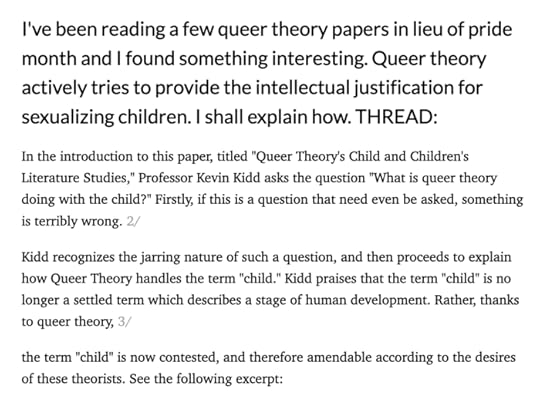
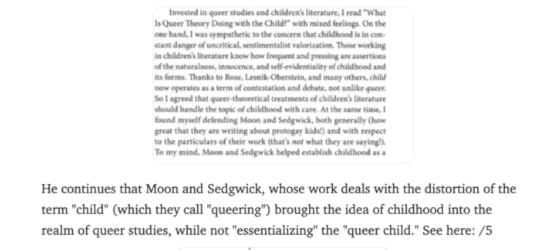
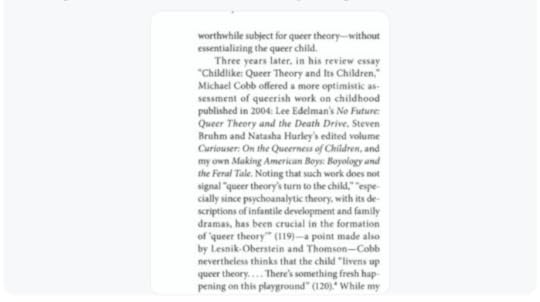
“There’s something fresh happening on this playground,” said every child molester, ever.
Watson goes on to discuss the role that poststructuralism plays in queer theory. As he puts it, poststructuralism claims that all reality is socially constructed, and that the general point of queer theory is to disrupt “oppressive” traditional social constructs, including gender norms. Childhood is one such social construct. Watson:

In fact, I went back to read one of the papers cited favorably in one of the quotes Watson uses, the 2005 one by Michael Cobb of the University of Toronto, the source of the pervy playground quote. Here’s a link. Excerpts:
Making children sexy, making children queer, is playing with matches. And given the character of the current ultraconservative, values-worried political climate, some fire is sure to ignite.
Yeah, you think? More; emphasis below mine:
There’s something fresh happening on this playground, perhaps because a child can stand in for almost anything; with a child, as so many of my childbonded colleagues endlessly tell me, anything is possible: “they do and say the craziest” things. And it’s this elasticity, this playfulness, that helps some very smart people say some very smart things. The queer child thus tells me something that is no longer a secret: despite those who’ve been whispering in my ear that queer theory is dead, repetitive, or even “over,” queer theory, it seems, is nonetheless alive and kicking, which is lucky for us, because “now more than ever,” queers need critical, intellectually daring, and politically minded work to compete with the conservative family values (especially the value of straight, innocent children) that not only grounds the U.S. nation, but soon will apparently ground the rest of the world.
He quotes a queer theory book by a queer scholar, now teaching at Tufts, named Lee Edelman, who, in his book No Future: Queer Theory and the Death Drive, criticizes the idea of the Child as a social figure whose existence forces us to think about the future. Here is part of the description of the book, from the Duke University Press catalog:
In this searing polemic, Lee Edelman outlines a radically uncompromising new ethics of queer theory. His main target is the all-pervasive figure of the child, which he reads as the linchpin of our universal politics of “reproductive futurism.” Edelman argues that the child, understood as innocence in need of protection, represents the possibility of the future against which the queer is positioned as the embodiment of a relentlessly narcissistic, antisocial, and future-negating drive. He boldly insists that the efficacy of queerness lies in its very willingness to embrace this refusal of the social and political order. In No Future, Edelman urges queers to abandon the stance of accommodation and accede to their status as figures for the force of a negativity that he links with irony, jouissance, and, ultimately, the death drive itself.
Are you understanding this? Edelman is openly saying that queers should become child-hating nihilists. From what I’ve been able to discern, this position is controversial among queer theorists, but Michael Cobb thinks this is all great fun:
And although he might be overstating the case about the Child’s essentially forward-timing qualities, and although he might upset people with his most irreverent assertions (“Fuck the social order and the Child in whose name we’re collectively terrorized; fuck Annie; fuck the waif from Les Mis”), he does some very important work pointing out that our political names carry a destructive logic that need not only bind us inexorably to the worst kind of political brat—the future. Instead, we might “bring out what’s ‘impossible, inhuman’” embedded within future’s captivity: “a haunting, destructive excess bound up with pious sentimentality, an overdetermination that betrays the place of the kernel of irony that futurism tries to allegorize as narrative, as history.”13 We might bring out the ghosts, then, the impossible beings, in order to break open the seams of the overarching political narrative. We would not then get history (that otherwise irons over the irony of the queer), but something more excessive, something that need not be figured well in advance. Attacking the Child somehow sparks such creative possibilities.
“Attacking the Child somehow sparks such creative possibilities,” said every child abuser, ever. Here, by the way, is the fuller quote from Edelman, cursing the enemies of queerness:
Fuck the social order and the figural children paraded before us as its terroristic emblem; fuck Annie; fuck the waif from Les Miz; fuck the poor innocent kid on the ‘Net; fuck Laws both with capital ‘l’s and with small; fuck the whole network of symbolic relations and the future that serves as its prop.
Cobb considers the work of Kathryn Bond Stockton, author of The Queer Child, described by, whaddaya know, publisher Duke University Press in this way:
Children are thoroughly, shockingly queer, as Kathryn Bond Stockton explains in The Queer Child, where she examines children’s strangeness, even some children’s subliminal “gayness,” in the twentieth century. Estranging, broadening, darkening forms of children emerge as this book illuminates the child queered by innocence, the child queered by color, the child queered by Freud, the child queered by money, and the grown homosexual metaphorically seen as a child (or as an animal), alongside the gay child. What might the notion of a “gay” child do to conceptions of the child? How might it outline the pain, closets, emotional labors, sexual motives, and sideways movements that attend all children, however we deny it?
Engaging and challenging the work of sociologists, legal theorists, and historians, Stockton coins the term “growing sideways” to describe ways of growing that defy the usual sense of growing “up” in a linear trajectory toward full stature, marriage, reproduction, and the relinquishing of childish ways. Growing sideways is a mode of irregular growth involving odd lingerings, wayward paths, and fertile delays. Contending that children’s queerness is rendered and explored best in fictional forms, including literature, film, and television, Stockton offers dazzling readings of works ranging from novels by Henry James, Radclyffe Hall, Virginia Woolf, Djuna Barnes, and Vladimir Nabokov to the movies Guess Who’s Coming to Dinner, The Hanging Garden, Heavenly Creatures, Hoop Dreams, and the 2005 remake of Willy Wonka and the Chocolate Factory. The result is a fascinating look at children’s masochism, their interactions with pedophiles and animals, their unfathomable, hazy motives (leading them at times into sex, seduction, delinquency, and murder), their interracial appetites, and their love of consumption and destruction through the alluring economy of candy.
Yeah, I guess we all want to know what queer theorists think about children’s masochism and interactions with pedophiles, right? Here’s what Cobb says, in appreciation of Stockton. Again, emphases mine:
Such an unorthodox form of theorizing exemplifies what many of the thinkers I’ve been discussing are doing, although Stockton does it in a more hyperbolic way: seeking to get beyond the prohibition and scandal of queer children, and to allow for the importance of the child to be turned into anything other than something thought to be natural and sacred and not open to queer play. That is, they are working out difficult histories and rhetorical tropes of the child, which have long been guarded by the more conservative, traditional family-loving members of North America. They accomplish as much through rhetorical leaps, metaphorical inventions, and analytical games. They do what children are thought to do in their most romantic, if not cheesy, idealizations: they are playful, they are imaginative, and they are suggestive.
Surely we must open children to “queer play” — that’s what Drag Queen Story Hour, and child drag shows, are doing — or the Christianists will win!
Here’s how Cobb’s essay ends. Once more, emphases are mine:
Nowhere, or no future, or not where we’re supposed to traditionally go, or grow. But the figurative dissolutions Stockton and the numerous, queer others writing about queer children produce help tear apart the world in order to offer some playful other things: as Edelman similarly suggests, in his discussion of birds, “[r]ather than expanding the reach of the human . . . we might . . insist on enlarging the inhuman instead—or enlarging what, in its excess, in its unintelligibility, exposes the human itself as always misrecognized catachresis [a misapplication of a phrase — RD], a positing blind to the willful violence that marks its imposition.” Somehow the queer child has given us not only queer children and the scandals they occasion, but also the ability to be radically speculative, suggestive, and intelligent. Queers become children and, then, animals. Very naughty indeed.
He’s praising Edelman for saying that queerness ought to cause us to throw off the human. That queerness means the death of Man. (Maybe the “trans wolf” Matt Walsh interviewed is an Edelman reader.) More from Edelman’s book:
Truth, like queerness, irreducibly linked to the “aberrant or atypical,” to what chafes against “normalization,” finds its value not in a good susceptible to generalization, but only in the stubborn particularity that voids every notion of a general good. The embrace of queer negativity, then, can have no justification if justification requires it to reinforce some positive social value; its value, instead, resides in its challenge to value as defined by the social, and thus in its radical challenge to the very value of the social itself.
In other words, total nihilism. Happy Pride, y’all!
I don’t believe that nihilist filth represents all gay people. The nice lesbian couple down the block probably doesn’t even know that it exists, or barely understands it. They aren’t responsible for it. But when the backlash comes, it is not going to discriminate.
I think Matt Walsh’s film, “What Is A Woman?”, is massively important, and I can’t urge you strongly enough to watch it. Kale Zelden and I will be interviewing him later today for our podcast. One striking thing about it is why it took so long for somebody to make this movie. Matt Walsh is just a conservative Catholic layman asking plain, sensible questions, and making pro-trans experts (e.g., a gender theorist, doctors) look like dissembling fools. Let me clarify: Walsh’s questions are not designed to make these people look bad; they are just straightforward, but it would seem that no journalist has ever asked these people these kinds of things before. Radical questions like, “What is a woman?” Walsh just lets these people talk. The results? Well, look — this could not be better:
This is absolutely fascinating.
Good work @MattWalshBlog.
pic.twitter.com/1XGB3HKVvo
— An0maly (@LegendaryEnergy) June 6, 2022
One of the questions I’m going to ask Walsh today is why activists like him and Chris Rufo get so much further in challenging this garbage than the massively funded Conservatism, Inc., infrastructure, Congressional Republicans, and the churches? Ask your pastor to screen this movie for middle schoolers and older at your church — and if he refuses, screen it for them off-campus. It’s important, and I know for a fact that so many religious leaders just don’t want to deal with this stuff. Walsh is not only talking about maleness and femaleness, but the concept of truth itself.
And yet, I think this guy is right (and his comment applies to me too, I concede):
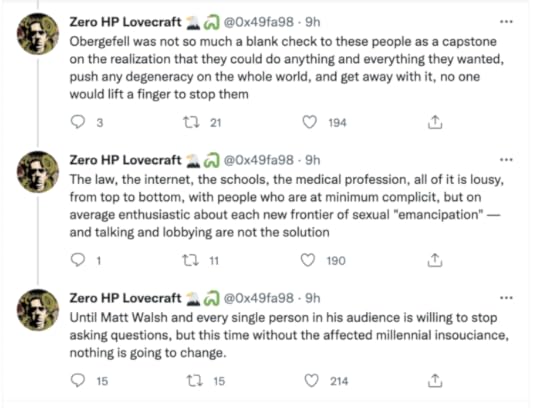
He’s wrong to fault Walsh for asking the questions — the fact that Walsh’s movie is so controversial shows you that it’s really timely — but he’s right that these questions require action. What, then? What can we really do to stop this stuff? I’m not asking rhetorically. Tell me, lawyers, what can be done?
In 2017, the late political philosopher Angelo Codevilla said that Americans already live in a state of “cold civil war.” The only way to prevent it from going hot, he said, is to return to a robust federalism. Excerpt:
America is in the throes of revolution. The 2016 election and its aftermath reflect the distinction, difference, even enmity that has grown exponentially over the past quarter century between America’s ruling class and the rest of the country. During the Civil War, President Lincoln observed that all sides “pray[ed] to the same God.” They revered, though in clashing ways, the same founders and principles. None doubted that those on the other side were responsible human beings. Today, none of that holds. Our ruling class and their clients broadly view Biblical religion as the foundation of all that is wrong with the world. According to the U.S. Civil Rights Commission, “The phrases ‘religious liberty’ and ‘religious freedom’ will stand for nothing except hypocrisy so long as they remain code words for discrimination, intolerance, racism, sexism, homophobia, Islamophobia, Christian supremacy, or any form of intolerance.”
The government apparatus identifies with the ruling class’s interests, proclivities, and tastes, and almost unanimously with the Democratic Party. As it uses government power to press those interests, proclivities, and tastes upon the ruled, it acts as a partisan state. This party state’s political objective is to delegitimize not so much the politicians who champion the ruled from time to time, but the ruled themselves. Ever since Woodrow Wilson nearly a century and a half ago at Princeton, colleges have taught that ordinary Americans are rightly ruled by experts because they are incapable of governing themselves. Millions of graduates have identified themselves as the personifiers of expertise and believe themselves entitled to rule. Their practical definition of discrimination, intolerance, racism, sexism, etc., is neither more nor less than anyone’s reluctance to bow to them. It’s personal.
On the other side, some two thirds of regular Americans chafe at insults from on high and believe that “the system” is rigged against them and, hence, illegitimate—that elected and appointed officials, plus the courts, business leaders, and educators are leading the country in the wrong direction. The non-elites blame the elites for corruptly ruling us against our will, for impoverishing us, for getting us into wars and losing them. Many demand payback—with interest.
So many on all sides have withdrawn consent from one another, as well as from republicanism as defined by the Constitution and as it was practiced until the mid-20th century, that it is difficult to imagine how the trust and sympathy necessary for good government might ever return. Instead, we have a cold civil war. Statesmanship’s first task is to prevent it from turning hot. In today’s circumstances, fostering mutual forbearance may require loosening the Union in unfamiliar and unwelcome ways to accommodate differences that may otherwise become far worse.
The day may well be coming when enough men and women get sick of the bacha-bazi’ing of children by a degenerate culture endorsed by elites that they start to take matters into their own hands. We should hope and pray to forestall that day by voting for political leaders who are willing and able to stop these predators. A society that sexualizes its children is not a society that deserves to exist. Want to know where all this is headed? Watch the experts interviewed by Matt Walsh in “What Is A Woman?” Read the queer theorists. Read Live Not By Lies, especially this passage:
“[T]he key actor in history is not individual genius but rather the network and the new institutions that are created out of those networks,” writes sociologist James Davison Hunter. Though a revolutionary idea might emerge from the masses, says Hunter, “it does not gain traction until it is embraced and propagated by elites” working through their “well-developed networks and powerful institutions.”
This is why it is critically important to keep an eye on intellectual discourse. Those who do not will leave the gates unguarded. As the Polish dissident and émigré Czesław Miłosz put it, “It was only toward the middle of the twentieth century that the inhabitants of many European countries came, in general unpleasantly, to the realization that their fate could be influenced directly by intricate and abstruse books of philosophy.” [Emphasis mine — RD]
Arendt warns that the twentieth-century totalitarian experience shows how a determined and skillful minority can come to rule over an indifferent and disengaged majority. In our time, most people regard the politically correct insanity of campus radicals as not worthy of attention. They mock them as “snowflakes” and “social justice warriors.”
This is a serious mistake. In radicalizing the broader class of elites, social justice warriors (SJWs) are playing a similar historic role to the Bolsheviks in prerevolutionary Russia. SJW ranks are full of middle-class, secular, educated young people wracked by guilt and anxiety over their own privilege, alienated from their own traditions, and desperate to identify with something, or someone, to give them a sense of wholeness and purpose. For them, the ideology of social justice—as defined not by church teaching but by critical theorists in the academy—functions as a pseudo-religion. Far from being confined to campuses and dry intellectual journals, SJW ideals are transforming elite institutions and networks of power and influence.
They’ve got Big Business, academia, the media, Hollywood, publishing, the music industry, law, medicine, the military — what’s left? The only institution capable of resisting the woke totalitarianism of these institutions is the US Government, two branches of which are now in the hands of the Democratic Party. We had better elect some intelligent and convicted politicians of the Right in these next two cycles — men and women who are sick of this garbage, and are unafraid to use the power of the state to defend normal people and normal families, and our freedoms, from the predators in these corrupted mediating institutions. It’s turning traditional totalitarian theory on its head — whoever imagined that the mediating institutions would be the corrupt oppressors, not the defenders of people from a corrupt and oppressive state? — but that’s where we are.
People like Peter Sagal don’t understand this, and might be capable of understanding it. What’s your excuse? If we fail to do our utmost to protect our kids, if we defenders of normalcy sit there passively while these creeps run over us and conquer the minds and bodies of our children, then we will have delivered our country to captivity — and ensured either civil war, or the solidification of totalitarianism via a social credit system administered by elites. The withdrawal of confidence in the US military by the classes that produce its next generation is a canary in the coal mine of civic and cultural collapse. These men didn’t fight the culture of bacha bazi only to come home to the Shire and find it corrupted by an American version of the same — and to find commanding officers and civilian military leadership who celebrate this kind of “diversity”.
At some point, many of you are going to have to realize that what “alarmists” like me are saying is actually true, and important. Here is how the process works; Scott Wiener is a California state legislator:
The three stages of progressivism:
1. “It’s not happening and is a harmful right-wing conspiracy theory.”
2. “It’s happening and it’s good that it’s happening.”
3. “We’re making it mandatory for your children.” https://t.co/uCNvkoZnMN
— Christopher F. Rufo
(@realchrisrufo) June 7, 2022
UPDATE: This is deeply true. It gives me no pleasure at all to recognize that is hard to imagine sharing a country under these conditions. This is quickly moving far beyond “tolerance”. The scariest thing in Matt Walsh’s documentary is not so much the male-female confusion, but the inability of these people to recognize truth as knowable and sharable:
Americans are divided about what men and women, the family, citizenship, and nation-states are and ought to be as well as when human life begins. Few want to admit reality, but Americans are now divided over the basic building blocks and purpose of human civilization.
— Matthew J. Peterson (@docMJP) June 7, 2022
UPDATE.2: OK, bam, right here is a sign of how deep and how high the insanity goes. Here is a story a reader sent from the US Air Force Sustainment Center. This is an official USAF publication. It is about how Airman Bryan Tisdale became Airman Anahlisa Tisdale. Excerpts, with boldface emphasis mine:
Nearly a decade later, the DOD Transgender Policy came to fruition, opening a door for Tisdale and those alike within the military. By this time Tisdale was married with a child on the way. Despite being married to a woman, Tisdale was conflicted about how she would live her life going forward. While her wife knew about her true identity, she knew that a transition to truly become Anahlisa would affect their marriage.
More:
While the decision to come out caused a rift in her marriage, Tisdale says she finally feels free being able to present her true self.
And:
Tisdale largely credits her liberation to the “amazing” leadership at Tinker AFB who have supported and backed her up through the entire process.
“I think she’s an inspirational Airmen,” said 72nd Air Base Wing Commander Col. Hall Sebren, “She is staying true to herself, which can be difficult for anyone to do under ordinary circumstances. By telling her story she allows others to be open and honest about who they are. … .”
It’s just like the deeper subtext of Matt Walsh’s film: gender ideology depends on a negation of the concept of Truth. This is why its advocates, including the US Armed Forces, fall back on an Orwellian distortion of language to advance ideological goals.
This is the US military today.
The post ‘Bacha Bazi’ For Americans appeared first on The American Conservative.
What Are Military Recruits Defending?
Well, recruitment for the Woke Military of Secretary Austin and Gen. Milley isn’t going so well. Excerpts:
“In real estate, you talk about buyer’s and seller’s markets,” Maj. Gen. Edward W. Thomas Jr., commander of the Air Force Recruiting Service, told Fox News Digital. “You know, this is a recruiting market right now. There are good opportunities to serve and good incentives to do so.”
The military faced a drop-off in recruitment during the pandemic: Each branch met active component goals, but reserve numbers have fallen short each year. That shortage has now hit the Active component goals for the Army and Navy, with other branches just meeting their goals.
More:
“Really in the long term … it’s declining eligibility, declining propensity or interest in serving and declining trust in government,” Thomas said.
“Today, 77% of American youth aged 17 to 24 will not qualify to serve the United States military without a waiver, 77%,” he continued. “That’s based on a variety of different reasons, from weight to medical issues to academic issues to behavioral issues, mental health issues. It’s a wide variety with 77% don’t qualify without a waiver.”
And Thomas admitted that the perception around the military withdrawal from Afghanistan may have impacted recruitment in the last six months, but stressed that he would not consider it “one of the primary drivers.”
I am advised that you should check out the comments under that story. I can’t see them from here in Austria, but the reader who put me onto the story says that there are a number of self-identified military men who say openly that they will not encourage their children to aspire to join the military as it is currently constituted. The reader himself says he is a religious conservative, and a veteran with generations of military service behind him, and not only is he discouraging his kids from military service, but every religious conservative he knows is doing the same thing.
I did this with my second son, who was considering the armed forces. I told him I would support him whatever he did, but that I didn’t want him to have to choose between obeying his conscience as a Christian, and obeying his commanding officer. Plus, after the last twenty years of US history, I told him, I don’t trust the civilian leadership of our country with his life. He’s now headed to trade school this fall instead.
Throughout June, the USMC takes #Pride in recognizing and honoring the contributions of our LGBTQ service members. We remain committed to fostering an environment free from discrimination, and defend the values of treating all equally, with dignity and respect.#PrideMonth #USMC pic.twitter.com/MOyvFmyJiB
— U.S. Marines (@USMC) June 1, 2022
Oh look, the US Government now sees a “heightened extremist threat” going into the midterm elections.OK, maybe so. Funny, though, how this announcement was made just before the Democrats’ big January 6 hearings, in which they are going to try to reframe the disastrous narrative for themselves. It’s really hard to take this seriously. It’s hard to take any authority seriously these days. Here’s Bari Weiss, commenting on the ridiculous self-immolation of the Washington Post over woke termagant Felicia Sonmez’s public harassment of two male colleagues:
By now we know how this will play out: There will be an investigation announced, or some other social slight from years ago will mysteriously emerge, or the crowd that chooses to spend their days mobbing people online won’t move on to their next target fast enough, and this story will linger. In the end, Weigel will either resign, or his enemies at the paper will find a way to demote him, or his name will be tarnished such that this “scandal” will continue to be used against him whenever it’s convenient.
Amazingly, this story competed with another Post drama from the weekend: The paper issued three corrections to a story by the technology columnist Taylor Lorenz, which still contains at least one obvious falsehood. The paper claims that Lorenz reached out to a source for comment, which the source says she didn’t do, and Lorenz later admitted she didn’t do (but the story still contains the lie). Even a CNN media reporter said it was “weird WaPo can’t get this basic detail straight.” Lorenz freaked out about CNN noting the correction debacle and said that doing so was “irresponsible & dangerous.” Yes: Dangerous!
So let’s get this straight: at the paper that cracked wide open the biggest presidential scandal in history, the paper that has long defined great political reporting, the paper of Katherine Graham and Ben Bradlee and David Broder, journalists lie and publicly attack their colleagues and remain comfortably in their positions. And a reporter is suspended without pay for a retweet.
She was, as you might recall, working at The New York Times until she resigned in 2020 in protest of the woke militancy inside the newsroom, which made it difficult to impossible to do one’s job. More:
To finally leave old media required me to confront some realities. Among them: The Washington Post is not the same place that broke Watergate, and The New York Times isn’t the same place that got the Pentagon Papers.
It’s not that the excellent, old-school reporters aren’t there. They are. They just don’t—or can’t—control the culture.
Partly that’s because of weakness and cowardice at the top of the masthead. Partly it’s because you can pretty much guarantee the kind of worldview you’re going to get when you hire journalists pedigreed by Harvard and Brown and Yale. They tend to think almost exactly the same way about almost every situation—and Twitter only reinforces the groupthink.
So whether the staffers and editors at places like the Times and the Post ignored the riots of summer 2020 while genuflecting to the lunatic idea that op-eds are violence because they were true believers in the new dogma or because they were careerists or because they were just plain scared only meant that some of them broke your heart more than others.
But knowing that wasn’t enough to untether me, even after I left. The real way I finally left old media is through the thrill of building something new.
What happens, though, when the institution you don’t trust as a conservative is the US military? I had dinner tonight with an American friend who lives in Europe. She was telling me about how glad she is to be over here, because it’s too depressing to go back home. She told me in detail how the opioid crisis is destroying her once-idyllic hometown, and how nobody seems to know what to do about it. As I listened to her, I thought about how J.D. Vance got in trouble earlier this year for saying that US leaders ought to care more about the opioid crisis here in America than they do about the war in Ukraine.
“I gotta be honest with you, I don’t really care what happens to Ukraine…I do care about the fact that in my community right now the leading cause of death among 18-45 year olds is Mexican fentanyl that’s coming across the southern border.” – @JDVance1 #OHSen pic.twitter.com/nf6MUzdWM5
— JD Vance for U.S. Senate Press (@JDVancePress) February 19, 2022
Listening to my friend at dinner talk about how drug dealers have taken over her hometown — a town whose very name is synonymous with old-timey American wholesomeness — was incredibly discouraging. What is happening to us? What kind of leadership do we have? The US armed forces leadership is chasing coolness. The president cares more about Ukraine’s border with Russia than he does about defending America’s border with Mexico. Our media are entirely captured by the woke loonies, and our capitalist leaders are totally in the tank for wokeness. We are a country in which it is actually controversial — potentially career-ending — to support what nearly everyone who ever lived anywhere, until America five minutes ago, thought was a woman.
What kind of political, social, and cultural order would these putative military recruits be defending? You want to put your life on the line to defend an order that hates you and what you hold to be true and sacred? Really?
The post What Are Military Recruits Defending? appeared first on The American Conservative.
Sterilized By Fear
I believe Ezra Klein is telling the truth here, of course, but man, what very different worlds he and I live in.

I have never, ever had anyone ask me that, or express those sentiments in my presence. Not once. I am a conservative blogger and writer who lives in south Louisiana ; Ezra is a liberal journalist who lives with his wife and kids in Oakland, in the San Francisco Bay Area.
In fact, I can’t think of any question that stands out from my speeches, dinners, and conversations. If we talk about politics at all, it’s usually something to do with the themes of my last two books (The Benedict Option and Live Not By Lies), reasonably enough — but even then, it’s far more common that in general conversation, we talk about all kinds of things. It really is startling to me that Ezra Klein lives and works in a milieu in which lots of people have that particular issue front to mind. I’m not saying that as a criticism, it’s just … strange.
To be fair, I wish more people from my own tribe were more apocalyptic than they are — not about climate change (though I believe that it’s happening), and more about cultural and religious collapse. I think that social, religious, and cultural conservatives don’t worry nearly enough about what’s happening to our moral and spiritual ecology. But that worry ought to be a catalyst to action, not to paralysis! And even then, the only reason I can bear such heavy thoughts is because I don’t spend all my time thinking about it. I like all kinds of things about life — things that don’t necessarily make good posts for a blog like this, but do add up to a fulfilling life, and one worth bringing children up in.
This morning I was walking around downtown Vienna, which has to be one of the richest cities on the planet. Yesterday I saw for the fourth or fifth time The Third Man, filmed in 1948, when parts of this city were in rubble from the war. And yet, people here still had children, not knowing what the future was going to bring. They had children because that’s what one does. That’s not who we are anymore, is it?
I wonder how many of these people just don’t want to have children, period, and are looking for a virtuous excuse to rationalize their decision…
What about you? Is there a single question or theme that comes up constantly in conversations in your circles? If yes, what is it, and why does it keep coming up? If not, why do you think your circles don’t live like Ezra Klein’s circles?
The post Sterilized By Fear appeared first on The American Conservative.
June 6, 2022
Fragile Felicia™ & The Prissy Post
The Washington Post has suspended reporter David Weigel without pay for retweeting a sexist joke, a person familiar with the matter told CNN on Monday.
Weigel did not respond to a request for comment, but an out-of-office email said that he would return on July 5.A spokesperson for The Post declined to comment, citing a need for privacy regarding personnel matters.Weigel on Friday retweeted YouTuber Cam Harless who joked, “Every girl is bi. You just have to figure out if it’s polar or sexual.”Weigel removed the retweet and apologized, saying he “did not mean to cause any harm.”
But the matter prompted outcry from staffers, both inside and outside of the newsroom.
Washington Post reporter Felicia Sonmez raised hell about the Weigel tweet. Another reporter, a gay Mexican-American male, politely defended Weigel, and got dragged into the fray by this insane Sonmez wokester. Glenn Greenwald gets it right:
So typical: WP reporter @feliciasonmez is now on her 3rd straight day of publicly bashing her own colleagues. She pressured the Post to publicly malign @daveweigel as “reprehensible”, forced him to repeatedly apologize, now is attacking another WP reporter for politely objecting. pic.twitter.com/m1LCmaIaBH
— Glenn Greenwald (@ggreenwald) June 5, 2022

That screenshot is from the WaPo’s Taylor Lorenz, a hot mess of woke hysteria.
David Weigel should not have been suspended — but if they’re going to do that to him, then what the hell are they going to do about Felicia Sonmez, who went public attacking not one but two colleagues? Sonmez has had a tough life — she was once sexually assaulted — but actual non-narcissistic professionals don’t go after their colleagues in public like this, not when something can be handled privately. She was determined to make an example of poor Weigel.
See, this is why you should never, ever, ever hire woke people. Ever. Especially in journalism!
Honestly, I cannot imagine why any smart, capable young person would want to go into mainstream journalism today. I feel so lucky to have gotten in during the last good years, before woke blew it all up. At the college paper, just about everybody drank to excess, half the people smoked, and everybody cussed and made improper comments, and then went out to the bar when we put the paper to bed at night. It was awesome!
And grown-up journalism was like that too, except when I started, in 1989, a lot of the reporters had been to rehab. Still, the idea was that you got into journalism because it was fun, filled with characters, and sometimes you could even do some good in the world. In one of my early journalism jobs, there was exactly one reporter who was what you would call today “woke,” and everybody avoided her, because she was utterly devoid of humor. You wondered why somebody like that would even want to go into journalism.
Now people like that basically run newsrooms. Where is the fun? Think of all the great newspaper and magazine writers of the twentieth century. How many of them would last five minutes in a contemporary newsroom? How many of them would want to be there? Journalists used to be fun to hang out with. When I was at the New York Post from 1998-2002, it was a lot of fun to go hang out at Langan’s Bar, and listen to the late, great tabloid master Steve Dunleavy hold court. Steve was never going to win a Pulitzer Prize, but man, did he ever make journalism seem like rascally fun. The stories he told — and most of them were true! It’s hard for me to imagine that Post ever going woke, but it’s also hard for me to imagine that there are any other newsrooms like it today.
I don’t know Dave Weigel, but I do know that he’s one of the best young reporters the Washington Post has. If they can make an example of him over tweeting a dopey joke, and let that harridan Felicia Sonmez who publicly persecuted him get away with her witch hunt, it’s a terrible sign to anybody with creativity and humor and flawed humanity. Only wokesters and cringing conformist robots need apply at the Washington Post.
Ever read H.L. Mencken? He was a terrible person. A real bigot. He was also a genius and an American treasure. They would never let him in the door of an American newspaper today. Tom Wolfe? He was a courtly gentleman, but I bet his opinions would cause the Fragile Felicias of the world to scream bloody murder. Truman Capote was one of the century’s great magazine writers, and he was extravagantly gay, but surely not p.c. enough for the Fragile Felicias.
I cannot stand these people. They are ruining journalism. It used to be disreputable and therefore alive. Now it is agonizingly prissy, and dying from suffocation beneath the whalebone corsets and losing its circulation because of the too-tight mind-forg’d manacles. With Fragile Felicias and her woke tribe running newsrooms, it’s no place for creative, flawed geniuses. She’s no Molly Ivins, that’s for sure. As a well-known contemporary philosopher put it (NSFW):
UPDATE: Did you know that Sonmez actually sued the Post, her employer, because they wouldn’t let her cover sexual assault cases, because she had been the victim of sexual assault? No kidding. From March of this year:
A judge has dismissed a lawsuit against The Washington Post and several of its editors that was filed by a staff reporter who alleged she faced discrimination on the job after she went public with her account of being a sexual assault victim.
In a ruling issued Friday in D.C. Superior Court, Judge Anthony C. Epstein said that politics reporter Felicia Sonmez had not demonstrated that The Post showed “discriminatory motive” when its editors decided to temporarily bar her from covering stories related to sexual harassment or misconduct.
Epstein noted that Sonmez alleged The Post reassigned her out of concerns “it had an advocate covering an issue she experienced.” However, that meant the company didn’t take action because of her victim status, he wrote, but rather to uphold an image of unbiased news coverage.
“News media companies have the right to adopt policies that protect not only the fact but also the appearance of impartiality,” the judge wrote.
He compared the editors’ decision to hypotheticals such as keeping a reporter who had spoken out about the personal impact of a relative’s murder from covering stories about violent crime, or a reporter who had campaigned for a political party from covering elections.
Fragile Felicia indeed. What kind of privileged twit takes her boss to court because she doesn’t get an assignment she wants? This person is trouble. The Post should fire her for insubordination over the way she went after Weigel and Jose Del Real, who had the temerity to defend Weigel. One of the conservatives I follow on Twitter said that he doesn’t understand why conservatives are falling all over ourselves to defend Weigel, who is not one of us. It’s because Weigel was treated unjustly here by the woke, in a way that either has happened or could happen to any of us. I don’t know Dave Weigel, and I don’t care what Weigel’s politics are: wrong is wrong. We don’t stand up for people who have been wronged because we like their politics, and we don’t fail to stand up for them because we dislike their politics. Felicia Sonmez is a bully, and she’s part of a class that bullies people constantly within professional journalism. Bullies have to be confronted.
Besides, if Dave Weigel is a liberal today, maybe having been mugged by a woke thug like Fragile Felicia will make a conservative of him.
Felicia Sonmez scrolling through Twitter pic.twitter.com/0gCaBsbd7F
— Noam Blum (@neontaster) June 6, 2022
The post Fragile Felicia™ & The Prissy Post appeared first on The American Conservative.
Re-Enchantment, With Iain McGilchrist
[Editor’s Note: If you are a paid subscriber to Rod Dreher’s Diary, my Substack newsletter focusing on spiritual, artistic, and cultural matters (no politics, no culture war!), you know how much enthusiasm I have for the work of Iain McGilchrist, the British psychiatrist who writes extensively about neuroscience and culture. His latest book, a 1,600-page masterwork called The Matter With Things, adds absolutely riveting scientific, philosophical, and metaphysical speculation to his usual themes. I really can’t say enough good things about this book, though I should point out that in the US, only the Kindle version is available now (and it’s good to buy the Kindle, so you don’t throw out your back!).
Well, if you are in the south of England next week, I’ll be appearing at a daylong seminar at Oriel College, Oxford, with Dr. McGilchrist and several others, to talk about his great book. Reserve your place at the “Retrieving Enchantment” seminar here.
If you know anything about McGilchrist’s work, you won’t need convincing to be there. But if you don’t follow him, well, you can learn a lot from his website, Channel McGilchrist. And, let me give you a little taste of what he’s writing about in this new book.
What follows is an excerpt from my most recent issue of Rod Dreher’s Diary. In it, I talk about the late British writer and Orthodox Christian convert Philip Sherrard, and his great little book The Rape Of Man And Nature, which is ostensibly about the origins of science, but is really about theology and disenchantment. In this passage from my newsletter, I tie McGilchrist’s work to Sherrard’s. — RD]
Perichoresis is flow: the mutual interpenetration between the divine and the human. You can imagine how much this resonates with me, having finished McGilchrist’s masterpiece The Matter With Things, in which the psychiatrist, based on his analysis of physics and neuroscience, concludes that reality itself is not static, but rather flow. All of reality, says McGilchrist, exists in a state of flow. This is something that the Fathers understood, and that Orthodoxy still understands in the present day.
To deny this fact, says Philip Sherrard, is to claim the independence of man from the divine source of his being:
It may even assert itself to such an extent that it has the Satanic conviction of its own independence and so denies the real source of its being: the assertion of the independence of the reason over the last few centuries — the cogito ergo sum — is an example of such Satanic possession of the soul.
We must recognize that the dualism between soul and body is only apparent, not real. The soul and the body of each of us is a unity held together by the “dynamic and creative will and energy of God.” And so:
We have become so used to viewing things in accordance with our single vision of the material world that we automatically identify our body solely with its solid material elements, its outward form. This, for us, constitutes our body. It also represents a singularly truncated way of looking at things. Indeed, unless one is to disregard many of the central experiences recorded not only in scripture but also in the lives of many saints and holy men and women, one has to recognize that the body formed of gross material elements is really a kind of condensation or husk or outer wrapping of a body of a far more subtle texture; and that within the outer material body, and interpenetrating it, is an organism of a finer kind of matter, of a finer and more fluid kind of substance. In fact, the whole of what we call the solid universe is but a hardened of crystallized form of this finer kind of matter, a spiritual energy frozen and arrested; and to this our physical body is no exception.
You will recall from our reading of McGilchrist that this parallels what modern physics has discovered about the nature of material reality. In modernity, though — that is, in the post-Descartes world — man perceives Nature not as something part of himself, but as
an object external to himself. [Modernity] presupposes a loss of that consciousness in which nature is seen as part of his own subjectivity, as the living garment of his own inner being. Consequently man has also lost the sense of his role in relationship to the rest of creation.
This is what the Fall did: alienated Man from God and from Creation. In Orthodox thought, to undertake the journey of theosis — re-integration with God — is to reverse the effects of the Fall, to allow God to remove the blinders from our spiritual eyes, and to re-Edenize (you might say) all of Creation. This is not, I hasten to say, a belief that we can re-create Heaven on Earth. That is only going to happen in full after the Second Coming. It is to say, though, that each of us, by cooperating with the Holy Spirit through prayer, repentance, fasting, and holy acts, can refine the divine within, and slowly allow God to restore the prelapsarian man. Put another way, we all dwell right here, right now, in a potential Eden; we just have to open the eye of the soul to it, and work to surrender to the healing, regenerative work of the Holy Spirit, to regain our sight.
More Sherrard:
For man is called upon to mediate between heaven and earth, between God and His creation. But when he closes his consciousness to what is above it, he obstructs that flow through which material things may be saturated by the Spirit or the Spirit may become incarnate, and the result is a disorder in creation which brutalizes both man and nature. Because it is only through man fulfilling his role as mediator between God and the world that the world itself can fulfil its destiny and be transfigured in the light and presence of God. It is in this sense that man — when his is truly human — is also and above all a priest — the priest of God: he who offers the world to God in his praise and worship and who simultaneously bestows divine love and beauty upon the world.
… It is in Christ that the wall of separation between heaven and earth, the supernatural and the natural, the sacred and the profane is destroyed in the living sacrament of the divine love and presence. God’s enhumanization has not only ‘taken manhood into God’; it has also taken the whole created world into God, has resurrected it and transfigured it in its very depths.
It is only man’s continuing alienation from the ground of his being that prevents him from realizing this, that throws a veil of opacity between God and man, God and the world, and keeps them in a state of false division and disunity. Correspondingly, it is through overcoming this alienation, and through remaking himself in the image and likeness of the divine that is at the heart of his own subjective life and that confers on him his unique quality as a person, that he shares in the priesthood of Christ and in that sacrament of love and beauty in which all things, released from their bondage, live, move, and have their being. Outside this relationship, apart from this sacrament, man has no real place in the world, or the world in him. He is but a tormented shadow of himself, and his world a forsaken wilderness, and on both he is compelled to seek ever further revenge for that crime against his own nature which he refuses to acknowledge, still more to expiate.
All of that is from the first chapter. There is much more to say, but I’ll reserve it for the next issue of the newsletter. In it, I’ll present Sherrard’s account of how Christian theology prepared the way for the radical disenchantment of modernity. It’s important to say, though, that disenchantment is not, strictly speaking, a problem of modernity. It is inherent to the Fall, in which Man, by asserting his own will over God’s — the characteristic Luciferian act — alienated himself from God, which is to say, from the ground of his very Being. Modernity, as post-Christian, only solidifies and institutionalizes the Fall, and calls the Fall liberation.
That is to say, we have all been living in a disenchanted world since the Fall, but those who love and serve God have had a bridge back to Him, and to Eden. We all recognized that we live in a world of sin and suffering, but we also had a map that showed us the way back to Eden. But this map could not be understood simply as an object of rational contemplation; it had to be known primarily through experience. That is, it is fine to think of theology, and to study the Scriptures to know the ways of the Lord, and what He demands of us. But the map is not the same as the territory, and we can only truly undertake the journey back to Eden — that is, dwelling in pure communion with God and His Creation — by using our tripartite faculties (body, mind, and spirit) to seek Him, and to bring every aspect of our lives into radical communion with Him.
What is so moving to me about reading Sherrard is how he makes explicit how far we have traveled from the world of the Fathers, even us modern Christians. I have been an Orthodox Christian for sixteen years, yet I am still shedding the false consciousness of modernity. As Boersma (who is Protestant!) says in Heavenly Participation, we Christians must return to the medieval synthesis, which is to say, more or less, to how virtually all Christians saw the relationship between God, Man, and Creation before the High Middle Ages in the West.
On our first morning in Vienna, Matt and I were up very early, and decided to take advantage of the light — so far north, the sun comes up unexpectedly soon for us subtropicals — and stroll around the empty city. (We would not have been surprised to have crossed paths with Ethan Hawke and Julie Delpy from Before Sunrise.) Somehow, we found ourselves talking about differences between Eastern and Western Christianity (you can well imagine how much I enjoy the company of my son). I told him that the whole question of indulgences, which were key to the Reformation, is a good example.
If the question of Man’s alienation from God is a forensic one — that is, if it is a legal matter — then indulgences (which are still part of Catholic doctrine) make a kind of sense. That is, if we fallen men stand in the dock, in a court proceeding, and if the institutional Church is kind of a divine bank in which merits are stored for disbursal, then it is not unreasonable to think that one can obtain these merits somehow to negate the punishment due us for our sins. It’s like the Church paying the fine. Obviously this model led to massive corruption, which is part of the reason that Luther rebelled. Yet the abuse of the indulgences system does not negate it in principle.
But the Orthodox don’t see the problem of the Fall, and of man’s reconciliation with God, as a legal matter. Rather, we regard it as organic (I say “we” because I am Orthodox, yet I too struggle to be free of the theological concepts that we in the West took in with our mother’s milk). Think of a garden struggling to thrive in the shadows. What it needs to be restored, and to thrive, is direct exposure to sunlight. What sense would it make to buy, or even to donate, “sunlight credits” on behalf of the poor little garden? Would the declaration that the garden receives twelve hours of sunlight daily, by order of the bishop, change the garden’s actual state? Of course not. But see, this is why to the Orthodox way of seeing things, the Reformation’s protest against Roman legalism was valid to some extent, it doesn’t fix matters, because the Reformed churches still follow the forensic (legal) model of sin and forgiveness. In other words, despite the justice of the Protestant rejection of indulgences, the core problem remains.
This is why we can’t overcome disenchantment by saying presto-change-o, the world is actually enchanted, we’re just too sinful to see it. That is true — that we are blind to the reality of its enchantment, because God penetrates all of reality! But overcoming this disenchantment is not something that can be ordered by church authorities, and not something that can be overcome simply by changing one’s mindset (that is only the first step). Believe me, I know perfectly well that Western Christians get this. The problem for (most) Protestants, I think, is that it leads them to think of salvation as a matter of what happens to us after death — as avoiding Hell. Sacramental Christians — Catholics and Orthodox, and perhaps some other kinds of Christians — understand that it’s not simply about the afterlife, but about rightly ordering our lives, and this world, to God. I feel sure that I am oversimplifying here, because of my lack of knowledge of the Protestant mind; I welcome your own thoughts, because they help clarify mine.
Still, Sherrard contends that the fundamental mistake made by the West was not made by Ockham and Duns Scotus — that is, by the Nominalists and the Voluntarists — but by the Scholastics themselves, by trading out a Christian vision based on Platonic concepts, which had been the Tradition for the first thousand years of the Church, for an Aristotelian one. We will explore Sherrard’s argument in the next newsletter.
I’ll leave the topic for now by quoting a passage from the Feb 19 newsletter (“Waves And Flow”):
Iain McGilchrist says that we in the West should rebalance our attention to the world to allow for flow, which is also a fundamental aspect of reality. If we don’t, we are not getting a fuller picture of how reality actually works. From The Matter With Things:
Let’s now turn briefly to look at the nature of the two great exemplars of flow – music and water – and, through them, at what in Chinese is discovered everywhere in the cosmos, the principle of flow known as li.
Music is as different from the separate notes seen on the score as life is from the language that aims to throw its net around it; when, in Robert Graves’s phrase, the ‘cool web of language winds us in’. (As an aside, score-dependent musicians rely more on the left hemisphere, improvising musicians on the right hemisphere.) In music, as in the living world, change is permanent, stasis is transitory. ‘What is perceived’, writes Thomas Fuchs, ‘is not a sequence of discrete tones but a dynamic, self-organising process which integrates the tones heard to create a melody’. Self-organising, note: it is an ‘automatic synthesis, no one actively performed by the subject’. In other words we have to escape the effortful sense of constructing something if we are to allow a flow simply to be. There must not be two elements here, but one. We must be actively receptive in relation to it, not actively expressive – as also in prayer and meditation.
This image from music is a perfect example of a philosophical insight into life that is otherwise hard to express explicitly. And Fuchs sees that our lives as social beings must belong to something that is best expressed as a dance or a piece of music, if we are to enmesh, engage, connect: Single pulses appear to interrupt flow, having the nature of points, much as is a single beat on a drum. It is perhaps not accidental that the potentially disjunctive element in music, rhythm, is underwritten commonly by the left hemisphere, while the potentially conjunctive elements of music, harmony and melody are usually dealt with by the right hemisphere. Together they go to make the structure of music’s flow, a union of division and union: however, within this flow, rhythm is wholly transformed and becomes itself a unifying force.
This transmogrification of an element of differentiation ultimately into a force for union is essential to the nature of creation. To quote Dewey: individuality is a ‘phase, though a decisive and outstanding one, of a process having continuity’. The everyday business of describing the world uses a structure of symbols – language, and in particular nouns – that leads us to believe that there are non-unique things, and that our representations of reality are the reality itself. By transcending language one may see the world as unique wholes that themselves together constitute unique wholes at a higher level, and so on without limit. As William James remarked: The essence of life is its continuously changing character; but our concepts are all discontinuous and fixed, and the only mode of making them coincide with life is by arbitrarily supposing positions of arrest therein. With such arrests our concepts may be made congruent. But these concepts are not parts of reality, not real positions taken by it, but suppositions rather, notes taken by ourselves, and you can no more dip up the substance of reality with them than you can dip up water with a net, however finely meshed.
Reality, like the river, is a flow, which only seems to be composed of discrete drops when we try – and fail comprehensively – to catch it in the net of language: the bits that we do catch, the drops from the net, are an artefact of our process of investigation. No net, no drops.
Similarly modern physics tells us that the entities that we discover when we probe the subatomic world are shaped by the process we use to investigate it – famously so, in the case of particles and waves. What seems to be fundamental is pattern and relationship, not the semi-distinct entities that are patterned and related.
Yet immediately we sense that our everyday language is inadequate to what is meant: some differentiation is necessary for there to be anything out of which a relationship can be constituted. And yet what is differentiated can never be separate, because it is what it is only in relationship to everything else. This is the very essence of music.
However to the Eastern mind, though processes may not follow programmatic rules, they are far from being any kind of mess. An ancient Chinese concept that stems from Confucianism is that of lǐ. It indicates a formal principle in all things, that is considered, together with ch’i (a vital force or energy, also written qi), ontologically prior to the cosmos itself, and to have given rise to it.
This idea of generation as an energetic force entering into a receptive form is itself deeply generative. According to Joseph Needham, lǐ indicates,
“the order and pattern in Nature, not formulated Law. But it is not pattern thought of as something dead, like a mosaic: it is dynamic pattern as embodied in all things living, and in human relationships, and in the highest human values.”
And it is not just in the living, as I understand it. Lǐ, as the ordering principle in the world, is something like ‘reason’, according to Alan Watts, but not in the now normal, Platonic, sense of that word. It is perhaps more like what Heraclitus called the logos. At that stage logos had not yet come to mean ‘reason’ in the rather limited modern sense, instead meaning the common principle that makes complexity, beauty and meaningful order arise in place of chaos, both in the living world and what we consider the non-living; and gives rise to a fittingness, or rightness, or dignity, in human affairs where they arise. Lǐ is closely related to the idea of the tao, the flowing formal principle of the cosmos.
If I understand my McGilchrist, the right hemisphere receives information, sends it to the left for analysis, and then the left returns the analysis to the right for incorporation into a holistic view of reality. Our problem is that we in the modern West have become stuck in the left side of our heads, mistaking a partial analysis for the only true analysis.
—
End of quote from Rod Dreher’s Diary. If you like that kind of thing, please consider subscribing. And if you are in or near Oxford, please reserve a spot at the Retrieving Enchantment seminar with Dr. McGilchrist and others. It’s free, but I imagine space will be limited, so get on the list now.

UPDATE: Ah ha, I see there will be a separate event with Iain in the evening, for those who can’t come to the symposium in the day. Register for the evening event here; in it, Iain and I will be discussing with Dr. James Orr themes of re-enchantment. Also free, but you have to register! Details:

The post Re-Enchantment, With Iain McGilchrist appeared first on The American Conservative.
Five Rays Of Light
I spoke once to a Christian friend who left his (very good) job because he could not in good conscience live with all the woke changes the new CEO was implementing. He told me there were enough conservative Christians in his senior-level department to have stopped most of this executive action, but almost none spoke out. They were too afraid to endanger their
career prospects, and to be thought poorly of by liberal colleagues. As my friend put it, what they really worshiped was success and assimilation to Babylon.
When he said this, I thought of the anti-communist Christian dissident Kamila Bendova’s warning to me in her Prague apartment: that I should not count on our fellow Christians to make a risky stand for our beliefs. She told me (I tell this story in Live Not By Lies) that under communism, in a time when her late husband went to prison for his beliefs, most Czech Christians did what everybody else did: kept their heads down and their mouths shut, to avoid trouble.
That does not apply to five Christian players on the Tampa Bay Rays Major League Baseball team. Excerpts:
Some Tampa Bay Rays players reportedly broke from the organization’s support of the LGBTQ+ community Saturday during the team’s Pride Night against the Chicago White Sox.
Most Rays players were wearing rainbow logos on their caps and sleeves. But the Tampa Bay Times noted that pitchers Jason Adam, Jalen Beeks, Brooks Raley, Jeffrey Springs and Ryan Thompson were among those who didn’t wear the logos of support.
Adam made a statement on behalf of the players who opted out and cited religious beliefs.
“A lot of it comes down to faith, to like a faith-based decision. So it’s a hard decision. Because, ultimately, we all said what we want is them to know that all are welcome and loved here,” he said, via the Tampa Bay Times.
“But when we put it on our bodies, I think a lot of guys decided that it’s just a lifestyle that maybe — not that they look down on anybody or think differently — it’s just that maybe we don’t want to encourage it if we believe in Jesus, who’s encouraged us to live a lifestyle that would abstain from that behavior. Just like (Jesus) encourages me as a heterosexual male to abstain from sex outside of the confines of marriage. It’s no different.
“It’s not judgmental. It’s not looking down. It’s just what we believe the lifestyle he’s encouraged us to live, for our good, not to withhold. But, again, we love these men and women, we care about them and we want them to feel safe and welcome here.”
From the team’s website, woke capitalism is in on the game, naturally:

The topic sparked numerous conversations — team-wide, small-group and individual — over the last several weeks. Players on both sides and management said they were constructive and did not create any division.
“I certainly hope not,” manager Kevin Cash said. “I think what it has created is, like, what you’ve heard — a lot of conversation and valuing the different perspectives inside the clubhouse but really appreciating the community that we’re trying to support here.”
In post-Christian America, I think that’s about the best outcome orthodox Christians and other dissenters from the forced Pride march through the institutions can hope for: a respectful dialogue that allows us to abide by our consciences. (I’ll have more to say about this in a separate post later today.) It’s good that the team’s management defends the right of religious dissenters within the organization, even as that management proclaims its devotion to the (typically coercive) civic religion.
As a Christian, I suppose it would be delightful if a sports team, I dunno, decided to have players wear crosses to observe Easter. But I would be appalled if any player — of another religion, or no religion at all — were compelled or pressured in any way to take part. It’s not right. And in the end, I would probably wish the team wouldn’t do it at all, because I wouldn’t want non-Christian players to feel socially pressured. The faith is strong enough to survive a sports team not signaling its support for Christianity.
Frankly, I wish we could return to a time when athletes were not invited or expected to show support for any cause other than winning the damn game. But as we know, Pride is the new civic religion, and one must burn a pinch of rainbow-colored incense to woke Caesar if one wants to avoid trouble.
I took this shot of a placard in an upscale clothing shop window in Vienna yesterday. I am sure it is not meant ironically; many of the shops, especially the fancy ones, in Vienna now are falling all over themselves to celebrate Pride. The words in Latin mean “true joy”. It certainly feels like the joyful unicorns are puking rainbows over all of us during this High Holy Month. I admire how those five Tampa Bay Rays did not resist this angrily … but they certainly resisted living by the lie. We all know there are more of you dissenting Christians (Jews, Muslims, atheists, and others) out there. Aren’t you sick of being coerced and vomited upon? Where is your courage?:

Hard to argue against players wanting freedom to express themselves based on their religious backgrounds. Major League Baseball, and most other major networks, have done everything they can do make people appear anti-gay for failing to celebrate gay pride, but these five are doing well standing up for themselves. It should be understood that we all don’t have to agree on each other’s life decisions/sexual orientations because we can mind our own business. Some people just want to make decisions that best suit them and let others do their thing. That’s how life was before social media and many would like that way of life to continue.
Rays manager Kevin Cash spoke to the media and admitted the player’s reluctance to wear their pride patches stirred conversation in the locker room and not once did he mention a heated discussion. Maybe this is how life should work? We aren’t all bullied to share black squares or flag patches to be viewed as quality human beings. We have nuanced discussions like adults that lead to a more healthy environment.
Good for these guys, man. Standing up for their faith.
The post Five Rays Of Light appeared first on The American Conservative.
June 4, 2022
After Francis, What Stability?
My friend a podcast partner Kale Zelden, a Catholic, has an interesting Twitter thread about how troubled he is by Pope Francis’s recent acts, and what it says about the direction of the Catholic Church. It begins here:
A thread on where we’re at:
1/16 pic.twitter.com/7dR4SrqmlR
— Kale Zelden (@kalezelden) June 3, 2022
Kale talks about how, as a younger man, he was so inspired by the figure of John Paul II, and the solid rock of Truth his papacy, and the Roman church, represented. Now, though, Francis continues to repudiate so much of JP2’s legacy, and not only that, but magisterial Catholic teaching. More:
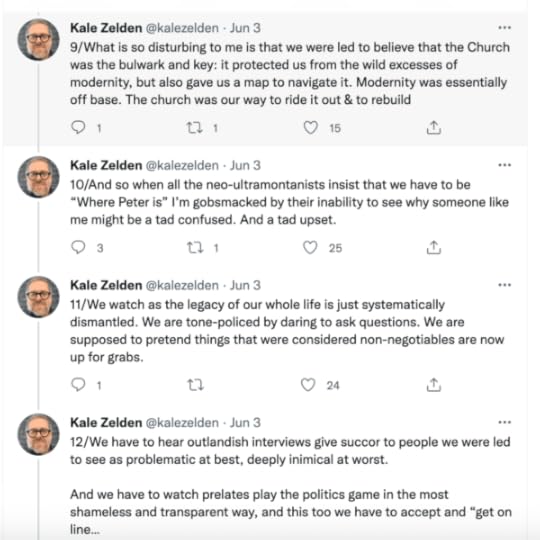
Kale refers his readers to this Catholic World Report essay by the Catholic theologian Larry Chapp, along the same lines. Chapp begins by talking about what it means that Francis has just elevated Bishop Robert McElroy, the super-liberal Uncle Ted McCarrick disciple, to the cardinalate — just the latest in a line of progressive red-hats made in America by Francis. Excerpts:
Indeed, McElroy was one of the bishops who voted against a USCCB petition pressing the Vatican for more transparency and speed in the McCarrick investigation. I repeat: he voted against transparency. Which marks him off as either someone who is: A) personally compromised himself in the McCarrick situation and who is seeking to cover things up; B) uncaring toward the victims of abuse; C) a Pope Francis sycophant who was simply trying to shield the Pope from criticism; or D) all, or some combination, of the above.
All that said, I think there is a need to identify the root issue at stake in all of these concerns and criticisms. Beyond particular and proximate issues such as LBTQIAA+++ promotion, Eucharistic discipline, sex abuse scandals, and obstructionism, it is important to ask a simple question: why does Pope Francis like Bishop McElroy enough to make him a Cardinal? After all, the man has some serious baggage.
And the answer to that question can only be ascertained once we understand how important to this pontificate Amoris Laetitia is. Just as Traditionis Custodes was in many ways a clear repudiation of Summorum Pontificum, so too is Amoris Laetitia a repudiation of large parts of Veritatis Splendor.
My view of this papacy is that Pope Francis—slowly and brick by brick—is attempting to subvert the theological hermeneutic of the previous two papacies: Pope John Paul II’s in particular, and primarily in the realm of the late Pontiff’s moral theology. Bishop McElroy has been an unabashed supporter of Amoris and his promotion to the red hat is the Pope’s way of signaling that McElroy’s approach to the moral theological principles of Amoris is correct.
More:
This also explains, as I have blogged on before, why Pope Francis has systematically dismantled the John Paul II Institute in Rome and replaced numerous professors and leadership—all of whom were devotees, of course, of John Paul’s thought, of Communio theology, and of Familiaris Consortio/Veritatis Splendor—with theologians who are largely proportionalists in moral theology and strong supporters of a more “progressive” agenda. And they have all been given the specific mandate to transform the Institute into . This is also why nobody from the previous regime at the Institute was invited to the Synod on the Family.
Therefore, in my view, the various red hats that Francis has given out to the Church in the U.S. are primarily, although not exclusively, about moral theology and the revolution in the post-conciliar theological guild on the topic of human sexuality. People tend to focus on the great controversies surrounding liturgy in the post-conciliar era. And those issues are important. But take it from someone who lived through it—the deepest, most important, most contentious, most divisive, and most destructive debates surrounded moral theology, especially after Humanae vitae and the massive dissent from it that followed.
You might think this is inside Catholic baseball. You’re wrong: it’s one of the biggest religion stories of our time. Kale Zelden is just a few years younger than I am. It turns out that we were both in the New Orleans Superdome in 1987 to see John Paul II. I wasn’t yet a Catholic, but I was drawn to the Dome by the personal magnetism of this Pope. Six years later, I was received into the Catholic Church. It wasn’t a straight line from one to the other, but as I was wrestling with whether or not to become a serious Christian, Catholicism seemed to be the only option (I barely knew what Orthodoxy was back then).
Why? Well, because of John Paul and what he signified. I understood him to be a morally courageous, powerful spiritual leader who stood confidently against the chaos and corruption of the modern world. I believed back then, in my early twenties, that if Christianity was going to survive, it would need what the Catholic Church alone had: a Pope and a Magisterium. The Protestant world was divided into thousands of churches, but the Catholic Church bestrode history and the globe as a colossus of unity and truth. Et cetera. That’s what I believed, because that’s what a lot of the triumphalists of the JP2 era said.
If you had come to me in 1993, right after I had been received into the Catholic Church, and told me that I would live to see a pope do the things that Francis has done, I would not have believed it possible. Seriously, I would not have believed it. Maybe you had to have been there, and been young and in love with John Paul II, to have been so confident about the future. The kind of thing Kale Zelden talks about (“We watch as the legacy of our whole life is just systematically dismantled”) resonates deeply in my heart, though I left the Catholic Church sixteen years ago.
If the abuse scandal hadn’t annihilated my capacity to believe in Roman Catholic claims of authority, then the Francis papacy probably would have done the trick. The reason I wouldn’t have believed a visitor from 2022 going back in time to 1993 with news of the many liberal accomplishments of the Francis papacy is because I honestly believed all that stuff about unchanging doctrine, and the pope never teaching error.
I know that many of my closest Catholic friends are suffering greatly right now. None have talked to me about becoming Orthodox, and I would not take advantage of someone’s suffering to press the case for Orthodoxy on them, unless I feared that they were in danger of losing their faith entirely. Don’t misunderstand me: I think that Orthodoxy is true — I believe that far more strongly today than I did when I became Orthodox in 2006 — but I remember how much pain I was in when my Catholic faith was being gutted out of me, and I would have resented anyone who took advantage of my suffering to push their version of Christianity on me.
Nevertheless, as someone who admires the Catholic Church and who wants it to be strong, and as someone who is passionately interested in religion, I can’t avert my eyes from the iceberg towards which Capt. Bergoglio is sailing his ship. In fact, I think he’s broadsided the thing, for the same reasons Kale Zelden and Larry Chapp do.
I doubt this will matter to most Catholics, who go about their business without worrying too much what the Pope says about this or that. Even Chapp ends his essay with:
Again, at the end of the day, I really don’t care whose head is adorned with a red hat or whose petard sits in an office chair on the via della conziliazione. The immediate needs of my day and the tidal undertow and sinful entropy of my degraded life seem much more pressing to me. I seek Christ and Him crucified.
It seems to me that if a Catholic is determined to remain Catholic, that’s the only realistic response he has after this papacy. Maybe there’s something I’m not seeing, but I don’t see how it’s possible to make the kinds of claims for Catholicism’s steadiness and continuity, especially through the papacy — claims that drew me in like a tractor beam in the early 1990s — and be taken seriously. After JP2 and BXVI, and now Francis, it looks like the Catholic Church is governed like countries are with changes of parties and governments after elections. You can’t just say, “Well, let’s just sit back and wait for God to send us a pope we like better.” It doesn’t work that way. A future conservative pope who undid all Francis has done would unavoidably destabilize the institutional Church and its authority even further.
I welcome comment and critique, but what I won’t post is griping about me being an ex-Catholic writing critically about this papacy. Nor will I post anti-Catholic smears. If you just want to take potshots at Catholics, or me, don’t bother writing anything, because I’m not going to post it. What I’m genuinely interested in is hearing from small-o orthodox Catholics — especially Gen X Catholics whose idea of the Church was shaped by the JP2 era — about how they are coping, and how they are explaining all this to themselves.
The post After Francis, What Stability? appeared first on The American Conservative.
Rod Dreher's Blog

- Rod Dreher's profile
- 508 followers

