Russell Roberts's Blog, page 2
July 4, 2023
Some Links
Enter George Washington. Upon military victory in 1783, the Continental Army’s supreme commander resigned. Even if he held vast emergency powers to fight a war against the world’s leading superpower, he relinquished all control and authority, leaving the Continental Congress in charge of the newly independent country. He refused any political power, despite support for a Washington-led monarchy and some army officials’ calls to violently take backpay.
Megan McArdle is optimistic about the resilience of American society. A slice:
Watch Americans dealing with one another day to day and you will mostly see them going out of their way to be nice. There are far more random acts of kindness in this country than there are drive-by shootings, and far more people acting with honesty and integrity, even when no one’s looking, than there are con men and thieves. We focus on the latter precisely because they are rare.
Which is why, for all the bad, America is better than it thinks itself. And I dare to believe that, in the future, it will be better still.
Deirdre McCloskey talks with Chris Kaufman about the bourgeois era.
Wall Street Journal columnist Jason Riley asks for evidence that Clarence Thomas benefitted from affirmative action. Two slices:
The political left’s reaction to Justice Clarence Thomas’s concurrence in last week’s Supreme Court ruling that bars the use of racial preferences in college admissions is more evidence that affirmative action stigmatizes black achievement. Justice Thomas has been labeled a hypocrite for opposing racial preferences because he supposedly benefited from them as a college student, yet no one has produced any evidence that race played a role in his admission to Holy Cross College or Yale Law School.
According to press accounts, Justice Thomas was recruited to Holy Cross by a dean, Father John Brooks, who wanted to increase the number of black students on campus, but the justice has long denied this claim. He started college at Immaculate Conception, a seminary in Missouri, but left after a year and returned home to Savannah, Ga. In his memoir, he says he applied to Holy Cross at the urging of a nun who had taught him in high school. “I ranked near the top of my class at Immaculate Conception, so Holy Cross had quickly accepted my application,” he writes. “The only problem was money, but the director of financial aid told me that something could be worked out.”
…..
Nor is there any evidence that Justice Thomas was admitted to Yale Law School under its affirmative-action program rather than through the regular admissions process. He graduated from Holy Cross ninth in his class (of more than 500 students). According to the New York Times, eight Holy Cross graduates were admitted to Yale Law between 1968 and 1978, the decade that included Justice Thomas’s law school career. Why assume that he got in only because of his race? Why question the justice’s credentials but not Bill Clinton’s or Hillary Rodham’s, two of his fellow Yale Law students? The reason is affirmative action, which has made people suspicious of black academic and professional success.
Charles Cooke writes wisely about Justice Clarence Thomas and affirmative action.
Hans Bader is rightly unimpressed by the dissenters in Students for Fair Admissions v. Harvard.
Arnold Kling reviews Jean Twenge’s Generations.
Each with a letter-to-the-editor in the Wall Street Journal, David Boaz and Christopher Hanford ably defend libertarianism from Barton Swaim’s assertion that it is “studiously amoral.” Here are those letters:
In his review of “The Individualists” by Matt Zwolinski and John Tomasi (Bookshelf, June 29), Barton Swaim refers to the “studiously amoral philosophy of libertarianism.” A popular summary of libertarianism, “don’t hit other people, don’t take their stuff and keep your promises,” is just the sort of basic morality that allows human beings to live together.
David Boaz
Senior Fellow, Cato Institute
Washington
The core tenet of libertarianism is that a person is free to do as he chooses until he inhibits the right of others to do the same. That principle will never need “an obituary.” Far from avoiding life’s biggest questions, it can be a guide for answering them.
Christopher Hanford
Benicia, Calif.


Quotation of the Day…
… is from page 44 of the 2022 paperback edition of C. Bradley Thompson’s superb 2019 book, America’s Revolutionary Mind (original emphasis):
Political self-government depends on moral self-government, which in turn depends on an individual’s ability and willingness to follow the “standard of reason.”
DBx: Without most individuals having the capacity for moral self-government, decent civilization is impossible. Decent civilization can, under such circumstances, be achieved neither by freedom nor by any species of collectivism. But whereas collectivism can destroy decent civilization that arose through freedom among morally self-governed individuals, collectivism can never – no matter how morally self-governed are most of the population – create or sustain decent civilization.
…..
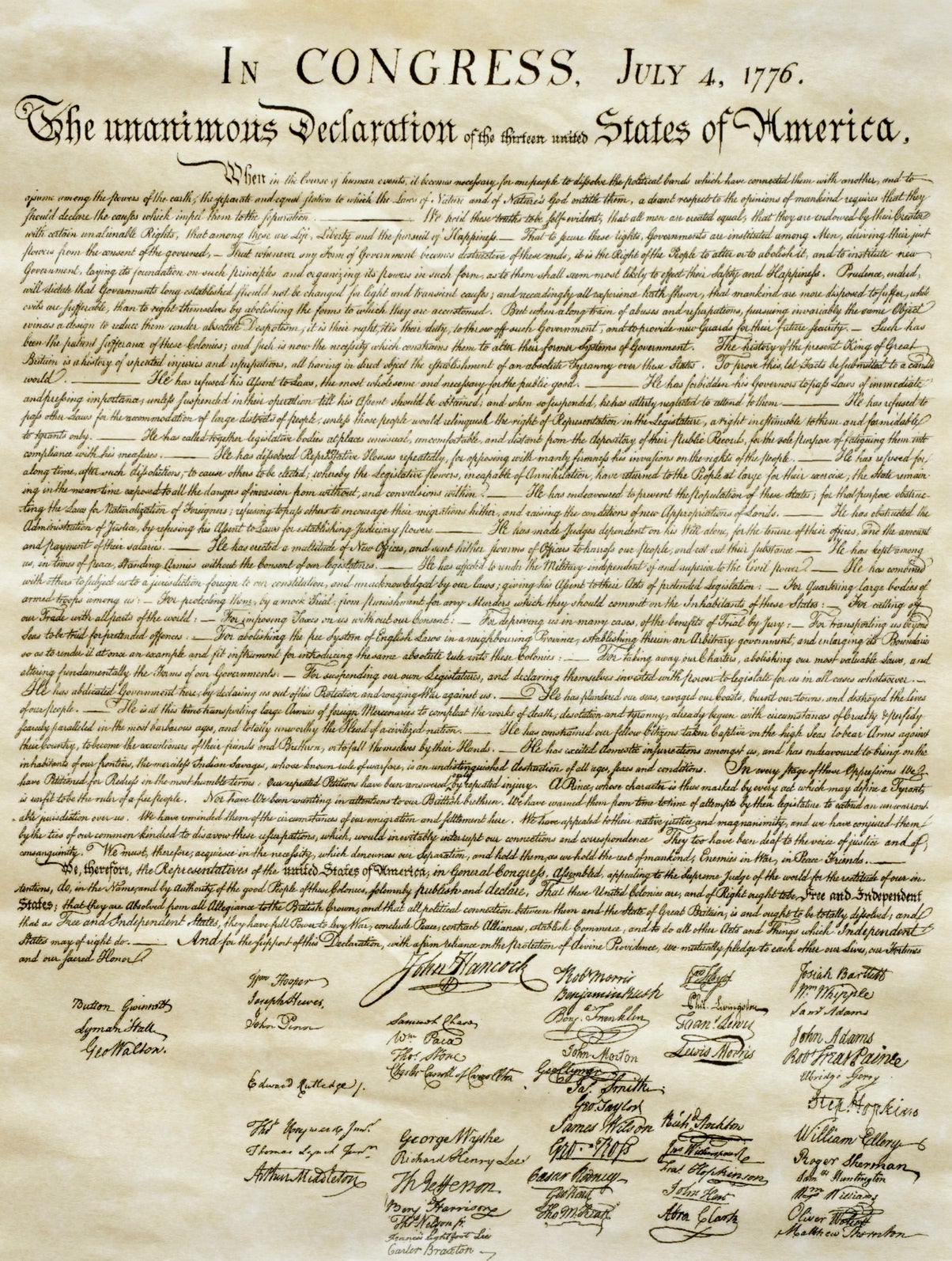
To all of my fellow Americans, Happy Fourth of July!
July 3, 2023
Bonus Quotation of the Day…
… is from pages 55-56 of Scott Lincicome’s superb Winter 2021 Cato Journal paper, “U.S. Trade Policy toward China: Learning the Right Lessons” (references omitted):
[T]he U.S. government has missed several opportunities to check China’s actions and support domestic labor markets since Beijing undertook the economic liberalization and legal commitments required of WTO accession. Most of those actions – for example on industrial subsidies and intellectual property – are covered by WTO rules and can be litigated through dispute settlement. Contrary to popular wisdom, moreover, such litigation has proven effective. For example, the United States was undefeated at the WTO when challenging Chinese trade practices between 2002 and 2018 and has won several more cases since that time. And when China loses WTO disputes, it tends to comply with the decisions. Chinese compliance is not perfect (nor is any other WTO member’s), but it is arguably better than that of the United States, which has famously shirked WTO rulings on subsidies, antidumping rules, and internet gambling.
DBx: At the 2019 FreedomFest in Las Vegas I debated Steve Moore on trade. (I defended free trade against Trump’s protectionism.) When there arose the issue of Chinese theft of Americans’ intellectual property, I criticized the Trump administration for immediately using such theft (only some of which is actual theft, by the way, as opposed to in-kind taxation) as an excuse to impose protectionist trade barriers. It would be better, I argued, first to take such disputes over intellectual property to the WTO. Why immediately retaliate against the Chinese in ways that impose unambiguous costs on innocent Americans? Steve accused me of being naive about the WTO, alleging that that organization is too ineffective to take seriously. Despite my mentioning evidence of the WTO’s effectiveness, including in disputes involving China, the audience cheered Steve as if my position was too pollyannish to take seriously.
Some Links
Boston Globe columnist Jeff Jacoby reminds us of what Frederick Douglass “really said in his great Independence Day speech,” delivered on July 5th, 1852. Here’s Jacoby’s conclusion:
He spoke on the Fifth of July, but he nevertheless exalted the date atop the Declaration of Independence. “The Fourth of July is the first great fact in your nation’s history — the very ring-bolt in the chain of your yet undeveloped destiny,” Douglass told his listeners. “Cling to this day — cling to it, and to its principles, with the grasp of a storm-tossed mariner to a spar at midnight.” The great abolitionist rejected the counsels of despair and contempt. The American founding, he knew, was as relevant as ever, holding out the promise of greater, better days to come. It was so in 1852. It remains so today.
GMU Econ alum Byron Carson explains the happy economic reality of substitutability.
My GMU Econ colleague Dan Klein writes in Reason about Adam Smith and the American Revolution.
Richard Fulmer asks if AI can fact check AI. A slice:
The claim that women are paid 75 percent of what men earn for doing the same jobs requires that millions of employers ignore their own self-interest. Why would they leave so much money on the table? Why not hire an entirely female workforce, pay them (say) 80 cents on the dollar, and wipe out the competition?
Does the alleged fact require that countless people are colluding? Consider, for example, the claim that inflation is caused by corporate greed. Really? Hundreds of thousands of firms simultaneously raise their prices and not one of them sees an opportunity to grab market share by underselling the competition?
Here from my GMU Econ colleague Bryan Caplan are some one-paragraph book reviews.
From last October, Andrew Ferguson reviews Rolling Stone founder Jann Wenner’s autobiography. (HT Craig Newmark) Two slices:
Over the last 50 years, roughly the lifespan of Rolling Stone, the defection of the white (and now, increasingly, the Hispanic) working class from the Democratic Party left limousine liberals a lot of room for redecoration. They turned the party into a kind of performance space, a stage for striking moral poses and issuing political mandates that always seem to require more from their fellow citizens than from themselves. The well-to-do activists of the Democratic Party, lucky them, get to have their Ben and Jerry’s Groovy Tie Dye Ice Cream Cake and eat it too. The meat-and-potatoes liberalism that shaped the party of Wenner’s youth seems a distant dream. It’s hard to imagine Eleanor Roosevelt posing in a backless number at the Met Gala or George Meany canvassing Martha’s Vineyard for John Kerry’s presidential campaign, as Wenner and his pal Larry David did in 2004.
…..
The same obliviousness holds true in his political excursions. Manmade climate change is evidently unaffected by the long flights on his personal jet. He is, who would’ve guessed, a passionate advocate of gun control and the confiscation of private firearms; one chapter is even titled “Fuck the NRA.” But—boy!—was he ever glad his guide on a cross country motorcycle trip was packing heat to protect him from the rednecks that infest the land between the coasts. (In fairness, I should add that the guide didn’t have to shoot any of them.) He bravely condemned the “greed” unleashed by Ronald Reagan and other Republicans. Yet even as he tends an ever rising pile of money, fighting for every inch of market advantage, squeezing the best financing rates he can from Wall Street, and slashing payroll to juice profits, he never succumbs to greed himself. Greed is one of those terrible character flaws that only afflicts other people. Most of them, thank God, do not have summer compounds in Montauk.
Kim Potter tweets: (HT Jay Bhattacharya)
My mom died bc of lockdowns.. no Covid in their area at the time. She had early onset Alzheimer’s. The gov closed facilities to family. My dad went daily to feed & walk w her. In his absence, she was strapped in a wheelchair & starved. Mar 12 – 135 lbs to Jun 20 – 85 lbs.
Quotation of the Day…
… is from pages 259-260 of the 1983 collection of some of the writings of the late G. Warren Nutter, entitled Political Economy and Freedom; specifically, it’s from Nutter’s previously unpublished 1973 essay “Moralism, Morality, and Trade”:
No policy can be constructed on the all-embracing principle that everything depends on everything else. Those cause-and-effect relations that are immediate and direct must be distinguished from those that are remote, indirect, and generally unpredictable. In that sense, a [national] security-oriented policy should be conceived as one designed to cope with clear and present external forces directly threatening preservation of our form of government and way of life.
To go beyond this specific purpose is to take upon ourselves a moral duty beyond our borders, whether to right wrongs as we perceive them, to spread freedom and democracy as we conceive them, or to liberate others from oppressions forces as we see them. It is to presume that we have a right or obligation to intervene directly in the internal affairs of other nations, provided only that our cause is just. If that presumption were warranted, other nations would have a similar right or obligation, and the only point of contention would be justness of cause, an issue not easily settled by consensus.
DBx: Pictured above is G. Warren Nutter (1923-1979).
July 2, 2023
Repeal the Jones Act
Here’s a letter to the Wall Street Journal:
Editor:
Arguing that America’s national security requires a vibrant merchant-marine fleet, Seth Cropsey observes that such vessels in the U.S. “are in short supply, as are the mariners that will command and crew them” (Letters, July 3rd).
Nothing has contributed as much to the decline of America’s merchant-marine fleet than has the 1920 Jones Act, which requires that each vessel carrying goods by water between U.S. ports be 75 percent owned by Americans, 75 percent crewed by Americans, and built (or rebuilt) – and registered – in the U.S. The resulting higher costs of transporting goods within the U.S. by water has had predictable negative effects, as explained by Colin Grabow, Inu Manak, and Dan Ikenson*:
Among oceangoing ships of at least 1,000 gross tons that transport cargo and meet Jones Act requirements, their numbers have declined from 193 to 99 since 2000, and only 78 of those 99 can be deemed militarily useful….
One of the main causes of that decline is the onerous domestic‐build requirement of the Jones Act, which prohibits U.S. shippers from operating vessels constructed abroad. American‐built coastal and feeder ships cost between $190 and $250 million, whereas the cost to build a similar vessel in a foreign shipyard is about $30 million. Accordingly, U.S. shippers buy fewer ships, U.S. shipyards build fewer ships, and merchant mariners have fewer employment opportunities to serve as crew on those nonexistent ships.
Meanwhile, facing exorbitant replacement costs, ship owners are compelled to squeeze as much life as possible out of their existing vessels. That means the Jones Act fleet is not only shrinking, but rapidly aging. The typical economically useful life of a ship is 20 years. Yet three of every four U.S. container ships are more than 20 years old and 65 percent are more than 30 years old. Excluding tankers, the ships in the Jones Act fleet currently average 30 years old, fully 11 years older than the average age of a ship in the world merchant fleet of other developed countries.
Politicians genuinely interested in using trade policy to strengthen America’s national defense can start by repealing the protectionist Jones Act.
Sincerely,
Donald J. Boudreaux
Professor of Economics
and
Martha and Nelson Getchell Chair for the Study of Free Market Capitalism at the Mercatus Center
George Mason University
Fairfax, VA 22030
* Colin Grabow, Inu Manak, and Daniel J. Ikenson, “The Jones Act: A Burden America Can No Longer Bear” Policy Analysis, Cato Institute, June 18, 2018.
Some Links
The Wall Street Journal‘s Editorial Board understands why so-called “public schools” are so lousy. A slice:
Former Los Angeles Unified School District Superintendent John Deasy testified in a lawsuit brought by minority students last decade that it can take 10 years and $250,000 to $450,000 to fire a lousy teacher. Fewer than 0.002% of teachers in California were dismissed for unprofessional conduct or poor performance.
A single year with a grossly ineffective teacher can cost a classroom of students $1.4 million in lifetime earnings. Less experienced teachers are more likely to be assigned to schools in lower-income neighborhoods. Yet these schools can’t recruit higher-performing teachers by offering higher pay since labor contracts base salaries on experience.
The unions more than anyone else are responsible for racial differences in education. College racial preferences try to paper over those disparities while easing political pressure for education reform. Ms. [Randi] Weingarten can’t admit this because she’d indict her life’s work.
Daniel Akst reports on an instance of entrepreneurial creativity helping to correct a current market imperfection caused by wokeness. Three slices:
President and publisher Tony Lyons aims to widen the Overton window—the range of ideas that can be discussed—which he considers intolerably narrowed by an unholy alliance of government, media, academics and corporations. His embrace of controversial manuscripts has its costs: It has made enemies of old friends, made it harder to find employees in the ideological monoculture of New York publishing, and brought pressure on his distributor, Simon & Schuster, which has stood by him.
A bearded, fit 60-year-old in a black T-shirt, Mr. Lyons speaks at length about these issues over coffee at New York’s Soho House, a fashionable downtown social club whose denizens might have been dismayed if they overheard our conversation. “If you’re stifling dissent,” he says, “then it’s not just freedom of speech that we’re losing, it’s democracy that we’re losing.
Mr. Lyons grew up in a liberal household on Manhattan’s Upper West Side. He recalls with pride that discussion and dissent were dinnertime staples. “I’m still the same kind of free speech Democrat that I would’ve been 30 years ago,” he says. “But other Democrats have changed.”
…..
You may disdain any number of his books, but in recent years his willingness to publish what others won’t has made Skyhorse not only a bulwark of dissent across the political spectrum but also a stronghold of literary culture against its self-righteous antagonists. In 2021, Blake Bailey’s huge biography of Philip Rothwas hailed as “a narrative masterwork” by Cynthia Ozick in the New York Times. Mr. Bailey’s book was the result of uniquely extensive access to the novelist, who died in 2018, as well as to his papers. But when the biographer was accused of sexual misconduct, including rape, W.W. Norton withdrew the book. It remains in print thanks to Skyhorse.
…..
Mr. Lyons doesn’t use sensitivity readers, and that alone qualifies him as a maverick in today’s environment. But he’s really an old-fashioned civil libertarian wary of power in all its forms. He especially deplores the extent to which social-media platforms, traditional media and government seem to have joined hands to combat “misinformation.” He sees such coercive unity as antithetical to the healthy clash of viewpoints necessary for discovering truth.
“The internet started out as an incredible opportunity for freedom of speech,” he says. “You’d have so many voices and the smartest people, the people with the best arguments, would probably rise to the top. And I believe that that would happen if you would allow freedom of speech. But the idea now is that the government wants to tell people what’s right. And even when they’re terribly wrong, they don’t admit to it.”
Here’s more wisdom from Bob Graboyes of Bastiat’s Window. A slice:
In April 2019, National Public Radio (NPR) and Kaiser Health News (KHN) ran a story describing the monstrous medical bill a family received after their child was bitten at summer camp by a snake—likely a copperhead—and airlifted to a hospital, where doctors administered four vials of the antivenin (a.k.a., antivenom) CroFab. The piece lambasted the air ambulance service, the drug company, the hospital, and the health insurer—and blamed the high prices on monopoly power and lack of price controls on drugs.
Websites worldwide picked up the story, variously describing the bill as “whopping,” “jaw-dropping,” and the work of “serpent profiteers.” KHN’s slightly edited version subtitled the story, “The snake struck a 9-year-old hiker at dusk on a nature trail. The outrageous bills struck her parents a few weeks later.”
NPR titled its piece, “Summer Bummer: A Young Camper’s $142,938 Snakebite,” but the title could just as easily have been, “Summer Miracle: Helicopter, Hospital, and Rare Serum Save 9-Year-Old’s Life—for Free.” As we learn near the end of the story, the family’s health insurer negotiated charges down to $107,863.33 and paid that amount; the camp’s insurer paid $7,286.34 to cover the deductible and coinsurance the parents would otherwise have paid. According to the report, the family paid zero.
GMU Econ alum Nikolai Wenzel documents annoying bureaucratic hassles.
“Large-Scale Adoption of EVs Faces Logistical Hurdles.” (HT David Henderson)
Emma Camp writes about the U.S. Supreme Court’s ruling against Biden’s student-loan forgiveness.
David Boaz appropriately takes issue with Barton Swaim’s misunderstanding of libertarianism. Two slices:
Here we go again. Another “obituary” for libertarianism. While Salon Magazine declares that we all live in a “libertarian dystopia,” and a new brand of big‐government conservatives promise to free the Republican party and American government from their libertarian captivity, Barton Swaim declares in the Wall Street Journal that a new book “works as an obituary” for libertarianism. That’s not a characterization that I think the authors—Matt Zwolinski and John Tomasi—would accept of their book, The Individualists: Radicals, Reactionaries, and the Struggle for the Soul of Libertarianism.
…..
The whole review is ahistorical. Swaim never mentions classical liberalism, the revolutionary movement that challenged monarchs, autocrats, mercantilism, caste society, and established churches beginning in the 18th century. Liberalism soon swept the United States and Western Europe and ushered in what economic historian Deirdre McCloskey calls the “Great Enrichment,” the unprecedented rise in living standards that has made us moderns some 3,000 percent richer than our ancestors of 1800. The ideas of the classical liberals, including John Locke, Adam Smith, and the American Founders, are those that animate modern libertarianism: equal rights, constitutional government, free markets, tolerance, the rule of law. Zwolinski and Tomasi say that “what sets libertarians apart is the absolutism and systematicity” with which we advocate those ideas. Well, yes, after 200 years of historical observation and philosophical and economic debate, many of us do believe that a firmer adherence to liberal/libertarian ideas would serve society well. We observe that the closer a society comes to consistent tolerance, free markets, and the rule of law, the more it will achieve widespread peace, prosperity, and freedom.
Swaim insists that libertarians do not engage “with ultimate questions—questions about the good life, morality, religious meaning, human purpose and so on.” He’s wrong about that. Adam Smith wrote The Theory of Moral Sentiments. F. A. Hayek stressed the importance of morals and tradition. Ayn Rand set out a fairly strict code of personal ethics. Thomas Szasz’s work challenged the reductionists and behaviorists with a commitment to the old ideas of good and bad, right and wrong, and responsibility for one’s choices. Charles Murray emphasizes the value and indeed the necessity of community and responsibility. Libertarian philosophers of virtue ethics find the case for limited government to be based on the search for the good life. Swaim would be on more solid ground to say that libertarianism does not presume to tell individuals what to believe and how to live. Separation of church and state and all that. As I wrote in a letter to the Journal (not yet published), Swaim refers to the “studiously amoral philosophy of libertarianism.” A popular summary of libertarianism, “don’t hit other people, don’t take their stuff, and keep your promises,” is just the basic morality that allows human beings to live together in peace.
Quotation of the Day…
… is from page 85 of University of Connecticut economist Richard Langlois’s monumental 2023 study, The Corporation and the Twentieth Century (original emphasis; footnotes deleted; links added):
The laissez-faire economists [around the turn of the 20th century], and often even their opponents, did not think in terms of an efficient equilibrium of prices, quantities, and number of firms; rather, following Adam Smith, they had a dynamic view of competition as active striving. Active competition took place along many margins, including both innovation and entry. The result of active competition would be not an efficient allocation of resources at any moment in time but rather a dynamic process of economic growth. They key to a healthy economy was thus freedom of contract, which meant both freedom from legal restraint, especially restraint on entry, and the freedom to engage in innovative economic arrangements. In the formulation of the day, this could be assured if there was potential competition – if the door were left open for others to enter markets and to innovate along technological, organizational, and even contractual dimensions.
DBx: On this date (July 2nd) in 1890, President Benjamin Harrison signed the Sherman Antitrust Act. This legislation has often been used by a coalition of three groups to dampen economic competition, these three groups being (1) rent-seekers, (2) social engineers, and (3) the economically ill-informed.
Three months after signing the Sherman Act, Pres. Harrison signed the McKinley Tariff (the latter of which was strongly supported also by Sen. John Sherman) – a fact that is, to put it mildly, difficult to square with the oft-made assertion that the intent of the government officials who enacted the Sherman Act was to ensure that consumers enjoyed as many as possible of the fruits of economic competition.
July 1, 2023
Sigh
This new correspondent believes that my mention of “taxpayers” in my letter of yesterday to WTOP reveals “the real reason” I applaud yesterday’s Supreme Court ruling against Biden’s student-loan forgiveness.
Mr. H__:
Correctly guessing that my annual income “is higher than average” – and, hence, that I’m a net taxpayer – you allege that my applause for yesterday’s Supreme Court ruling against Pres. Biden’s student-loan forgiveness “comes from a place of greed.” According to you, my “real reason for objecting to President Biden’s debt cancellation is [that I] want to keep as much money for [myself] and don’t give a damn about the people [I] teach.”
First, you are not and have never been a student of mine, so I’ll thank you to reserve the responsibility for assessing how much or little I care about my students to my students.
Second, if my only goal were to maximize my after-tax income, upon learning of yesterday’s Court ruling my reaction would have been very different from what it in fact was. A precedent of allowing the forgiveness of federal student-loan debt makes such borrowing more attractive. With more and larger federal student loans being taken out, the demand for what I supply – college teaching – would rise. My employer, George Mason University, would become flush with more money. As a result, my salary would rise.
In short, if I were as single-mindedly greedy for money as you suppose me to be, yesterday’s Court ruling would have caused me, not to rejoice, but to weep.
Sincerely,
Donald J. Boudreaux
Professor of Economics
and
Martha and Nelson Getchell Chair for the Study of Free Market Capitalism at the Mercatus Center
George Mason University
Fairfax, VA 22030
Bonus Quotation of the Day…
… is from page 198 of Israel Kirzner’s 1984 paper “The Open-Endedness of Knowledge” as this paper is reprinted in Competition, Economic Planning, and the Knowledge Problem (Peter J. Boettke and Frédéric Sautet, eds., 2018), which is a volume in The Collected Works of Israel M. Kirzner:
[K]nowledge is open-ended in the sense that no matter how much we know, this is as nothing compared with what we know that we do not know.
DBx: Indisputably correct. Yet advocates of industrial policy nevertheless offer proposals as if they are not among those of us who know that we do not know.
Industrial-policy advocates believe themselves to have somehow divined, for example, that the financial sector of today’s economy is too large while the sector that produces tangible things is too small. How did these advocates come to possess this knowledge? (And why are they not personally putting their own money at stake in efforts to profit from what is surely – if these advocates are correct – an opportunity for gigantic personal profit?) The answer, of course, is that they in fact know no such thing. They simply leap from the fact that the economy doesn’t look like what they feel it ‘should’ look like to the conclusion that they’ve somehow discovered a profound truth.
Further, how do these advocates know, with sufficient confidence, that their proposed schemes for ‘correcting’ alleged problems such as this one will not create additional problems that will prove to be far worse than the ones they manage to ‘correct’? To read or listen to industrial-policy advocates is invariably to encounter the thoughts of individuals who suppose that the economy is a relatively simple device to which is attached a few handy knobs that can be turned this way or that way in order to bring about predictable results.
Russell Roberts's Blog

- Russell Roberts's profile
- 39 followers