
Lea Wait's Blog, page 282
September 3, 2015
The 2015 Cover Controversy!
Vaughn Hardacker here. Last month my publisher, Skyhorse Publishing, forwarded me the proposed cover for my novel THE BLACK ORCHID, slated for release on March 1, 2016. My first impression was: “Wow, what a great cover!” Then I wondered if the story included enough sex to warrant the cover. Nevertheless, I rushed out to post the cover for the world to see on Facebook, Twitter, and Google+. In no time the comments came rolling in–every one positive. My agent thought it was quite risqué and possibly it indicated more sexual content than was in the novel (see my reservation above), but it was reminiscent of the noir covers popular in the 1950s and 1960s. We both agreed that if nothing else it would be eye-catching.

Then I got a comment from our own Kate Flora: “Nice cover…I think I’ve seen those legs before.” I assumed Kate was making a joke and didn’t think about it again. Then I got an email from Kate saying “…check out the following link” followed by a link to amazon.com. I followed the link and here’s what I saw!

I immediately spoke with my agency (Talcott Notch Literary Services) and Gina Panetteiri, President and founder, explained that publishers often purchase the rights to artwork from agencies, they then obtain the right to change it to suit their needs. She went on to say that it is not uncommon for this situation to arise.
I then contacted the publisher and sent them a copy of the link and they informed me that they would redo the cover. The irony of this situation is that Kate and I are represented by the same agent and she recently signed a publication contract with the very same publisher for her book, A Good Man with a Dog. While similar covers may not be a major issue, I wondered what the effect might be if the two authors were with the same publishing house (although the books are with different houses and Kate’s book was released in 2011 as the fifth of her Thea Kozak series).
I think this must be one of those psychic events we often hear about. If Kate and I were not personal friends (both in life and online) and if we were not colleagues this might have gone unnoticed. But what is the probability that two authors in the same publishing house and represented by the same agent would have books utilizing the same cover artwork!
So, now I’m waiting for the publisher to redo the cover so I can send out a correction post along with the new cover.
You will never guess what’s on Amazon though–yup the duplicated cover!


September 2, 2015
A Family Reunion in Maine
Hi. Barb here, less than a week before I leave Maine for the season. (Sniff.)
I come from a tiny family. My father was an only child as were both my grandfathers. My mother had one sister who had three children, my only first cousins. My mother had two first cousins, my father had three. I have one brother.

The cousins: Front row l-r: Bobby, Rip, Bill, Back row: Barbara Jean, Barb, Linda. Unconsciously, each guy sat in front of his sister.
Compare that to my husband, who had twenty-eight first cousins and five siblings. No wonder it took me a little while to adjust to his family gatherings.
So a tiny family. Add to that I grew up on the east coast, and my cousins in Chicago. It’s not like we never saw one another. My cousins made several trips to Jersey shore with my aunt and uncle to spend a week in Sea Girt with my grandparents. I remember when I was first married, my aunt and uncle brought my cousin Bill to Boston to see Carlton Fisk catch at Fenway Park. And when she was in graduate school, my cousin Linda visited with her boyfriend and somehow left engaged. I was never sure if her husband planned that all along, or whether after a dozen terrifying trips up and down the Jamaicaway trying to find our house in West Roxbury, they decided to cling together for the rest of their lives, which would have been an understandable reaction.
I was closer to my mom’s cousins, who were much nearer in age to me than they were to Mom. I call them Bobby and Barbara Jean, though the rest of the universe knows them as Rob and Barb. Bobby is eight years older than me and joined the U.S. Navy when he was nineteen, so to me he was the glamorous grown-up cousin, off in exotic places. But Barbara Jean, only four years older, spent many happy weeks over several years with my brother Rip and me in Sea Girt. She was the one who talked to me about teenager stuff like dating and dances. As the older child in my nuclear family, I’d have no idea about popular music before the Beatles if it weren’t for Barbara. But thanks to her, I can sing along to the entire score of Jersey Boys.

The outlaws pap the cousins.
During the adult years of kids and careers and craziness, we didn’t see much of one another. But then we didn’t need to. We had our moms, who kept up on the telephone and let us know what was going on in one anothers’ lives. Mostly, it was the mother-approved, upbeat, happy version, but we also knew about some of the pain and struggles.
Then, slowly, we lost that generation. And we could have just as easily lost one another.
When my mom died, my cousin Bill, who’d grown close to her, really wanted to come to her memorial. I held him off. We’re WASPs, and for us these events are stiff-upper-lipped affairs that you white-knuckle through and forget as quickly as possible. I wanted to see Bill when I’d have time to talk to him and not be dealing with my children’s grief at losing their grandparent or the sadness of my mother’s friends. So I promised we would get together.
The following winter, I realized Bobbie and his wife and Barbara Jean and her husband were in Venice, Florida, and my husband Bill and I were in Key West. Was that enough critical mass to attract the others?
I sent out an e-mail, proposing a date when Bill and I would be driving north from Key West. My cousin Barbara remembers thinking, “This will never work. No way all these people’s schedules fit together.” But slowly and amazingly, the responses rolled in. “Yes” “yes” and “yes.” Everyone but my cousin Susie could make it. Six cousins and their spouses got together in Florida and had a roaring good time. Such a good time, we vowed to get together again.

2014 the cousins and spouses in Venice, Florida
And we did, last weekend at our house in Boothbay Harbor, Maine. We talked and we ate and we adventured and then we talked and ate some more. Bobby’s wife Jan calculated that among the twelve of us, we represented 225 years of marriage, so by this point the spouses have long, shared experience with the family stories, too. We looked at black and white photos on which my grandmother had helpfully noted things such as, “you can see the back of Rip’s head,” without a word about who you could actually see in the photo, or what the date, place, or occasion was. I lobbied for “someone” to take up genealogy, but so far, no takers.
It was all so easy and fun we started talking about “next time,” maybe in the midwest so Susie can at last join us.

Of course, some cousins and friends had to go to the Cabbage Island Clambake, inspiration for my Maine Clambake Mystery novels.
We’re older now. Six of the twelve of us are retired. Only one couple still has a kid at home, and we have a little money in our pockets, so flights to visit family are a much more realistic possibility. But you hafta wanna.
My aunt Carol died last fall, so the last tie between us has been broken, unless we forge our own. We could easily become strangers whose children and grandchildren, weirdly, and for no reason they understand, all make the same potato salad and gingersnaps for family gatherings. But I hope that doesn’t happen. When you become the generation at the edge, there is something wonderful about being with the only people in the world who know where those recipes came from.
Readers, how about you? Family reunions? Yes, no, maybe?
September 1, 2015
September Beginnings
Lea Wait, here.
To me, September has always meant “begin again.” From pre-kindergarten through college, it was the time school started. (I still can’t get used to schools starting in August, which they do for my grandchildren in Virginia and Kansas.) 
September is the time to buy notebooks. Pencils. Pens. Composition books. Assignment notebooks. Everything new, pristine, and full of promise. This year grades would be higher. Friends would be closer. Teachers would be more inspiring. In short: a time of hope.
I still get an unreasonable thrill going to office supply stores and searching the aisles for the perfect notebooks, pads, writing implements, calendars, mailing envelopes … all the tools of the writers’ trade. I know buying elastic bands and staples and padded envelopes and pads of paper shouldn’t make my heart beat faster. But does.
I’m choosing the tools that, this time, will ensure that my next manuscript will be stronger. My perpetual “to do” list will be completed. My files will be neater.
Ultimately, that I will, this time, be a better, more whole person. More efficient. More organized. More productive. And, ultimately, somehow, life will be better.
Yes. When it comes to office supplies (aka school supplies) I am completely delusional.
But now it’s happening again. It’s early September. Last week the latest in my Mainely Needlepoint series, Threads of Evidence, was published. Yesterday I put the manuscript of my next Shadows Antique Print mystery series, Shadows on a Morning in Maine, in the mail to my editor.
Today I’m going to go through the rite of organization: clean out my desk drawers and in-box. Sharpen my pencils. File my notes for Morning in Maine. And get out notes for my next project.
I know what it’s going to be. I have a folder of ideas and a pile of reference books to be checked. It’s in a genre I’ve never tried before, and that’s exciting. And I have only a couple of weeks to test out the possibility … after that I’ll have to work on my next manuscript, due December 1.
But I’m giving myself two weeks to begin again. Try something new.
I hope it works.
And if it doesn’t … I’ll put it away for another day, and start on a new mystery.
Because September is a time for beginnings.
Lea Wait is the author of the 7-book Shadows Antique Print Mystery Series, the latest of which is Shadows on a Maine Christmas, and the Mainely Needlepoint series, Twisted Threads and Threads of Evidence. She’s also written a series of essays about Maine and writing, Living and Writing on the Coast of Maine, and five historical novels for ages 8 and up. She invites readers to friend her on Facebook and Goodreads.
August 31, 2015
Being Published
Our guest today is Detective Sergeant Bruce Coffin, who retired a while back from the Portland police department and has now embarked on the task of writing crime instead of fighting crime.
Bruce Coffin: The other day someone asked what it felt like to have one of my stories  published. I told them it felt great. Of course. What else would I have said? My answer was short and direct, although as I think back on that moment, not entirely truthful. The truth is beyond words.
My writer friends have been a constant source of encouragement. Saying things like, “don’t worry it will happen,” and, “your writing is good, it’s just a matter of time.” But as the years passed I began to wonder. Do I really have what it takes to break through the barrier? The unpublished writer’s corner? I wondered…
In spite of the ever present specter of doubt, I worked hard on rewriting and re-editing my first novel, crafting new short stories and rewriting and re-editing those, again and again. I had trusted friends and relatives read my work and offer their opinions and advice. I continued to enter contests and submit my work to publishers and agents. And I continued to add to my collection of rejection e-mails.
If you’ve never received one, I can tell you first hand that notices of rejection from the publishing world are funny things. They look suspiciously like dear John letters. Designed to soften the blow, they say things like, “We thoroughly enjoyed your story,” or “your work shows real promise.” Well written and pleasant, but rejections just the same. As painful and heartbreaking as if they’d come from an ex-girlfriend to someone actually named John.
You can drive yourself crazy. I reacted differently each time I received a rejection. Sometimes I’d feel depressed. Other times I’d be angry. Pissed that they’d failed to recognized the brilliance in my writing. I thought, what possible story could someone have penned that was better than the one I’d submitted? Jeesh. But then I’d take a step back. Eventually, reading the work of the writers they did publish. Wow, I’d think. That story really was better than mine. I’d love to write a story that good. Then I’d look at the rejection e-mail again. It wasn’t so bad after all. Maybe they really did like my story.
So, I climbed back into the saddle of my trusted stead (my IPad), vowing to continue my quest. To push on toward that holy grail of publication. Being able to hold my head up high as I walked among the published writers, knowing I belonged. That I was one of them. From that day forward whenever someone I’d just met asked what I did, and I answered that I was a writer, I could mean it. When they asked the enviable follow-up question, where can I find your work? No longer would I have to mumble, oh, I’m not published yet, before slithering away to some dark corner in search of alcohol or a high ledge. I’d be able to actually tell them! Maybe they’ll want a signed copy of my work? Sure, I’ll say. Happy to do it. Who should I make this out to?

Doesn’t this guy look happy!!!
The truth is, when I awoke on that memorable Tuesday morning and checked my email, I couldn’t believe what I was seeing. The word congratulations hung there on the screen. Surely this must be spam that made its way into my inbox. Who else begins an email with congratulations? Certainly not a publisher. Obviously, In my pre-coffee state I was hallucinating. The SPAM must have been right next to another rejection email and I’d jumbled the words together in my mind. I was sure that when I looked back the email would tell me that I’d won a free four day trip to the Caribbean, or maybe a surprise gift, all of which would only cost me three easy payments of $79.99.
I rubbed my eyes and looked again. Congratulations. It really was from a publisher. I jumped out of bed and did a short awkward version of the Snoopy dance. Thankfully, there were no witnesses. I went and found my wife in the next room. Wanting to appear nonchalant, I tried to calm myself. When I told her the news, she let out a squeal of delight. I think I may have let out a squeal myself. I was over the moon. Giddy with excitement. Insert any other tired cliché for thrilled that you can think of, here.
Time has passed. I’ve read that email at least a hundred times. Shared the news with others and tried to get a handle on the idea of finally getting published. What does it mean? What it means is working harder. Writing more and honing my craft. In the past week I’ve penned a new short story and returned to the task of re-editing my first novel. Neither of which feels like a burden any longer. Now that I’m a published writer.
Now, if you’ll pardon me, this newly published writer has a lawn to mow.
Appalachian Trail is suddenly the place to be (theoretically)
Maureen Milliken here…
Remember back in 2009, North Carolina governor Mark Sanford’s alibi for an extramarital affair with a woman in Argentina was that he was hiking the Appalachian Trail?
Sanford was away from home for about a week, but events overtook him and the alibi didn’t hold up.
And the Appalachian Trail, briefly at least, became part of a bad punchline.
Until then, not that the trail was unheard of, but it wasn’t really in the news a lot. There’d be brief mentions here and there, but it was just there. Someplace, for most of us, other people went to hike.
Not this summer though. I’m going to dub this The Summer of the Appalachian Trail.

Paul Doiron’s “The Precipice” is one of many reasons the Appalachian Trail is getting a lot of attention this summer.
A lot of the credit goes to Maine crime writer Paul Doirin, who’s sixth Mike Bowditch novel, “The Precipice,” was released at the beginning of the summer and the trail plays a big part.
Hollywood has also remade the Bill Bryson classic “A Walk in the Woods,” with Robert Redford playing the Bryson character. The movie comes out next weekend. If you’ve never read the book, it’s as harrowing as Doiron’s in its own way as Bryson and another horrifically unprepared friend hike the trail from Georgia to Maine.
The movie is getting a lot of buzz, and no one seems too bothered that 79-year-old Redford is playing the role of Bryson, who was 44 when he hiked the trail in 1996. Bryson, least of all. Though if Robert Redford were turning my book into a movie, I probably wouldn’t have any gripes either.
Nick Nolte, 74, is playing his friend, Steve Katz. And of course, because it’s Hollywood, 56-year-old Emma Thompson is playing Redford’s wife. I guess I’d look kind of jerky if I pointed out that Bryson’s wife would have had to be 21 for that to match, but I guess I should just be grateful Hollywood, which can’t conceive of men over 30 actually being paired with women their own age, didn’t give Redford a 21-year-old wife. I guess he wouldn’t be out on the Appalachian Trail if that were the case. But I digress.
This morning’s Kennebec Journal and Morning Sentinel, as well as other Maine newspapers, carries an Associated Press story about hikers trashing the trail, drinking, crowding it out. Kind of the latest Mount Everest.
The story speculates that the movie “Wild” about a troubled woman hiking the Pacific Rim trail led to the resurgence and speculate “A Walk in the Woods” is going to make it worse.
The AP story says that more than 830 people completed the 2,189-mile hike last year, up from just 182 in 1990, according to the Appalachian Trail Conservancy. At Baxter State Park, the north terminus of the trail, the number of registered long-distance hikers grew from 359 in 1991 to more than 2,000 in 2014.
So fame has its downside. Funny as an affair alibi, it’s now become a bucket list must-do for, I guess, people who like to party and throw trash around.
It’s getting bad enough that Baxter State Park officials are threatening to have the last miles of the trail and it’s famous end moved from the park and the summit of Mount Katahdin.
The reality of the trail, as Bryson so effectively spells out, is not as a party spot.
Doiron’s book, while fiction, is also a reminder that the trail is remote, it’s dangerous and it shouldn’t be taken lightly. Doiron told the Boston Globe in an interview published in Sunday’s paper that a harrowing event on the trail when he was 22 changed his life and informed his fiction
He and two friends were hiking the trail in 1988 when they were struck by lightning and one of them was critically injured.
“It was the longest night of my life and my first brush with mortality,” Doiron told the Globe. “In my books now I write about the need for humans to be humble before the power of nature. I learned that lesson when I was 22 on the Appalachian Trail.”
Two years ago, Geraldine Largay’s disappearance on the trail, brought it onto the front pages of newspapers. The Tennessee woman, a thru-hiker, vanished without a trace in Franklin County here in Maine as she neared the last hundred or so miles of her hike. She has yet to be found.
Largay was hiking through what’s considered the toughest and most dangerous section of the trail’s 2,000-plus miles. Despite intensive and repeated searches, they have yet to find even her backpack. No, it’s not to be taken lightly.
My guess is that once movies that have made college kids and rich bucket-list people think the trail is something they just have to do fade back a little, the trail will get back to normal.
But the things that make it so compelling — to the brave few who understand it and hike it because of that, and the rest of us who settle for reading about it — will always remain.
Maureen Milliken is the author of Cold Hard News, the first in the Bernie O’Dea mystery series.
August 28, 2015
Weekend Update: August 29-30, 2015
 Next week at Maine Crime Writers there will be posts by Maureen Milliken (Monday), Lea Wait (Wednesday), Barb Ross (Thursday) and Vaughn Hardacker (Friday) with a special guest post by Bruce Coffin on Tuesday.
In the news department, here’s what’s happening with some of us who blog regularly at Maine Crime Writers:
Check this out. Many of us are planning to attend Murder By The Book in Bar Harbor Friday, September 18 and Saturday, September 19 and you can be there, too. Get your tickets now!
Lea Wait: On Sunday, August 30, I’ll be interviewed by host Harry Rinker of “What’ve You Got?” a nationally syndicated radio equivalent of Antiques Road Show. To check when the show airs in your city, check Harry’s website.
Kaitlyn Dunnett/Kathy Lynn Emerson: If you’re on Goodreads, starting August 31st you can enter a giveaway for advance reading copies of the next Liss MacCrimmon mystery, The Scottie Barked at Midnight. Number nine in the series, it will be in stores October 27th. Also, the trade paperback edition of the first in the Mistress Jaffrey series, Murder in the Queen’s Wardrobe, will be available in the U.S. on Tuesday, September 1st. The second Mistress Jaffrey Mystery, Murder in the Merchant’s Hall is already out in the UK. Publication date in the U.S. for both the hardcover and the ebook is December 1st.
An invitation to readers of this blog: Do you have news relating to Maine, Crime, or Writing? We’d love to hear from you. Just comment below to share.
And a reminder: If your library, school, or organization is looking for a speaker, we are often available to talk about the writing process, research, where we get our ideas, and other mysteries of the business. Contact Kate Flora: mailto: kateflora@gmail.com
August 27, 2015
Judge Dread
Psst. Down here. It’s me, Chris. You might be wondering why I’m hiding under my desk with a pitcher of Mylanta White Russians. Well, I’ll tell you.

My, but that UK cover’s snazzy.
As of yesterday, THE KILLING KIND is officially out in the world. Okay, part of the world. More specifically, the British part. It doesn’t come out in the US for another couple weeks. (September 15th, to be exact. Which means you still have plenty of time to preorder it if you’d like.)
Book releases are wonderful, stressful, terrifying experiences. It’s like hosting an open house in your own head. “Greetings, strangers!” you say. “Here’s all the weird stuff I’ve been secretly thinking about for the past few years. Come poke around and then judge me on the internet.” And believe you me, they will.
I’ve been fortunate in my career. Most of my reviews have been quite favorable. So far, THE KILLING KIND has extended that streak. It received a starred review from Kirkus, as well as very favorable reviews from from Library Journal and Publishers Weekly. But, like all authors, my books have gotten their share of howlers, too, and I’m sure I’ll get plenty more before I’m through. There’s no point complaining; it comes with the gig. You’ve just got to find a way to come to grips with it.

This is what the US version looks like. Commit it to memory. Consider memorializing it in tattoo form. Did I mention there’s still time to preorder?
I used to Google obsessively as release day approached, and read every single review I got. I even had a tried-and-true method for putting bad ones behind me. Thankfully, I’ve since mellowed. Sure, I’ll read the first couple reviews on Amazon and Goodreads, just to see which way the wind is blowing, but after that, I’ll glance occasionally at my average, and that’s that. If a book blogger points me toward their review on Twitter, I’ll read it, but I no longer seek them out. (Side note, bloggers: don’t feel obligated to @ message an author if you’ve given them a poor review. Most writers, this one included, would rather wallow in blissful ignorance.) And while I’ll cop to reading every professional review I get, these days it’s with an eagle eye and a mercenary heart, always looking for a pull quote I can use.
That’s not to say I don’t care what people think of my books. I care deeply. Too much, in fact. All authors do. But we live in a time when anyone can judge anything for any reason. It doesn’t pay to take it all to heart.
But why take my word for it, when you can hear from actual famous people instead?
August 26, 2015
Stuck? Busy? Unproductive? Some Thoughts About Finishing Your Work
 Kate Flora: Something happens to a lot of us as September approaches. Conditioned by anywhere from 12 – 19 years of going back to class each fall, we start thinking about getting serious about our work. Knuckling down to postponed projects. Finally writing that story or novel. Below are some thoughts from a handout I give my students at the end of a six-week writing class:
Write something you would like to read
Always remember that the enemy is not the badly written page but the empty page.
Think Anne Lamott, Bird by Bird, and the shitty first draft.
Those Pesky Editing Heads
You know the ones, they keep giving advice, and criticism, and fuss and fidget about every sentence you write until your head spins and you can’t write a word? Think about turning off the editing heads long enough to let you get something down on the page that you can work with.
Consider doing NaNoWriMo (National Novel Writers Month) in November, where the word count forces you to write with obsessing. Remind yourself that getting it down is more important than getting it right. You can use rewrite to make corrections and improvements.
Remember that perfection is not possible.
Show, don’t tell and other things we’re told that are true
Or, as one of my students once said to another: I now know how I’m supposed to feel, what I want you to do is make me feel it.
Specific is better than general. Details make a scene feel authentic. Remember that as long as you avoid the “data dump” readers love lore.
Be true to your ideas and your characters, not your story. Don’t bend your characters to fit the story, bend the story to fit who your characters are. Let the actions and the conflicts arise from who they are.
Treat your reader honestly. Don’t hold back a lot of secrets. You can mislead, using the shell game of clues and action, or an unreliable narrator, but don’t lie.
Remember, when you’re in a snarling, sweaty lather, that this is supposed to be fun. It’s only a book.
Where Do You Write?
Are you honoring your passion for writing by creating a good place to work? Remember that no one will make your writing time for you, and others won’t respect your desire to write if you don’t.
 Dedicated place – remember that sometimes having a particular place where you write can become a part of the writing process.
Rituals: Going there, sitting down, opening a notebook or a file, all of these ordinary actions can become a form of ritual which may help you get back into what you are writing. Many writers also have the practice of rereading and editing what they wrote in the last session to start the writing flow.
What’s around you: Consider whether there are things you can do to make it more appealing or inspiring—a bulletin board with notes to yourself, or pictures which relate to what you are writing or something you want to write. A quote that raises a question. A quote that uses the language you would like to use. Something someone has written or said that inspires you or challenges you.Conversely, you might post a picture of Kanye West, who brags that he doesn’t read. Sometimes an “I’ll show you” attitude can also help to get going.
Dedicated time:
My writing teacher used to say that any writing session should be at least two hours—the first hour to shed the world and focus the mind and the second hour to really get down to the writing. Only you will know what works best for you, but trying to build in a few sessions of dedicated time is important. Don’t have two hours? Don’t worry. A regular practice is what is most important. Check out Stephen P. Kelner’s book, Motivate Your Writing and Kenneth Atchity’s book, A Writer’s Time.
Work with a set of realistic goals.
Do set deadlines but be sure that they fit with what you know about your writing style and  how much time you have. If, for example, you can set a goal of five pages a week, in a year, you’ll have novel. In a month, you could have a twenty page short story. Setting a word count or page count gives you a positive feeling of accomplishment as those pages pile up. It also helps to still those pesky editing heads. You can tell them you’ll get back to them just as soon as you reach your goal. With luck, the words will flow and you’ll write more than five pages.
Save Everything – even when it feels like you’re writing gravel or the story takes an unplanned turn. Another time, you may want to recycle what you wrote there. Or you may reread the pages at a future date and decide, with a bit of editing, that they aren’t so bad.
Write You Are Meant to Write:
Be sure that your material is something you care about. You need to:
Care about the personality of your characters;
Care about the themes of your story;
Care about what’s at stake
Because if it doesn’t matter to you, it won’t matter to your reader.
Some thoughts about breaking the log jam:
Make a calendar/spreadsheet/whatever and chart each scene: time of day, characters, what happens. Try to plot out the next five to ten scenes. Sometimes working scene by scene can be less overwhelming than chapter by chapter or than trying to envision the whole story.
Consider learning about how to use a storyboard with yellow stickies you can move around to rearrange scenes and chapters
Some writers use Scrivener to organize their writing.
Print out and read the book or story straight through until now. Reading hard copy can give it a different feel.
To get a sense of the rhythm of your writing, read it into a recorder or your phone and then play it back. Read it to someone else. Have someone read it to you.
Stuck and thinking you’re unable to go forward? Write a scene you know you will use later on.
Teeing off the above, if you don’t know how to get from Chapter One or Page One to The End, write the scenes you do know and then think about what you’ll need to write to connect them. Then start writing those connections. There is no one “right” way to write your story. There is only your way.
Write the ending, then go back to where you got stuck and write toward it.
Apply butt to chair. Remain until 500 words are down. Repeat at your next writing session. Even if it’s crap, a synergistic “something” will often happen that will show you the path. Remember those first painful trips to the gym when you’ve been delinquent? Your writing muscles will get stronger.
Go back to the first chapter and read through what you’ve already written, editing as you go. It helps to find the momentum again, and to continue on. Pay attention to your character. Did you get off track? Is your character not acting like him or herself? Is anything happening that matters? Have you gotten stuck because your own story is boring you? Shake things up. Let your character do something unexpected.
Sometimes pulling something out and wrestling with it can make it start to work. Practice the type of “riff writing” Elizabeth Lyon describes in her excellent book on revision, Manuscript Makeover.
If your character is still misbehaving, take him or her for that ride in the car and ask why the character is behaving in that way. Seriously. The first time I heard writers say this, I thought it was crazy, but you need to be writing characters you want to spend time with. Characters, just like employees, can be fired if they’re not doing their job.
Still stuck?
Remind yourself that brain surgeons don’t often complain about surgeon’s block, and pilots have to keep flying the planes. Remember that just because it’s hard doesn’t mean you give up. Most things that are worth doing are hard. So if you’ve written your 500 words for days and are still getting gravel, take out your trusty copy of Anne Bernays and Pamela Painter’s What If? and do some exercises.
Take yourself on an artist’s date and see if refilling the well might help. The world is full of fascinating things that may get you writing again.
…An artist date is a block of time, perhaps two hours weekly, especially set aside and committed to nurturing your creative consciousness, your inner artist. In its most primary form, the artist date is an excursion, a play date that you preplan and defend against all interlopers. You do not take anyone on this artist date but you and your inner artist, a.k.a your creative child…
Excerpt from The Artist’s Way, page 18 Julia Cameron
When all else fails, try ironing. Smoothing things out and creating order may either inspire you or the repetitive tedium may send you gratefully back to the keyboard.
August 25, 2015
Murder without the Gore: Part II
Kathy Lynn Emerson/Kaitlyn Dunnett here, continuing my discussion of traditional mysteries, particularly those labeled cozies. To read part one, click here
I’ve seen a lot of discussion about likeable and unlikeable characters. The sleuth, it’s said, should be likeable, as should her friends. The victim and the villain . . . not so much. A great many of the victims in cozies seem to deserve their fates, but there is no rule that says they have to be unlikeable. I killed off a woman everyone in town loved in the first book in my series, Kilt Dead . . . on the advice of my agent. By the same token, some of my continuing characters are obnoxious. That could mean they’ll end up being victims in later books . . . or not. If I were to kill off everyone who’s annoying, I could end up with a bunch of very dull characters!
 Personally, I don’t believe the sleuth always has to be likeable either. In the case of Liss MacCrimmon, some readers find her fresh and interesting while she annoys the hell out of others. In my current historical series, the sleuth is someone I spun off from the earlier Face Down series. She was a child in those, a spoiled brat with rather despicable parents. Frankly, I think her flaws make her more interesting, as well as giving her room to grow and mature. I toned her down a bit on the advice of my agent, but she’s still got some bite. My publisher loves her—which frankly is all that really matters—and although a few reviews have indicated that readers find her annoying, most seem to have had a positive reaction to her unique situation and personality.
And with that, let me segue into the historical mystery subgenre. Historical mysteries are not always traditional mysteries, but they certainly can be. It depends on the level of sex and violence. Historical, at least in the definition used by the Bruce Alexander and Agatha awards, refers to mysteries that take place prior to 1950. Novels that were contemporary when they were written, such as those by Agatha Christie or Dorothy L. Sayers, are not historical novels.
 Another type of traditional mystery is the humorous mystery, which includes the caper. In these, humor is the most prominent feature. Examples are the Stephanie Plum novels by Janet Evanovich, Joan Hess’s Maggody series, Dorothy Cannell’s Ellie Haskell series and, of course, all four series written by the late, great Maine writer, Charlotte MacLeod.
One caveat if you are going to attempt to be funny: humor is always tricky because it is so subjective. What one person finds hilarious may strike another as just plain stupid. Worse, readers who miss the point of something that is meant to be funny quite often get snarky about it when they post a review.
You’ll sometimes hear the criticism TSTL leveled at the heroine of a novel. Too stupid to live. It’s best personified by the Gothic heroine who, in the middle of the night in her flowing white nightgown with only a candle for light, goes down in the basement, or up in the attic, or out into the night, because she hears a strange sound. I decided to have a little fun with this in one of the Liss MacCrimmon books by turning it into a running gag. Liss finds this trait annoying when she comes across it in a book and when others do stupid things, and then, of course, ends up doing something equally stupid herself. Most readers seem to have caught on to the joke but one reader, one who, naturally, posted a review on Amazon, got so mad at Liss that she quit reading before she got to the punch line.
Sometimes you just can’t win.
What’s funny . . . and what isn’t . . . is in the mind of the reader.
 Another subgenre of the traditional mystery is romantic suspense, although you’re as likely to find these books shelved in the romance section of the bookstore as in the mystery aisle. Classic romantic suspense written by people like Daphne du Maurier, Mary Stewart, Phyllis A. Whitney, and Barbara Michaels have always been considered traditional mysteries, too. What’s being written today tends to include romantic encounters that are a little more explicit than some fans of the traditional mystery want to read, and offer plots that are about a 50/50 split between the romance and the suspense, but if you skip over the more graphic sex scenes, writers like Nora Roberts and Jayne Ann Krentz, to name just two prominent, bestselling authors, fit quite easily into the traditional mystery genre.
 When you stop and think about it, most mysteries nowadays contain some elements of romance. Although there are readers who avoid reading series that burden the sleuth with a love interest, convincing relationships between the detective and those close to him or her—family and friends as well as lovers—are what turn a character from a cardboard cutout into a human being. Some of the best mysteries, past and present, include romance. Even series where the detective is celibate, such as Ellis Peters’s Cadfael, contain subplots where a pair (or two) of young lovers complicate the case.
Most traditional mystery novels weave together the mystery plot (the sleuth discovering who dunnit) with one, and sometimes two, subplots. Usually, the main subplot involves an aspect of the sleuth’s private life. It could be a romantic dilemma, conflict with another character, or a secondary mystery that needs solving. Whatever it is, it adds depth to the novel and aids in character development. Ideally, the plot and subplot are inseparable.
“Murder without the Gore: Part III” will be posted next month on September 8. In the meantime, feel free to chime in with opinions, reading suggestions, and general comments on the subject. Happy Reading.
Kathy Lynn Emerson/Kaitlyn Dunnett is the author of over fifty books written under several names. She won the Agatha Award in 2008 for best mystery nonfiction for How to Write Killer Historical Mysteries and was an Agatha Award finalist in 2014 in the best mystery short story category for “The Blessing Witch.” Currently she writes the contemporary Liss MacCrimmon Mysteries (The Scottie Barked at Midnight) as Kaitlyn and the historical Mistress Jaffrey Mysteries as Kathy (Murder in the Merchant’s Hall). The latter series is a spin-off from her earlier “Face Down” series and is set in Elizabethan England. Her websites are www.KaitlynDunnett.com and www.KathyLynnEmerson.com
Welcome Jessie Crockett
Hi. Barb here. Today, Jessie Crockett will be joining the Maine Crime Writers for the first time. I originally met Jessie through Sisters in Crime New England. Our first books came out at the same time in August, 2010 and we’ve been connected ever since. I blog with Jessie over at Wicked Cozy Authors, so I know a few of her secrets. We thought it would be fun if I interviewed her as a way of introducing Jessie to all of you.
BR: Welcome to Maine Crime Writers, Jessie!
 JC: Thanks so much of having me! I love to spend time in Maine either in the real world or the cyber one!
BR: You live in New Hampshire most of the year and your current connection to Maine is your summer residence in Old Orchard Beach, but I know you have deep roots in Maine going back on both sides of your family. Tell us about them.
JC: Both of my parents were from Maine and all the people in their families going back time out of mind. My father’s people were from the East Dixfield area and my mother’s were from mid-coast. I have family with birthplaces from Carthage Basin to Vinal Haven and all sorts of spots in between.
BR: Your first two series are set in New Hampshire. Tell us a little about Live Free or Die and the Sugar Grove series.
 JC: New Hampshire, like Maine is filled with interesting architecture, natural beauty and self-reliant citizens. Both my Granite State mystery series and the Sugar Grove series celebrate all those things. In Live Free or Die the protagonist is the chief of her volunteer fire department and the solution to the mysteries she is facing can be found in the past as much as the present. The Sugar Grove books look at life on a family tree farm and what it means to carve out a unique niche in a large family.
BR: You are currently working on a new historical series for Berkley set in Old Orchard Beach in 1898. What about Old Orchard Beach inspires you?
JC: Just about everything! I love the beach, of course and the miles of sand to walk and think. Just doing that primes the creative pump for me. But even more is the extraordinary history of the place. The series I am writing takes place the year the pier opens for the first time. At the time it was built it was the world’s longest pleasure pier and as such, a tremendous attraction. Trains deposited thousands of vacationers every day all summer long. The variety of people it attracted is astonishing. There are the famous like Louis Armstrong and Charles Lindberg. There were wealthy families who stayed for the season in grand hotels and mill girls who came for a day at the seaside. It was actually difficult for me to choose a time period to focus on because so many decades were so appealing.
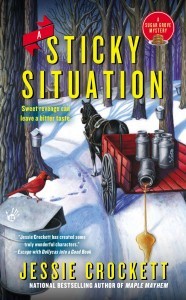 BR:When you are in Maine, where do you write? What are you looking at as you work?
JC: I work on the front porch. My desk faces the street but the screen door allows in breezes from the sea. The sounds of crashing waves and squeals from amusement park riders run uphill and spill all over me as I write. In spring and fall, when the leaves are off the trees, I can catch a glimpse of the water winking up at me. Truly, I am blessed.
BR: Recommend a favorite spot in Maine. A “hidden gem” if you will.
JC: This may not be what you had in mind but I’m going to say Heavenly Socks in Belfast. It is a yarn shop with an unusual amount of sock-weight yarn on offer. The staff is knowledgeable and so welcoming. And the town is charming. Well worth the drive.
BR: I think that’s a great recommendation. I’ll have to tell my sister-in-law who runs a yarn shop about it.
Everyone, say hello to Jessie!
Lea Wait's Blog

- Lea Wait's profile
- 509 followers

