
Lea Wait's Blog, page 256
July 8, 2016
Weekend Update: July 9-16, 2016

 Next week at Maine Crime Writers there will be posts by John Clark (Monday), Kate Flora (Tuesday), Susan Vaughan (Wednesday), Vaughn Hardacker (Thursday), and Jen Blood (Friday).
In the news department, here’s what’s happening with some of us who blog regularly at Maine Crime Writers:
Saturday, July 9, from 9 a.m. until 1 p.m., Maine Crime Writers Jen Blood, Jessie Crockett, Kate Flora, Maureen Milliken, Barbara Ross, Lea Wait, and alum Paul Doiron will be among the thirty-five authors signing their books at Books in Boothbay, Route 27, at the Boothbay Railway Museum. Sisters in Crime of New England will also be presenting “Murder in the Old Railway Chapel,” testing your deductive skills.
July 11, at 6:30 p.m., Vaughn Hardacker will be speaking at the Freeport Community Library.
July 13, at 3:30 p.m., Vaughn Hardacker will be speaking at the Fort Fairfield Public Library.
July 12, from 6:30 until 8 p.m., Kate Flora, Jen Blood and Lea Wait will be speaking at the Belfast Library in Belfast, Maine about (fictional) crime in Maine.
July 16, at 3 p.m., Barbara Ross and Lea Wait will be talking about their and other Maine mysteries at Mainely Murders Bookstore, 1 Bourne Street, in Kennebunk, Maine.
An invitation to readers of this blog: Do you have news relating to Maine, Crime, or Writing? We’d love to hear from you. Just comment below to share.
And a reminder: If your library, school, or organization is looking for a speaker, we are often available to talk about the writing process, research, where we get our ideas, and other mysteries of the business. Contact Kate Flora: mailto: kateflora@gmail.com


July 7, 2016
Another Wedding in Maine
by Barb, looking forward to Books in Boothbay this Saturday

Kate and Briana in first grade
Four years and a bit ago, I wrote about a wedding in Portland, Maine. The post was about a lot of things including a very special bride and groom, but fundamentally it was about two little girls who met at nursery school, recognized something in each other, and stayed friends from that day to this, despite time and distance.
My daughter Kate had flown back from her year living in London especially for Briana’s wedding. At the time, Kate had little idea what the next chapter of her life would hold. She’d been working on her Masters in Creative Writing at London Metropolitan University–a fun, time-off sort of year–when inspiration struck. She wanted to teach writing at the college level. Kate had accepted a place in the MFA program at UMass Boston, but everything else was a blur. She had the summer to finish her master’s thesis, find a place to live, get some sort of part-time employment, and find a life in Boston after college years spent spent in Durham, New Hampshire, followed by five years working in Manhattan, and then school in London.

Kate and Briana at Briana’s wedding
None of us knew on that day that Kate would finish her thesis that summer and graduate from London Met with distinction, then three years later graduate with her MFA, and love living in South Boston and then in Jamaica Plain. None of us knew she’d get a job teaching composition and literature at Mount Ida College. And definitely none of us knew that on the exact same weekend, four years later, she would also get married in Portland, Maine.
But that’s exactly what happened. Kate met Luke, and they fell in love, and through a series of twists and turns, they found the wedding venue of their dreams at the Portland Company. They picked the weekend before Memorial Day for a variety of good reasons–four years exactly after Briana and Nick’s wedding.

Briana’s daughter helps the bridesmaids get dressed. Photo by Abby Lorenz.
This time, Briana stood up for Kate and signed her marriage contract as a witness. And maybe most fun of all, Briana and Nick’s two-month-old daughter was along for the ride.
Sometimes we don’t know how things are going to turn out. And then they turn out exactly the way they should.

The bridesmaids. Briana far left. Photo by Abby Lorenz.

Briana comes down the aisle with Luke’s brother Hansen. Photo by Abby Lorenz.
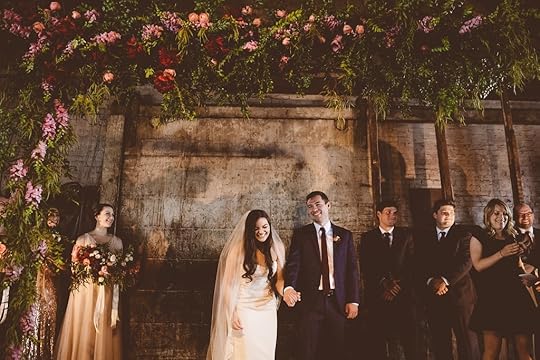
The ceremony. Photo by Abby Lorenz.
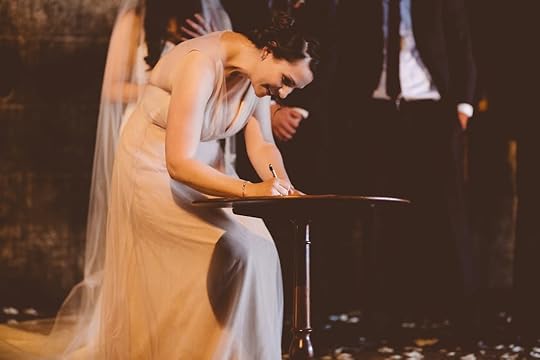
Briana witnesses the marriage contract. Photo by Abby Lorenz.

Briana and Nick at the reception.
Save
Save
Save
Save
July 6, 2016
It’s summertime in Maine and the readin’ is easy
If it’s summer, it’s reading season! Actually, if you’re like me, any time is reading season. Or, with pesky things like work getting in the way, want-to-read season. But there’s something about summer, especially if you live in Maine, that gives you that extra push to pick up a book (or tablet, or Nook, you get the picture).

Even Nesowadnehunk Stream in Baxter State Park is a perfect place to read in the summer in Maine.
Maybe it’s the longer days and the need to be outside. We get so few months here when it’s pleasant out, when those of us lucky enough to have a nice porch or patio can use it, or a beach nearby, or a tree to sit under. The days last so much longer and the livin’ (and readin’) is easy.
And the fun thing about summer, too, is that the Maine Crime Writers community (as well as all our writing friends), emerge from our dark writer’s garrets, blink in the unfamiliar sun and get out there and meet the readers. Not that we don’t do that in the winter, too, but again: snow, short days, cold. Ugh.
This Saturday features one of the delights of a reader’s summer in Maine: Books in Boothbay.
The event, sponsored by the Boothbay Public Library and held at Railroad Village in the town, features more than 50 writers, including some who blog at this site. The writers’ organization Sisters in Crime New England (some of us on this blog are members) will not only have a booth at the event where you can meet some of your favorite writers, but a mystery for readers to solve. I’m proud to say I’m one of the suspects in the murder of Eunice K. Stoneheart. I don’t want to give too much away, but I will say that if I did it, it’s because she had it coming.
While Books in Boothbay (which is 9 a.m. to 1 p.m. Saturday) is a lot of fun, you don’t have to go to an event like that to meet your favorite writers or discover new ones.
Many of us participate in events throughout the state. Monday, Kate Flora, Dick Cass, Vaughn Hardacker and I had a Meet the Maine Crime Writers booth at the Belgrade Fourth of July gala, and had a great time meeting and talking to readers.

Meet the Maine Crime Writers booth at the Belgrade 4th of July.
Libraries across the state host writers year-round, but ramp it up in the summer. You don’t have to be a regular patron of a library or bookstore to attend a reading or event.
How do you find these? This blog’s weekend update frequently lists what’s going on, as does the Maine Writers and Publisher’s Alliance. Most of the state’s libraries have websites that publicize their events, as do your favorite author’s websites. Newspapers, too, are great resources. My paper, the Morning Sentinel of Waterville, as well as its sister paper, the Kennebec Journal of Augusta, and mother paper, the Portland Press Herald, not only list events daily, but also have a community calendar on the web.
We all know summer is awesome and summer in Maine is extra-awesome. Make it even better for yourself by checking out some of our state’s great writers. You won’t be disappointed and I guarantee you they will appreciate it.
Maureen Milliken is the author of the Bernie O’Dea mystery series. No News is Bad News, the second in the series, was released last week. Follow her on Twitter: @mmilliken47, on Facebook at Maureen Milliken mysteries and check out her website for events, book news and to sign up for updates, maureenmilliken.com. Thanks for reading!
A Day in Kennebunkport
(Today we begin an occasional series to introduce our readers to some of our favorite parts of Maine, our “A Day in . . .” series. We hope you’ll follow our perambulations and be tempted to explore some of these places yourself)
Bruce Coffin: Several months ago, following a twelve year hiatus, my wife and I returned to the Captain Lord Mansion nestled within the picturesque village of Kennebunkport, ME. This was our seventh stay in the former sea captain’s residence turned B & B.
We discovered the inn in the mid 80s when I was still relatively new to the police force. Back then I worked quite a lot of overtime to supplement our income. One of the outside details was providing plainclothes security during business hours for a local high end jeweler. Endless hours of watching customers come and go, checking for furtive movements, gestures, glances or anything out of the norm indicating they were up to no good. During the down time, when there were no customers, I read, everything in the store. I read about mining expeditions, gemology, travel, sales, even the inside labels sewn to my suit jacket. I tell you, this was one action-packed detail. One of the periodicals regularly displayed on a table in the lobby was the Conde Nast Travelers Guide. The official travel magazine for the masses. It was fun to imagine jetting about the globe, visiting strange new places, that was if money hadn’t been in such short supply. It was in this most prestigious of travel mags that I first discovered the Captain Lord. I was instantly captivated by the glossy professional photos taken at the inn. Each of the rooms ornately decorated and furnished with antique beds, Queen Anne dressers, and claw foot tubs. All of this and we wouldn’t have to fly to New Delhi to get there!
Straightaway, I began planning our weekend adventure. By weekend of course I mean middle of the week. Rookie cops don’t get weekends, not in the traditional sense. The upside was that the Captain’s rates we’re better during the week, likewise was the choice of rooms. As soon as my shift ended I drove home and called the inn. From a landline. Come on now, this was the 80s. There were no cellphones, no email, and no internet.
 From the very first, we fell in love with both the inn and its locale. Staying there was quite literally like traveling back in time. We even found ourselves adopted by Aggie, the inn’s official tiger cat. The owners were very gracious hosts and seemed to genuinely enjoy chatting with the guests. Breakfast was a splendid array of homemade muffins, yogurt, granola, fruits, and egg based casseroles. There was something for every palate.
Our days were spent seated in the warmth of great room in front of the large brick fireplace, or driving along the York County coastline, or strolling among the various shops and eateries of Kennebunkport.
Many things have changed over the past thirty years. Aggie is no longer haunting the inn, although perhaps in spirit. The real wood fire in the great room has been replaced by gas. But the rooms continue to be regularly updated and the inn retains all of its charm.
Sadly, one of our favorite K-Port dining locations, Windows on the Water, is gone. But good restaurants still abound in the village, Federal Jacks, David’s, Allison’s, Hurricane, and a brand new favorite, Ports of Italy. Perhaps the best thing about Kennebunkport is that everything is within walking distance.
If you haven’t visited this jewel of Maine’s southern coast, it’s high time you did.
July 4, 2016
Celebrating the THIRD of July … And a New Beginning
Lea Wait, here. And I have nothing against the Fourth of July. In fact, I have my own way of celebrating it — an annual viewing of my all-time favorite musical, 1776. When I was raising my children in New Jersey every Fourth of July we would watch that movie, eat Chinese food and then listen to a band concert and watch fireworks, both on the grounds of a nearby Veterans’ Hospital. A wonderful way to remember what July 4th means.
But in our family the third of July is also a very special day.
When I was in my late twenties I wanted very much to be a mother. I would tear up at the joyful news that another of my friends was pregnant. I knit baby blankets and sweaters for new arrivals. I collected baby clothes for orphanages and adoption centers abroad.
For two years I spent Friday nights volunteering with abused children between the ages of six and twelve who were living temporarily on one floor of the New York Foundling Hospital. I gave baths and read stories and took children to Central Park. I saw the results of abuse, and I heard the laughter of children who were survivors. Most of all, I realized that the children I got to know needed even more love and understanding and hope than younger children.
I was single, and I began thinking about adopting an older child. The guy I’m now (MANY years later) married to, and was then dating, took pictures for my first home study. I was twenty-eight.
Skipping a lot of details, my first daughter arrived home from Thailand in March of 1977. I was thirty, and she was almost five years old. She was tiny and beautiful. She also had night terrors and tantrums. But I had hope. Time and love would make a difference. Only a month after she arrived I applied to adopt another child. It had taken several years to adopt Alicia and I wanted her to have a sister.
In April of 1978 my agency called. Would I be interested in adopting an eight-year-old girl who was in Korea? My answer was immediate. YES. I spent that afternoon driving from my office in Piscataway, New Jersey through heavy traffic to my local agency, on the upper east side of New York City, to see a picture of my daughter-to-be. The picture was a small, blurred, black and white image. I propped it on my small dashboard on my way home and somewhere along the way decided her American name would be Caroline, after my grandmother.

Caroline, Alicia & Lea, July 3, 1978, Kennedy Airport
After my adoption and Immigration paperwork was completed the agency in Korea said they’d try to send Caroline to me before September, when her school year would start. They’d try, but they couldn’t promise. Many children were ahead of her in the queue.
Her sister-to-be and I built bookcases in what had been my study and would now be her bedroom, and hung Korean and United States flags on her bulletin board on either side of a “Welcome Home” sign. I perfected my kimchi and contacted a Korean pediatrician.
My job required travel that summer, so I scheduled it as early as I could, and planned a vacation in Maine with Alicia.
I was at my office Friday afternoon, July 1, when the call came. A measles epidemic had hit the orphanage where Caroline was staying. All of the children scheduled to fly to their new parents were sick, but, because she was older, Caroline had already had measles. She’d be using a ticket intended for another child, and arriving at Kennedy Airport late July 3 … at least two months ahead of schedule.
July 3 was a windy, rainy, night. I was too nervous to drive. My sister’s boyfriend drove Alicia and I to the airport. The roof of his car leaked. I was too excited to care.

3 weeks later, on a boat trip in Maine
It was immediately clear that Caroline was ill. She was weak and scared. She refused to speak to anyone, even in Korean. (She didn’t speak English, of course.) Her pediatrician said she was severely dehydrated. (I later learned she’d thrown up on her first flight, out of Seoul, and then had slept the rest of the long trip. The woman who escorted her had focused on the babies she was bringing to the States, and hadn’t woken Caroline up to make sure she had something to drink.)
In any case, Caroline was home, and within a few days was feeling better. Two weeks after her arrival she and her new sister and I vacationed in Maine. And she was ready when she entered second grade in September.
In our home we celebrate arrival dates as well as birthdays, and the next July 3 there were fireworks. Caroline thought for several years that they were to celebrate her homecoming! But, fireworks or none, July 3 would always be an important date for her, and for me.

Caroline, a couple of years ago
I never dreamed when I took Caroline home that first July third, so weak she could hardly stand, that eleven years later she’d join the United States Army. She served overseas and stateside in a MASH unit, married a wonderful man she met while they were both serving, and, both now out of the Army, they now lives in Virginia with their two beautiful daughters, ages fifteen and sixteen. They’ll be visiting Maine at the end of July.
It won’t be July third, but it will be a time for more memories, and more celebrations.
Lea Wait writes the Mainely Needlepoint and Shadows Antique Print mysteries, and historical novels for children. As a single parent, she adopted four older girls who’d been born in Asia; she now has eight grandchildren. She invites you to friend her on Facebook and Goodreads and to check her website for more information about her and her books.
July 3, 2016
Celebrating the 4th of July

Belgrade 4th of July 2015: Lea Wait, John Clark and Kelly McClymer
Kathy Lynn Emerson/Kaitlyn Dunnett here. When I drew July 4th as my next blogging date, I wasn’t sure at first what to write about. Last year I spent the day selling books with several other Maine Crime Writers in Belgrade Lakes. Fun, but tiring. Kate Flora, Vaughn Hardacker, and Maureen Milliken are doing that this year, so if you’re in the vicinity, be sure to stop by. One year, when my cousin Moira was visiting, we invited the in-laws over and had a cookout on our back deck. But to tell you the truth, most years we don’t do anything special. We tend to avoid parades, and although I enjoy watching fireworks, I get nervous if they go off close to the heavily wooded area where we live.
 That said, when I was writing the proposal for what became Kilt at the Highland Games (in stores July 26), the title I started out with was Kilt on the 4th of July. Setting it on this patriotic holiday was nixed by my publisher’s sales department. I’m still not entirely sure why, but I’ve learned not to argue. The main reason I wanted that setting was so I could have fireworks to cover up the sound of a gunshot. Solution: add fireworks to the annual (fictional) highland games taking place in Moosetookalook, Maine at the end of July.
But I digress. What I really want to write about is how a curmudgeonly, eccentric, semi-hermit like myself is likely to celebrate the day. Staying home, obviously. Perhaps doing a bit of writing, even on the holiday. Reading—of course! It’s likely there’s a Red Sox game on TV. And what else? How about a movie with a 4th of July theme?
 Out of curiosity, although I already had a couple in mind, I went to Google for lists of 4th of July movies. Such lists were plentiful, but a bit odd. For one thing, they weren’t limited to Independence Day itself. All the ones I looked at broadened their definition to “patriotic” movies rather than movies that were 4th of July specific. A list of ten from Forbes in 2012 put Jaws at #4. Well, it does take place as the town prepares for Independence Day festivities. #1-3 were Rocky, Independence Day, and The Patriot. ABC News in 2013 didn’t rank by number but their list of eight included Miracle (the U.S. ice hockey win at the winter Olympics—um, stretching it a little!), National Treasure, and Frost/Nixon. A 2015 list from Entertainment was also eclectic, including Captain America: The First Avenger, Top Gun, A League of their Own, Saving Private Ryan, and Forrest Gump. Boston.com, also in 2015, listed thirty titles, including Air Force One, All the President’s Men, Apollo 13, Die Hard, and The Bridge on the River Kwai. That last one seems an odd choice. Most of the characters are British!
The actual 4th of July appears to be missing from most of these selections, with the exception of the one movie that made every list I looked at: Independence Day. That was the first one I thought of. Invaders from outer space attack earth, humans go into battle on the 4th of July, following a speech by the U. S. President that ranks right up there with Henry V’s on St. Crispin’s Day, and the world is saved. What’s not to love? Since there’s a sequel in theaters now, I expect some intrepid souls will go see that today. As a semi-hermit, I’ll wait till it comes out on DVD.
 What struck me as even stranger than the inclusion of titles like The Bridge on the River Kwai and Die Hard (set at Christmas) was the absence of what has to be the quintessential 4th of July movie. Where was 1776, that superbly-cast musical account of how the Declaration of Independence was written? Its freeze-frame ending on the 4th of July as the Liberty Bell rings in the background is about as patriotic as you can get.
So, what films are on my list of top patriotic movies to watch on Independence Day? I’m going to put 1776 first and then go with three I own on DVD, have watched multiple times, and will quite possibly watch again today: Independence Day, National Treasure, and Captain America: The First Avenger.
Other suggestions, anyone?
Kathy Lynn Emerson/Kaitlyn Dunnett is the author of over fifty books written under several names. She won the Agatha Award for best mystery nonfiction of 2008 for How to Write Killer Historical Mysteries and was an Agatha Award finalist in 2015 in the best mystery short story category for “The Blessing Witch.” Currently she writes the contemporary Liss MacCrimmon Mysteries (Kilt at the Highland Games ~ July 2016) as Kaitlyn and the historical Mistress Jaffrey Mysteries (Murder in the Merchant’s Hall) as Kathy. The latter series is a spin-off from her earlier “Face Down” series and is set in Elizabethan England. Her websites are www.KaitlynDunnett.com and www.KathyLynnEmerson.com
July 1, 2016
Weekend Update: July 2-3, 2016
Next week at Maine Crime Writers there will be posts by Kaitlyn Dunnett/Kathy Lynn Emerson (Monday), Lea Wait (Tuesday), Bruce Coffin (Wednesday), Maureen Milliken (Thursday), and Barb Ross (Friday).
In the news department, here’s what’s happening with some of us who blog regularly at Maine Crime Writers:
from Kaitlyn Dunnett: The ebook of The Scottie Barked at Midnight is on sale for $2.99 from Kindle and iBooks (and probably others). Since the paperback won’t be out until the fall, this is a real bargain compared to the cost of the hardcover.
WINNERS: The winners of the drawing for Advance Reading Copies of Kilt at the Highland Games are David Plimpton and Marilyn Lugner. Congrats to you both.
On Monday, July 4th, Maureen Milliken, Kate Flora, and Vaughn Hardacker will be sharing a table at the Belgrade Lakes Fourth of July extravaganza, 10 a.m.-2 p.m., 78 Main St. (right next to the gyro stand!), in Belgrade Lakes village. Be sure to visit us at the Meet the Maine Crime Writers tent!
From Barbara Ross: Next Saturday, July 9th from 9:00 to 1:00 come see Barbara Ross, Lea Wait, Kate Flora, Jessie Crockett Estevao, Maureen Milliken, Brenda Buchanan, Bruce Coffin, Paul Doiron, and a host of other New England mystery authors, as well as children’s authors and authors of every kind, at Books in Boothbay at the Railway Village in Boothbay.

And also part of Books in Boothbay, our own Jen Blood has teamed up with Sisters in Crime to stage a murder scene. You can read about it on Jen’s June 15th post: http://mainecrimewriters.com/jens-posts/murder-at-the-old-railway-chapel
Good news about Maine Crime Writers alum, Sarah Graves: Sarah’s DEATH BY CHOCOLATE CHERRY CHEESECAKE is the start of a “Death by Chocolate” series to be published by Kensington, but in it she returns to Eastport, Maine, picking up where she left off with A BAT IN A BELFRY and writing about the same characters as in her earlier series. Now the emphasis isn’t on home repair, but rather on a new venture, a waterfront chocolate shop, The Chocolate Moose, and the mystery of who killed the local health inspector.
Finally, thanks to the graphics skills of Barbara Ross, Maine Crime Writers have (or is that has?) a gorgeous new poster for our events. Which we unveil here for the very first time:

An invitation to readers of this blog: Do you have news relating to Maine, Crime, or Writing? We’d love to hear from you. Just comment below to share.
And a reminder: If your library, school, or organization is looking for a speaker, we are often available to talk about the writing process, research, where we get our ideas, and other mysteries of the business. Contact Kate Flora: mailto: kateflora@gmail.com
June 30, 2016
Meet Maine Literary Award Winner Brendan Rielly
 Today we’re pleased to introduce Brendan Rielly, who is the winner of the 2016 Maine Literary Award for Crime Fiction, to discuss his debut work, An Unbeaten Man.
Q. Tell us about The Unbeaten Man.
The Unbeaten Man features a Bowdoin College microbiologist who creates a microbe that can clean up any oil spill no matter the size, which should be a great thing. But bad guys figure out a way to weaponize it, and they force him to deploy it against Russia and Saudi Arabia to destroy their oil reserves and cripple their countries and throw the world in chaos. That’s the big plot. What’s underlying that is that the main character, Michael McKeon, had a very tortured and difficult childhood. He grew up in Westbrook, which is actually my home time, and lost his sister and his parents to drugs and violence. Left on his own, he found his way to the Mission Possible Teen Center, which is a real place in Westbrook, now called My Place Teen Center, where his mentor was a Bowdoin College professor who introduced him to math and science and got him moving on a good path. Now, years later, he’s a professor at Bowdoin. The bad guys force him to do their bidding by kidnapping his wife and adopted daughter. Having lost one family, he can’t even bear the thought of losing another. So in the true genre of thriller heroes, he will do whatever it takes.
Q. What inspired The Unbeaten Man?
This is sort of an esoteric start, but I was actually reading Thomas Friedman’s book, Hot,  Flat and Crowded. He talks a lot about oil politics and that when oil prices are high, oil nations like Saudi Arabia and Russia rattle the sabre a little more, and when oil prices are low, that shifts the balance of power. He mentions some of the attacks that have been attempted on oil facilities, particularly in Saudi Arabia and particularly at the oil facility that’s featured in my book, which is called Abqaiq, which is one of the most vital pieces of the Saudi oil infrastructure. It is a constant target for attacks, so it has one of the most secure facilities in the world and no attack has ever been successful. That jumped into my brain, and I started to think, what if instead of attacking the facility, somebody could actually attack the oil? What if you could put something in the oil that would destroy it and then would go back out to all of the other oil reserves and all of the other facilities? I started doing a little research and came across some work that had been done in the oil sands up in Canada, where they were working with microbes that could break oil down and release natural gas, destroy the oil but actually get natural gas out of the ground. It wasn’t a big jump from there to say, well, if you could do that, what if you could just destroy it, and that was the plot of the book.
Q. How long did it take to write the book?
About eighteen months to research and write. There was a lot of research involved because
there’s science in the book, and I’m not a scientist. I worked with four different professors to
make sure I got the science right and made any changes that they felt needed to be made.
Q. How has The Unbeaten Man been received?
Fantastic. It’s actually kind of been overwhelming on a couple of levels. One level is with other authors. This has opened me up to this group of authors not just in Maine but literally around the entire world, this group of international thriller writers who have been so welcoming and supportive. You would think there was competition, my book is selling and maybe their book isn’t selling, but there is none of that. They have been incredibly supportive, connected me into other markets, giving me reviews. Just to start off with, there were reviews on the back of the book by Steve Berry and Doug Preston and Gail Lynds. These are three New York Times bestselling authors, people at the top of their profession. They gave me glowing reviews. The International Thriller Writers Organization has featured me a couple of times, so that has been fantastic. The reception from the public has also been a blast. I was out at the Maine Mall Borders and sold out of the book, and other book stores have reported to me that they’ve sold out of it multiple times. The only kind of metric that I’ve seen anywhere so far is at Longfellow Books here in Portland. At the end of 2015, they published their top 100 best sellers, and my book was #47 despite the fact that it had only been out for three weeks. It’s just been so much fun talking about the book and having people enjoy the book. When you create something, you put a lot of yourself out there, and whether it’s a painting or a sculpture or a book, it’s a pretty great feeling when somebody picks up a thing that you created and says that they like it.
Q. Kind of a cliched question, we know, but have you always wanted to be a writer?
I’ve always been interested in writing. I grew up in a very literary family. I’m the middle of three generations of published authors. My father, Ed Rielly, is an English professor at St. Joseph’s College. He has written and published more than twenty book. I grew up surrounded by books, and I always loved them. I started writing as a little kid, stories for myself or for friends, and then I kind of gave it up as I got into high school. I was too focused on other stuff. Then in law school, I got the itch again to start writing and took an advanced fiction writing class at Notre Dame. I was only a couple of years older than the kids in the class, but in those couple of years, I had graduated from college, worked for a year, gotten married, gone to law school and just had a baby. So we were from different worlds. While they were writing these kind of Jack Kerouac/Rage Against the Machine all night long pieces, I was writing short stories about my son’s clown mobile, which led for kind of awkward critiques. I wrote my first novel during law school. It was horrible and I’ve never shared it with anybody. It sits in a box of shame in my house.
From that first novel, I moved into a variety of things, but nothing I ever went public with. I would write children’s stories for my kids when they were little. When my kids got a little older, I wrote the first thing that I really liked and thought about sharing publicly–a young adult fantasy. It was like a science-based version of Harry Potter. I was starting to discover my voice. I liked that a lot, but never had the time to try to find an agent and get it published. Then I started thinking a little more seriously about writing and trying to get something published. I realized that I really should write what I love to read, which are thrillers, so I began working the book which became An Unbeaten Man.
MCW: Most of us have books in the drawer!
Q. Is there a sequel in the works?
The Unbeaten Man is the first in a series. Book two,picks up four months after the first book and principally involves Iran. Another book I have completed is a tongue-and-cheek guide to parenting called How to Raise the Perfect Child or at Least Lie About It. I’ve shared that book with some of the people in the publishing world and other authors, and it’s gotten a great reception but I haven’t really made a full court press to find an agent and get that out there. So these are all things that I have to try to carve out time to do.
Q. How do you think growing up in Maine influenced your storytelling?
The place makes the person and Maine certainly impacts and shapes its residents. Maine provided the setting for An Unbeaten Man and will continue to provide the setting for the Michael McKeon series. Maine also provided the setting for my young adult fantasy novel. Maine brings you out of yourself—whether gazing out over the ocean or wandering in the woods or staring down a ski slope—but also gives you the space to create. When you’re constantly jostled by people surrounding you, you’re a different person and a different writer than when you have the space to interact with your environment and think on your own.
Q. What are the burdens and benefits of having a writing parent?
I never saw any of it as a burden. I always found it very helpful to have someone review my writing and make it better. My parents have always been very helpful readers of my work. They’ve always been very loving and supportive, but I also want people to tell me what needs to be improved. I want to get better and feedback is extremely valuable.
Q. How long were you in the unpublished writer’s corner before you sold your first book?
Ugh. That depends on how you measure it. I wrote my first novel during law school 20+ years ago. It was horrible and I knew at the time it was horrible, but it was an exercise in simply getting from start to finish. I never shopped that book. It remains in a box of shame in my basement. Over the years, as I moved through children’s books to young adult fantasy and to a tongue in cheek guide to parenting, I tried sporadically to jump into the published world but with no luck. Once I wrote An Unbeaten Man, I didn’t have time to market it because I was helping Morgan work on his project that turned into Neighborhood Heroes. Then when Morgan and I were at the Book Expo of America in NYC for Morgan’s book. Down East asked to see my book and offered to publish it. So, anywhere from a couple weeks to 20+ years.
Q. What advice would you give to an aspiring writer? Pretend that you have to pay for the words you use. It makes you value them more and choose them wisely.
MCW: Argh! Do I have to pay for the 100 words I took out of one of my novels?
Q. One of our favorite questions to ask newbies here at Maine Crime Writers is to tell us about a favorite Maine place—one that a lot of people might not know about.
The chapel at Bowdoin College. Everyone knows Bowdoin’s beautiful quad and its art museum, but the chapel has always been a place of peace for me.
Q. And of course, since it is summer in Maine and food is on everyone’s mind–can you share a favorite place to eat and tell us why.
Since it’s summer, I’ll go with ice cream. Catbird Creamery in Westbrook. Fantastically inventive, delicious ice cream. Furious George will challenge your taste buds. I love anything with rhubarb. Or stick with the salted chocolate.
An Unbeaten Man is Brendan Rielly’s first thriller. Brendan is a member of ITW and Maine Writers & Publishers Alliance and studied advanced fiction writing while attending law school. Brendan is chair of Jensen Baird’s litigation department and lives with his wife and three children in Westbrook, Maine, where he is the City Council President. Brendan is the middle of three generations of Maine authors with his father and son (as a high school senior) also published.
June 29, 2016
Windjammer Days
by Barb, in Maine at last
It’s Windjammer Days in Boothbay Harbor. My husband, Bill Carito, has gotten deep into iPhone photography, so we took a Balmy Days harbor tour billed especially for photographers. The day was foggy and damp, but you know you’re with a group of photographers when everyone boards the boat, looks up at the sky, and says, “Perfect day!”
Here are some of Bill’s photographs of the day. If you like what you see and want to see more, you can friend him on Facebook here or follow him on Instagram at billcarito (for black and white) and bill.carito.colorphotos (for color).
Enjoy!


June 27, 2016
Ten Tips for Tuning Up Your Descriptions
Kate Flora: There are so many challenges facing a writer who is trying to craft fiction that sometimes descriptions fall far down the list. By the time an author has developed a cast of characters, created a plot filled with twists and turns, and mastered the art of writing dialogue, descriptions can sometimes be left to old clichés or place-holders that await that moment when the author can revisit the work and give them a fresh, new twist.
But we all want our work to shine. Stand out from the vast fields of competing works.

How would you describe this?
Description is meant to be evocative and memorable. We want our books to be the ones that readers will clasp with delight as they say to a friend or significant other: Listen to this . . .
Engage all of your senses. Don’t just describe what can be seen. Describe what can be smelled. Heard. Touched. Perhaps even tasted. Engaging your senses as you try to write description will engage your reader’s sense when they read what you have written. It will locate them more fully and create a greater emotional attachment to your story.

Worn? Shabby? Ancient? Rustic? Draped in wisteria?
Dig deeper and try to find a fresh way of showing. We can talk about worn steps or peeling paint, and a reader will know what we mean. But are there other ways to convey the age of a house, or its long use or lack of repair? The paint rolled away from the weather clapboards like it was recoiling in distaste. The foot-worn centers of the steps were as swayed as a tired old horse. The shutters hung off the house like they were trying to escape. The house looked like it had simply given up. Since writing the dark and desolate can be easier than writing the bright and happy, try the same exercise with a house that’s immaculate or tenderly cared for.
Try writing exercises. Since everything we write must do double or triple duty, it’s great to plug into the wonderful exercise John Gardner offers in the Art of Fiction. It’s one I always use with my students to help them see how they can tell through indirection. The exercise is this: write a paragraph describing a building as seen by a man whose son has died in the war, without mentioning the son, or death, or the war. Then describe the same building from the point of view of someone is love without mentioning love or the lover. See how the description changes as the observing eye changes.
See through you character’s eyes. Figure out what sorts of things your central

Color and tone can set a mood. Reflections in the water can match reflections by a character
character is attuned to, and add those to that character’s inner narration, the way they describe the world themselves. How do they see other people? What characteristics might jump out, and how would they define it? Long ago, as I moved from my Thea Kozak series to my Joe Burgess series, I realized that Thea organizes her world in lists and details, while Joe is more attuned to nature. I need to keep that in mind as I move them through their worlds and play the game with myself of asking: How would Joe Burgess see this? How would Thea Kozak see this? How are they different and what makes them particular to this character?
What does your character carry? In Tim O’Brien’s The Things They Carried, a huge amount of information about the various members of his platoon is conveyed by the things they carry. Choosing certain items, or habits, or mannerisms for a character, either a central character, or someone your central character is observing, can be a very effective shorthand. If you struggle with this idea, you can always start with your purse or your pocket, or the glove box, console, or trunk of your car. What do you carry and what does it say about you? Now, what does your character carry?

Bathed in streaks of late afternoon light through a stained glass window
Color your world. It is perfectly easy to describe something as blue or green or red. But the world is full of wonderful color names, so why not use them? Color names can go in positive, even poetic directions, such as obsidian, cornflower, sapphire or celadon. They can also convey darkness, ugliness, or a sense of the distasteful. Try liver, puce, mole, or mud.
Set your world in motion. Just as the use of color can tune up your writing, so can the use of motion. You can have your character walk into a room, and that’s okay. It gets them there. But if the character bursts into the room, strolls into the room, shimmies into the room, or enters as though being chased by a bear, the scene will be more dynamic. Bring your powers of observation along as you go for a walk, or sit in a mall food court, or go to a farmer’s market or a country fair, and start people watching. People don’t move alike, and as you watch, be thinking about how you would describe what you see. A limp? A strut? A hesitation? Someone strolling through the world like she owns it or teeters along on shoes that are far too high, seeming perpetually on the verge of being launched forward. Sometimes people walk as though the weight of their depression is almost too heavy to carry. Observations like these deepen both the observer and the observed.
Steal from others. Not directly, of course. But it can be very helpful, in determining what appeals to you as a writer, and why, to keep a little notebook in which you write passages which particular appeal to you as you’re reading them. Don’t just copy the passage or mark it in a book. Take the time to write it out by hand. There is something about the act of copying that helps you to feel the rhythm and weigh of the language.
Expand your vocabulary. Get yourself a couple of great books to help you expand your descriptive vocabulary. On my shelf, I have a book called The Describer’s Dictionary by David Grambs, described as “a treasury of terms and literary quotations for readers and writers.” What could be better than pages of quotes and words to describe patterns or edges? Like this one: “Men swore. They pushed at the wheels with long oak poles and slashed at the oxen till their backs were crosshatched with bleeding welts and their noses ran pink foam.” John Gardner, Grendel. Useful to see how other writers have done it.
I also often turn to Rodale’s Synonym Finder. It’s Maine in the summertime, but there are those days when the fog rolls in. How might you describe the sounds on a foggy night? Muffled, muted, dampened, dead-sounding, flat, toneless, indistinct, distorted. I’ve always had fun making lists of words and tacking them to the wall as I am writing the scene.
Keep buying writing books. And read and read the ones that speak to you. Recently, at a library book sale, I found a book by Rebecca McClanahan called Word Painting: A Guide to Writing More Descriptively. It’s a great book to dip into if you’re feeling dull or uncreative.

Play with the contrasts of light and dark

Or dark and light. Match a character’s mood or create a contrast
Lea Wait's Blog
- Lea Wait's profile
- 509 followers

