Leonard D. Hilley II's Blog, page 5
July 1, 2020
A Well-deserved Vacation … From Everything
For almost a week, we vacationed at Virginia Beach. Usually, I take my computer to keep up with what’s going on Facebook, Twitter, etc., but with all the turmoil occurring with Covid and protests, I chose to leave my laptop behind, and I’m GLAD I did.
The most interesting part of vacation was the TOTAL lack of stress by not checking comments and posts in the Facebook and Twitter feeds. Instead, I found myself relaxing and enjoying the sunrises on the balcony while drinking coffee.
Listening to the crashing waves, seeing the pelicans and seagulls seeking early morning feeding, and having the cool morning, salty air flow past me caused all the worries of the world to simply melt away. I was with my wife, the love of my life, and our daughter and two wonderful grandchildren. The world was, for those days, quite close to normal.
This was when I began to realize that perhaps we’d all do ourselves a great favor by spending less time watching the dismal news stations and the alarming shared posts that bombard our minds via social media. Nature seemingly is undisturbed and a welcome to ease your thoughts.
Our vacation environment also stoked my muse concerning several of the books I’ve been working on. I’m excited to proceed with those now.
Stay safe. More to come soon.


May 23, 2020
We’re All Carriers
In 1993, I took microbiology at Berea College, as part of the curriculum required for my B.S. in biology. So much has changed in technology since then.
Dr. Dawn Anderson’s lectures were interesting but labs were even more interesting. The hands-on approach increases one’s understanding in almost every science course.
A few weeks into the semester, we did streak plates. We plated for Staphylococcus and Streptococcus. Once the cultures grew, we were then to test which antibiotics worked most successfully on each strain.
For Staph, we used long Q-tip like swaps and swabbed the inside of our noses. Then, we took the tip and streaked it across a nutrient-filled agar plate and covered the petri dish. For Strep, we used a different swab and swabbed the backs of our throats and repeated the same procedure. We labeled the plates with our names and which bacteria contained inside. These were placed into an incubation chamber for us to check the following week during lab.
The following week, we were given our two plates. Both of my plates looked like cotton balls had been stuffed inside the dishes. Glancing around the room, I noticed that no one else’s plates looked anything like mine. Some had no growth on theirs at all.
I wondered if I’d done something wrong. Dr. Anderson walked around the lab glancing and inspecting plates while she gave directions for the next part of our assignment. When she reached me, she immediately took my Staph plate and held it up before the class, calling their attention by saying, “This is what a plate colony should look like.”
A few minutes later, she returned and did the same thing with my Strep plate, which was quite embarrassing, as it made me feel like I had the plague or something. Not only was this embarrassing, it greatly concerned me. Why had my micro populations exploded and no one else’s had?
After class dismissed, I stopped by her office and asked, “Why were my cultures so noticeable and no one else’s were? I seldom ever get sick or a sore throat. Shouldn’t I be sick all the time?”
“No,” she replied. “It simply means you have a strong immune system.”
She never gave a reason for why my cultures were so different than everyone else’s. I was a nontraditional student and seven years older than the others. Did that make a difference?”
While it’s true I seldom get sick, whenever my immune system gets compromised, it’s usually quite severe.
Only a few months before I re-enrolled at Berea College, I was required to take a MMR booster shot because of the measles outbreaks at colleges across the country. Had vaccines changed that much?
During the same semester, my wife-to-be and I began dating. Both of us got sore throats soon after. Nothing serious, and she told me that she often got strep throat. Since we’ve been together, we seldom suffer any sore throats at all.
In 1998, when we attended Morehead State University, our five-year-old son got a severe sore throat. My wife was taking microbiology, so she took our son to her professor and had his throat swabbed. Dr. Garner plated the cultures and found that our son had both alpha and beta strains of strep, which might explain why she and I had gotten sore throats when we first began dating. Perhaps she had one strain and I had the other, but now, our son had both and possibly we do, too.
With what’s going on in our current ‘pandemic’, little is discussed about every person’s norma flora. Norma flora is the bacteria that lives inside you and on your skin. They’ve set up colonies on all of us. Strange as it may sound, they actually fight to protect you from foreign bacteria. After all, it’s their home, too, and they don’t like intruders. They have territories where they thrive and it’s when they move out of their territories that they become a threat and possibly dangerous to you.
Hand sanitizer is a great precaution but sometimes, it’s an overkill. You’re also killing off beneficial bacteria of your norma flora. Overuse of antibiotics via injections, pills, and other means has–over time–helped create super bacteria like MRSA. MRSA is badass and resistant to most antibiotics because it has evolved to survive. These superbugs have gotten stronger. You see, that’s what your immune system should be doing. It should be getting stronger.
The more inactive people become, the more overweight people become, and the less time you access fresh air and sunlight, the weaker your immune system becomes. We all need exercise to lessen tension, strengthen our muscles and minds, and we need to socialize. Fear and worry weaken our immune systems. Stop watching all the negative news. Anchors and politicians aren’t scientists with your best interests at heart. Research. Live life. Better yourselves.
I leave you with this video of George Carlin’s Germs (NSFW explicit language) https://youtu.be/X29lF43mUlo
March 22, 2020
“You Can’t Please Everyone…
So ya gotta please yourself,” from the famous chorus of Rick Nelson’s “Garden Party”. With today’s social media, it doesn’t matter what the topic for discussion is. A division quickly forms with one side slamming the other.
During the past decade, I’ve read the comments for various topics and articles online. The subject matter isn’t important, but the results are similar. Even with the most positive comments, others deride the remarks and give them thumbs down. Some go further with aggressive vitriol and ad hominem. I wonder why society has become so bitter, why so many enjoy trashing others, and why the art of debate ceases to exist.
As an author, I don’t post about politics or religion and seldom about sports. Over the years, I’ve explained my reasons for this, and to my college students, as well. Simply put, religious views and political views are sacred to each individual for different reasons. Often, one’s beliefs are a product of how he or she were raised. If others have opposing viewpoints, that doesn’t make them right and you wrong and vice versa. It makes you different from one another. These differences shouldn’t make you enemies, but far too often, it does.
Environments shape people. Cultures shape people’s outlook on life, too. Differences make life interesting, as long as one culture isn’t trying to eliminate the other. But how bland would life be if we all looked identical and thought the same, if we only had one genre of music or one particular type of book or movie?
Think about it. Negativity and arguments even leak over to the online food and restaurant reviews. One might give rave reviews to a certain restaurant and dish. Another reviewer then trashes that person for his/her review. Sorry, but our taste buds are all different and actually change over time.
No, we’re never going to all like the same things or hold the exact same beliefs and values as one another. We’re not meant to. Does it hurt us to consider others’ feelings and show them respect as a fellow human being?
A few weeks ago, a person said, “Don’t debate. It’s a trap.”
How is debate ever a trap? A legitimate debate, that is, where two or more people discuss the pros and cons of a topic is not a trap, but an opportunity for opposing viewpoints to be evaluated. The philosophy of debate being a trap reveals the inner fear, perhaps the insecurity, that someone else might change the person’s viewpoint, as many folks cling to ‘my mind’s made up’. But that shouldn’t be the case. We can each learn from one another, and maybe, just maybe, we can begin shaping a better world without all the negativity, division, and hatred.
I’ll tell you what. I’d as soon treat you as a friend, even if you don’t me. I’m too old for added drama in life.
Stay safe, folks.
Until next time….
March 18, 2020
Titan and His Three Little Pigs
Raising a Cane Corso mastiff is often stressful, as the breed grows exponentially compared to others. The stress comes from having a full-size dog that’s still a puppy. Gradually, as the dog matures, this lessens and the dog is more precious than gold.
Titan is almost two years old. He still has his moments, the trying two-year old stage, but for the most part, he’s settling down. He a huge dog, full of love, and when he gets excited, his entire body shakes, not just his tail.
Because of a Cane Corso’s sharp teeth and incredibly strong jaws, there are few toys he’s not destroyed. Walmart sells little grunt pigs, so we took a chance he might not rip it apart. For some reason, he loved it. He played rough with the first one and it stopped grunting, so we bought another one. He kept it all the time and would ‘share’ it with us in the evenings. He placed it on the couch and nudged it with his nose for us to toss, so he could fetch it. Sometimes, however, he bit it and played tug instead. Due to his extremely sharp teeth and his iron grip, he ripped the pig’s snout.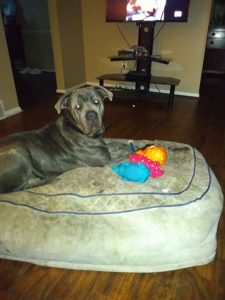
Dismayed, he took the little pig to his bed and discovered the inside of the pig has cotton stuffing. We took it away from him because he’d have continued destroying it. He pouted, heartbroken.
The following morning I went to Sam’s. A large display near the dog food aisle had 3-pack sets of the grunt pigs. I couldn’t believe it. I bought a set for him and waited until my wife came home from work to give them to him. Only we made them grunts from different rooms, which confused him. He’d drop the one and come running to find another one. After he had all three, he set them in his bed and slept beside them.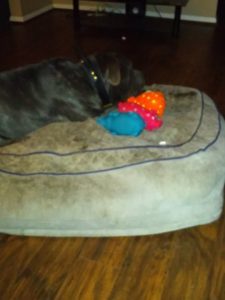
I wonder if he thinks they’re pups. Several times, I’ve found them facing his food dish like they were going to eat with him. He’s very protective of them, but still brings them to us in the evenings for us to toss.
Until next time….
March 17, 2020
The Deimos Virus (Re-released) Behind the Scenes
The Deimos Virus was the most difficult novel I’ve written. From concept to finished product was a fourteen year timespan. The story required a lot of research on my part and with the Mars rovers and other exploration projects by NASA, ideas about the landscape constantly changed. In the news over the past decade, there’s talk about establishing a colony on Mars, which brings to mind so many possibilities for how civilization could be established.
At times, I can imagine how different it’d be to view the stars at night from the red planet. Stargazing on Earth is polluted by the street lights of major cities and even suburban areas. To observe meteor showers is almost impossible unless we drive to a secluded area far from these lights.
Can you imagine nightfall on Mars? The darkness surrounds you while the bright stars fill the night sky. What about the quietness not disrupted by automobiles, trains, jets, and industries? A nightfall filled with peace and lack of pollution? One of the downsides is it’s a frozen terrain that lacks colorful scenery like we experience on Earth. But these scenes intrigue me. Seeing the first humans embark on settling the forbidden terrain is inspiring to a degree, but getting this started wasn’t quite so easy.
The Deimos Virus wasn’t so much difficult to write as it became convenient to place on the back burner while I wrote other novels. Often, I’ve had three strong novel ideas pressing on my mind at the same time. I’ll work on each during the day, but ultimately, within a few days, I realize I cannot effectively write all three works at the same time. Of the three, one usually surfaces as the story with the most urgency. The characters demand full attention to their dilemmas and the storyline has gripped me to pursue them to the end to see who survives. For some reason, The Deimos Virus got pushed back… a lot.
How did the idea for The Deimos Virus evolve?
In 1984, while my sister, Gina, and I were visiting our father for a week, he took me to the Exxon he managed during his shift. In between customers and his paperwork, we could talk about different things, and I met several of his employees. One of his employees mentioned a sci-fi idea to me when my father told him I was writing a novel. His idea intrigued me.
“What if,” he said (the best query method writers utilize), “the government invented a computer chip to implant in our brains, which controlled our thought processes to the point we were forced to work sixteen hours but only believed we’d worked eight?” Thus, the employer got eight hours of free labor the worker doesn’t know about. The concept stuck with me, but my version is far different, and my original title with a weaker plot was “I Dream of Sleep“.
I wrote a short story for this almost ten years after talking with him, but it needed more plausibility. It wasn’t set on Mars, either. All I had was a seed for a novel, which needed planted, fertilized, and plenty of time to mature and branch out.
In 1999, my wife and I purchased our first house in Fort Payne, Alabama. In the storage building behind the house, I found a stack of 1980s Omni magazines and other science magazines the previous owner abandoned. Some of these books dealt with the ambitious goals of colonizing Mars and other planets and how we could achieve this. For some reason, my imagination went wild and incorporated the ‘Dream Chip’ as I previously termed it into a ‘space colonization on Mars’ novel. I changed the name to ‘Sleeper Chip’ and these essentially were used on the Martian miners to control them, as they’re ruthless prisoners from Earth tricked into believing their prison sentences will be expunged after mining for so many years. These chips are controlled by an electronic device, CAM-L. So they mine, eat, and sleep, but have no knowledge of their actions at all.
Why is The Deimos Virus the fifth book in the Predators of Darkness Series?
Although this book is a part of the series, it IS a stand alone novel. You don’t need to read the previous four books to understand the story; although it doesn’t hurt to gain more background information with book three.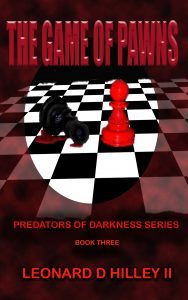
This book is in the series due to two of the characters introduced in The Game of Pawns (Book Three of the series). Boyd Grayson is a multibillionaire who works with genetics and scientific technology. With his vast fortune, he has begun his Mars project and settled an encampment in Olympus Mons. He’s far ahead of any other space exploration teams and for his investments, he’s reaping greater financial gains due to the discovery of a rare gem only found on Mars, the MarQuebes.
Grayson hires a genius early on, Steven Matthews, who becomes his nemesis. Both men are narcissists who loathe one another and their mental devious games are to outwit the other and take the prominent high seat (at least, to their thinking). The battle of scientific wits is gauged in The Game of Pawns. These two set the center stage for what occurs in The Deimos Virus.
The opening, however, introduces us to Dr. Frank Carter, who is the M.D. on the Deimos Moon Station where he contracts an alien virus and watches most all of the inhabitants succumb to the disease. Their deaths spark his resentment for Grayson on Earth and his need for vengeance. He’s the opening catalyst that sets the story into action. His dilemma is getting back to Earth to exact his revenge. To do so, he teams with two prisoners to steal a shuttle to return to Earth.
Carter’s introduction and dilemma wasn’t something I preplanned. He was a product of one of those days when I’m staring at a blank page and allowing my mind to drift, typing in a free-flow. Bit by bit, the opening chapter emerged. But this was years before The Game of Pawns was written, so the opening for The Deimos Virus evolved more so after finishing the third book in the series.
What’s after The Deimos Virus?
For the past two weeks, I did a thorough revision process for the novel and the characters evolved as well. I also went back to the original ending for the story, which leaves the possibility for several branch off novels, based on the characters in the book. I cannot divulge more information, as doing so would be considered major spoilers for those who’ve yet to read the novel. All I can say at this point is I’m working on the sixth book in the Predators of Darkness Series.
The digital Kindle copy of The Deimos Virus is currently on sale at $2.99 (438 pages) for the next two weeks.
Until next time…..
March 5, 2020
My Magical Money Shirt
When I was six years old, our grandparents were visiting from Ohio. I always loved when they visited, as we seldom got to spend a lot of time with them.
One evening, close to bedtime, I was in the living room watching television. My parents were seated on one couch, and my grandparents were seated on the other one.
Papaw said, “That shirt you’re wearing is a money shirt.”
I looked at the shirt with great curiosity. It was a plain green pullover T-shirt. Nothing fancy about it.
Obviously, noticing my confusion, he said, “That’s a money shirt. Do you know what a money shirt is?”
I shook my head.
“It has magical powers. Come here. Let me read the tag on the back.”
I walked to where he sat, and he turned me around and pulled up the tag. “Uh-huh. A money shirt.”
Something clanged on the floor. Several pennies rolled.
“Better grab ’em,” he said.
“Did you do that?” I asked.
He shook his head. “No. Those came from your shirt.”
I scooped up the pennies, and he stood. Without me noticing, he started dropping coins through my shirt and directed me to grab them. More pennies, some nickels and dimes, and then a few quarters. Change was all over the floor. Grandpa wasn’t as good with misdirection as Penn & Teller, but he was quick enough that I never saw what he was doing. It wasn’t too difficult for him to keep the charade going since I was so excited about getting all the money off the floor.
Apparently, my father got jealous about what he was doing, so he joined in, too. Both of them sat on their knees on the hardwood floor dropping money while I wasn’t looking. Then a dollar bill fell.
Papaw said, “You’d best hang on to that money shirt. It’s magic.”
My mind raced. I had another shirt designed like that one except it was red. I told them about it. “I bet it’s a money shirt, too,” I said. I ran to my bedroom and got the shirt from the closet. I eagerly presented it to him.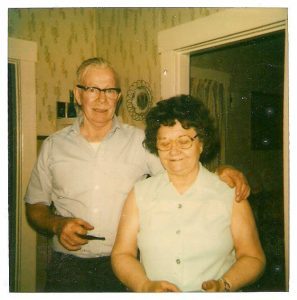
He and my father shook their heads. “Nope. I’m afraid it’s not one.”
I was disappointed. No more coins or dollar bills fell. I took all the money and put it in my bank and had to go to bed.
I never got to see my Grandma and Papaw as often as I’d liked, but fond memories of them have stuck with me all these years. Not a day passes that I don’t think of him, and he passed away in 1984. I truly hope my grandkids will remember all the games and experiences we’ve shared together later in their lives. Memories can be great treasures and time passes so quickly that we often don’t get to do all the things we planned to do.
Until next time ….
February 23, 2020
Never Stop Improving
“Never Stop Improving” has been Lowe’s slogan since 2011. Those three words are powerful, even outside of home improvement projects. This mantra should be something we strive to achieve each day in our personal lives. We should work to sharpen our skills and find ways to improve what we do.
Make today better than yesterday.
Any skill requires practice in order to master it. Whether arts or vocation or hobbies, one doesn’t simply become great at performing tasks overnight. Sometimes, in order to reach the stage of being a master, one must invest years of his/her life, working each day to improve. Of course, a small portion of the world is born having innate gifted talent or intellect that advances them far ahead of others at an earlier age. These prodigies, however, are the rare exceptions. But for those of us who start with good talent and want to become even better, we recognize that our skill has not yet reached its peak. We must continue to apply ourselves and research to discover ways for improvement.
For years, I jumped between various hobbies and educational goals that I loved with great enthusiasm and vigor. I learned, though, that I didn’t have enough time to equally invest in these pastime projects. I was unable to do justice to all of them. If I continued pursuing all of them, none would be greater than mediocre. I narrowed down my pursuits and focused on fewer projects. My one passion that has always dominated all the others? Writing.
Writing novels is my greatest passion. The majority of my other interests I set aside, so I could better focus on writing, world building, fleshing out characters, and developing plots. I’ve learned that’s how my mind is geared. Regardless of what early interests I’ve had, the zeal of following characters into their worlds through their ordeals and recording them in a book has only increased. But, I have to confess something. I didn’t choose to become a writer. The urge to write is ingrained in me. I’ve known this from the time I was ten years of age.
I would be a lesser person if I didn’t write. During some long periods of time when I’ve not been able to write due to outside constraints, I’ve been miserable. The same hasn’t been true for the other crafts I’ve chosen to leave behind. Although I enjoyed them, I’ve had no nudge to return to them. If I’m not writing, there’s a constant nudge and prodding for me to get back to work.
Does that mean I wasted my time with all the other hobbies I had? No, of course not. I learned a lot from research and practicing with those experiments. The knowledge I gleaned has been useful in many of my books and characters. Gained knowledge is never a liability. The more you learn, the broader your range for writing diverse characters and plots becomes. The absolute worst thing you can do with knowledge is waste it. Instead, find ways to apply it and always keep reading, keep learning. Study other authors, their techniques, and how they write prose and dialogue.
I invested years in insect collecting and butterfly/moth rearing. For over twenty years, I accumulated a large collection. I thought I wanted to become an entomologist or a botanist, because I love the natural sciences. I love science so much that I earned my B.S. in biology. Yet, the urge to write outweighed those goals, and my outlook gradually changed.
I was at a crossroads when I returned to college after a seven year hiatus. I was torn between majoring in biology and English. At the time, I had started my novel, Predators of Darkness, which dealt with genetic mutations. I needed to understand genetics and microbiology better than I already did, so I dedicated myself to finishing my degree in biology. I don’t regret that decision because the science in my novel(s) is/are fairly solid (other than occasional fictional aspects thrown in), and that helps strengthen the plausibility. Even now, I marvel at the advancements in medical science and technology. Our understanding continues to expand, especially in the micro aspects of biology. It’s truly remarkable where we are in the scientific world today, and almost daily, scientists are making new discoveries.
The whole time I worked on my B.S., I was still writing and trying to improve my craft. I read and studied a synonym dictionary. I learned the definitions and how to spell the list of possible words used for the MCAT; thus, broadening my vocabulary. I read volumes of writing technique books and magazines, as well as interviews with countless authors about their writing processes. I devoured as much information as I could because I wanted my writing to be as great as the top authors in the published world.
My writing has improved so much over the years, but I still desire to polish my writing style. I’m still working toward my mastery of the writing craft. I doubt I’ll ever be fully satisfied with my work, subconsciously thinking there’s room for making it better, but I will constantly strive to NEVER STOP IMPROVING.
Until next time …..
February 20, 2020
Throwback Thursday: Christmas Break 1985
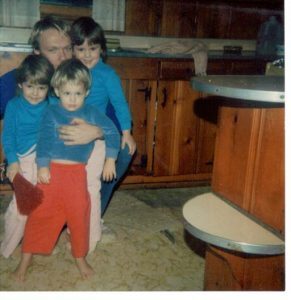 I was a college freshman at Berea College in 1985. One of the hardest things about being a student at Berea was moving two states away and leaving my twin sisters and little brother. I was fifteen years older than the twins and sixteen years older than my little brother. With the age differences, my sister Gina and I helped take care of them a lot, and sometimes, they were more like my children instead of siblings.
Only a few days after my enrollment at Berea, I found myself sorely missing them. I didn’t have any transportation to go and visit regularly. I did have the good fortune of getting to carpool at Thanksgiving and Christmas breaks with other students who lived in my home county.
Darryl Yates was a year ahead of myself and had graduated from Sylvania High School. He drove a Volkswagen Rabbit, which got great gas mileage and the price of gas at the time was $0.88/gallon. Jeff Cole, a friend that graduated from Plainview High School in ’85 with me, and Mike Morris, from Sylvania, were all bound for Alabama during Christmas Break.
The morning after finals surprised us. Several inches of snow covered the ground overnight, and when I looked out the dorm window to see this, I worried that our trip home would be delayed. Darryl shrugged it off and said that the Rabbit wouldn’t have any trouble. The Interstates would be clear. So we loaded up and headed south on I-75.
Right outside of London, Kentucky, I saw the billboard sign for the Dog Patch Trading Post. On our trips to Ohio to visit our grandparents when we were kids, our father always stopped. The store had various items that made good gifts, so I asked Darryl if he minded to stop there, so I could buy my family some presents for Christmas. He agreed, and we all went in. I bought several stuffed animals for my twin sisters and little brother, a cedar jewelry box for Gina, and something for my mother.
We probably spent a half hour in the store looking around, and when we were back on the road headed home, Darryl said, “I wish you’d have told me about that place earlier in the week. I already bought a lot of gifts, and I could’ve gotten better things there.”
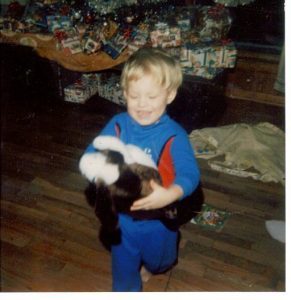 By the time we were near Knoxville, there was less snow, and none when we reached Alabama.
I hid the toys and gifts from everyone when I got home and had my mother wrap everyone’s gifts, except hers. Christmas was still more than a week away.
The twins and my little brother practically jumped on me when I entered the house. Their excitement made me realize that they missed me as much as I had missed them. They might have been small, but three against one still isn’t fair (as you can see in the picture).
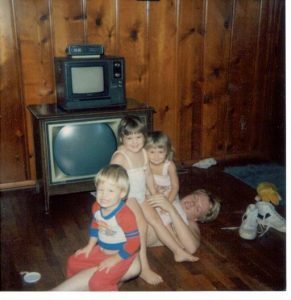
When Christmas break had ended, I had a harder time returning to Berea. I missed them more than ever. These memories are priceless, and I’m thankful to have the pictures reminding me of those days, in what seems so long ago.
Bittersweet memories.
Until next time ….
January 6, 2020
To See or Not to See?
While this might not be the most relevant question, if you’re writing mystery/suspense, this question plays a pivotal role in your story.
In 1998, during my senior year at Morehead State University, I took two creative writing courses as electives. We had a visiting professor that taught both classes while the tenured professor took a year off from teaching. Overall, the classes were entertaining and set up as a writer’s workshop.
Each week, designated students brought and handed out copies of their short story or a novel chapter to the class to read before the next class meeting when, as a class, we offered critiques of the work to the writer. The process was to help us see errors, story flaws, etc., and we did so in a civil matter.
During this time, I had been working on my first novel, Predators of Darkness: Aftermath. When my turn came to give copies of my work to the class, I brought the first chapter of this novel.
The novel’s mood and tone is dark and considered dystopian/horror. In the opening, the city is shrouded by a dense fog. No electricity. Lurking in the streets are genetically altered monsters. Due to the darkness and obscure nature of the drifting fog, there isn’t a clear view of the monsters (shifters). Their iridescent eyes are visible and their bloodcurdling chatters echo from the streets below.
Our professor said that I should detail what these creatures look like in the first chapter, which seemed his common point to everyone. All the pertinent information must be given in the first chapter. The reader needs to know, according to him.
I disagreed. Yet, he hammered his point that the reader must know.
Again, I shook my head and was adamant that doing so was the worst thing for the story.
“Why?” he asked.
My argument was simple. If I show you what these creatures looked like in the opening chapter, the suspense and fear that the reader has is gone. The reader needs to feel the fear and dread that the characters endure. By keeping the appearance of the shifters partly hidden, readers keep reading. Kill the mystery too soon, and the urgency to flip the next page lessens.
Of course, without having fleshed out characters the readers empathize with, the suspense is dead anyway.
He thought about my point and after a minute or so, he grinned and agreed. By the look in his eyes, he had an epiphany. His approach to the majority of the students’ work was to put it in the first chapter, but the first chapter only holds so much.
He had a novel that had just been released by Simon & Schuster, and the advice he had given was how he had written the story. Everything was given in the opening chapter. We knew what was going to happen before it occurred. I had bought a copy of his book at the early part of the semester and never got past the third chapter, mainly because all the information had been given up front. I couldn’t get invested in the chapters because the urge and mystery was not there.
In the early 70s, most of the crime shows on television began with a short preview that practically gave away the story, and I’ve never understood why they did that. Why tell the audience before hand? It kills the fun of trying to figure out who did what. So why bother watching? Perhaps they figured out their mistake because the majority of shows no longer do this.
One of the things I have learned over the years about writing mystery/suspense is to keep the reader guessing. Plot twists and turns are a great way to do this. Fear of the unknown or what’s going to happen lure people in. Placing lovable characters into dangerous situations pulls at the readers’ heartstrings.
To See or Not to See? Don’t give away too much information too soon.
Until next time ….
January 2, 2020
Weight Loss & Writing Full-time
A couple of years ago, I mentioned the dangers of a sedentary life as a writer (or anyone in general), and how I had developed a DVT in my lower left leg. That incident clearly has a strong chance of occurring to anyone who is sedentary and not active.
Most, if not the majority of full-time writers, spend hours seated while writing. Walking desks are good ways to avoid this as is the new desks where you can raise the work area and stand instead of being seated all the time.
But there are other dangers to avoid, too. For me, it was silent and steadily happening without me paying that much attention. Even though I kept active in the gym, going at least four times a week, I was gaining weight–a lot of weight, and ignoring the symptoms.
My self-denial was one of my worst enemies. When I mowed grass during the early spring, I struggled to push the mower for long periods of time on the level part of our yard. The hillsides, which are at forty-five degree angles, were far worse. After only a half hour of mowing, my chest was tight and I was gasping for air. I had to sit down on the back deck in the shade. Sweat rolled off me, and my chest ached. I feared a possible heart attack.
I kept telling myself that I was okay, and that going to the gym was keeping strong. Lawn mowing, however, forced me to think through my facade. I knew something wasn’t right.
My wife scheduled us doctor appointments in August for physicals and blood work. I went and we had a new doctor instead of our regular one. She asked pointed questions, and we were honest.
When they took my weight, I was astounded. I weighed 283 lbs, which was my highest weight. I should have never allowed myself to get that heavy. We had a scale in our bathroom, but to me, it was invisible (subconsciously). I was too close to 300 lbs. That was a problem I planned to correct.
I’m not sure what it is about getting older, but I often thought about my situation before we had our physicals. I knew I was too heavy, and I worried about what would happen if I passed out or fell later within the next few years. My wife and daughter couldn’t possibly move me. I’d be stuck on the floor until paramedics arrived. I needed to lose weight.
Another problem I suffered was my knees hurt all the time. I had a difficult time leaning over to tie my shoes. Squatting to pick something up was impossible. The pain in my knees was one of the most painful things I endured. I had no flexibility in my legs. My son kept telling me to stretch.
I went for a job interview and the bruise where they had taken my blood was on the inside of my left elbow. I got the job and found myself aching at the end of each work day, due to the concrete floors. I didn’t know how long I could endure it.
Our blood work came back, and my wife was in tears as she told me I was pre-diabetic. She worried that I was going to die. She didn’t want to lose me. She said that the doctor told her that I needed to lose weight. We both did. I nodded and said that I planned to, and I was serious about it. My target weight goal was 245 lbs. Losing weight required MORE than exercise. It meant changing our food habits.
I cut breads and potatoes. I increased my proteins and cut bad carbs. Each morning (5-6 days/week now) I started aerobics on the treadmill. We walked twenty minutes each day before we worked out. I drank more water. I ate more steamed vegetables.
With these changes and the amount of constant walking I did at my new job, the pounds melted away. By the end of December I had lost 35 lbs. I’m at 248 lbs. and I feel better than I have in years. My flexibility has returned. The last time I had mowed the lawn before the frost, I wasn’t tired or gasping for air. I can do squats without weights and without pain. I’m wearing pants I’ve not worn in three years. I have an adjustable belt that has had to have two sections cut off. Shirts that were too snug in August are now like tents on me.
What helped besides the doctor’s visit, changing my diet, and aerobic exercise? I started keeping a journal. I weigh each morning, write it down, and then after I work out, I write down what exercises we did at the gym. Keeping a daily track record keeps the goal in my head. It reminds me not to stray off the plan. Thirty-five pounds less is great.
However, I’m not finished. I’ve set a new goal to reach 225 lbs. I’ll post more later. We still need to do followup appointments with our doctor.
Until next time ….