Judith T. Lambert's Blog, page 2
October 28, 2016
On Top of the Great Pyramid
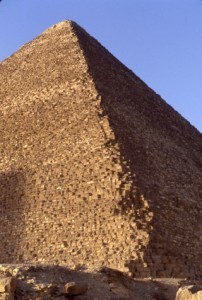
Not the side of the Great Pyramid we climbed! 1983
It’s been many years since this picture was taken and I am glad I found it. Blogging was the farthest thing from my mind back then. (Blogging hadn’t even been invented yet.) But now a whole new world exists and it’s time for me to blog! I’ve got a picture, not just a memory. I am tickled to have a handful of pictures that document my climb.
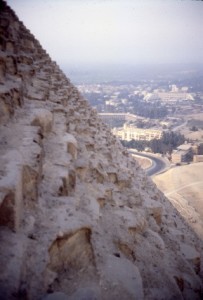
Part way up the Great Pyramid Cairo
It wasn’t Mount Everest but it was scary. My husband-to-be had to hoist me up the first minutes of our climb. I remember clinging for dear life to each block. I wanted my arms to turn into suction cups. We were exhilarated as we made it up to the top, but then we were shocked to see a German trio had beaten us and actually spent the night camping there. I remember being confounded on how they had gotten their equipment to the top. Conversely, I am completely blank on how we got down. The stones were only an arm’s length shorter than me.
When we finally descended, the guards who had waited patiently for more than an hour chased us. Half the fun was knowing we would be badgered to pay baksheesh, or bribe money, in return for our getting away with our mischief. Of course there were signs posted: It Is Illegal to Climb the Pyramids. But people who arrived before the sun rose, could get their start before an audience of guards awoke.
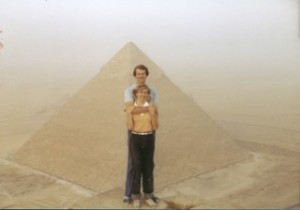
At the top 1983
That doesn’t go on anymore, I imagine, and probably for good reason, as some people used to fall and die each year. Supposedly, there is only one edge of the pyramid that’s good for climbing. How we learned which side to take is still a mystery but I think it was through word of mouth. But we made it, and in doing so I got a great picture and a memorable experience.
The post On Top of the Great Pyramid appeared first on Judith Lambert Books.


October 2, 2016
A Symbolist View of the Egyptian Ankh
In my blog titled Is Akhenaten’s Image of the Sun E=mc2 Written in Stone? and in Chapters 3 and 9 in The Light, I had a wonderful time exploring the deeper meaning of Akhenaten’s sun disk. I have now turned my attention toward the fabled ankh. The Egyptian ankh has miraculously made the jump from antiquity into our modern mindset. Most people are familiar with this ubiquitous symbol simply referred to as, the Key of Life. I couldn’t perceive why we called it this. Just looking at it, I didn’t see “life” per se. Was it given this name simply because it was often held by the Egyptian Gods or seen being fed to mere mortals?
While in Egypt, I often gazed without comprehension or connection at the ankh on statues, in pharaoh’s tombs, or chiseled into stones. I decided to try and dissect the ankh the same way I had looked at Akhenaten’s sun. There was the round loop, the side arms, and finally the long shaft. The symbol of life wasn’t giving up any secrets easily. I thought to myself…how and why do they get “life” out of this symbol? I was stymied. Some explanations equated it with the crosses of Christianity. I could see the jump. As I continued looking at the ankh from a symbolist view, things changed. I have John Anthony West and R.A. Schwaller de Lubicz, the pioneers in the “Symbolist” school of Egyptology, to thank for their contributions.
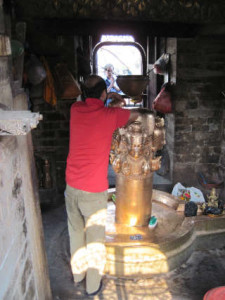
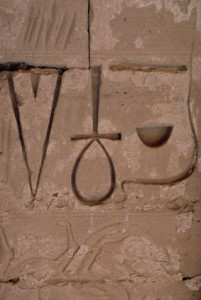 Holding a souvenir metal ankh from my travels, I rolled it in my hand as I mentally fiddled with it. I accidently turned it upside down. Looking at it in this way caused me to reflect on the Vedic lingam and yoni that I had seen in Indian temples. Could it be that perhaps the ancient Egyptian ankh is an inverted lingam and yoni taken from the Vedic religion of India? Could a mystical idea such as this traveled in antiquity? The ankh is never portrayed in an upside down fashion in Egypt of course, but when you do invert it, the connection to a lingam and yoni becomes clearly visible. I wondered if the Key of Life was an adaptation? Or maybe it was the ankh that had been adapted by the Indians.
Either way that connection would indeed make the ankh the symbol of life. For the yoni and lingam of India is the sacred concept of male and female cosmic principles. Looking at the ankh…the round loop is the yoni, the central staff the lingam, and the middle bars are where they meet and the trough between them. Eureka…I could see where the mystical feminine and masculine components were found within the image of the ankh.
 Take a look at the upside down ankh next to a lingam and yoni and decide for yourself if there isn’t perhaps a visual and symbolist connection between the two. I think it’s fascinating to consider the possibility of mystical knowledge traveling between civilizations in a long ago age.
* I offer my thanks to John Anthony West and R.A. Schwaller de Lubicz for their groundbreaking research. Their symbolist theory allowed me to comprehend the nature of symbols differently.
The post A Symbolist View of the Egyptian Ankh appeared first on Judith Lambert Books.
September 24, 2016
The Golden Rosaries of Medjugorje, Part 2
Okay, here’s my second comment on rosaries that turn to gold. And here is another photo of the rosary that so impressed me.
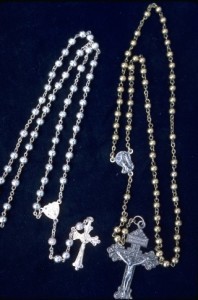
Comparison photo of the changed rosary to my newly bought rosary
After our first journey and the magnificent changes in other people’s rosaries, I began a personal investigation to find out if this kind of thing was happening all over town. I asked everywhere and anyone I met. My newfound mission and I became obnoxious. I spent my days wondering how rosaries could possibly turn to gold and what might cause that kind of change. I became obsessed with the outward phenomena.
Then I decided I wanted my own rosary to change to gold. (See my newly purchased silver rosary next to Elena’s family rosary that changed in Medjugorje from silver to a golden color.) I had bought one at the shop by this time, even though I didn’t know how to use it, nor did it mean much to me. Not being raised Catholic; it wasn’t something I thought I actually needed.
In the beginning, it was a trapping that I became fixated on. One day, someone said to me that the golden rosaries were an outer manifestation of what was occurring in a person’s heart. Sort of outer meets inner. After that, I became less obsessed with finding rosaries and less impatient for my own to change. Slowly I matured and moved toward focusing on the internal gifts I was receiving.
Chasing rosaries and phenomena doesn’t entice me like it once did. Finally, over time, I have settled down into a routine of practice and prayer. I am no longer a person impatient for visible results.
The post The Golden Rosaries of Medjugorje, Part 2 appeared first on Judith Lambert Books.
September 20, 2016
The Golden Rosaries of Medjugorje, Part 1
“Rosaries turn to gold, the sun spins in the sky, and sometimes you are healed.” (From: A Mother Goddess for Our Times: Mary’s Appearances at Medjugorje)
I saw so many incredible things happen. Many were external, like the rosary photo shown here. Sometimes I would see a bleeding crucifix or a weeping statue. The sun spins everyday and is safe to look at. It’s especially easy to see as the late afternoon nears. But the changing of silver to gold really occurs in our heart. That’s the most important change taking place in Medjugorje.
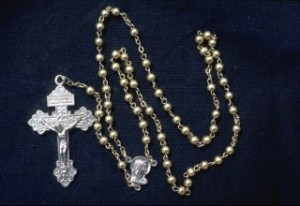
The rosary that changed
As I write this, a feeling of longing to go back to Medjugorje sweeps over me. I miss Medjugorje and what it did for me. I grew so much during my visits there. I was able to retreat from myself and lose myself in the magic of the place. Medjugorje creates enough space to enter another world. The picture is an untouched photo of what once was a sterling silver rosary. Elena brought this rosary with her to Medjugorje on her first visit. I met Elena by happenstance when she traveled with our group from Saudi Arabia. Medjugorje was a difficult place to travel to or find lodging in during the early days of the apparitions. Villagers opened up their spare rooms for rent and meals were served around the family table. Elena told me this was her family’s rosary and that it was given to her to bring on the trip. The rosary was old and she came from a pious family. I saw it—sterling silver one day, and the next day it was gold. I kid you not. Her rosary became exactly as you see it in this un-retouched picture I took, except for one solitary bead (medallion and crucifix) that remained silver. Our group was astonished and I was filled with utter disbelief and challenge at the time. It was quite a first journey for me and my amazement remains to this day.
And why would I put this forward? It sounds preposterous even as I write. But it’s what happened. The magnitude of this phenomenon and more remains a mystery that forever coaxes me back to Medjugorje.
The post The Golden Rosaries of Medjugorje, Part 1 appeared first on Judith Lambert Books.
September 12, 2016
Is Akhenaten’s Image of the Sun E=mc2 Written in Stone?
As I write this, the world waits to find out if the chambers behind the walls in King Tutankhamen’s tomb in Luxor, Egypt, will be opened. If they are, our knowledge of the Amarna period could substantially increase. This means today is a perfect time for me to write about the iconic sun disk of Akhenaten, King Tut’s father. I’ve been perplexed by this particular image of the sun, especially familiar to us since the discovery of the royal throne in Tut’s tomb in 1922 by Howard Carter. That image has mesmerized and baffled us for nearly a century.
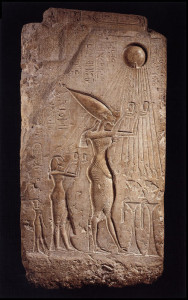 My favorite time in history has to be the Amarna period. Its art and artifacts, its beliefs, ideas, and ideals all fascinate me. I’ve often wondered what the pharaoh’s larger message to the world may have been. I spent a whole chapter discussing Akhenaten’s gift to us in my book, The Light: A Modern-Day Journey for Peace, where I came to the conclusion that Akhenaten’s sun disk may not be just some haphazard image. In my opinion, it might be a precisely calculated image rendered to impart knowledge. Its objective could be to disseminate a spiritual revelation through imagery, as this was a primary modality for the time in which Akhenaten lived.
With the idea of this precise image in mind, I attempted to decipher what Akhenaten’s sun disk might be telling us beyond what we already know. As I looked in awe at this image of the sun, I began by breaking the image down into its components, as if I were trying to read it using words. The sun, for me, became simply energy. The branching rays were a pathway. The hands (a few holding ankhs) became the material world, or perhaps solid matter. And of course the ankh meant life. Putting the image back together, I came to three possible conclusions for what this mystifying image might be telling us.
1) It represents Light as the highest principal. The information is purely spiritual. In printed reproductions, the rays terminate in tiny hands, and you can see there are also hands that feed life (the ankhs) to the pharaoh and his wife, Queen Nefertiti. Written in words, the essential message perhaps being something like God is Light that feeds or gives us life.
Other scholars, like Sigmund Freud, have posited that Akhenaten’s sun disk represents the worship of a singular god—one without imagery—thus making Akhenaten the first monotheist.
2) Akhenaten may have used the image to describe photosynthesis. With today’s high-powered magnification techniques, we have a better understanding exactly how plants use sunlight directly to create food, and thus life and physical matter. Because Akhenaten drew the sun’s disk with its rays terminating in hands could indicate that he understood photosynthesis and/or wanted to communicate an idea akin to photosynthesis.
Akhenaten’s declarations, observances, and love of nature perhaps support this. Written in words, he might have been saying Light makes matter and Light creates life.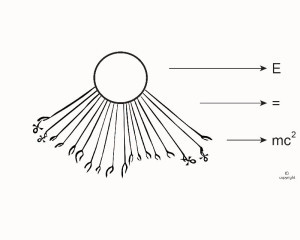
3) Albeit a more farfetched interpretation is that Akhenaten’s image correlates with Einstein’s theory of relativity or E = mc2. Who hasn’t pondered Einstein’s theory? Even schoolchildren have heard of it. Admittedly, I am not a physicist, so I don’t claim more than a rudimentary understanding of his sophisticated equation, but even so, I tried applying the equation to Akhenaten’s iconic image. Does it fit? Well, maybe. Akhenaten’s Sun becomes Einstein’s E. Akhenaten’s rays are Einstein’s = sign. Akhenaten’s hands become Einstein’s m, or mass. Finally, the speed c is accounted for by the intrinsic nature of the rays themselves; thus the rays represent the speed of light, which is required by the equation.*
Neither I nor anyone else knows for sure the precise message Akhenaten was communicating in his perplexing image. These are a few observations that came to mind as I studied the pharaoh and his unusual portrayal of the sun disk. What I do believe is that Akhenaten’s image is neither meaningless nor happenstance. It was purposefully conceived, and perhaps we should more deeply consider what this image is offering us and not simply take it at face value or as a caricature of the sun.
With barriers in our understanding falling, our time has the ability to recognize that science and religion can form partnership at a certain level. Perhaps re-considering Akhenaten’s genius facilitates the process of grasping where they meet.
*I would like to thank John Anthony West and R. A. Schwaller de Lubicz (now deceased) for their groundbreaking work on symbolist theory. Their teachings led me to these insights and to my ability to apply a symbolist viewpoint to the iconic image of Akhenaten’s sun disk.
The post Is Akhenaten’s Image of the Sun E=mc2 Written in Stone? appeared first on Judith Lambert Books.
May 30, 2016
Moses and Monotheism: What Does God Look Like?
I’m in Egypt and in such heavy thought that I’m hardly noticing things around me. I’ve been reading a book by Sigmund Freud titled Moses and Monotheism. And I’m wondering, didn’t we discredit and debunk Freud’s theories some time ago? Should I really take Freud seriously?
But it is a remarkable book. I read it twice. Even though I can’t put my finger on why Freud’s book has me so stymied, nevertheless, I know there’s something important for me to figure out from this manuscript. It’s a book that’s been largely forgotten; yet it’s become a catalyst for me and has ignited a fire within me. I sense that Freud has hold of something significant and he’s trying, gropingly, urgently, repetitively, to tell us what it is. But his words leave a lot unanswered.
His book seems to express his own inner quandary, too. It’s his ruminations. And it’s as if I’m investigating with him. When I read it, I sense I’m looking straight into Freud’s mind, as he seems to be on the edge of some great discovery. I can see that, and I can also see how his ideas are groundbreaking. Moses and Monotheism has me perplexed and spellbound at the same time. But I think there’s something murky and incomplete in Freud’s grappling.
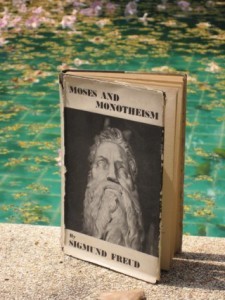
My first edition of Moses and Monotheism
Freud’s writing has spurred my own thoughts, which are now wildly percolating. They rise in bursts of insight. Moses and Akhenaton. Who were they? Who were they together? Who were they apart? Did they know each other? Was it necessary, as Freud trumpets, for them to have known one another? Or did they know only of each other’s special talents?
My thoughts turn to high religion. Can spiritual talent be handed down? What was really going on with these two very famous men? I had to know what they were trying to tell us? Better yet, what was it they were trying to show us? That’s when the epiphany hit me; when my mind moved to pictures. Theirs wasn’t just a God of words! They had a visible, tangible God. They both showed us that God is Light! I had it! Moses: the burning bush, the pillar of smoke by day and fire by night, the glowing Ark of the Covenant. Akhenaten: his obsession with the solar orb, its rays ending in tiny hands. Light. The Light. The Light of my dream, and what I believed must be the Light of the near-death experience, too. That was it! The connection was clear to me now. Akhenaton and Moses were Masters of the Light.
I had my third chapter. After days of brooding, it came flooding in, all at once, washing over me like a revelation. I felt it to the core of my being, a profound knowing. Moses and Akhenaten had been trying to show us what God looked like. It didn’t matter if they knew each other or not. High-adept religious practices might have been passed down because there was only a hundred years or so between them, and possibly less if you believed Freud. My book was coming together. For me, this insight offered up a weighty piece to the puzzle. It was an important component and would become the glue of my search—the pivotal point in my book.
Note: This isn’t the copy of Moses and Monotheism I originally brought with me to Egypt. It’s a first edition purchased much later for about $90. To find an affordable first edition of Freud’s work was thrilling and the book remains a personal treasure.
Here’s a link to buy Freud’s book:
Moses and Monotheism-Sigmund-Freud
The post Moses and Monotheism: What Does God Look Like? appeared first on Judith Lambert Books.
May 27, 2016
The Cowgirl on the Giza Plateau
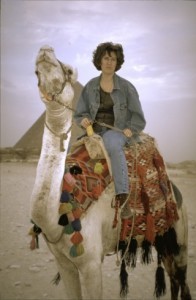
Me not smiling at the Great Pyramid
The Giza Plateau is where my quest began. Well, not this exact spot, but the pyramids are right up there. First of all (and off topic a bit), like most tourists, I’m trying to fathom what in the heck this building behind me is all about. My husband, John, takes the photo. It’s supposed to be the photo for my book cover…for the book I hope to write. We have neither tripod nor technique. Almost everything we do is by the seat of our pants; Egypt seems to lend itself (almost conspiratorially) to our project.
So this picture is one of those quickly taken ones. I had a great idea and hoped it would work. A one-off thing we’ve all tried. As hokey as it now sounds, when we took that photo, I wanted the sun to be just over my shoulder and coming out the top of the pyramid. But the day turned overcast and gloomy. “It’s hardly ever like this in Cairo,” I complained. We had time for just a couple photos because a sandstorm had suddenly whipped up. The Giza Plateau was nearly empty by 6 P.M. and time for the camels to head home for their evening meal when we got the picture.
“Just get the picture! I need this for the cover!”
“Smile,” my husband replied.
“But I don’t feel like smiling. This is supposed to be a serious cover. Take the photo!” We could both see a nasty storm building. ”We’ve got to go!”
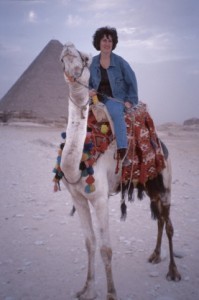
My husband’s better shot
All the while, I was thinking about the ancient religions of Egypt. What was the meaning of the Great Pyramid? It’s so impressive; it’s got to be something more than a tomb. “The millennium is soon to arrive,” I was telling myself, “and with it, maybe a time for understanding between religions? But how does one put that together?”
By that time, we’d taken exactly two pictures. One of me with a smile, the other without. The camels were on a fast trot toward home and my eyes were squinting as the wind and sand began to sting. The Giza Plateau was startlingly empty, except for our silhouetted figures against the ruddy sky. We were late and the last tourists to reach the camels’ stables. It was an exhilarating ride on the windswept plain of Giza. The sky turned a dusty beige-rouge, and I could hardly see because sand was blowing everywhere, and stuck especially between my eyelashes and my teeth. But we were invigorated and laughing.
Our camels scurried off to their evening meal. And me, I was truly amazed by the many things that Egypt ignites, fascinating my mind and my soul.
P.S. The shot of me smiling turned out much better…my husband was right!
The post The Cowgirl on the Giza Plateau appeared first on Judith Lambert Books.