
Lijia Zhang's Blog, page 36
December 27, 2017
Nestorian Church
In the middle ages, Famagusta, in Northern Cyprus, became an important trading port, therefore a cosmopolitan city, populated by French, Italian, Greek, Syrian, Armenians and other merchants. The churches in the city reflected such multicultural co-existence.
One of the churches – rather, the remains of it, is a Nestorian Church.
Known at The Church of the East, it was an Eastern Christian Church in the Persia Empire.
Intrigued, I looked into it and learnt that it is called 景教。Itemphasizes a distinction between the human and divine natures of the divine person, Jesus.It was first introduced to China in the 7th century and became rather popular in Chang’an (today’s Xian). It was most likely the first Christianity that entered China. So popular, churches were constructed throughout China. They were called 十字寺,’temple with a cross’。
Now I remember there’s a ‘shi zi si’ in Nanjing!
The picture shows the damaged Nestorian Church in Famagusta.


December 21, 2017


December 20, 2017


December 13, 2017


December 8, 2017
Lotus on NPR’s great read list
I am thrilled that Lotus is featured in NPR’s great reads guide in 2017!
https://apps.npr.org/best-books-2017/#/tag/tales-from-around-the-world


November 30, 2017


November 22, 2017


November 12, 2017
social commentary
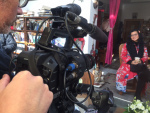
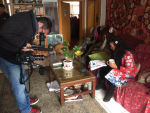
On sunday, I spent hours being interviewed by an Australian TV crew, about marriage/wedding ceremony in China and its significance in Chinese cultural context. For me, I enjoy such interviews. Apart from the attention, they serve as mental tease. Besides, I love to share what I know about the Chinese culture with broad audience.


November 6, 2017
Hk literature festival
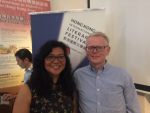
In HK, enjoying the literature festival. My session on my novel Lotus was moderated by the fabulous and erudite Ian Johnson. Of course it went well. Yesterday I gave a talk to an international school about gender issue. Last night, a dinner (people paying to have dinner with me) was organized for me by Young China Watchers, attended by mostly journalists and diplomats. To my great relief, it also went well. Now I only have a lecture at HK Baptist University about writing/literature.


October 30, 2017
journalism Vs fiction
My last session (and one of the last sessions of the festival in Ubud) was about the relationship between journalism and fiction with Australian lawyer/surfer turned writer Jock Serong, Portuguese poet Anna Weidenhoizer and Indonesian journalist and writer Muhammad Subhan. Every panelist has written both fiction and non-fiction. It was brilliantly moderated by Australian journalist Rosemarie Wilsom, a big reader of both fiction and non-fiction.
I thought that, given it was late and audience felt hot and tired, there might not be enough people. To my delightful surprise, there was a sizeable crowd, though not as big as the session with Jung Chang, of course.
It went really well!
Below are some of the points I made.
Journalism and fiction cover a lot of common ground. There’s little wonder that some successful writers come from journalistic background, Mark Twin, Ernest Hemingway, Joan Didion, to name just a few.
Some journalists got into the profession because they love writing. Then some find journalism frustrating and limiting. There’s a fundamental difference between the two: one is pure imagination and the other pure documentation. In journalism, you have to stick to what has actually happened. You can’t allow your imagination go wild. That’s a major restriction for some literary minded journalists. That was why in the 60s the so-called ‘New Journalism’ was launched in US where journalists generously borrowed techniques commonly used in faction writing, setting the scenes, good conversation, sense of suspense, character development. One good example is in Cold Blood by Truman Capote.
I’d like to think that I’ve become a slightly better writer after spending years in completing the novel and I hope I can better apply the fictional techniques I’ve learnt in my future non-fiction books.



![[image error]](https://lijiazhang.files.wordpress.com/2017/12/img_1294.jpg)
![[image error]](https://lijiazhang.files.wordpress.com/2017/10/img_0931.jpg)