Lijia Zhang's Blog, page 22
July 29, 2022
lasswho
I am thrilled to have joined Lasswho, which connects fans with their heroes and other inspiring people for live video chats.
Here’s my profile.


July 14, 2022
My Caucasus adventure
My Caucasus Adventure
Finally, this will be my last dispatch from the Caucasus.
I hesitated to use the world ‘adventure’, because it suggests something daring and even dangerous. But there’s nothing really dangerous about travelling in Georgia and Armenia. Sure, these are far-flung places, off the beaten tracks, and in close proximity to Russia. I started out by taking a hiking trip organized by a walking group in London. Since the war in Ukraine broke out, five people had dropped out, fearing it was too close to Russia, therefore dangerous. In my view, they were far too cautious or they were not well informed enough.
Another element of adventurous travel is certainly level of uncertainty. In many ways, there’ are fewer and fewer adventures left in the world these days.
A few months ago while travelling on my own in Morocco, I saw a large bus carrying a herd of American tourists turned up at the Roman ruins outside Meknes, bearing the sign ‘Morocco Adventure’. I just laughed: being herded around in a bus can’t be qualified as an ‘adventure’.
I enormously enjoyed my recent trip to the Caucasus because it felt like a proper travel with some measure of uncertainty.
Example one, the night train. I always have a romantic notion about long train journeys. So I took the overnight train from Tbilisi to Yerevan, leaving the Georgian capital at 8.30 pm and arriving at 7 am at the capital of Armenia. It didn’t quite work out well – too much waiting/farting around at both the Georgian and Armenia borders. Worse still, the train conductor barged into our carriage and forced us to get up because he needed to take the sheets, two hours before our scheduled arrival! Then again, I expected that things might go wrong when you travel in a less developed region.
I loved my little adventure from Kutaisi to Gori. There is only one day time train from Kutaisi to Gori, which arrives in the late afternoon – too late to visit the Stalin museum. So I took a minivan from Kutaisi heading to the capital and asked to be dropped off on the highway close to Gori.
When I walked down from the highway and got onto the road that leads to Gori, I couldn’t find any taxi – not surprisingly, it was in the middle of the no-where. So I decided to hitchhike. Before long, a middle aged Georgian man stopped, looking at me curiously: there are not many Asian people in Georgia and fewer Asian hitchhikers. Delighted in using my pigeon Russian, I explained that I needed to go to the Stalin Museum, but he said he was not going to the city center. I suddenly remembered how to say ‘bus station’ in Russian, even though I had no idea where the station was. So I shouted the word. He understood me, smiled and gestured me to get on. In ten minutes, we turned up at the local bus station, where I found a taxi.
When I told a neighbor about this, she said: “Hitchhike? Haven’t you heard stories of single women getting adducted and killed while attempting to get a lift?”
“But Georgia is the safest country in the world,” I replied. Our tour guide and every Georgian I met told me so. I later checked and found that according to one survey, Georgia is ranked the fourth safest place in the world, after Qutar, Taiwan, and United Arab Emirates, and the safest place in Europe. Even if the crime rate in Georgia were higher, I would still try to hitchhike. Just a small risk to run. When travelling, I am as happy as a pig in shit.
One important reason that I loved my Caucasus trip so much was I had been fortunate enough to be introduced to so many interesting people, writers, journalists, historians and artists who each helped me to understand this fascinating region, steeped in history.
I spent one particularly memorable evening with two Georgian friends of a friend. I had met Tini, a very sweet and intelligent Georgian girl in Beijing a few years ago. She was so happy and enthusiastic when I told her that I intended to visit her country, as if it were a personal favour to her. When I turned up in Tbilisi in middle June, Tini happened to be away in Germany, but she put me in touch with two of her friends. Since they were ‘global-minded’ and English-speaking, I presumed that they were youngish people. They turned up two oldies – both relatives of Tini. And they are utterly charming.
One of them is Giorgi, a semi-retired engineer who is well into his 60’s and the other is Merab, a fully retired doctor, a brain surgeon, who used to run his own practice. We met at the latter’s elegant flat, decorated by his fantastic photos – Merab is also a keen amateur photographer as well as a global trotter.
We started the conversation politely and gingerly. Soon I discovered that we had plenty to talk about. To start with, they had been briefed about me, and Giorgi also read every article I had written that he could find online. You can imagine how this made me happy – I didn’t expect a fan club in Tbilisi! Partly because of Tini, they are more interested in China than the average Georgian. Merab, an old bachelor, is paying for his brother’s children to take private Chinese lessons because China, in his view, will soon become the number one power in the world. Being well-educated old fashioned gentlemen, they had read Chinese classics such as The Dream of Red Manson and The Water Margin. Regarding myself, having grown up in China, I know quite a bit about Russian/Soviet. I read lots of classic Russian literary works as well as Soviet ones. They laughed when I told them that one book that had made a big impact in my life was How Steel Was Tempered, a classic socialist realistic novel. Of course, they had also read it at school.
By the end of the evening, we were laughing and joking away, as if we were old friends. We talked everything and anything, Georgians’ burning desire to join the EU, their fear of Russia’s further aggression and their hopes for the future.
When I asked them about their view of Stalin, Merab shook his head violently. He told me that he had come from a prominent intellectual family and several of them had been persecuted. He then took out of his family album, showed me their photos and explained their life stories. I learned a lot on this evening and laughed a lot.
It is an evening such as this one that inspires me to travel. (The first photo shows me with my delightful Georgian companions.)
July 11, 2022
Stalins underground printing workshop
Stalin’s Underground Printing Workshop
In Tbilisi, the capital of Georgia, there was an underground printing workshop. In those inter-connected underground tunnels, Stalin and his revolutionary colleagues printed revolutionary magazines and pamphlets, calling to overthrown the Tsar.
I heard about this place from my friend Wei. He, in turned, had read about it in a Chinese textbook. When he and his lovely wife Karin visited Tbilisi some dozen of years ago, they visited the workshop, now a house museum. He was pleased to find it matching what he had read as a child in an article written by renowned Chinese wrier Mao Dun.
While I was in Tbilisi recently, I made a point of visiting it. When I turned up, the old caretaker, pushing 80, was watching some film on his tiny black and white TV. The museum is now run by the Georgian Communist Party. Without any financial help from the state, the house museum has been crumbling. When the caretaker is not in the mood, he sometimes doesn’t bother to open it; but if any visitor shows any interest, he will bombard you with information he knows, so I had heard.
Upon learning I am a Chinese, the old man’s eyes lit up – nearly half of the visitors come from China.
He led me to the printing machine, a German beauty. It was smuggled into Georgia in pieces through a network of underground revolutionaries. Then he took me to see the 15 meter-deep dry well and the inter-connected tunnels – from where the revolutionaries operated. Meanwhile, two women looked out from a little house and would send signals when police approached. The caretaker is obviously a dye-hard Communist who looks back at the revolutionary through rose-tinted lens and I had his lavish attention – well, I was the only visitor on that morning.
For three years from 1904 to 1906, Stalin and his colleagues churned out thousands of pamphlets. After the police discovered it, they filled out the well and the tunnels and the operation stopped.
After Stalin came to power, the underground printing press was restored to its original state.
Before I left, the caretaker insisted that I wrote something in the visitor’s book. Sure enough, plenty of Chinese characters crawled all over it. As I sat there, thinking what to say, he showed me a Chinese textbook which includes the Mao Dun article that had inspired my friend Wei. Finally, I scribbled: remember history, and reflect history. Thank you Wei and Karin for the tip. I greatly enjoyed the visit.
July 9, 2022
Nobel Laureate be attacked by patriotic troll
Here’s the link to my latest oped about the worrying trend of the so-called ‘patriotic trolls’ attacking writers. Patriotism has become a cheapened weapon in China. If you don’t like your opponent, you accuse them as ‘pro-west’ or even ‘hanjian’ – traitor! I worry about the literary scene in China.
July 7, 2022
7 July, 2022 20:14
Stalin’s Museum In his Hometown
Funny that I should write a dispatch from Georgia one week after I have returned home. While travelling, I was too busy exploring and meeting all sorts of interesting people that I hardly had time to write any FB posts. But some of those experiences/stories are worth-telling. In any case, writing those posts here are my way to keep a record of my life.
Today I want to talk about the Stalin Museum in Gori, his hometown in eastern Georgia. I wanted to visit the place partly because I am reading an interesting biography of the Soviet dictator Stalin: Passenger to Revolution. Gori wasn’t very easy to get to but I was glad to have made the effort.
This museum is regarded as one of the most interesting museums in the country. Constructed in 1957, a few years of his death, it radiates more than a whiff of religious air. As I walked up the carpeted stairs to the main exhibition hall, I felt like entering a tall temple, dedicated to him.
The exhibition charts his remarkable rise from a poor shoemaker’s son to one of the most powerful men in the 20th century, detailing his childhood, his early revolutionary activities, brief mentioning of his personal lives and his friendship with Lenin. Among his birthday presents on display, quite a few of them came from the Chinese leaders.
I noticed with interest that the museum does avoid the purges and his gulags where millions of people lost their lives. It even mentions one sickening detail: the family of the executed prisoners had to pay for the cost of the bullet.
After I finished the visit, I lingered to chat with the staff in my broken Russian. I wanted to find out how people from his hometown regarded Stalin today. All thumbs went up. “Great leader!” “Hero!” They were impressed that I knew Stalin’s nickname as ‘Soso’ and his family name was ‘Jughashivili’, so much so, one woman grabbed some keys and beckoned me to follow her.
It was then that I realized that the museum has other parts, beside the main building. There is Stalin’s parental home, a humble wooden hut, which is now enshrined in a Greco-Roman style pavilion. It is usually locked. There’s also his personal railway carriage – he was afraid of flying and always travelled by train – in his personal carriage.
Later, I met a young tour guide, shepherding a bored German couple. She let the couple wander on their own and explained to me that most people in Gori still feel very proud of him, especially the older generations, some of who feel nostalgic about the good old Soviet days, but the young and educated people don’t care about him and even dislike him.
The Stalin Museum is a popular tourist attraction. Bus loads of people from all over Georgia and beyond come to visit.
I wonder most of the visitors are like me – driven by curiosity rather than admiration.
July 1, 2022
Armenia genocide
Talking about Armenia, one has to mention the Armenia Genocide, which was the systematic destruction of the Armenia people and their identity by the Ottoman Empire during the First World War, including the forced deportation and massacres.
On my last day in the country, I visited the Armenia Genocide Memorial and Museum on the northern outskirt of Yerevan. I found it a moving experience.
The museum itself is housed in a grey underground bunker where large photographs with texts tell the harrowing story of the genocide, which saw up to 1.5 Armenians being killed. A wide concrete path leads to the memorial, which consists a 40 meter-high spire, next to a circular structure where 12 slabs, representing the 12 lost regions in western Armenia, hunching over a permanent flame on the ground.
All the while, a haunting piece of opera is playing. The atmosphere is somber and moving.
An Armenia cross-stone, commemorating the 1988 Sumqayit massacre in Azerbaijan, stands nearby. The relationship between the two Caucasus countries, both former Soviet states, has been tense. They fought a war in 2020 over the mountainous Nagorno-Karabakh, a region inhabited mostly by the Armenians but within the Azerbaijan territory.
Close to the entrance there is a row of trees planted by foreign leaders who recognized the Armenia genocide. Turkey still refuses to admit it.
Standing outside the museum, one can see the snow caped Mt. Ararat, a symbol of Armenia, but Turkey took control of it during the Turkish-Armenia War in 1920.
Armenia is a country traumatized by its past and still facing enormous challenges, particularly over its security, but it has survived so far and is trying to soldier on. And it is certainly a country well-worth a visit.
June 20, 2022
Pro Europe rally in Tbilisi
People Mountain, people Sea. That was the Chinese phrase that came to my mind tonight as I took part in a mass pro-Europe rally in the heart of Tbilisi.
Tonight, thousands of Georgians gathered in front of the Parliament, appealing to the council of European Union, which will decide on the country’s EU bid in a few days. People waved Georgian flags and held placard that read “We are Europeans”. Politicians and representatives from all walks of life gave impassioned speeches, declaring Georgia as one of the oldest European nations and expressing their willingness to throw their lot with the EU.
A few days ago, the European Commission recommended candidate status for Ukraine and Moldova, but not Georgia, to the dismay of the locals.
Plenty of Georgians are also not happy with their government’s stance on the Ukraine war. Although people here are sympathetic to the Ukrainians and angry with Russia, which still occupies 20% of their territory, the government has been careful not to upset its powerful northern neighbor too much. It has not joined the sanction against Russia.
As the rally reached its climax, Beethoven’s ‘Ode to Joy’, the European Union’s official anthem, was played through loud speakers. People sang along, waving their mobile phones, with the flash on. It was a touching sight.
The rally might not change the mind of the Council of the EU, but it is important to get their voice heard.
June 4, 2022
May 19, 2022
The British Library
I was invited to take part in the Slow Café event at the British Library this Tuesday, in conjunction with its ‘Breaking the News’ exhibition. I am pleased to report that it went well. Plenty of people turned up: friends, those who are interested in the current affairs and perhaps those attracted by free coffee?
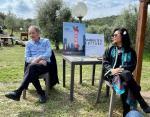
I am only too happy to meet other impressive panelists: Afghanistan journalist Shazia, Jonathan Cohen, the director of Conciliation Resources. Our session was skillfully moderated by Giles Whittell, a senior editor with Tortoise Media group and a veteran correspondent with the Times of London. Interestingly, I have mutual friends with all three of them.
Indeed, friends are the one that make the world beautiful. Thank you Kelly, Cathy, Ali and Jonathan, for coming along!
May 8, 2022
A working party in Tuscany
I’ve just returned to London after three weeks in Italy. Loved every bit of it. The highlight, though, was a gathering at an eco-farm in Tuscany, organized by Pio, a renowned Italian journalist. I had met him when he interviewed me after my memoir was published in Italy.
Some six weeks ago, when Pio invited me to join him at a big ‘working party’ at the farm, I immediately said yes – of course, I never want to miss a trick. Also I only saw ‘party’ but not the word ‘working’ before it.
It took place over the May Day weekend. Upon arriving at the farm on Friday evening, Pio casually told me: “You are going to give a talk tomorrow. Everyone is looking forward to it.” “Oh, really?” I said. “What should I talk about?” “You, China, whatever you like.”
So over the breakfast the next day, I scribbled out some notes to form a coherent ‘China Story’, my life story, the changes that have taken place in China and the challenges it is facing: Covid, Ukraine crisis, the conflict with the US, ect.
It went well, I am pleased to report.
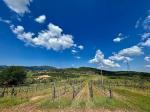
Once it was out of the way, I enjoyed myself even more. The farm is just outside Suvereto, a beautiful medieval village. The villas we stayed were surrounded by lovely vineyard. The party consisted of about 18/19 people, who are interested in Asia, Japan in particular. They are all Italian professionals, writers, journalists, publishers, illustrators and teachers. Most of them speak some English.
Overall, it was well-organized. We had excellent take-away food; we had BBQ; (people made various starters and I made a Chinese salad with Sichuan pepper oil); we ventured to the seaside; we took talks in the enchanting countryside; we had wine tasting; we danced and sang (including ‘Happy Birthday’ and ‘The Internationale’ – there were a few intellectual lefties among the party goers.)
On Sunday morning, I had a little bit of ‘work’ – moderating a talk by a former Italian ambassador who recently published a book about China’s irresistible rise.
The final bit of work was an interview with Pio. Here’s the link:
https://www.ow7.rassegnestampa.it/MinisteroAffariEsteri/PDF/2022/2022-05-06/2022050651518667.pdf
All in all, the gathering was more of a ‘party’ than ‘work’, which I appreciated.