David Moody's Blog, page 35
March 26, 2019
Straight to You audiobook now available
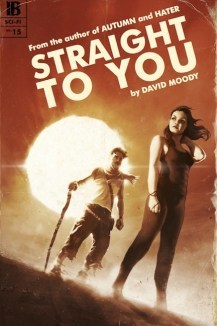
My mission to get audiobook versions of all my novels published is a little closer to completion as STRAIGHT TO YOU has just been released. It’s superbly narrated by Matthew Jackson, and I’m really pleased with how it’s turned out. You can listen to a sample here, or grab a copy from Audible, Amazon or iTunes.
The sun is dying. The temperature around the world is rising by the hour with no sign of any respite. At this rate the planet will soon become uninhabitable; all life extinguished. It might be weeks away, it might be days…we may only have hours remaining. Society is crumbling. The burning world is descending into chaos.
Steven Johnson’s wife is hundreds of miles away and all that matters is reaching her before the end. He has to act now, no time to stop and think. Every second is precious. Tomorrow is too late.
“Straight To You deserves to be ranked alongside such classics as The Stand and Swan Song.” –Ginger Nuts of Horror
“A truly breath-taking and awe-inspiring read from an undeniable master of this sub-genre.” –DLS Reviews
The post Straight to You audiobook now available appeared first on David Moody - author of AUTUMN and HATER.


March 24, 2019
The Day of the Triffids (part 3)
This week my DAY OF THE TRIFFIDS retrospective reaches peak point. If you’ve read my earlier posts you’ll know that a). TRIFFIDS is my favourite book and it’s had an enormous influence on my writing and b). I’m currently working my way through the various film and TV adaptations. I’ve made no secret of the fact that I’d love to write the screenplay for a Triffids movie/miniseries, so I’ve been looking at the pluses and minuses of each version to try and understand why they’ve succeeded or failed. Today we get to the 1981 BBC TV version which is, without question, the most faithful adaptation of John Wyndham’s story yet produced.
Back in the day, when there were only three UK TV channels and we were on the cusp of the home video revolution, this adaptation of TRIFFIDS occupied the primetime. It faired pretty well, with decent viewing figures, favourable reviews and plenty of media coverage. Following the release of the novel in 1951, the name Triffid came to be used to describe any over-sized or vaguely menacing-looking plant, and the beautiful design of the 1981 creature (for want of a better word) also became unexpectedly iconic. I wrote previously about how hard it must be to visualise a genuinely threatening, seven-foot tall, walking carnivorous plant, and yet visual effects designer Steve Drewett did just that. Their vivid colouring, their stings dripping with poison, and their borderline flamboyant, quiff-like styling resulted in a realisation of the Triffids like nothing seen previously or since. There’s an arrogance to their appearance. It’s almost as if they want you to come and have a go if you think you’re hard enough.
But before I get into the detail and explain why I think this adaptation works so well, let’s watch the title sequence and enjoy the theme music by Christopher Gunning. I say enjoy, but if I’m honest, at the tender age of eleven, these titles scared me just about as much as the Triffids themselves!
Produced by David Maloney, one of the driving forces behind BLAKE’S 7, the six, thirty minute episode format of the 1981 adaptation of Triffids gave the writer and director space to breathe. Gone are the constraints of making a single ninety-minute movie and, as a consequence, the series is able to more closely follow Wyndham’s original novel. There are some deviations which make the story feel somewhat uneven, but these can largely be forgiven. There’s a cliffhanger at the end of every episode, for example, and these are frequently ineffective and forced. And it wouldn’t have made any sense for there to be a time jump in the middle of a chapter, so the final episode is set six years later and, as a result, feels superfluous. I’d have preferred a longer exploration of Bill Masen’s journey and for the series to have ended at the point where he’s reunited with Josella. It robs the story of the climax it deserves.
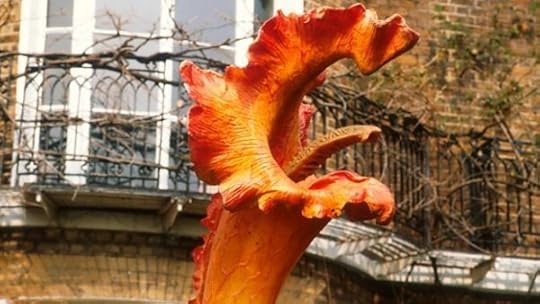
Throughout the opening episodes, this version of Triffids barely puts a foot wrong. By necessity it takes some liberties with the source material, but the changes introduced by screen writer Douglas Livingstone are carefully done and are in keeping with the tone of the book. Those who’ve read the novel will know that there’s a huge exposition dump early on, where Bill explains his history, and his history with Triffids, to the reader. Livingstone cleverly enables this by having Bill, in hospital with his eyes bandaged as a result of a Triffid sting, preparing an audio ‘letter’ to a friend by recording his memories on cassette.
It takes Bill the entire first episode to get out of hospital, but by the time the second instalment arrives, we’re deep into Wyndham’s familiar apocalyptic territory. There are many memorable scenes here: the blind woman desperately trying to open a tin of cat food to eat; the man who, with a rope tied around his waist and his wife holding the other end to keep him safe, edges out into his back garden to pick vegetables to eat, only to be struck down by a Triffid; the pack of zombie-like blind people who crowd around cars and bang their hands against the locked doors of the pub where Bill and Jo take shelter, desperate to get inside; the man who was blind before the comet display who now walks along the street with his white stick, unable to quite work out why the world feels so different this morning…

There’s very little sensationalism on show here. It’s a slow-moving apocalypse which succeeds by remaining reasonably in time with the beats of the original novel. Visual effects are largely (and wisely) kept to a minimum, with some magnificent sound design adding to the unease. The cast is strong: John Duttine is a spot-on Bill Masen, with good support from Maurice Colbourne as Coker and Emma Relph as Jo.
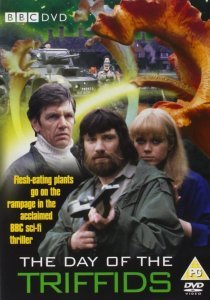 It’s hard to believe that this adaptation was made thirty years after the original publication of the novel, and that it’s now another forty years since the series was first broadcast. As you’d expect, there are many aspects which now feel simplistic and outdated, and yet the series doesn’t suffer unduly as a result of this. It’s a technically limited adaptation with problems symptomatic of the time – for example, the jarring cuts between exterior scenes recorded on film, and studio scenes recorded on videotape – but these issues don’t detract, and I think I know why that is.
When you boil it down to basics, THE DAY OF THE TRIFFIDS isn’t a story about blind people or about carnivorous walking plants, it’s about a handful of survivors trying to come to terms with what has happened to the world about them. Like all the best post-apocalyptic fiction, it’s about human reactions and interactions. As was seen in the earlier film adaptation (and as we’ll see again in the second BBC TV version), it’s so easy to put the Triffids front and centre and let them steal the show. That’s the opposite of what the story needs, and I believe it’s why this version works so well. Less is most definitely more.
And that’s a lesson the team behind the next version of Triffids definitely didn’t pay attention to in school.
The 1981 version of DAY OF THE TRIFFIDS is available on DVD from all the usual outlets.
The post The Day of the Triffids (part 3) appeared first on David Moody - author of AUTUMN and HATER.


March 14, 2019
You goddam HATERS!
Well that was interesting! A few weeks ago I asked an obvious question on my website, Facebook and Twitter. I wanted to know which side you’d choose: HATER or UNCHANGED. The results are in.
I thought it would be interesting to just ask the one question with no follow-ups. I could have asked whereabouts in the world you live or any number of other questions to see if what factors affected your allegiance, but I didn’t. In the HATER books, the Hate ignores all our existing differences, so it made sense for this very unscientific poll to do the same.
369 people voted across this website, Facebook and Twitter, with 59% of people picking Haters over Unchanged. Interestingly, this varied between platform. On my website the split was 49% Hater, 51% Unchanged, on Facebook it was 62% Hater, 38% Unchanged, and on Twitter it was 58% Hater and 42% Unchanged. Does that mean people feel more Hate on social media sites than here on my warm and welcoming website? I don’t know, maybe they do. Interestingly, Haters were far more vocal, with around 60% of comments being from Haters and only 40% Unchanged.

So there you have it. Totally unscientific and little more than a ‘finger in the wind’ exercise. Still, if you’re in the UK like me, I hope this has taken your mind off the other votes we’re currently having to contend with for a couple of blissful minutes!
One last thing. I was interested to read a comment on this poll where the commenter said their allegiance had switched now they’re reading the second HATER trilogy because it tells the story from the Unchanged perspective. If I’m honest, the same thing happened to me while I was writing the books. As I worked my way through HATER, DOG BLOOD and THEM OR US I was Hater all the way. But having spent the last few years writing ONE OF US WILL BE DEAD BY MORNING, ALL ROADS END HERE and CHOKEHOLD, my loyalties seemed to switch. I wonder if, by the time you’ve read CHOKEHOLD, you’ll have come to the same conclusions about the state of the human race as I did…
The post You goddam HATERS! appeared first on David Moody - author of AUTUMN and HATER.


March 12, 2019
Announcing the final HATER novel – CHOKEHOLD
All the focus has been on ALL ROADS END HERE recently, but I wanted to let you know that the absolute final HATER book, CHOKEHOLD, is in the bag and is lined-up for release on November 19 (my birthday, wouldn’t you know!). It’s already available to pre-order. Here’s the cover. It perfectly sums up the tone of the book.
I won’t say too much because I don’t want to spoil things for those who haven’t yet read the other novels, but CHOKEHOLD deals with a whole new chapter in the overall HATER story. It takes place in the aftermath of DOG BLOOD and ALL ROADS END HERE and, in many ways, is also a prequel to THEM OR US. More familiar characters will be returning, and I think you’re really going to like it. Especially the fact that this is the first time… No. Shut up, Moody. I’m not saying anything else. You’ll just have to wait and see.

CAREFUL – SLIGHT SPOILERS FOR ALL ROADS END HERE FOLLOW
A series of nuclear strikes has left huge swathes of the country uninhabitable. It’s a level playing field now: both Hater and Unchanged alike have to fight to stay alive. Both have retreated to their camps to regroup, less than twenty miles away from each other.
It’s here that the last major battle of the final war will inevitably be fought, but neither side has any idea what’s waiting for them just around the corner.
Both armies are ready to fight to the death, each of their leaders hell-bent on victory. Their tactics are uniformly simple: strike first, get the enemy in a chokehold, then strangle the life out of them.
The post Announcing the final HATER novel – CHOKEHOLD appeared first on David Moody - author of AUTUMN and HATER.




March 7, 2019
100 Word Horrors Part 2
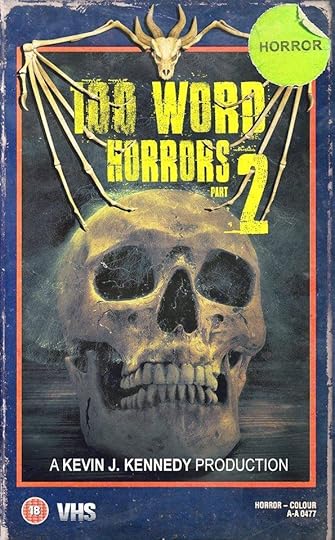
Really pleased to have a (very) short story in this collection. Editor Kevin Kennedy has assembled seventy micro-stories, each no longer than one hundred words, and has bound them up in this fine looking volume. It’s available now in paperback and ebook from Amazon and all the other usual online places. Great to see some familiar names in the table of contents, including Shaun Hutson, Richard Chizmar and Paul Kane. And if you’re wondering how long a one hundred word story is, here’s your answer: this blog post is exactly one hundred words. Not a lot of space, is it?
The post 100 Word Horrors Part 2 appeared first on David Moody - author of AUTUMN and HATER.




March 5, 2019
Read an ebook week 2019
 This week is READ AN EBOOK WEEK – a long-standing initiative that I’ve been pleased to support for a number of years. The debate over the merits of print books versus ebooks versus audiobooks will never be settled – I believe each format has its plusses and minuses, and what suits one reader (or listener) might not suit the next. I just try and make my books available in as many formats as I can, and I also try not to exploit my readers by asking them to buy the same book many times over. Never forget – if you buy a signed copy of a title published by Infected Books from www.infectedbooks.co.uk, you’ll immediately be able to download a complementary ebook version. Similarly, buy a print Infected Books title from Amazon, and you can claim a Kindle copy through the Kindle Matchbook programme.
My career was built on a foundation of ebooks. If I hadn’t been able to give so many copies of AUTUMN away (somewhere in the region of half a million by the time the free download disappeared in 2008), then I doubt anyone would have ever heard of me. So please, download and read an ebook this week. And when you’re done, please review and share. Recommendations are invaluable for authors and are always appreciated.
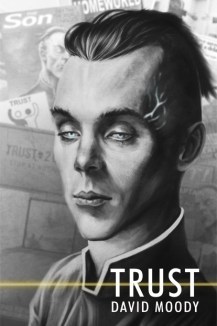
The post Read an ebook week 2019 appeared first on David Moody - author of AUTUMN and HATER.




March 3, 2019
The Day of the Triffids (part 2)
The first screen adaptation of John Wyndham’s DAY OF THE TRIFFIDS was released in 1963, was also known as INVASION OF THE TRIFFIDS, and was directed by Steve Sekely, a Hungarian-born director with very little else of note on his long filmography. Interestingly, Sekely was supported on TRIFFIDS by an uncredited Freddie Francis (more about this later). Francis, you might remember, was the director of a number of Hammer and Amicus horror films before going on to become an Oscar-winning cinematographer who worked on many films including CAPE FEAR, GLORY and THE ELEPHANT MAN.
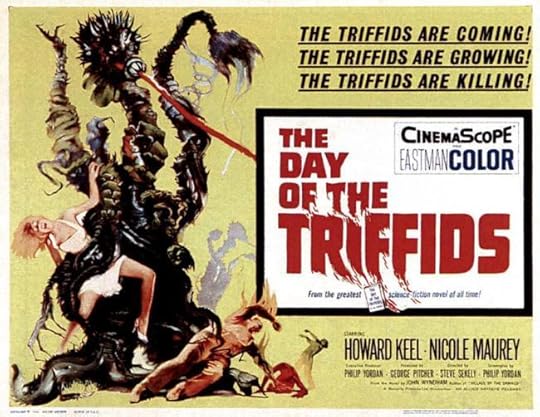
Interestingly, the reviews of this adaptation of TRIFFIDS are split, with many people finding a lot to enjoy in here. As a huge admirer of the novel, I was disappointed. The film suffers greatly because of its age. Have a look at the trailer, click the link, and I’ll explain why.
There are a couple of reasons why the age of this film makes it so unsatisfying to watch today. The first is that so much of what makes Wyndham’s novel special is jettisoned here, and the film becomes a by-the-numbers creature-feature, designed purely as an audience pleaser. British Triffid farmer Bill Masen becomes American seaman and all-round hunk Bill Masen (played by Howard Keel), and the action shifts from the UK to mainland Europe during the course of the story. When I wrote about the book here, I talked about the scenes towards the end where Masen and his group in their isolated farmhouse are surrounded by hordes of Triffids in scenes pre-dating NIGHT OF THE LIVING DEAD, and you’ve very little of that in this adaptation. This is much more formulaic. Far less affecting.
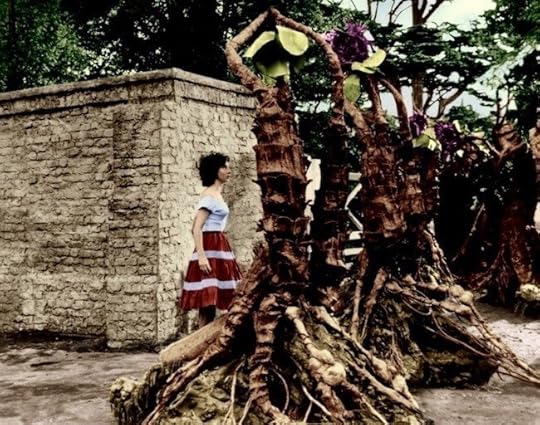
The second reason the film’s age is an issue is the special effects. They’re as awful as you’d expect. As I said last time, when you look at some of the covers of the various editions of the novel published over the years, you start to appreciate how difficult it actually is to make a seven-foot tall, walking carnivorous plant appear anything other than completely ridiculous. The Triffids here are intermittently effective, but mostly look like cheap B-movie monsters being wheeled around on trolleys. If this was a run-of-the-mill B-movie where the creatures were only required to jump out and attack on cue, this wouldn’t be a problem. As Triffids are fundamental to the plot (the clue’s in the title!), these technical shortcomings massively hamper the film. I guess the audiences of the 1960’s would have had less of a problem. The Triffids have their moments here, but they’re few and far between.
I mentioned Freddie Francis earlier. His involvement in this adaptation resulted in another frustrating facet of the film. From what I can gather, when Sekely turned in his cut of the movie, the powers that be decided it was too short. Francis was brought in to add extra scenes and bulk the feature out. The way he achieved this was by introducing a sub-plot which isn’t in the novel, and which barely feels like it’s in the movie. Jeanette Scott and Keiron Moore play Karen and Tom Goodwin, a resolutely British couple who happen to live in a remote lighthouse and find themselves under attack from Triffids (that’s not as daft as it initially seems – the initial spread of the Triffids in Wyndham’s novel is attributed to their seeds being carried on the wind). What is daft, however, is the way the couple stumble across a way to kill Triffids in the final act (clue – they’re surrounded by saltwater). This, thanks to the cringeworthy narration which top and tails the film, means there’s hope for mankind after all. And this, of course, is at odds with the ending of the novel. But in terms of this particular adaptation, the sub-plot makes no sense at all. It’s completely separate from the rest of the film, and there’s no cross-over whatsoever. The additional scenes are entertaining enough, but it’s like watching two different films which have been spliced together by someone with no appreciation of logic or pacing.
I’m sure I’m sounding harsher than I should be here. This version of DAY OF THE TRIFFIDS works as a hokey monster movie, but in terms of an adaptation of Wyndham’s classic novel, it misses the mark by a long way. The initial scenes are faithful to the book and work particularly well, but unfortunately it’s downhill from there. See for yourself – it’s currently streaming on Amazon Prime.
Next up, the 6 part BBC TV adaptation which gave 11 year old me nightmares for weeks.
The post The Day of the Triffids (part 2) appeared first on David Moody - author of AUTUMN and HATER.




February 26, 2019
The longer, the better (sometimes)
All my recent talk of book launches and anniversaries has left me thinking about what I’ve achieved as a writer and what I still want to achieve. If I think of my career in terms of how a farmer manages their fields, then I’d say I’m currently in a fallow period after a couple of pretty decent harvests. I caught the crest of two waves originally when I a) started publishing independently before most others, and b) wrote about zombies just as the living dead became massively popular. And then, a few years later, I enjoyed another prolonged purple patch when Guillermo del Toro somehow stumbled on a copy of HATER and, for a time, everyone wanted a bit of me.
But writing is a fickle, unpredictable business. Just ask my friend Joseph D’Lacey who recently posted this brutally honest piece about his career.
For those of us who just happen to love writing and who hate self-publicising with a passion, being an author is not the easiest of career choices. You keep doing it because you can’t stop, and with every page you write you convince yourself that this could be the next big thing, even though you know that competition to actually be the next big thing is impossibly fierce. And then when you’ve finished writing and you hand your work to someone else to read, all the confidence you’ve built up evaporates and turns to crippling self-doubt. Well it does for me, anyway.
A frustrating amount of this is completely out of the writer’s control. You don’t control the market, you have no influence on current trends, you can do little to make sure yours is the right book seen in the right place at the right time… and yet, we keep at it. Sometimes even the very thing you’re trying to write can conspire against you.
I’m sitting on a pile of unfinished projects, and if I’m honest, they’re stopping me from moving on. There’s 17 DAYS which I spent years writing and which genuinely fried my brain, and there’s KAI, a YA monster novel which ticks all the plot and action boxes but which currently misses the mark in terms of characterisation and voice. And there’s THE SPACES BETWEEN – a huge science-fiction/horror series which I first pitched to my agent in 2010 but which I’ve so far made no progress on other than two drafts of the first book. I swear, that one in particular is waiting for this Brexit bullshit to be concluded (so it might take some time). It’s set in a fiercely independent, totally corrupt, totally money-orientated, totally fucked UK, so I’m guessing it’ll pretty much start writing itself any day now!
So, what’s the point of this post? I guess it’s both a type of therapy in confessing all of this, and also an explanation as to why some books I’ve announced haven’t yet appeared. But they will. I’m still actively working on ALL of the projects I’ve mentioned above, and I intend on seeing them ALL through to completion. You see, going back to the farming analogy, the first signs of a new crop are beginning to peek up through the soil. It just takes a little patience, persistence, and time.
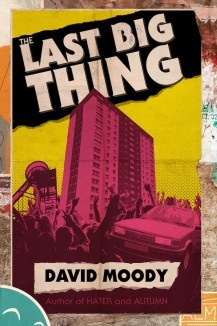
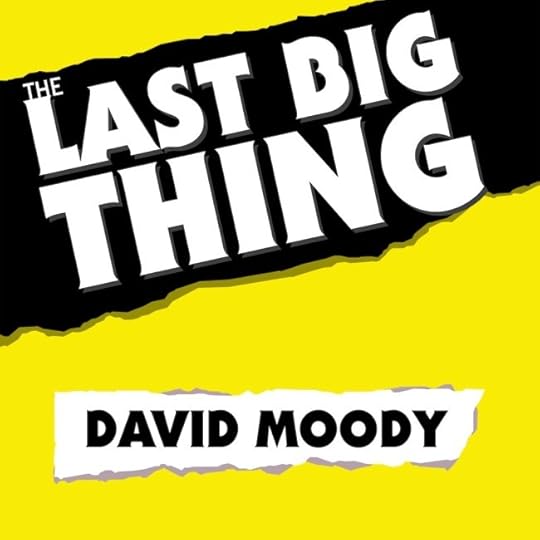
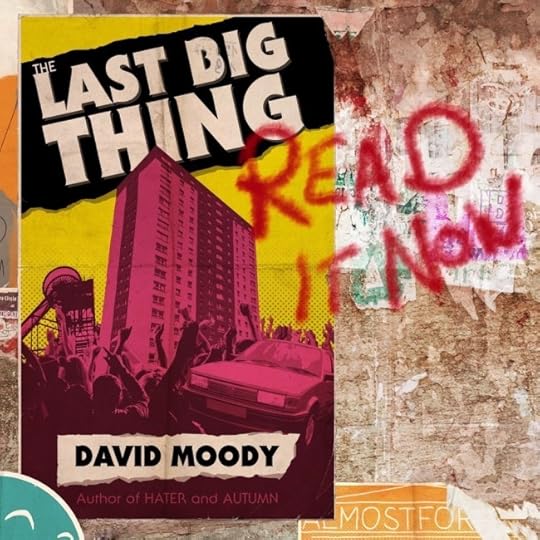
In January I released THE LAST BIG THING, a collection of odd tales which seem to have gone down really well with readers. I wrote three new stories for the book including WE WERE SO YOUNG ONCE. Quite a few readers have mentioned how that one in particular has affected them, and that’s really gratifying. I can clearly remember where I was when I first had the idea for it (running through Halesowen, February 2009), and it took a decade for me to be in the right place and the right frame of mind to actually get it written. The same was true of AWAY WITH THE FAIRIES, which I couldn’t have written if I hadn’t spent endless hours with my Dad in hospital just before he passed away in February 2016, and then my mother-in-law before her death in October 2017. Both events helped shape the story from the germ of an idea to something complete (and, I hope, unsettling).
You can’t force these things, I’ve learnt. You just have to keep sowing and ploughing and fertilising and reaping etc. This has been an extremely long-winded way of saying two things. One – there are loads more Moody books on the horizon: a bumper crop on the way. Two – please buy THE LAST BIG THING. It’s cheap, beautiful, and I’m very proud of it. I think you’ll have a lot of fun using it to try and piece together the inner workings of my frazzled brain.
The post The longer, the better (sometimes) appeared first on David Moody - author of AUTUMN and HATER.




February 24, 2019
The Day of the Triffids
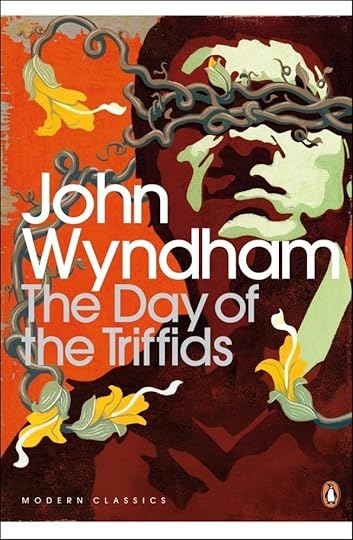
Time and time again, when I’ve been asked in interviews to name my favourite book, I always plump for John Wyndham’s 1951 classic, THE DAY OF THE TRIFFIDS. As I started typing this piece, I’d literally just put the novel down after reading it for the first time in ten years or so, and it seemed that now would be an ideal time to write about it in more detail and explain why it’s been such an influence on me and my work. Similar to what I did with Richard Matheson’s I AM LEGEND a couple of years back, I also plan to re-watch and write about each of the film/TV adaptations of the story. I’ve always found this a really interesting thing to do – each adaptation has pluses and minuses (some many more minuses than pluses) and by analysing them it helps me appreciate the strengths of the source material even more.
So, what’s it about? I’m sure you know by now, but here’s a brief synopsis. A new breed of plant is discovered – the Triffid. It has some remarkable qualities. Not only are Triffids a rich source of a natural oil, they’re also incredibly dangerous: they’re mobile and are able to drag themselves around, they possess poisonous, whip-like stings which they deploy with deadly accuracy, allowing them to kill and feed off the remains. And they can communicate with each other. Great herds of them roam the countryside together, given half a chance.
Typically, the potential for profit outweighs risk, and soon huge numbers of Triffids are being farmed commercially. Bill Masen is a Triffid farmer. When the book begins he’s in hospital, recovering from a sting which has almost rendered him blind. His eyes are covered, which is particularly frustrating because the Earth is scheduled to pass through a cloud of comet debris, and the skies around the world will be lit up in a display of unparalleled magnificence.
Next morning, everyone who watched the comet display discovers they’ve been blinded, and the world descends into utter chaos.
It’s the synchronicity of this story that gets me every time. Two events – the arrival of the Triffids and the comet debris – are apparently unconnected (though there’s some question as to whether that actually is the case), but their combined impact is devastating. By stripping the vast majority of the human population of their sight, Wyndham skews the odds in favour of the Triffids.
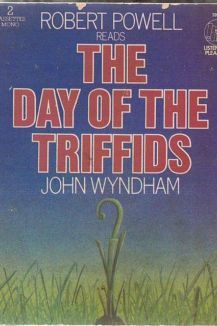
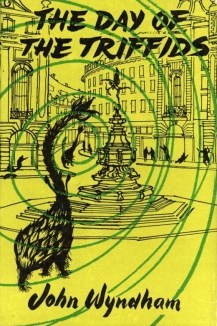 When I tell people that TRIFFIDS is the book which has influenced me most over the years, it’s for good reason. Sure, there are aspects of the novel which jar and don’t sit well, but there’s so much to recommend here. This book was a formative part of my post-apocalyptic education. I discovered it when I was 11, tucked away at the back of my junior school classroom library. It really shouldn’t have been there, but it was. And looking back, I wish I’d asked if I could keep it, because having just Googled the cover, I realise now it was a first edition. It was a pretty innocuous-looking book, but I devoured it from cover to cover over the course of a weekend. It’s no exaggeration to say that reading the book was a life-changing experience. It traumatised me, and I didn’t have long to wait before the terror was ramped up even further when the first BBC TV adaptation of the novel was broadcast. I saved up my pocket money and bought myself a copy of the TV tie-in edition, then received an audiobook version for my birthday (read by Robert Powell and published on two mono cassettes, no less!). It’s fair to say I was addicted to the story.
But why?
 Let’s start at the beginning with the opening of the book. “When a day that you happen to know is Wednesday starts off by sounding like Sunday, there is something seriously wrong somewhere.” Wyndham’s first scene is a masterstroke which we’ve seen copied time and again in recent years. 28 DAYS LATER, THE WALKING DEAD – they’ve both riffed on the ‘waking up in hospital after the shit has hit the fan’ approach, and why not? It works. As a plot device, it’s brutally efficient in allowing the hero to wake up (relatively) unscathed after the event and for them to then discover the nightmare of the apocalypse along with the reader/viewer. Similar to Rick Grimes in The Walking Dead and Jim in 28 Days Later, Bill strolls out into the world relatively innocent and undefended, aware something’s not right, but not at all sure what has actually happened. But it’s not Triffids he encounters initially, it’s people. Desperate, helpless people who are suddenly unable to see. To my mind, that’s an even more terrifying prospect than walking out into a crowd of zombies or carnivorous plants. Let’s face it, we’ve all fantasised about being the last person left on Earth after some terrible apocalyptic event, but what Bill faces is far more daunting. His ability to see in a world of the blind means that he initially feels responsible for the rest of the population. It doesn’t take long for him to realise he can’t do anything but help himself. Though Wyndham’s characters in the book frequently come across as stereotypical and clichéd (and with increasingly outdated moral viewpoints), you still feel that Bill has the weight of what’s left of the world on his shoulders. And this is a point we come back to in the book again and again – is there any point helping the blind, or should the sighted simply focus on keeping themselves alive?
You know, if you describe the book to someone in the simplest terms possible –the world is taken over by giant, carnivorous, walking plants when everyone is blinded – then it just sounds ridiculous. You only have to look at some of the questionable cover art to have graced the novel over the years to realise how difficult it is to pull off a terrifying seven foot tall plant! And yet, to me anyway, the book remains unnerving and uncomfortably plausible. Why is that? I think it has a lot to do with Wyndham’s characterisation and writing approach. The people we come across in the novel… they’re largely just ordinary folk who find themselves living through an impossible nightmare. There’s a blunt matter-of-factness to his writing, and the lack of sensationalism makes it disarmingly easy to buy into the bizarre plot. Author Brian Aldiss described Wyndham’s books as ‘cosy catastrophes’, and I think that’s a wonderful description. There are no huge set-pieces or battle scenes here: the fate of the world doesn’t rest on Bill Masen’s shoulders at all, just the fate of Bill Masen’s world.
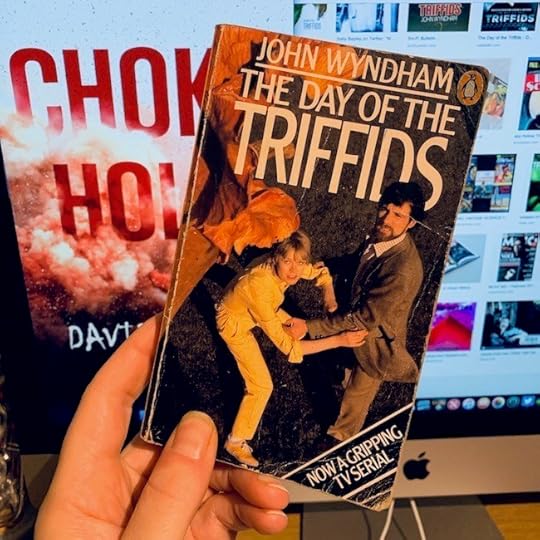
My original, much loved copy of The Day of the Triffids. It cost £1.25, which was all the money I had in the world in 1981!
Looking back now, almost forty years since I first read TRIFFIDS, and over twenty years since the first draft of AUTUMN, I can clearly see how Wyndham’s novel shaped my stories and my approach to writing overall. My zombies have as much in common with the silent, slowly shuffling Triffids than they do George Romero’s living dead, and the way Wyndham’s deadly plants congregate around the isolated farmhouse, locking in on any sounds the survivors make, is a clear precursor to the attack on Penn Farm at the end of the first AUTUMN novel.
And that, I think, is what I love most of all about THE DAY OF THE TRIFFIDS and what I’m most proud of with AUTUMN – these stories are about worlds which are spiralling out of control in the most unexpected of ways. While everyone’s looking in one direction – literally, in the case of the TRIFFIDS – the real danger is coming from elsewhere. It’s a slow, methodical, unstoppable apocalypse, with none of the noise and bluster of most visions of armageddon, and perhaps that’s why it’s had such a profound effect on me over the years. I’m naturally an introvert, and Wyndham’s book feels like an introvert’s apocalypse. The blindness is a misdirect. The real danger comes from society’s complacency, arrogance, and lack of preparedness.
So why have the TV and film adaptations of the novel often missed the mark so badly? Come back here over the next few weeks as I try and work that out.
The post The Day of the Triffids appeared first on David Moody - author of AUTUMN and HATER.




February 21, 2019
Which side are you on?
Genuine question. I really want to know. Can you spare 10 seconds? Because after writing ONE OF US WILL BE DEAD BY MORNING, ALL ROADS END HERE and CHOKEHOLD, I’m just not sure where I stand.
I’ve been running polls on Facebook and Twitter recently to ask this most basic of questions that I’ve never asked before, but because it’s increasingly difficult to keep something visible on social media without paying through the nose, I’ve decided to ask the same question again here. I’ll keep this poll open for at least a week, then I’ll report back with the final summarised results.
Note: There is a poll embedded within this post, please visit the site to participate in this post's poll.
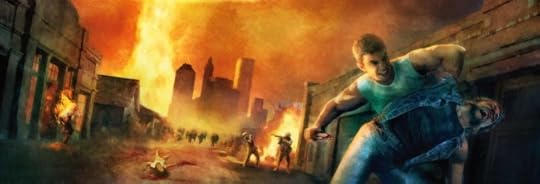
Dog Blood art by Tomislav Tikulin
The post Which side are you on? appeared first on David Moody - author of AUTUMN and HATER.