
Amy E. Lilly's Blog: Book signing at Dahlgren General Library, page 3
December 5, 2021
Houdini & the Spiritualists
Harry Houdini was a well-known escape artist, a film star, and a tireless warrior against spiritualism. He placed advertisements in local newspapers, including this one in the December 1, 1922 Richmond Times Dispatch.
 Richmond Times Dispatch 01 Dec 1922
Spiritualism was a religious movement based on the belief that the dead and the living could have contact with each other. Houdini fought against fraudulent mediums and even testified before Congress in 1926. His goal? To put the fraudulent mediums who preyed upon the grieving out of business.
In the United States, modern Spiritualism’s roots began in 1848 with the Fox Sisters of New York. Karen Abbott wrote a compelling piece about the sisters in this article for Smithsonian Magazine. The three sisters gained millions of followers until sister Maggie Fox gave an exclusive interview in 1888 and demonstrated how they were able to fool so many people for so long. Despite Maggie’s confession, Spiritualism continued to flourish. Sir Arthur Conan Doyle, the creator of Sherlock Holmes, was a firm believer in the movement. Many point to Doyle’s son’s death as the starting point of his belief in Spiritualism, but he joined the Society for Psychical Research long before his son’s death in 1918.
I delved into Spiritualism and Houdini’s campaign against it while researching the 1920s and veterans of World War I. I have a character who is a soldier returning from war suffering from terrible shell shock (what we now know as PTSD) who developed a firm belief in the afterlife. He did it to atone for the sin of surviving when others didn’t. In contrast, my main character, Evie, lost her mother and brother in a short span of time. Rather than subscribe to belief in spirits talking to the living, she believed they couldn’t because surely if it was real, her family members would have “spoken” to her in her time of grief.
If you’re interested in learning more about Houdini and his fight against fraudulent mediums, I recommend reading David Jaher’s The Witch of Lime Street. It describes Houdini’s yearlong campaign to expose a Boston medium.
26 total views, 26 views today


November 30, 2021
Hush-a-bye : Serialized story
It’s the 1850s and serialized stories are all the rage. Amazon Kindle takes a note from history and allows authors to serialize stories. I’m writing a mystery story set in rural West Virginia. It’s a step away from my love of the cozy and historical mysteries. Each week, I’ll publish a new “episode” via Kindle Vella. It’s a chance for you to read the first three episodes of the story for free, and if you like it, purchase tokens to read additional episodes.
Here’s the link to the first episode. Enjoy!
4 total views, 2 views today
November 28, 2021
1920s Leftovers
 “Roast Turkey” by SliceOfChic is licensed with CC BY-NC-ND 2.0. To view a copy of this license, visit https://creativecommons.org/licenses/...
I hope everyone had a wonderful holiday with friends and family. Currently, I’m on a mission to use up the leftover turkey in creative ways. I made a turkey potpie with a buttermilk crust and even impressed myself when it came out of the oven with a beautiful golden crust. My husband who claimed he would swear off carbs immediately after Thanksgiving went back for seconds. He decided to wait until we polished off the potpie.
Out of curiosity, I looked at newspapers from 1921 to see how the Jazz Age handled leftovers. I’ve never made turkey hash or croquettes, but turkey noodle soup is a favorite when it’s cold outside. Not sure what melon seed macaroni was, a quick Google search said it was another name for orzo.
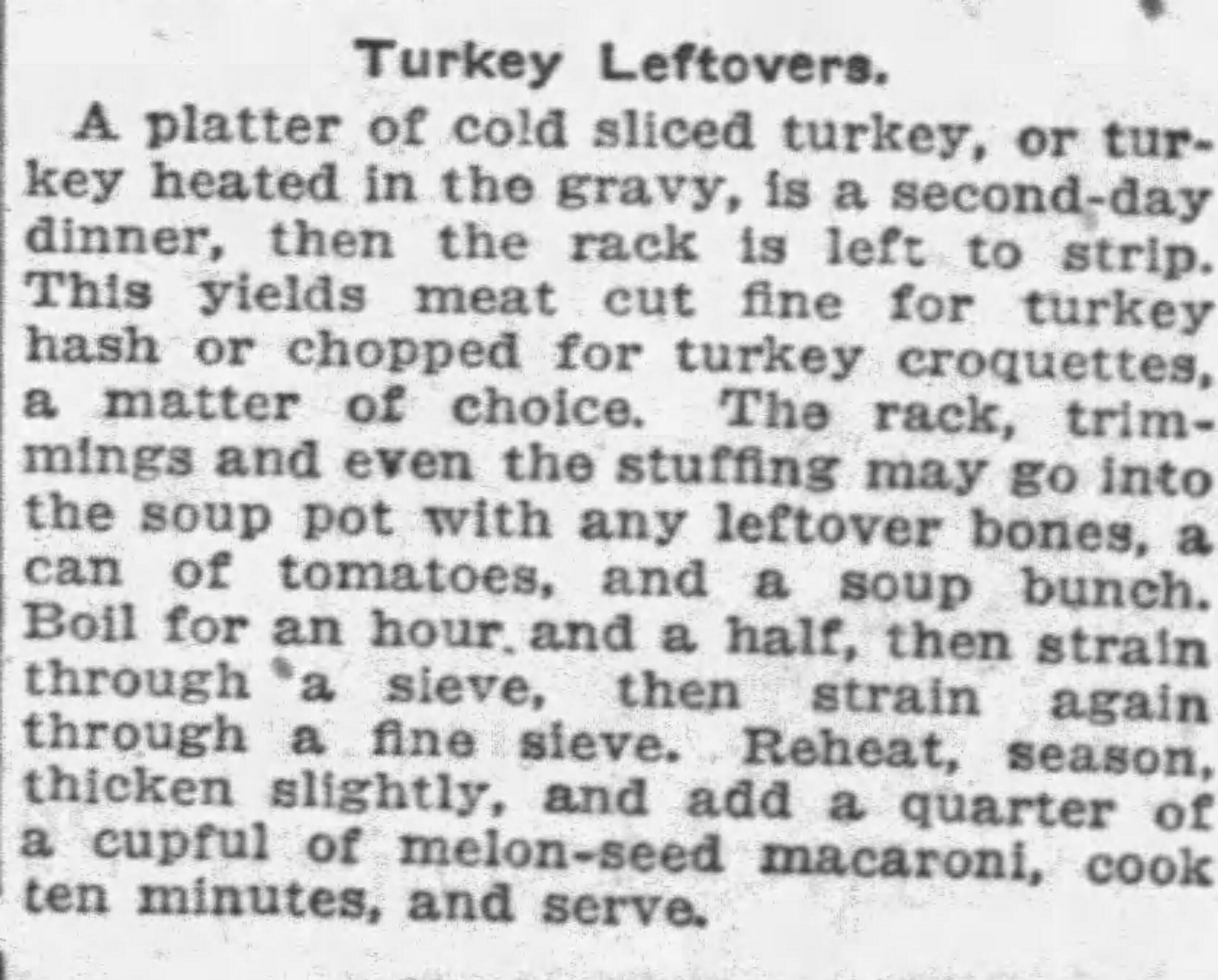 Image: The Sheboygan Press – 11/21/21
I learned that I’ve been doing dessert wrong. No mention of pumpkin pie, but I did learn what to do with leftover plum pudding and pound cake. Next year, I’m pulling out the plums. Here’s the Sheboygan Press’s suggestion for leftovers.
 Image: The Sheboygan Press 11/21/21
What is your favorite recipe for leftover turkey? Feel free to share in the comments.
18 total views, 18 views today
November 3, 2021
Summer of ’72
This is a flash fiction piece I wrote this weekend for a contest. The contest assigned historical fiction, wagon, and daybook. Each of these had to appear in a story of 1,000 words or less. I used elements from my childhood in Colorado. Our first home had an old wagon and a rock fence. I spent many hours playing on both.
Some folks had air conditioning in their homes. My parents stuck fans in the windows and told us to go outside and play under the sprinklers when the temperature edged over ninety. My older brothers had already made friends and spent the hottest hours of the day hanging out with them. Not me. I preferred my own company. Yesterday, Mama let me call my best friend Shannon back home. The lady we shared the party line with interrupted my call. She had to call her daughter in New Mexico and asked me to hang up the telephone.
“You’re driving me crazy,” Mama mumbled, her mouth full of pins. She’s sewing me a new pantsuit and chose a blue corduroy fabric she said brought out the color of my eyes. I’d rather wear my bellbottom jeans, but Mama said I needed to dress like a lady. “Go outside and play, but make sure you’re home by dark.”
Outside, I entertained myself for a good ten minutes, swinging on the tire Daddy hung on the big oak tree out front. You can only twirl around so many times before you want to upchuck. I tried to catch one of the fat grasshoppers that spit brown juice, but their legs were faster than mine. Trudging to the rock fence, I whistled at the neighbor’s horse while holding a piece of foxtail grass in my hand.
“Fine, big dummy,” I shouted when she ignored me. “I’ll find another horse to give this tasty apple-flavored grass to.” Mama said I’ve got too much imagination, and I walk around with my “head in the clouds.” Whatever that means. I’m always the shortest kid in class, so my head’s never even come close to a cloud.
My brothers claimed they found an old pioneer town in the fields behind the house. I decided to see it for myself. Daddy told me not to go that far, but I could still see the roof of my house. My shoes kicked up dust with each step. The sagebrush pricked at my ankles when I got too close. Daddy said we lived in the high desert now, and that’s why there’s so much cactus and sagebrush. It sure didn’t look like the green fields of home. Everything is so sharp here and painted in shades of gray-green and tan.
It didn’t take me long to find the skeleton of an old wagon. I ran my hand over the wooden spokes, blackened with age. After I hoisted myself up, I closed my eyes and imagined my brown hair in long pigtails covered by a sunbonnet. Our covered wagon was last in line.
“Keep an eye out, Annalee,” Pa said. “If you see a buffalo, holler. One will feed us for a good month or more.”
“Yes, Pa.” I squinted my eyes at the blazing sun. Sweat trickled down my back through my gingham dress. Ma cut it down from an old dress of hers. If I grew too much more, it would be too small by the time we get to California.
A buzzing bee forced me back into the present day. One stung me last week, and it hurt like the devil. I looked for the bee. Something in the back of the wagon glinted. I pushed my fingers through a gap in the boards and touched something cool and smooth. Treasure. I wiggled my fingers around until I grasped it. I pulled. My hand wouldn’t budge. I twisted, and sharp pain shot through my wrist.
“Ouch!” I’m good and stuck. I wondered how long until someone notices I’m gone. It could take days for them to find me out here. By that time, I’ll be white bone like those cow skulls they sell at the tourist shop in town.
An hour later, sweat has dried in a crust on my forehead, and I’ve wiped dusty tears from my eyes. My shouts for help answered only by the drone of the grasshoppers.
“Whatcha doing?”
A boy balanced on a boulder nearby. Like the landscape, he’s shades of brown and tan.
“I’m stuck.”
He hopped down, and a puff of dust rose in the air around him. He peered at my problem for a moment. “When I pull on this board, you should be able to get your hand out.” He cracked his knuckles, then tugged. I yanked my hand free from its trap and yelped as I tumbled backward.
“Thanks.” I hopped down and looked in the dirt to see if my treasure had fallen free from its hiding spot.
“I’m Roger. I live next door.”
“Annalee.” I crawled beneath the wagon. “Can you keep a secret?” There between the slats was a silver coin.
Roger crawled next to me. “Sure can.”
I pointed. “I found treasure.” Reaching, I grasped the edge of the coin and pulled. Success. I hold it up to the sunlight. Etched on one side is a woman’s face and on the other, an eagle.
“Can I hold it?” Roger asked.
I hesitated, but figured he saved my life. I owed him. “Okay, but you have to promise to give it back.”
Roger turned the coin over in his hand. “This is a Morgan silver dollar. It’s from 1872. See.” He handed the coin back to me.
“We could share the coin. I get it for one week. You get it the next.” I blushed. “If you want to, I mean.”
Roger grinned. “Yeah. Shake on it?”
I spat in my hand and held it out. Without blinking, Roger spat in his own and shook.
“We got a new color television at my place. You want to come over tomorrow?” Roger asked.
I nodded. “Cool.”
Later that night with the fan blowing hot summer air, I sat on my bed with my pink daybook open. In my best cursive, I wrote, June 8, 1972. I made a friend named Roger today and found treasure. It’s going to be the best summer ever.
49 total views, 2 views today
October 25, 2021
Monday’s Molls & Mugs – Elizebeth Friedman
Far from being a ganster’s moll, Elizebeth Friedman was the codebreaker who helped to bust them. Elizebeth Friedman is widely known as the first female cryptanalyst. She and her husband William led a team of codebreakers during World War I.
During Prohibition, Elizebeth worked with the federal government to break the rum runners secret codes. In 1925, the United States Coast Guard enlisted Elizebeth to break the sophisticated code system the bootleggers used on shortwave radios. The rumrunners used these codes to relay information about number of barrels and location of the shipments. During her time assisting the government, Elizebeth cracked over 12,000 codes. Her work helped bust a notorious smuggling ring based out of New Orleans. Four of the men arrested were part of infamous gangster Al Capone’s gang.
When Prohibition ended, Elizebeth continued her work as a codebreaker. During World War II, she was able to crack a major Nazi spy ring operating out of South America. In addition, Elizebeth deciphered coded letters sent by Velvalee Dickenson, a spy for the Japanese, which subsequently led to Velvalee’s arrest and conviction as a spy.
Elizebeth and her husband William worked for years as codebreakers. While William Friedman received accolades at the time for his work, it wasn’t until years later that Elizebeth was recognized for her contributions.
 Image Courtesy of the Library of Congress
22 total views, 3 views today
October 18, 2021
Monday’s Molls & Mugs
This week instead of talking about the 1920s and all that was fabulous about the bootleggers, gangsters, and their ilk, I wanted to announce my fellow author’s book release. Heather Weidner has a book birthday this week, and I’m super excited about it. If you love cozy mysteries, fun characters, and unique settings, Heather’s Vintage Trailers & Blackmailers : A Jules Keene Glamping Mystery releases tomorrow.
Jules Keene owns Fern Valley Camping Resort in the Blue Ridge Mountains. The beauty and tranquility of her resort is shattered when she finds on her of her guest murdered in the woods near her vintage trailers. Jules immerses herself in the world of the Dark Web to find out what happened to her guest.
Heather is a fellow member of Sisters in Crime here in Central Virginia. In addition to the Jules Keene Glamping mysteries, she writes the Delanie Fitzgerald mystery series also set in Virginia (Secret Lives and Private Eyes, The Tulip Shirt Murders, and Glitter, Glam, and Contraband).
Heather’s books can be found at all the major retailers, so hurry and discover your next great read! (Side note: I adore the cover of this book.)

28 total views, 10 views today
September 26, 2021
Monday’s Molls & Mugs
This week’s mug is George Remus, former successful defense attorney turned bootlegger and murderer. George was born in Germany, but he and his family arrived in the U.S. when he was a child. The family settled in Chicago. George found early success as a pharmacist, but at age 24, he decided to become a lawyer. He specialized in criminal defense and became known for developing the “temporary insanity” defense. This tactic became a portent for his future because he would use temporary insanity as the reason he killed his second wife.
Before he became a murderer, George Remus became a successful bootlegger in Cincinnati. At one time, he had close to 3,000 employees help him with his illicit trade. Remus studied the newly passed Volstead Act and used a loophole in the law to buy pharmacies and distilleries and sell his bonded, government-approved liquor as medicine. He would then hijack his own trucks and sell the booze illegally at a much higher profit. A brilliant move on George’s part and he quickly became a millionaire.
George’s personal life wasn’t so successful. His first marriage ended in divorce when he had an affair with his legal secretary, Imogene Holmes. He married Imogene and adopted her daughter from her previous marriage. When George was nabbed by the revenuers for his illegal liquor trade, he was prosecuted and found guilty. He received a two-year sentence and went to prison. George gave Imogene control over his money while he was gone. While in the pokey, George confided to a fellow inmate/undercover federal agent Franklin Dodge that Imogene controlled the cash. That agent quit his job and took up with Imogene and the two commenced to stealing George’s fortune. By the time George left prison, Imogene and her new lover, Franklin, had fleeced George and left him with $100. If stealing his fortune wasn’t bad enough, Imogene and Franklin took out a hit on George which failed. She then filed for divorce. George really was a horrible judge of character when he chose Imogene to be his wife.
George would soon have his revenge. Imogene was on her way to divorce court when her cab was forced off the road. George jumped out of his car and dragged Imogene from the cab. He shouted, “Now, you decomposed piece of clay, I’ve got you!” He then shot Imogene in the stomach. Imogene was transported to the hospital where she later died from her injuries. George hitched a ride to the police station where he confessed to the crime.
George took up his own defense and pleaded temporary insanity due to the dastardly acts of Imogene and her lover Franklin. His first wife, Lilliam, and daughter came to his defense at trial attesting to his character. Lilliam testified, “George was always a good man. He never hurt a fly. I cannot understand why he did this. But I am sure he was justified.” The jury deliberated for just nineteen minutes before acquitting him. He spent seven months in an insane asylum before being released. He then went on to marry his third wife- his secretary Blanche Watson. The two moved to Kentucky and lived a quiet life until George’s death in 1952.
George Remus, brilliant criminal defense lawyer and successful bootlegger, but a hot mess when it came to his women.
 George Remus
 Imogene Remus
Photos courtesy of The Daily News December 25, 1927
6 total views, 5 views today
September 20, 2021
Monday’s Molls & Mugs
Have you heard of the Queen of the Bootleggers? Her name was Gertrude “Cleo” Lythgoe and she was a famous female rumrunner who kept the liquor flowing between the Bahamas and the United States for three years before calling it quites. Cleo called herself the Rum Queen of the Bahamas, but to me she was the ultimate queen of reinvention.
Gertrude Lythgoe began her career as a librarian in Bowling Green, Ohio. She found a better job as a lumber sales agent on a British schooner. Lateral career move? Maybe, but when Prohibition began, she leased the schooner and set herself up as a legitimate liquor dealer based in Nassau. She operated a legitimate business, but she also supplied illegal liquor the thirsty masses in the U.S. in the early 1920s. She lived in the Lucerne Hotel in Nasssau, and she and her fellow rum runners would hold regular meetings. When things got too hot for them and the group feared spies were listening in, they moved their meetings to the pirates graveyard.
Although this work was exciting and lucrative, Cleo reinvents herself a third time when she finds herself in shark-infested waters following a shipwreck. As she floated in the water, she wondered what her life would have been like if she hadn’t started bootlegging “hams”. Hams were burlap-wrapped bundles each containing twelve liters of liquor. Her epiphany made her wonder if her life would have been better as a wife and mother. Fortunately for Cleo, she found herself in shallow water and swam to the shore of Bimini Harbor. Following the wreck of her schooner, Cleo supervised the return on her cargo to her warehouse. The original load of Scotch would have netted her a cool $80,000 which equals over $1.2 million today.
After one too many close calls with the Coast Guard, hijackers, and bad weather, Gertrude “Cleo” Lythgoe left Nassau and went into hiding in various locations around the United States. Despite her fear from her former “colleagues,” Cleo had no problems detailing her life in several newspapers around the country. In July 1925, the Tampa Tribune ran a series of articles written by the Rum Queen herself which details her life. Cleo claims to have worked as a librarian, a spy during World War I, and later a legitimate liquor importer before turning to bootlegging. One of the facts she shared was the prices paid by Americans to wet their whistle.
Prices By the Case19252021Champagne $ 36.00 $ 562.77Liqueurs $ 45.00 $ 703.46Gin $ 12.00 $ 187.59Vermouth $ 22.00 $ 343.91American Rye (exported to UK prior to Volstead) $ 35.00 $ 547.13Scotch $ 12.00 $ 187.59Prices calculated using the U.S. Inflation Calculator found at usinflationcalculator.comAnother item of interest to me is the Scotch she would smuggle into the United States. All Scotch distilled in Great Britain was required to be aged for a minimum of three years before it was allowed to be sold to the British public. Scotch sent to the United States required no such aging which is why it was considered “green” alcohol. It could be shipped as soon as it was distilled. The difference between what Cleo termed “Scotch Scotch” and “Uncle Sam Scotch” was the greenness and the lack of blending.
My favorite term Cleo used was a “Volstead Vampire.” These were pretty girls who would help smugglers bring the liquor into the country. Due to the gentlemanly nature of many revenuers, pretty girls were less likely to be questioned, so they were used like today’s drug mules to help smuggle the booze.
Believing she was jinxed and there was a price on her head, Cleo quit the booze business. After a furious round of articles in newspapers across the country, she faded from public view and spent her years living in various hotels around the country. In 1965, she published her autobiography The Bahama Queen : The Autobiography of Gertrude “Cleo” Lythgoe. She died in Los Angeles in 1974 at the age of 86.


 Images courtesy of The Tampa Tribune and The Bradenton Herald accessed via Newspapers.com
36 total views, 12 views today
September 14, 2021
Sword of MuskGregor
A flash fiction story (1,000 words) I wrote for NYC Midnight this weekend. My assignment was a fantasy story with a sword and a boat parade. I had a blast writing this one.
The muskrats live happily on the banks of the Tumbly River until the beavers arrive. Hamish MuskGregor decides he will not leave his burrow to the beavers and will fight them to save his river home.
“Papa, tell us a bedtime story,” Phineas begged. His mother had bathed him and made him brush his sharp incisors. Now, the tiny muskrat was ready for sleep.
His father waddled across the burrow to the nest of old fur and soft leaves where Phineas, Nigel, and Matilda slept. He settled his large frame onto a birch stool and leaned forward. “I’ll tell you a tale if you promise to go right to sleep afterward. Tomorrow is a big day in the pond.”
“We will, Papa,” the three muskrats promised. They circled their nest, pushing and pulling the softest leaves into place before they curled into a tight clutch of bodies. Their furry faces looked up, black eyes wide, as their father began his speak.
“This is the tale of Hamish MuskGregor, chieftain of the Fernpond clan,” Papa said, his voice deep.
“He’s the reason we have the boat parade, isn’t he?” Matilda squeaked. She used her paw to push her brother, Nigel, to the far part of the nest. Nigel barked a protest and a brief tussle ensued.
“Children, if you don’t stop this instant, you’ll go straight to bed without a story,” Mama said. She dried her paws on the dish towel by the sink and sat down on the leaf and twig couch. She picked up her knitting needles made from porcupine quills. Soon the clicking of the needles filled the burrow.
Papa lit his acorn pipe. “Hamish wasn’t always a chieftain. In fact, he began life as a humble muskrat on the banks of the Tumbly River. He spent his days gathering crayfish and cattails and building his burrow in hopes to one day find a wife.”
“Like Mama?” Nigel asked.
Papa nodded his grizzled head. “Like your mother. Life was peaceful on the river. Water rats, birds, and foxes lived in harmony.”
“But it all changed when the beavers moved in,” Phineas said.
“Who’s telling this story?” Papa puffed on his pipe and waited for the pups to settle. “Yes, the beavers came with their large dams and big ideas for change on the Tumbly River. Chieftain Tomas was head of the family and went to speak to them.”
Phineas closed his eyes and imagined the large muskrat chieftain marching to meet the beavers with his fur slick and shiny with water. He must have been a magnificent sight.
“Chieftain Tomas believed the beavers to be friendly, so he went alone. But the next day, his body was found bruised and battered on the banks of the river with a tuft of beaver fur clenched in his hand.”
Little Matilda shivered. She enjoyed a good story, but Mama knew she would have nightmares. Mama laid her knitting down and came and stroked Matilda’s head. The little muskrat pup closed her eyes and waited for the tale to continue.
“The Fernpond clan held a council with the elders of the river. Half of the clan wanted to move to new waters while the others wished to stay and fight. There was no easy answer for the muskrats. The beavers were bigger, and their tails were deadly,” Papa said, his voice low and deep.
Then Hamish spoke up.” Phineas sat up and smiled, his yellow teeth glinting in the candlelight.
“Back in bed,” Mama admonished. She grabbed a blanket of old cloth she’d found on the bank of the river and tucked it over her three pups.
“Yes, young Hamish MuskGregor had built a beautiful bank burrow and he wasn’t eager to leave it behind.” Papa closed his eyes. “He came to the center of the clan meeting and although he was small, he stood on his hind paws and turned to each clan elder one-by-one looking them straight in the eye. Hamish said this was his home and his river. He then reached into a small scabbard he had fashioned out of leaves and pulled out a sword made of bone. Hamish held the bone sword high in the air and declared he would fight until his final breath to keep his home.
“When he was done, Hamish stood waiting. A roar of barks and squeaks filled the air. Teeth gnashed and long tails whipped in a frenzy as the clan decided to go to war.”
Nigel’s eyes were wide. He popped his thumb into his mouth and sucked. He waited for Papa to continue the story.
“Hamish and his clan brothers built a fleet of boats from twigs and cattails. The women gathered old fish bones from the banks of the river and used their teeth to sharpen them. Even the young pups worked by sewing sails from leaves and hair from a horse’s mane.” Papa shifted the acorn pipe from one side of his mouth to the other, drawing deeply. The bowl glowed with each puff. “One week later, under cover of darkness, the Fernpond clan boarded their boats and sailed towards the beaver dam.”
All three muskrats sat up and leaned toward their father, eager to hear the end of this well-known story. “They were so brave,” Phineas said.
“Yes, they were,” Mama said. She reached out her paw to try to smooth a cowlick, but Phineas wiggled away.
“As they drew close to the dam, Hamish gave a mighty battle cry. The rest of the muskrats swarmed across the branches, ousting the beavers from their beds. Although bigger, the beavers weren’t prepared for the onslaught of swords and teeth. By dawn, all that remained of the beavers was a small log trapped on a rock.”
“And the beavers never returned,” Phineas said, giving a satisfied sigh. He settled back under the blanket. “Now, we have our Tumbly River Boat Parade to celebrate the victory every year.”
Nigel gave a big yawn. “I want a troutsicle after the parade.”
“Me, too,” Matilda said, her eyes fluttered as she fought sleep.
“Goodnight, children,” Papa said as he blew out the candle.
“Goodnight,” Phineas mumbled as he drifted off to sleep.
45 total views, 10 views today
March 6, 2021
Podcast Interview
Check out my interview on Bryan Nowak’s All Things Writing Podcast.
2 total views, 1 views today
Book signing at Dahlgren General Library

Join me on Friday, May 15th at the Dahlgren General Library located at NSA South Potomac in Dahlgren, VA. Reading and book signing will be from 4 p.m. to 6 ...more
- Amy E. Lilly's profile
- 23 followers

