Rob Kitchin's Blog, page 27
December 7, 2019
Failing forward
The plastic bottle bounced off the wall.
‘Fuck!’
‘Are you okay,’ Julie asked.
‘Do I look okay? I just died. Painfully.’ Josh pointed to the stage.
‘Are you kidding me? They thought you were hilarious.’
‘Except it wasn’t a comedy! He’s lost his job, his wife, his house. Even his dog hates him!’
‘Well, no-one noticed. It seemed perfect.’
‘It was an unmitigated disaster! It was meant to illicit sympathy not sniggers.’
‘Josh!’ The company director boomed. ‘Who knew you had it in you? Pathos, wit, timing.’
‘You liked it?’
‘Loved it! What’s it called?’
‘How to fail forwards.’
A drabble is a story of exactly 100 words.
‘Fuck!’
‘Are you okay,’ Julie asked.
‘Do I look okay? I just died. Painfully.’ Josh pointed to the stage.
‘Are you kidding me? They thought you were hilarious.’
‘Except it wasn’t a comedy! He’s lost his job, his wife, his house. Even his dog hates him!’
‘Well, no-one noticed. It seemed perfect.’
‘It was an unmitigated disaster! It was meant to illicit sympathy not sniggers.’
‘Josh!’ The company director boomed. ‘Who knew you had it in you? Pathos, wit, timing.’
‘You liked it?’
‘Loved it! What’s it called?’
‘How to fail forwards.’
A drabble is a story of exactly 100 words.


December 3, 2019
Review of Landmarks by Robert MacFarlane (2015, Hamish Hamilton)
 We have a varied vocabulary for naming and describing landscapes. Words abound for particular natural features and phenomenon, varying between localities. Robert MacFarlane is a nature writer with a passion for collecting such words and for the prose of other books that focus on our relationship with landscape and nature. His thesis is that as we become more urban and distant from the land our vocabulary about place is shrinking with words and phrases dying out. As a result, we are losing touch with the places that have long sustained us. In Landmarks he provides a series of essays about the particular aspects of the British landscape (mountains, woods, coast, etc.), hooking the discussion around the work of another naturalist and the authors own journeys and experiences, and providing a glossary of words related to that landscape.
 It’s clear from MacFarlane’s own expressive prose that he is in love with words, landscape and nature, and he finds pleasure in exploring all three and their relationship with each other. Moreover, he is fascinated by other peoples’ attempts to make sense of our connection with places and is passionate about the writings of others. The essays that make up the book are nicely expressed and constructed, telling a set of interesting meditations on words, landscapes and lives. The initial essays are longer and more well developed, with some of the latter chapters being quite short and less substantial. The glossaries provide a set of interesting words, some recognizable, most local vernacular, unfamiliar to those not from the area. Combined these alternating essays and glossaries provide a joyous celebration of place and nature. And it’s all but impossible to read without noting down several other books that MacFarlane praises for future reading.

December 2, 2019
November reads
 I only read five books in November, though a couple were much longer than usual. The stand out book was Chan Ho-Kei's The Borrowed, a set of five interlinked police procedural novellas set in Hong Kong, spanning 1967 to 2013.
The First Wave by James R Benn ***
The Winter of Her Discontent by Kathryn Miller Haines ***
The Honorable Schoolboy by John Le Carre ****
Incensed by Ed Lin **.5
The Borrowed by Chan Ho-Kei *****
December 1, 2019
Lazy Sunday Service
 I’ve been mulling over my academic writing voice for some time. It’s okay. It works, but it’s not as I’d like it to be. During the week I took the decision to do something about it by looking for a creative fiction writer or essayist to help me re-craft my prose and narrative style. I’m hoping they are going to guide me to write non-fiction differently, but also to incorporate fiction more into my academic work. I'm going to use the process to develop the draft for a new book that I'm presently planning. All being well, it'll be an interesting journey that'll pay dividends for future writing projects.
 My posts this week
Review of The First Wave by James R Benn
Review of The Winter of Her Discontent by Kathryn Miller Haines
Other world
November 30, 2019
Other world
‘Where are we going, Janie?’
They were far from the main path, moving deeper into the forest.
‘I told you, to the Other World.’
‘Are you sure it’s this way?’
‘Yes! Look there’s the Elven lair.’ Janie pointed at a massive, gnarled oak stump.
Jack smiled and trailed after his daughter.
‘And what’s in this other world?’
‘Small folk and magical beasts. It’s in here.’ Janie disappeared into a small cave.
Jack poked his head in.
‘Janie?’
It was empty.
‘Are you coming?’ Janie asked.
‘Where are you?’
‘You have to believe, Daddy. Think of a unicorn and step inside.’
A drabble is a story of exactly 100 words.
They were far from the main path, moving deeper into the forest.
‘I told you, to the Other World.’
‘Are you sure it’s this way?’
‘Yes! Look there’s the Elven lair.’ Janie pointed at a massive, gnarled oak stump.
Jack smiled and trailed after his daughter.
‘And what’s in this other world?’
‘Small folk and magical beasts. It’s in here.’ Janie disappeared into a small cave.
Jack poked his head in.
‘Janie?’
It was empty.
‘Are you coming?’ Janie asked.
‘Where are you?’
‘You have to believe, Daddy. Think of a unicorn and step inside.’
A drabble is a story of exactly 100 words.
November 29, 2019
Review of The First Wave by James R Benn (2007, Soho Press)
 Lieutenant Billy Boyle and his boss, Major Samuel Harding, are in the first wave of the invasion of Algeria, tasked with riding ahead of the US Army and trying to persuade the opposing French Vichy troops to surrender without out fight. His quest doesn’t quite go to plan and they are met by French Fascists loyal to Petain and Nazi Germany. As they are thrown in jail, Boyle witnesses local French resistance members being rounded up, including his former girlfriend, Diane, an SOE agent. A few hours later they are released and soon have their hands full investigating a murder and theft at a field hospital. Boyle hasn’t forgotten about Diane though and when an opportunity is presented to go and rescue her he sets off in pursuit.
The First Wave is the second book in the Billy Boyle series set in World War Two. Boyle is a former Boston cop and a nephew of General Eisenhower, on whose staff he serves as an investigator. In this outing he is selected to run a mission to persuade French Vichy troops in Algeria to surrender rather than fight landing American troops. Along with Kaz, his Polish colleague, and his boss, Major Sam Harding, he’s soon turning his investigative skills to a murder at an army hospital and the theft of the first batch of penicillin in circulation, as well as tracing the whereabouts of Diane, his former girlfriend turned SOE agent in Algiers. The story is very much a boy’s own adventure, with Boyle swashbuckling his way around Algiers and the dusty coastal strip, doing battle with French fascists and a rotten apple in the US Army. Benn spins a couple of different threads that intersect at times, and keeps the pace high making sure there’s an action sequence every ten pages or so. The plot is a little thin at times and is held together with spider web of coincidences – especially with respect to characters knowing each other prior to this adventure and being involved in it (because in a global war a number of people from different services, two of them ex-girlfriends, will find themselves in the same spot and conspiracy). But if one can put the shortcomings on a back burner, then it’s a reasonably entertaining Hollywood Romantic/Action version of the initial invasion of North Africa.

November 25, 2019
Review of The Winter of Her Discontent by Kathryn Miller Haines (2008, William Morrow)
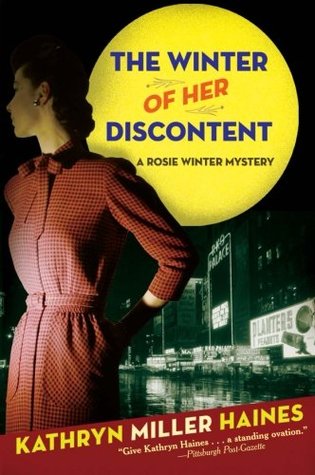 1943, New York. Rosie Winter is an aspiring actress looking for her big break. When a minor star who used to live in the same boarding house in which Rosie now resides is found murdered and her mob friend, Al, claims responsibility she decides to investigate. Convinced that Al is innocent and is taking the rap for other reasons, she auditions for dance chorus with her room-mate, Jayne, in the play the actress had been cast in a leading role. She quickly discovers that the play is backed by a mobster, there is something shady going on in the theatre, and the play is a flop in-waiting. To make matters worse her fellow actresses are on edge and seem obsessed with a Broadway dance hall for service men, and her boyfriend is missing in action. Along with Jayne, Rosie pokes her nose in where it isn’t wanted, trying to discover who killed the actress, whether it’s linked to the strange events at the theatre, and why Al is taking the fall for a crime he didn’t commit.
The Winter of Her Discontent is the second book in the Rosie Winter mystery series set in World War Two. Rosie is an actress with Mob connections who used to work for a detective agency and turns her hand to solving murders. In this outing, set in 1943, her Mob-friend Al has confessed to a murder he didn’t commit and she’s determined to find the real killer. The victim is an actress who was set to star in a Broadway play. Rosie and her roommate, Jayne, audition for the dance chorus so they can investigate. It quickly becomes clear that the play is being set up to fail and someone has a vendetta against the lead actresses. Taking the form of a cosy mystery, Miller Haines spins out Rosie’s investigation, which soon splits into a couple of strands and also deals with tensions in Rosie’s boarding house and her attempt to find out more about her boyfriend’s missing in action status. There’s plenty going on, though it’s a little slow at times, all pretty staged (perhaps no surprise given its theatre theme) and reasonably well telegraphed. I never really warmed to Rosie, the story often teetered on the edge of credibility, and Al’s confession made very little sense given the lack of evidence and he could have just gone to ground instead. Nonetheless, it’s engaging and entertaining enough read.

November 24, 2019
Lazy Sunday Service
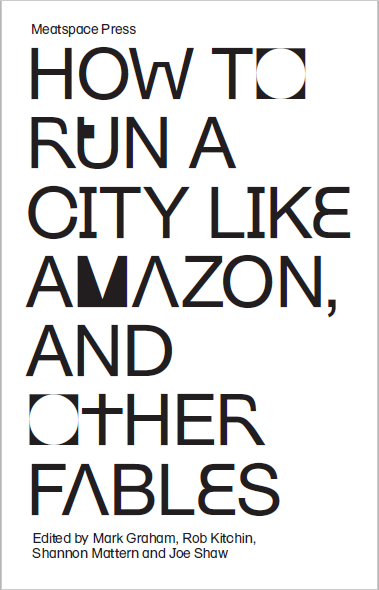 I was updating my CV during the week and it turns out that the 'How to Run a City Like Amazon, and Other Fables' was my 30th academic book published (excluding the encyclopedia, which I'm not really sure how to count), which seems a bit of a milestone. The balance between written and edited books used to be even, but with the last six all being edited it's slipped a bit to 12:18. The plan is four of the next five will be written, so that should help even the keel a bit. Just have to write three of them! (one in press).
 My posts this week
Review of The Honorable Schoolboy by John Le Carre
New book: How to Run a City Like Amazon, and Other Fables
The professional personal
November 23, 2019
The professional personal
‘If I’m wrong, it doesn’t mean you’re right.’
‘Why can’t you just admit that you’re wrong?’
‘I have. Why can’t you?’
‘Because I’m not.’
‘Yet, you can’t prove it and your solution hasn’t worked.’
‘Just give it time.’
‘We can give it a century and it still won’t work.’
‘This is about me, isn’t it?
‘No, it’s not.’
‘You’re jealous.’
‘Of what?’
‘That I’m better at this than you.’
‘Why do you have to make the professional personal? This isn’t about us, it’s about fixing this mess.’
‘You’re the one making this about us!’
‘Jesus, Carl, stop being a dick.’
A drabble is a story of exactly 100 words.
‘Why can’t you just admit that you’re wrong?’
‘I have. Why can’t you?’
‘Because I’m not.’
‘Yet, you can’t prove it and your solution hasn’t worked.’
‘Just give it time.’
‘We can give it a century and it still won’t work.’
‘This is about me, isn’t it?
‘No, it’s not.’
‘You’re jealous.’
‘Of what?’
‘That I’m better at this than you.’
‘Why do you have to make the professional personal? This isn’t about us, it’s about fixing this mess.’
‘You’re the one making this about us!’
‘Jesus, Carl, stop being a dick.’
A drabble is a story of exactly 100 words.
November 21, 2019
New book: How to Run a City Like Amazon, and Other Fables
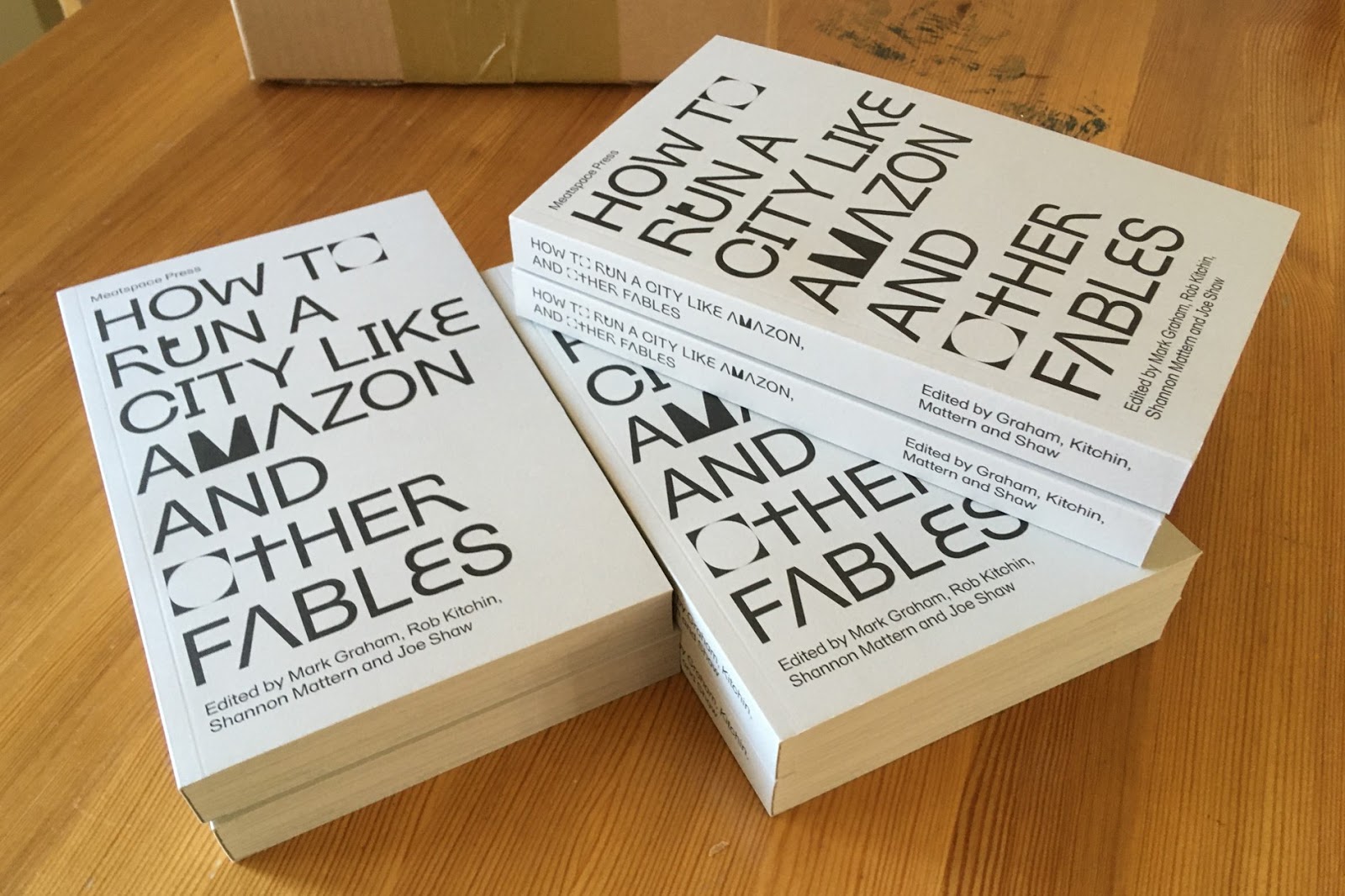 My new book was released a couple of weeks ago. ‘How to Run a City Like Amazon, and Other Fables’ published by Meatspace Press and edited with Mark Graham, Shannon Mattern and Joe Shaw. It is available as open-access download. There’s also a limited print run, with artwork specially designed by Carlos Romo-Melgar and John Philip Sage.
The book consists of 38 chapters, with all but six consisting of speculative short fiction. It started life with one line statement on Facebook - ‘You can probably hear me howling into the void where you are’ - about an article titled 'Cities should act more like Amazon to better serve their cities.' The FB post generated some discussion and sparked the idea for a book exploring the notion of cities run like or by businesses. The post was shared on Friday and by Monday over 30 academic FB friends had offered to write chapters about different companies.
Blurb
Should cities be run like businesses? Should city services and infrastructure be run by businesses?
For some urban commentators, policy-makers, politicians and corporate lobby groups, the answer is ‘yes’ to both questions.
Others are critical of such views, cautious about shifting the culture of city administration from management to entrepreneurship, and transforming public assets and services run for the common good into markets run for profit.
The stories and essays in How to Run a City Like Amazon, and Other Fables explore how a city might look, feel and function if the business models, practices and technologies of 38 different companies were applied to the running of cities. What would it be like to live in a city administered using the business model of Amazon (or Apple, IKEA, Pornhub, Spotify, Tinder, Uber, etc.) or a city where critical public services are delivered by these companies?
Collectively, the chapters ask us to imagine and reflect on what kind of cities we want to live in and how they should be managed and governed.