William H. Russeth's Blog, page 4
April 1, 2011
Historical Battle of Telamon – Wilder Than Fiction
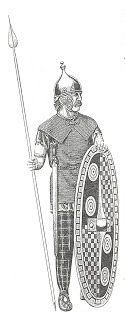
Insubre Warrior
Every now and then, we discover a historical incident more exciting and fascinating than anything fiction and fantasy writers can create. One such event was the historic battle of Telamon, Italy. Telamon is a hill near Pisa where two Roman armies managed to trap and annihilate a huge force of Gallic warriors in 224 B.C. According to Polybius (2, 28-3) 40,000 Celtic warriors from Boii, Taurisci, and Insubres, tribes were slain and 10,000 were captured, securing Roman domination of the area known as Cisalpina Gallia, which was largely northern Italy.
The Celtic tribes from Transalpina Gallia(France) across the Alps joined forces joined forces with the Celtic tribes occupying Cisalpina Gallia and swept into Etruria (Tuscany). The Celts attacked Etruria because they feared Roman domination and saw an opportunity to fill their wagons with Roman treasure. But another reason for the attack may have been encouragement from the Carthaginians. This was during the years of Rome's struggle with Carthage. Several of Rome's Legions were engaged in Spain struggling for dominance with the Carthaginians. The threat at home forced Rome to agree to less than desirable terms, withdraw her legions, and return to Italy to meet the Celtic threat.
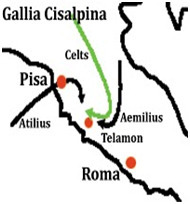 Initially, the Celtic tribes had a free rein, pillaging their way across Etruria, easily defeated Etruscan militias, and Roman legions led by Consul-General, Lucius Aemelius Papus. It looked dark for Rome, and many were certain the invaders would sack their beloved city, just as the Celtic Chieftain, Brennus, had done in 387 BC.
Nothing stood in their way until Consul-Genereal Caius Atilius Regulus returned from Spain, landing his legions at Pisa. Hard luck for the Celtic invaders. Now Atilius' legions were ahead of them and Amelius' regrouped legions were behind them. The Roman vise squeezed tight dooming and the Celtic horde.
What captivated me about the battle was that Atilius was fighting in the front ranks of his soldiers. This was a Roman Consul-General commanding multiple legions, over 20,000 men. It would be like Patton personally leading the charge in WWII. Aitilius, heroically stormed up Telamon hill, leading a contingent of cavalry and ran head on into Celtic Calvary. Sadly, Atilius' reward for his bravery was decapitation, a time honored Celtic tradition. Yes, he his head was taken as a trophy. It infuriated his legions and they continued the attack ferociously. At the end day Rome was the undisputed power in Cisalpina Gallia and this was the beginning of the end for the Celtic world in Europe.
It was such a great story that it inspired me to include it in my novel, Cult of Camulos, which begins with a depiction of this decisive, but not so famous battle. In, "Cult of Camulos", I depict Aitilius having single combat with the foremost Celtic warrior, which is suggested in some accounts, but not well documented. However, it is a documented account of a Celtic Chieftain challenged the Roman general Marcus Claudiau to single combat at the battle of Clastidium three years earlier. Marcus fared better than Aitilius, easily slaying his opponent. Little has been published on the battle of Telamon, but if you are interested in further reading, you might start with Simon James. He presents an excellent account in his book "The World of the Celts".

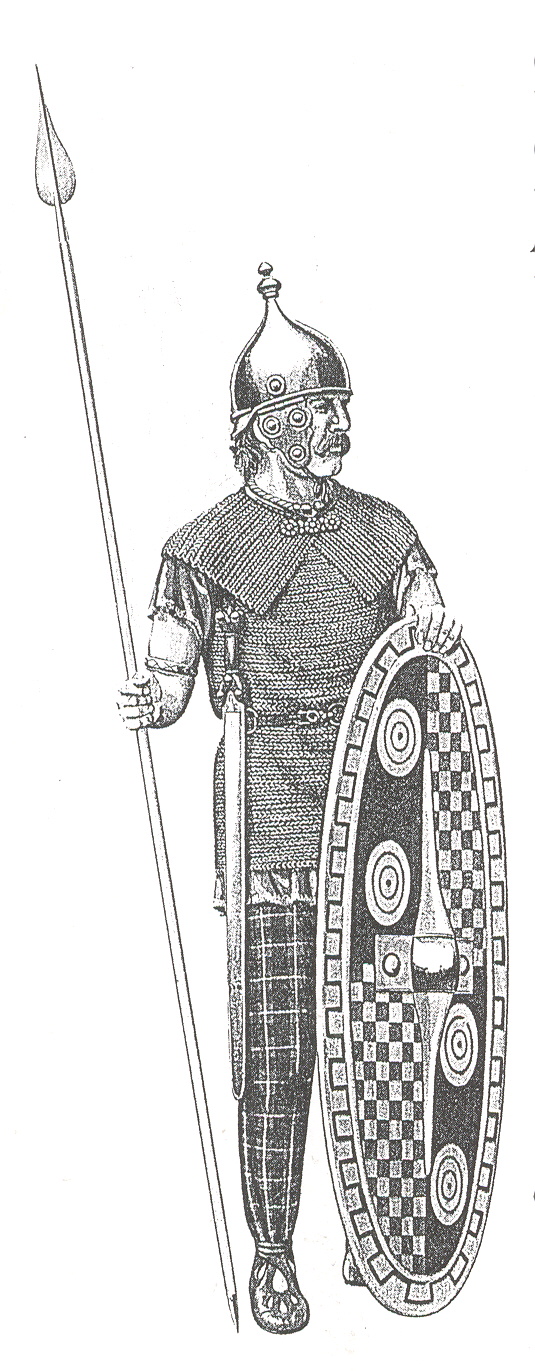
Insubre Warrior
Every now and then, we discover a historical incident more exciting and fascinating than anything fiction and fantasy writers can create. One such event was the historic battle of Telamon, Italy. Telamon is a hill near Pisa where two Roman armies managed to trap and annihilate a huge force of Gallic warriors in 224 B.C. According to Polybius (2, 28-3) 40,000 Celtic warriors from Boii, Taurisci, and Insubres, tribes were slain and 10,000 were captured, securing Roman domination of the area known as Cisalpina Gallia, which was largely northern Italy.
The Celtic tribes from Transalpina Gallia(France) across the Alps joined forces joined forces with the Celtic tribes occupying Cisalpina Gallia and swept into Etruria (Tuscany). The Celts attacked Etruria because they feared Roman domination and saw an opportunity to fill their wagons with Roman treasure. But another reason for the attack may have been encouragement from the Carthaginians. This was during the years of Rome's struggle with Carthage. Several of Rome's Legions were engaged in Spain struggling for dominance with the Carthaginians. The threat at home forced Rome to agree to less than desirable terms, withdraw her legions, and return to Italy to meet the Celtic threat.
 Initially, the Celtic tribes had a free rein, pillaging their way across Etruria, easily defeated Etruscan militias, and Roman legions led by Consul-General, Lucius Aemelius Papus. It looked dark for Rome, and many were certain the invaders would sack their beloved city, just as the Celtic Chieftain, Brennus, had done in 387 BC.
 Nothing stood in their way until Consul-Genereal Caius Atilius Regulus returned from Spain, landing his legions at Pisa. Hard luck for the Celtic invaders. Now Atilius' legions were ahead of them and Amelius' regrouped legions were behind them. The Roman vise squeezed tight dooming and the Celtic horde.
What captivated me about the battle was that Atilius was fighting in the front ranks of his soldiers. This was a Roman Consul-General commanding multiple legions, over 20,000 men. It would be like Patton personally leading the charge in WWII. Aitilius, heroically stormed up Telamon hill, leading a contingent of cavalry and ran head on into Celtic Calvary. Sadly, Atilius' reward for his bravery was decapitation, a time honored Celtic tradition. Yes, he his head was taken as a trophy. It infuriated his legions and they continued the attack ferociously. At the end day Rome was the undisputed power in Cisalpina Gallia and this was the beginning of the end for the Celtic world in Europe.
It was such a great story that it inspired me to include it in my novel, Cult of Camulos, which begins with a depiction of this decisive, but not so famous battle. In, "Cult of Camulos", I depict Aitilius having single combat with the foremost Celtic warrior, which is suggested in some accounts, but not well documented. However, it is a documented account of a Celtic Chieftain challenged the Roman general Marcus Claudiau to single combat at the battle of Clastidium three years earlier. Marcus fared better than Aitilius, easily slaying his opponent. Little has been published on the battle of Telamon, but if you are interested in further reading, you might start with Simon James. He presents an excellent account in his book "The World of the Celts".


March 5, 2011
Visual Wonder - Cathedral at Cordoba
About a year ago, we were on tour in Spain. Of course food and wine was beyond words. Vino tinto and tapas—does it get any better? I was, at least, remotely aware of the most famous attractions before I got there. But one sight caught me completely off guard, the Cathedral at Cordoba.
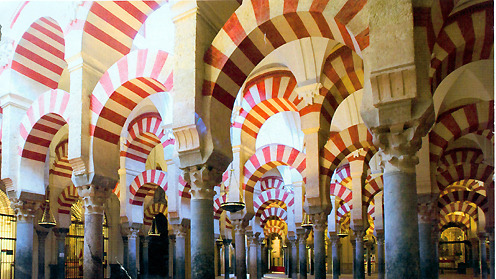 This Christian cathedral was originally built by Visigoths in the 6th century. Moslems demolished it in 785AD and erected a monumental mosque in its place, modeled after a famous Mosque in Damascus. They kept expanding on it and improving on it until it became the mosque of reference and exceeded the grandeur of the mosque in Damascus.
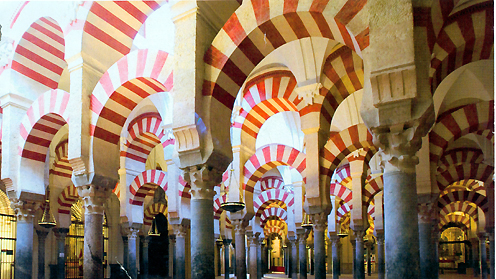
When you step inside the small doorway in the plain brick exterior, your gaping mouth will hit the floor. It is like walking inside an Escher painting the size of a football field. Optically it dazzles your senses--makes you feel like you are looking into a mirror of infinitly reflected images. In every direction you look, beautifully tiled archways recede into space.
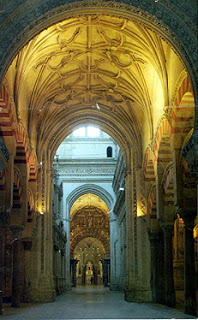 But this is not the end of the story. In 1236, King Ferdinand III reconquered Cordoba. He recognized the beauty and wonder of the Islamic mosque and rather than destroy it, he built a full size Christian cathedral right in the middle of it. When you make your way through the myriad of endless Moslem archways, you emerge into the Christian Cathedral with Gothic arches reaching towards the heavens.
Most my neighbors have been on tour in Spain. Oddly, they all missed the Cathedral at Cordoba. If you are lucky enough to visit southern Spain, be sure to take the side tour and see the cathedral at Cordoba.
 This Christian cathedral was originally built by Visigoths in the 6th century. Moslems demolished it in 785AD and erected a monumental mosque in its place, modeled after a famous Mosque in Damascus. They kept expanding on it and improving on it until it became the mosque of reference and exceeded the grandeur of the mosque in Damascus.
When you step inside the small doorway in the plain brick exterior, your gaping mouth will hit the floor. It is like walking inside an Escher painting the size of a football field. Optically it dazzles your senses--makes you feel like you are looking into a mirror of infinitly reflected images. In every direction you look, beautifully tiled archways recede into space.
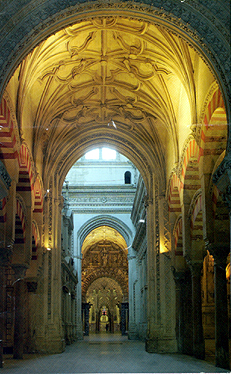 But this is not the end of the story. In 1236, King Ferdinand III reconquered Cordoba. He recognized the beauty and wonder of the Islamic mosque and rather than destroy it, he built a full size Christian cathedral right in the middle of it. When you make your way through the myriad of endless Moslem archways, you emerge into the Christian Cathedral with Gothic arches reaching towards the heavens.
 Most my neighbors have been on tour in Spain. Oddly, they all missed the Cathedral at Cordoba. If you are lucky enough to visit southern Spain, be sure to take the side tour and see the cathedral at Cordoba.
Viusal Wonder - Cathedral at Cordoba
About a year ago, we were on tour in Spain. Of course food and wine was beyond words. Vino tinto and tapas—does it get any better? I was, at least, remotely aware of the most famous attractions before I got there. But one sight caught me completely off guard, the Cathedral at Cordoba.
This Christian cathedral that was originally built by Visigoths in the 6th century. Moslems demolished the it in 785AD. The Moslems erected a monumental mosque in its place, modeled after a famous Mosque in Damascus. They kept expanding on it and improving on it until it became the mosque of reference and exceeded the grandeur of the mosque in Damascus.
When you step inside the small doorway in the plane brick exterior, your gaping mouth will hit the floor. It is like walking inside an Escher painting the size of a football field. Optically it dazzles your senses--makes you feel like you are looking into a mirror of infinitly reflected images. In every direction you look, beautifully tiled archways recede into space.
But this is not the end of the story. In 1236, King Ferdinand III reconquered Cordoba. He recognized the beauty and wonder of the Islamic mosque and rather than destroy it, he built a full size Christian cathedral right in the middle of it. When you make your way through the myriad of endless Moslem archways, you emerge into the Christian Cathedral with Gothic arches reaching towards the heavens.
Most my neighbors have been on tour in Spain. Oddly, they all missed the Cathedral at Cordoba. If you are lucky enough to visit southern Spain, be sure to take the side tour and see the cathedral at Cordoba.
This Christian cathedral that was originally built by Visigoths in the 6th century. Moslems demolished the it in 785AD. The Moslems erected a monumental mosque in its place, modeled after a famous Mosque in Damascus. They kept expanding on it and improving on it until it became the mosque of reference and exceeded the grandeur of the mosque in Damascus.When you step inside the small doorway in the plane brick exterior, your gaping mouth will hit the floor. It is like walking inside an Escher painting the size of a football field. Optically it dazzles your senses--makes you feel like you are looking into a mirror of infinitly reflected images. In every direction you look, beautifully tiled archways recede into space.
But this is not the end of the story. In 1236, King Ferdinand III reconquered Cordoba. He recognized the beauty and wonder of the Islamic mosque and rather than destroy it, he built a full size Christian cathedral right in the middle of it. When you make your way through the myriad of endless Moslem archways, you emerge into the Christian Cathedral with Gothic arches reaching towards the heavens. Most my neighbors have been on tour in Spain. Oddly, they all missed the Cathedral at Cordoba. If you are lucky enough to visit southern Spain, be sure to take the side tour and see the cathedral at Cordoba.
August 16, 2010
Orange Triumphal Arch - Symbolic of Roman-Celtic struggle.

When a book is accepted for publication, it sets off an agonizing search, primarily by the author, for a cover idea. Sure, the publisher hires an artist, but nobody is really in a position to understand what the story is about and what images best convey the content of the book to the reader. The adage about judging a book by its cover may or may not be true, but the cover and a twenty-word blurb are about all you have to convince a prospect to purchase your story.
The other problem is that n...
June 19, 2010
More Ancient or Modern Art
 About a month ago I posted a bit on modernistic art found in the ancient world. That posting jogged my memory of some interesting pieces that I viewed in the Museum of Athens from the Cycades Islands that are near Greece in the Agean Sea. The Cycladic culture was a mysterious Neolithic culture that existed into the early Bronze Age, until about the time that the volcano sunk a good part of Santorini (Thira) in 1490 BC. Not much is known about this culture except that the white sculptures...
June 3, 2010
Stonehenge at Hunt, Texas, One of Two.

About a year ago the Celtic Myth Pod Show ( www.celticmythpodshow.com) had a blurb on the two replicas of Stonehenge that had been built in Texas. One I knew, the one in Odessa, but it is far from my home in Georgetown. It would be like driving from Paris to Berlin. However, I was not aware of the other one, located in Hunt, Texas, less than one-hundred miles away. The morning was bright and my wife was willing (you have to act on those moments). We headed across the winding highways through ...
May 11, 2010
The Harp - Why would Ireland pick such a wimpy national symbol?
 Do you ever wonder why the Irish Harp is the symbol on the flag of Ireland or the symbol of Guiness Beer. I didn't know either until my wife and I went to Branson, Missouri this spring. It is a great place and April is a great time to visit. Traffic is manageable, good seats are available at the shows, and the golf courses were open. We spent a sunny day in Silver Dollar City, which is sort of an amusement park with rides and live shows. One of the venues featured a renowned harpist, Dearbhai...
April 26, 2010
How modern is modern art, really?
What exactly is so modern about modern art? This sounds like a silly question. Everyone assumes that the idea of spontaneous expression, free from the fetters religious and political agendas were phenomena that developed at the end of nineteenth and beginning of the twentieth century. I have a deep appreciation of the things that artists like Picasso and Matisse accomplished, but in many respects their creations resembled works found in much earlier ages.
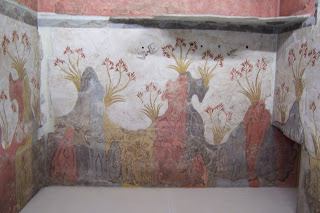 I believe examples of what we could c...
 I believe examples of what we could c...
April 3, 2010
A Little Night Music
 I am not what you would call a classical music lover and when my wife suggested that we attend a Mozart Concert in Vienna, I agreed trying not to show my lack of enthusiasm. I enjoy listening to all types of music, but going to live concerts is not my thing. Why do people spend hundreds of dollars to sit in a torturously hard seat with no legroom to watch their favorite performers on a "jumbotron", because you need binoculars to see them on the distant stage? I am good for about thirty minute...
March 20, 2010
Child-Eating Monster Terrorizes Town
 The town was Tarascon in Provence, France, located on the Rhone River, just a few miles north of the Mediterranean. People of Tarascon swear that in about 46AD a child-eating monster terrorized the town. The people in the region called the monster Tarasque and described the beast as having six short legs, the shell of turtle, the head of a lion, and a scaly tail, tipped with a scorpion's sting. They believed the monster had come from Galatia (Asia Minor). The legend of the monster had been e...