
Rod White's Blog, page 16
February 20, 2023
A call to prayer: Frodo and Sza on Mt. Doom

Frodo’s picture, above, is a call to prayer. Isn’t that how you feel sometimes when you go to God? Hanging off your own cliff?
Frodo is not my favorite character in The Lord of the Rings because I am too much like him. All his problems and struggles seem too close to home to be part of a character.
Our GollumI think my favorite character is still Gollum. Tolkien based him on all sorts of slimy, dark creatures in European stories, and gave us a psychologically interesting being to whom we can all relate. In Gollum we can recognize the parts of us living out in some cave where we exiled them — ugly, unwanted, unacceptable parts lurking in the shadows. We, too, are the Smeagol who might kill Deagol (the Cain who might kill Abel, if just in our hearts) to get the ring of power.
In the story, Gollum shadows Frodo (like he did Bilbo) looking for a chance to get his “precious” back: the ring which had the power to enslave him and deform him. Dark desire for the ring’s power drove him to follow Frodo right to the edge of the fires of Mt. Doom.
On that precipice Frodo is overtaken by his shadow as Gollum is lost in the perverse joy of retrieivng his “precious.” As they wrestle, Gollum falls off the edge, and Frodo almost goes with him. In their wrestling, I see us all battling with our own shadows (as I think Tolkien saw, too), tempted to give in to our lust for power and self-sufficiency when we are called to love and community. Frodo almost lets himself go into the lava – you might be feeling that look in his eyes right now.
In case you think this LOTR stuff is a topic that got beat to death 20 years ago, I refer you to Sza wondering how her shadow took over in Kill Bill. I had to laugh when I first heard her clever song. But then I watched the video [not suitable for any ages] and wondered why she let go.
Our SamMy second favorite character in The Lord of the Rings is Samwise Gamgee. Tolkien called Sam the “chief hero” of the saga, adding:
I think the simple “rustic” love of Sam and his Rosie (nowhere elaborated) is absolutely essential to the study of his (the chief hero’s) character, and to the theme of the relation of ordinary life (breathing, eating, working, begetting) and quests, sacrifice, causes, and the ‘longing for Elves’, and sheer beauty.
If Gollum is Frodo’s shadow, Sam might be his idealized self. The former being his shameful parts, the traits and feelings that our family and community would rather not have us deal with. The latter being the part of us that only admits to having good and admirable qualities even though this might not be true. In between the two hangs Frodo, now missing a ring finger, wondering if a true self is even possible.
As Gollum is burning up. Sam looks down on Frodo with love and hope. (Who would not like to be as free and loyal as Sam?!). Frodo is hanging by his fingertips, trying to find enough strength to lunge for Sam’s hand. It is definitely a Christian story! You may have been in that scene too. At least I hope you were on the edge of transformation some time and thought, “I must ‘lay hold on that for which also I was laid hold on by Christ Jesus.’” (Phil 3:12)

The other reason I like Gollum and Sam is the collaborative effort they make with Frodo. Life is a group effort. We have a collection of selves inside to coordinate. We also need help from other people to get anywhere in a human/spiritual life. I can’t help but think Tolkien might see them as a prayer group, the two or three gathered in His name.
It is easy to see how Sam is crucial to Frodo’s effort. Without his friendship, all of Middle Earth would be taken over by orcs! It is harder to see what Gollum has to do with the success of Frodo’s quest, but his negative motivation also ends up being used for good. There is a lot going on with us, which is why the prayer of discernment in so important. Frodo is, in himself, a little community inside and he travels in one outside – so are we and so do we. We all need to pray to figure out who we are now, how we belong, and where we are going.
The quest to Mt. Doom is not just about what is happening inside Frodo (or you) it is also about what happens in the group. Three people went. Their journey went forward just like the familiar Akan proverb:
It is because one antelope will blow the dust from the other’s eye that the two antelopes walk together.
They do not know where they are going, how they will complete their task, or whether they will die before they get there. They need individual and group discernment, none of which is easy to find. Sound familiar? We need awareness of all our parts to be our true selves. And we need our brothers and sisters to get to our awareness — they blow the dust out of our eyes. Frodo gets to see the self-destruction of his avoidance and invisibility in Gollum and sees the possibility of love and honor in Sam. As he bravely stays on the path of his destiny, he becomes himself.
Our prayerWhen we are discerning the presence of God in our lives it is wonderful to sit face to face or in a circle where the caring love of God is respected. As our companions question, challenge or simply hold us in prayer, they blow the dust from our eyes and we recognize the leading of God’s Spirit. Sometimes they might clarify our vision with their insights, but most of the time they just lend us support as we claim the truth we see and commit to its implications for our lives.
It is a dusty world. Seeing what God gives us to see is not always easy. It takes serious living to discern, to perceive clearly and judge accurately. We have to sift through a lot of illusion to discover what is real. That is just what Frodo had to do, isn’t it?
Poor Gollum! He gave up sifting and lost his name! His sense of self was bent. He was stuck in avoidance. He loved the power to make himself invisible. The ring of power finally killed him (Poor Sza!). Our unacknowledged and unloved shadow parts often drive us the same direction. We may not fall into lava, but our true selves might be invisible, even to ourselves.
The whole drama on the precipice seems like a replication of what a good time of prayer might look like. We are often wrestling in the presence of God. And what transpires is often a matter of really living or falling into some abyss.
Prayer, with the community within or without, is love for God in action. For me it is often love for God in inaction, in silence. But it can be taking a walk or walking with a friend. It could be five minutes of centering at work. For some right now it is all night in their seminary chapel. It could be a pause to listen to geese returning, or sorting donations at the thrift store.
Prayer fine-tunes our hearts to hear the prayer of God in us, to feel God’s desire for us. After a journey in prayer, we may come to live out of that desire in all of life. As we pray, our attachments (our rings) are soon easier to recognize and we are freed to latch on to the hand reaching to save us.
The post A call to prayer: Frodo and Sza on Mt. Doom appeared first on Development.

February 13, 2023
Slander divides: Six ways to overcome it
Trump unleashed a slanderfest and it is the one “trickle-down” principle that seems to be working. I have experienced it and a remarkable number of my clients and acquaintances in the church have experienced, it too.
Slander is not, “Someone told the truth about me and I did not like it.” That may be impolite, if they have not warned you how the truth might hurt you, but it is not slander. Slander is “character assassination.” It is when you tell a lie, share an unproven statement as fact, or provide innuendo that demeans someone’s character. In the most public sense, such damage is actionable. But slander mostly happens in small systems like the office or the church where leaders are controlling the narrative or where leaders are being taken down by unhappy or ambitious subordinates. Slander is a weapon in everyday power plays. It would be easier to recognize if everyone who wields the weapon knew they were doing it, but people believe lies and spread them as if it is righteous to do so. They also get caught in systems that will hurt them, too, if they don’t follow the latest party line/lie.
The Bible repeatedly teaches about the importance of words and the deadliness of slander. In Proverbs 16:28 it says “A perverse [person] spreads strife / And a slanderer separates intimate friends.” Slander is the spark that lights the fuse of gossip which can blow up a reputation and divide whole systems.

It is acutely painful to be slandered, and pastors and ministry leaders are particularly easy targets. An acquaintance recently attended a church meeting at which 20+ pages of anonymous criticism of them was distributed but nothing from other people who had submitted glowing praise. Another was subjected to a secret collection of hearsay about their interactions in the office and was demoted even though the investigation was never concluded. If you have been an influencer or manager for a while, you have likely had someone publicly attack your character based upon some action or word they misconstrued or based upon their perception of something you did. It can be devastating.
Noting someone’s unhealthy behavior, as you see it, is part of sorting out relationships. Questioning the value or validity of someone’s judgment or methods is part of improving a mission. Everyone needs feedback and probably needs to be saved from their worst traits, at times. We all deserve the respect to receive such words of “constructive criticism” within a trusting relationship — and we all need to stay open to those words, even when the process is imperfect. But character assassination is quite a another thing. If you watched the State of the Union address and listened to the aftermath, you probably felt, like I did, the country seems to be simmering in slander. The political arena, social media, workplaces, associations, marriages all seem ready to boil.
The last place in the Bible where slander is directly mentioned directly is 1 Peter 3, where he teaches:
Make a defense to everyone who asks you to give an account for the hope that is in you, yet with gentleness and reverence; and keep a good conscience so that in the thing in which you are slandered, those who revile your good behavior in Christ will be put to shame.
The way to that grown-up faith leads through a battleground for our souls as we trip over the slander thrown in our paths. Even so, the journey can be transforming, if we don’t let slander rule us. Here are steps to take toward a transformed destination.
If you are slandered, feel itNot too long ago, I heard of an incident when someone again slandered me in public. Thank God they were doing it in a very small pond, but the nasty water lapped on my doorstep. I was angry. I think that’s a natural response to being violated. I was hurt so bad I shook with emotion. I’m not ignoring those feelings right now, even though writing about them is painful, because ignoring emotions increases the likelihood they will find an unhealthy road to travel out of their warehouse. Be angry but do not sin.

If we can acknowledge our emotions and respect them as they pass through, we won’t be tethered by the slander that aroused them – at least that is a possibility. It is better to stay anchored in who are and in what we have been given to do.
Slander is so divisive it can make us doubt ourselves. A ruthless liar can make us doubt we even know our own truth! In the midst of chaos, especially the emotional chaos triggered by slander, we must anchor in what we know is true regarding who we are, what our convictions are, and what our mission in life is. Otherwise, we will be tossed around like a small boat in the middle of a storm.
If a cloud of slander comes down on you, it makes sense to get some practical distance. Don’t jump into an argument (like Facebook is still famous for). You might want to quarantine calls from people who will keep stirring you up.
Distance yourself emotionally too. Notice if you are ruminating on your injury or falsely being ashamed of yourself. One person I know was slandered and wouldn’t show their face in their small town for a month! The sooner we accept we can’t change what has happened and move into new territory, the better. Part of moving on might be connecting with anyone who may have been affected and explaining your situation no matter how embarrassing it may seem. Tell the truth about the lie and let it pass.
Check your perceptions and sourcesOne time a person felt slighted by the church and somehow got their dissatisfaction reported on in a local paper! It caused a small cyclone of recrimination and fear about our reputation. That’s what slander does and why it is such a favored tool among power-hungry people.
Before you jump to conclusions and take some vengeful action on such people, make the effort to confirm you actually know what happened. Obviously, people get misquoted in the media all the time. And gossip is not a reliable source of facts. If you can talk to the source, that would be ideal (see below). If you question what people are telling you, you might discover it is not the worst you imagine.
You can try contacting websites where slander is posted and ask them to take it down, but you may find some will demand cash and try to bully you into signing up for useless programs to “repair your reputation.” A lot of those sites are run by borderline “scammers” themselves. Some lawyers specialize in removing lies.
Stand up for yourselfYou may need the law to help you. [Here is an explanation of the Pennsylvania defamation law]. When I was defrauded by a contractor in 2020, I looked into a lawsuit. The lawyer I consulted was kind enough to tell me it would cost me much more than I would ever recover if I received anything at all. The defamation law is mostly for rich people, too.
It is not a good idea to just roll over and let a slanderous person roll over you. But fighting fire with fire might not come to a good end, either. For instance, if you get involved in addressing all the accusations in public, it might just feed the fire. You might unwittingly validate the lie and the liars by treating them with undue respect. But telling your story can make a difference. At least tell people with sympathetic ears what the truth is and let it have whatever effect it will. Don’t bottle it up.
Don’t let slanderers steal your joy. A slanderer needs that kind of power. They weren’t speaking a love language. It is not totally your fault they hurt you. If a person wants to bring you down and make you feel bad, there must be something wrong with them. So don’t live as if their lie deserves to preoccupy you. Go out on the town, hit the gym, or do whatever you enjoy doing. Don’t let go of your accomplishments and happiness.
Gently confront the slanderer (not by text or email)It’s amazing how often people engage in the sin of slander without realizing it. Therefore, the most loving thing you can do for all parties concerned—including the slanderer—is to gently, lovingly confront them. Such a conversation should be done in person, not over email, text, phone, or social media. In certain situations, it might be helpful to bring a friend or an outside party trusted by both of you. But it is probably best to begin by going alone (try Matthew 18!). Bringing someone else in too quickly can escalate the situation.
It’s important to go in “a spirit of gentleness” (Gal. 6:1), and not put the other on the defensive with a fault-finding or accusatory tone. Here are two ways to do this:
Begin with questions. This enables you to get all the facts before arriving at any conclusions, and it’s less confrontational. But don’t shy away from using the word “sin” and “slander” if that’s what it is.Express vulnerability to the slanderer. This is easy to overlook since it’s not our natural tendency when dealing with someone who has hurt us. But sentences which begin with “I felt sadness/pain when…” rather than “you sinned against me when…” are more likely to “gain your brother/sister” (Matt. 18:15), which is the most important goal. Amazingly, because some people slander without realizing it, they’re genuinely surprised they’ve hurt you. Starting off with sharing your heart rather than with accusation can de-escalate the situation and produce a peaceable result.It’s awkward and scary to confront someone. But if you can, it is better. Some people see the straightforward approach of Matthew 18 as impossible for disempowered people who have a lot to lose when confronting a person in power. But I don’t think Jesus was talking to people who could go toe-to-toe with their overlords, either. To be honest, this option may not be open to you at all, since slander is often accompanied with being cut-off, these days. The ultimate slander is being “cancelled,” isn’t it? Nevertheless, if you have the context it would be best to “overcome evil with good” (Rom. 12:21).
If you can’t get repentance and reconciliation at least exercise forgiveness. If we forgive those who slander us and don’t participate in their cut-off, we are less likely to be trapped in bitterness and more likely to be released into the freedom we need to make healthy decisions with a clear mind.

It’s sometimes right to to defend your reputation against those who have slandered you, especially if you are in a leadership role and the slander damages the business or mission. But it is often better to stay silent and let truth be your advocate in the long run. If you don’t have the character, defending it won’t make much difference, but if you do, it will probably have staying power.
Even if you do need to defend yourself, give it some time. Don’t panic. Don’t explode. Don’t be guided by fear. It is hard to say whether Paul is defending Jesus and his mission or himself (or if he should separate the two) in 1 Thess. 2 and 2 Cor. 10–13, but I can’t remember a time when defensiveness ever built love.
Slander sets off our fear and a slew of “what ifs.” But most people who hear slander can smell it. And even if they are too afraid to shout it down, they probably won’t move with it. The famous Spurgeon said: “A great lie, if unnoticed, is like a big fish out of water—it dashes and plunges and beats itself to death in a short time.” He hasn’t lived through the Trump era, but he’s probably right.
Even if our good character does not “win the argument” for us, it is better to trust truth than just fearfully fight lies. After all, it’s in the context of being maligned that Jesus says, “Have no fear of them, for nothing is covered that will not be revealed, or hidden that will not be known” (Matt. 10:26).
It takes humility to trust, especially when we feel humiliated. Since we know all things work together for good in Christ we should give it a try. We might humbly think we could learn something from being slandered. There is probably a seed of truth in the lie, or it would not be effective. You did not do everything right. You may need improved skills. You may need better boundaries. You might recognize a ticking time bomb next time. You might see how you were codependent with a toxic person.
Even as I am letting the slanderer pass through and out of my mind and emotions, I wish them grace, I love my enemy. And I don’t make my prayer the means of their repentance as if they should dominate that, too! Just last night I felt I was getting somewhere in this as I woke up from a dream in which I was sitting down at a table and one of my enemies was chatting with me like we were friends. My insides were definitely recovering!
Be a transformed victimTim Keller is famous for saying, “In Christ I’m not just more sinful than I ever dared fear, but more loved than I ever dared hope.” In Christ, each of us is a beloved child of God; right now the Spirit of God is praying for us. Jesus was slandered and killed by his enemies. He’s OK and we will be too.
I wrote the Senior paper for my history B.A. on George Whitefield. Here he is with his famous dramatic flre to make a good point to end with:
Let the name of Whitefield perish, but Christ be glorified. Let my name die everywhere, let even my friends forget me, if by that means the cause of the blessed Jesus may be promoted. . . . I am content to wait till the judgement day for the clearing up of my reputation; and after I am dead I desire no other epitaph than this, “Here lies G. W. What sort of man he was the great day will discover.”
I can almost guarantee that Whitfield did not completely think or feel all that he said. But, like me, he certainly intended to. I feel I’m good with Jesus. I feel bad when others lie about me, unjustly accuse me, or don’t bother accusing me at all and undermine my reputation in secret. But in the end, it is always being saved by grace that matters.
If you’ve got some feelings or insight about this, please leave a comment or two. Do you agree we are simmering in slander in the U.S.? Have you experienced some of it? What are you doing to recover that works for you?
The post Slander divides: Six ways to overcome it appeared first on Development.February 6, 2023
The Spirit of God is praying for you
There are a lot of Christians who have played hide-and-seek with God ever since they decided to follow Jesus and be part of the church. God seems very hard to find, and some have given up looking.
One of the main reasons they give up is they were taught it is very dangerous to live “outside God’s perfect will.” Their faith has been preoccupied with looking for that will but feeling uncertain they ever found it. I got this training early on, and it weighed on me, too. I secretly did not know what God’s will might specifically be in any given moment and I secretly thought, as a result, I was not in it. I say “secretly” because the church was preoccupied with rounding up those straying from God’s will and I preferred looking like I was in the fold.

I rebelled against that teaching early on. But I regularly meet people in my practice who have lived in it their whole life. Many continue to anxiously turn to the means the church provides to learn this will: 1) preaching and teaching, and 2) Bible reading. But their experience of those means usually leaves them alone to wrestle with the data and conform their ways to God’s will, as they were taught it. They feel uncertain they are performing properly and go back for more of the treatment that is supposed to make them feel certain.
I meet many people who have done a sincere job with this method, which is better suited for children, but have been left with an adolescent faith which cannot, effectively, withstand the trials of adulthood. By the time they get to me, they have come to the end of the left-brained faith they learned and are looking for a deeper experience of themselves and God. I can relate; in my teen years I was blessed with an out-of-order youth pastor who introduced me to life in the Spirit. I discovered a deeper way of life in Christ was hidden in the same Bible which had been used to lock me into a set of principles functioning as an external locus of control.
Among the many teachings in the Bible that lead to an internal sense of belonging and safety is this small snippet in Paul’s letter to the Romans:
Likewise the Spirit helps us in our weakness, for we do not know how to pray as we ought, but that very Spirit intercedes with groanings too deep for words. And God, who searches hearts, knows what is the mind of the Spirit, because the Spirit intercedes for the saints according to the will of God. (Romans 8:26-7 NASB 1995)
Metaphysically, those sentences provide endless fuel for arguing oneself into confusion and avoidance. But the plain meaning, experientially, though mysterious, is not that hard to understand. The Spirit of God is praying for me. Jesus came to find me, and the Spirit of God is personally making sure I feel found.
Rose Mary Dougherty on the deeper way of the Spirit Rose Mary Dougherty (1939-2019)
I read Rose Mary Dougherty’s old book on Group Spiritual Direction while on retreat last week and she kept referring to these verses in many helpful ways. Here’s one:
It is in the loving presence of God that we come to be discerning. Prayer, then, is the starting place of discernment as well as the atmosphere in which it happens. Prayer for our part is our way of honoring our relationship with God. It fine-tunes the heart to the prayer of God in us, God’s desire for us. Gradually we come to live out of that desire in all of life.
The Spirit is praying for me. Knowing God is a lot more than knowing what to do or doing what your told. In the translation from Romans 8, above, you could get tripped up if you misunderstood the phrases “the mind of the Spirit” and “the will of God.” Dougherty uses the more right-brained “heart” and “desire” to teach what it is saying. The prayer of our hearts tunes us into God’s prayer in us. The Spirit unleashes our deepest desire to connect to God; the way is not about quashing desire for fear of what imperfection it might connect to.
I looked up Romans 8 in Greek and I think Dougherty has a better feel for what Paul is saying than the scholarly men, for the most part, who have been in charge of the most popular Bible translations. In Romans 8, Paul is definitely talking about living up to our new destiny, so exploring how God thinks and how she thinks of us makes sense, and understanding what God wants from us is relevant. But it is a mistake to make those things most relevant. Nevertheless, the translators wrote their emphasis right into the translations! I think you kind of need to skew the Greek to make it come out the way they do.

I was moved by how Dougherty refocused people who want to get beyond a constant argument in their mind by emphasizing the revelation that the Spirit of God searches our hearts in love to find ways to bring us into goodness. We are naturally way in over our heads when we seek God. But God knows we are. Prayer is all about discerning the presence of God who is constantly praying for us, connecting us according to God’s desire to be with us and God’s hope to see us flourish. Emphasize that and growth, security and deeper understanding follow.
Here are three more quotes from Dougherty which helped me keep my prayer oriented towards presence rather than lapsing into a critical assessment of my weakness.
In prayer we open ourselves to God’s gaze, looking with God at God’s desire for us; our desire for God, noticing how our prayer reflects these desires.
I almost always see this gaze as me looking into my mother’s eyes as a baby. I think there is even an old picture of her gazing into mine. I know people who visualize God “searching our hearts” like a spotlight from the top of a prison wall, because they are looking at themselves through a critical lens. But that critical impulse is mostly bent desire, the desire to be known as someone good and lovable. Prayer undoes the condemnation we carry, just like Paul begins chapter 8, “There is now no condemnation for those who are in Christ Jesus. For the law of the Spirit of life in Christ Jesus has set you free from the law of sin and of death.” Emphasize that.
Dougherty’s understanding gives us a place to look for God outside our “mind.”
We might be helped to recall times when prayer rose spontaneously in our hearts. Then we might remember what we already know, that prayer is God’s initiative, that God indeed has already taken the initiative in our hearts and our hearts have responded.
It has been my deepest delight in 2022 to witness a few people come to the realization that God has always been with them. They had been so consumed with pleasing God and avoiding their horrible shame they never felt God loving them. But they feel loved now, and a great joy is growing in them. It is like Dougherty says:
As we join the prayer of God within us, our defenses and our images of ourselves are gradually chipped away; we begin to know ourselves for who we are in God – beings who are loved very much, who are invited to become who we really are, beings in love.
Teilhard de Chardin affirms this when he says of human beings, “Driven by the forces of love, the fragments of the world seek each other so that the world may come into being.” When people live in God’s presence and come together to share in it and tell their life stories, they change and the world changes.
Alongside the evils the Trumpish people of the world have unleashed these days, especially taking opportunity through the pandemic, an amazing desire for sincere, unalloyed faith is also springing up. The groaning of creation is in synch with the groaning of the Spirit as God continues to die and rise with us, and us with God. Even when we don’t know what to do, we can’t discern what is right, and we don’t even know how to pray, the Spirit of God is in us, for us, and interceding with us according to God’s loving will and hope. Let’s emphasize that so we never forget it, even when what’s coming at us tempts us to doubt such a wonder is even possible.
The post The Spirit of God is praying for you appeared first on Development.January 30, 2023
The wonder of being saved: A collection of ways
I’ve been improving my EMDR skills and enjoying the process of helping people install “safe places” to which they can return when the trauma they are processing feels overwhelming. We also imagine nurturing, wise, or protective people who can be called upon to help in the lonely process of bringing up dreadful past experiences — trauma stuck in the deep parts of the brain and then inexplicably triggered and replayed as if they were happening in the present. Feeling safe is strangely uncommon, it seems. Welcoming new feelings of being nurtured, helped or protected, or imagining those feelings if they are hard to recall, can be very useful for healing.
The wonder of being saved It is not easy to be healed. Many people have despaired for a long time of ever being saved from what troubles them. When we watched The Whale the other day, Brendan Fraser’s character really did not want to be saved. And his long lost daughter did not want to be saved by him. The rain-drenched missionary who came in with salvation was soundly berated. Even after the unexpected forgiveness of his parents came through, he was still vilified. The movie is like Captain Ahab pursuing the whale of personal meaning and Moby Dick tangling him up in his own futility.
The lessons of the movie made me wonder what people are learning these days. If The Whale is indicative, they can’t be saved and they can’t save. But they don’t have the resources to save themselves. All they can do is avoid the pain hard, even when they thirst for meaning. Trauma therapists all over the world are working overtime to get some tools into their hands. Quite often their collaboration saves them. Just don’t tell the philosophers of the day such a thing is happening.
As the movie ended, I had to stop and thank God for saving me. For some reason, from an early age, I never thought it was reasonable to think I could save myself. The numbers just did not add up – what was required overwhelmed that with which I was equipped. Just before I typed that sentence a person texted me and reminded me of a lunch we had 20 years ago, which I completely do not remember — don’t even have a face. But they buzzed in to connect because of a piece of advice I gave them when they were in college. They never forgot that, given the way they work, they would never have faith if they just approached it intellectually. They needed the grace of God in Jesus.
I had to stop and thank God for saving me. I was reminded that the skills I am teaching people to help unravel the trauma that ties them up are skills I was taught by God and his people long before I knew about EMDR, or psychotherapy for that matter. As I remembered all the ways God has provided me safety and security, I came up with something of a memoir of the riches of faith I’ve received. I keep seeing how they not only work in conjunction with psychotherapy, they work much deeper. So often they have been blessing me long before I become aware of them.

I thank God for the healing presence of compassionate psychotherapists. I am grateful even when they act like they discover things God-fearing people have always known, then codify them like they belong to science, and then sell them. They encourage me to see what I have been given in new ways as they repackage old truths that are new to their clients. I’ve learned so many of their lists of “tools” I decided to make one of my own. These some of are the ways I have been saved and I am being saved.
Breathing – Deliberate breathing/mindfulness is central to reducing anxiety and becoming attentive to our capacity to develop. It may have been Father Keating who opened up this practice to me. Now, every day, I spend some time centering and opening my heart by first attending to my breathing. At this point, I am usually sensing my place in God’s presence as soon as I intentionally inhale.
Imagining – I love how EMDR practices require people to use their renewed imagination as a tool for overcoming their trouble. That was a central element of my prayer in my thirties when I needed to be healed and encouraged to grow.
Recalling people, places, experiences – People overcoming trauma search their souls for anything that can be a resource. Sometimes they have drops of water in the desert and it has to be enough for now. When I look back on my life of faith there are hundreds of people to call on, living and dead, who have made my way sure, I am even confident about the future! I have countless experiences of faith, hope and love to call on. It is all an amazing collection of riches.
Wildly good waysI decided to list ways of being saved because even some of my spiritual direction clients do not know about them. And really, why would they? The atmosphere in which we live gives birth to movies like The Whale in which people are stuck, stuck, stuck and defending their right to be hopeless and self-destructive. But even now, there are wildly good ways to exprerience the life beyond our ways.
My place: Tomorrow I will sit down in the chair in which I pray, study and meditate and enjoy God’s presence. Maybe I will decide to taken my kneeling bench out and kneel before my icon wall where significant art and symbols come around me like nurturing, wise friends and teachers.
Beads: At some point I may take up my new Anglican prayer beads and pray through my own “rosary,” remembering family, friends and clients.
Journal: At some point I will take out my journal, note my thanks, note the signs of God in the past day as well as acknowledge my sins and then ponder the events and challenges of the new day with God. I might sing.
Direction: Last week I visited my spiritual director and had the benefit of a kind mirror questioning my story and pulling me toward the guidance he could see. I also enjoyed the company of men in my new spiritual direction group as they inspired me with their sincerity and vulnerability.
Retreat: This week I hope to take a retreat. These experiences are central disciplines that have marked my life in the Spirit for decades. Dedicated time alone with God gives me space to hear and rest and hope in new directions. Part of what I will do is remember what has happened during the last quarter and see how I have been accompanied.
Church meetings: Being part of the church meetings and enjoying group worship used to be my central weekly discipline as well as a way to appreciate the historic Christian calendar. I am in between congregations at the moment. But slowly, much larger ways to be the church as well as much smaller ways are proving satisfying.
My brief listing of the riches of my life in the Spirit is hardly about all my accomplishments. I made the effort to show up, of course, but mostly I responded to the whispers and wooing of God’s grace. Beyond the traumas of the world and my own injured sense of self, there was God providing security and reinforcing love. When I meet up with people who have not experienced these riches yet, I can’t judge them. My journey can’t be explained and theirs doesn’t need to be either. I wonder at my blessings and can feel how deep the darkness would be if I lived without the ways of salvation.
The post The wonder of being saved: A collection of ways appeared first on Development.January 23, 2023
Group communication “sad?” Try on some Virginia Satir.
I was in a group meeting with some wonderful people the other day. As I reflected on it this morning, I remembered Virginia Satir. She is often called the “mother of family therapy.” As a doctor of marriage and family therapy, she has done a little mothering of me, too. You can read her Wikipedia page for interesting details. Today I just want to share two things she offered the world that would improve most of the groups we are in: workplace, family and the beleaguered church.
 Virginia Satir (1916-1988)Tell your own story
One of the things that made me think of Virginia Satir is the fact I was sounding a bit like her in our group. We were group of Christians from around the country reflecting on a new statement about how to follow Jesus these days. (I’m reserving the name of the group because it is not the point). Like Satir, I was trying to encourage people to tell their own stories with confidence, not worrying what someone else might be thinking all the time they are sharing.
Virginia Satir knew how to share what she had to say. I have always admired her for creating a theory and forming a school of thought to explore her insights, even though, as a woman in the 1960’s to 80’s, as soon as she raised her voice, people called her “tyrannical” and considered her theories “unscientific.” She used her theories in her therapy and taught her disciples anyway, and we are still appreciating what she created.
I don’t think I agree with some significant things in her well-known declaration of self-esteem: “I Am Me,” but I am thrilled with the spirit behind it. My comrades in our group had brilliant things to say, but the present atmosphere in which we live and the captivity of recent Christianity to modern thought induced them to pose most of what they said in relation to an imagined opponent or a critical expert. I think we should all begin, as Satir encourages us to do, with “I am me and I am okay.” Especially if one is in Christ and can say, “There is no condemnation in Christ Jesus, no fear; in the Spirit I am who I am.” We don’t need to make an argument all day, even if people who don’t love us are out there somewhere, supposedly ready to take us down.
There is room for a good argument, of course, even gainst “straw” opponents. Working out common goals allows us to come from all sorts of places and end up on a mutual path. It usually takes some time and effort to get to harmony — and presenting my sacred opinion, standing alone with its chin up, is rarely the best place to start. Instead of setting up an argument with how we talk and act, I think we should begin with our own story and receive another’s and so allow our vulnerability to seed the group (and the world!) with the possibility of real love.
Be aware of your communication styleSatir continues to be well-known today for her five communication styles. By now, you probably know your Myers-Brigs letters, your Enneagram number/wings and all sorts of other labels that might chafe like a wool sweater sometimes. Satir’s labels came from observing families and seeing the same patterns arise again and again. She generalized the variations so people could consider how to make one another better humans, not just clutter the family system with dysfunction and debilitating pain.
As we went through our group the other day, I periodically got a glimpse of myself putting on one of these communication styles or fending off, in my mind at least, some dysfunctional style from someone else. Our group was super polite and not that intimate yet, so we were not treated to anything extreme. But our process made me wonder how the church keeps going when we are often stuck in the four less-functional styles of communicating and often despair of getting to the best style (Or think we are already best, but no one will tell us we aren’t because they think too poorly of themselves to reveal their experience!).
 I aspired to be a “leveler” in the group according to Satir’s model. The leveler is “congruent,” meaning their internal states match what is communicated externally. For Satir, that means they are OK being themselves and are open to others being themselves. They are aware of self, other and context in a way that allows them to mentalize about what is happening instead of just reacting out of fear. In the chart (that blurry thing at the left), the leveler’s stance s open, arms welcoming, legs relaxed, and their facial expressions and tone match their internal state. We are not all likely to be the “non-anxious presence” we hear about all the time, but trying to stay aware helps a group stay connected, even when times are hard. Satir followers often quote the Roman poet Horace to that end: “When things are steep, remember to stay level-headed.”
Satir had first hand knowledge of how communication styles could hurt. In the “family” of the first family therapists, the blamers accused her of all sorts of things, the placaters fawned over her, the rationalists were disappointed that she did not come up with a theoretical model to meet their expectations, and the distracters considered her irrelevant.
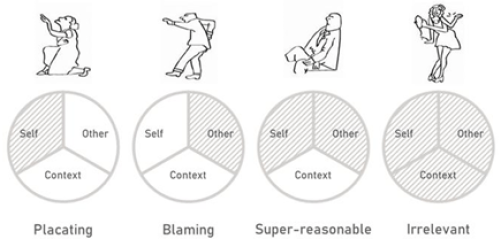
You may have had the same experience during a Zoom call for work this week, or in a small group of the church, or at your family dinner table. I was having a little taste of all the dysfunctional styles coming at me in my group the other day (and coming from me, too!). In the chart above, you can see that each style is missing congruity with something — and irrelevant misses them all!
The four off-kilter typesBlamers defend by pointing the finger at someone else. They use words like “you should have” or “if you would try harder, then I wouldn’t have to…” or ” I do it right so this couldn’t have been my fault.” Most Christians are clever enough to do this subtley. They would be more likely to quote the Bible or the latest critic of the church to put you in your place, which leaves them blameless. They set an atmosphere on edge.
Computers (the super-reasonable or rational) often position themselves with their arms crossed and use super reasonable words, like “I tried to tell you”, or “according to so-in-so.” or “when we last had this discussion.” They defend by ignoring feelings and other information, relying on logic to sound all put together. In the chart above, they are all context, but not personal or relational. They make an atmosphere feel distant or cold.
When I get around a group of Christian leaders, it is often the blamers and computers versus the placators and distracters. That might just be the way of all flesh. But it also might be becasue their family systems operated like this. Married couples are more likely than not to have a “pursuing” partner and a “withrdrawing” partner. The withdrawers often have communication styles like placators and distractors. Truth without love kills. Love without truth lies.
Placators defend by trying to marginalize conflict in order to protect themselves or stabilize relationships. They sound like “please, won’t you just listen” or “now, it wasn’t that bad,” or “I don’t want to fight,” or they just stay quiet, sometimes letting their facial expressions say what they are not willing to put out there. I was on Zoom the other day with my group, which is a good venue to observe how faces tell things people are not yet willing to say. The make the atmosphere a bit unreal or desperate.
Distracters (the “irrelevant” style) attempt to derail the conversation when they are uncomfortable. Their postures are more like rapid movements, or laughing at inappropriate moments. Words they use sound like “not to change the subject, but” or “did you see that new movie?” Maybe more, they feel so irrelevant or are so irrelevant to what is hapening they can’t keep their attention on it, they are easily distracted. I think people kept shutting off their video during our meeting the other day because it was hard to keep up the energy it takes to connect that way. I took a phone call from the City of Philadelphia myself. The make the atmosphere feel insubstantial, even shameful.
Being a leveler is hard. It is a lot easier to stay reactive and most of us prefer that, even when we feel called to love our neighbors as ourselves. Virginia Satir believed if we would all get congruent and live as levelers, world peace would be ushered in. As soon as she said that, she was criticized for being a naive woman who ignored the needs of the “Third World” (as Eurocentric people called it then). She went around the world telling her story, anyway. As a result, her present influence might be more significant outside the United States now than it was inside then.
The post Group communication “sad?” Try on some Virginia Satir. appeared first on Development.January 16, 2023
The blessings lurking in elementary school and behind the screen
As I recall it, the closest my grandson’s winter concert got to noting the meaning of Christmas was singing the song “Count Your Blessings.” The school managed to accurately describe Hannukah and Kwanzaa, but missed the incarnation of Jesus — unless “Jingle Bells” (by the much-loved and enthusiastic kindergarten) is enough of a hint for you. (Honestly, I probably could have discerned the presence of Spirit in anything those 5-year-olds sang. I shouted for an encore.)
I was counting my blessings when I left the school, despite the sting of witnessing Jesus being despised. Pointedly ignoring Jesus makes Christian supremacy that much more obvious, it seems to me. Nevertheless, I have not stopped singing “Count Your Blessings” in my head, which is not a bad thing. I even recorded it for my sister so she could enjoy remembering our mother singing it.
 Micky and Minnie nostalgic for their more authentic past — Kinkade StudioThe lyrics matter
When you think about most popular American songs very long, they tend to fall apart. But think about them we must, or they might help us fall apart. So here we go.
The chorus of this little song is what got it into the elementary holiday concert of 2022. The kids’ great grandparents heard it first in 1954.
When I’m worried and cannot sleep
I count my blessings instead of sheep
And I fall asleep counting my blessings.
Sweet and comforting, isn’t it? The country had experienced some hard years. And those lyrics have some practical value don’t they? They are somewhat psychologically and spiritually sound.
The idea of “counting sheep” to get to sleep was purportedly donated to European culture by shepherds who had to keep a count of their sheep entering the pen. It was boring enough to put you to sleep – or so became the popular thought. A brave sheep will jump a fence under about four feet, and then the followers will jump, one by one, which is also mesmerizing. In the 1800’s, the image worked its way into plays and such, and became a cliché. It is probably better to imagine something like waves on the beach or a soothing symphony orchestra. But counting blessings might do the trick. It is surely better than piling up worries! So many of us sleep so poorly, we could use some tricks.
Counting stuff might not help you sleepThe American song problems arise when we get to the other part of the chorus and the verse.
When my bankroll is getting small
I think of when I had none at all
And I fall asleep counting my blessings
I think about a nursery
And I picture curly heads
And one by one I count them
As they slumber in their beds.
I am not sure the teacher should have resurrected this old chestnut. But that’s undoubtedly because I follow Jesus and don’t like how his holiday has turned into a shopping spree all over the world. When the kids got further in this song, they found out the “blessings” are all about money and stuff. And it kind of looks like children are among the “possessions.” This seems in line with the American sense of well-being: “I think about when I was poor, but now I have stuff; about when I was childless but now I’m not.”
I’m not sure how the poor, unmarried and childless Jesus fits into all of that! Not to mention the third graders! So stick with the first stanza up there! Otherwise, going to sleep kind of depends on having enough stuff, which very few of us are good at having, even when we’re as rich as Carrie Fisher.
 [BTW, Carrie Fisher (AKA Princess Leia) is the daughter of Debbie Reynolds and Eddie Fisher. Fisher had the most-selling rendition of “Count Your Blessings” in 1954 right after Irving Berlin published it].
There is meaning behind the idealization
Irving Berlin, the Russian secular Jew, was married to an Irish Catholic heiress for 63 years. He wrote “Count Your Blessings” for the movie White Christmas (named after the #1 best selling single ever), a redux of Holiday Inn, which both fenced off the idea of a godless winter holiday. White Christmas was nominated for an academy award in 1955.
The parents of Berlin’s wife were opposed to their interfaith marriage and wouldn’t speak to the couple for years until they lost their second child a month after he was born, on Christmas Day. So you can see the lyric came out of his own rags-to-riches and terrible pain. Berlin said the song came from his doctor telling him to stop belly-aching and count his blessings.
The movie stars who sang it to each other in the movie were Bing Crosby and Rosemary Clooney (George Clooney’s aunt and Debbie Boone’s mother-in-law). Their stories kind of undermine the sentiment with which Berlin probably wrote the song, because they didn’t or couldn’t perform it authentically. But they could perform the idea of it. Their lives demonstrate just how committed we Americans can be to presenting an image packed with idealized meaning (like “the holidays”), even down to being our own brand, becoming an ideal, public “self.”
Bing Crosby was an amazing showman but was probably an even better entrepreneur and visionary. His unique voice catapulted him to fame from nowhere and he took it from there. He pioneered sound equipment (and was instrumental in stealing advanced devices from Germany after WW2) which made him sound even better. He might be the first person to perfect a personal “brand.” His “Bingness” made him even richer and more famous when it was translated into big movies like White Christmas and Going My Way. In his “on the road” movies with Bob Hope he was the smooth, calm, connective , all-American guy to Hope’s goofier and more accident-prone guy. It sold. His kids said they wished some of that “Bingness” would have come home with him, where he was a distant, driven loner. It was mostly acting.
Rosemary Clooney also recorded the song and it was well received. But her own story belied its gentle confidence even more than Bing’s. She was a traumatized child who escaped to Hollywood. She married Jose Ferrer and birthed five children in five years. She divorced him over his affairs and married him again, then divorced him over his affairs again. She then waited thirty years before marrying again, all the while dependent on tranquilizers and sleeping pills. After Bobby Kennedy was killed, she had a nervous breakdown onstage and entered psychoanalysis for eight years. Always a heavy smoker, she died of lung cancer. She presented herself as a fulfilled mother, and she did love mothering. But the “Rosemaryness” on screen masked the trauma of her childhood and the ongoing instability of her life.
I think the stories of these people are fascinating. So is your story. But theirs has quite a lesson for me. In the U.S. especially, the screen lures us into what is ideal. I don’t mean fake, since it has truth and love in it, but it is never true to what is. The song “Count Your Blessings” ends up with sweetness rather than actually being sweet. It is strange, isn’t it? It is a song about vulnerability sung by people who can’t seem to manage their own vulnerability, at least in real life. So in that sense it becomes an anti-vulnerability song we are supposed to swallow even if we don’t have the blessings. We use it to salve the vulnerability we can’t face when the lights are on.
We may have a little “Aww. That’s sweet” feeling (and then immediately mock it) but we don’t have the real sense of resting in real comfort. Accepting that idealized sweetness as real seems to actually blunt our receptors for truly being blessed. Maybe it is comfort porn. The love we get in real life is not as ideal as what characters are having on screen (or Instagram).
“Count Your Blessings” is only 2:42 minutes long! In that brief time we get a little taste of blessingness performed with Bingness and Rosemaryness, which I kind of like. Like I said, it is a pleasant earworm. But I would hate to live off it! By this time, the postmoderns have effectively deconstructed all that and exposed every dark underbelly available, anyway, so we probably get only a minute’s worth of the sweetness. What is left?
Maybe people will go with a relationship with God through Jesus, or though whatever preliminary means they discern. The real stuff is better. And it’s left when all the idealizations have been exposed as such.
The post The blessings lurking in elementary school and behind the screen appeared first on Development.January 9, 2023
Beyond trauma and resilience is Love

A rich sense of blessing came over my wife and I not long ago. The experience has stuck with me and continues to loosen the barriers between me and my original union with God. Bessel van der Kolk and Psalm 139 help. Here is a bit of the psalm:
For You shaped me, inside and out.
You knitted me together in my mother’s womb long before I took my first breath.
I will offer You my grateful heart, for I am Your unique creation, filled with wonder and awe.
You have approached even the smallest details with excellence;
Your works are wonderful;
I carry this knowledge deep within my soul. — Psalm 139:13-14 (The Voice)
You should probably take a deep breath and read that again so you can sink into it.
It took me a few decades of life before I could take a deliberate breath and appreciate what my mind and body knew about God. So much of the Christianity surrounding me as I grew up was focused on being in right relationship with God, the great “external locus of control.” You’ve heard: “Get right with God. God is good all the time. Everything happens for a reason. Jesus is Lord of all. Jehovah is King.” The Church has often been a place where men fight each other to see what image of God is going to dominate, or what philosophy will rule. You’ve seen: Pastors raised up in sky-high pulpits or on jumbotrons, giant altars, a screen from behind which a man brings out holy things, founders who end up as dictators. Even Psalm 39, above, has been used to describe a very powerful creator whose total knowledge gives him total control (“God’s in control”) and so gives infinite opportunity to criticize the smallest details of our sin.
My Christian clients often come to therapy with the predictable effects of their damaging view of God. Even when they accept Jesus into their hearts (often in response to fear of hell or fear of ostracism from their family if they don’t), he resides in them like a prison warden, and the most avoidant are in solitary confinement. Yet, once given a chance to tell their story, to be seen and heard, to explore the taboo topics of trauma and self-condemnation, they find a surprising knowledge of another God deep within. As they find their own value and exercise their own agency they get a new sense of an internal locus of control, and a new view of God emerges. They are free to form a much deeper relationship. As a result, Psalm 139 becomes more like the very gentle reading in The Voice. In that amplified translation, the rich word they translate “shaped” feels more intimate and, for what I want to say today, like a loving touch.
 Bessel van der Kolk recording On Being. (Image by Kelli Wilkes)Is resilience all we’ve got?
As I have been languidly reading The Body Keeps Score (in order to keep up with everyone else, honestly), I have enjoyed Bessel van der Kolk’s memoir-like presentation of how the science of trauma has developed over his lifetime, since the 1970’s. He’s a learner and open to any way to help people, to whatever works to free them, including spiritual ways. In 2021, Krista Tippet unearthed that his parents were fundamentalist Christians and the fact he “spent a fair amount of time in a monastery in France called Taize.” One thing he has learned lately impressed me. It came from his own experience of MDMA as a means to revisit places where memories are stuck in a debilitating narrative of trauma.
Van der Kolk was a sickly, impoverished, hungry child with neglectful, traumatized parents. He says in the interview,
In my last experience [with MDMA}, actually, I experienced in a very deep way what that little boy went through, who was starving and his mom was not there for him. And I had a tremendous sense of compassion for, oh my God, what that little boy went through. And the people around me were extremely attuned. And it sort of took care of something so subliminal inside of myself that I think it’s produced quite a significant transformation inside myself. In terms of that I don’t feel deprived. I don’t feel that there’s a deficit anymore.
He says the drug gave him access to the “cosmic dimensions” of himself. It opened him to the “mystery of the universe” and he ended up “feeling at once insignificant and utterly precious at the same time.” He could have written Psalm 139 himself!
When van der Kolk and others explore trauma they are looking for psychological, relational and physical ways to diminish or reform memories that color future reactions to life and love and often shape us for self-destruction. When most therapists get to the “bottom of things” their main hope for healing is human resilience. In their view, our personal capacity, for the most part, is the power we have to get well and feel well, or at least stay safe and sober. Often their confidence is well placed because we are wonderfully made and have an amazing capacity for survival. For most of us, trauma often ends up transforming us, not tormenting us. In North Jersey I think most people say, “What doesn’t kill you makes you stronger.”

I am often amazed at the resilience people demonstrate. Once they rediscover their capacity, when it is affirmed, and they construct a new narrative for how their life works, they often feel good to go and they go. Others, once they have a new sense of safety and personal agency, are free to see what is deeper than their trauma. Beyond the faulty foundations of their attachment and the troubles of this world, they have always known God, in one way or another. Van der Kolk begrudgingly sees this knowledge in his parents’ infantile faith. But then he can’t miss it when his normal senses are bypassed with MDMA and wonders are revealed, received by and stored in his right brain, where he knew God before he knew language.
This post arose from a similar experience of revelation and reassurance. We were having a conversation and both felt grateful for how our faith had helped us keep going and even transforming us when we were deeply hurt, not only by each other and the forces surrounding us, but by the trauma of the last two years and experiences clear back to our early childhood. We were helping each other memorize the new narrative of love we had learned, the love that preceded our trauma, the trauma to which we had devoted much energy recounting and fearing.
Maybe now that scientists like van der Kolk are belatedly acknowledging the primacy of the right hemisphere of the brain, more and more people will be open to their natural state of oneness with God. He says in his book, “The right brain is the first to develop in the womb, and it carries the nonverbal communication between mothers and infants” (p.79). I believe it is primarily in the right hemisphere where God also nonverbally communicated with us and continues to nurture us in a spiritual womb. I often tell about my first experience of church as a five-year old. I did not bother much with the left-brain lessons. But when we sang the songs, music being among the languages of the right brain, I felt like I was at home; they gave my senses the words to explain how I had always known God.
Psalm 139 gets at the sense we have always been with God and God has always been with us. I think it has always been a good reminder, a symbolic representation, of what we all know in our deepest hearts beyond our brokenness. We were created in love. Psalm 139 is another version of my kindergarten experience of oneness, “If it happened there it happens everywhere.” We are all known by a loving God. Jesus makes that plain.
So we can all find faith in God which supports us even better than our own resilience. We can find assurance that allows us to keep going when we are hurt. In the face of all the trouble we face, it makes sense to be stubbornly loved and always looking for love, even when the absence we feel hurts, knowing it is there, sinking into it beyond words, feeling it in the love of others. If it happened then, it can always happen. Deeper than suffering, than resilience, even deeper than trauma transformed is love. My prayer remains, “Your works are wonderful; I carry this knowledge deep within my soul.” I am the work of your love.
The post Beyond trauma and resilience is Love appeared first on Development.January 2, 2023
Top Ten Posts of 2022
I like to write and would probably do it whether anyone read my writings or not. But it is nice to be heard. Thanks for listening. Thanks, especially, to you who have responded, personally, in some way this year. You encouraged me.
I hope to encourage you, too. I hope you develop psychologically, spiritually and relationally by visiting my site. If I have a gift for you, I am happy when you receive it. Let’s stay on the journey together in 2023!

FFF #17 — Brendon Grimshaw and his Seychelles wonder
I loved being in solidarity with the Fridays for the Future climate strikers.
The church in the rearview mirror
While on retreat I get some vision for my future that might help you move on, too.
I believe in you: I’m rarely talking about me
My 50th reunion gives me a lot to love about the community I have.
Jesus gives 5 ways to endure the shame: Kansans lead the way
The first followers of Jesus would applaud the declarations of independence from corrupt Christianity some people are proclaiming.
Should I forgive them if they never offer an apology?
Forgiveness is hard under all circumstances. When reconciliation is unlikely, it is even harder.
“How I Got Over:” Mahalia Jackson helps us do 2022
I have been singing with Mahalia all year. She did, indeed, help me get over.
The new movement of the Spirit takes lament, commitment, action
Time with the Jesus Collective inspires me to move with the Spirit now.
Overwhelm: The feeling and what we can do about it
The word of the year might be “overwhelm.” Better to name it than just wear it.
Three reasons the Trump effect is not over yet
The elements of the Trump effect are not going away too soon. The wickedness has a “trickle down” impact.
In this uncertain now: Who are you Lord and who am I?
I have had a tough couple of years in a few ways. How about you? Who are you and who is God now?
1. Fridays for the Future #6 — Phoenix/Tucson the most unsustainable: It’s about water
My trip to Arizona gets me thinking about climate change
2. Why are the Post-Covid regimes so cruel?
Experiences with hurting leaders makes me wonder
3. Osheta Moore: When White Supremacy runs the stop sign
Hanging on to being the beloved.
4. The love story about God and us: Another version on Netflix
The atonement debated on the tube!
5. Jesus Collective is taking us back to the future on the “third way”
I take a stab at affirming the transcendence that make the “third way” more than a compromise.
6. Resources for Understanding and Impacting the Borderlands
My gateway to the treasure trove of resources I collected on my MCC pilgrimage to the borderlands
7. Criticism is undermining relationships like never before
One of the “four horsemen” of relationships is riding roughshod over the country.
8. Does it take too long to make a good friend?
We are a lonely bunch of people these days, aren’t we?
9. Rebuild after an affair: 4 basic nutrients for new love
My clients and friends long to keep their marriages together, but can’t see how.
10. Find your contemplation where you can
There are many ways to connect with God. No need to feel tyrannized.
December 26, 2022
A psalm for St. Stephen’s Day
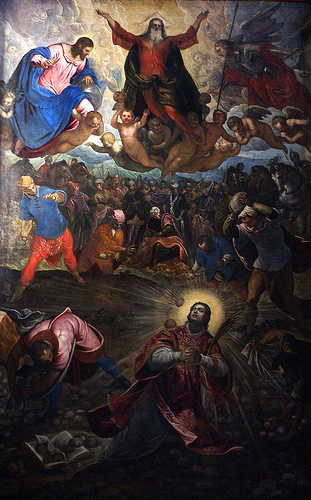 Stoning of Saint Stephen, altarpiece of San Giorgio Maggiore, Venice, by Jacopo & Domenico Tintoretto
Oh, Stephen. You would not shut up.
People skip your chapter in Acts
because it is too long.
They can tell you don’t care;
you just don’t care if you get killed,
get killed like Jesus, your mentor,
sure you will see heaven open up if you die
just like he rose before you.
Oh, we want you people to shut up.
We already have your death day in a dead week,
overshadowed by new fat and football games.
We can’t even remember who all those Steves
are named after and haven’t read Acts in ages,
or we would see all the believers who said nothing
while you were getting heated up then stoned cold.
Oh, they wanted you to shut up.
They dreaded what anyone with half a brain
could see coming, saw rocks on their heads.
They knew you were sealing eternity for thousands,
messing up car payments and frightening Mom.
They regretted not having things in order:
a go bag, a will, a trust for the kids,
A DNR at Jerusalem General.
Soon Philip would be transporting
and talking to the Queen of Sheba’s eunuch.
The whole world would be turning upside down
right when the kids were enjoying their new toys.
Cassidy Hutchinson would have looked at you
and suddenly her tongue would loosen.
The women who took down Weinstein
would have looked at each other and agreed,
“The risk is worth it, to infinity and beyond.”
The actor Zelenskyy would go to Bakhmut
and get a flag for Pelosi, who stood up for gays
when it could still cost a career.
Just when you think martyrs are in species collapse
a Chinese phone mechanic decides enough is enough
or Salvadoran women end a war.
Most recent weeks, our faith ecosystem
feels flattened by a bomb cyclone of unbelief,
a blizzard of Blizzards, a terror of inflation or Elon Musk,
an Amazon full of cattle delivering a heatwave overnight.
We avoid it all hard; it’s our last superpower.
Then some Stephen stands up, won’t shut up.
John Lewis gets his head bashed in
and we reflexively hold our own again.
But his courage, her courage, that courage of whoever you are
ripples across the stony, stoned landscape,
and I find myself ready to visit a jail,
talking to strangers I can barely understand,
looking for a way to fuel lost causes, transported,
writing new chapters that might not be read,
risking being dismissed as archaic,
irrelevant, unprofitable, out of order.
Oh Stephen, you will get us all killed,
or you’ll get the world recreated.
December 19, 2022
The fourth week of Advent – The joy of hope
[This is revised from an Advent message given during Circle of Hope’s “captivity” in Benjamin Franklin High School]
Advent is the pregnant season. It always seems to pop up and try to grab my attention just in time, right when I feel emptied out or adrift on an ocean of trouble. Thank you, Jesus!
The noisy prophet, Jeremiah, is often the tool God uses to focus my attention on hope instead of trouble. The revelation he experiences draws me into a listening space with him and I often end up pregnant with hope, myself. I hope that is your experience this year (after, again, what a year!). As Jeremiah speaks what he hears from God, he paints a picture that won’t be completely clear until God impregnates the world with himself in Jesus Christ and continues the process through His followers. Here we are being what he is seeing.
I love the richness of having Jeremiah open our eyes from his vantage point 2600 years before our time. He can do this because what we experience with God and remember during Advent is like what I hear is sort of a timeless moment women in labor experience just before the baby is born. For some women everything seems to stop – they may have a wild sense of euphoria or suspension, maybe a still point before the final push, when the seconds slow down and all times become this one time. We are called by Advent to enter into such a still point and be with God as God is with us. I believe Jeremiah had many still points when God came to him. What the Lord revealed then can teach us now. We can enter that timeless moment with him.
 Ebed-Melek Pulls Jeremiah out of the Cistern — Johann Melchior Bocksberger (1587)Some things never change
We need a Jeremiah during Advent to tell us to keep looking for the fullness. But don’t overlook what you’ve already received! Jeremiah did not have the already but not yet experience we have – he was fully into not yet. And his own people definitely overlooked him like yours may be dismissing you. But he has an amazing amount to teach us about hoping for God when he seems far away.
Jeremiah is a fascinating guy. God calls him into the middle of a huge political situation in Judah, which is the remaining functioning part of the nation of Israel at the time – we are in the 620’s BC, here. His little country is a political football between two huge empires: Egypt on the south, with which the kings of Judah have been allied for a while, and a new conqueror, Babylon, to the north, with its famous, brilliant, King Nebuchadnezzar. The powers that be in Judah, including some sincerely patriotic, but false prophets, are on the side of Egypt. But Jeremiah is convinced that God is going to use Babylon as part of His plan to fulfill what He started in Israel. So he says, “Don’t resist Babylon.” Because of this message, Jeremiah is a lonely, isolated, threatened prophet, trying to hold on to his faith and calling while the conquerors are at the door, as the city of Jerusalem is about to be taken over again, and as his own people think he may be a traitor. There is a lot of sadness and doom and personal struggle in the prophecies of Jeremiah that his buddy Baruch so carefully wrote down.
When you look at what Jeremiah says, it may seem like he lives in Philadelphia, or in your own town. He cries out about sin and separation from God, outright rebellion and disrespect — broken, antagonistic, competitive relationships are making a mess everywhere — everyone has their own agenda. Survival of the fittest reigns. Who you know, not what you know, reigns. King Zedekiah is generally considered illegitimate, a ruler who did not gain power in the proper way (no one “stopped the steal”).
From the belly of that city and situation Jeremiah tells what he hears from God. And I mean belly, quite literally, since the king throws Jeremiah into a cistern for a while so he will be quiet. From the pits, Jeremiah prophecies hope. God likes using people to do that. Jeremiah impregnates the city of Jerusalem, the navel of Israel, like a little seed planted in the cistern; he shoots up life into the air and talks about hope that is going to arise from this distressing pregnancy. God’s people have become like a woman with no prenatal care at all, but she is going to give birth to a remarkable, healthy child. That is his message.
See if you can listen to him over the 2600 years since he lived. I’m not sure anyone can do this anymore. We all think this “magic moment” is the only time we can share. But I think our eternal God can draw us all together across time. In these readings from Jeremiah’s prophecies, see if you can enter the moment with him. See if you can hope for something you don’t have from God yet and believe it will come.

In this first piece, Jeremiah is speaking to people under the yoke, like so many of us and like even more of those around us. We see our version of this yoke in the bondage of addiction to drugs and porn, of self-destructive habits of heart and relating we can’t get rid of, the yoke of unbelief we cling to, of fear, the prison of disease and cancer and trauma, of demons and mental illness, of relationships that dominate us, of ignorance. From the belly of all that Jeremiah is crying out to get people to hear the possibilities of the coming of the Lord.
“In that day,” declares the LORD Almighty,
“I will break the yoke off their necks
and will tear off their bonds;
no longer will foreigners enslave them….
I am with you and will save you,”
declares the Lord. — Jere 30:8,11 (NIV)
Jeremiah doesn’t know when “that day” is, but he sees it. It is an eternal now, a live possibility.
Hope before your jumpMeanwhile, it has really gotten bad. The people and the whole nation have gotten to the point of no return. It is like some of us who teeter on the edge of diving into what kills us, and then jump, or like some of us who have been ambivalent about a relationship for so long that we finally get too far away to get back to reconciliation – too dismissed or dismissive, cancelled or cut off.
This is what the LORD says:
“Your wound is incurable, your injury beyond healing.
There is no one to plead your cause, no remedy for your sore, no healing for you.
All your allies have forgotten you; they care nothing for you.
You have been stricken as one would strike an enemy and punished as one would the cruel,
because your guilt is so great and your sins so many. — Jer. 30:12-14 (NIV)
Jeremiah’s pictures of what things are like, begin to feel like Philadelphia. It is like he is walking down some of the streets where quite a few of us work and live. Jeremiah sees the ruin, but he cries out for hope.
This is what the LORD says: “I will restore the fortunes of Jacob’s tents
and have compassion on his dwellings; the city will be rebuilt on her ruins,
and the palace will stand in its proper place.
From them will come songs of thanksgiving and the sound of rejoicing.
I will add to their numbers, and they will not be decreased;
I will bring them honor, and they will not be disdained.
Their children will be as in days of old,
and their community will be established before me;
I will punish all who oppress them.” — Jer. 30:18-20 (NIV)
Can anyone hear this? We were at Sampan on 13th St. the other night (very good!) and they were blasting electronica and people were talking so loud we could hardly hear each other. Can anyone hear anymore? As it turns out, most people in Jeremiah’s hometown, Jerusalem, couldn’t listen.
Some people always see and hear the promiseYou may see as well as Jeremiah, and even better. We can’t wait for a season that gives us a better excuse to celebrate all that God has born in the world than Advent. We strain to take it all in.
Keep trying to look to what is coming from God: in your yoke, in your bondage, in your incurable-seeming wounds, in the middle of your ruined city where so many lives are ruined right now due to their own sin and the sin of the system. Can you hear God’s message of hope? He says:
the Lord will not turn back
until he fully accomplishes
the purposes of his heart.
In days to come
you will understand this. — Jer. 30:24
The LORD appeared to us in the past, saying:
“I have loved you with an everlasting love;
I have drawn you with unfailing kindness.
I will build you up again,
and you…will be rebuilt.” — Jer. 31:3-4
 Hope in the pregnancy
How is this going to happen? – how will this purpose accomplished, how will this this drawing to himself take place, how will this building up again begin? In a very strange image, Jeremiah says we hope in a pregnancy.
Study it for yourself, but Jer. 31:22 (NKJ) says:
The Lord will create a new thing on earth –
a woman will surround a man.
It is the language of sex, of procreation. “Surrounding” in the old English is a euphemism for having sex. Usually men are seen as the ones who surround the woman. But here is a turn of events. God is going to do something upside down, and a woman will surround a man! God had often been imagined as surrounding the nation of Israel, husband to wife. Can it be that Israel will surround God? Could this be Jeremiah dimly seeing God being born, surrounded by a woman from Israel? Jerome in the fourth century thought this was all about Jesus being “surrounded” by Mary in the womb. However much a person can get out of this, I certainly think it means that a new kind of pregnancy is going to occur. And from my vantage point, it has occurred.
What did Jeremiah see that gave him hope in the pits? In one of the most striking examples of being pregnant with God’s presence, Jeremiah sums it up, and he still gives me hope. I hope this seems remarkable to you – not only because Jeremiah could see it, but because it all came about with the coming of Jesus.
“The days are coming,” declares the Lord,
“when I will make a new covenant
with the people of Israel
and with the people of Judah.
It will not be like the covenant
I made with their ancestors
when I took them by the hand
to lead them out of Egypt,
because they broke my covenant,
though I was a husband to them,”
declares the Lord.
“This is the covenant I will make with the people of Israel
after that time,” declares the Lord.
“I will put my law in their minds
and write it on their hearts.
I will be their God,
and they will be my people.
No longer will they teach their neighbor,
or say to one another, ‘Know the Lord,’
because they will all know me,
from the least of them to the greatest,”
declares the Lord.
“For I will forgive their wickedness
and will remember their sins no more.” — Jer. 31:31-4
Notice two things about this, OK, so you can be a part:
“I will put my law in their minds and write it on their hearts.”
This is about you and God. She wants to be incarnate in you, impregnate you with life and see life get born in you and from you.
“I will be their God,
and they will be my people.
No longer will they teach their neighbor,
or say to one another, ‘Know the Lord,’
because they will all know me,
from the least of them to the greatest,”
This is about US and God. She wants to be incarnate in you, impregnate you with life and see life get born in you and from you. God wants US to know him, from the least to great. I know the church in the U.S. is a wreck right now, but there are multiple seeds in cisterns sprouting right now. God will be among us, knowable. We will know him in the biblical sense and be pregnant with him. And we will give birth to love and goodness and hope in the world.
This is as crazy as a woman surrounding a man! What do you do with this, apart from receive it and appreciate it? If you are listening to Jeremiah at all, you couldn’t do the “Christmas” thing with it and see Jesus as some nice little gift under your tree. The only true response is to get intimate, get pregnant, give birth, enjoy the timeless now of knowing and being known by God with us.
The post The fourth week of Advent – The joy of hope first appeared on Development.


