Goodreads helps you follow your favorite authors. Be the first to learn about new releases!
Start by following David Edmonds.

Showing 1-24 of 24
“When you play Bobby, it is not a question of whether you win or lose. It is a question of whether you survive. —BORIS SPASSKY”
― Bobby Fischer Goes to War: How a Lone American Star Defeated the Soviet Chess Machine
― Bobby Fischer Goes to War: How a Lone American Star Defeated the Soviet Chess Machine
“Subjectivism maintains that there are no objective moral truths.”
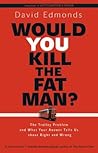
― Would You Kill the Fat Man?: The Trolley Problem and What Your Answer Tells Us about Right and Wrong
― Would You Kill the Fat Man?: The Trolley Problem and What Your Answer Tells Us about Right and Wrong
“Would you rather have people be helpful or not? It turns out that having little nice things happen to them is a much better way of making them helpful than spending a huge amount of energy on improving their characters.”5”
― Would You Kill the Fat Man?: The Trolley Problem and What Your Answer Tells Us about Right and Wrong
― Would You Kill the Fat Man?: The Trolley Problem and What Your Answer Tells Us about Right and Wrong
“I think that success in life is largely a matter of luck. It has little correlation with merit, and in all fields of life there have been many people of great merit who did not succeed – Popper”
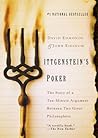
― Wittgenstein's Poker: The Story of a Ten Minute Argument Between Two Great Philosophers
― Wittgenstein's Poker: The Story of a Ten Minute Argument Between Two Great Philosophers
“Most people seem to believe that not only is it permissible to turn the train down the spur, it is actually required—morally obligatory.”
― Would You Kill the Fat Man?: The Trolley Problem and What Your Answer Tells Us about Right and Wrong
― Would You Kill the Fat Man?: The Trolley Problem and What Your Answer Tells Us about Right and Wrong
“Bentham maintained that what mattered about an action was how much pleasure it produced and how much pain was avoided. He enjoined us always to act so as to maximize pleasure and minimize pain.”
― Would You Kill the Fat Man?: The Trolley Problem and What Your Answer Tells Us about Right and Wrong
― Would You Kill the Fat Man?: The Trolley Problem and What Your Answer Tells Us about Right and Wrong
“Deontology states that there are certain things, like torture, that you just shouldn’t do.”
― Would You Kill the Fat Man?: The Trolley Problem and What Your Answer Tells Us about Right and Wrong
― Would You Kill the Fat Man?: The Trolley Problem and What Your Answer Tells Us about Right and Wrong
“What I am concerned about is when tolerance is raised to a political principle and used as a substitute for discourses of justice, equality, or even freedom. What I am suggesting is that when it is raised to the level of a political principle of that sort, it usually cloaks the kinds of powers that are at issue.”
― Philosophy Bites
― Philosophy Bites
“Jews were the standard-bearers of the Austrian idea of unity.’ A poignant though probably apocryphal tale is of a group of Austro-Hungarian Army officers casting earth into the grave of a fellow soldier: each does it in the name of his own nationality – Hungarian, Czech, Slovak, Polish. Only the Jewish officer speaks for Austria.”
― Wittgenstein's Poker: The Story of a Ten Minute Argument Between Two Great Philosophers
― Wittgenstein's Poker: The Story of a Ten Minute Argument Between Two Great Philosophers
“Tolerance isn’t just a discourse of power, it is also a discourse of conditionality; that is to say, you will be tolerated unless and until you behave in certain ways, at which point I will no longer tolerate you.”
― Philosophy Bites
― Philosophy Bites
“With his rigorous reasoning, Hume had punctured the Enlightenment's inflated claims on behalf of reason. So there was irony, too, in his overwrought response to the assault by Rousseau, the man of sensibility. When, in the summer of 1766, Hume jettisoned a lifetime of moderation, he seemed fixed on demonstrating that reason was indeed the slave of the passions.”
― Rousseau's Dog: Two Great Thinkers at War in the Age of Enlightenment – An Intellectual History of Treachery and Shattered Friendship
― Rousseau's Dog: Two Great Thinkers at War in the Age of Enlightenment – An Intellectual History of Treachery and Shattered Friendship
“But racial pride is not only stupid but wrong, even if provoked by racial hatred. All nationalism or racialism is evil, and Jewish nationalism is no exception.”
― Wittgenstein's Poker: The Story of a Ten Minute Argument Between Two Great Philosophers
― Wittgenstein's Poker: The Story of a Ten Minute Argument Between Two Great Philosophers
“I do not believe in race; I abhor any form of racialism or nationalism; and I never belonged to the Jewish faith. Thus I do not see on what grounds I could possibly consider myself as a Jew. I do sympathize with minorities; but although this has made me stress my Jewish origin, I do not consider myself a Jew.”
― Wittgenstein's Poker: The Story of a Ten Minute Argument Between Two Great Philosophers
― Wittgenstein's Poker: The Story of a Ten Minute Argument Between Two Great Philosophers
“One has to read Heidegger in the original to see what a swindler he was,” said Popper. His philosophy was “empty verbiage put together in statements which are absolutely empty.”19 On this even Carnap—not Popper’s biggest fan—concurred.”
― The Murder of Professor Schlick: The Rise and Fall of the Vienna Circle
― The Murder of Professor Schlick: The Rise and Fall of the Vienna Circle
“Wittgenstein had explained his ideas on verification to Waismann and Schlick in late 1929 and early 1930, and Waismann then made them public in an article he wrote for the first volume of Erkenntnis. Verificationism offered a criterion for what was meaningful. Its proponents were motivated by the desire to make all domains of inquiry scientific, and so banish metaphysics from the domain of “meaning.” It claimed that unless something was open to being verified it was meaningless.”
― The Murder of Professor Schlick: The Rise and Fall of the Vienna Circle
― The Murder of Professor Schlick: The Rise and Fall of the Vienna Circle
“Why do we classify all the mental things together as the mental at all? I think action is mental because it’s intentional, in the sense that it’s directed on to something other than itself. So when you act, when you go to buy yourself a coffee, you’re aiming at something beyond yourself, namely the result of getting a coffee.”
― Philosophy Bites
― Philosophy Bites
“threnody through the postmortem”
― Bobby Fischer Goes to War: How a Lone American Star Defeated the Soviet Chess Machine
― Bobby Fischer Goes to War: How a Lone American Star Defeated the Soviet Chess Machine
“Think how the world must have looked to our ancestors, as they began to emerge from their animal background and become conscious. By their conversation amongst themselves, they had to learn to structure their experience and build up a picture of the world around them. We have done this for ten thousand years and more, and now we are where we are today. We ourselves had to build up our own picture of the world, by degrees, from within, through our own conversation. That is how the human race came into being.”
― Philosophy Bites
― Philosophy Bites
“Rousseau's constant influence on later generations is indubitable (though not always positive). He can be seen as father of the Romantic movement (and even a great-grandfather of the Green movement). The Romantics were inspired by his confirmation of the worth of each and every one of us, however ordinary, by his emphasis on equality, on knowledge of the inner self, and on a spiritual connection with nature, as well as by his imagination and the depth of his feelings.”
― Rousseau's Dog: Two Great Thinkers at War in the Age of Enlightenment – An Intellectual History of Treachery and Shattered Friendship
― Rousseau's Dog: Two Great Thinkers at War in the Age of Enlightenment – An Intellectual History of Treachery and Shattered Friendship
“the idea is that the infinite doesn’t stand opposed to anything else—it is all-inclusive—while on the other hand, precisely what that is, is a way of contrasting the infinite with the finite. By definition, you can’t contrast the infinite with the finite, although that’s exactly what you want to do.”
― Philosophy Bites
― Philosophy Bites
“Now that sense of intellectual urgency has dissipated. Tolerance, relativism, the postmodern refusal to commit, the cultural triumph of uncertainty – all these rule out a repeat of the pyrotechnics in H3. Perhaps, too, there is currently so much specialization, and so many movements and fissures within higher education, that the important questions have been lost.”
― Wittgenstein's Poker: The Story of a Ten Minute Argument Between Two Great Philosophers
― Wittgenstein's Poker: The Story of a Ten Minute Argument Between Two Great Philosophers
“His face was broad and fat, his mouth wide, and without any other expression than that of imbecility. His eyes vacant and spiritless, and the corpulence of his whole person was far better fitted to communicate the idea of a turtle-eating alderman than of a refined philosopher. His speech in English was rendered ridiculous by the broadest Scottish accent, and his French was, if possible, still more laughable.”
― Rousseau's Dog: Two Great Thinkers At War in the Age of Enlightenment – An Intellectual History of Treachery and Shattered Friendship
― Rousseau's Dog: Two Great Thinkers At War in the Age of Enlightenment – An Intellectual History of Treachery and Shattered Friendship
“On the whole, their message to their students remained steady: that science was good and metaphysics was bad. As Neurath put it to Feigl in 1938, “what we have in common will remain; as products of their time, the differences will fade.”
― The Murder of Professor Schlick: The Rise and Fall of the Vienna Circle
― The Murder of Professor Schlick: The Rise and Fall of the Vienna Circle
“Analytic philosophy has gone in various directions that the Circle would not approve. But the self-identifying merits of analytic philosophy are its meticulous attention to logic and language and the pursuit of clarity, the contempt for grandiosity, and the calling-out of nonsense. There is a suspicion of arguments that rely on “feel” or “intuition” over substance. The Circle was not unique in promoting these intellectual virtues, but they helped foster a climate in which they are now so much taken for granted that they are virtually invisible. In that sense, success of the Circle ideas lies in their apparent absence.”
― The Murder of Professor Schlick: The Rise and Fall of the Vienna Circle
― The Murder of Professor Schlick: The Rise and Fall of the Vienna Circle