Goodreads helps you follow your favorite authors. Be the first to learn about new releases!
Start by following Patrick Joyce.

Showing 1-18 of 18
“As the world is connected understanding is disconnected.”
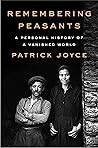
― Remembering Peasants: A Personal History of a Vanished World
― Remembering Peasants: A Personal History of a Vanished World
“What the skeleton is to anatomy, the peasant is to history, its essential, hidden support," (Joyce is quoting Andro Linklater, Owning the Earth).”
― Remembering Peasants: A Personal History of a Vanished World
― Remembering Peasants: A Personal History of a Vanished World
“Historically, peasants do not generally speak, they are spoken to.”
― Remembering Peasants: A Personal History of a Vanished World
― Remembering Peasants: A Personal History of a Vanished World
“Why ought we remember peasants? We have a debt to those forgotten by history. Peasants exemplify what it is to be forgotten more than most. This feeling of there being a debt is further informed by the sense that in ‘advanced’ western societies the dead in general are too happily put away, banished from our easily forgetful minds. In putting away the dead we put away in the past. Of the dead, there is nothing more certain than that we will one day be a member. Death unites us as humans, and, just as much as when we are alive we hope to be respected, so it is when we are dead. So, in putting away the dead we also put ourselves away. Peasants were good at remembering the dead, respecting them, which is one of the best possible reasons for remembering them.”
― Remembering Peasants: A Personal History of a Vanished World
― Remembering Peasants: A Personal History of a Vanished World
“These peasants were raised in the culture where male and female society was much more strictly demarcated than in ours, and where to us now relations between the sexes seem to have lacked naturalness and freedom. Church, school and rural custom were the policeman of the division.”
― Remembering Peasants: A Personal History of a Vanished World
― Remembering Peasants: A Personal History of a Vanished World
“If we are cut off from the past, we are also cut off from ourselves. The epigraph to [John] Berger’s Into Their Labours is taken from St John 4: 38: ‘Others have laboured and ye are entered into their labours.’ We are indeed entered into the labour of peasants and so have a debt to them, a debt which is also one we have to ourselves. Debts should be redeemed. If we are in a sense ultimately the children of peasants, then a kind of redemption may lie in honouring our forebears, for surely children should pay respect to their parents, which is to say, their ancestors.”
― Remembering Peasants: A Personal History of a Vanished World
― Remembering Peasants: A Personal History of a Vanished World
“So it is that the dead belong to us, and we to them, and a moral bond is established. We are physically engendered by those who went before us, and are in this sense a bodily projection of the past. Drawing on his Jewish roots, [Walter] Benjamin gives voice to this sense that we are a projection of the past in these words: ‘Every present must recognize a past that is meant in it.’ In listening to the voices to which we lend our ears today, we need to listen especially hard for the echo of those voices which have been silenced. ‘Been silenced’, we should note, a wrong actively done.”
― Remembering Peasants: A Personal History of a Vanished World
― Remembering Peasants: A Personal History of a Vanished World
“The word human comes from the Latin word humus meaning earth or ground. We are made from the earth to which we will return.”
― Remembering Peasants: A Personal History of a Vanished World
― Remembering Peasants: A Personal History of a Vanished World
“Ireland has long been considered a place where in betweenness is marked.”
― Remembering Peasants: A Personal History of a Vanished World
― Remembering Peasants: A Personal History of a Vanished World
“There is also the silence before outsiders, tax officials and policemen, say, the fear of saying too much, the distrust of those who ask questions, the distrust of one's own capacities two, the vast incomprehension produced by the encounters of one mismatched code and another.”
― Remembering Peasants: A Personal History of a Vanished World
― Remembering Peasants: A Personal History of a Vanished World
“We may all have to learn before too long how to be survivors, and peasants, the class of survivors, have things to teach us.”
― Remembering Peasants: A Personal History of a Vanished World
― Remembering Peasants: A Personal History of a Vanished World
“At one time, not so long ago in the greater scheme of things, the vast majority of people on the globe were workers on the land, so that it can be said that almost all of us are in one way or another the children of peasants. Now it is all ending, vanishing before our inattentive eyes. These thousands of years of history are coming to an end.”
― Remembering Peasants: A Personal History of a Vanished World
― Remembering Peasants: A Personal History of a Vanished World
“How different the great weight of historicity in religious buildings and holy objects there is in most of Europe compared to Ireland. Its religion, like its history, is different from most of the rest of Europe, particularly its immediate neighbour, England. Faith in Ireland was relegated to nature and the landscape to a greater degree than anywhere else on the European mainland.”
― Remembering Peasants: A Personal History of a Vanished World
― Remembering Peasants: A Personal History of a Vanished World
“Old women, remembering those who have gone before. Remembering with their missals, remembering at graves. Women who sit alone in churches, women perched in churchyards alone, women who tend graves, like my mother – these old women – if sometimes seems – are the soul of faith across Europe.”
― Remembering Peasants: A Personal History of a Vanished World
― Remembering Peasants: A Personal History of a Vanished World
“The family anchors things in the peasant world. The essential point is that land — whether it is self-owned, rented, aspired to or enserfed — is understood to be a social rather than an economic entity. Reproduction as well as production comes into the picture.”
― Remembering Peasants: A Personal History of a Vanished World
― Remembering Peasants: A Personal History of a Vanished World
“Peasant’ is a tricky word, one that is troublesome to me as I'm using it to describe my own forebears, when they would mostly not have used the term, and would perhaps not even have known what it meant.”
― Remembering Peasants: A Personal History of a Vanished World
― Remembering Peasants: A Personal History of a Vanished World
“Peasants eat and live domestic life in the room in which the food is prepared and cooked. There is a little division between the eater and the food.”
― Remembering Peasants: A Personal History of a Vanished World
― Remembering Peasants: A Personal History of a Vanished World
“Silence, the repository of peasant wisdom, comes from a deep well in the peasant soul. ...
Silence preserves group solidarity, within both the family and the village.”
― Remembering Peasants: A Personal History of a Vanished World
Silence preserves group solidarity, within both the family and the village.”
― Remembering Peasants: A Personal History of a Vanished World