Nel giugno del 1865, durante un viaggio in compagnia della sua amante, Charles Dickens rimane coinvolto in un incidente ferroviario, in seguito al quale incontra un sinistro personaggio di nome Drood che cambierà per sempre la sua vita. Il racconto degli avvenimenti che seguirono è affidato al suo migliore amico ed eterno rivale, Wilkie Collins, autore di libri come La donna in bianco e La pietra di luna, che viene coinvolto in una serie di indagini nell'underworld di Londra, attraverso sotterranei oscuri e misteriosi, colonie umane di derelitti, fumerie d'oppio clandestine, pratiche di mesmerismo e sette segrete. Quando Drood sembra avvicinarsi alle loro ricerche, egli viene messo da parte da Dickens, il quale comincia a mostrare segnali inquietanti di cambiamento. Come se non bastasse, anche Collins inizia ad avere visioni inspiegabili, allucinazioni, un senso costante di minaccia. Provato fisicamente e mentalmente ma avvinto da questo gioco mortale, Collins si dibatte tra la paura della follia e il dubbio che tutto faccia parte di un diabolico piano della creatura che si fa chiamare Drood. Centrato sulle figure di due degli scrittori inglesi più influenti della modernità, è un romanzo storico-letterario sul mistero dell'ultimo omonimo romanzo rimasto incompiuto di Dickens, un inquietante racconto sovrannaturale e un'indagine psicologica sui recessi più oscuri della mente umana. Un'opera ambiziosa nella produzione narrativa di uno dei maestri contemporanei del romanzo americano.
Dan Simmons was an American science fiction and horror writer. He was the author of the Hyperion Cantos and the Ilium/Olympos cycles, among other works that span the science fiction, horror, and fantasy genres, sometimes within a single novel. Simmons's genre-intermingling Song of Kali (1985) won the World Fantasy Award. He also wrote mysteries and thrillers, some of which feature the continuing character Joe Kurtz.
Hello, Dear Readers. Wilkie Collins here. In case you’re unfamiliar with me, I was a best selling English novelist during the mid-1800s, and a friend and frequent collaborator with Charles Dickens. I’m also the narrator of this new novel Drood despite the fact that this Dan Simmons fellow is trying to claim the credit when it clearly states that I left this manuscript to be published one-hundred and twenty-five years after my death.
Something I should confess immediately is that I use laudanum and opium regularly as treatment for my physical ailments. In fact, I tend to swig the laudanum like spring water on a hot day, and while I was initially a bit frightened by the opium dens, I soon found them quite inviting. Oh, and my physician was also giving me regular doses of morphine. I admit to using the medicines freely so that the readers will know that I’m still a reliable narrator. I’m also haunted constantly by apparitions like a frightening doppelganger who tries to take over my writing and my life. However, I’m quite sure these are visions are real and have nothing to do with the laudanum. Or the opium. Or the morphine.
The other thing you should know is that my good friend and colleague Charles Dickens was immensely popular in his day. (This chap, Kemper, informs me that in current terms, Dickens was ‘like a f------g rock star’.) Not that I was jealous, mind you. Even though he was always more popular with critics and the public, made far more money than I did, and always got the lion’s share of credit of projects we collaborated on, I can assure you that I always stayed above petty concerns like envy. Even as he treated my brother, Charles’s son-in-law, quite terribly and had a habit of being a bit condescending when we discussed writing, I still bore Charles no ill will. (At least, not until near the end.)
Anyhow, it’s well known that when Charles Dickens died he left an unfinished novel called The Mystery of Edwin Drood. What isn’t known is the story behind that novel and Charles’s odd behavior during the last five years of his life.
In 1865, Charles was on a train that had a terrible accident. While he was unharmed, many other passengers were injured or killed. Charles confessed to me that while helping with the wounded, he met a very strange man who called himself Drood. Charles noticed later that most of the injured that Drood appeared to be helping were later found to be dead.
Charles wanted to track down this Drood character and enlisted me as a companion while following clues through the worst slums of London, including an entire underground society existing in the numerous crypts beneath the city.
This began a nightmare period for me that lasted until Charles’s death. A former police inspector began blackmailing me to report on Charles’s activities with Drood, and this inspector claimed that Drood was the leader of a vast criminal organization responsible for hundreds of deaths. Charles became obsessed with murder and mesmerism. Despite his failing health, he insisted on embarking on a series of readings in Europe and America that frequently shocked and terrified his audiences. Worst of all, Drood began to take an interest in me also.
So I highly recommend you read this tale of our tragic involvement with Drood and how it impacted our friendship, our writing and our sanity. Again, I’ll dispute Kemper’s theory that my medicine may have had some impact on my perception of these events, but I will admit that when you have two prominent fiction writers involved in a story, it’s wise to be wary of embellishments.
As a bonus, you’ll also get to read how Charles and I always conducted ourselves as English gentlemen. For example, when Charles’s wife and mother of his ten children had the audacity to complain about his mistress, Charles forced her to apologize to the woman and then exiled her from his house and family. Or how I lived with a woman I claimed as my housekeeper for years, but would never let my mother visit because I obviously couldn’t allow Mother to associate with such a harlot.
If ever there was a book that's impossible to review (at least without major spoilers) it's this one. So instead of reviewing it, let me say a few things to anyone who might be thinking of reading it.
First off, don't approach this like a horror novel. It's not in the sense that Carrion Comfort, Summer of Night or even The Terror were horror novels. There are elements of horror in it but if you are expecting an intense fright fest you'll probably be disappointed. This is a novel about obsession, reality, insanity, jealousy and the thin line between love and hate.
Second, this isn't a novel about Charles Dickens. Sure, he's in it plenty but this is really about Wilkie Collins, a contemporary of Dickens' and lesser known novelist.
Finally, don't believe other reviews that try and give a simple explanation for what happens in the story. There are a ton of different ways to look at the novel. There is no simple explanation or easy answer.
I loved the book. I'm not at all surprised that reviews on this one have been more mixed. It's nothing like Simmons other stuff (no big surprise there if you've read even a few of his novels) but it is brilliant, just maybe not in the way you'd expect.
By some quirk of fate, or just the same people growing up with the same influences, there were three books concerning the last years of Charles Dickens' life published in 2009, Drood was Dan Simmons' contribution. If you've read Simmons' peerless The Terror, you know just how good he is at mixing historical fiction and gothic horror. Drood is narrated by famous writer and friend of Dickens Wilkie Collins, and follows their relationship, their lives and the repercussions of coming across the mysterious and seemingly criminal 'Drood' at the Staplehurst train crash site. Simmons once again takes a near microscopic look at history and the times and people around Dickens and Collins in this period to really take you back to the 19h century and the way people lived there, which he does really well. To overlay this detail and superb research with a fantasy-horror root to the unfinished composition of The Mystery of Edwin Drood, that sees darkness and evil originated by outsiders under London and around these writers doesn't really work. Also once you know Simmons is a big of a bigot you can't help but read more into the 'outsiders' contaminate theme and indeed the downplaying but shared reprehensible behaviour of the privileged in these times. A very interesting read for the historical background and details of Dickens and Collin's later lives, but a no-no for a historical horror fiction drama... just skip this and read The Terror! 6 out of 12 for some immaculate researching. The fact that this took me nearly 6 months to finish tells you all you need to know? 2020 read
"This true story will be about Charles Dickens's final five years and about his growing obsession during that time with a man - if man he was - named Drood, as well as with murder, death, corpses, crypts, mesmerism, opium, ghosts,band the streets and alleys of that black-biled lower bowel of London that the writer always called "my Babylon" or "the Great Oven."
4.9 🌟's
Initial Thoughts
My love affair with Dan Simmons continues in 2023 with his historical horror...Drood.
Yes I'm a huge fan of this author and I've read a good chunk of his bibliography in the last twelve months, most recently his sci-fi epic Ilium. One of the most original concepts I've come across, I was blown right out of my smelly socks by it. He's an ultra-talented writer who can adapt his narrative voice to perfectly suit the style of story he's tackling.
But it was his novel The Terror which made me a die hard fan. A story that expertly blended historical fact with supernatural elements so brilliantly. Without doubt, one of the finest novels I've ever read. I was hoping for more of the same with Drood, one of those books that's been talked up by my Goodreads' peeps despite its pretty low rating on here.
"The Date Of Dickens's Disaster was 9 June, 1865. The locomotive carrying his success, peace of mind, sanity, manuscript, and mistress was - quite literally - heading for a breach in the rails and a terrible fall."
The Story
As the title suggests the story centres around the final years of Charles Dickens' life and his unfinished novel, The Mystery of Edwin Drood. But it's told from the perspective of his close friend, fellow author and collaborator Wilkie Collins. You know, the guy who penned The Woman in White and The Moonstone? Yeah me neither! It's in the form of a memoir and addressed to a future 'Dear Reader'.
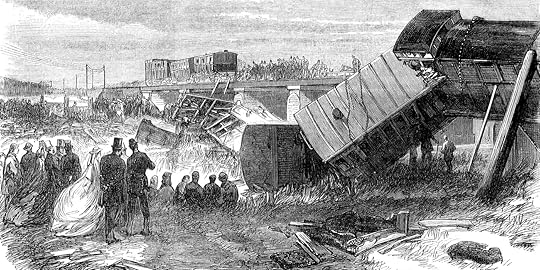
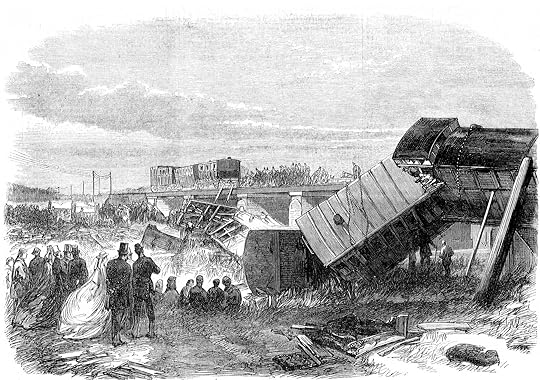
It kicks off with the Staplehurst Rail Disaster of 1865, when the train Charles Dickens was hitching a ride in famously derailed. Fifty-three year old at the time he was at the height of his literary power and the most famous author in the world. He was lucky to escape with his life and while helping to rescue the few who survived he encounters the mysterious and cadaverously thin gentleman that goes by the name of Drood, who looks to be occupying himself by sucking the life out of those that are seriously injured. Nothing sinister there then.
But who is this Drood? A question that will become an obsession for Dickens and his friend Wilkie.
“he was cadaverously thin, almost shockingly pale, and stared at the writer from dark-shadowed eyes set deep under a pale, high brow that melded into a pale, bald scalp. A few strands of graying hair lept out from the sides of this skull-like visage.”
So after confiding in his fellow author, Dickens sets out with Wilkie into the labyrinth of sewers beneath the streets of London in search of this mythical and notorious figure while trying to figure out his true identity. The answer will lead both to the brink of insanity.
But the search for Drood is only a small fraction of this story. The vast majority deals with the friendship between the pair and how it deteriorates over time. Living in the shadow of the world's most famous author is no easy thing and Wilkie constantly battles with the green eyed monster along with drug addiction throughout.
The Writing
Simmons is one of the best writers in the field of horror today and few can write a scene of adrenaline fuelled nightmares quite like him. They will live in your mind rent free for a long time to come. His sentences are clean and crisp, articulate but never flowery and he's certainly on form in this one with some beautiful writing on display. There's a number of eerily evocative scenes that will send a chill right up your spine.
As I've already explained, it's told in the first person perspective, in the form of a memoir, which certainly gives it an authentic and very immersive feel. You're getting a slice of real history here mixed with fiction and it's often difficult to see the distinction as the lines blur.
The level of research that Simmons put into this one is certainly impressive and it's evident that it's a labour of love. The sheer size of this doorstop of a novel, at eight hundred pages, is proof in itself. This is a book about writers and their craft with a lot of material drawn from the authors' biographies that complements the story so well. I'm not sure there's anyone out there who can blend actual historical fact and fiction quite like this author.
The narrative obviously detours into the realm of fantasy in a number of incidents and this is where the horror elements are injected into the plot. There's plenty of twists and turns as both Dickens and Collins plunge into physical and emotional turmoil. The unreliability of the narrator meant I was never quite sure if what was happening was real or imagined, particularly with all the drugs Wilkie was going through. He really could have opened his own chemists!
My only complaint is that story does drag in the middle. The story is supposed to be focused on Drood but he only makes a small number of appearances as the writing delves into Wilkie's daily ministrations. Don't get me wrong, certain aspects are fascinating and I did enjoy the majority of it. But those who are expecting a fast paced horror will be badly disappointed.
"Imagine a villain so devilish and clever, my dear Wilkie, that he murders someone simply to have had the experience of murder."
The Characters
The friendship between Collins and Dickens is fundamental to the story as it examines the effect of competition and jealousy. With one clearly in the shadow of the other. Collins certainly doesn't make it out of this one with a glowing reputation as he becomes an envious, bitter and drug addicted man. But do you know what? It makes for an entertaining read and he is the epitome of an unreliable narrator, especially when all those factors begin to take a toll on his mental health. Erratic and at times completely unlikeable, but evidently blind to his own faults, it makes for such a unique reading experience.
With Dickens, much the same, he is presented very much warts and all. He certainly comes in for a good bit of criticism. Despite quite clearly being a genius he has a huge ego, cheats on his wife and at times is a poor friend. I was expecting a good bit of hero-worshiping and it's refreshing to get this approach. But since everything is viewed through the eyes of the drug-induced Wilkie you've got to take all that with a pinch of salt.
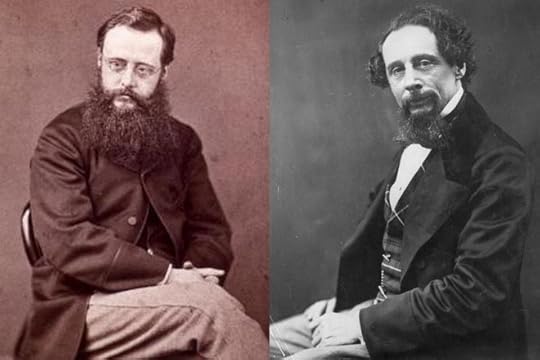
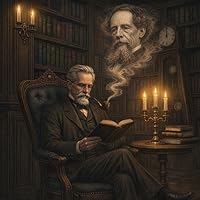
Wilke Collins and Charles Dickens
But much like one of Dickens' novels, Drood is one that is character heavy. So there's a lot more on offer than the main men. From the tough private investigator, Hatchery, to the underground kingpin, King Laazaree, who controls the opium dens beneath the city. Now that is a guy I need to know! The character work in this one is nigh on perfect.
Final Thoughts
I'm writing this review a week after finishing Drood and it's certainly a book that's sticking around in what little grey matter I have upstairs. It's a book that's left a big impression and I won't forget it in a hurry. This is a very unique blend of horror, mystery, adventure and above all historical fiction.
You won't need a full appreciation of Dickens' or Collins' work to enjoy this one. I've only read A Christmas Carol and still had an absolute blast. I imagine it would add to the experience though if you were.
Drood is very much an experience and Simmons takes his time. It's not an easy read and you do need a degree of patience, so I'm not saying it's for absolutely everyone. But trust me, if you can handle that slower pace it's worth the effort and you'll certainly reap the rewards from this magnificent book. A treat for any fan of either writer.
Two years ago I read Dan Simmons's The Terror in pretty much one go, it was that good and gripping. It expertly combined several areas in which I'm interested and knowledgeable - Victorian Arctic exploration, the Franklin expedition, and supernatural fiction - and I was thrilled when I found out that his next book, Drood, promised more of the same: a doorstopper of a book modeled after the Victorian melodramas I enjoy, featuring two real-life authors whose life and works I know a lot about (Charles Dickens and Wilkie Collins), and with references to Dickens's final, unfinished novel, The Mystery of Edwin Drood, which has a small reference shelf devoted to it in my library.
Drood was, therefore, a book I approached with high hopes, and I was slightly sad to find myself disappointed in the end result. The book contains a number of excellent set-pieces - the Staplehurst railway disaster, the forays into London's Undertown - as well as some wonderful description and characterisation, most notably in the form of the narrator, Wilkie Collins; and the relationship between Dickens and Collins was well depicted, their undoubted friendship always under attack from Dickens's dominating nature and Collins's frustration at always being in his friend's shadow. The references to, and echoes of, Dickens's unfinished novel were also well done; if you want to get the most out of Drood, you'd do well to read Edwin Drood first.
However, Simmons seems to have fallen victim to that common affliction, the desire of contemporary novelists setting their work in an earlier time to want to drop in every factoid of information, every nugget of gossip they gleaned while researching. Time and again the novel comes to a halt while characters have awkward conversations which amount to info-dumps, or we learn more about London's sewers, Victorian publishing, and exactly who was at Dickens's house at any given time than we really need to know. The revelation at the end of the book, when it came, was a disappointment - I couldn't help thinking 'Is that it??' - and the book then continues for another forty pages which are largely unnecessary. As Louis Bayard points out in his review of Drood in the Washington Posthttp://www.washingtonpost.com/wp-dyn/..., somewhere inside this 700+ page book, there's a lean thriller half the size struggling to get out.
As an aside - and this may contain a minor spoiler, so be warned - I was surprised that Simmons, who referenced almost every work Dickens wrote following the Staplehurst railway disaster, made no mention in the book of Dickens's seminal ghost story 'The Signalman'. With its railway setting, supernatural elements, and references to the idea of a double, it would seem to have been a natural tale to make reference to.
I would have imagined that a seasoned novelist of big books steeped in historical context might have avoided the beginner's error of forgoing actual narrative for HUNDREDS OF PAGES OF EXPOSITION, but I would have been wrong.
Apparently, Mr. Simmons could not forgo even one of the trifling matters of Dickensiana he picked up in the course of his research, and furthermore, he clearly couldn't be bothered to find ways to include these details dramatically.
This is a big, baggy mess of a thing, slack and sloppy just where it needs to be taut and running on tension. The book suggests to me that Simmons thought that using a novelist (Wilkie Collins) for a narrator afforded him (Simmons) the luxury of writing about Dickens's work in the style of a literary critic--wrong!--and at that, one working in the 20th century--double wrong! The passage on identity and doubling made me cringe it was so anachronistic in its language and use of theoretical concepts.
There are too many poor choices in this book to account for all of them. I really don't understand how the same writer can produce exquisite sci-fi like Hyperion, pretty good historical fiction/horror like The Terror, self-important trash like Carrion Comfort, and then utterly mediocre, structurally unsound work like this. My best guess is that somehow this is an issue of productivity; Simmons pushes out a lot of material, and I suppose much of it is bound to be not-so-great as a result.
This book is almost 800 pages long. I knew after the first fifty, definitely after the first hundred, that I wasn’t enjoying it, but I kept reading because 1) I’m a stubborn bitch, 2) Dan Simmons has written good books in the past, and 3) I just felt like it had to get better, right? RIGHT?
Not so much. If you want to read a book about an unlikeable narrator—in this case, supposedly Wilkie Collins—bitch about his likewise unlikeable friend/rival/whatever—supposedly Charles Dickens—for 800 pages while some vaguely spooky stuff happens, none of which is scary or interesting enough to sustain the narrative—then this doorstop of a read is the book for you. If not, then don’t be like me—run! Run! Save yourselves!
This is one hell of an excellent book! I had low expectations going into it and they were blown so far out of the water that they ended up in space. That’s how good this book is. It is a big monster of a book but trust me, every single page is worth it! Simmons tells such a captivating story here, I was completely drawn in right from the very first page. This book sunk it’s claws into me and didn’t let go until I was done. When I wasn’t reading it, I was thinking about reading it. Dickens fans and horror fans, read this epic book. You won’t regret it!
A fun little pagan horror story, just in time for Halloween, with an appropriate Victorian-era London setting, "Drood" may be the ticket. I read this back in 2009, and it started me on a path of Dan Simmons novels that I have not regretted...
Part biography, part literary criticism, part Victorian mystery, and part psychological thriller, Dan Simmons's epic novel "Drood" is all-wonderful and amazing.
Like his last novel, "The Terror", Simmons incorporates actual documented historical events with extrapolated what-ifs that at first appear to be outrageous but, as the story progresses, begin to sound surprisingly plausible and believable.
"Drood" begins with a horrific railcar accident in Staplehurst, England in the late 1800s. Among the survivors of that catastrophe were Charles Dickens and his mistress. Also among the survivors was a mysterious figure named Drood, a figure that would weigh heavily upon Dickens's mind for years after the incident, until his death four years later.
The Staplehurst Rail Crash of June 9, 1865 resulted in the deaths of ten people. Charles Dickens, his mistress, Ellen Ternan, and her mother survived the crash, although Dickens suffered injuries that adversely affected him until his death.
Indeed, Dickens's final (and sadly unfinished) work, "The Mystery of Edwin Drood", was (according to Simmons) a direct result of the writer's fascination and obsession with the mysterious man, who may or may not have been a figment of Dickens's imagination.
The story is wisely crafted as a first-person narrative from the viewpoint of Wilkie Collins, a lesser-known writer who was perhaps Dickens's closest friend. (Collins has the proud distinction of being the father of the English mystery novel, whose most famous novels "The Woman in White" and "The Moonstone" are currently regaining popularity in the literary world due in part to Andrew Lloyd Weber's musical "The Woman in White".)
The woefully under-rated Wilkie Collins
Simmons has created a truly fantastic story that twists and turns in ways that are, at times, absurdly funny and deliriously disturbing. As he did in "The Terror" (a fictionalized account of the failed Franklin expedition to the Arctic), Simmons also plays with the reader's knowledge (or lack thereof) of history by "inventing" histories to fit his fiction, a fact that I am sure hard-line historians may find absolutely infuriating. Lovers of challenging and thought-provoking fiction, however, will love this book, and it is my personal pick for the Best Novel of the Year. Some good companion-pieces to this novel would definitely be Dickens's "The Mystery of Edwin Drood" and Collins's "The Moonstone", both of which are referred to quite frequently in "Drood".
I'm giving this a 4.5 stars instead of a 5 for only one reason: I rather hate all the characters in this book and they were all god-awful annoying.
This is NOT to say that they weren't also amazingly complicated, well-written, fascinating, infuriating, and beautifully drawn, because they were. Amazingly so.
Let me preface this by saying that this is my second time reading this book and it is just as good this time as the first time I read it. Since then, I've also read a couple of Wilkie Collin's novels and truly enjoyed them. Charles Dickens also, but that came years before I read Drood.
Why is this important? Because these two authors feature mightily in this tale, with Wilkie being the amazingly difficult-to-like jealous author who loved, worked with, and frequently hated his best friend, Charles Dickens. Add to this the sinister mystery of Drood, a strange man Dickens had become obsessed with for many years, a massive opium addiction, the mysteries of mesmerism, crooked ex-cops, the underworld of London, and of course the burning jealousy, and this was a wild and wildly conflicting tale that lives up to some of the very best mysteries I've ever read.
The fact that it is also a huge research project, that all the characters fly to life, and that I was genuinely creeped out on a number of occasions shouldn't be passed off as a fluke, either.
I'm haunted by this novel. I can't say I actively LIKED it at any point, but it got under my skin big time a decade ago and remained there until I HAD to read it again to be fascinated all over again. And I was. I was totally fascinated. And it still keeps me thinking.
Just what happened after all? I mean, we do get a resolution, several even, but damn me if I'm still caught in Wilkie Collin's unreliable narration.
Brilliant.
Not easy, but definitely brilliant and memorable. I think this should be called genuine literature and not relegated to horror or historical. It's so much more than either.
It's been some years since I read this book, but it's still one of those that I remember quite well because I liked the story so much. The Mystery of Edwin Drood by Charles Dickens was never finished and this book tells about how Charles Dickens become obsessed with the mysterious being called Drood. It's a thick book, but well-written and fascinating to read. Simmons capture the atmosphere of the late 1900-centery very well. The story is dark and mysterious and keeps you captivated.
This was one massive doorstop of a novel. Dan Simmons seems to thrive in this long-as-fuck format. His work should bore me to tears and for whatever reason it doesn’t.
It’s too slow.
Too little action.
Too looong.
And I dig it.
The only thing I can figure is the dude obviously has some serious writing/storytelling skills because I didn’t get disengaged once while reading this one despite long periods of pretty much nothing happening.
”When the last autumn of Dickens’s life was over, he continued to work through his final winter and into spring. This is how all of us writers give away the days and years and decades of our lives in exchange for stacks of paper with scratches and squiggles on them. And when Death calls, how many of us would trade all those pages, all that squandered lifetime-worth of painfully achieved scratches and squiggles, for just one more day, one more fully lived and experienced day? And what price would we writers pay for that one extra day spent with those we ignored while we were locked away scratching and squiggling in our arrogant years of solipsistic isolation?
Would we trade all those pages for a single hour? Or all of our books for one real minute?”
Wilkie Collins was a writer (generally credited with starting the detective genre with his novel The Moonstone) and a real-life friend of the great Charles Dickens, and he serves as our (perhaps not-so) humble narrator for this 950 page tome. Collins is an opium/laudanum/morphine addict who also suffers from debilitating gout—although he makes one passing mention that a doctor once told him that his affliction was not gout at all, but advanced venereal disease. But I’m sure it’s just gout. Anyways, this is all important to the plot as Wilkie proves to be an extremely unreliable narrator, and this becomes clear very quickly. Sifting through the opium haze in this novel to attempt to discern fact from fiction is great fun.
The last 5 years of Charles Dickens’s life is the subject here, beginning with the horrendous real life train crash that he experienced. He tells Wilkie that as he was attempting to help people on that fateful day, there was a strange man, or perhaps spectre, present that seemed to be causing the deaths of survivors. Dickens and Collins then become sucked into London’s underworld in an attempt to get to the heart of the mystery of this man, Drood. That is the basic setup, and trust me that the less you know going into this, the better.
After finishing this book and reading a few reviews, I can’t help but echo some thoughts of Ed Lorn, who I feel nailed a few things about this book. This is a horror novel; a ghost story indeed, but it is so much more. At times it borders on brilliance, as much of Simmons stuff does. It is about friendship—all the subtleties that come along with it—especially between two friends who are both competing writers. Wilkie is second fiddle, and has something to prove to the world, and himself.
”To be honest with you, Dear Reader who lives and breathes in such a remote branch of my future that no hint of my candour could possibly get back to anyone who loves Charles Dickens, I am…was…almost certainly always shall be…ten times the architect of plot that Charles Dickens ever was. For Dickens, plot was something that might incidentally grow from his marionette-machinations of bizarre characters; should his weekly sales begin slipping in one of his innumerable serialised tales, he would just march in more silly characters and have them strut and perform for the gullible reader, as easily as he banished poor Martin Chuzzlewit to the United States to pump up his (Dickens’s) readership.
My plots are subtle in ways that Charles Dickens could never fully perceive, much less manage in his own obvious (to any discerning reader) meandering machinations of haphazard plotting and self-indulgent asides.”
But there’s more to it than this; the respect and deep rooted jealousy of Dickens’s brilliance is more than apparent.
Most of all however, this book is about the power of storytelling, and what it means to the reader. The right story is like being mesmerized—pulled into the world the author has created and taken for a ride. That is exactly what this book was for me. Now the big question—should you read this book? I don’t know. It’s definitely not for everyone, but I will say if you have any interest in the time period, or Charles Dickens, then I believe it is worth your time. There’s no doubt that some people will find this book to be a slog, and I get it, but I was so absorbed in this world that I am actually sad to be finished. I have downloaded 2 Wilkie Collins novels and am quite excited to give them a look. I will say that while this book is definitely horror, please do not go in expecting a full-on typical horror story. It is different, and it is much more than that.
The writing here, stylistically, is possibly the best I have read by Simmons. It’s written in first person, from Wilkie’s POV in the style of the times, and it is nothing short of magnificent. I could never write this way, and I suspect that most authors would have trouble as well, but Simmons nailed it. The setting is perfectly painted as Simmons has done in other books, and the character development is brilliant—some of the best I have ever read. I felt the cold on that blustery Christmas afternoon, walking alongside Wilkie and Charles. I feel like I really know both Wilkie and Dickens. Dickens is a colorful character, and Simmons does him full justice bringing him to life—so often Dickens and his books are seen as creaky, dusty old Victorian relics that we are forced to read at some point, but this is so far from the case. He was an interesting person who wrote exciting and thought provoking novels that have truly stood the test of time, and Simmons respect for him really shines through here. If some of his intention was to spark an interest in both Dickens and Collins, he has succeeded wonderfully.
The humor in this book was a pleasant surprise. I laughed every time Wilkie referred to the book he was thinking of writing as “The Serpent’s Eye (or possibly The Eye of the Serpent).” It was one funny little insight into the oddities and obsessive little things the creative mind can dwell on (the book ended up being titled, The Moonstone). Wilkie just could not decide between two virtually identical titles for a book he hadn’t even begun writing yet. Also, the remarks about Dickens attempting to commit “suicide by reading tour” made me chuckle. Touring takes a lot out of you physically, and this little tongue-in-cheek remark was both funny, and totally rings true.
Could it have been cut down? Probably. Definitely even, but I try not to think like that...it is what it is, and I’m glad it’s as long as it is. If you cut down any book too much you lose the character development and atmosphere that ultimately attaches a reader to a narrative. Where exactly do you draw the line? At some point you just have bare bones plot, and that isn’t generally what I look for in a reading experience. I was never bored, and this is a book that left me thinking after I closed it for the night. This is one I plan to reread, as I think it will be well suited for that. Overall, this is what reading is all about. Simmons knew what he was doing every step of the way, and once again proved himself to be a pro at this. There’s plenty more I’d love to say about this wonderful novel, but this review is already far too long. 4.5/5
Where to start with this kitten-squisher of a book? I think most important to know is that this book is MEANT to be infuriating and that the author has succeeded 100% in making me scream in frustration. *lol*
London, 1865. A time of seances, people's fascination with hypnosis and mysticism and mesmerism, of thick fogs and bowler-hat-wearing "gentlemen". One such is the famous author Charles Dickens. The other is another author and narrator of this tale: Wilkie Collins. They are both friends and rivals. And both are equally infufferable. Be it their description of Dickens (former) wife as being bovine (yep), or Wilkie juggling two mistresses (one at home, one in a flat) while throwing a hissy fit when one of those mistresses has a suitor, or the typical arrogance of people of a slightly higher birth. To say nothing of their diva-esque dramatic behavior. A case could be made for this book's most realistic and severe horror element being how full of themselves Dickens and Wilkie are! Anyway, one day in June, Dickens is on a train when disaster strikes. In the rubble, Dickens meets the mysterious Mr. Drood. He tells Wilkie about this and subsequently becomes enraptured, downright obsessed, with the character to the extent that he drags Wilkie to the slums of London and even to worse parts of town (lime pits and parts inhabited by people so poor that they cannot compete with the poor citizens). Over the next couple of years, we follow the two as they discuss book plots, hold readings and stage theater plays - and descend into madness. We don't actually know what exactly causes Dickens to dive off the deep end, but Wilkie's madness is certainly at least aided by his opium addiction (he drinks laudanum, takes morphine etc). That was also nothing too unusual as opium dens were very popular in London in those years. Much more uncommon is the supposed story of the afore-mentioned Mr. Drood. Former inspectors and constables are employed or blackmail, thereby inserting themselves into the "investigation" into who the character is and what he might want.
I think that by now you also see a problem with the narrator of the book: being a drug addict, Wilkie is utterly unreliable. We therefore constantly try to piece together what actually happened and how, what is a lie he tells to make himself appear a better person and what is some delusion or other he suffers from.
That also means that we can't even be certain if there indeed IS a Mr. Drood, let alone if he has any supernatural powers (perhaps not being fully human, in fact) or what the hell is going on! *lol* (The latter is a slight exaggeration.)
One important note on the audiobook: it appears that the only one available on Audible nowadays is about 10.5 hours long. That is about 1/3 of the actual book! Yep, they've abridged it. And while I understand that a tome such as this isn't to everyone's taste, it's abominable! One simply doesn't cut books short! URGH!!! I have no idea how coherent the plot is in the abridged form because I managed to find a full version (older audiobook), but I'd never read a castrated form of a tale. Not least because the style of Dan Simmons' tale mirrors that of Dickens and Collins with theirs which is definitely done by design.
Anyway, the author managed to realistically invoke the atmopshere of a creepily foggy London where coppers walk around with whistles and batons while people lounge in opium dens or attend "authentic" rituals or murder prostitues without ever being caught. The best scenes, atmosphere-wise, were Dickens' first train accident and when Wilkie is only to find . Though I have to admit that Wilkie was quite nice too. *evil grin* Personally, I love the feel of Victorian London and equally enjoy diving into stories taking place at the time.
The characters were also very realistic. I have no problem imagining Dickens being indeed a dick. Or a former inspector turning to blackmail or ... well, actually, there was one thing that I DIDN'T understand: why none of the women had murdered any of these "artists" for their assholery. *lol*
So yeah, the book was annoying and aggravating because of who it was about and for the lack of . But it was also very well done indeed, impeccably researched, and realized in a wonderful stylistic way.
In the same way that Stephen King began to branch out of the horror genre, so it appears is Dan Simmons branching out of the sci-fi and fantasy nook. Two years ago, he blended a historic novel with elements of horror and sci-fi for "The Terror." Now he blends together historical elements with the dark trappings of a turn of the century horror novel in "Drood."
Five years before his death, author Charles Dickens was involved in a train wreck. "Drood" begins the story with that wreck and introduces a mysterious character known only as Drood. Drood appears to Dickens during the wreck and the best-selling author becomes obsessessed with finding the mysterious character. Into this journey, the author brings his good friend and novelist, Wilkie Collins.
Collins serves as our narrator for this journey and early on, Simmons sews in elements that make Collins an unreliable narrator. Collins admits to having gout and using large quantities of laudnum early on in the story. And while Collins does encounter the mysterious Drood at certain points in the novel, readers will come away questioning if Drood is real or a figment of both writers' imaginations, given that Collins and Dickens rarely encounter Drood with other people around to verify Drood's existence.
In fact, the perception of who Drood is and his nefarious dealings in the underworld subtly alter as the story progresses.
In a lot of ways, this is a ghost story, though whether or not the ghost exists is up to the reader to decide.
While not quite as compelling as "The Terror" (which had the great sense of isolation to drive the narrative), "Drood" is still a solid and enjoyable book. And yes, it's also solid in terms of it sheer weight. The book is a long one and you'll definitely be in for the long-haul on this one. But it's worth the time, though there were several points that Simmons could have easily edited down or not included as much "look at my research" historical detail and it wouldn't have harmed the novel a bit.
Starting in 1965, Wilkie Collins narrates the last 5 years of Charles Dickens’s life (750 pages), and the last 19 yeas of his own life (10 pages). The book starts with the Staplehurst rail crash, in which Charles Dickens was one of the survivors, and where he first meets the mysterious Drood. Then the journey begins, and it's a meandering journey, with murder, drugs, mesmerism, mistresses, ponies, lime pits, flowers, blackmail, playwriting, author signings, many many tangents, and much waffling.
I suppose to get something from this book you have to have some interest in Charles Dickens & Wilkie Collins, because their friendship is the foundation of this book. The Drood element, the mystery part if you like, accounts for much less of the book, and it's intermittent, which makes it a little hard to follow. As you would expect from Simmons he's put an enormous amount of research into this , and he loves to share it with the reader. The detail is heavy, but that make the pace really slow, especially in the middle bit.
This books is long, and it feels long. Some exciting bits, so incredibly tedious bits. There's so much detail, so many tangents, that it becomes confusing, and a couple of times I wasn't sure what was real, and what was drug fuelled nightmare.
3 stars is fair, I nearly gave it 4 just for the amount of work that's gone in to it, but lets be honest, it's just a bit boring.
Dan Simmons is an author who will remembered in nearly every genre he has written in. He changed the horror genre with his 1989 epic ‘Carrion Comfort’. He brilliantly portrayed the coming of age concept with his 1991 small town tale ‘Summer of Night’. He immortalized himself in the science-fiction genre with his mind-bending 1989 novel ‘Hyperion’. In 2007, he entered historical-fiction with his novel ‘The Terror’, now a hit show on AMC. He wrote the ultra-violent Joe Kurtz series, officially entering the crime-thriller genre.
A man whose work stretches beyond limits, yet in 2009, he published what just might be his finest work and greatest achievement. ‘Drood’.
‘Drood’ is the fictional telling of the final five years of Charles Dickens’ life, told in first-person by Dickens’ friend, foe and collaborator, the opium addict Wilkie Collins. Simmons’ tale takes place in the year of 1865, the reader is transported to this time with frightening realism. There is not a single paragraph, sentence or syllable that would make the reader believe that this was a story published in a modern era. Simmons’ devotion to his research is overwhelming, his approach to his highly readable fiction is that of a historian. He paints the story with so many confirmed facts, his natural progression into fiction cannot be pinpointed.
‘Drood’ shares similar traits with ‘The Terror’ as the concept of the fantastical is present (or is it?) throughout the historical tale. Simmons creates a truly remarkable unreliable narrator in Collins, the readers question his motives and delivery from the start. This novel could have been a disaster as the entire nearly 800 page story is told through the perspective of a truly unlikeable character, yet Simmons creates a perfect tale that is devoid of a protagonist. This is not a novel where the reader has the option of rooting for a character but instead is thrust into a world of depravity, told through the eyes of the deplorable. Despite being similar in length to ‘The Terror’, ‘Drood’ is a much more heavy and strenuous novel. This is not a weekend read, in fact, it may take you an entire season to start and finish ‘Drood’, despite this, it is never dull. It is not a fast paced break-neck read, yet every word is important and interesting.
In terms of ‘historical-horror’, I would say that ‘Drood’ falls more into the historical category than it does in the horror. Despite being titled ‘Drood’, the name for the mysterious phantom that haunts and plagues Dickens, Collins, and London, the majority of the novel is not about this figure. The novel is more of an examination of history, literature, addiction, jealously, rage, corruption, storytelling and its power, and relationships.
Like Dickens’ skill of mesmerism, ‘Drood’ hypnotized and enchanted me throughout and it might just be the finest hour of Simmons’ career.
Sorprende la gran cantidad de estilos en los que este autor se mueve como pez en el agua. Tras haber leído otros dos libros suyos completamente distintos, llego a la conclusión de que Dan Simmons es un gran amante de la literatura como forma artística y que disfruta al máximo contando historias, independientemente del género al que pertenezcan. Es más, la mezcla de los elementos más dispares parece ser el germen de toda su obra. En este caso tenemos una novela biográfica, histórica, costumbrista, con elementos fantásticos, policiacos, místicos, siniestros y a veces un poco paranormales.
A pesar del título y como bien podemos vislumbrar casi desde el principio, el protagonista de esta historia no es Charles Dickens. El autor de ‘Historia de dos ciudades’ está presente en cada momento pero mayormente como el destinatario de la envidia, la admiración y el asombro de Wilkie Collins, el verdadero actor principal. La maravilla de esta elección, en mi opinión, reside en que, además de no ser la perspectiva que esperábamos, estamos tratando con un narrador cuya credibilidad se ve comprometida en numerosas ocasiones, de manera que nunca estamos seguros del suelo que pisamos.
Following the resounding success of my Locus Quest, I faced a dilemma: which reading list to follow it up with? Variety is the spice of life, so I’ve decided to diversify and pursue six different lists simultaneously. This book falls into my GIFTS AND GUILTY list.
Regardless of how many books are already queued patiently on my reading list, unexpected gifts and guilt-trips will always see unplanned additions muscling their way in at the front.
Dan Simmons is a man of many styles. His most acclaimed works, and the books I adore, are big, complex sci-fi epics with classic literary references entwined throughout. See the Hyperion Cantos and Ilium/Olympus. These are my very favouritest type of books and Ilium in particular inspired me to start my reading list quests, and to share that experience on Goodreads. So thank-you for your awesomeness Mr Simmons!
But Dan-the-man also writes psychologically tense little modern-era horror stories, such as Song of Kali and The Hollow Man – indeed, it was with this kind of novel that he launched his career and won his first awards. These are good books, very much worth reading, but they don’t quite hit the sweet spot for me in the same way as his sci-fi.
Then we come to the third category, into which this book falls – a kind of merging of the two above: big, detailed, historical, creeping-gothic-horror tales, with just a dash of fantasy elements. Our examples here are The Terror and Drood. The Terror was my least-favourite Simmons novel so far – not to say it’s a bad book, just a bit bloated for me, but that’s a different review – but it meant that I came to Drood with some hesitancy. I was looking to be convinced.
I wasn’t disappointed. Whereas The Terror was kinda slow-going, Drood kicks off with a bang. Charles Dickens is in a rail crash! Several carriages jump the rails on a bridge and drop, smashing into the ravine below. Dickens’ carriage is left swinging over the drop, but like the badass hero he is, Charlie D climbs out of his carriage, rescues the ladies within, then climbs down into the ravine to aid the survivors of the crash. Amidst this carnage we meet the title character, Drood – a noseless creep with pointy teeth who wears a black cloak. This guy is like an escapee from a Hammer horror movie, but here he is in broad daylight being creepy as heck.
The story is narrated by Wilkie Collins – Dickins’ friend/collaborator/rival. I’m not normally a fan of the unreliable narrator device because I don’t like trying to double-guess a tale – but here Simmons does it so boldly that I couldn’t help but smile. Wilkie drinks laudanum (opium tincture) by the glass. We’re not talking about a few drops in his wine to help him get to sleep – we’re talking a good, regular slurping. Laudenum can bring on hallucinations, and Collins accepts the reality of a girl with green skin and tusks instead of teeth haunting his servants' stairway. So – to put it in modern parlance – our narrator is tripping-balls. Which puts something of a slant on his story.
The story itself is... difficult to describe succinctly. It’s about the relationship between Collins and Dickens. It’s also about Dicken’s relationship with the underworld-hypnoist-criminal-mastermind, Drood. It’s also about Collins’ descent into madness. It’s got some very gothic overtones (but good gothic, tense and cryptic – not hyperbolic gothic, like Lovecraft, which I find grating).
It’s not a perfect book – like The Terror, I felt it could lose a couple of hundred pages without significant detriment – but for all that, I never felt bored. I always wanted to get back to my book, and whenever anyone asked if it was good, I never hesitated to say yes. But it’s a difficult, awkward, antagonistic style of storytelling and it’s a long way from comfort/popcorn reading. It’s weird, but it’s also kind of wonderful and enthralling.
Even the ending – which at one point I thought was going to be a kind of ‘it was all just a dream’ cop-out – didn’t disappoint. It frustrated, sure, but that’s par for the course.
In case anyone feels you need to have read Dickens and/or Collins work to get the references within Drood, I’m sure it would add an extra level of resonance, but I haven’t read any of either, and I enjoyed this tale plenty without them.
One final point – for anyone who was a big fan of The Terror, there’s a nice tie-in towards the beginning of this book where Dickens and Collins write and perform a play based on the disappearance of HMS Terror.
All-in-all, Drood is a fascinating and enthralling read - a solid 4-star recommendation.
In the end, Wilkie Collins grudgingly has to do this when, leafing through his late friend Dickens’s Bleak House, he is struck with the superior genius that lies in Dickens’s use of language. “The book was the style and the style was the man. And the man was – had been – Charles Dickens.” With these words not only Collins, but seemingly also Dan Simmons, author of the novel Drood, himself offers homage to the novelist Charles Dickens.
And yet it is a strange tribute that is paid the great English writer. Wilkie Collins, narrator of the tale Drood and actually a friend and co-writer of the Inimitable’s, is careful to present Dickens in a poor light, enlarging on his harsh treatment of his wife Catherine and his romantic affair with the actress Ellen Ternan and availing himself of any opportunity to draw Dickens as a pompous, vane and self-righteous ageing man, who, ludicrously, even preens himself on his capacities of mesmerism. The tale starts with Dickens’s escape from death in the Staplehurst Rail Disaster on June 9th, 1865 and his vision of an uncanny individual named Drood, who seems, as he walks about among the injured passengers, to take one victim’s life after the other’s. From now on, Dickens is haunted by the idea of Drood and goes out of his way to find him in his hideout in the London sewers. Collins, who is at first rather sceptic about the existence of Drood, by and by finds himself drawn into the machinations of Drood and his underlings on the one hand, and of the dishonourably discharged ex-inspector Field on the other, who is absolutely convinced of having, in Drood, the mastermind of English crime under his very feet, somewhere in the London drains, and who imbues his foe with preternatural powers as he talks about him.
What comes over as a flaw of Simmons’s novel is its tendency to lengthiness and procrastination due to ample biographic detail on both Dickens and Collins and their respective families, it being hard to figure out, at the same time, where fact and fiction interweave. This melange, to my mind, would only seem enjoyable to the dyed-in-the-wool Dickens, Collins, Victorian novel aficionado. The general effect on the average reader, however, might be quite a put-off – all the more so as Drood at times seems to dwindle away from the plot, which is suddenly about Collins’s suspecting Dickens of murder and eventually about the narrator’s plotting murder most foul himself. This might not go down well with impatient readers.
What I like most about the novel is Wilkie Collins as a highly unreliable narrator. First of all, he is drifting more and more into drug-addiction – although he claims to be taking increasing doses of laudanum and opium for medical reasons. Apart from that his drug-fevered brain is fed by both Dickens and the dodgy ex-inspector Field with gruesome stories about Drood’s powers. Last but not least, Collins’s envy for his superior novelist-friend further addles his perspective on things. Whereas it is quite easy for us readers to notice the hallucinatory character of Collins’s doppelgänger and a mysterious spectre-woman, there are other instances in which we are at a loss about what we can believe and what we had better take with a grain of salt. Although Collins professes his intention to tell us exclusively about Dickens and Drood, he invariably reveals a lot about his own life, details which are hardly to his credit (especially his dire treatment of his mistress Caroline G., while at the same time he animadverts upon Dickens’s ousting his wife). In all this, Simmons’s choice of viewpoint is marvellous, – increasingly so, as he manages to adopt a local and temporal colour style of writing, with only sometimes the contemporary American writer’s style being tangible.
Equally intriguing, there are various allusions to Dickens’s and Collins’s novels, such as the dull, yet not to be underestimated stonemason Dradles, who would later make his appearance as Durdles in The Mystery of Edwin Drood, or the writers’ comments on each others’ and their own works. Drood is therefore not only a mystery thriller and a study of a mind twisted by jealousy and drugs, but also a book about writing books.
This is an ambitious book, even by Simmons' standard - indeed, probably by anyone's standard. Like most books that try to acheive so much, it is flawed, but by setting the sights to such a long range Simmons fires his book so far ahead of the majority of perfectly realised but narrowly circumscribed books that he can be forgiven for not quite hitting the target. So what was he aiming for and how close did he get?
Drood is written as if it is a memoir written by Wilkie Collins and then sealed until after his death. The memoir deals with strange events in the lives of himself and Charles Dickens, during Dickens' last five or so years of life. These events are connected to the mysterious Drood, who shares a name with the titular character of Dickens' unfinished final novel. The memoir attempts to keep to the known history of the period and of Collins and Dickens. It also attempts to mimic the "sensational" style of story told by Collins in his novels, plays and stories. The book is a mystery - just as Collins' pioneering The Moonstone is - and also a study in character creation. It's a historical novel and a supernatural story, too, and an examination of creative rivalry, friendship, hatred, madness and the works of Collins and Dickens.
Starting with the failures, Simmons sometimes uses words or phrases that are anachronistic or foreign: "Gotten" appears once - I think this had faded from use in Britain before the 1850s, though it appeared in Defoe's Moll Flanders in the previous century. "London Times" appears once, though "The Times" is used in every other instance - I blame the editor, who should have spotted the inconsistency. "Drapes" and "sidewalk" haven't appeared in any genuine Victorian fiction I've read and I doubt anybody used the phrase "city blocks" either but the worst, most horrible, glaring offence against accurate usage of the place and period is when Simmons mistakes Britain for England and thereby makes Sir Walter Scott English. Harumph! This occurs very early on and it sensitised me to the whole issue of accurate usage which didn't help Simmons' cause. Now Simmons is an American, so the audacity required to attempt to write a book not merely from the perspective of a Briton, but a Victorian Briton, too, is enormous and he gets it right far more than he gets it wrong but still, the errors stand out to a British reader: I would love it if the author would introduce a second edition of the novel that corrects these distracting errors.
An issue that many might consider a theme of Simmons' writing is, in my view, becoming a liability; this is Simmons' urge to pass off literary criticism as fiction in his books. It's not entirely absent from any of the Simmons books I've read (approx. 10) and in some cases it becomes a bore and throws one out of the story altogether. Usually this lit. crit. is put convincingly in the voice of characters but in some cases it descends into obvious authorial voice opinion expression seated unnaturally in dialogue passages or reveries. In this case, there is one passage about Dickens' Our Mutual Friend that really should have been saved for the lecture theatre. I am also developing something of a feeling that Simmons might not be celebrating literature so much as showing off about how well-read he is. Some of your readers have read some famous books, too, you know, Dan! That said, Simmons books do usually leave me with an urge to read one or more of the authors he has been discussing (unless it's Proust, in which case he just makes me want to scream at the top of my lungs and never go near a copy of any of his works).
The central mystery of Drood is pretty mysterious but I was disappointed to find that I was fairly close to being correct when the revelation finally came. There were also periods when the book became a little dull as nothing apparently relating to this central mystery seemed to be occurring.
So that was the bad: here's the don't knows: Simmons obviously wished to write believably as if Collins was the author, i.e. to mimic his style and I cannot judge how successful he was in this, apart from the general slip-ups mentioned above; nor do I know how historically accurate the verifiable events are. I also do not know if his depictions of the historically real characters correspond with opinion expressed at the time.
Moving on to the successes: The "sensational" passages of the story are truely delightful; the early scene of the train crash and the first visit to Undertown are excellent and a number of other scenes stand out. (Wilkie vs. The Entity is another personal favourite.)
The characterisation is excellently realised - Collins and Dickens are as real seeming, complex and believable as any denizens of the pages of novels. The relationship brings to mind that of Salieri and Mozart and shows how it is possible to both love and hate a friend at the same time - this is a real triumph of the novel, as is the depiction of a man slowly going insane (or possibly just more insane) without properly understanding why or even fully recognising that it is happening.
A favourite aspect of the book for me is that the explanation of the central mystery (i.e. Drood) does not actually explain all of the weird occurances in the book. The reader is left to figure out some of them from clues in the book and still others one has to make a determination about without much evidence one way or another as to the solution. I have my own theory and I'll keep it to myself so as to keep the spoilers down to the trivial level.
My feeling is that this book is worth the time (and effort on occassion) for anybody who was able to enjoy Simmons' most famous SF novels and who also reads widely beyond that single genre - I suspect that if you know the works of Dickens and Collins you will gain more from it in some ways than I did. The imperfections are irritating but, coming full circle, few books this ambitious are without some and they are not so deep as to undermine the book in its entirety.
Some final thoughts: Salieri and Mozart is an obvious comparison, so is Fowles' The French Lieutenant's Woman; but the latter has completely different aims and is, astonishingly, far less ambitious and far more nearly perfect.
Having been very fortunate to have an arc pass through my hands many months before publication, I want to say that Drood is a literary masterpiece that may enshrine Mr. Simmons as one of the top US writers of the present.
The last 5 years of Charles Dickens' life as told in a secret journal by younger disciple, friend and secret rival Wilkie Collins after the tragic train accident that turned Dickens life upside down.
Obsession, artistic creation, addiction and the dark recesses of the human mind and of London of the late 1860's are the main subjects of the book, while the two main protagonists Charles Dickens and the narrator Wilkie Collins will remain with the reader for a long time.
There are so many details and interesting stuff in this novel to satisfy any Dickens or Collins fan, any Victoriana fan, mysteries, magic or the belief in it, underground cults, the genesis of several famous novels, the beginning of authorial public performances, the writer as a celebrity...
Highly, highly recommended and a very engrossing though not a very easy read
I expect this book to compete for all literary awards of 09 for which it will be eligible
A galloping, epic saga of the mysterious friendship between Wilike Collins and Charles Dickens. Part literary history and party fantastic imagination, it was a joy to read. I savored it for a while--it's not one to read in a night or a week. But enjoyed every moment I spent with it. Stick with this one and you will be glad you did.
Maybe I'm just not cut out for Dan Simmons' particular brand of mysticism. I didn't like the supernatural bent of The Terror and didn't like the supernatural bent of this book. What appears to be a suspenseful Dickensian supernatural mystery is actually, beneath the surface, an incredibly long and dull tour of Victorian London and opium dreams.
The jacket copy of this edition misconstrues the book's nature, at least in my opinion. When I borrowed this book, I thought I was getting a supernatural mystery told from the point of view of Charles Dickens (or perhaps following him from a limited third-person perspective). Instead, the actual narrator of the book is Dickens' friend and protégé, Wilkie Collins. In fact, I would go as far as saying that the book isn't about Dickens at all. It's more about Wilkie Collins, and Dickens is only involved because the majority of the public will have never heard of Collins but would love, like me, to read a book about Dickens. Now this is all well and good--I didn't mind reading a book about Wilkie Collins. I just wish I had known that going into the book.
Similarly, I shouldn't be upset about supernatural elements in a book that is supposed to be supernatural, right? Except that the entire "Drood" mystery is conflated by the prospect of it all being an opium- or mesmerism-induced fantasy. Perhaps I just dislike it when the supernatural elements aren't blatantly real but merely just suggested.
Almost everyone mentions the unnecessary length of Drood, and it's a valid point. There's no reason for this novel to be nearly 800 pages. Simmons does a wonderful job describing Victorian London, and I liked being immersed in that world. But he could have ... summarized certain episodes. The first two hundred or so pages are enjoyable, and then the book's supernatural aspect goes into overdrive, and it becomes tiresome.
This is just a book worth skipping, period. It doesn't matter how much you love Victorian London, Charles Dickens, or Wilkie Collins. There's no reason to subject yourself to Drood. The payoff isn't worth it. Go read an Anne Perry mystery instead.
This book is huge—for more reasons than just its length. I believe Dan Simmons to be an incredible writer, but he and I just don't connect, as Ilium exhaustively proved long before I found out about Drood or my obsession with anything Drood-related, (which I find very appropriate—those who have read Simmons's Drood will understand) manifested itself. I felt this novel to be too long, and not even because of the long biographical passages abut both Dickens and Collins, which I enjoyed and appreciated very much, considering I am writing my bachelor's thesis about these two authors. I guess it's simply Simmons that I find generally verbose, regardless of the topic he's tackling. And that's one fault I've never been, and never will be, able to condone. The story, however -by which I mean plot, rhythm, construction, and everything in between- is brilliant, and I'm glad I managed to make it through to the end.
At 771 pages, this book about the rivalry between Charles Dickens and his friend Wilkie Collins was way too long. The two men were rivals and friends, in real life; Dickens wrote to a friend that he found The Moonstone unbearable and Collins in a letter does not seem to be overly upset at Dickens' death. This is a brilliant mix of real and fictional bits of their lives. Collins even has an epiphany towards the end that he could never compare to Dickens' greatness, as he's reading Bleak House, Collins comes across this section,". . . 'when the sun shone through the clouds, making silvery pools in a dark sea.' Silvery pools in the dark sea. Pools in the sea. . . .and I knew in that instant, . . . passing over these few words in these short sentences, that I would never----not ever. . .be able to think and write like that."
I suspect DROOD is the Marmite of novels set in the Victorian era. Like all Simmons' recent work, it is meticulously researched, but there also lies the problem, for he cannot stop himself from showing us that research on the page - not only the bits that are pertinent to the story, but too many of the bits that are merely interesting, but flow-stopping. As in another Simmons exploration of a literary figure, that of Henry James, in THE FIFTH HEART, we get details of dinner parties, lists of famous literary guests, and explanations of public buildings works that do nothing to further the story.
That said, I enjoyed the book enough to give it four stars, for as a writer, it is a fascinating glimpse into how we tell stories, both to ourselves and our audiences, and also how such stories take shape and form - and a certain degree of reality.
It also touches on something a lot of writers know but don't talk about - the almost crippling at times green wave of envy and self loathing that comes when one of your friends has wild success. They're still a friend, you still love them, but there's that little voice, deep down, willing to commit murder in the face of their happiness... or maybe that's just me. :-)
Simmons' control of point of view and the mechanics of the writing itself are as masterful as ever. The narrator is a fully realized character, although I doubt the real Wilkie Collins was quite so unreliable as portrayed here, for the prodigious quantities of opiates consumed would surely have left a man quite unable to write such great works as The Moonstone and The Woman in White.
His friendship with Dickens, and the way it affects Collins and his work, are nicely depicted, and there are some glorious set pieces, in a train crash, in the sewers under London, and in the descriptions of Dickens' live performances.
You don't need to have read either Collins' or Dickens' work to appreciate this book, but it does help to have done so, to provide context for a lot of the conversations between the writers, and also the final mystery of Drood himself.
I did like it, and it might have got five stars, if it had been two or three hundred pages shorter and tighter.
I have a confession. I have never read any Charles Dickens. I have never wanted to read any Charles Dickens. I have seen several versions of A Christmas Carol. So, I can say that I know nothing of Charles Dickens. I suspect this is why I liked this book. I do not have him on some kind a pedestal only to be disappointed by his being human. I had never heard of Wilkie Collins either. I imagine he does not share that same pedestal as his dear friend Charles.
I can say that this was an amazing blend of actual history and fantasy tossed together in a haze of opium smoke.And I think Wilkie is the best one to have based this tale upon. He was an interesting person. That is a fact. He led in interesting life. That too is a fact. He was also an opium addict. That too is a fact. I loved the telling of this story with his voice. I will forever be "Dear Reader" in my mind.
I really am not sure of what to tell you, Dear Reader about this book. Only that I was taken back to London, walked those streets, suffered the stench of the filth and death. And I loved every minute of it. I spent time with Wilkie and Dickens in various places. I had a luncheon in a cemetery. I witnessed several of Dickens famous readings of his work. And I loved it all Dear Reader. I spent time in opium dens,in the bad parts of London. I loved that as well.
Dear Reader, I wanted to call in sick to work so I could finish my grand adventure. But the REALITY is, I could not. If I was the kind of person to shirk my duties, I would have called in 3 days in a row and plowed through its 700 plus pages. But Dear Reader, I am not a shirker. And this was a most enjoyable journey through time. And I am glad it took a little extra time to read.
Dear Reader , I want to offer just a bit of caution, women were so screwed. It pissed me off. I was able to count to 10 and move on. I suggest the same should you decide to attend this age.
This is the first book I've read by Dan Simmons but it certainly won't be the last. I was drawn to this particular book because of my love for the works of Charles Dickens, but I knew I had to read it after attending a book signing where Mr. Simmons talked about the book and its "unreliable" narrator, Wilkie Collins. I was not disappointed!
The richness and depth of Mr. Simmons research and prose is exquisite. It is the sort of book one must immerse one's self into. I nearly felt the stays of my Victorian corset poking my ribs it is so spectacularly reminiscent of the writing styles of the period. The story is redolent with details sorely missing from more modern twenty-first century works. I particularly like the way it left me with things to think about for days and days after reading the last pages. Each reader gets the ending they want, really. It's brilliant the way Simmons doesn't tell the reader the ending, but lets you imagine your ending. I would venture a guess that if you asked ten different people the ending, you would get then different answers. That, is true artistry.