I first heard of Katherine Johnson just a few months ago, when I was watching a Sci-Fi time travel series on television. “Timeless” was a lot of hokum, but fun, and interestingly, many of the historical figures in the stories were real, and portrayed as authentically as they could. So when I became aware of this particular black woman, a high-flying mathematician with the ability to think outside the box – and learned that she had played a great part in the space race – I investigated further.
To my astonishment I found that there were more … and yet more. A whole department of black women, in fact, all with superlative mathematical abilities, usually holding master’s degrees, and all highly specialised in their fields. All had played an essential part in the aeronautics industry, and eventually the space race. They were human computers, long before the term was ever applied to machines.
I cast my mind back to the 1960s. An image of walls of screens, banks of technical equipment and the experts talking to the astronauts flashed into my mind. And without fail, all those people shouting excitedly into the microphones or beavering away in the corner were male, and all white. Even the astronauts were all male, and all white, if they were American. Living in England we were just as caught up in the awe and enthusiasm for the space race as any other country. But the progress made by Russia (who incidentally had female astronauts at this time) was just as exciting for us as the progress made by the USA.
When I discovered that there was a book called Hidden Figures: the Story of the African-American Women Who Helped Win the Space Race, all about these women who seemed to have been erased from history, it became a must-read. What a clever title: “Hidden Figures”! A pun on figures; a double meaning of “numbers”, and also the word for an important person in history – and triple if one considers the association with the female form. Like it or not, the word “figure” in terms of vital statistics (there’s another one!) is rarely applied to the male of the species. Almost immediately, it seemed, a film came out too. I saw the film “Hidden Figures”, and what a triumph it was. Some of the events depicted seemed so far-fetched, and jaw-droppingly bigoted. But this was in a country, and an era, when segregation was the law, I reminded myself. It was probably largely factual, but more of a “feel-good” film which glossed over a lot of the detail.
So then I read the original book, Hidden Figures: The Story of the African-American Women Who Helped Win the Space Race which had been published in 2016. I was hoping to gain more background and insight into the scientific and engineering discoveries, as well as the history of civil rights. I wanted facts and figures – and I certainly found them. The amount of information presented was almost overwhelming. Usually in a review of a nonfiction book I will attempt to provide an overview, and perhaps précis parts of it, since there are less likely to be “spoilers”. But with this book I found it very hard to identify the focus.
The author herself comments on this:
“For better or for worse, there is history, there is the book and then there’s the movie. Timelines had to be conflated and [there were] composite characters, and for most people [who have seen the movie] have already taken that as the literal fact. ... You might get the indication in the movie that these were the only people doing those jobs, when in reality we know they worked in teams, and those teams had other teams. There were sections, branches, divisions, and they all went up to a director. There were so many people required to make this happen. ... It would be great for people to understand that there were so many more people. Even though Katherine Johnson, in this role, was a hero, there were so many others that were required to do other kinds of tests and checks to make [Glenn's] mission come to fruition. But I understand you can’t make a movie with 300 characters. It is simply not possible.”
The early chapters seem to mainly follow Dorothy Vaughan, and I enjoyed reading the story of her life. But the narrative switched around so much. Interspersed with technical information about aeronautics, was historical information about how American politics was shaping views and legislation on segregation. The characters were changing too. Was I following her story or someone else’s? Or was I learning how the Research Centre at Langley, which was eventually to become the National Aeronautics and Space Administration Centre (NASA), developed. The truth was, Margot Lee Shetterly was attempting to cover all these bases. I was heartily glad I had seen the film first (and it’s not often that is true for me, as I generally feel that books have far more substance).
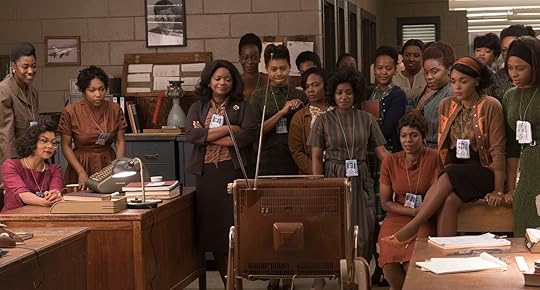
The film follows three women, Katherine Johnson, Dorothy Vaughan and Mary Jackson. A fair amount of dramatic license is used, since these three women were not working together, nor even following career paths at the same time. The book clarifies the facts about them, but also of many other women’s lives and career paths – dozens more. This is not an exaggeration. It is not helped by the fact that women may have more than one surname through their lives, if they change their name on marriage, and possibly again when widowed. Dotting around between them, darting backwards and forwards in different decades, is very confusing.
The narrative is roughly chronological, but proceeds in a zigzag fashion, according to which woman is featured at the time. Margot Lee Shetterly may be describing the progress made in one aspect of engineering in great detail. Or she will describe the break-up of one department and moving around of the staff. Or she may be focusing on the situation as regards segregation in the different States, which had a bearing on the intake of the Langley Research Centre. The book’s history is followed logically, but trying to follow the life of one of the women involved, then another, then another, Dorothy Hoover, Dorothy Vaughan, Amry Jackson, Kathryn Peddrew, Ophelia Taylor, Sue Wilder, Christine Darden and many many more, proves practically impossible. There seem to be several different books here. They would all be interesting, but I feel it needs simplifying in some way for ease of reading.
“In the early stages of researching my book, I shared details of what I had found with experts on the history of the space agency. To a person, they encouraged what they viewed as a valuable addition to the body of knowledge, though some questioned the magnitude of the story.
“How many women are we talking about? Five or six?”
I had known more than that number just growing up in Hampton, but even I was surprised at how the numbers kept adding up.”
“a 1994 study, estimated that Langley had employed “several hundred” women as human computers. On the tail end of the research for Hidden Figures, I can now see how that number might top 1,000.”
Surely the warning bells should have rung at this point. Define your task. What are you writing – a survey? A history? A compendium of human statistics? A report? A story?
Perhaps the author should have stayed with her first idea, starting in 1935, when a few women were hired by the National Advisory Committee for Aeronautics (NACA), to be their first computer pool at the Langley campus. The unusual decision to select only females, and furthermore, only from the segregated black community, has been explained by NASA’s historian:
“The women were meticulous and accurate ... and they didn’t have to pay them very much.”
Yet even so it had caused an uproar. The men in the laboratory could not believe that a female mind could calculate such rigorous mathematics, or handle the expensive advanced comptometers (or calculating machines). But the women who were hired were top-notch mathematicians, either already holding master’s degrees or destined to gain one. What a basis for a riveting story, describing the trajectory of those first five black women who went to work at Langley’s segregated west side in May 1943: the women later known as the “West Computers”! Dorothy Vaughan was one of the earliest; a natural leader, she soon became the spokeswoman for the West Computers. By 1948 she had become NACA’s first black supervisor, and later, an expert FORTRAN programmer.
The story of these “West Computer”’s lives would have made a fascinating tale in itself.
One of the high points comes with astronaut John Glenn’s 1962 trip around the globe. Katherine Johnson’s main task in the lead-up to this, and during the mission itself, was to double-check and then reverse engineer the newly-installed IBM 7090’s trajectory calculations. John Glenn did not completely trust the computer and asked the head engineers to:
“get the girl to check the numbers ... If she says the numbers are good ... I’m ready to go.”
Hollywood of course demanded that this scene occur at a dramatically tense moment in the film. Nevertheless, it is based on a true occurrence. The words were said, and the events are just “tightened up” a bit. Other scenes, perhaps largely invented to illustrate changing attitudes, include one cheer-rousing sequence when the head of the Space Task Group, Al Harrison, destroys the “colored ladies room” bathroom sign. Did it actually happen? Perhaps not. But many thousands of similar episodes did.
The film streamlined it all nicely. By selecting just three women, and missing out much of the science, it made for a very smooth storyline. Often with the book I felt I was just reading a lot of facts and figures, yet in between there would be interesting anecdotal material, expressed in a lucid and readable way. This was Margot Lee Shetterly’s first book, and she can write very well. We are rooting for the women as they overcome discrimination, and feel strong indignation as they were kept in the background and suffered gross insults. It was so startling to me, as an English reader. I never knew there were specialist “Negro Colleges” until recently. Sadly, even in living memory, the UK also used to be prejudiced in favour of white people, and there was also a (strongly contested) idea that black children underachieved academically. But the schools and colleges were always multiracial. It was unquestioned. Therefore for English readers there is a sense of shock every time the fact of racial segregation in a country so similar to our own, and so recently, rears its ugly head. We cannot escape the appalling drama of it all.
But I become lost in the vastness of America, only having a vague sense of where these geographical locations are, never mind the institutions which are being described. When I also have time switches back and forth, and as the author herself admits a “cast” of over 300 characters, and a fairly detailed history of scientific developments, areas where I only have a cursory knowledge of present trends, I am lost. Victorian novels with casts of hundreds hold no terrors for me, but even careful reading did not really help here. I had no framework; no “hook” such as a story, to hang the facts on, neither could I remember these people very easily, except in terms of the film.
Margot Lee Shetterly remembered visiting her father’s workplace:
“Women occupied many of the cubicles; they answered phones and sat in front of typewriters, but they also made hieroglyphic marks on transparent slides and conferred with my father and other men in the office on the stacks of documents that littered their desks. That so many of them were African American, many of them my grandmother’s age, struck me as simply a part of the natural order of things: growing up in Hampton, the face of science was brown like mine.”
“As a child … I knew so many African Americans working in science, maths and engineering that I thought that’s just what black folks did.”
Hidden Figures: The Story of the African-American Women Who Helped Win the Space Race is a startling story on many levels, showing how black females have always comprised a significant part of the mathematical and engineering workforce at NASA, defying both the double whammy of being female and being black:
“As late as 1970, just 1% of all American engineers were black, a number that doubled to a whopping 2% by 1984. Still, the federal government was the most reliable employer of African Americans in the sciences and technology; in 1984, 8.4% of Nasa’s engineers were black.”
“Even as a professional in an integrated world, I had been the only black woman in enough drawing rooms and boardrooms to have an inkling of the chutzpah it took for an African American woman in a segregated southern workplace to tell her bosses she was sure her calculations would put a man on the moon.”
I am thoroughly glad that Margot Lee Shetterly devoted so much time and care to researching and telling this story. However, a good author knows what to select, and what to reject, and does not just stick all her research in somewhere, regardless. The confused structure of this book means reading flow is extremely patchy.
“I’m sensitive to the cognitive dissonance conjured by the phrase ‘black female mathematicians at Nasa’”.
Oh yes! How I would love to say the book is amazing; the facts certainly are. I cannot in my heart give this an average rating. But in all fairness I cannot rate it as higher than 4 stars, and I feel that even this is on the generous side.
The film is fictionalised, as the author clearly said, whereas the book is scrupulously factual. But the book is just too complicated. I know which of them I am likely to revisit.
Extra Quotations:
“There was Dorothy Hoover, working for Robert T Jones in 1946 and publishing theoretical research on his famed triangle-shaped delta wings in 1951. There was Dorothy Vaughan, working with the white “East Computers” to write a textbook on algebraic methods for the mechanical calculating machines that were their constant companions.
There was Mary Jackson, defending her analysis against John Becker, one of the world’s top aerodynamicists. There was Katherine Johnson, describing the orbital trajectory of John Glenn’s flight, the maths in her trailblazing 1959 report as elegant, precise and grand as a symphony. There was Marge Hannah, the white computer who served as the black women’s first boss, co-authoring a report with Sam Katzoff, who became the laboratory’s chief scientist. There was Doris Cohen, setting the bar for them all with her first research report – the NACA’s first female author – back in 1941.
My investigation became more like an obsession; I would walk any trail if it meant finding a trace of one of the computers at its end. I was determined to prove their existence and their talent in a way that meant they would never again be lost to history.”