Fritz Leiber was one of the most famous fantasy and SF writers of the century, the author of many classics, including the popular Fafhrd and the Gray Mouser fantasy series. In 1936, young Leiber, then in correspondence with the famous writer H.P. Lovecraft, drafted this eerie story.
Now Tor is pleased to present in print for the first time this short novel of cosmic dread and Lovecraftian horror, lost since the 1950s. It is a story of science gone awry, of strange dimensions—of love and death. Kesserich is a lone scientist in his California home laboratory, plunging intuitively beyond the bounds of known science into the deepest mysteries of time and space.
Fritz Reuter Leiber Jr. was one of the more interesting of the young writers who came into HP Lovecraft's orbit, and some of his best early short fiction is horror rather than sf or fantasy. He found his mature voice early in the first of the sword-and-sorcery adventures featuring the large sensitive barbarian Fafhrd and the small street-smart-ish Gray Mouser; he returned to this series at various points in his career, using it sometimes for farce and sometimes for gloomy mood pieces--The Swords of Lankhmar is perhaps the best single volume of their adventures. Leiber's science fiction includes the planet-smashing The Wanderer in which a large cast mostly survive flood, fire, and the sexual attentions of feline aliens, and the satirical A Spectre is Haunting Texas in which a gangling, exo-skeleton-clad actor from the Moon leads a revolution and finds his true love. Leiber's late short fiction, and the fine horror novel Our Lady of Darkness, combine autobiographical issues like his struggle with depression and alcoholism with meditations on the emotional content of the fantastic genres. Leiber's capacity for endless self-reinvention and productive self-examination kept him, until his death, one of the most modern of his sf generation.
Used These Alternate Names: Maurice Breçon, Fric Lajber, Fritz Leiber, Jr., Fritz R. Leiber, Fritz Leiber Jun., Фриц Лейбер, F. Lieber, フリッツ・ライバー
This is a novella that Leiber wrote in 1936, three years before he made his first literary sale, and it remained unpublished until five years after his death. The writing was influenced by his extensive correspondence with H.P. Lovecraft, and to me it reads as like rather accomplished fanfic. He captures the feel of Lovecraft's cosmic menace and strangeness rather well, and his prose is more accessible. There's no monstrous evil involved, just some jumbled rumination and speculation about electric-powered time travel that didn't remind me much of Wells at all. He switches narrative voices in an interesting way in the final chapter, which is supposed to tie up the whole thing. It's an interesting piece, enjoyable as a curiosity, but not major Leiber.
I really, REALLY, wanted to like this book. I've been on a bit of a Lovecraft kick lately and this was on a list of best Lovecraft influenced works. I give it a resounding...meh. It would have made an okay short story and probably should have had 30-35 pages cut out. The reveal isn't as scary has Fritz Leiber seems to think. But it was clearly a love letter to Lovecraft, which I totally appreciate.
Billed as H.G. Wells meets Lovecraft but it never lived up to that in my eyes. More Wells than Lovecraft which isn't necessarily bad but I was looking for something with a new twist and thought the combination might work...but it didn't for me.
This is an example of a back-loaded story. Although only 120 pages, it's the last 20 pages that make it work. Everything before that is basically set-up for the long-winded explanation that ends the story. Which makes it a bit of a slog to read. That being said, the end does kind of justify it. The conceptualization of time travel that Leiber creates here is very unique and memorable. And Kesserich's understanding of it and its dangers is nuanced as well. And the first 80% of the book does provide a good example of tone. The story is full of foreboding and feels claustrophobic and disturbing. For a story this relatively short, it is extremely slow-moving, and even manages to minimize some of its major events. Once the 'secret' is revealed, it does make it a worthwhile read, but you'll definitely need to invest the time to push through.
After having read all of the reviews for this book, I figured that I was going to be in for a major treat, but I was a bit disappointed. The story didn't hold me -- I put this one down for a while and read 3 others in the meantime -- so it was tough. However, on the positive side, I'm always looking for books about time travel, so this just added to my list.
here's the story in a nutshell: Back in their college days, there were four friends that hung out together -- Mary Andrews, John Ellis, Daniel Kesserich, and the narrator of our story, George Kramer. Time passes and Kramer receives a letter to come to Smithville, CA, where Ellis now lives. It seems that Mary has died. So off Kramer goes, but when he gets there, there is no Ellis. What he finds is a town sort of run amuck, looking for Ellis, bent on lynching the guy for supposedly murdering his wife. In the midst of this, Kramer is surrounded by strange happenings that he cannot explain. As events progress and as things heat up, Kramer is intent on solving these seemingly inexplicable occurrences.
I won't say more, because it will give things away. Once I got back to the book, it didn't take me long to read it, since it was only a short novella. If you like somewhat-Lovecraftian-style writing, then you'll like this one, but don't even think about comparing it to HPL and his writings. It's just not the same dark ambiance that oozes out of HPL's stories. It was okay.
Gonna keep this one brief because 1. I just spent waaaayyy too much time writing my review of The Heart is a Lonely Hunter, and 2. This book is itself brief, and reads more like a thought experiment or something unremarkable out of Weird Tales magazine than a fully-realized novella.
Bought this one when Constance (my wife and steady reading companion) visited a little used bookstore called "My Book House" in Natchez, MS over the past summer. I was struck by the cover art (still am -- I'm a sucker for a good cover), and the flap betrayed whisperings of H.P. Lovecraft. Besides, it's a posthumous tale from the Nebula-award-winning Fritz Leiber!
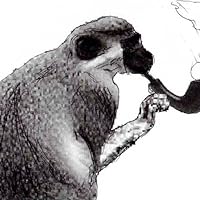
Turns out its publication was really just a cash grab. It has no business being printed as a complete novella. The book's 125 pages have reached these lengths primarily because of the enlarged font and page-sized illustrations that look like poorly-modeled photographs that have been hastily run through a shabby "newspaper photo" filter. Although a couple of them were uncannily unnerving and forced me to rake my eye across them a few times. Could've easily read this in maybe 90 minutes, if not less.
Suffice it to say, there's not much that's remarkable here. Some rehashed tropes that were done better by authors more versed in this particular genre, but it was an interesting exploration of the "butterfly effect" idea as it meets time travel (which, again, was done better by Ray Bradbury in his 1952 short story "A Sound of Thunder").
Still, it was an entertaining romp, with everything neatly explained by the story's conclusion. I'm probably going to hold onto this one just for the cover, though. It's got more going on with it than the story within does.
Normally I don’t review books less than 200 pages long, especially when a considerable percentage of the page count is taken up by illustrations, blank pages and spacious typesetting. However, for this work I’ll make an exception. Sure, it doesn’t amount to much more than a short story, a novella at best. But a novella from weird fiction master Fritz Leiber is better than an entire set of weighty tomes from most other authors. I’ve been a fan of Leiber’s work ever since the first time I read “Smoke Ghost,” so I guess I can’t really tell if non-aficionados would get much out of it. But for my money, this is the best treatment of time travel I’ve ever read. The author manages to come up with an explanation for the process so elegant that it seems reasonably plausible, manages to side-step most of the tiresome sub-genre clichés, and actually fuels a handful of interesting plot twists. My only disappointment was that the story didn’t seem to reflect quite as much Lovecraftiana as the cover promised. To be sure, Lovecraft’s influence can be seen in the tale, but the “mythos” and the more grandiose aspects of cosmic horror are missing from the novella. Nonetheless, I’m glad I read this book and recommend it without reservation.
The central complaint to be offered for this story is its brevity. Though Leiber's discretion in doling out the explanation for the mysterious events in Smithville is masterful and to the benefit of the story's delivery, it is undermined by the tale's limited scope. Like Kesserich himself, the act of reading the story becomes but a blur and the impact of the events and the revelation of their significance is muffled.
However, this tale is wonderfully written and, for its brevity, its setup and payoff for suspense and inexplicable incidents is well-executed. It has the added benefit of a really original take on a common science-fiction trope and accompanying philosophical musings about the ethics and purpose of the whole business. It was a pleasant read on the whole and highly recommended for anyone who enjoys the works of H.P Lovecraft.
Time travel stories can be a bit fraught and hackneyed, and while I wouldn't call this brilliant, it is at least neither of those things. While more of a "weird tale" mystery and not exactly the "eldritch horror" that the alleged Lovecraft influence would imply, this at least remains a fairly original take on the topic even today. It is also—oddly—both short and simultaneously bloated, and clearly written by a young author who has not yet found their footing. No wonder it went unpublished for so long. Were there not such hunger for the work of a deceased artist, it is unlikely this would ever have seen publication. Entertaining nonetheless, and probably still unfilmable even in this CGI era, and thus likely to remain an unfamiliar variant expression of time travel for some time to come.
Preso solo perchè c'era il nome di Leiber in copertina. Lettura molto veloce e molto breve, gradevole ma non eccezionale. Ha però retto bene il passare del tempo, questo si, considerando che il manoscritto risale al 1936 e venne pubblicato postumo. Meglio la prima parte, più misteriosa, che la seconda, nella quale l'autore si arrampica sugli specchi e tira fuori pagine e pagine di supercazzole per dare al tutto un senso scientifico compiuto.
Liked this one. Prose was good, and it had many interesting ideas, though they were, owing to the novel's structure, primarily loaded in the lattermost portion of the novella. Classic Frankenstein-esque novel, reminding me of other post-Enlightenment exploration of scientific advancement gone too far.
Written in 1936 and published in 1997, this is a novella in the style of Lovecraft. Fans of HPL would probably like this, and big Fritz Leiber fans will be able to see the beginnings of what would come.
I've read two books by Leiber before and enjoyed them, so I was excited to pick this one up. Something about this story didn't quite work for me, maybe the time travelling aspect of it was a bit cumbersomely handled, but it was original and well written, Leiber has once again demonstrated what a good writer he was. More fantasy with scifi aspects than cosmic horror as the book cover advertised. Interestingly enough (particularly considering the subject) this story was lost for a long time, since 1950s, and only resurfaced in the 1990s. Neat edition with original artwork inside. Very short novel, novella really, took only slightly over an hour to read. Solid read overall, must for a fan, but not Leiber's best, so maybe not an ideal way to get introduced to the author. Keeping in mind that this is one of his earliest works (originally written in 1936), it is quite an auspicious story. Leiber was a terrific versatile and talented writer and any fan of speculative fiction should read his work.
Considering that his short story 'Gonna Roll the Bones' is one of my favorite stories, I'm surprised it took me so long to get around to reading anything else by Fritz Leiber. This may not have been the best place to start, it's just an ok Lovecraftian time travel - horror story. There's a few nice creepy touches, but overall it's just a quick diversion. My edition included a number of odd illustrations, their tone of black humor was out of character with the rest of the book and seemed to be better placed in some kind of sci-fi farce instead of this book, they only served to distract from the intended mood the author was trying to create.
Fritz Leiber seemed to be quite the character, having been a world class fencer and world traveller. He really enjoyed life, too bad so much of his work is out of print.
A posthumously published quick read. One of the blurbs describes it as H.G. Wells meets Lovecraft, which is fairly apt. Mostly makes me want to read more of his other stuff. Its a shame he's so out of print. It seems like there should at least be a good collection of all the Fafhrd and the Grey Mouser stuff, but they only seem to put out crappy paperbacks that don't collect as many stories, or collect them as well, as the old copies I found in the library.
I just gave this a re-read, since I like to read spooky stuff during the Halloween season.
This is a novella that reads a bit like a detective story, but includes time travel along with some decidedly creepy elements. It is an early Leiber tale, with a heavy Lovecraftian influence, but it exemplifies Leiber’s ability to adjust his style to the story at hand, and to give his imagination room to play.
A stab at a sci-fi horror story, Daniel Kesserich uses a pulp-ish time travel premise to tell a Machen-ish horror story, with a dab of Twilight Zone-esque small town mob hysteria thrown in for fun. Two stars for the story, which was a little shallow, four for the illustrations, which were good and creepy.
Amazing! I think the bad reviews on this come from people expecting the usual Fafhrd and the Gray Mouser and ending up with a speculative, Lovecraftian story involving time-travel and parallel universes. If you're looking for sci-fi/horror this is the book though; the ending literally blew my mind - I'm still trying to wrap my head around the fifth-dimension!
A nifty little novella, and while not Leiber's best, it's a worthy addition to any weird fiction library. Time travel, resurrection of the dead, a creepy little California town where something is Not Quite Right -- what more can one want? It would have made a great Twilight Zone episode.
Nicely eerie--and creepy. But so much of it happens offstage (or doesn't happen at all); I don't really think you're getting full value for your buck (and I checked it out of the library). Well-tied together though--with all peculiar doings accounted for at the end.