

What do you think?

Snow Crash
In reality, Hiro Protagonist delivers pizza for Uncle Enzo's CosoNostra Pizza Inc., but in the Metaverse he's a warrior prince. Plunging headlong into the enigma of a new computer virus that's striking down hackers everywhere, he races along the neon-lit streets on a search-and-destroy mission for the shadowy virtual villain threatening to bring about infocalypse. Snow Crash is a mind-altering romp through a future America so bizarre, so outrageous… you'll recognize it immediately.
576 pages, Paperback
First published June 1, 1992
About the author
Neal Stephenson
100 books29.4k followersNeal Stephenson is the author of Reamde, Anathem, and the three-volume historical epic the Baroque Cycle (Quicksilver, The Confusion, and The System of the World), as well as Cryptonomicon, The Diamond Age, Snow Crash, and Zodiac. He lives in Seattle, Washington.
Ratings & Reviews
Friends & Following
Create a free account to discover what your friends think of this book!
Community Reviews
Displaying 1 - 30 of 14,334 reviews

February 17, 2012
Disliking this book seemed quite impossible. After all, it had all the necessary ingredients: the pervasive air of nerdy geekiness (or, perhaps, geeky nerdiness), an unexpected take on linguistics, a kick-ass female character, a parallel (virtual) reality, a hefty helping of (admittedly, overexaggerated) satire, and just enough wacky improbable worldbuilding to satisfy my book loving soul. Or so it seemed.
But awesome ingredients do not always add up to a satisfying dish¹ (as my horrible cook self knows much too well).
I did NOT come to this book with an open mind. I came to it infinitely biased in its favor, ready to love it to pieces, prepared to find in it the same irresistible allure that so many of my Goodreads friends appreciated. Alas, after the first few pages my good-natured amusement gave way to irritated frustration, then to impatience, and eventually, as the book was nearing its final pages, my feelings changed to dreaded passionless indifference - akin to the emotions stirred by a disclaimer on the back of a pill packet.
It is very disappointing when a book leaves you indifferent after hundreds of pages spent with the characters and the plotlines - especially when it is a book with such immense potential as 'Snow Crash' had based on all the reviews and snippets I have seen, with all the ingredients for an amazing sci-fi adventure I listed above.
As for the antagonists, we haveL. Ron Hubbard L. Bob Rife, a computer magnate and a leader of a questionable religion; the Feds that have lost their power but retained their bureaucracy; and enigmatic Raven, equipped with a motorcycle, a few deadly spears and another weapon that earns him more respect from the authorities that that a few small nations get.
And then there's the titular Snow Crash:
Sounds awesome, doesn't it? To me, the concept of Snow Crash initially evoked the memories of Delany's Babel-17, a book that I loved for all it's strangeness and far-fetchedness and irresistible pull into the blend of linguistics and sci-fi.
But then 'Snow Crash', having barely taken off, disappointingly crashed. Pun very much intended.
Maybe this had something to do with the clumsily thrown in heaps of infodump, painfully interrupting already shaky and unsteady narrative, adding tons of poorly placed and far-fetched exposition which it mistakes for layers of complexity, basking in self-importance while being needlessly silly (and, frankly, needless).
Maybe it was the sheer number of complex plot threads that weaves complexity but ended up going nowhere, with few (admittedly, memorable) exceptions.
Maybe it was what I can only perceive as casual racism so pervasive in descriptions of most 'ethnic' characters and entire groups featured in this novel, so present in every casually thrown stereotype. Intentional or not, it was unpleasantly grating.
Maybe it was the lack of dimension in Stephenson's characters. Hiro appears to be created as an embodiment of a teenage computer whiz's dreams, not developing in the slightest throughout the novel, only acquiring more and more badassery in the throwaway 'why not?' sloppy manner. Y.T., despite her awesomeness², behaving in a strangely robotic fashion. Raven and Uncle Enzo, frustratingly underdeveloped. Juanita, whose character could have been interesting, appears to exist solely as potential mate for Hiro. The only times I felt any connection to the characters were the appearances of the robotic dog, and I am not even a dog person.
Honestly, I can't help but see how this book would have worked so much better in a graphic format, being it a comic book (like, apparently, it was initially envisioned) or a film; the action scenes would have looked splendid while the awkwardness of language with overused frequently clumsy metaphors and the jarring present tense (which really doesn't work for this story) would have been cast aside.
-----------
Yes, I am very disappointed at my disappointment with this book. I wish I had the ability to overlook its flaws, but the indifference I felt when reading it precluded me from caring enough to let its good moments overshadow the bad. 2 stars, one for the robot-doggy and another for Y.T. who occasionally made me almost care.
——————
Also posted on my blog.
But awesome ingredients do not always add up to a satisfying dish¹ (as my horrible cook self knows much too well).
¹Remember 'Friends' episode where Rachel tries to make English trifle for Thanksgiving desert, but because of a couple pages unfortunately sticking together ends up making half English trifle and half the shepherd's pie? Joey was baffled that the rest of the gang found the dish unpalatable:
'I mean, what's not to like? Custard, good. Jam, good. Meat, good!'
I did NOT come to this book with an open mind. I came to it infinitely biased in its favor, ready to love it to pieces, prepared to find in it the same irresistible allure that so many of my Goodreads friends appreciated. Alas, after the first few pages my good-natured amusement gave way to irritated frustration, then to impatience, and eventually, as the book was nearing its final pages, my feelings changed to dreaded passionless indifference - akin to the emotions stirred by a disclaimer on the back of a pill packet.
It is very disappointing when a book leaves you indifferent after hundreds of pages spent with the characters and the plotlines - especially when it is a book with such immense potential as 'Snow Crash' had based on all the reviews and snippets I have seen, with all the ingredients for an amazing sci-fi adventure I listed above.
“We are all susceptible to the pull of viral ideas. Like mass hysteria. Or a tune that gets into your head that you keep humming all day until you spread it to someone else. Jokes. Urban legends. Crackpot religions. Marxism. No matter how smart we get, there is always this deep irrational part that makes us potential hosts for self-replicating information.”Here's a glimpse of the plot, as much as I can listlessly muster. Hiro Protagonist, our hero and protagonist (cleverly annoying or annoyingly clever, I'm not quite sure) is a hacker in a future completely corporatized and fractured by consumerism America. He delivers pizza for the Mafia franchise by day and in his spare time hangs around Metaverse, a computer-based simulated reality where he is a sword-fighting badass with a juicy piece of expensive (virtual) real estate and important friends. To those having trouble picturing this, think of ‘The Matrix’ as compared to the gloomy existence outside of it. Y. T. is his sidekick, a Kourier with a healthy dose of vital spunk and kindness to animals that just may result in the most spectacular payback at the most crucial moment. Uncle Enzo is the head of the Mafia franchise, and does not like late pizza deliveries - he has his reasons.
As for the antagonists, we have
And then there's the titular Snow Crash:
“This Snow Crash thing--is it a virus, a drug, or a religion?”
Juanita shrugs. “What's the difference?”
Sounds awesome, doesn't it? To me, the concept of Snow Crash initially evoked the memories of Delany's Babel-17, a book that I loved for all it's strangeness and far-fetchedness and irresistible pull into the blend of linguistics and sci-fi.

But then 'Snow Crash', having barely taken off, disappointingly crashed. Pun very much intended.
Maybe this had something to do with the clumsily thrown in heaps of infodump, painfully interrupting already shaky and unsteady narrative, adding tons of poorly placed and far-fetched exposition which it mistakes for layers of complexity, basking in self-importance while being needlessly silly (and, frankly, needless).
Maybe it was the sheer number of complex plot threads that weaves complexity but ended up going nowhere, with few (admittedly, memorable) exceptions.
Maybe it was what I can only perceive as casual racism so pervasive in descriptions of most 'ethnic' characters and entire groups featured in this novel, so present in every casually thrown stereotype. Intentional or not, it was unpleasantly grating.
Maybe it was the lack of dimension in Stephenson's characters. Hiro appears to be created as an embodiment of a teenage computer whiz's dreams, not developing in the slightest throughout the novel, only acquiring more and more badassery in the throwaway 'why not?' sloppy manner. Y.T., despite her awesomeness², behaving in a strangely robotic fashion. Raven and Uncle Enzo, frustratingly underdeveloped. Juanita, whose character could have been interesting, appears to exist solely as potential mate for Hiro. The only times I felt any connection to the characters were the appearances of the robotic dog, and I am not even a dog person.
² Y.T., while being far from an excellent character, was at least a ray of (grumpy) sunshine in the otherwise grey landscape of this novel. She has spunk and heart and confidence that is engaging and does not strike fakes notes that often. She made me almost care, and for this I appreciate her character. If only the rest if the book had the same spirit...Maybe it was the inability to interweave the plot threads into a coherent storyline, to create a bigger whole out of separate parts. The ideas are there, the concepts are there; what's missing is cohesiveness able to pull them together, untangle them and weave a net captivating the readers' brains and imagination. Without this cohesiveness, even the wildest and most daring ideas - like Stephenson's unconventional approach to viruses, for instance - remain disjointed, underdeveloped, unfinished, unpolished, like the refugee Raft in his novel, made of heaps of refuse clumped together trying to make a whole but failing at it.
Honestly, I can't help but see how this book would have worked so much better in a graphic format, being it a comic book (like, apparently, it was initially envisioned) or a film; the action scenes would have looked splendid while the awkwardness of language with overused frequently clumsy metaphors and the jarring present tense (which really doesn't work for this story) would have been cast aside.
-----------
Yes, I am very disappointed at my disappointment with this book. I wish I had the ability to overlook its flaws, but the indifference I felt when reading it precluded me from caring enough to let its good moments overshadow the bad. 2 stars, one for the robot-doggy and another for Y.T. who occasionally made me almost care.
——————
Also posted on my blog.

September 16, 2013
Wow.
Wow, wow, wow.
I had thought that William Gibson’s Neuromancer was the alpha male of the cyberpunk genre; the template upon which all others would be drawn. Turns out, Gibson was the prophet, but Stephenson was the barbarian, breaking ground with a riveting, relentless new age thriller.
Snow Crash by Neal Stephenson is a wild trip.
A fun conglomerate of Hunter S. Thompson, Philip K. Dick, Anthony Burgess and John Brunner, written 8 years after Neuromancer and 19 years before Ready Player One this is a bright light on the cyberpunk literary landscape. Set in a near alternative future, Stephenson introduces a world where governments have collapsed and societies are held loosely together by anarcho-capitalism.
The book was nominated for a Prometheus Award but what could be a libertarian dream may also be seen as a laissez-faire nightmare. This is a blitzkrieg of ideas, a cacophony of sci-fi, techno-socio-economic observations, a kaleidoscope of theological and philosophical concepts thrown together in a Mark Twainian fantasy hopped up on Red Bull and amphetamines.
Above all this is an intelligent, modern adventure that expertly weaves in elements of pre-history and archeological thrill seeking. If Bladerunner led to The Matrix, then this is what’s next. And, if Stephenson had not boiled it all together enough into a steaming cup of Have At You!, then he also has the best name for a lead character of all time: Hiro Protagonist.
A very, very Goodread, five stars, two snaps and a bag of chips.
** 2018 addendum - it is a testament to great literature that a reader recalls the work years later and this is a book about which I frequently think. As great a hero as Hiro is, the scenes between Raven and YT are those that I recall the most and Raven is a character about whom more could be written. The casting of Ravinoff by Jason Momoa would be a good one.
*** 2023 reread -
Love this book, truly one of the great science fiction novels of all time.
This has lost none of its potency in the 30 years since its publication, if anything its message has renewed relevancy with the inclusion of its cautionary message about centralized information gathering and dissemination.
While the most organic comparisons will be to Neuromancer and Ready Player One, this has been wildly influential on many works since and a consequential legacy of many works before it, Snow Crash is a high water mark in this genre.
Actually, when I think of this book in terms of other works like Catch-22 or Slaughterhouse Five, this is not just great SF but great literature and we can find that Stephenson, writing in the early 90s, has provided to us a work unique for its time and place.
The anarcho-capitalist setting and socio-economic observations subtly screaming out on most every page also made me consider a comparison with Howard Chaykin’s work on his American Flagg series from the 80s.
Stephenson’s characterization was delicious, making this work on many levels; Uncle Enzo and Raven, and the man with the glass eye teaming up with Hiro and YT to make this so much fun. I did not realize it last time, but this is told from the perspective of an omniscient but chatty storyteller so we can hear Stephenson’s own voice mischievously breaking the fourth wall here and there, and again with the comparison to Chaykin.
This can also be funny and with a long list of humorous elements scattered throughout the narrative that made me consider an oblique comparison to Trevanian. Reverend Wayne’s Pearly Gates franchise is as much fun as the Fosterites from Heinlein’s Stranger in a Strange Land.
Finally I will add this great book to my list of all time favorites. As of this addendum I have published over 1800 reviews and this makes the tenth book on that exclusive list. It’s that good.

Wow, wow, wow.
I had thought that William Gibson’s Neuromancer was the alpha male of the cyberpunk genre; the template upon which all others would be drawn. Turns out, Gibson was the prophet, but Stephenson was the barbarian, breaking ground with a riveting, relentless new age thriller.
Snow Crash by Neal Stephenson is a wild trip.
A fun conglomerate of Hunter S. Thompson, Philip K. Dick, Anthony Burgess and John Brunner, written 8 years after Neuromancer and 19 years before Ready Player One this is a bright light on the cyberpunk literary landscape. Set in a near alternative future, Stephenson introduces a world where governments have collapsed and societies are held loosely together by anarcho-capitalism.
The book was nominated for a Prometheus Award but what could be a libertarian dream may also be seen as a laissez-faire nightmare. This is a blitzkrieg of ideas, a cacophony of sci-fi, techno-socio-economic observations, a kaleidoscope of theological and philosophical concepts thrown together in a Mark Twainian fantasy hopped up on Red Bull and amphetamines.
Above all this is an intelligent, modern adventure that expertly weaves in elements of pre-history and archeological thrill seeking. If Bladerunner led to The Matrix, then this is what’s next. And, if Stephenson had not boiled it all together enough into a steaming cup of Have At You!, then he also has the best name for a lead character of all time: Hiro Protagonist.
A very, very Goodread, five stars, two snaps and a bag of chips.
** 2018 addendum - it is a testament to great literature that a reader recalls the work years later and this is a book about which I frequently think. As great a hero as Hiro is, the scenes between Raven and YT are those that I recall the most and Raven is a character about whom more could be written. The casting of Ravinoff by Jason Momoa would be a good one.
*** 2023 reread -
Love this book, truly one of the great science fiction novels of all time.
This has lost none of its potency in the 30 years since its publication, if anything its message has renewed relevancy with the inclusion of its cautionary message about centralized information gathering and dissemination.
While the most organic comparisons will be to Neuromancer and Ready Player One, this has been wildly influential on many works since and a consequential legacy of many works before it, Snow Crash is a high water mark in this genre.
Actually, when I think of this book in terms of other works like Catch-22 or Slaughterhouse Five, this is not just great SF but great literature and we can find that Stephenson, writing in the early 90s, has provided to us a work unique for its time and place.
The anarcho-capitalist setting and socio-economic observations subtly screaming out on most every page also made me consider a comparison with Howard Chaykin’s work on his American Flagg series from the 80s.
Stephenson’s characterization was delicious, making this work on many levels; Uncle Enzo and Raven, and the man with the glass eye teaming up with Hiro and YT to make this so much fun. I did not realize it last time, but this is told from the perspective of an omniscient but chatty storyteller so we can hear Stephenson’s own voice mischievously breaking the fourth wall here and there, and again with the comparison to Chaykin.
This can also be funny and with a long list of humorous elements scattered throughout the narrative that made me consider an oblique comparison to Trevanian. Reverend Wayne’s Pearly Gates franchise is as much fun as the Fosterites from Heinlein’s Stranger in a Strange Land.
Finally I will add this great book to my list of all time favorites. As of this addendum I have published over 1800 reviews and this makes the tenth book on that exclusive list. It’s that good.

October 31, 2020
Don´t do drugs, cyborg metaverse cyberpunk ghetto kids
High VR AR and finally only reality.
What would VR and AR be without being hooked on a potentially fatal wonderdrug, as the only chance to escape bleak reality, in an anarcho neoliberal nightmare controlled by corporations, organized crime, and the rest of government mutated into a bizarre self satire of bureaucracy without any real power.
Not like his second milestone, Diamond Age.
In contrast to the somewhat Dickensian Diamond Age, this one is pure cyberpunk without biopunk elements, accelerating the badass dystopian transhumanist ideals to degenerated turbo capitalistic free market terror.
Humor as black as the world
I had some of the best laughs with the hidden easter egg black comedy. Be careful not to miss them! Kool Aid, lol. This is by far Stephensons`funniest novel, I don´t know why he didn´t continue to expand this element.
Remember the mutating memes
One of the most famous, best, important, and mind boggling ideas of this work is that any ideology, memes, manifestations of epigenetic and cultural evolution in progress, sadly often faith and sick ideologies, are parasitic, viral information, infecting the minds of humans as a first, single, abnormal mutation in the brain of just one particularly odd primate ancestor. I don´t want to single out any group unfairly, I´m already poking fun at enough other favorite targets, it´s just that one of the many, negative side effects of any belief system taking hold is a bit of madness along the way.
Action, philosophy, linguistic theories mixed with faith origin ideas, and quick cuts between pure fun and sophisticated mind penetration that will leave one blown away.
Mix this all with the cool, quick writing style, extreme high complexity and density of ideas, philosophy, switching between action scenes and deep, linguistic introspections, inner monologues, dialogues, and social criticism, and one has a milestone of sci-fi and literature in general.
Who combined humanities, tech, and economics first?
I wonder how many sci-fi movies have been influenced by literature, someone should consider making a list, because I watch close to no TV and will thereby never be able to compare it. In this case, I am not even sure if Gibson, Stephenson, or a forgotten, unknown author was the first one to mix economic criticism with VR and humanities.
Cherry pick wisely
I´ve said this before, don´t read all of Stephenson´s work if you aren´t really into sci-fi or like to skim and scan lengthy passages, because Diamond Age and Snow Crash aren´t like many of his other novels. These are often more something like hard-science fiction, space opera, philosophical theory hybrids that are really exhausting to read, don´t care about writing conventions, and could have been much better, if just reduced to an acceptable length and included in a normal, suspenseful plot. Instead of just egomaniacally letting the author drivel about whatever comes to his mind in the form he thinks is cool, that is what sadly made his brick books like Anathem and Cryptonomicon unreadable for many people.
In a parallel universe, Stephenson could have evolved into a readable sci fi superhero
Instead, Stephenson sabotages himself and his legacy, by being too much focused on the high brow, deep, art aspect and forgetting that he once was one of the prodigies of cyberpunk and sci-fi itself before becoming unreadable for a vast majority of the bibliophiles, even sci fi holics like myself. I´ve read many of his works and enjoyed them, but won´t reread them, because the best genre of them all is my lifeblood, but I couldn´t find another author who got so hypercomplex, interwoven, and difficult or impossible to understand as Stephenson with his close to 1k page behemoths of books. Yes, they offer unique and intelligent insights and revelations, but this would taste much less bitter without the knowledge that most readers, for completely understandable, logical, and appropriate reasons, won´t ever become comfortable with it.
High VR AR and finally only reality.
What would VR and AR be without being hooked on a potentially fatal wonderdrug, as the only chance to escape bleak reality, in an anarcho neoliberal nightmare controlled by corporations, organized crime, and the rest of government mutated into a bizarre self satire of bureaucracy without any real power.
Not like his second milestone, Diamond Age.
In contrast to the somewhat Dickensian Diamond Age, this one is pure cyberpunk without biopunk elements, accelerating the badass dystopian transhumanist ideals to degenerated turbo capitalistic free market terror.
Humor as black as the world
I had some of the best laughs with the hidden easter egg black comedy. Be careful not to miss them! Kool Aid, lol. This is by far Stephensons`funniest novel, I don´t know why he didn´t continue to expand this element.
Remember the mutating memes
One of the most famous, best, important, and mind boggling ideas of this work is that any ideology, memes, manifestations of epigenetic and cultural evolution in progress, sadly often faith and sick ideologies, are parasitic, viral information, infecting the minds of humans as a first, single, abnormal mutation in the brain of just one particularly odd primate ancestor. I don´t want to single out any group unfairly, I´m already poking fun at enough other favorite targets, it´s just that one of the many, negative side effects of any belief system taking hold is a bit of madness along the way.
Action, philosophy, linguistic theories mixed with faith origin ideas, and quick cuts between pure fun and sophisticated mind penetration that will leave one blown away.
Mix this all with the cool, quick writing style, extreme high complexity and density of ideas, philosophy, switching between action scenes and deep, linguistic introspections, inner monologues, dialogues, and social criticism, and one has a milestone of sci-fi and literature in general.
Who combined humanities, tech, and economics first?
I wonder how many sci-fi movies have been influenced by literature, someone should consider making a list, because I watch close to no TV and will thereby never be able to compare it. In this case, I am not even sure if Gibson, Stephenson, or a forgotten, unknown author was the first one to mix economic criticism with VR and humanities.
Cherry pick wisely
I´ve said this before, don´t read all of Stephenson´s work if you aren´t really into sci-fi or like to skim and scan lengthy passages, because Diamond Age and Snow Crash aren´t like many of his other novels. These are often more something like hard-science fiction, space opera, philosophical theory hybrids that are really exhausting to read, don´t care about writing conventions, and could have been much better, if just reduced to an acceptable length and included in a normal, suspenseful plot. Instead of just egomaniacally letting the author drivel about whatever comes to his mind in the form he thinks is cool, that is what sadly made his brick books like Anathem and Cryptonomicon unreadable for many people.
In a parallel universe, Stephenson could have evolved into a readable sci fi superhero
Instead, Stephenson sabotages himself and his legacy, by being too much focused on the high brow, deep, art aspect and forgetting that he once was one of the prodigies of cyberpunk and sci-fi itself before becoming unreadable for a vast majority of the bibliophiles, even sci fi holics like myself. I´ve read many of his works and enjoyed them, but won´t reread them, because the best genre of them all is my lifeblood, but I couldn´t find another author who got so hypercomplex, interwoven, and difficult or impossible to understand as Stephenson with his close to 1k page behemoths of books. Yes, they offer unique and intelligent insights and revelations, but this would taste much less bitter without the knowledge that most readers, for completely understandable, logical, and appropriate reasons, won´t ever become comfortable with it.

October 31, 2007
Cyberpunk’s next generation pretty much began here. Written by someone who -unlike William Gibson- actually knows computers, this anime in novel form is one of those rare SF books that is read by many non-SF readers.
On a personal note, this is probably the only book I’ll ever read whose main character is half black and half Japanese, just like me! When I first read it, I was working at a pizza place, just like the protagonist, and I actually got fired around the same time I got to the point of him losing his job as well. Also, my first name is Hiroshi and he goes by Hiro. Cool, huh? OK, aside from those neat little coincidences, we are not at all alike. It just made reading it all the more fun for me. Plus I hated that job.
Admittedly, there are certain aspects of this book that are a tad dated now (it was written in 1991), and he can’t quite get past certain stereotypes of Japanese people that many Westerners harbor. Still, there is some fun bit of social commentary and parody on just about every other page, and Stephenson satirizes globalization years before most people even knew what globalization is.
There is also some really fascinating stuff involving the concept of memetic viruses, which he ties to Sumerian mythology and the Tower of Babel. I know that a lot of people find this part of the book to be boring, but I was fully engrossed. The kind of thing I live for when I read SF.
On a personal note, this is probably the only book I’ll ever read whose main character is half black and half Japanese, just like me! When I first read it, I was working at a pizza place, just like the protagonist, and I actually got fired around the same time I got to the point of him losing his job as well. Also, my first name is Hiroshi and he goes by Hiro. Cool, huh? OK, aside from those neat little coincidences, we are not at all alike. It just made reading it all the more fun for me. Plus I hated that job.
Admittedly, there are certain aspects of this book that are a tad dated now (it was written in 1991), and he can’t quite get past certain stereotypes of Japanese people that many Westerners harbor. Still, there is some fun bit of social commentary and parody on just about every other page, and Stephenson satirizes globalization years before most people even knew what globalization is.
There is also some really fascinating stuff involving the concept of memetic viruses, which he ties to Sumerian mythology and the Tower of Babel. I know that a lot of people find this part of the book to be boring, but I was fully engrossed. The kind of thing I live for when I read SF.
August 6, 2009
Juvenile nerd power fantasy in a nutshell
I'm a big fanboy of the cyberpunk genre. I should have liked this book. Instead, I can honestly say that hate this book-- and I also feel bad saying that about someone's work, because it's almost like saying you hate someone's baby.
Maybe it was all the hype I was exposed to before reading it,but I just could not shake a deep feeling of annoyance throughout 90% of this book. I found myself rolling my eyes a lot. And when I wasn't doing that, I was asking myself things like: "Do people really think this is the Cyberpunk cream of the crop? How many pages to go?"
The first obvious problem was the prose. Apparently some people's funny bones get tickled by similes comparing military bases to boils on someone's ass, metaphors about valleys and geological cunnilingus, and clever wordplay like calling refugees "Refus" (Refuse, har har har, get it?). To an elitist douchebag like me it just sounds juvenile and unimaginative. Combine all that with clunky, corny writing, and it's just downright lame. I could have also done without the "Unix In A Nutshell"-like explanations of EVERYTHING that drag down the flow of the book even more.
The other big problem was that I did not care about any of the characters. Hiro was annoying as hell because it's obvious that he's just a nerd's fantasy of what he wishes he could do. Y.T. also got on my nerves. She could have disappeared in the middle of the book and I would not have missed her. There was nothing likeable or interesting about either of them. Ironically, among all the cartoony, shallow characters, the only ones that had some sense of deeper humanity were Ng and Raven.
Another letdown was that the book's ideas were not that great, which did not help the plot. I just did not buy the whole "neurolinguistic hacking" angle as it was used. People becoming brainless zombies from watching some binary code on a screen, or listening to some Sumerian "namshub"? That is so far removed from the fields of NeuroLinguistic Programming and memetics, that this might as well have been a Dungeons & Dragons novel. I get it. Brains are just like computers, so they can get viruses, binary code, 0's and 1's, blah blah blah. Seriously, I can suspend disbelief, but you can only take a metaphor so far before it starts to look stupid.
Finally, for a book that's supposed to be a belly busting satire, the humor in this book is rather lame and nerdy. I read people talking about how this book made them howl with laughter, but almost everything fell pretty flat for me. The only section that got a half-assed 'heh' from me was the government policy on the use of toilet paper, but by the second page the joke had already become stale.
All in all, I doubt that I will buy another book from this author. Judging from what little I've read in Cryptonomicon and Diamond Age, there is little that has changed for me to warrant another look.
I'm a big fanboy of the cyberpunk genre. I should have liked this book. Instead, I can honestly say that hate this book-- and I also feel bad saying that about someone's work, because it's almost like saying you hate someone's baby.
Maybe it was all the hype I was exposed to before reading it,but I just could not shake a deep feeling of annoyance throughout 90% of this book. I found myself rolling my eyes a lot. And when I wasn't doing that, I was asking myself things like: "Do people really think this is the Cyberpunk cream of the crop? How many pages to go?"
The first obvious problem was the prose. Apparently some people's funny bones get tickled by similes comparing military bases to boils on someone's ass, metaphors about valleys and geological cunnilingus, and clever wordplay like calling refugees "Refus" (Refuse, har har har, get it?). To an elitist douchebag like me it just sounds juvenile and unimaginative. Combine all that with clunky, corny writing, and it's just downright lame. I could have also done without the "Unix In A Nutshell"-like explanations of EVERYTHING that drag down the flow of the book even more.
The other big problem was that I did not care about any of the characters. Hiro was annoying as hell because it's obvious that he's just a nerd's fantasy of what he wishes he could do. Y.T. also got on my nerves. She could have disappeared in the middle of the book and I would not have missed her. There was nothing likeable or interesting about either of them. Ironically, among all the cartoony, shallow characters, the only ones that had some sense of deeper humanity were Ng and Raven.
Another letdown was that the book's ideas were not that great, which did not help the plot. I just did not buy the whole "neurolinguistic hacking" angle as it was used. People becoming brainless zombies from watching some binary code on a screen, or listening to some Sumerian "namshub"? That is so far removed from the fields of NeuroLinguistic Programming and memetics, that this might as well have been a Dungeons & Dragons novel. I get it. Brains are just like computers, so they can get viruses, binary code, 0's and 1's, blah blah blah. Seriously, I can suspend disbelief, but you can only take a metaphor so far before it starts to look stupid.
Finally, for a book that's supposed to be a belly busting satire, the humor in this book is rather lame and nerdy. I read people talking about how this book made them howl with laughter, but almost everything fell pretty flat for me. The only section that got a half-assed 'heh' from me was the government policy on the use of toilet paper, but by the second page the joke had already become stale.
All in all, I doubt that I will buy another book from this author. Judging from what little I've read in Cryptonomicon and Diamond Age, there is little that has changed for me to warrant another look.

August 28, 2008
me lu lu mu al nu um me en ki me en me lu lu mu me al nu um me al nu um me me mu lu e al nu um me dug ga mu me mu lu e al nu um me...

September 11, 2019
I expected this to be bizarre. I was not disappointed!
In the past I have not had much luck with Cyberpunk. While I did enjoy this one more than my previous experiences, I still don’t think it will be a genre that I will generally go out of my way to read. It is just a little but too out there, to the point of being a chore to push through, from time to time.
This book goes from cinematic action to humor to religious philosophy to computer hacking to mafia violence with great abandon. In discussing this with my book club we had to clarify timelines and how one chapter might relate to another because of the fuzzy jumps in the plot. But, then I would find giant sections of great and extremely interesting clarity. It really did keep me on my toes!
I am not sure who I might recommend this to because I don’t think I know anyone that I would point at and say “yeah, this book is so you!” But, it is considered a modern classic, so it may come up in book discussions and it might be worth having it as a point of reference between you and your book buddies. But, be warned, I feel like the majority might find it to be a bit of a chore and lose interest quickly.
In the past I have not had much luck with Cyberpunk. While I did enjoy this one more than my previous experiences, I still don’t think it will be a genre that I will generally go out of my way to read. It is just a little but too out there, to the point of being a chore to push through, from time to time.
This book goes from cinematic action to humor to religious philosophy to computer hacking to mafia violence with great abandon. In discussing this with my book club we had to clarify timelines and how one chapter might relate to another because of the fuzzy jumps in the plot. But, then I would find giant sections of great and extremely interesting clarity. It really did keep me on my toes!
I am not sure who I might recommend this to because I don’t think I know anyone that I would point at and say “yeah, this book is so you!” But, it is considered a modern classic, so it may come up in book discussions and it might be worth having it as a point of reference between you and your book buddies. But, be warned, I feel like the majority might find it to be a bit of a chore and lose interest quickly.

January 16, 2010
Did you ever have a kid at school who tried to appear smart and as the font of all knowledge by catching on to the tail-ends of things while listening to adults, absorbing some of it, and then spouting forth in front of an assembly of kids, his (or her, --let's be fair here) own regurgitation of what he had heard in the adult quarter, which would often make most of the other kids hang on to his/her every word simply because they themselves didn't have a clue what he was talking about?
Well, with Snow Crash, Neal Stephenson is that kid grown up. Stephenson latches on to all kinds of ideas and then regurgitates his reductionist, lopsided version of them in 'novel' form. The effect it had on this reader, is similar to what the screeching of chalk on a board does to most people; it set my teeth on edge.
There are so many lopsided, half-developed ideas with huge holes in logic in them, in this novel, that I cannot mention them all and remain as brief as I am sure that you, dear reader, would prefer me to be. Most of them pertain to Stephenson's lopsided extrapolation of how a virtual reality world would work, and his (to me loopy) ideas on neurolinguistics, ancient history and religions.
I was ambivalent about his snarky depiction of capitalism taken to the extreme. In the Snow Crash world, everything is privatised to the point that civil services such as police and prisons are privatised, and 'burbclaves' (small city states) have their own laws and services to the point that America doesn't have federal law anymore--yet there are still Feds! The latter institution is highly satirised by Stephenson, with regard to the typical bureaucratic yards of red tape and the tech and intel gathering overkill and so on. I admit that I found these bits humorous. I reckon Stephenson is, by their inclusion into a state that has no laws, and where the federal government seems merely a token from days gone by, saying that the FBI was superfluous to start with in any case, hah. But the overall effect of the Snow Crash background setting is that of an almost schizophrenic collage of bits and pieces stuck together to create a highly disjunctive world.
I enjoyed the action sequences and I very much enjoyed his two female protagonists; slightly less so the male one.
In this early novel, Stephenson shows faint glimmerings of promise. His clumsy explanations of the tech aspects of the world is jarring and often nonsensical, so the main little points of light lie with the action sequences and the characterization, the latter which I found not too bad since many of his stereotypes were slightly more rounded than actually stereotypical and many of the characters were relatively believable and even likeable in spite of the clumsiness. The hero Hiro, (or shall I say, Hiro Protagonist, the protagonist) did feel paper-thin however, like just a another piece of deus ex machina.
So, four stars for the fact that the novel passes the Bechdel test, and for having created the eminently likeable character Y.T.
But minus a star for the jarring racism and lack of cultural and ethnic sensitivity, and minus another star for setting my teeth on edge with his loopy ideas and his lopsided, cartoony projections into a future consisting of what feels like a world constructed of cardboard cutouts.
(And minus a virtual star for positing that patriarchal religions are more rational than matriarchal ones. )
Oh, and pretty important to me is to mention the subtraction of another virtual star for the sex with a fifteen year old girl, and her 'relationship' with a mass murderer more than twice her age.
Add half a star back for the humor.
Many people credit Stephenson with being the first person to think of a cyberverse in which humans could participate represented by avatars, but by his own admission, Lucasfilm with Habitat was there before him. ;)
In fact, it might not be an overstatement to say that Stephenson had pretty much gypped his idea off of developers Randy Farmer and Chip Morningstar. (Please be my guest and Google them.)
In his book The Virtual Community: Homesteading on the Electronic Frontier, Howard Rheingold writes in Chapter Six:
In Austin, Texas, in 1990, at the First Conference on Cyberspace, I met the two programmers who created the first large-scale, multi-user, commercial virtual playground.
In their address to the conference, and the paper they later published, "The Lessons of Lucasfilm's Habitat," Chip Morningstar and F. Randall Farmer recounted their experience as the designers and managers of a virtual community that used computer graphics as well as words to support an online society of tens of thousands. Much of that conference in Austin was devoted to discussions of virtual-reality environments in which people wear special goggles and gloves to experience the illusion of sensory immersion in the virtual world via three-dimensional computer graphics.
Randy Farmer and Chip Morningstar stood out in that high-tech crowd because the cyberspace they had created used a very inexpensive home computer, often called a toy computer, and a cartoonlike two-dimensional representation to create their kind of virtual world. Farmer and Morningstar had one kind of experience that the 3-D graphics enthusiasts did not have, however--the system they had designed, Habitat, had been used by tens of thousands of people.
Source: http://www.rheingold.com/vc/book/6.html
Papers presented by Randy Farmer and Chip Morningstar :
http://www.stanford.edu/class/history...
Some fascinating thoughts on the internet as a marketplace:
http://www.stanford.edu/class/history...
PS. I relented and added a half star for making YT female and such a fun character and subtracted a quarter star for making her blonde, then added back a quarter star for the way in which NS made fun of the FBI bureaucracy.
Well, with Snow Crash, Neal Stephenson is that kid grown up. Stephenson latches on to all kinds of ideas and then regurgitates his reductionist, lopsided version of them in 'novel' form. The effect it had on this reader, is similar to what the screeching of chalk on a board does to most people; it set my teeth on edge.
There are so many lopsided, half-developed ideas with huge holes in logic in them, in this novel, that I cannot mention them all and remain as brief as I am sure that you, dear reader, would prefer me to be. Most of them pertain to Stephenson's lopsided extrapolation of how a virtual reality world would work, and his (to me loopy) ideas on neurolinguistics, ancient history and religions.
I was ambivalent about his snarky depiction of capitalism taken to the extreme. In the Snow Crash world, everything is privatised to the point that civil services such as police and prisons are privatised, and 'burbclaves' (small city states) have their own laws and services to the point that America doesn't have federal law anymore--yet there are still Feds! The latter institution is highly satirised by Stephenson, with regard to the typical bureaucratic yards of red tape and the tech and intel gathering overkill and so on. I admit that I found these bits humorous. I reckon Stephenson is, by their inclusion into a state that has no laws, and where the federal government seems merely a token from days gone by, saying that the FBI was superfluous to start with in any case, hah. But the overall effect of the Snow Crash background setting is that of an almost schizophrenic collage of bits and pieces stuck together to create a highly disjunctive world.
I enjoyed the action sequences and I very much enjoyed his two female protagonists; slightly less so the male one.
In this early novel, Stephenson shows faint glimmerings of promise. His clumsy explanations of the tech aspects of the world is jarring and often nonsensical, so the main little points of light lie with the action sequences and the characterization, the latter which I found not too bad since many of his stereotypes were slightly more rounded than actually stereotypical and many of the characters were relatively believable and even likeable in spite of the clumsiness. The hero Hiro, (or shall I say, Hiro Protagonist, the protagonist) did feel paper-thin however, like just a another piece of deus ex machina.
So, four stars for the fact that the novel passes the Bechdel test, and for having created the eminently likeable character Y.T.
But minus a star for the jarring racism and lack of cultural and ethnic sensitivity, and minus another star for setting my teeth on edge with his loopy ideas and his lopsided, cartoony projections into a future consisting of what feels like a world constructed of cardboard cutouts.
(And minus a virtual star for positing that patriarchal religions are more rational than matriarchal ones. )
Oh, and pretty important to me is to mention the subtraction of another virtual star for the sex with a fifteen year old girl, and her 'relationship' with a mass murderer more than twice her age.
Add half a star back for the humor.
Many people credit Stephenson with being the first person to think of a cyberverse in which humans could participate represented by avatars, but by his own admission, Lucasfilm with Habitat was there before him. ;)
In fact, it might not be an overstatement to say that Stephenson had pretty much gypped his idea off of developers Randy Farmer and Chip Morningstar. (Please be my guest and Google them.)
In his book The Virtual Community: Homesteading on the Electronic Frontier, Howard Rheingold writes in Chapter Six:
In Austin, Texas, in 1990, at the First Conference on Cyberspace, I met the two programmers who created the first large-scale, multi-user, commercial virtual playground.
In their address to the conference, and the paper they later published, "The Lessons of Lucasfilm's Habitat," Chip Morningstar and F. Randall Farmer recounted their experience as the designers and managers of a virtual community that used computer graphics as well as words to support an online society of tens of thousands. Much of that conference in Austin was devoted to discussions of virtual-reality environments in which people wear special goggles and gloves to experience the illusion of sensory immersion in the virtual world via three-dimensional computer graphics.
Randy Farmer and Chip Morningstar stood out in that high-tech crowd because the cyberspace they had created used a very inexpensive home computer, often called a toy computer, and a cartoonlike two-dimensional representation to create their kind of virtual world. Farmer and Morningstar had one kind of experience that the 3-D graphics enthusiasts did not have, however--the system they had designed, Habitat, had been used by tens of thousands of people.
Source: http://www.rheingold.com/vc/book/6.html
Papers presented by Randy Farmer and Chip Morningstar :
http://www.stanford.edu/class/history...
Some fascinating thoughts on the internet as a marketplace:
http://www.stanford.edu/class/history...
PS. I relented and added a half star for making YT female and such a fun character and subtracted a quarter star for making her blonde, then added back a quarter star for the way in which NS made fun of the FBI bureaucracy.

January 8, 2009
I have a little SAT analogy to help you understand how awesome this book is: Snow Crash is to Books as The Matrix is to movies (with only the absolute BEST parts of Tron and Da Vinci Code thrown in). I'm not talking about all the commercialized Matrix-saga and the weird hype... I'm talking about the first time you sat in the movie theater and saw that chick in the Matrix spin around in suspended animation and kick the crap out of a bunch of cops and thought, "What the #@*%??? COOL!" That's pretty much how this entire book reads. I actually had to add it to my "favorites" list. Can't believe I'd never heard of it before?! (my thanks for suggesting it, Erich)
I guarantee there is not a sentient male breathing who won't count this among their top 20 at least. As for you fellow females, if you enjoy a great action romp like I do... and I don't mean the stupid, dime-a-dozen shoot-em-ups, we're talking Die Hard I/Aliens/Terminator 2 (and aforementioned Matrix) caliber here... then you'll love it, too. It has everything: Mafia pizza delivery tycoons, robot dogs, samurai fights, brainwashing hackers, ancient Sumerian gods, hydrogen bombs, hallucinogenic drugs, punk skateboarders... SWEET, as J.T. would say.
My favorite parts: Stephenson's out-of-this-world unique writing style, the analogy of hacking into a persons brain using language in the same way people hack into computers using code, the amazing action sequences, use of the second person (you/we) to directly connect to the reader, the sections written from the robot dog's perspective, the use of binary code-type language in terms like "hacker" and "harpooning" (for example, the hero can both "hack" into a computer AND "hack" your body to pieces with a katana). BRILLIANT!
A couple tiny complaints: There wasn't nearly enough of Raven, the villain. He ranks right under Hannibal Lector and that guy from the movie Serenity to me... everything a villain should be: a sexy, terrifying brute of a nuclear mutant who rips people to pieces with glass knives. Also, Hiro Protagonist wasn't much of a... well, hero protagonist. He did a little too much research and not quite enough slashing people with his katana for my taste. Raven's foil, Y.T., stole the show--TOTALLY. Not like I minded. I'm all for a 15-year-old skater chick saving the world. SWEET!
(Rated R for an isolated sex scene, medium violence, and consistent swearing.)
FAVORITE QUOTES:
Until a man is twenty-five, he still thinks, every so often, that under the right circumstances he could be the baddest mother****** in the world. If I moved to a martial-arts monastery in China and studied real hard for ten years. If my family was wiped out by Colombian drug dealers and I swore myself to revenge. If I got a fatal disease, had one year to live, devoted it to wiping out street crime... Hiro used to feel that way, too, but then he ran into Raven. In a way, this is liberating. He no longer had to worry about trying to be the baddest mother****** in the world. The position is taken.
He turns off the techno-**** in his goggles. All it does is confuse him; he stands there reading statistics about his own death even as it's happening to him. Very post-modern.
BMW drivers take evasive action at the drop of a hat, emulating the drivers in the BMW advertisements--this is how they convince themselves they didn't get ripped off.
Interesting things happen along borders--transitions--not in the middle where everything is the same.
[We've:] got millions of those Young Mafia types. All destined to wear blazers and shuffle papers in suburbia. You don't respect those people very much, Y.T., because you're young and arrogant. But I don't respect them much either, because I'm old and wise.
The world is full of power and energy and a person can go far by just skimming off a tiny bit of it.
I guarantee there is not a sentient male breathing who won't count this among their top 20 at least. As for you fellow females, if you enjoy a great action romp like I do... and I don't mean the stupid, dime-a-dozen shoot-em-ups, we're talking Die Hard I/Aliens/Terminator 2 (and aforementioned Matrix) caliber here... then you'll love it, too. It has everything: Mafia pizza delivery tycoons, robot dogs, samurai fights, brainwashing hackers, ancient Sumerian gods, hydrogen bombs, hallucinogenic drugs, punk skateboarders... SWEET, as J.T. would say.
My favorite parts: Stephenson's out-of-this-world unique writing style, the analogy of hacking into a persons brain using language in the same way people hack into computers using code, the amazing action sequences, use of the second person (you/we) to directly connect to the reader, the sections written from the robot dog's perspective, the use of binary code-type language in terms like "hacker" and "harpooning" (for example, the hero can both "hack" into a computer AND "hack" your body to pieces with a katana). BRILLIANT!
A couple tiny complaints: There wasn't nearly enough of Raven, the villain. He ranks right under Hannibal Lector and that guy from the movie Serenity to me... everything a villain should be: a sexy, terrifying brute of a nuclear mutant who rips people to pieces with glass knives. Also, Hiro Protagonist wasn't much of a... well, hero protagonist. He did a little too much research and not quite enough slashing people with his katana for my taste. Raven's foil, Y.T., stole the show--TOTALLY. Not like I minded. I'm all for a 15-year-old skater chick saving the world. SWEET!
(Rated R for an isolated sex scene, medium violence, and consistent swearing.)
FAVORITE QUOTES:
Until a man is twenty-five, he still thinks, every so often, that under the right circumstances he could be the baddest mother****** in the world. If I moved to a martial-arts monastery in China and studied real hard for ten years. If my family was wiped out by Colombian drug dealers and I swore myself to revenge. If I got a fatal disease, had one year to live, devoted it to wiping out street crime... Hiro used to feel that way, too, but then he ran into Raven. In a way, this is liberating. He no longer had to worry about trying to be the baddest mother****** in the world. The position is taken.
He turns off the techno-**** in his goggles. All it does is confuse him; he stands there reading statistics about his own death even as it's happening to him. Very post-modern.
BMW drivers take evasive action at the drop of a hat, emulating the drivers in the BMW advertisements--this is how they convince themselves they didn't get ripped off.
Interesting things happen along borders--transitions--not in the middle where everything is the same.
[We've:] got millions of those Young Mafia types. All destined to wear blazers and shuffle papers in suburbia. You don't respect those people very much, Y.T., because you're young and arrogant. But I don't respect them much either, because I'm old and wise.
The world is full of power and energy and a person can go far by just skimming off a tiny bit of it.

February 8, 2011
Technological deus ex machina removes all tension from an already slow plot-line. The characters are hollow and emotionally disengaged from their own story, which had the futile makings of something original.
The ending is atrocious, preceded by chapter-length misinterpretation of “neurolinguistics” written solely to remind us that not everyone is cut out to be a scientist since some people grow up to write pop-fiction.
Yet all these criticisms pale in light of Snow Crash’s unbelievably insipid action scenes, the following of which is my favorite.
Stephenson just has this inimitable capacity to make anything, even samurai sword fights, sound dumb AF. I love how he clarifies the position of the right foot and the left foot. And the squatting and shuffling imagery is especially *chef's kiss*.
Omg, Hiro has no zanshin at all?! Can you believe it?
Anyway, yes. Imagine that but for like 500 pages.
The ending is atrocious, preceded by chapter-length misinterpretation of “neurolinguistics” written solely to remind us that not everyone is cut out to be a scientist since some people grow up to write pop-fiction.
Yet all these criticisms pale in light of Snow Crash’s unbelievably insipid action scenes, the following of which is my favorite.
”The businessman reaches across his body with his right hand, grips the handle of his sword just below the guard, draws it out, snaps it forward so it’s pointing at Hiro, then places his left hand on the grip just below the right.”
“Hiro does the same. Both of them bend their knees, dropping into a low squat while keeping the torso bolt upright, then stand up again and shuffle their feet into the proper stance—feet parallel, both pointed straight ahead, right foot in front of the left foot.”
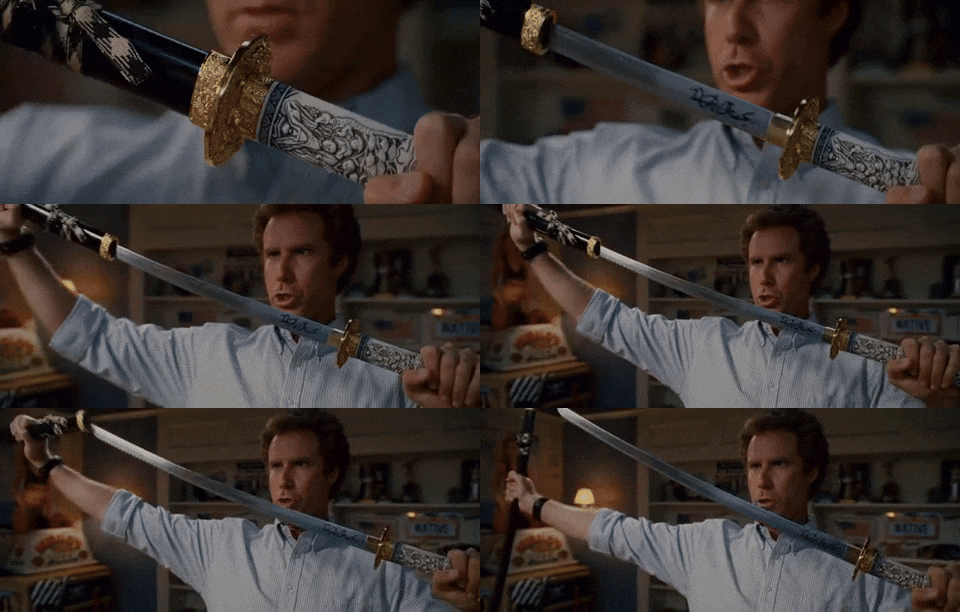
Stephenson just has this inimitable capacity to make anything, even samurai sword fights, sound dumb AF. I love how he clarifies the position of the right foot and the left foot. And the squatting and shuffling imagery is especially *chef's kiss*.
”The businessman turns out to have a lot of zanshin. Translating this concept into English is like translating fuckface into Nipponese, but it might translate into emotional intensity in football lingo.”
“He charges directly at Hiro, hollering at the top of his lungs. The movement actually consists of a very rapid shuffling motion of the feet, so that he stays balanced at all times. [...] Emotional intensity doesn’t convey the half of it, of course. It is the kind of coarse and disappointing translation that makes the dismembered bodies of samurai warriors spin in their graves. The word zanshin is larded down with a lot of other folderol that you have to be Nipponese to understand. And Hiro thinks, frankly, that most of it is pseudomystical crap, on the same level as his old high school football coach exhorting his men to play at 110 percent. Hiro doesn’t have any zanshin at all. ”

Omg, Hiro has no zanshin at all?! Can you believe it?
“The next time the businessman sets up his ear-splitting screech and shuffles toward Hiro, cutting and snapping his blade, Hiro parries the attack, turns around, and cuts both of his legs off just above the knees. It takes a lot of practice to make your avatar move through the Metaverse like a real person. When your avatar has just lost its legs, all that skill goes out the window.
'Well, land sakes!' Hiro says. 'Lookee here!’ He whips his blade sideways, cutting off both of the businessman’s forearms, causing the sword to clatter onto the floor.
'Better fire up the ol’ barbecue, Jemima!' Hiro continues, whipping the sword around sideways, cutting the businessman’s body in half just above the navel. Then he leans down so he’s looking right into the businessman’s face.”
Anyway, yes. Imagine that but for like 500 pages.

January 10, 2014
First published in 1992, Snow Crash is considered one of the seminal cyber-punk novels. I wasn’t even sure what that meant when I picked it up; I plucked it from the stacks at the used bookstore with the vague feeling this was one of those classics I’m supposed to have read. For once, the inside voice was right–this was a book I didn’t want to miss.
The opening scene of a mad-cap pizza delivery quickly draws the reader in. Hiro Protagonist (cringe), thirty year-old hacker, chronically unsuited for the career-track, has now found his longest term employment delivering pizzas for the Mafia, who now run pizza chains along with more dubious enterprises. He’s racing against the clock, trying to get the pizza delivered so Uncle Enzo, spokesman and Don, doesn’t have to apologize and give up a whole wad of cash. His delivery credentials get him through most of the gated suburbs, but a short cut lands him in deep water. Thankfully, a skateboarder who was hitching a lift using a special skater harpoon takes pity on him and completes the delivery with seconds to spare. Her actions bring her to the attention of Uncle Enzo. Hiro’s actions, unfortunately cost him his job, but it isn’t long before his genius ex-girlfriend recruits him to find a virus that’s wiping computers clean–and hackers’ minds.
That’s just the first few pages. It goes on to involve a shared computer simulation, religious evangelicals, an ear-destroying rock concert, a sociopath on a motorcycle, a fusion-powered attack dog and a floating raft-like armada.
Three and a half static-y stars
*********************************
Unfortunately, my windy and critical review will have to be continued someplace permanent, where it won't be deleted.
Find it at:
http://clsiewert.wordpress.com/2014/0...
or
http://carols.booklikes.com/post/7602...
The opening scene of a mad-cap pizza delivery quickly draws the reader in. Hiro Protagonist (cringe), thirty year-old hacker, chronically unsuited for the career-track, has now found his longest term employment delivering pizzas for the Mafia, who now run pizza chains along with more dubious enterprises. He’s racing against the clock, trying to get the pizza delivered so Uncle Enzo, spokesman and Don, doesn’t have to apologize and give up a whole wad of cash. His delivery credentials get him through most of the gated suburbs, but a short cut lands him in deep water. Thankfully, a skateboarder who was hitching a lift using a special skater harpoon takes pity on him and completes the delivery with seconds to spare. Her actions bring her to the attention of Uncle Enzo. Hiro’s actions, unfortunately cost him his job, but it isn’t long before his genius ex-girlfriend recruits him to find a virus that’s wiping computers clean–and hackers’ minds.
That’s just the first few pages. It goes on to involve a shared computer simulation, religious evangelicals, an ear-destroying rock concert, a sociopath on a motorcycle, a fusion-powered attack dog and a floating raft-like armada.
Three and a half static-y stars
*********************************
Unfortunately, my windy and critical review will have to be continued someplace permanent, where it won't be deleted.
Find it at:
http://clsiewert.wordpress.com/2014/0...
or
http://carols.booklikes.com/post/7602...

May 14, 2007
Crazy, strange, exciting, visionary, action-packed, sexy. Reading this book is like watching the Matrix for the first time. Though it may lack pretense of more complex literature, it asks vague and interesting enough questions to match The Bard's sophistry.
Beyond that it is just a great read. It shows a vision of the future that seems eminently likely, but unlike 1984 or Brave New World, has not started to feel stilted. It also lack the long-winded philosophical diatribes and allegories that stagnate that breed of classics. Gibson may have invented Cyberpunk, but Stephenson takes the genre out for a joyride and loses a hubcap on a bootstrap turn.
It was originally planned as a graphic novel, but when that got scrapped, Stephenson filled it out and got it published. Perhaps this is why his other works never match Snowcrash's frenetic teenage energy and sensuality. I wish there were more books this interesting and enjoyable.
Beyond that it is just a great read. It shows a vision of the future that seems eminently likely, but unlike 1984 or Brave New World, has not started to feel stilted. It also lack the long-winded philosophical diatribes and allegories that stagnate that breed of classics. Gibson may have invented Cyberpunk, but Stephenson takes the genre out for a joyride and loses a hubcap on a bootstrap turn.
It was originally planned as a graphic novel, but when that got scrapped, Stephenson filled it out and got it published. Perhaps this is why his other works never match Snowcrash's frenetic teenage energy and sensuality. I wish there were more books this interesting and enjoyable.

March 23, 2017
Neal Stephenson is a fascinating author. A master of the craft of writing, he is also a completely inept storyteller.
In a world where anarchism and capitalism have seemingly joined forces to dispose of concepts like government and law, Snow Crash tells the tale of the unbelievably stupidly named Hiro Protagonist and his adventures in and out of the virtual reality known as the Metaverse. It is a cyberpunk novel involving everything from computer hacking to linguistics to Sumerian mythology. Like any Stephenson novel, it’s a trainwreck.
But Stephenson can create such beautiful trainwrecks. If you look away from the unfortunate fact nobody has apparently told him how a story works, or how to create a somewhat multi-dimensional character, you can appreciate the marvel that is a Stephenson setting and the love of knowledge that shines from the pages.
This particular novel is a chaotic blend of good and bad, beautiful and ugly, clean and messy. It can be considered a masterpiece with obvious flaws, or an overrated waste of paper with equally obvious virtues. Take your pick.
I did not find this very enjoyable, mostly because I simply didn't enjoy the setting as much, and ran across some pretty annoying flaws. Still, every Stephenson book I read takes him closer to becoming one of my favourite authors, even this one.
In a world where anarchism and capitalism have seemingly joined forces to dispose of concepts like government and law, Snow Crash tells the tale of the unbelievably stupidly named Hiro Protagonist and his adventures in and out of the virtual reality known as the Metaverse. It is a cyberpunk novel involving everything from computer hacking to linguistics to Sumerian mythology. Like any Stephenson novel, it’s a trainwreck.
But Stephenson can create such beautiful trainwrecks. If you look away from the unfortunate fact nobody has apparently told him how a story works, or how to create a somewhat multi-dimensional character, you can appreciate the marvel that is a Stephenson setting and the love of knowledge that shines from the pages.
This particular novel is a chaotic blend of good and bad, beautiful and ugly, clean and messy. It can be considered a masterpiece with obvious flaws, or an overrated waste of paper with equally obvious virtues. Take your pick.
I did not find this very enjoyable, mostly because I simply didn't enjoy the setting as much, and ran across some pretty annoying flaws. Still, every Stephenson book I read takes him closer to becoming one of my favourite authors, even this one.

March 7, 2012
derisively laugh to me for opportunities of full and cringe-worthy and tedious equally be to found i which, Against A Dark Background beloved the disliked who jackass of kind the am i that mind in keep also should you, seriously review this take you before but. FAIL. hipness insouciant of display a with audience its dazzle to designed lie a - lie brazen some of middle the in worship i someone catching like was it, one this with was i disappointed how express can't words. nowhere go but brilliant seem that (business Sumerian that like) ideas many so. cyberbullshit confusing of full too, snarky too, shallow too. finish couldn't i that (far so) book Stephenson Neal only the.
one extra star for being incredibly ahead of its time.
one extra star for being incredibly ahead of its time.

August 10, 2008
6.0 stars. On my list of All Time Favorite novels. While reading this book, I was constantly thinking to myself "WOW, what a great concept" and "HOW did Stephenson think that up?" Without giving away too much in the way of spoilers, I was particularly amazed at the way the author took computers, vitual reality and the metaverse and tied it into ancient religions, philosophy and the origin of language. I thought this aspect of the novel was absolutely mind-boggling. Add to that a great anti-hero, a superb villain (actually several villains) and a brilliantly detailed and quirky view of a dystopian future and you have a one of kind reading experience. HIGHEST POSSIBLE RECOMMENDATION!!!!
Nominee: British Science Fiction Award for Best Novel
Nominee: Arthur C. Clarke Award for Best SF Novel
Nominee: Locus Award for Best SF Novel
Nominee: Prometheus Award for Best Novel
Nominee: British Science Fiction Award for Best Novel
Nominee: Arthur C. Clarke Award for Best SF Novel
Nominee: Locus Award for Best SF Novel
Nominee: Prometheus Award for Best Novel

May 27, 2010
Here's what I think: This is not just a book about computers, although the shiny veneer of the Metaverse, and computer avatars, and Hiro Protagonist's (yes, that’s the name of the protagonist in the story) career as a hacker might make you think it is. But there’s a lot more going on here, beneath that flashy action-adventure SF stuff. This is a complicated, messy book, and not that easy to follow. But, it's fascinating and I WANTED to understand everything, so as soon as I got to the last page, I was tempted to turn back to chapter one and start over.
And wow, is it flashy, with its future world as neon-lit and noisy as a Las Vegas casino. On one level, this is a story about a hacker and a 15-year-old futuristic-skateboard-riding courier girl who team up to save the world from a religious cult on one hand, and a mutant motorcyclist Aleutian who has a nuclear bomb and a grudge on the other. It’s all very hip and edgy, with sword fights, commercialism run amok, and an interesting look at virtual reality as imagined by the author twenty years ago. I was on sensory overload trying to process everything.
But on another level, this is a book about language, and brain structure, and viruses, and religion. AND computers! And what the heck, mix in some Sumerian mythology, too. :)
What if you didn't have to learn language, what if we all were born able to communicate with each other? And what if that kept us from developing and progressing as a species? And what if the development of all the myriad of languages humans now speak happened because of a virus?
What if language ITSELF, and the concepts spread through the use of language, are viruses? And what if there were religious cults, worshippers of an ancient Sumerian deity, whose purpose was to spread those viruses?
Put all those levels together, and you’ve got Snow Crash. No, I didn't give it five stars, because it was all just a little too much. For me, of course. And there's no character development. And it's messy. But still, wow.
For fellow SF literature nerds out there, I suggest a compare and contrast with Samuel Delaney’s Babel-17, another SF classic that explores the impact of language on human behavior.
And wow, is it flashy, with its future world as neon-lit and noisy as a Las Vegas casino. On one level, this is a story about a hacker and a 15-year-old futuristic-skateboard-riding courier girl who team up to save the world from a religious cult on one hand, and a mutant motorcyclist Aleutian who has a nuclear bomb and a grudge on the other. It’s all very hip and edgy, with sword fights, commercialism run amok, and an interesting look at virtual reality as imagined by the author twenty years ago. I was on sensory overload trying to process everything.
But on another level, this is a book about language, and brain structure, and viruses, and religion. AND computers! And what the heck, mix in some Sumerian mythology, too. :)
What if you didn't have to learn language, what if we all were born able to communicate with each other? And what if that kept us from developing and progressing as a species? And what if the development of all the myriad of languages humans now speak happened because of a virus?
What if language ITSELF, and the concepts spread through the use of language, are viruses? And what if there were religious cults, worshippers of an ancient Sumerian deity, whose purpose was to spread those viruses?
Put all those levels together, and you’ve got Snow Crash. No, I didn't give it five stars, because it was all just a little too much. For me, of course. And there's no character development. And it's messy. But still, wow.
For fellow SF literature nerds out there, I suggest a compare and contrast with Samuel Delaney’s Babel-17, another SF classic that explores the impact of language on human behavior.

August 22, 2018
“If you know how to catch a ride, you can go places.”
Super entertaining ride through dystopia and pizza delivery (as if there was any real difference in the two), ancient Sumerian mythology, computer and religious viruses, hacker groups and some very strange and creepily familiar communities in Neal Stephenson’s Snow Crash! And that really is just the beginning. Absolutely loved the inventiveness (and here is my caveat) until at least the first half or three quarters mark. While I plan to reread this book (because I’m sure I will get more out of a second or even a third reading), I lost sight of the plot. To be fair, I don’t believe this was ever meant to be a plot-driven novel. All the same, as I approached the end, it felt less like the book was coming to a conclusion and more like it was running out of energy.
Even though it has an edgier, science fiction feel to it, Snow Crash reminds me of one of my favorite novels, Thomas Pynchon’s V (as well as a Pynchon novella, The Crying of Lot 49). Ideas are spilled across every landscape and community Stephenson describes as well as every sentence he writes. Inventiveness applies to characters as well. The naming of his main character, Hiro Protagonist, master swordsman, hacker and pizza deliveryman, was perfect! There were other likeable characters like the young skate punk, Y.T. Despite some issues down the stretch with the plot, I really enjoyed Snow Crash! 4.5 stars.
Super entertaining ride through dystopia and pizza delivery (as if there was any real difference in the two), ancient Sumerian mythology, computer and religious viruses, hacker groups and some very strange and creepily familiar communities in Neal Stephenson’s Snow Crash! And that really is just the beginning. Absolutely loved the inventiveness (and here is my caveat) until at least the first half or three quarters mark. While I plan to reread this book (because I’m sure I will get more out of a second or even a third reading), I lost sight of the plot. To be fair, I don’t believe this was ever meant to be a plot-driven novel. All the same, as I approached the end, it felt less like the book was coming to a conclusion and more like it was running out of energy.
Even though it has an edgier, science fiction feel to it, Snow Crash reminds me of one of my favorite novels, Thomas Pynchon’s V (as well as a Pynchon novella, The Crying of Lot 49). Ideas are spilled across every landscape and community Stephenson describes as well as every sentence he writes. Inventiveness applies to characters as well. The naming of his main character, Hiro Protagonist, master swordsman, hacker and pizza deliveryman, was perfect! There were other likeable characters like the young skate punk, Y.T. Despite some issues down the stretch with the plot, I really enjoyed Snow Crash! 4.5 stars.

June 11, 2009
My Neal Stephenson reading has been all backwards. The first one I read was Cryptonomicon, then the Baroque Cycle and then Anathem. So going back to one of his earlier and 'simpler' novels seemed like it'd be a breeze after having to practically learn a fictional language to finish Anathem.
While Snow Crash may have some more familiar sci-fi tropes (hackers, skateboarders and virtual reality are now almost stereotypes although I'm sure it seemed fresh in '92 when this was written), it still has the brain-bustin' Stephenson style theories in it.
In this case, his whole premise of ancient Sumerian languages as an audio virus was definately something that took a lot of explanation, and it's those types of intricate ideas that make Stephenson one of my favorites.
But the other thing I love about Stephenson is that he can explain this crazy theory for page after page until you forget about everything else in the book, and then the next chapter will have an epic action scene with swords, gatling guns, and a variety of other near-future weapons.
Terrific book. And I think there's probably a lot of material written or filmed since '92 that should probably cut Stephenson a royalty check. I'm looking at you, Matrix!
While Snow Crash may have some more familiar sci-fi tropes (hackers, skateboarders and virtual reality are now almost stereotypes although I'm sure it seemed fresh in '92 when this was written), it still has the brain-bustin' Stephenson style theories in it.
In this case, his whole premise of ancient Sumerian languages as an audio virus was definately something that took a lot of explanation, and it's those types of intricate ideas that make Stephenson one of my favorites.
But the other thing I love about Stephenson is that he can explain this crazy theory for page after page until you forget about everything else in the book, and then the next chapter will have an epic action scene with swords, gatling guns, and a variety of other near-future weapons.
Terrific book. And I think there's probably a lot of material written or filmed since '92 that should probably cut Stephenson a royalty check. I'm looking at you, Matrix!

August 21, 2020
3.5 Stars
This modern cyberpunk classic is smart, funny and oh-so-cool. I loved the setup with a pizza delivery hacker who is literally named "protagonist". The story is intentionally over the top as it satirizes the cyberpunk subgenre. I adored the beginning, but I thought the story was unnecessarily long. I think the novel would have had a stronger, sharper narrative if it had been a few hundred pages shorter. While not perfect, I would definitely recommend this novel to science fiction readers.
This modern cyberpunk classic is smart, funny and oh-so-cool. I loved the setup with a pizza delivery hacker who is literally named "protagonist". The story is intentionally over the top as it satirizes the cyberpunk subgenre. I adored the beginning, but I thought the story was unnecessarily long. I think the novel would have had a stronger, sharper narrative if it had been a few hundred pages shorter. While not perfect, I would definitely recommend this novel to science fiction readers.
November 2, 2023
قبل از خوندن بعضی کتابها برای خودم یه سری تصورات دارم و در مورد این یکی هم داشتم ولی تبدیل شد به یکی از خر تو خرترین چیزهایی که خوندم و فرسنگها با چیزی که فکر میکردم باشه، فاصله داشت
واقعا عجیب بود. بعضی جاها آبکیترین کتاب ممکن رو میخوندی و بعضی جاهای دیگه داری به شکل خیلی عمیقی اسطورهشناسی و فلسفه و زبانشناسی میخونی. ولی چیزی که برام قطعیه اینه که از لحاظ دنیاسازی یکی از بهترین کتابایی بود که تا حالا خوندم
بعضاً دیدم به کسایی که از بازیکن شماره یک خوششون اومده این کتاب رو پیشنهاد میدن. من فقط فیلم اون کتاب رو دیدم و راحت میگم به جز ایدهی دنیای مجازی هیچ شباهتی بهم ندارن و اگه با اون تصور برید سراغش احتمال 99 درصد پشیمون میشید
به کسایی که دنبال یه داستان سرراست هم هستن پیشنهادش نمیدم. با اینکه کلیت داستان قابل فهمه، ولی تمرکز روی مسیر داستان برام سخت بود که به خاطر تمرکز روی دنیاسازیشه
هرجور حساب میکنم این کتاب رو فقط به یه عدهی محدودی میتونم پیشنهاد بدم که کامپیوتر، برنامهنویسی، واقعیت مجازی، زبانشناسی و اسطورهشناسی علاقه دارن و با مقدار قابل توجهی طنز ابلهانه هم مشکلی ندارن :))
-------------
سر ترجمه غر دارم بزنم
موقع خوندن میفهمیدم که ترجمهی این کتاب باید خیلی کار سختی بوده باشه ولی به صورت کلی مترجم از پسش براومده بود
مشکلم بیشتر با انتخابهای آگاهانهی مترجم سر بعضی کلمات و عباراته که به شخصه درک نمیکنم. مثلاً مترجم پاشنهی آشیل رو چشم اسفندیار ترجمه کرده که وقتی چشمم بهش خورد یهو زدم زیر خنده و حواسم کلا از کتاب پرت شد
یه مشکل دیگهم هم سر ترجمه/عدم ترجمهی اسم شخصیتهاست. یکی از شخصیتهای اصلی داستان یه دختر پونزده سالهس به اسم اصلی وای. تی
y.t. مخفف yours truly هست
مترجم یورز ترولی رو "ارادتمند شما" ترجمه کرده و مخففش "ارشا" شده اسم این شخصیت توی نسخهی فارسی
به شخصه با این مشکلی ندارم به شرطی که باقی اسامی هم ترجمه میشد که نشده
مخصوصا شخصیت اصلی داستان که اسمش هیرو پروتاگونیسته و نویسنده هم از این انتخاب اسمش منظور داشته
یا ریون که یکی از شخصیتهای منفی داستانه که بازم ترجمه نشده.
اصرار به معادلسازی برای بعضی کلماتی که سالهاست همه از کلمهی انگلیسیشون استفاده میکنن هم برای من حداقل جالب نیست اصلا. این حس بهم دست میده که انگار مترجم دنبال خودنماییه بیشتر تا اینکه یه ترجمهی تر و تمیز تحویل بده
همین دیگه
-------------
این کتاب هدیه بود و مرسی از هدیهدهندهش که یکی از کارهای خیلی مهم علمیتخیلی رو هدیه داد بهم ♥
واقعا عجیب بود. بعضی جاها آبکیترین کتاب ممکن رو میخوندی و بعضی جاهای دیگه داری به شکل خیلی عمیقی اسطورهشناسی و فلسفه و زبانشناسی میخونی. ولی چیزی که برام قطعیه اینه که از لحاظ دنیاسازی یکی از بهترین کتابایی بود که تا حالا خوندم
بعضاً دیدم به کسایی که از بازیکن شماره یک خوششون اومده این کتاب رو پیشنهاد میدن. من فقط فیلم اون کتاب رو دیدم و راحت میگم به جز ایدهی دنیای مجازی هیچ شباهتی بهم ندارن و اگه با اون تصور برید سراغش احتمال 99 درصد پشیمون میشید
به کسایی که دنبال یه داستان سرراست هم هستن پیشنهادش نمیدم. با اینکه کلیت داستان قابل فهمه، ولی تمرکز روی مسیر داستان برام سخت بود که به خاطر تمرکز روی دنیاسازیشه
هرجور حساب میکنم این کتاب رو فقط به یه عدهی محدودی میتونم پیشنهاد بدم که کامپیوتر، برنامهنویسی، واقعیت مجازی، زبانشناسی و اسطورهشناسی علاقه دارن و با مقدار قابل توجهی طنز ابلهانه هم مشکلی ندارن :))
-------------
سر ترجمه غر دارم بزنم
موقع خوندن میفهمیدم که ترجمهی این کتاب باید خیلی کار سختی بوده باشه ولی به صورت کلی مترجم از پسش براومده بود
مشکلم بیشتر با انتخابهای آگاهانهی مترجم سر بعضی کلمات و عباراته که به شخصه درک نمیکنم. مثلاً مترجم پاشنهی آشیل رو چشم اسفندیار ترجمه کرده که وقتی چشمم بهش خورد یهو زدم زیر خنده و حواسم کلا از کتاب پرت شد
یه مشکل دیگهم هم سر ترجمه/عدم ترجمهی اسم شخصیتهاست. یکی از شخصیتهای اصلی داستان یه دختر پونزده سالهس به اسم اصلی وای. تی
y.t. مخفف yours truly هست
مترجم یورز ترولی رو "ارادتمند شما" ترجمه کرده و مخففش "ارشا" شده اسم این شخصیت توی نسخهی فارسی
به شخصه با این مشکلی ندارم به شرطی که باقی اسامی هم ترجمه میشد که نشده
مخصوصا شخصیت اصلی داستان که اسمش هیرو پروتاگونیسته و نویسنده هم از این انتخاب اسمش منظور داشته
یا ریون که یکی از شخصیتهای منفی داستانه که بازم ترجمه نشده.
اصرار به معادلسازی برای بعضی کلماتی که سالهاست همه از کلمهی انگلیسیشون استفاده میکنن هم برای من حداقل جالب نیست اصلا. این حس بهم دست میده که انگار مترجم دنبال خودنماییه بیشتر تا اینکه یه ترجمهی تر و تمیز تحویل بده
همین دیگه
-------------
این کتاب هدیه بود و مرسی از هدیهدهندهش که یکی از کارهای خیلی مهم علمیتخیلی رو هدیه داد بهم ♥

April 9, 2022
Paladin Christoff “Anvil” Magnússon and Reverend Mother Jen “Pool Noodle” Kumiko are vectors of transmission, looking to infect all sentient creatures of the wasteland with a meta-viral-load known as the collected works of Neal Stephenson (a.k.a. “The Goddamn Word”). Sartorially ejaculated into the tight crevices of their T-69 power suits, with their integrated heavy exterior composite armor and steel encased depleted uranium bilayer, and armed to the nucleotide with technology designed to produce sudden and vertiginous negative externalities within the respective portfolios of the heretical - they are the vanguard of The Brotherhood of The Goddamn Word’s evangelical designs.
Brother Christoff removes his giant power-hammer from the magnetic holster on his back, its shaft telescoping to full length in his gauntleted fist. He grips the holy sledge (Homeostasis Fucker) and admires the warm light emanating from its massive head as radioactive isotopes engage in holy fission. Actuators within his suit hum as he hefts the instrument aloft.
“Knight Vision on.” He says. Both pressing their fingers to their necks as if detecting a pulse, causing visors of gunmetal gray to shroud their faces. Dual slits open and glow with a cold blue light as associated visual tech augments their paltry biological capacities. “For as it is written in Snow Crash; Brother Ng, in his impenetrable chariot of repurposed runway fire truck, did use thermals to detect snipers most hidden and thus protect Holy Mother Y.T. from elements of vile industriousness.”
“As it is written.” Noodle intones. Withdrawing her somewhat diminutive, ordinary tack hammer and rapping it across her palm. “Uncle Enzo did attend to details most assiduously. Like unto when he removed his socks and slit his trousers to proceed stealthily against a foe most worthy. He of the Fu Manchu and the molecule blades. And Lady Jaunita did condense fact from the nuance of vapor.”
“So mote it be.” Anvil agrees, pointing to a cluster of makeshift housing rising from the garbage-scape. An incongruous boil of life on a mummified ass. “Two warm bodies inside. Both unarmed. A sentinel of arachnid origins, equipped with primitive slug thrower, patrolling outside.”
“Radscorp?” Noodle asks.
“A big one.”
“On your command.”
“Proceed with your original composition of The Goddamn Word.”
“Ahh..” Noodle clears her throat and begins her rhetorical assault as the two forge ahead. Anvil with Homeostasis Fucker high over head, leading the way.
Tongue punching aural geometries with her amplified voice; “Citizens of the wastes! Have you ever, while nurturing a bolus of combat stimulants deep within the nested hierarchy of your experiential existence, found yourself stricken with an incredible need for Cyberpunk in the vein of Brother Gibson?”
Radioactive hoboscorpion with shotgun chitters into view. Fluorescent chemicals glowing in the ultraviolet spectrum across its exoskeleton. Pincers working the lever of the slug thrower. Tail poised to strike and deposit venom. Brother anvil, with servos screaming, crests embankment of detritus with titanic speed, leaping high into the air with spring loaded grace, rocket packs deploying calculated thrust to maximize parabolic grandeur.
“I ask you again! Citizens of the wastes! Have you ever, while carpet-bombing your nervous systems with vast quantities of psychoactive drugs, felt a deep spiritual need for dystopian science fiction in which the world has been balkanized into corporate fiefdoms where anarcho-capitalist ideologies reflect their morphological absurdities in the funhouse mirrors of Emperor Stephenson’s inexhaustible imagination?”
Anvil crashes back to the earth, his hammer flattening the chitinous offender with such violence that all eight legs rocket from its central body, each carrying enough force to knock a bison crossed eyed. It’s pincers, still clutching the gun, are jettisoned into the atmosphere where they discharge both barrels as if in impotent rage. The rapid expansion of superheated air around the buried maul creates a peel of thunder, sending out a spray of errant scrap as the shockwave expands, flattening nearby double-headed oxen and ripping the siding off several proximate tenements, revealing a man squatting above a hole and a woman rising from her agitated half sleep now in mortal fear.
“A technological thriller alloyed with explorations of mythology...” Noodle continues, taking a moment to deflect, with her claw hammer, a rusty muffler borne aloft by concussive forces. “In which linguistics are examined in a manner that is most intriguing. In which pitbull terriers, cloaked in the vestments of cybernetic enhancement, locomote in fashions super sonic. Where the bestest good boy, verily, I say unto you; Fido! Doth well and truly shine most stellarly at denouements commencing. Inside these pages, you may escape the squalor of your lives, like unto Father Protagonist, who, jacking into the metaverse, transcends the ignominy of dwelling within the bowels of U-Store-It and fulfills his namesake.”
Anvil, with Homeostasis Fucker resting comfortable across his shoulders, gestures for Noodle to take the lead.
“Brother. Sister.” She says, producing two copies of Snow Crash and placing them inside the skeletal remains of their exploded domicile. “Enjoy The Goddamn Word.”
Brother Christoff removes his giant power-hammer from the magnetic holster on his back, its shaft telescoping to full length in his gauntleted fist. He grips the holy sledge (Homeostasis Fucker) and admires the warm light emanating from its massive head as radioactive isotopes engage in holy fission. Actuators within his suit hum as he hefts the instrument aloft.
“Knight Vision on.” He says. Both pressing their fingers to their necks as if detecting a pulse, causing visors of gunmetal gray to shroud their faces. Dual slits open and glow with a cold blue light as associated visual tech augments their paltry biological capacities. “For as it is written in Snow Crash; Brother Ng, in his impenetrable chariot of repurposed runway fire truck, did use thermals to detect snipers most hidden and thus protect Holy Mother Y.T. from elements of vile industriousness.”
“As it is written.” Noodle intones. Withdrawing her somewhat diminutive, ordinary tack hammer and rapping it across her palm. “Uncle Enzo did attend to details most assiduously. Like unto when he removed his socks and slit his trousers to proceed stealthily against a foe most worthy. He of the Fu Manchu and the molecule blades. And Lady Jaunita did condense fact from the nuance of vapor.”
“So mote it be.” Anvil agrees, pointing to a cluster of makeshift housing rising from the garbage-scape. An incongruous boil of life on a mummified ass. “Two warm bodies inside. Both unarmed. A sentinel of arachnid origins, equipped with primitive slug thrower, patrolling outside.”
“Radscorp?” Noodle asks.
“A big one.”
“On your command.”
“Proceed with your original composition of The Goddamn Word.”
“Ahh..” Noodle clears her throat and begins her rhetorical assault as the two forge ahead. Anvil with Homeostasis Fucker high over head, leading the way.
Tongue punching aural geometries with her amplified voice; “Citizens of the wastes! Have you ever, while nurturing a bolus of combat stimulants deep within the nested hierarchy of your experiential existence, found yourself stricken with an incredible need for Cyberpunk in the vein of Brother Gibson?”
Radioactive hoboscorpion with shotgun chitters into view. Fluorescent chemicals glowing in the ultraviolet spectrum across its exoskeleton. Pincers working the lever of the slug thrower. Tail poised to strike and deposit venom. Brother anvil, with servos screaming, crests embankment of detritus with titanic speed, leaping high into the air with spring loaded grace, rocket packs deploying calculated thrust to maximize parabolic grandeur.
“I ask you again! Citizens of the wastes! Have you ever, while carpet-bombing your nervous systems with vast quantities of psychoactive drugs, felt a deep spiritual need for dystopian science fiction in which the world has been balkanized into corporate fiefdoms where anarcho-capitalist ideologies reflect their morphological absurdities in the funhouse mirrors of Emperor Stephenson’s inexhaustible imagination?”
Anvil crashes back to the earth, his hammer flattening the chitinous offender with such violence that all eight legs rocket from its central body, each carrying enough force to knock a bison crossed eyed. It’s pincers, still clutching the gun, are jettisoned into the atmosphere where they discharge both barrels as if in impotent rage. The rapid expansion of superheated air around the buried maul creates a peel of thunder, sending out a spray of errant scrap as the shockwave expands, flattening nearby double-headed oxen and ripping the siding off several proximate tenements, revealing a man squatting above a hole and a woman rising from her agitated half sleep now in mortal fear.
“A technological thriller alloyed with explorations of mythology...” Noodle continues, taking a moment to deflect, with her claw hammer, a rusty muffler borne aloft by concussive forces. “In which linguistics are examined in a manner that is most intriguing. In which pitbull terriers, cloaked in the vestments of cybernetic enhancement, locomote in fashions super sonic. Where the bestest good boy, verily, I say unto you; Fido! Doth well and truly shine most stellarly at denouements commencing. Inside these pages, you may escape the squalor of your lives, like unto Father Protagonist, who, jacking into the metaverse, transcends the ignominy of dwelling within the bowels of U-Store-It and fulfills his namesake.”
Anvil, with Homeostasis Fucker resting comfortable across his shoulders, gestures for Noodle to take the lead.
“Brother. Sister.” She says, producing two copies of Snow Crash and placing them inside the skeletal remains of their exploded domicile. “Enjoy The Goddamn Word.”

October 2, 2011
This book felt like a really good idea. One of those really good ideas that you know will make a good novel (or whatever it is you think about making), and you have all these other really good details so you add them to your good idea. And you come up with some more characters and they are really good and some awesome organizations and maybe have another good idea or two and you just keep adding them on, like paint in some Clement Greenberg adored jizz-fest of painting, layer upon layer and more layers you have all this great stuff going on, and then you realize you have to make it all do something. And something happens and it's really pretty unspectacular, like in the painting analogy there is all this great layering going on and what is produced is some big yellow smiley face, but this book is better than that but it was still something of a let down when you realize that all the build up, all the different organizations and people and neat ideas were all just so that what happened could happen in the book.
Oh and then as soon as the plot stuff climaxes the book comes apruptly to a halt, like if Star Wars cut to credits right as the Death Star started to explode (not that the stuff left in the movie after that was anything great, but it would still feel very abrupt).
Yeah, that is what this book felt like. Great ideas. Great build up, and then, 'oh, that's it?' *
*don't give me this Neal Stephenson was prophetic shit in defense of why this book should get 5 stars or more. Yeah, he named some things, but it's not like he predicted things existing, he just influenced things being named.
Oh and then as soon as the plot stuff climaxes the book comes apruptly to a halt, like if Star Wars cut to credits right as the Death Star started to explode (not that the stuff left in the movie after that was anything great, but it would still feel very abrupt).
Yeah, that is what this book felt like. Great ideas. Great build up, and then, 'oh, that's it?' *
*don't give me this Neal Stephenson was prophetic shit in defense of why this book should get 5 stars or more. Yeah, he named some things, but it's not like he predicted things existing, he just influenced things being named.

June 8, 2023
This book was seriously impressive.
Hiro Protagonist (the name alone is so deliciously self-aware) is a hacker and a pizza delivery driver in real life and some version of a prince / hero fighter in the virtual.
For in this futuristic Los Angeles (still 21st century though), the VR is at least as real and part of human life as RR (regular reality). Especially ever since the economy crashed. Oh and there is no law anymore. In fact, LA is no longer part of the USA at all since the "government" started selling territory to private organizations. Thus, there are quasi-sovereign gated communities and enclaves known as FOQNEs (Franchise-Organized Quasi-National Entities). One such FOQNE is the Italo-American Mafia that Hiro works for.
One really interesting development in this weird future America was what had become of the Library of Congress after merging with what used to be the CIA. *lol*
It is therefore no surprise that Hiro meets Italian mobsters as much as former love-interests, who code specific elements of the VR, and a special courier, all while uncovering a scheme to "infect" society with a special form of virus that could up-end the world as he knows it.
In an essay in 1999, Stephenson explained that the title of the novel is the term for a particular software failure mode on the early Macintosh computer. So you know what calamity to expect. Especially considering how reliant everyone is on tech and VR here (yes, even more than nowadays).
Anyway, it's not just something that will make the lights go out, it can have very dangerous or even lethal effects on a person's body in RR.
I LOVED the blend of futuristic tech, a dystopian world, Sumerion mythology (Tower of Babel) and more. It seems the author is very good at and interested in blending history with linguistics, politics, philosophy and - here - computer science. I mean, this book was published in 1992 and he coined the word Metaverse. Take THAT, Zuckerberg!
Seriously, everyone was quirky and the world almost disorientingly weird, but I enjoyed every second I got to spend with the characters - be it uncle Enzo or the discoveries made thanks to the library or Lagos.
We even get quite some impressive fighting when . Not to mention . That was some breathstopping action!
In short: this is pretty much a perfect book no matter from which angle you look at it. And it obviously influenced A LOT of other authors who subsequently created very similar stories. Funnily enough, I was reading this while learning of Apple's new product, "visionPro", which in turn triggered me to think of the awesome possibilities on the excited side and the potential negative implications on the dystopian side. Which made for an even more special feel while reading this book. *lol*
Hiro Protagonist (the name alone is so deliciously self-aware) is a hacker and a pizza delivery driver in real life and some version of a prince / hero fighter in the virtual.
For in this futuristic Los Angeles (still 21st century though), the VR is at least as real and part of human life as RR (regular reality). Especially ever since the economy crashed. Oh and there is no law anymore. In fact, LA is no longer part of the USA at all since the "government" started selling territory to private organizations. Thus, there are quasi-sovereign gated communities and enclaves known as FOQNEs (Franchise-Organized Quasi-National Entities). One such FOQNE is the Italo-American Mafia that Hiro works for.
One really interesting development in this weird future America was what had become of the Library of Congress after merging with what used to be the CIA. *lol*
It is therefore no surprise that Hiro meets Italian mobsters as much as former love-interests, who code specific elements of the VR, and a special courier, all while uncovering a scheme to "infect" society with a special form of virus that could up-end the world as he knows it.
In an essay in 1999, Stephenson explained that the title of the novel is the term for a particular software failure mode on the early Macintosh computer. So you know what calamity to expect. Especially considering how reliant everyone is on tech and VR here (yes, even more than nowadays).
Anyway, it's not just something that will make the lights go out, it can have very dangerous or even lethal effects on a person's body in RR.
I LOVED the blend of futuristic tech, a dystopian world, Sumerion mythology (Tower of Babel) and more. It seems the author is very good at and interested in blending history with linguistics, politics, philosophy and - here - computer science. I mean, this book was published in 1992 and he coined the word Metaverse. Take THAT, Zuckerberg!
Seriously, everyone was quirky and the world almost disorientingly weird, but I enjoyed every second I got to spend with the characters - be it uncle Enzo or the discoveries made thanks to the library or Lagos.
We even get quite some impressive fighting when . Not to mention . That was some breathstopping action!
In short: this is pretty much a perfect book no matter from which angle you look at it. And it obviously influenced A LOT of other authors who subsequently created very similar stories. Funnily enough, I was reading this while learning of Apple's new product, "visionPro", which in turn triggered me to think of the awesome possibilities on the excited side and the potential negative implications on the dystopian side. Which made for an even more special feel while reading this book. *lol*

November 3, 2022
Un presente ma diverso. Una rete digitale chiamata Metaverso. Hacker e drogati, Mafia e fattorini della pizza, bombe atomiche portatili e virus linguistici.
Qui si ride di gusto. Evitate pure di sforzarvi nel cercare significati nascosti tra le righe, tipo alienazione sociale, dipendenza dalle droghe, il potere dell'informazione, ecc.. soliti temi cyberpunk. Anche se presenti sono del tutto secondari. Questa è la folle parodia di una ucronia anarchica e un filo distopica.
Partiamo dai due protagonisti: uno si chiama Hiro Protagonist, già il nome è tutto un programma, un incrocio tra John Wick, Neo di Matrix e la Sposa di Kill Bill, hacker che se ne va in giro armato con due katane micidiali. L'altra protagonista è una quindicenne che sfreccia con il suo skateboard super tecnologico sulle autostrade arpionando i veicoli in corsa facendo slalom come una surfista per portare pacchi in giro.
Un vero fumetto o cartone animato su carta che coinvolge e rapisce per la sua follia dilagante.
Sembra un romanzo di Dick, Gibson e Pratchett mescolati con LSD e steroidi.
La prima metà è un delirio, da applausi meritati.
Peccato ci sia un pesante calo nella seconda metà, complice la lunghezza eccessiva del romanzo, i totali cambi di ritmo durante le tediose spiegazioni da enciclopedia sulla natura del virus e una risoluzione sotto tono dell'intera vicenda. Se fosse rimasto al livello della prima metà lo avrei apprezzato maggiormente, invece Stephenson si sente in dovere di dare spiegazioni a valanga.
Il Metaverso ma soprattutto la trovata linguistica è interessante, seppur troppo pedante nell'esposizione anche per me che sono un simpatizzante delle stravaganti teorie di Zecharia Sitchin ed ho divorato tutti i suoi saggi. Se questi argomenti vi stuzzicano, vi consiglio caldamente di leggere il "Dodicesimo pianeta", o tradotto in italiano "il pianeta degli dei" per approfondire.
Adatto per trascorrere ore in allegria, ridendo di pancia delle folli trovate di Stephenson nel presentare questo mondo alternativo tra Mafia, droghe, virus e anarchia.
Il rap di Sushi K. mi è entrato nel cervello e mi ha steso.
------------------------------
A present but different. A digital network called Metaverse. Hackers and drug addicts, Mafia and pizza delivery men, portable atomic bombs and linguistic viruses.
Here we laugh heartily. Also avoid trying to find hidden meanings between the lines, such as social alienation, drug addiction, the power of information, etc. usual cyberpunk themes. Even if present they are completely secondary. This is the crazy parody of an anarchic and slightly dystopian uchronia.
Let's start with the two protagonists: one is called Hiro Protagonist, the name itself says it all, a cross between John Wick, Neo from The Matrix and the Bride from Kill Bill, a hacker who goes around armed with two deadly katanas. The other protagonist is a fifteen-year-old who speeds with her super-technological skateboard on the highways, harpooning moving vehicles, slaloming like a surfer to carry packages around.
A real comic or cartoon on paper that involves and captivates due to its rampant madness.
It sounds like a Dick, Gibson and Pratchett novel mixed with LSD and steroids.
The first half is a frenzy, worthy of applause.
It's a shame there is a heavy decline in the second half, thanks to the excessive length of the novel, the total changes of pace during the tedious encyclopedia-like explanations on the nature of the virus and a subdued resolution of the entire story. If it had remained at the level of the first half I would have appreciated it more, but instead Stephenson feels obliged to give an avalanche of explanations.
The Metaverse but above all the linguistic invention is interesting, although too pedantic in its exposition even for me who am a fan of Zecharia Sitchin's extravagant theories and have devoured all of his essays. If these topics excite you, I highly recommend you read the "Twelfth Planet", or translated into Italian "the planet of the gods" for further information.
Suitable for spending happy hours, laughing heartily at Stephenson's crazy ideas in presenting this alternative world of Mafia, drugs, viruses and anarchy.
Sushi K.'s rap got into my brain and knocked me out.
Qui si ride di gusto. Evitate pure di sforzarvi nel cercare significati nascosti tra le righe, tipo alienazione sociale, dipendenza dalle droghe, il potere dell'informazione, ecc.. soliti temi cyberpunk. Anche se presenti sono del tutto secondari. Questa è la folle parodia di una ucronia anarchica e un filo distopica.
Partiamo dai due protagonisti: uno si chiama Hiro Protagonist, già il nome è tutto un programma, un incrocio tra John Wick, Neo di Matrix e la Sposa di Kill Bill, hacker che se ne va in giro armato con due katane micidiali. L'altra protagonista è una quindicenne che sfreccia con il suo skateboard super tecnologico sulle autostrade arpionando i veicoli in corsa facendo slalom come una surfista per portare pacchi in giro.
Un vero fumetto o cartone animato su carta che coinvolge e rapisce per la sua follia dilagante.
Sembra un romanzo di Dick, Gibson e Pratchett mescolati con LSD e steroidi.
La prima metà è un delirio, da applausi meritati.
Peccato ci sia un pesante calo nella seconda metà, complice la lunghezza eccessiva del romanzo, i totali cambi di ritmo durante le tediose spiegazioni da enciclopedia sulla natura del virus e una risoluzione sotto tono dell'intera vicenda. Se fosse rimasto al livello della prima metà lo avrei apprezzato maggiormente, invece Stephenson si sente in dovere di dare spiegazioni a valanga.
Il Metaverso ma soprattutto la trovata linguistica è interessante, seppur troppo pedante nell'esposizione anche per me che sono un simpatizzante delle stravaganti teorie di Zecharia Sitchin ed ho divorato tutti i suoi saggi. Se questi argomenti vi stuzzicano, vi consiglio caldamente di leggere il "Dodicesimo pianeta", o tradotto in italiano "il pianeta degli dei" per approfondire.
Adatto per trascorrere ore in allegria, ridendo di pancia delle folli trovate di Stephenson nel presentare questo mondo alternativo tra Mafia, droghe, virus e anarchia.
Il rap di Sushi K. mi è entrato nel cervello e mi ha steso.
------------------------------
A present but different. A digital network called Metaverse. Hackers and drug addicts, Mafia and pizza delivery men, portable atomic bombs and linguistic viruses.
Here we laugh heartily. Also avoid trying to find hidden meanings between the lines, such as social alienation, drug addiction, the power of information, etc. usual cyberpunk themes. Even if present they are completely secondary. This is the crazy parody of an anarchic and slightly dystopian uchronia.
Let's start with the two protagonists: one is called Hiro Protagonist, the name itself says it all, a cross between John Wick, Neo from The Matrix and the Bride from Kill Bill, a hacker who goes around armed with two deadly katanas. The other protagonist is a fifteen-year-old who speeds with her super-technological skateboard on the highways, harpooning moving vehicles, slaloming like a surfer to carry packages around.
A real comic or cartoon on paper that involves and captivates due to its rampant madness.
It sounds like a Dick, Gibson and Pratchett novel mixed with LSD and steroids.
The first half is a frenzy, worthy of applause.
It's a shame there is a heavy decline in the second half, thanks to the excessive length of the novel, the total changes of pace during the tedious encyclopedia-like explanations on the nature of the virus and a subdued resolution of the entire story. If it had remained at the level of the first half I would have appreciated it more, but instead Stephenson feels obliged to give an avalanche of explanations.
The Metaverse but above all the linguistic invention is interesting, although too pedantic in its exposition even for me who am a fan of Zecharia Sitchin's extravagant theories and have devoured all of his essays. If these topics excite you, I highly recommend you read the "Twelfth Planet", or translated into Italian "the planet of the gods" for further information.
Suitable for spending happy hours, laughing heartily at Stephenson's crazy ideas in presenting this alternative world of Mafia, drugs, viruses and anarchy.
Sushi K.'s rap got into my brain and knocked me out.

January 10, 2008
After so many years of rereads (this book now has the distinction of being the only audiobook I've so far listened to *twic*), it's still such an amazing ride. Hiro and YT versus Raven and L. Bob Rife in a tale of anarcho-capitalism and America as high-tech third world dystopia and much neurolinguistic hacking! Both hilarious and absolutely brilliant, there's few reads as good to me as the hyperactive cerebral mindfuck that is the legendary post-cyberpunk roller coaster of Snow Crash.
Re-reading again, and it still holds up. It's so fascinating and also funny, Stephenson used to be such a witty writer. I suppose we are now past the unnamed year that Snow Crash was supposed to take place in, but it's still better than any other outdated sci-fi predictions. And the linguistic ancient Sumerian mythology aspects are ever timeless. I only wish I could have read more of Hiroaki Protagonist, last of the freelance hackers and greatest sword fight in the world...
Re-reading again, and it still holds up. It's so fascinating and also funny, Stephenson used to be such a witty writer. I suppose we are now past the unnamed year that Snow Crash was supposed to take place in, but it's still better than any other outdated sci-fi predictions. And the linguistic ancient Sumerian mythology aspects are ever timeless. I only wish I could have read more of Hiroaki Protagonist, last of the freelance hackers and greatest sword fight in the world...

November 20, 2008
This book has style and furious energy, like all Neal Stephenson, but it doesn't really make sense. Well... if you casually invent the Metaverse while telling a rattling good story, who cares about a logical hole or nine? And the incidental details are terrific. My favourite was the biker who is a nuclear power in his own right, but there were many others.
__________________________________
I happened to look at the Wikipedia article, and was immediately entranced by the plot summary. The anonymous author's deadpan delivery is perfect. For your amusement:
__________________________________
I happened to look at the Wikipedia article, and was immediately entranced by the plot summary. The anonymous author's deadpan delivery is perfect. For your amusement:

August 28, 2020
This was a tough read but I stuck with it and finished because I hate to DNF.
I finished it just there and damn, what a drag!
In this one Neal Stephenson writes like he's describing a dream he's had, I'm not into that.
The characters weren't likeable and the story was all over the damn place and never made much sense to me.
Worst book I've read in a long time.
Just not for me.
I'm not giving up on this author though, I'll try Seveneves at some point.
I feel like I need some easy reading now, my brain is like gravy.
I finished it just there and damn, what a drag!
In this one Neal Stephenson writes like he's describing a dream he's had, I'm not into that.
The characters weren't likeable and the story was all over the damn place and never made much sense to me.
Worst book I've read in a long time.
Just not for me.
I'm not giving up on this author though, I'll try Seveneves at some point.
I feel like I need some easy reading now, my brain is like gravy.

July 23, 2015
I tried. I really, really did. Everyone kept telling me I'd love it, that is was so seminal to recent sci-fi that I just had to read it if I was to truly appreciate the genre… And then I did and I was like… "Meh!" To be fair, a lot of elements of "Snow Crash" are flipping cool. I for one, look forward to the day and age where pizza-delivery mafias will replace the governement; can't be worse than what's going on now. The origins of language and how language shapes the human mind is such a fascinating subject, as is the Sumerian mythology used to bring these concepts on. But these things are so overwhelmed by male-adolescent fantasy-fulfilling elements that the good bits end up too little too late for me.
A katana-wielding hacker/pizza delivery boy who goes by the name of Hiro Protagonist (I am not even kidding) is recruited by his corporation-running-genius ex-girlfriend to find and destroy a computer virus named Snow Crash that destroys the minds of the hackers plugged into the Metaverse who come in contact with it. He partners up with YT, a daredevil skateboarding teenage girl with a serious attitude problem. Hiro will soon find a link between the Snow Crash, which turns out to be a neuro-linguistic virus, and a religious organization who seeks to use it as a tool for mass population control.
The uneven pace, the huge piles of exposition, chase scenes that are as useless as one infamous pod-race, the clumsy way Stephenson tries to make YT's chapters sound more like her by dumbing down his writing (if I see the word "thingy" one more time, so help me…): all these things were so annoying that while I can appreciate what he was doing, I did not have a good reading experience slugging my way through "Snow Crash". I'm sorry Neal: I know you were trying really, really hard, but I think that might just be your problem, trying too hard.
Of course, now I know where "The Matrix", "Ready Player One" and a ton of other books and video games got their ideas from, and that's great. I am glad I read it, but I won't be re-reading it; if language related sci-fi is your thing, check out "Embassytown" by Mieville, which is dense, but at least it's gorgeously written.
A katana-wielding hacker/pizza delivery boy who goes by the name of Hiro Protagonist (I am not even kidding) is recruited by his corporation-running-genius ex-girlfriend to find and destroy a computer virus named Snow Crash that destroys the minds of the hackers plugged into the Metaverse who come in contact with it. He partners up with YT, a daredevil skateboarding teenage girl with a serious attitude problem. Hiro will soon find a link between the Snow Crash, which turns out to be a neuro-linguistic virus, and a religious organization who seeks to use it as a tool for mass population control.
The uneven pace, the huge piles of exposition, chase scenes that are as useless as one infamous pod-race, the clumsy way Stephenson tries to make YT's chapters sound more like her by dumbing down his writing (if I see the word "thingy" one more time, so help me…): all these things were so annoying that while I can appreciate what he was doing, I did not have a good reading experience slugging my way through "Snow Crash". I'm sorry Neal: I know you were trying really, really hard, but I think that might just be your problem, trying too hard.
Of course, now I know where "The Matrix", "Ready Player One" and a ton of other books and video games got their ideas from, and that's great. I am glad I read it, but I won't be re-reading it; if language related sci-fi is your thing, check out "Embassytown" by Mieville, which is dense, but at least it's gorgeously written.

Did Not Finish
August 17, 2017DNF @ 15%
Alright, so this is doing absolutely nothing for me. It's dense with tech lingo & not incredibly compelling & so maybe I'll come back to it later.
Alright, so this is doing absolutely nothing for me. It's dense with tech lingo & not incredibly compelling & so maybe I'll come back to it later.

December 22, 2020
Delightfully dorky, this raucously riotous romp through the freaky futuristic fads of yesteryear's imagined tomorrows really appealed to the 13-year-old Edgelord in me.
2.5 stars. Hits the gas real hard early on but runs out of fuel too soon and sputters to a standstill before the finish line. Then it just sort of blows up.
2.5 stars. Hits the gas real hard early on but runs out of fuel too soon and sputters to a standstill before the finish line. Then it just sort of blows up.
Displaying 1 - 30 of 14,334 reviews