

What do you think?

War of the Worlds #1
La guerra de los mundos
La guerra de los mundos es un clásico tanto de la ciencia ficción como de la literatura universal. Pocos libros como éste plasman con tal nitidez e inteligencia la condición humana en sus más crudos aspectos. A lo largo de la poderosa escritura de Wells vemos cómo los marcianos, que arriban a la Tierra con la intención de conquistar y sojuzgar a sus habitantes, son retratados con los rasgos más característicos de sus antagonistas: los humanos. Todo el horror que es infligido a los terrícolas por unos seres repugnantes, pero más inteligentes y poseedores de una civilización superior, no es sino el horror que los humanos ocasionan al resto de las especies que comparten su estadía en la Tierra. De alguna forma los marcianos representan el rostro que se trata de ocultar de la propia Humanidad. Por eso La guerra de los mundos, junto con 1984 de Orwell —que por cierto eran contemporáneos, aunque no precisamente amigos— representan las dos alegorías más contundentes de la condición humana. Pero también es un relato épico de dimensiones titánicas, donde el lector se irá adentrando más y más en un mundo a punto de fenecer, donde su protagonista —a pesar de percibir la terrible similitud entre los dos antagonistas— jamás pierde la esperanza en la victoria de los hombres sobre los alienígenas. A fin de cuentas la existencia es una lucha continua. De una forma u otra la guerra de los mundos es impostergable. Sólo le queda al lector disfrutar el amargo cáliz de lo inevitable.
200 pages, Paperback
First published January 1, 1898
About the author
H.G. Wells
6,112 books11.5k followersHerbert George Wells was born to a working class family in Kent, England. Young Wells received a spotty education, interrupted by several illnesses and family difficulties, and became a draper's apprentice as a teenager. The headmaster of Midhurst Grammar School, where he had spent a year, arranged for him to return as an "usher," or student teacher. Wells earned a government scholarship in 1884, to study biology under Thomas Henry Huxley at the Normal School of Science. Wells earned his bachelor of science and doctor of science degrees at the University of London. After marrying his cousin, Isabel, Wells began to supplement his teaching salary with short stories and freelance articles, then books, including The Time Machine (1895), The Island of Dr. Moreau (1896), The Invisible Man (1897), and The War of the Worlds (1898).
Wells created a mild scandal when he divorced his cousin to marry one of his best students, Amy Catherine Robbins. Although his second marriage was lasting and produced two sons, Wells was an unabashed advocate of free (as opposed to "indiscriminate") love. He continued to openly have extra-marital liaisons, most famously with Margaret Sanger, and a ten-year relationship with the author Rebecca West, who had one of his two out-of-wedlock children. A one-time member of the Fabian Society, Wells sought active change. His 100 books included many novels, as well as nonfiction, such as A Modern Utopia (1905), The Outline of History (1920), A Short History of the World (1922), The Shape of Things to Come (1933), and The Work, Wealth and Happiness of Mankind (1932). One of his booklets was Crux Ansata, An Indictment of the Roman Catholic Church. Although Wells toyed briefly with the idea of a "divine will" in his book, God the Invisible King (1917), it was a temporary aberration. Wells used his international fame to promote his favorite causes, including the prevention of war, and was received by government officials around the world. He is best-remembered as an early writer of science fiction and futurism.
He was also an outspoken socialist. Wells and Jules Verne are each sometimes referred to as "The Fathers of Science Fiction". D. 1946.
More: http://philosopedia.org/index.php/H._...
http://www.online-literature.com/well...
http://www.hgwellsusa.50megs.com/
http://www.britannica.com/EBchecked/t...
http://en.wikipedia.org/wiki/H._G._Wells
Wells created a mild scandal when he divorced his cousin to marry one of his best students, Amy Catherine Robbins. Although his second marriage was lasting and produced two sons, Wells was an unabashed advocate of free (as opposed to "indiscriminate") love. He continued to openly have extra-marital liaisons, most famously with Margaret Sanger, and a ten-year relationship with the author Rebecca West, who had one of his two out-of-wedlock children. A one-time member of the Fabian Society, Wells sought active change. His 100 books included many novels, as well as nonfiction, such as A Modern Utopia (1905), The Outline of History (1920), A Short History of the World (1922), The Shape of Things to Come (1933), and The Work, Wealth and Happiness of Mankind (1932). One of his booklets was Crux Ansata, An Indictment of the Roman Catholic Church. Although Wells toyed briefly with the idea of a "divine will" in his book, God the Invisible King (1917), it was a temporary aberration. Wells used his international fame to promote his favorite causes, including the prevention of war, and was received by government officials around the world. He is best-remembered as an early writer of science fiction and futurism.
He was also an outspoken socialist. Wells and Jules Verne are each sometimes referred to as "The Fathers of Science Fiction". D. 1946.
More: http://philosopedia.org/index.php/H._...
http://www.online-literature.com/well...
http://www.hgwellsusa.50megs.com/
http://www.britannica.com/EBchecked/t...
http://en.wikipedia.org/wiki/H._G._Wells
Ratings & Reviews
Friends & Following
Create a free account to discover what your friends think of this book!
Community Reviews
Displaying 1 - 30 of 16,741 reviews

September 26, 2018
Paraphrasing Whitehead, I would say that the safest general characterisation of the science-fiction tradition is that it consists of a series of footnotes to H. G. Wells. Indeed, The War of the Worlds is probably the most influential novel of the whole science fiction genre, as well as a significant part of the horror category. I remember reading this short novel as a child and being viscerally engrossed and terrified. Rereading it now made me aware of a few more things. First, I realised how this book sums up and, in a way, accomplishes some of the things H. G. Wells had experimented with before. To name a few: the Darwinian conflict between two similar species (The Time Machine), the fascination for freakish life forms (The Island of Dr Moreau), the chase around working-class London and its surrounding area (The Invisible Man).
It is possible that H. G. Wells’s remarkable book was perceived, at the close of the 19th century, as just a fin de siècle catastrophic story — similar to, say, Mad Max or Terminator at the end of the 20th. In hindsight, The War of the Worlds is much more than that. It is indeed the kernel and the seed of all the later tales of extraterrestrial invasion and tropes of apocalyptic destruction, from H. P. Lovecraft’s The Colour Out of Space to Arthur C. Clarke’s Childhood's End, Robert Heinlein’s The Puppet Masters, Ray Bradbury’s The Martian Chronicles, Arkady Strugatsky’s Roadside Picnic, Michael Faber’s Under the Skin, Ted Chiang’s Story of Your Life, or Jeff VanderMeer’s Annihilation… Not to mention films and TV: Alien, Independence Day, and so many more that I forget as I write this short note.
What strikes me the most is that Wells depicts humanity in the shoes of the invaded party and pictures the invaders as an alien race of bloodthirsty molluscs — which, in itself, sounds like a veiled but stark criticism of Western imperialism and sense of superiority. But, as it turns out, Wells’s prophetic vision was not so much that of a War of the Worlds with extraterrestrial invaders, but precisely a vision of the World War between fellow humans, that would break out some twenty years later, with a technological arsenal not unlike that of the Martians (cf. mechanised artillery, chemical warfare, surgical strikes). Later still, when the Second World War began, and the Nazis were about to invade the whole of Europe, Orson Welles remembered this old tale about a Martian invasion. He turned it into an incredibly relevant radio sensation. The masses of refugees, described by H. G. Wells, fleeing the war in a disorderly and life-threatening manner is a sight anyone may witness even today, despite all the concrete walls or steel fences that are supposed to stop them.
In short, this is an unavoidable masterpiece. The only reproach I could make is regarding the ending. The deadly flu epidemic the Martians eventually suffer from feels a bit like a disappointing Deus ex Machina. As a side note: historically, things unfolded the other way around when Spanish Conquistadors landed on the shores of the New World. They didn’t win against the Aztec and Inca Empires so much because of the superiority of their weapons, religion or culture, but because they were bringing the smallpox virus along with them — the first major and unwitting case of biological warfare.
Edit: Wells’s novel has been brought to the screen a significant number of times, one of the most recent ones being Steven Spielberg’s adaptation (2005) with Tom Cruise. The film takes a few liberties with the book, setting the story in present-day Connecticut. However, one very clever unfaithfulness is that the aliens do not come from Mars but from underground (a nod to The Time Machine, no doubt). Spielberg isn’t new to the alien-first-contact genre. But this is an outright nightmarish and nail-biting take on what had once been a benevolent musical spaceship or a heart-warming horticultural E.T. longing for home — in this film, aliens also play the trombone and are versed in landscaping. Still, they spray their gardens with human blood. Spielberg’s War of the Worlds comes after the intense and graphic scenes of the Omaha Beach assault in Saving Private Ryan and is roughly in the same vein. Some scenes, like the innumerable bodies, suddenly floating down a glistening river, or the empty cloths raining from a blazing sky, are strangely beautiful and horrifying. In the midst of the gruesome devastation, Tom Cruise, Tim Robbins and Dakota Fanning are exceptional, playing the parts of regular people, suddenly overwhelmed with PTSD and facing the brutal ending of all things.
It is possible that H. G. Wells’s remarkable book was perceived, at the close of the 19th century, as just a fin de siècle catastrophic story — similar to, say, Mad Max or Terminator at the end of the 20th. In hindsight, The War of the Worlds is much more than that. It is indeed the kernel and the seed of all the later tales of extraterrestrial invasion and tropes of apocalyptic destruction, from H. P. Lovecraft’s The Colour Out of Space to Arthur C. Clarke’s Childhood's End, Robert Heinlein’s The Puppet Masters, Ray Bradbury’s The Martian Chronicles, Arkady Strugatsky’s Roadside Picnic, Michael Faber’s Under the Skin, Ted Chiang’s Story of Your Life, or Jeff VanderMeer’s Annihilation… Not to mention films and TV: Alien, Independence Day, and so many more that I forget as I write this short note.
What strikes me the most is that Wells depicts humanity in the shoes of the invaded party and pictures the invaders as an alien race of bloodthirsty molluscs — which, in itself, sounds like a veiled but stark criticism of Western imperialism and sense of superiority. But, as it turns out, Wells’s prophetic vision was not so much that of a War of the Worlds with extraterrestrial invaders, but precisely a vision of the World War between fellow humans, that would break out some twenty years later, with a technological arsenal not unlike that of the Martians (cf. mechanised artillery, chemical warfare, surgical strikes). Later still, when the Second World War began, and the Nazis were about to invade the whole of Europe, Orson Welles remembered this old tale about a Martian invasion. He turned it into an incredibly relevant radio sensation. The masses of refugees, described by H. G. Wells, fleeing the war in a disorderly and life-threatening manner is a sight anyone may witness even today, despite all the concrete walls or steel fences that are supposed to stop them.
In short, this is an unavoidable masterpiece. The only reproach I could make is regarding the ending. The deadly flu epidemic the Martians eventually suffer from feels a bit like a disappointing Deus ex Machina. As a side note: historically, things unfolded the other way around when Spanish Conquistadors landed on the shores of the New World. They didn’t win against the Aztec and Inca Empires so much because of the superiority of their weapons, religion or culture, but because they were bringing the smallpox virus along with them — the first major and unwitting case of biological warfare.
Edit: Wells’s novel has been brought to the screen a significant number of times, one of the most recent ones being Steven Spielberg’s adaptation (2005) with Tom Cruise. The film takes a few liberties with the book, setting the story in present-day Connecticut. However, one very clever unfaithfulness is that the aliens do not come from Mars but from underground (a nod to The Time Machine, no doubt). Spielberg isn’t new to the alien-first-contact genre. But this is an outright nightmarish and nail-biting take on what had once been a benevolent musical spaceship or a heart-warming horticultural E.T. longing for home — in this film, aliens also play the trombone and are versed in landscaping. Still, they spray their gardens with human blood. Spielberg’s War of the Worlds comes after the intense and graphic scenes of the Omaha Beach assault in Saving Private Ryan and is roughly in the same vein. Some scenes, like the innumerable bodies, suddenly floating down a glistening river, or the empty cloths raining from a blazing sky, are strangely beautiful and horrifying. In the midst of the gruesome devastation, Tom Cruise, Tim Robbins and Dakota Fanning are exceptional, playing the parts of regular people, suddenly overwhelmed with PTSD and facing the brutal ending of all things.

August 12, 2022
Written in 1897, The War of the Worlds is one of the earliest stories about mankind and aliens. Many consider this book to be the inception of the science fiction genre.
This story is relatively straightforward: An unknown man is going about his life in jolly old England when aliens invade, causing chaos and destruction. How will this story end? Will humans overcome the aliens or will they all be captured, killed, or enslaved?
The War of the Worlds starts off smashingly. HG Wells doesn’t need a 100-page warm up. The action starts flowing from the start. Also, there are some very humorous bits. It is quite easy to see how with the humor amplified, this could turn into The Hitchhiker’s Guide to the Galaxy.
The War of the Worlds seems so realistic in many ways. In fact, on October 30, 1938, there was a radio broadcast that adapted The War of the Worlds, changing the invasion point from England to New Jersey. People who listened on the radio actually thought that it was real!
Although the story started strongly, I became bored around the halfway point. Some of the sentences and paragraphs were way too long. We can only store so many words in our short-term memory. If you write an extremely long sentence, people will forget the beginning by the time they reach the end. Modern guidance suggests 15-20 words per sentence. It appears based on my Google Search, that around the time of Wells the average sentence averaged 20-30 words. However, Wells has sentences which are greater than 100 words!
This style of writing is difficult to read, and I appreciate how literature has evolved (Philip Pullman, Neil Gaiman, Blake Crouch).
Additionally, Wells gets a little too far off the path with the copious descriptions of the aliens: the organs and the clothing. As Philip Pullman warns, the author must not leave the path. “The reason for this is simple: if you leave the path, the readers put down the book.” With this, I wholeheartedly agree (especially combined with the massive paragraphs).
Overall, I admire HG Wells for his inspiration into future works of science fiction. Of course, the Flesch Reading Ease score had not yet been developed at the time that Wells authored The War of The Worlds.
2025 Reading Schedule
Jan A Town Like Alice
Feb Birdsong
Mar Captain Corelli's Mandolin - Louis De Berniere
Apr War and Peace
May The Woman in White
Jun Atonement
Jul The Shadow of the Wind
Aug Jude the Obscure
Sep Ulysses
Oct Vanity Fair
Nov A Fine Balance
Dec Germinal
Connect With Me!
Blog Twitter BookTube Insta My Bookstore at Pango
This story is relatively straightforward: An unknown man is going about his life in jolly old England when aliens invade, causing chaos and destruction. How will this story end? Will humans overcome the aliens or will they all be captured, killed, or enslaved?
The War of the Worlds starts off smashingly. HG Wells doesn’t need a 100-page warm up. The action starts flowing from the start. Also, there are some very humorous bits. It is quite easy to see how with the humor amplified, this could turn into The Hitchhiker’s Guide to the Galaxy.
The War of the Worlds seems so realistic in many ways. In fact, on October 30, 1938, there was a radio broadcast that adapted The War of the Worlds, changing the invasion point from England to New Jersey. People who listened on the radio actually thought that it was real!
Although the story started strongly, I became bored around the halfway point. Some of the sentences and paragraphs were way too long. We can only store so many words in our short-term memory. If you write an extremely long sentence, people will forget the beginning by the time they reach the end. Modern guidance suggests 15-20 words per sentence. It appears based on my Google Search, that around the time of Wells the average sentence averaged 20-30 words. However, Wells has sentences which are greater than 100 words!
This style of writing is difficult to read, and I appreciate how literature has evolved (Philip Pullman, Neil Gaiman, Blake Crouch).
Additionally, Wells gets a little too far off the path with the copious descriptions of the aliens: the organs and the clothing. As Philip Pullman warns, the author must not leave the path. “The reason for this is simple: if you leave the path, the readers put down the book.” With this, I wholeheartedly agree (especially combined with the massive paragraphs).
Overall, I admire HG Wells for his inspiration into future works of science fiction. Of course, the Flesch Reading Ease score had not yet been developed at the time that Wells authored The War of The Worlds.
2025 Reading Schedule
Jan A Town Like Alice
Feb Birdsong
Mar Captain Corelli's Mandolin - Louis De Berniere
Apr War and Peace
May The Woman in White
Jun Atonement
Jul The Shadow of the Wind
Aug Jude the Obscure
Sep Ulysses
Oct Vanity Fair
Nov A Fine Balance
Dec Germinal
Connect With Me!
Blog Twitter BookTube Insta My Bookstore at Pango

May 10, 2013
The War of the Worlds belongs to the league of immortal books.
Tribal wars, civil wars, colonial wars… H.G. Wells managed to raise a phenomenon of war to the higher interplanetary level.
Panic and terror… It is useless to fight back… The only way to escape is to flee and hide… And the horrendous invaders – gigantic extraterrestrial bedbugs – know no mercy.
Although the victory may come from an unexpected quarter, all the invasions sooner or later become doomed.
Tribal wars, civil wars, colonial wars… H.G. Wells managed to raise a phenomenon of war to the higher interplanetary level.
The air was full of sound, a deafening and confusing conflict of noises – the clangorous din of the Martians, the crash of falling houses, the thud of trees, fences, sheds flashing into flame, and the crackling and roaring of fire. Dense black smoke was leaping up to mingle with the steam from the river, and as the Heat-Ray went to and fro over Weybridge its impact was marked by flashes of incandescent white, that gave place at once to a smoky dance of lurid flames. The nearer houses still stood intact, awaiting their fate, shadowy, faint, and pallid in the steam, with the fire behind them going to and fro.
Panic and terror… It is useless to fight back… The only way to escape is to flee and hide… And the horrendous invaders – gigantic extraterrestrial bedbugs – know no mercy.
Four or five little black figures hurried before it across the green-grey of the field, and in a moment it was evident this Martian pursued them. In three strides he was among them, and they ran radiating from his feet in all directions. He used no Heat-Ray to destroy them, but picked them up one by one. Apparently he tossed them into the great metallic carrier which projected behind him, much as a workman’s basket hangs over his shoulder.
Although the victory may come from an unexpected quarter, all the invasions sooner or later become doomed.

August 29, 2019

I didn't listen to the novel-novel, but I listened to a radio adaptation performed by some fan-favorite cast members of Star Trek. <--Leonard Nimoy is amazing.
It was cool as hell.
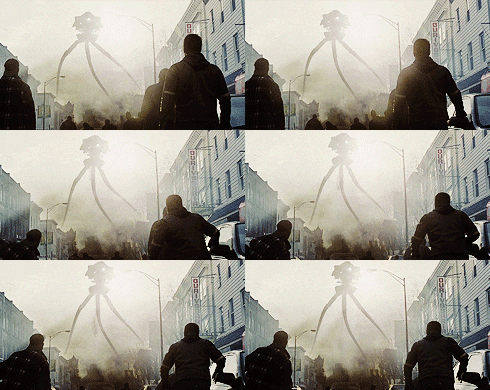
And hilarious.
Because it doesn't really have a Big Battle or anything that humanity has to do to overcome these invaders. They just show up, and we watch in horror as they thoroughly hand us our asses.

Eventually, they just...die off because (regardless of their superior intelligence & firepower) they didn't get their shots before they landed on Earth.
So.
Basically, humans were saved because Mars was full of anti-vaxxers.

And if it happened on Mars, who's to say it can't happen here? Perhaps the true moral of the story is that by unlocking space travel, we can rid ourselves of some of our less desirable brethren by letting them roam around the universe unchecked?
I like to think that this story had a happy ending for more than just the Earthlings.

An L.A. Theatre Works full-cast performance featuring: John de Lancie, Meagan Fay, Jerry Hardin, Gates McFadden, Leonard Nimoy, Daryl Schultz, Armin Shimerman, Brent Spiner, Tom Virtue and Wil Wheaton.


March 7, 2018
Invading aliens have never been that ridiculously incompetent
That´s an often seen problem in classic sci-fi, the authors didn´t really care about thinking too much about logic or readers' problems with suspension of disbelief, they just wanted to tell their story. As long as there were no other genre writers and they had the monopoly, that worked out quite well. But
Aging well and growing old gracefully is a completely different thing
Many old and classic sci fi has problems with realism, often combined with struggling to fuse plot and characters. Some worst cases like general bad works and the weak ones by Heinlein and Dick, even mix this together with strange ideology, passages with poor writing, and authors' voice. But at least
Wells added some hidden criticism about the British empire
By satirizing colonialism and making humankind the colonized victims, he opened up many important questions about the ethical implications. Of course, these were totally ignored and never discussed, just as the dark past of many big countries like the US, France, Turkey, Russia, China, etc. People don´t want to get their flag tainted with the blood of millions and their patriotism vilified, because it helped promote exploitation and genocide. So all media of the time, and nowadays too, prefer to drivel about
How cool alien invasions are
And no one loves them more than I do, because I may have seen and read something between 1 to 3 k versions in all media I consumed united over the decades. There can be so much more added to the mix, science fantasy, cosmic horror, mind manipulation, infiltration, cooptation, friendly assimilation, and especially how many different species on different technological levels do it.
Mentioned plot holes are always a running gag element in sci fi
But honestly, no virus scanners, biotech enhanced vaccinations, or any kind of quarantine plan? After having handled lower Clarketech, thereby probably physics manipulation and understanding of astrophysics we just could dream of? And then they are unable to do what freaking apes like us could do with the stone age smallpox vaccination warp speed concept of rubbing infected, dried pus and creepier stuff in fresh cuts? Come on, alien overlords, you can do so much better, ask me if you want some tips. I believe in your supremacy and will always help you colonize our planet by betraying my species
Tropes show how literature is conceptualized and created and which mixture of elements makes works and genres unique:
https://tvtropes.org/pmwiki/pmwiki.ph...
That´s an often seen problem in classic sci-fi, the authors didn´t really care about thinking too much about logic or readers' problems with suspension of disbelief, they just wanted to tell their story. As long as there were no other genre writers and they had the monopoly, that worked out quite well. But
Aging well and growing old gracefully is a completely different thing
Many old and classic sci fi has problems with realism, often combined with struggling to fuse plot and characters. Some worst cases like general bad works and the weak ones by Heinlein and Dick, even mix this together with strange ideology, passages with poor writing, and authors' voice. But at least
Wells added some hidden criticism about the British empire
By satirizing colonialism and making humankind the colonized victims, he opened up many important questions about the ethical implications. Of course, these were totally ignored and never discussed, just as the dark past of many big countries like the US, France, Turkey, Russia, China, etc. People don´t want to get their flag tainted with the blood of millions and their patriotism vilified, because it helped promote exploitation and genocide. So all media of the time, and nowadays too, prefer to drivel about
How cool alien invasions are
And no one loves them more than I do, because I may have seen and read something between 1 to 3 k versions in all media I consumed united over the decades. There can be so much more added to the mix, science fantasy, cosmic horror, mind manipulation, infiltration, cooptation, friendly assimilation, and especially how many different species on different technological levels do it.
Mentioned plot holes are always a running gag element in sci fi
But honestly, no virus scanners, biotech enhanced vaccinations, or any kind of quarantine plan? After having handled lower Clarketech, thereby probably physics manipulation and understanding of astrophysics we just could dream of? And then they are unable to do what freaking apes like us could do with the stone age smallpox vaccination warp speed concept of rubbing infected, dried pus and creepier stuff in fresh cuts? Come on, alien overlords, you can do so much better, ask me if you want some tips. I believe in your supremacy and will always help you colonize our planet by betraying my species
Tropes show how literature is conceptualized and created and which mixture of elements makes works and genres unique:
https://tvtropes.org/pmwiki/pmwiki.ph...
![Profile Image for [ J o ].](https://i.gr-assets.com/images/S/compressed.photo.goodreads.com/users/1673171874i/4639825._UY200_CR4,0,200,200_.jpg)
April 15, 2017
Read as part of the Infinite Variety Reading Challenge, based on the BBC's Big Read Poll of 2003.
The War of the Worlds goes beyond the of-the-time popular military invasion fiction, which took away the standard protagonist/antagonist arc of single characters and popped whole countries or tribes in their place, and brings down to Earth a whole new enemy at a time when science fiction did not exist and science itself was oft thought of as fiction.
In Surrey, a professor is caught up in the invasion of Martians as they sweep through London and its surrounding boroughs after witnessing several explosion on the planet Mars at the Ottershaw observatory. We follow the un-named professor and his brother in first-person narrative, seeing through their eyes this invasion and the destruction caused.
The air was full of sound, a deafening and confusing conflict of noises-the clangorous din of the Martians, the crash of falling houses, the thud of trees, fences, sheds flashing into flame, and the crackling and roaring of fire. Dense black smoke was leaping up to mingle with the steam from the river, and as the Heat-Ray went to and fro over Weybridge its impact was marked by flashes of incandescent white, that gave place at once to a smoky dance of lurid flames.
The first thing one needs to reference is the radio adaptation of 1938, which was narrated by Orson Welles and caused panic due to its news-bulletin style: those listening thought it was the truth. Whilst reading the novel, there is no doubt that the imagery, style and prose of H.G. Wells purported this panic. It is written with such imagination that it's difficult not to imagine oneself standing on the side of a crater as Martians crawl sluggishly out of their spaceships.
It is not often that I can forgive a book its downfalls due to the time of its writing. (It's all very well to accept that, for the most part, racism and sexism and things of that ilk were at many times in history acceptable behaviour, but enjoying a book from a period with those things in this day and age is a thing I find difficult to do.) However, in the case of The War of the Worlds I think it is vitally important to read the book with the exact time and place it was written in history to be lodged within your mind alongside every word you read.
We have a primitive form of speculative fiction, the very foundations of what we now call science fiction. At the time, H.G. Wells was writing fiction that had scientific and imaginative leanings, but no-one would dare think that perhaps the fiction was not quite fiction after all. There is little mention of the Martians weaponry or technology except when it is in use: any modern-day writer of sci-fi would absolutely be telling you all about the nuts and bolts of the piece. We have primitive science, because that is what they had at the time of writing. Whilst the future may have been thought of, the idea of futuristic technology was as alien to them as the Martians and their technology are in the book.
So, the excitement of the scientific exploration of futures is not to be found here. But the imagination of Wells is so beyond almost everything else that was around at the time and coupling it with popular militarist fiction means that this is an extremely important novel in the progression of English fiction. It is not surprising that Wells was, like Darwin himself, stuck inextricably between the truth of science and the tradition of religion.
The story itself, if put in perspective-removed from its time period and thought of solely as a novel-is nothing special. The narrator is disjointed with his surroundings, the story disappointing in the way it ends and less dramatic and climactic than it could have been. The style of prose is lacking, the dialogue just standard and the characters just slight breezes on a warm day. In that, it would require a mere two or three stars: enjoyable, if a little boring. But this is a novel that should be remembered for when it was written.
The imagination of a scientific man who is at odds with what is right and wrong. The spectacular birth of a new genre of, not only writing, but of thinking, too. The fact that even though my oestrogen levels were almost at zero, the reunion at the end made me cry my eyes out because it was written so perfectly, so unexpectedly.
Of course, that film with that actor was better. Of course it was. We have perspective and technology now that means the original The War of the Worlds is pretty pathetic. It cannot possibly compete with our high standards of today, unless you have half a brain and take this novel for what it truly represents. Unless.
The War of the Worlds goes beyond the of-the-time popular military invasion fiction, which took away the standard protagonist/antagonist arc of single characters and popped whole countries or tribes in their place, and brings down to Earth a whole new enemy at a time when science fiction did not exist and science itself was oft thought of as fiction.
In Surrey, a professor is caught up in the invasion of Martians as they sweep through London and its surrounding boroughs after witnessing several explosion on the planet Mars at the Ottershaw observatory. We follow the un-named professor and his brother in first-person narrative, seeing through their eyes this invasion and the destruction caused.
The air was full of sound, a deafening and confusing conflict of noises-the clangorous din of the Martians, the crash of falling houses, the thud of trees, fences, sheds flashing into flame, and the crackling and roaring of fire. Dense black smoke was leaping up to mingle with the steam from the river, and as the Heat-Ray went to and fro over Weybridge its impact was marked by flashes of incandescent white, that gave place at once to a smoky dance of lurid flames.
The first thing one needs to reference is the radio adaptation of 1938, which was narrated by Orson Welles and caused panic due to its news-bulletin style: those listening thought it was the truth. Whilst reading the novel, there is no doubt that the imagery, style and prose of H.G. Wells purported this panic. It is written with such imagination that it's difficult not to imagine oneself standing on the side of a crater as Martians crawl sluggishly out of their spaceships.
It is not often that I can forgive a book its downfalls due to the time of its writing. (It's all very well to accept that, for the most part, racism and sexism and things of that ilk were at many times in history acceptable behaviour, but enjoying a book from a period with those things in this day and age is a thing I find difficult to do.) However, in the case of The War of the Worlds I think it is vitally important to read the book with the exact time and place it was written in history to be lodged within your mind alongside every word you read.
We have a primitive form of speculative fiction, the very foundations of what we now call science fiction. At the time, H.G. Wells was writing fiction that had scientific and imaginative leanings, but no-one would dare think that perhaps the fiction was not quite fiction after all. There is little mention of the Martians weaponry or technology except when it is in use: any modern-day writer of sci-fi would absolutely be telling you all about the nuts and bolts of the piece. We have primitive science, because that is what they had at the time of writing. Whilst the future may have been thought of, the idea of futuristic technology was as alien to them as the Martians and their technology are in the book.
So, the excitement of the scientific exploration of futures is not to be found here. But the imagination of Wells is so beyond almost everything else that was around at the time and coupling it with popular militarist fiction means that this is an extremely important novel in the progression of English fiction. It is not surprising that Wells was, like Darwin himself, stuck inextricably between the truth of science and the tradition of religion.
The story itself, if put in perspective-removed from its time period and thought of solely as a novel-is nothing special. The narrator is disjointed with his surroundings, the story disappointing in the way it ends and less dramatic and climactic than it could have been. The style of prose is lacking, the dialogue just standard and the characters just slight breezes on a warm day. In that, it would require a mere two or three stars: enjoyable, if a little boring. But this is a novel that should be remembered for when it was written.
The imagination of a scientific man who is at odds with what is right and wrong. The spectacular birth of a new genre of, not only writing, but of thinking, too. The fact that even though my oestrogen levels were almost at zero, the reunion at the end made me cry my eyes out because it was written so perfectly, so unexpectedly.
Of course, that film with that actor was better. Of course it was. We have perspective and technology now that means the original The War of the Worlds is pretty pathetic. It cannot possibly compete with our high standards of today, unless you have half a brain and take this novel for what it truly represents. Unless.

April 26, 2021
“No one would have believed in the last years of the nineteenth century that this world was being watched keenly and closely by intelligences greater than man’s and yet as mortal as his own; that as men busied themselves about their various concerns they were scrutinized and studied, perhaps almost as narrowly as a man with a microscope might scrutinize the transient creatures that swarm and multiply in a drop of water. With infinite complacency men went to and fro over this globe about their little affairs, serene in their assurance of their empire over matter…”
- H.G. Wells, The War of the Worlds
Many Halloweens have come and gone since I first purchased H.G. Wells’s The War of the Worlds, intending it to be part of my seasonal reading. There it sat, with many other good literary intentions. With this book in particular, I never felt any urgency. That’s a function of how many derivative versions I’ve consumed. I’ve seen the movies, the television adaptations, and the parodies on The Simpsons. I’ve also listened to a recording of Orson Welles’s infamous 1938 radio broadcast.
In short, I felt a nagging duty to read it, but nothing more.
Having finally finished The War of the Worlds, I discovered that in some ways, the experience was superfluous. This is a short novel, coming in at around 200 pages, and it doesn’t have much in the way of plot. It is quite episodic, and the various filmed versions of this tale have ably captured the major beats. In other words, there wasn’t much left to surprise me, at least in terms of how it all unfolds.
What did surprise me was its execution. For all the meanings heaped upon Wells’s slim book, it is first and foremost brutally entertaining. This has the gloss – and sentence structure – of a classic. But at its heart, it’s really just a pulpy clash between aliens and humans.
***
A summary of The War of the Worlds is probably unnecessary. Suffice to say, at the end of the nineteenth century, cylinders from Mars begin burying themselves in the soil of Great Britain. From these cylinders emerge big-brained Martians, who immediately begin building war machines, which are then turned loose upon poor England.
The story is told in the first-person by an unnamed narrator. We never learn too much about him – characterizations are not a strong point here – except that he is a philosopher, and that he is married. Most of The War of the Worlds consists of the narrator’s own experiences as he tries to get back to his wife. Somewhat awkwardly, however, Wells also has his narrator spend time relating his brother’s travails, even though he wasn’t present for them. (There are some truly great scenes involving the brother, yet I found this second storyline a bit of an authorial cheat).
With our narrator as a guide, the reader is taken on a tour of a section of blasted-out Great Britain that really sets the bar for all the postapocalyptic fiction to follow. Showing an absurdly keen appreciation for local geography, Wells has his narrator travel from Woking to Weybridge, Weybridge to Halliford, Halliford to Putney, Putney to London, and so on and so forth. Along the way he witnesses battles between massed artillery and alien tripods; scrounges for food; gets trapped in a house with a raving curate (perhaps the most gripping set piece); and exchanges philosophical musings with an artilleryman who has lost his unit (and possibly a few marbles).
Wells’s descriptions – as has been widely noted elsewhere – eerily prefigure the mechanistic slaughters to come in both the First and Second World Wars. There is poison gas and shattered cities. There are mass exoduses of terrified civilian populations, with rioting and looting in the streets. Though this is not graphic in the modern sense, Wells writes with a certain unsparing ruthlessness. In one memorable scene, a British ironclad engages in a suicidal delaying action in the River Thames.
The evocation of total warfare and its aftermath is impressive, and Wells seems to take a bit of pleasure in fictionally destroying his real-life neighborhood.
***
Far more than most novels featuring aliens and Heat-Rays, The War of the Worlds requires close attention. This was published in 1898, and it shows. Wells employs a rather ornate, formal style, with long, compound sentences that often try to do too much. Occasionally, I had to read a page twice to understand what was actually happening (it can be especially hard to keep track of the unnamed characters). Despite its brevity, this took me longer to finish than expected. Still, there are certain sequences that have the taut pacing and tension of a thriller. Furthermore, while Wells can occasionally be a bit wordy, he uses those words to good effect, creating lasting images.
***
The War of the Worlds is one of those titles that is ripe for projection. Because it feels prophetic, there are many interpretations. The most obvious, of course, is that it is a critique of colonialism. After all, it features the world’s great imperial power being forcefully subjugated by a foreign invader. Wells pointedly suggests this himself in the text, referring to the Tasmanian people of Australia being “swept out of existence,” and then asking whether humans were “such apostles of mercy as to complain if the Martians warred in the same spirit?”
This is all well and good, but it is worth mentioning that viewed from the twenty-first century, Wells has more than a bit of baggage. He was enamored of a certain construction of “natural selection” wherein all the “lesser” races would eventually disappear, a prospect he did not exactly mourn. Wells was also known as an anti-Semite, and some of that bleeds into these pages, especially in his description of an “eagle-faced man” who is run over by a fleeing cab while trying to pick up gold sovereigns that have spilled on the ground. For the most part, though, The War of the Worlds seems free of whatever reprehensible notions Wells carried. While there is definitely some Darwinian concepts interwoven into the narrative, the “natural selection” angle is played out vis-à-vis the conflict between humans and extra-terrestrials.
***
Science fiction has always been a marvelous vehicle for addressing real social concerns through entertainment. The War of the Worlds is no exception. As noted above, it can be seen as a criticism of imperialism, or of technology, or of any number of other things. Wells has built a foundation that can support many different structures. Steven Spielberg, for example, used Wells’s setup to create what is perhaps the best film to deal with America’s post-9/11 anxiety and dread. If you want to think deeply about it, you can. Based on the introduction to the edition I read, many have.
Just as importantly, you can choose to simply enjoy it – as I did – as the relatively lowbrow adventures of a man trying his best not to get blown up, while everything around him is spectacularly obliterated.
- H.G. Wells, The War of the Worlds
Many Halloweens have come and gone since I first purchased H.G. Wells’s The War of the Worlds, intending it to be part of my seasonal reading. There it sat, with many other good literary intentions. With this book in particular, I never felt any urgency. That’s a function of how many derivative versions I’ve consumed. I’ve seen the movies, the television adaptations, and the parodies on The Simpsons. I’ve also listened to a recording of Orson Welles’s infamous 1938 radio broadcast.
In short, I felt a nagging duty to read it, but nothing more.
Having finally finished The War of the Worlds, I discovered that in some ways, the experience was superfluous. This is a short novel, coming in at around 200 pages, and it doesn’t have much in the way of plot. It is quite episodic, and the various filmed versions of this tale have ably captured the major beats. In other words, there wasn’t much left to surprise me, at least in terms of how it all unfolds.
What did surprise me was its execution. For all the meanings heaped upon Wells’s slim book, it is first and foremost brutally entertaining. This has the gloss – and sentence structure – of a classic. But at its heart, it’s really just a pulpy clash between aliens and humans.
***
A summary of The War of the Worlds is probably unnecessary. Suffice to say, at the end of the nineteenth century, cylinders from Mars begin burying themselves in the soil of Great Britain. From these cylinders emerge big-brained Martians, who immediately begin building war machines, which are then turned loose upon poor England.
The story is told in the first-person by an unnamed narrator. We never learn too much about him – characterizations are not a strong point here – except that he is a philosopher, and that he is married. Most of The War of the Worlds consists of the narrator’s own experiences as he tries to get back to his wife. Somewhat awkwardly, however, Wells also has his narrator spend time relating his brother’s travails, even though he wasn’t present for them. (There are some truly great scenes involving the brother, yet I found this second storyline a bit of an authorial cheat).
With our narrator as a guide, the reader is taken on a tour of a section of blasted-out Great Britain that really sets the bar for all the postapocalyptic fiction to follow. Showing an absurdly keen appreciation for local geography, Wells has his narrator travel from Woking to Weybridge, Weybridge to Halliford, Halliford to Putney, Putney to London, and so on and so forth. Along the way he witnesses battles between massed artillery and alien tripods; scrounges for food; gets trapped in a house with a raving curate (perhaps the most gripping set piece); and exchanges philosophical musings with an artilleryman who has lost his unit (and possibly a few marbles).
Wells’s descriptions – as has been widely noted elsewhere – eerily prefigure the mechanistic slaughters to come in both the First and Second World Wars. There is poison gas and shattered cities. There are mass exoduses of terrified civilian populations, with rioting and looting in the streets. Though this is not graphic in the modern sense, Wells writes with a certain unsparing ruthlessness. In one memorable scene, a British ironclad engages in a suicidal delaying action in the River Thames.
Suddenly the foremost Martian lowered his tube and discharged a canister of the black gas at the ironclad. It hit her larboard side and glanced off in an inky jet that rolled away to seaward, an unfolding torrent of Black Smoke, from which the ironclad drove clear. To the watchers from the steamer, low in the water and with the sun in their eyes, it seemed as though she was already among the Martians…They saw the gaunt figures separating and rising out of the water as they retreated shoreward, and one of them raised the camera-like generator of the Heat-Ray. He held it pointing obliquely downward, and a bank of steam sprang from the water at its touch. It must have driven through the iron of the ship’s side like a white-hot iron rod through paper…
The evocation of total warfare and its aftermath is impressive, and Wells seems to take a bit of pleasure in fictionally destroying his real-life neighborhood.
***
Far more than most novels featuring aliens and Heat-Rays, The War of the Worlds requires close attention. This was published in 1898, and it shows. Wells employs a rather ornate, formal style, with long, compound sentences that often try to do too much. Occasionally, I had to read a page twice to understand what was actually happening (it can be especially hard to keep track of the unnamed characters). Despite its brevity, this took me longer to finish than expected. Still, there are certain sequences that have the taut pacing and tension of a thriller. Furthermore, while Wells can occasionally be a bit wordy, he uses those words to good effect, creating lasting images.
***
The War of the Worlds is one of those titles that is ripe for projection. Because it feels prophetic, there are many interpretations. The most obvious, of course, is that it is a critique of colonialism. After all, it features the world’s great imperial power being forcefully subjugated by a foreign invader. Wells pointedly suggests this himself in the text, referring to the Tasmanian people of Australia being “swept out of existence,” and then asking whether humans were “such apostles of mercy as to complain if the Martians warred in the same spirit?”
This is all well and good, but it is worth mentioning that viewed from the twenty-first century, Wells has more than a bit of baggage. He was enamored of a certain construction of “natural selection” wherein all the “lesser” races would eventually disappear, a prospect he did not exactly mourn. Wells was also known as an anti-Semite, and some of that bleeds into these pages, especially in his description of an “eagle-faced man” who is run over by a fleeing cab while trying to pick up gold sovereigns that have spilled on the ground. For the most part, though, The War of the Worlds seems free of whatever reprehensible notions Wells carried. While there is definitely some Darwinian concepts interwoven into the narrative, the “natural selection” angle is played out vis-à-vis the conflict between humans and extra-terrestrials.
***
Science fiction has always been a marvelous vehicle for addressing real social concerns through entertainment. The War of the Worlds is no exception. As noted above, it can be seen as a criticism of imperialism, or of technology, or of any number of other things. Wells has built a foundation that can support many different structures. Steven Spielberg, for example, used Wells’s setup to create what is perhaps the best film to deal with America’s post-9/11 anxiety and dread. If you want to think deeply about it, you can. Based on the introduction to the edition I read, many have.
Just as importantly, you can choose to simply enjoy it – as I did – as the relatively lowbrow adventures of a man trying his best not to get blown up, while everything around him is spectacularly obliterated.

January 22, 2022
you've heard of The Book Was Better, now get ready for The Old-Timey Radio Adaptation Was Better
this was very impressive for its time, but...
hard to live up to a radio show so immersive and captivatingly realistic it tricked a bunch of dweebs from the past into thinking we were being invaded by aliens.
2.5 stars
--------------------
tbr review
one of the better first dates of my life involved going to look at a special moon event while listening to the radio adaptation of this book.
the person it was with turned out to be the worst so i'm going to read this and override the memory
this was very impressive for its time, but...
hard to live up to a radio show so immersive and captivatingly realistic it tricked a bunch of dweebs from the past into thinking we were being invaded by aliens.
2.5 stars
--------------------
tbr review
one of the better first dates of my life involved going to look at a special moon event while listening to the radio adaptation of this book.
the person it was with turned out to be the worst so i'm going to read this and override the memory
June 22, 2007
I acknowledge that I am one of the few people who actually enjoyed the recent "War of the Worlds" movie. The reason for this has to do more with the original book than Tom Cruise or Steven Speilburg's tendency to wittle everything, including alien attacks, down to simple family problems. In a lot of ways, "War of the Worlds" (2006) was a close to dead-on adaptation of the original Victorian novel.
Just a few words on why you should like, or if you don't like, respect "War of the Worlds" as a movie:
It avoids alien movie cliches:
1. There are no characters (Presidents, generals, etc.) who tell you what is going on on a global scale--all information is through rumors.
2. You do not see a major city destroyed nor any iconic landmarks.
3. Instead of humanity banding together to defeat a common foe, the characters and others they interact with are left increasingly fragmented and isolated.
That being said, Speilburg's "War of the Worlds" adapts much of the plot line and themes from the original novel. Instead of the 1950s version which pits a united front against the aliens (Cold War adapted), the original Victorian novel has a character travel isolated. Wells' narrater, like Tom Cruise, finds himself on a ferry-crossing, holed up with a panicked priest (who conflated with the artillery-man, provides us with a freaky Tim Robbins. Robbins even shares a few lines with the artillery-man). The ending is much the same, a kind of "Now what?" sense pervades. And of course, Morgan Freeman's opening and closings, are practically word by word from the novel.
The movie is also a great window into some of the novel's most important themes. "War of the Worlds," is a very Post-9/11 movie. There is the dust, the annhilation of things we find familiar, clothing floats from the sky in mimic of office paper...There is a pervading fear of complete and nonsensical annhiliation. Whereas the 1950s adaption pits humanity against an enemy, the updated version worries itself with unknown enemies who spring from the ground. And, Speilburg, not one to be subtle, has Dakota Fanning ask Tom Cruise, "Is it the terrorists?"
That being said, the Victorian novel is a catelogue of Victorian anxieties. This is the age of colonialism, afterall, and suddenly England is beset by a much more powerful force, unexpected, and completely foreign. 'Reverse' colonialism? The aliens take England's resources, kill off its people, and even cover the landscape with alien plant-life.
And perhaps the most over-arching anxiety of all: Darwin. Here we have evolution at its cruelest; then consume us (drinking our blood like in Bram Stoker's Dracula). Just when humanity seems at its lowest, nature kicks in and saves the day. The ending seems anti-climatic now, but you have to remember that H.G. Wells did not have a pop-reference that included Will Smith destroying the mother-ship.
So my point is, "War of the Worlds" is an amazing book and good movie, and one can inform the other.
"This is not a war any more than it's a war between men and ants."
Just a few words on why you should like, or if you don't like, respect "War of the Worlds" as a movie:
It avoids alien movie cliches:
1. There are no characters (Presidents, generals, etc.) who tell you what is going on on a global scale--all information is through rumors.
2. You do not see a major city destroyed nor any iconic landmarks.
3. Instead of humanity banding together to defeat a common foe, the characters and others they interact with are left increasingly fragmented and isolated.
That being said, Speilburg's "War of the Worlds" adapts much of the plot line and themes from the original novel. Instead of the 1950s version which pits a united front against the aliens (Cold War adapted), the original Victorian novel has a character travel isolated. Wells' narrater, like Tom Cruise, finds himself on a ferry-crossing, holed up with a panicked priest (who conflated with the artillery-man, provides us with a freaky Tim Robbins. Robbins even shares a few lines with the artillery-man). The ending is much the same, a kind of "Now what?" sense pervades. And of course, Morgan Freeman's opening and closings, are practically word by word from the novel.
The movie is also a great window into some of the novel's most important themes. "War of the Worlds," is a very Post-9/11 movie. There is the dust, the annhilation of things we find familiar, clothing floats from the sky in mimic of office paper...There is a pervading fear of complete and nonsensical annhiliation. Whereas the 1950s adaption pits humanity against an enemy, the updated version worries itself with unknown enemies who spring from the ground. And, Speilburg, not one to be subtle, has Dakota Fanning ask Tom Cruise, "Is it the terrorists?"
That being said, the Victorian novel is a catelogue of Victorian anxieties. This is the age of colonialism, afterall, and suddenly England is beset by a much more powerful force, unexpected, and completely foreign. 'Reverse' colonialism? The aliens take England's resources, kill off its people, and even cover the landscape with alien plant-life.
And perhaps the most over-arching anxiety of all: Darwin. Here we have evolution at its cruelest; then consume us (drinking our blood like in Bram Stoker's Dracula). Just when humanity seems at its lowest, nature kicks in and saves the day. The ending seems anti-climatic now, but you have to remember that H.G. Wells did not have a pop-reference that included Will Smith destroying the mother-ship.
So my point is, "War of the Worlds" is an amazing book and good movie, and one can inform the other.
"This is not a war any more than it's a war between men and ants."

February 2, 2022
I swear that I read this when I was younger, but when I went to add this to Goodreads as a re-read (it was the January selection for my Completist Book Club), I did not find it in my list. And, because this is one of those books that has a plot people tend to know because of movies and/or its general pop culture relevance, it is difficult for me to know which parts of my memories of this are from the book and which are from other places. But, re-read or not, I am glad I read it in January 2022.
This is classic sci fi. It is easy to see how many parts of this led to the tropes we see in literary and cinematic sci-fi today. And it is pretty amazing the creativity Wells had for coming up with such vivid and scientifically based alien technology and biology. This book was way ahead of its time!
While the setting is late 1800s England (horse carriages, telegrams, etc.), it is not hard to picture this in a modern setting. Wells did a great job making the story timeless. Often when I read books set in this era, they may be good, but they can also feel dated – not a bad thing, it is just that time moves on. But, with this one, society may have advanced, but it did not feel like time had moved on.
If you love the classics and/or love sci-fi and you have not read this book, I feel like it is a must for you to get it on your list right away. I was leaning toward 4 stars on this book, but the classic status and the effect it has had on sci fi over the years push that up to 5 stars!
This is classic sci fi. It is easy to see how many parts of this led to the tropes we see in literary and cinematic sci-fi today. And it is pretty amazing the creativity Wells had for coming up with such vivid and scientifically based alien technology and biology. This book was way ahead of its time!
While the setting is late 1800s England (horse carriages, telegrams, etc.), it is not hard to picture this in a modern setting. Wells did a great job making the story timeless. Often when I read books set in this era, they may be good, but they can also feel dated – not a bad thing, it is just that time moves on. But, with this one, society may have advanced, but it did not feel like time had moved on.
If you love the classics and/or love sci-fi and you have not read this book, I feel like it is a must for you to get it on your list right away. I was leaning toward 4 stars on this book, but the classic status and the effect it has had on sci fi over the years push that up to 5 stars!

January 4, 2017
This was not anything like the Tom Cruise movie so be warned. If you’re expecting an action story about a divorced union container crane operator with a 10 year old daughter you ain’t gonna find it here. They changed like 99% of everything around. As far as I could see there are only two things which are the same, one is that the Martians attack Earth in these COOL THREE LEGGED METAL 70 FOOT HIGH HEAT RAY KICK ASS DEATH MACHINES and two is that they die in the same way which I won’t say here because that would be a giant spoiler but really it’s a bit feeble but I guess could happen because they came from Mars which don’t have bacteria. I don’t do biology so I don’t know if a whole PLANET can not have bacteria. Seems like also they couldn’t have had YOGHURT as well, but HG Wells does not make this clear. Nor Stephen Spielberg either. Now this book version I think is not the book of the movie, I think it came first so that may explain why the movie is better, because really this book is lame. Yes more realistic because like the main guy is no Tom Cruise, but less action. What happens is that the Martians land and like fry everyone up with the DEATH HEAT RAY and send out the BLACK SMOKE to finish off anyone left alive and the main guy hops around and hides and eats really gross stuff and just sees stuff. As for instance he sees the army get a lucky shot in and kill the one single Martian but then like his buddies just wipe out the whole British army. Boom, heatray zzzzz – GONE! Oh yeah the book is set in England which I thought was strange. Why not America like the movie? Anyway just when the guy has realized that from now on we’re just going to be MARTIAN FRENCH FRIES and kept in cages (when not heatrayed) then the Martians just like shrivel up and die. End of. So, in my opinion, I say watch the movie. Or you could go for the prog rock version, lol. Oh I guess I did give away the end. Okay, SPOILER – sorry. But everybody knows this story. It’s like saying oh in the end Dracula dies with a steak in his arse. It’s a known fact.

January 18, 2026
Regarded as one of the pioneers of the sci-fi novel and the alien invasion trope, it was first published in serial form in 1897 and then as a full novel a year later. Tells the tale of a superior intelligent species from a dying Mars that has been scrutinising Earth for some time and ultimately decides to invade.
Set in Victorian London, our unnamed narrator meets his friend Ogilvy, a well-known astronomer; they spot what look like falling stars coming from Mars towards Earth. It's not long before they hit Earth's atmosphere and crash-land one by one. The first is thought to be a meteorite, but it soon becomes clear Martian life has launched an incoming attack.
The book is split into 2 parts. Book 1 focuses on the time between the initial invasion and the realisation of our narrator that he is in the throes of a fight for survival—we also get to learn about the journey of his brother. Book 2 focuses mainly on our narrator and the world slowly being overtaken by the Martians, leading to the finale.
Our narrator wasn't a particularly likeable character; he was an elitist snob who thought everyone was beneath him. Not only did he seem to care very little for what happened to his earlier companion, but later, while hiding in ditches, thirsty and starving, he still manages to belittle—via his inner monologue—other survivors he comes upon. Even when he was in the same position as everyone else, he still couldn't resist being unpleasant.
The narrative is incredibly slow-paced at times, and it does tend to veer off course into rambling territory in abundance. The story arc of the brother, whilst fairly dominant in the latter part of book 1, completely disappeared in book 2, so his fate was left a mystery. We also get some casual misogyny thrown in for good measure—unfortunately, when reading these older books, you do tend to come across outdated attitudes and language on occasion.
Not one of my favourite classic reads, and my rating for this one mostly goes to the rich literary prose and its archetypal Martian storyline, which has inspired many an adaptation. Whilst this may have been a revelation when it was first released, it's one that hasn't aged particularly well. I found the characterisation woeful and the narrative as a whole a leaden, plot hole-filled chore.
Set in Victorian London, our unnamed narrator meets his friend Ogilvy, a well-known astronomer; they spot what look like falling stars coming from Mars towards Earth. It's not long before they hit Earth's atmosphere and crash-land one by one. The first is thought to be a meteorite, but it soon becomes clear Martian life has launched an incoming attack.
"With infinite complacency men went to and fro over this globe about their little affairs, serene in their assurance of their empire over matter."
The book is split into 2 parts. Book 1 focuses on the time between the initial invasion and the realisation of our narrator that he is in the throes of a fight for survival—we also get to learn about the journey of his brother. Book 2 focuses mainly on our narrator and the world slowly being overtaken by the Martians, leading to the finale.
Our narrator wasn't a particularly likeable character; he was an elitist snob who thought everyone was beneath him. Not only did he seem to care very little for what happened to his earlier companion, but later, while hiding in ditches, thirsty and starving, he still manages to belittle—via his inner monologue—other survivors he comes upon. Even when he was in the same position as everyone else, he still couldn't resist being unpleasant.
The narrative is incredibly slow-paced at times, and it does tend to veer off course into rambling territory in abundance. The story arc of the brother, whilst fairly dominant in the latter part of book 1, completely disappeared in book 2, so his fate was left a mystery. We also get some casual misogyny thrown in for good measure—unfortunately, when reading these older books, you do tend to come across outdated attitudes and language on occasion.
Not one of my favourite classic reads, and my rating for this one mostly goes to the rich literary prose and its archetypal Martian storyline, which has inspired many an adaptation. Whilst this may have been a revelation when it was first released, it's one that hasn't aged particularly well. I found the characterisation woeful and the narrative as a whole a leaden, plot hole-filled chore.

August 30, 2011

“No one would have believed in the last years of the nineteenth century that this world was being watched keenly and closely by intelligences greater than man's and yet as mortal as his own; that as men busied themselves about their various concerns they were scrutinised and studied, perhaps almost as narrowly as a man with a microscope might scrutinise the transient creatures that swarm and multiply in a drop of water.”
A beautiful opening to the book but I must say the Martians did a very poor job of scrutinising us human chappies and our little blue planet considering what transpires later. Ah, but I must not spoil the book even though I imagine most people reading this review (all three of them) already know how it ends. Which brings me to my next point, if you know the story of The War of The Worlds quite well already but have not actually read the book I urge you to read it, especially if you are a science fiction fan. I don't think there are many books in the pantheon of sci-fi as important as this one. This is the book that launched the alien invasion sci-fi trope and even manages to remain one of the best examples of it.
H.G. Wells was
He even included some element of hard sf into his novels, here is an example from this book:
“It is still a matter of wonder how the Martians are able to slay men so swiftly and so silently. Many think that in some way they are able to generate an intense heat in a chamber of practically absolute non-conductivity. This intense heat they project in a parallel beam against any object they choose, by means of a polished parabolic mirror of unknown composition, much as the parabolic mirror of a lighthouse projects a beam of light.”
Yes, you may already have a fairly good idea of The War of The Worlds’ beginning middle and end without ever reading the book but you would miss Wells’ marvelously immersive and visual storytelling and the subtexts embedded in the original texts. The scene of naval battle between the military’s ironclads and the Martian tripods is vividly depicted and should please fans of military sf and general badassery. The slightly surreal chapter involving the artilleryman is a particularly interesting depiction of people who always seem to be brimming with ideas, plans and suggestions but never actually do anything.
The story of The War of The Worlds is so potent that Orson Welles’ 1938 War of the Worlds 1938 radio broadcast “became famous for causing mass panic, although the extent of this panic is debated”. Still, even moderate panic is an amazing achievement for a radio drama.
This book has of course been adapted into movies several times. Unfortunately a straight adaptation complete with the Victorian setting does not seem to have been made. The most recent adaptation being the 2005 Spielberg directed movie with Tom Cruise being the usual Cruisian hero, dodging Martian heat rays like nobody's business.
For this reread I went with the free Librivox audiobook version, very well read by Rebecca Dittman.
I hope to eventually read all of Wells’ sci-fi and perhaps his more mainstream books also. Anyway, never dismiss H.G. Wells' sci-fi as old hat because he invented the hat and it is still superior to most of today's headgear.
* I have a bee in my bonnet about today's frequent (and incorrect) overuse of "literally".
A quick note about the ending:

I love this album cover art from Jeff Wayne's Musical Version of The War of the Worlds. For some reason, I never heard the album in its entirety, but the hit single Forever Autumn is great.
Note:
• Update May 6, 2017: Now the Beeb is making a proper Victorian era adaptation, hurrah!

• Update June 22, 2020: Haven't seen the (above-mentioned) 2019 BBC series! LOL! There is also a 2019 French / US adaptation. Havn't seen that either!

"The Martians" by Rodney Matthews

June 2, 2022
3,5/5

April 7, 2020
The classic Mars invasion of Earth tale, told in excruciating detail, from the viewpoint of the invaded England. One of the key Science Fiction books. In the 21st century, a fair bit of Well's works and writing are not ageing well, and I feel it's come to the point that older works, especially sci-fi must be judged in the context of when they were written - and this was written in 1898! Three Stars, 6 out of 12.
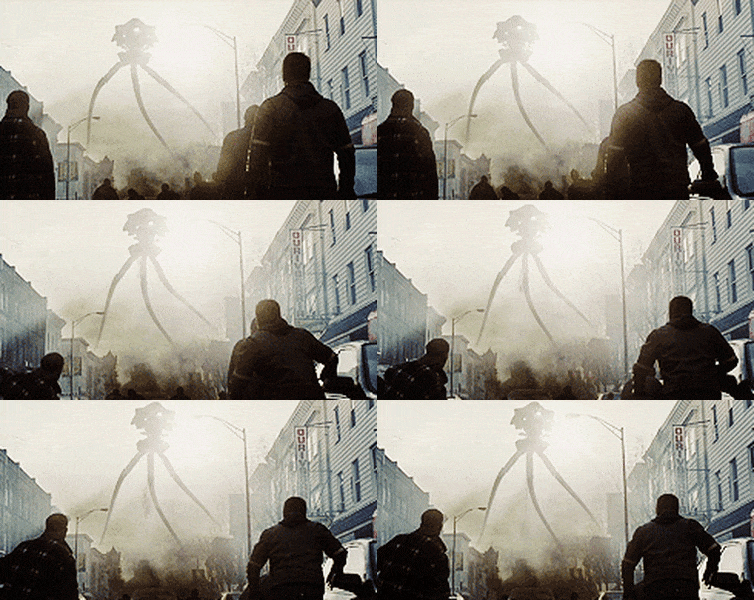
2010
2010
![Profile Image for Saranya [uni- kinda ia].](https://i.gr-assets.com/images/S/compressed.photo.goodreads.com/users/1791100382i/187457635._UY200_CR0,0,200,200_.jpg)
October 3, 2025
H.G. Wells is the kind of dude who will give me nightmares on a daily basis. Seriously, I had no idea that a sci-fi could make me sob like a maniac.
At the time when this was written, the British Empire was the apex predator of the globe. The author did an amazing job here forcing his Victorian readers to experience what it is like to be on the receiving end of a technologically superior, colonizing force. It is a humbling, terrifying reversal of roles.
H.G. Wells invented a nightmare that hasn't ended. The War of the Worlds is an alien invasion story not because of the technology it predicts, but because of the primal fear it taps into.
Martians aren't little green men. They are cephalopod-like entities encased in towering, three-legged fighting machines. The imagery of these metallic giants wading through the English countryside, howling "Ulla! Ulla!", is still haunting over a century later. They don't just kill. They harvest.
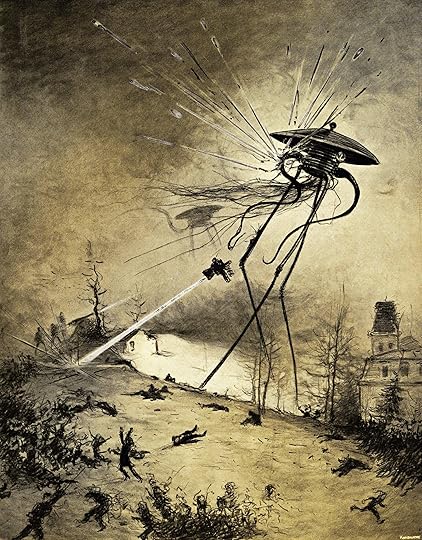
ᯓ ✈︎ Pre-Read
Need to read this after watching the fantabulous movie!
At the time when this was written, the British Empire was the apex predator of the globe. The author did an amazing job here forcing his Victorian readers to experience what it is like to be on the receiving end of a technologically superior, colonizing force. It is a humbling, terrifying reversal of roles.
H.G. Wells invented a nightmare that hasn't ended. The War of the Worlds is an alien invasion story not because of the technology it predicts, but because of the primal fear it taps into.
Martians aren't little green men. They are cephalopod-like entities encased in towering, three-legged fighting machines. The imagery of these metallic giants wading through the English countryside, howling "Ulla! Ulla!", is still haunting over a century later. They don't just kill. They harvest.
ᯓ ✈︎ Pre-Read
Need to read this after watching the fantabulous movie!

March 28, 2026
⭒⭒⚛⭒⚔⭒⚛⭒⚔⭒⚛⭒⚔⭒⚛⭒⚔⭒⚛⭒⚔⭒⚛⭒⚔⭒⚛⭒⭒
⭐ 4.1
☄︎ Plot:
First published in 1898, The War of the Worlds remains startlingly effective in its portrayal of mass panic and helplessness in the face of an otherworldly invasion. When mysterious cylinders crash into the English countryside, humanity initially approaches the phenomenon with curiosity. The illusion of safety shatters rapidly as towering Martian fighting machines emerge, unleashing destruction across Victorian England with terrifying efficiency. Wells constructs the narrative not as a heroic battle for victory, but as a grim survival account observed through the eyes of an ordinary man attempting to navigate the collapse of civilisation. Events unfold with sharp, cinematic urgency, escalating from cosmic intrigue into full-scale catastrophe with unnerving plausibility.
☄︎ Writing Style:
Wells writes with journalistic precision, blending scientific speculation with vivid observational detail. The prose is formal yet accessible, capturing the chaos with the raw immediacy of a real-time documentary. Descriptions of the Martian machinery and the desolation left in its wake are strikingly imaginative, especially considering the novel predates modern survival horror conventions entirely. The pacing occasionally slows during philosophical reflection, but this serves to anchor the surreal elements in rational reasoning.
☄︎ Characters:
The narrator functions less as a deeply developed protagonist and more as a lens through which societal breakdown is witnessed. His reactions - disbelief, terror, instinctive self-preservation and eventual moral uncertainty - feel believable within the cataclysmic circumstances. Supporting figures often embody ideological responses to catastrophe: the curate represents hysteria and spiritual fragmentation, while the artilleryman clings to delusional fantasies of rebuilding power amidst ruin. Meanwhile, the Martians are depicted as utterly alien, tentacled entities - psychologically ambiguous and disturbingly indifferent to the suffering inhabitants of Earth.
☄︎ Impact:
Beneath the invasion narrative lies a biting critique of human arrogance and assumed dominance over nature. Wells forces mankind into the very role colonial powers had historically imposed upon others: displaced, vulnerable, and technologically outmatched. Themes of survival and the fragility of the global order permeate the novel, giving it an enduring relevance that extends far beyond its premise. Even over a century later, its atmosphere of existential dread remains potent.
☄︎ Overall:
The War of the Worlds not only popularised the concept of the alien invasion, it also succeeds as a visceral and visionary disaster tale. Readers expecting a character-driven plot may find it emotionally distant, but those interested in apocalyptic themes, speculative storytelling and foundational genre fiction will likely find it immensely rewarding.
☄︎ Final Thoughts:
I was surprised by how brilliantly the Victorian setting enhanced the contrast between the Martians and Earth dwellers. The imagery of civilians fleeing disintegrating cities in horse-drawn carts, roads clogged with hysterical crowds, and entire communities falling into confusion as society buckles gave the novel a sense of helplessness that modern reinventions often lack. There's something unsettling about the concept of one's own species facing extinction while armed with nothing more than woefully inadequate artillery and blind hope. Even after decades of stories inspired by The War of the Worlds, it's clear the author understood something timeless about our nature: how quickly confidence evaporates when confronted with something larger than ourselves. More than anything, this felt like discovering one of the blueprints for modern science fiction - and realising the original still holds up incredibly well.
Genre:
☄︎ Foundational Science Fiction
☄︎ Apocalyptic Fiction
Tropes and Themes:
☄︎ Alien invasion
☄︎ Impossible odds
☄︎ Scientific speculation
☄︎ Societal collapse
☄︎ Human insignificance
☄︎ Colonialism
☄︎ Existential dread
☄︎ Civilian narrator
☄︎ Survival
Content Warnings:
⚠ Violence and mass death
⚠ Apocalyptic destruction
⚠ Themes of extinction and societal collapse
⭐ 4.1
☄︎ Plot:
First published in 1898, The War of the Worlds remains startlingly effective in its portrayal of mass panic and helplessness in the face of an otherworldly invasion. When mysterious cylinders crash into the English countryside, humanity initially approaches the phenomenon with curiosity. The illusion of safety shatters rapidly as towering Martian fighting machines emerge, unleashing destruction across Victorian England with terrifying efficiency. Wells constructs the narrative not as a heroic battle for victory, but as a grim survival account observed through the eyes of an ordinary man attempting to navigate the collapse of civilisation. Events unfold with sharp, cinematic urgency, escalating from cosmic intrigue into full-scale catastrophe with unnerving plausibility.
☄︎ Writing Style:
Wells writes with journalistic precision, blending scientific speculation with vivid observational detail. The prose is formal yet accessible, capturing the chaos with the raw immediacy of a real-time documentary. Descriptions of the Martian machinery and the desolation left in its wake are strikingly imaginative, especially considering the novel predates modern survival horror conventions entirely. The pacing occasionally slows during philosophical reflection, but this serves to anchor the surreal elements in rational reasoning.
☄︎ Characters:
The narrator functions less as a deeply developed protagonist and more as a lens through which societal breakdown is witnessed. His reactions - disbelief, terror, instinctive self-preservation and eventual moral uncertainty - feel believable within the cataclysmic circumstances. Supporting figures often embody ideological responses to catastrophe: the curate represents hysteria and spiritual fragmentation, while the artilleryman clings to delusional fantasies of rebuilding power amidst ruin. Meanwhile, the Martians are depicted as utterly alien, tentacled entities - psychologically ambiguous and disturbingly indifferent to the suffering inhabitants of Earth.
☄︎ Impact:
Beneath the invasion narrative lies a biting critique of human arrogance and assumed dominance over nature. Wells forces mankind into the very role colonial powers had historically imposed upon others: displaced, vulnerable, and technologically outmatched. Themes of survival and the fragility of the global order permeate the novel, giving it an enduring relevance that extends far beyond its premise. Even over a century later, its atmosphere of existential dread remains potent.
☄︎ Overall:
The War of the Worlds not only popularised the concept of the alien invasion, it also succeeds as a visceral and visionary disaster tale. Readers expecting a character-driven plot may find it emotionally distant, but those interested in apocalyptic themes, speculative storytelling and foundational genre fiction will likely find it immensely rewarding.
☄︎ Final Thoughts:
I was surprised by how brilliantly the Victorian setting enhanced the contrast between the Martians and Earth dwellers. The imagery of civilians fleeing disintegrating cities in horse-drawn carts, roads clogged with hysterical crowds, and entire communities falling into confusion as society buckles gave the novel a sense of helplessness that modern reinventions often lack. There's something unsettling about the concept of one's own species facing extinction while armed with nothing more than woefully inadequate artillery and blind hope. Even after decades of stories inspired by The War of the Worlds, it's clear the author understood something timeless about our nature: how quickly confidence evaporates when confronted with something larger than ourselves. More than anything, this felt like discovering one of the blueprints for modern science fiction - and realising the original still holds up incredibly well.
Genre:
☄︎ Foundational Science Fiction
☄︎ Apocalyptic Fiction
Tropes and Themes:
☄︎ Alien invasion
☄︎ Impossible odds
☄︎ Scientific speculation
☄︎ Societal collapse
☄︎ Human insignificance
☄︎ Colonialism
☄︎ Existential dread
☄︎ Civilian narrator
☄︎ Survival
Content Warnings:
⚠ Violence and mass death
⚠ Apocalyptic destruction
⚠ Themes of extinction and societal collapse

June 30, 2013
Was H.G. Wells schizophrenic? I'm just wondering because his novels fall into 2 distinct groups. There are the gently humorous novels such as "Kipps" or "The History of Mr Polly" - and then there are his SF novels, of which The War of the Worlds is surely the most famous.
His prescience is startling. Not only was he writing in the pre-atomic age, but it is as well to remember that this book was written over a century ago (1898) which is even before powered flight (though only just!) I now want to read "War in the Air" to see if his imagination mirrored a potential reality as accurately as this.
The story-line is gripping, and immensely powerful. H.G. Wells is particularly good at seeing the individual's experience set against the whole devastating picture, (shifting between the viewpoint character and his brother), which draws the reader into the story.
His prescience is startling. Not only was he writing in the pre-atomic age, but it is as well to remember that this book was written over a century ago (1898) which is even before powered flight (though only just!) I now want to read "War in the Air" to see if his imagination mirrored a potential reality as accurately as this.
The story-line is gripping, and immensely powerful. H.G. Wells is particularly good at seeing the individual's experience set against the whole devastating picture, (shifting between the viewpoint character and his brother), which draws the reader into the story.

October 2, 2018
الإنسان لا يحيا و لا يموت هباء
و لكن اتى النهار الذي ستعرف فيه المدينة اي هول كانت ترقد فوقه لالاف السنين
لقد انطلق الرعب في الشوارع في صورة مركبات ثلاثية الارجل ..يوقظها برق فتخرج من باطن الارض
 لتحرق و تدهس و تنشر الفناء و تسرق الامان.. و يلاحظ ان ويلز حرص على ان يكون الشر كامنا في باطن ارضنا..بيننا و ليس قادما من كواكب اخرى
و مع انتشار الدمار تنتشر اخلاق الزحام
و ينقسم البشر الى : أكثرية تتصرف بانانية مطلقة و حماقة متناهية
و أقلية : يساعدون و يساعدون لو على حساب انفسهم
و مع توالى الاحداث الكابوسية يصبح البقاء للاذكى و الاوفر حظا
و يقرع ويلز اجراس الخطر🔔
و يزعزع إحساس العالم الغربي الزائف بالامان
و انه لا امل للبفاء الا بالتكاتف و التأزر حتى لا تفنى الموارد و نهلك جميعا
و لكن اتى النهار الذي ستعرف فيه المدينة اي هول كانت ترقد فوقه لالاف السنين
لقد انطلق الرعب في الشوارع في صورة مركبات ثلاثية الارجل ..يوقظها برق فتخرج من باطن الارض
لتحرق و تدهس و تنشر الفناء و تسرق الامان.. و يلاحظ ان ويلز حرص على ان يكون الشر كامنا في باطن ارضنا..بيننا و ليس قادما من كواكب اخرى و مع انتشار الدمار تنتشر اخلاق الزحام
و ينقسم البشر الى : أكثرية تتصرف بانانية مطلقة و حماقة متناهية
و أقلية : يساعدون و يساعدون لو على حساب انفسهم
و مع توالى الاحداث الكابوسية يصبح البقاء للاذكى و الاوفر حظا
و يقرع ويلز اجراس الخطر🔔
و يزعزع إحساس العالم الغربي الزائف بالامان
و انه لا امل للبفاء الا بالتكاتف و التأزر حتى لا تفنى الموارد و نهلك جميعا

March 6, 2013
"Las obras de Mr. Wells pertenecen, sin duda, a un tiempo y un grado de conocimiento científico futuro muy alejado del presente, pero no completamente fuera de los límites de lo posible."
Julio Verne
Ya lo he afirmado en reseñas anteriores. La capacidad de anticipación a la tecnología y el futuro que tenía Herbert George Wells era ampliamente superior a la de Julio Verne a punto tal que el visionario francés lo admitía sin reparos.
Pero además de esta característica tan marcada en sus novelas, Wells nos alertaba sobre los posibles peligros que involucraba a la tecnología en poder de los hombres, sobre los riesgos de los avances científicos y los alcances de la ciencia sobre el planeta.
Sumado a esto, es importante reconocer también que Wells profundizaba en el costado psicológico del ser humano ante tantos cambios inesperados y en cómo el hombre tiene que lidiar con estos.
En tan sólo cuatro años, Wells había escrito cuatro novelas inolvidables: "La guerra de los mundos", "El hombre invisible", "La máquina del tiempo" y "La isla del Dr. Moreau", lo que demuestra su poderío narrativo que perdura aún hasta nuestros días.
"La Guerra de los Mundos" no es solamente un libro sobre la invasión de la Tierra a partir de la llegada de los marcianos. Tiene muchos elementos más que la hace una novela muy entretenida para ser tan corta y, como comentara anteriormente, nos muestra otro costado: el de la reacción del hombre ante la pérdida de su libertad.
A lo largo de la historia, hemos conocido acerca de las distintas invasiones y en todas ellas el patrón común es precisamente ese, el de la libertad perdida. Usualmente pondemos el ojo en el vencedor, pero no prestamos atención al vencido o dominado y en cómo influye en éste el hecho de ser sometido en todos los aspectos.
Es sobre esa faceta en donde Wells ahonda el desarrollo de su novela, porque para ser sinceros, si reemplazamos a los habitantes de la tierra, por ejemplo con un ejemplo cualquiera, por los polacos, luego de la invasión nazi en 1939 a Polonia, veremos que ese sufrimiento es similar al que nos cuenta el narrador de esta historia.
La opresión que viven los habitantes de la Tierra puede compararse a la de este pueblo o a cualquiera que haya experimentado un suceso similar.
Para ello y a la par de lo que sucede con la caída de los distintos cilindros a Inglaterra, Wells comienza a relatarnos las reacciones de los hombres que sufren el asedio y de cómo va esto trastocando su vida.
Durante el transcurso de la novela nos encontramos con grandes diferencias entre los seres humanos como sucede entre el narrador y el cura y también con el artillero. Estas distintas maneras de pensar nos llevan a un contrapunto interesante.
En primer lugar descubrimos que insólitamente la falta de fe y esperanza repercute totalmente en el cura, que es casualmente quien por su posición ante precisamente esa fe es quien más debe reconfortar al débil. En este caso no funciona y creo que se debe a una crítica que Wells entabla hacia la Iglesia como constitución.
Desconozco si era o no creyente pero pude notar que por momentos el narrador (que es tal vez un Wells encubierto) nos daba una imagen paranoica, frágil y temerosa de alguien que supuestamente debe mostrarnos exactamente lo contrario.
En el caso del artillero, se desarrolla una personalidad completamente opuesta. La de aquellos hombres que bajo la influencia de la invasión a la que están sujetos intentan tomar partido para su beneficio o pactando secretas sumisiones a cambio de una traición a los suyos o en otros casos queriendo intentar una represalia que es imposible llevar a cabo y es ahí en donde el autor pone al descubierto nuestras defectos, ambicione o debilidades como personas.
El punto del artillero es de todas maneras muy válido, pues éste pone de manifiesto que la supervivencia de los seres humanos está ligada directamente a que entendamos que, ante un dominio tan brutal como el que ejercen los marcianos, éstos estarán unidos o dominados. En nosotros está descubrir la verdad.
Un dato interesante que descubrí durante el tramo final de la segunda parte es que los marcianos comienzan a rociar toda la zona con un una nube letal negra, principalmente en la ciudad de Londres que en ese libro equivale a la Nueva York de las películas de Hollywood, y este detalle me recordó a la de la nevada mortal con la que comienza la mítica historia gráfica de Hector Oesterheld en "El Eternauta". Tal vez, a partir de esta novela haya habido algún tipo de inspiración en el autor argentino para desarrollar su historia.
Para finalizar, simplemente dejo una pequeña reflexión e interrogante, ya que sabemos que esto es ficción, que la ficción es justamente la creación de mundos a partir de la realidad, que se han escrito muchos libros sobre el tema y que se filmaron centenares de películas pero, si un día nos despertáramos con la noticia de una invasión extraterrestre...
Tú: ¿cómo reaccionarías?
Julio Verne
Ya lo he afirmado en reseñas anteriores. La capacidad de anticipación a la tecnología y el futuro que tenía Herbert George Wells era ampliamente superior a la de Julio Verne a punto tal que el visionario francés lo admitía sin reparos.
Pero además de esta característica tan marcada en sus novelas, Wells nos alertaba sobre los posibles peligros que involucraba a la tecnología en poder de los hombres, sobre los riesgos de los avances científicos y los alcances de la ciencia sobre el planeta.
Sumado a esto, es importante reconocer también que Wells profundizaba en el costado psicológico del ser humano ante tantos cambios inesperados y en cómo el hombre tiene que lidiar con estos.
En tan sólo cuatro años, Wells había escrito cuatro novelas inolvidables: "La guerra de los mundos", "El hombre invisible", "La máquina del tiempo" y "La isla del Dr. Moreau", lo que demuestra su poderío narrativo que perdura aún hasta nuestros días.
"La Guerra de los Mundos" no es solamente un libro sobre la invasión de la Tierra a partir de la llegada de los marcianos. Tiene muchos elementos más que la hace una novela muy entretenida para ser tan corta y, como comentara anteriormente, nos muestra otro costado: el de la reacción del hombre ante la pérdida de su libertad.
A lo largo de la historia, hemos conocido acerca de las distintas invasiones y en todas ellas el patrón común es precisamente ese, el de la libertad perdida. Usualmente pondemos el ojo en el vencedor, pero no prestamos atención al vencido o dominado y en cómo influye en éste el hecho de ser sometido en todos los aspectos.
Es sobre esa faceta en donde Wells ahonda el desarrollo de su novela, porque para ser sinceros, si reemplazamos a los habitantes de la tierra, por ejemplo con un ejemplo cualquiera, por los polacos, luego de la invasión nazi en 1939 a Polonia, veremos que ese sufrimiento es similar al que nos cuenta el narrador de esta historia.
La opresión que viven los habitantes de la Tierra puede compararse a la de este pueblo o a cualquiera que haya experimentado un suceso similar.
Para ello y a la par de lo que sucede con la caída de los distintos cilindros a Inglaterra, Wells comienza a relatarnos las reacciones de los hombres que sufren el asedio y de cómo va esto trastocando su vida.
Durante el transcurso de la novela nos encontramos con grandes diferencias entre los seres humanos como sucede entre el narrador y el cura y también con el artillero. Estas distintas maneras de pensar nos llevan a un contrapunto interesante.
En primer lugar descubrimos que insólitamente la falta de fe y esperanza repercute totalmente en el cura, que es casualmente quien por su posición ante precisamente esa fe es quien más debe reconfortar al débil. En este caso no funciona y creo que se debe a una crítica que Wells entabla hacia la Iglesia como constitución.
Desconozco si era o no creyente pero pude notar que por momentos el narrador (que es tal vez un Wells encubierto) nos daba una imagen paranoica, frágil y temerosa de alguien que supuestamente debe mostrarnos exactamente lo contrario.
En el caso del artillero, se desarrolla una personalidad completamente opuesta. La de aquellos hombres que bajo la influencia de la invasión a la que están sujetos intentan tomar partido para su beneficio o pactando secretas sumisiones a cambio de una traición a los suyos o en otros casos queriendo intentar una represalia que es imposible llevar a cabo y es ahí en donde el autor pone al descubierto nuestras defectos, ambicione o debilidades como personas.
El punto del artillero es de todas maneras muy válido, pues éste pone de manifiesto que la supervivencia de los seres humanos está ligada directamente a que entendamos que, ante un dominio tan brutal como el que ejercen los marcianos, éstos estarán unidos o dominados. En nosotros está descubrir la verdad.
Un dato interesante que descubrí durante el tramo final de la segunda parte es que los marcianos comienzan a rociar toda la zona con un una nube letal negra, principalmente en la ciudad de Londres que en ese libro equivale a la Nueva York de las películas de Hollywood, y este detalle me recordó a la de la nevada mortal con la que comienza la mítica historia gráfica de Hector Oesterheld en "El Eternauta". Tal vez, a partir de esta novela haya habido algún tipo de inspiración en el autor argentino para desarrollar su historia.
Para finalizar, simplemente dejo una pequeña reflexión e interrogante, ya que sabemos que esto es ficción, que la ficción es justamente la creación de mundos a partir de la realidad, que se han escrito muchos libros sobre el tema y que se filmaron centenares de películas pero, si un día nos despertáramos con la noticia de una invasión extraterrestre...
Tú: ¿cómo reaccionarías?

February 9, 2014
This classic 1898 science fiction novel has teeth to it, and it’s not just the Martians. The War of the Worlds is a lot more thoughtfully written than I had remembered. In between deadly heat rays, huge tripod machines striding around the country killing everything in their path, and bloodthirsty Martians trying to take over Earth (starting with Great Britain), there's also critique of colonialism, religious hypocrisy, and even how humans treat animals. The ways in which people react in a crisis is given just as much attention as the Martians' actions.
I read this when I was a teenager, but for whatever reason I didn’t get much out of it at the time. But I let myself get roped into a GR group read of it, partly because it's so short. And also because my literary diet needs more classics. And you know? I'm glad I did.
Upping my rating from 3 stars to 4.5 on reread, partly in recognition of how advanced this book was for its time in some of its concepts, and the influence it's had on the SF genre.
Group read with the Non-Crunchy Classics Pantaloonless crew.
I read this when I was a teenager, but for whatever reason I didn’t get much out of it at the time. But I let myself get roped into a GR group read of it, partly because it's so short. And also because my literary diet needs more classics. And you know? I'm glad I did.
Upping my rating from 3 stars to 4.5 on reread, partly in recognition of how advanced this book was for its time in some of its concepts, and the influence it's had on the SF genre.
Group read with the Non-Crunchy Classics Pantaloonless crew.

June 27, 2017
You would think that as Man grows in intelligence he would likewise grow in morality. But you would be wrong. Or at least, that is what history teaches us. About a hundred years before Harvard professor Robert Coles wrote his now famous article “The Disparity Between Intellect and Character,” H.G. Wells made much the same observation.
At the end of The War of the Worlds, the unnamed narrator returns to his house and sees the paper he had been working on before the war began. “It was a paper on the probable development of Moral Ideas with the development of the civilizing process” (194). There’s one for the wastepaper basket! As with much science fiction, the aliens in The War of the Worlds reveal more about us than about them.
Throughout the book, Wells compares Man with the lower animals. And it becomes increasingly uncomfortable. At the start, we are microbes under the Martians’ microscope. We might be able to pass over the metaphor without much thought if only he didn’t go on to compare us to monkeys, lemurs, dodo birds, bison, ants, frogs, rabbits, bees, wasps, and rats ~ animals we exploit or exterminate without compassion.
The narrator doesn’t fail to make the connection between the Martians’ treatment of humans and our treatment of animals. When he discovers that the Martians regard human beings as food, he is able to shift his perspective and see the human diet from the point of view of an animal that is typically regarded as food: “I think that we should remember how repulsive our carnivorous habits would seem to an intelligent rabbit” (139).
Moreover, it is not only animals that we destroy. Other humans are also fair game.
“And before we judge of them too harshly, we must remember what ruthless and utter destruction our own species has wrought, not only upon animals, such as the vanished bison and the dodo, but upon its own inferior races. The Tasmanians, in spite of their human likeness, were entirely swept out of existence in a war of extermination waged by European immigrants, in the space of fifty years. Are we such apostles of mercy as to complain if the Martians warred in the same spirit?” (5).
If only moral growth went hand-in-hand with intellectual growth! But apparently evolution doesn’t work that way. So a look at the Martians is a look into a mirror. It is also a look into our own future. And it is a future difficult to look upon. The Martians are ugly. And not just on the outside.
Evolution has turned them into little more than heads. Thanks to natural selection, their bodies function with marvelous efficiency. They need not eat, sleep, or engage in sexual intercourse. They communicate by telepathy. Through Darwinian adaptation, they lost what they did not need to survive and developed what they did need. And what they needed was intellect, not character. Heads, not hearts.
Is this where our species is headed? Wells was an advocate of Darwinism and if the Martians represent the future of Man, then The War of the Worlds must be read as a cautionary tale. The Epilogue supports this interpretation:
“If the Martians can reach Venus, there is no reason to suppose that the thing is impossible for men, and when the slow cooling of the sun makes this earth uninhabitable, as at last it must do, it may be that the thread of life that has begun here will have streamed out and caught our sister planet within its toils. Should we conquer?” (198-199).
Should we conquer? If we don’t want to become blood-sucking heads without hearts we had better not! On the contrary, we had better learn compassion for those over whom our superior intelligence gives us power. “Surely, if we have learnt nothing else, this war has taught us pity —pity for those witless souls that suffer our dominion” (166).
At the end of The War of the Worlds, the unnamed narrator returns to his house and sees the paper he had been working on before the war began. “It was a paper on the probable development of Moral Ideas with the development of the civilizing process” (194). There’s one for the wastepaper basket! As with much science fiction, the aliens in The War of the Worlds reveal more about us than about them.
Throughout the book, Wells compares Man with the lower animals. And it becomes increasingly uncomfortable. At the start, we are microbes under the Martians’ microscope. We might be able to pass over the metaphor without much thought if only he didn’t go on to compare us to monkeys, lemurs, dodo birds, bison, ants, frogs, rabbits, bees, wasps, and rats ~ animals we exploit or exterminate without compassion.
The narrator doesn’t fail to make the connection between the Martians’ treatment of humans and our treatment of animals. When he discovers that the Martians regard human beings as food, he is able to shift his perspective and see the human diet from the point of view of an animal that is typically regarded as food: “I think that we should remember how repulsive our carnivorous habits would seem to an intelligent rabbit” (139).
Moreover, it is not only animals that we destroy. Other humans are also fair game.
“And before we judge of them too harshly, we must remember what ruthless and utter destruction our own species has wrought, not only upon animals, such as the vanished bison and the dodo, but upon its own inferior races. The Tasmanians, in spite of their human likeness, were entirely swept out of existence in a war of extermination waged by European immigrants, in the space of fifty years. Are we such apostles of mercy as to complain if the Martians warred in the same spirit?” (5).
If only moral growth went hand-in-hand with intellectual growth! But apparently evolution doesn’t work that way. So a look at the Martians is a look into a mirror. It is also a look into our own future. And it is a future difficult to look upon. The Martians are ugly. And not just on the outside.
Evolution has turned them into little more than heads. Thanks to natural selection, their bodies function with marvelous efficiency. They need not eat, sleep, or engage in sexual intercourse. They communicate by telepathy. Through Darwinian adaptation, they lost what they did not need to survive and developed what they did need. And what they needed was intellect, not character. Heads, not hearts.
Is this where our species is headed? Wells was an advocate of Darwinism and if the Martians represent the future of Man, then The War of the Worlds must be read as a cautionary tale. The Epilogue supports this interpretation:
“If the Martians can reach Venus, there is no reason to suppose that the thing is impossible for men, and when the slow cooling of the sun makes this earth uninhabitable, as at last it must do, it may be that the thread of life that has begun here will have streamed out and caught our sister planet within its toils. Should we conquer?” (198-199).
Should we conquer? If we don’t want to become blood-sucking heads without hearts we had better not! On the contrary, we had better learn compassion for those over whom our superior intelligence gives us power. “Surely, if we have learnt nothing else, this war has taught us pity —pity for those witless souls that suffer our dominion” (166).

June 11, 2021
Wells invented cliches for a Hollywood blockbuster before Hollywood had any. He was truly a visionary: predicted all possible plot twist for the post-apocalyptic stories. Except one - in his book aliens attacked Britain not the USA.

August 15, 2013
PLEASE SEE POSTSCRIPT
Well with GR telling me I haven’t read any books this year (doh !), I thought I’d finish my first.
In all seriousness this is a re-read because I want to go on to Stephen Baxter’s The Massacre of Mankind, which is part of one of this years numerous challenges (why do I do this to myself ?)
Anyway GR says this is my 2nd read of this classic book (hah, what does GR know), whereas in fact it is probably my 5th or maybe 6th. To me it is certainly 4.5 stars and is enjoyable for so many reasons. The book itself is well written, as per usual from HG, it is not just a science fiction book but an in depth look or even examination of human nature and lastly I spent my childhood growing up and walking around the villages and countryside where the cylinders landed, so expected to see a Martian at any moment. How can I not like it, I know the roads the “writer” walks, cowers and scuttles along through the course of the story.
Let’s hope Mr Baxter can live up to this high standard with his authorised sequel.
PS I have added this postscript as some witty people have enquired if I was wandering the lanes and byways of this book with HG Wells. Now I maybe approaching my prime (cough cough) but I’m not Victorian 😂😂
Well with GR telling me I haven’t read any books this year (doh !), I thought I’d finish my first.
In all seriousness this is a re-read because I want to go on to Stephen Baxter’s The Massacre of Mankind, which is part of one of this years numerous challenges (why do I do this to myself ?)
Anyway GR says this is my 2nd read of this classic book (hah, what does GR know), whereas in fact it is probably my 5th or maybe 6th. To me it is certainly 4.5 stars and is enjoyable for so many reasons. The book itself is well written, as per usual from HG, it is not just a science fiction book but an in depth look or even examination of human nature and lastly I spent my childhood growing up and walking around the villages and countryside where the cylinders landed, so expected to see a Martian at any moment. How can I not like it, I know the roads the “writer” walks, cowers and scuttles along through the course of the story.
Let’s hope Mr Baxter can live up to this high standard with his authorised sequel.
PS I have added this postscript as some witty people have enquired if I was wandering the lanes and byways of this book with HG Wells. Now I maybe approaching my prime (cough cough) but I’m not Victorian 😂😂

June 25, 2014
Wells sort of made a bet and wanted to have it covered both ways: in which shape will Apocalypse come?
Humanity wiped out by super-humans ruling over invincible machines?
Or wiped out by a tiny bacteria?
Choose your ending! And enjoy a vintage science fiction writer while you wait ...
Humanity wiped out by super-humans ruling over invincible machines?
Or wiped out by a tiny bacteria?
Choose your ending! And enjoy a vintage science fiction writer while you wait ...

April 12, 2020
This is supposed to reflect the anxieties of Victorian England about being invaded,and even when the attack is finished,the author cautions that another invasion is possible.
There is an irony here.It was England itself which had occupied so much of the globe,and it is mankind that has managed to reach Mars.And had it encountered any Martians there,wars would have been waged on Mars,just as they always have been on earth.
It is not a pleasant book to read.It is all about disaster. Possibly the first major book about alien invasion of the earth,something I've grown tired of,given Hollywood's obsession with it.
Wells describes the chaos after the invasion well,as social order is destroyed.And guess what defeats the Martians,earth's pathogens just the way they are attacking humanity now.
The Martians don't need to sleep,they can be active all the time,they don't need the distraction of sex to procreate,they live on the blood of living creatures and they are all intelligence.Sounds pretty efficient.
A novel idea for its time,but I can't say it fully held my attention.Would have liked it to be shorter.
2.5 stars
There is an irony here.It was England itself which had occupied so much of the globe,and it is mankind that has managed to reach Mars.And had it encountered any Martians there,wars would have been waged on Mars,just as they always have been on earth.
It is not a pleasant book to read.It is all about disaster. Possibly the first major book about alien invasion of the earth,something I've grown tired of,given Hollywood's obsession with it.
Wells describes the chaos after the invasion well,as social order is destroyed.And guess what defeats the Martians,earth's pathogens just the way they are attacking humanity now.
The Martians don't need to sleep,they can be active all the time,they don't need the distraction of sex to procreate,they live on the blood of living creatures and they are all intelligence.Sounds pretty efficient.
A novel idea for its time,but I can't say it fully held my attention.Would have liked it to be shorter.
2.5 stars

May 21, 2007
In fiction, the fate of the successful innovator is seldom a happy one; the writer who invents an original plot or fresh theme may seem predictable, even shallow, to later readers, once that plot or theme—appropriated by scores of imitators—no longer shines like new. So it is with H.G. Wells and his The War of the Worlds (1897). Invading creatures from outer space became a cliché of “golden age” science fiction, and a double-cliche after the drive-in movies of the ‘50’s. H.G.’s “bug-eyed monsters” no longer chill us as they did the thrilled readers of more than a hundred years ago.
That’s not H.G. Wells fault, though, for they are certainly bad-ass “bug-eyed monsters,” as “bug-eyed monsters” go. Bear-sized land-octopi with a circle of little mouth-tentacles (shades of Cthulhu!), they make their way around England in walking tanks (tripodal fighting machines equipped with a deadly heat-ray and an even deadlier cloud of black gas), sustaining themselves by draining the blood from any available human (or—in a pinch—a sheep or two) while emitting strange whistles of delight.
Still, scary stuff like this got old a long time ago, and I found myself bored with the whole monster invasion thing (as I suspect you might too). But then I paused, dipped a bit into literary history, and soon realized that The War of the Worlds was a more interesting work than I had suspected.
Ever since the Franco-Prussian War in 1870, dozens of English novels had been written under the umbrella of the “invasion literature” genre, beginning with Chesney’s The Battle of Dorking (1871), which featured a German invasion of England. The name of the invading country varied in these books—often Germany, sometimes France—but all the novels tended to feature surprise attacks, the devastation of Southern England (including London), and the inadequacy of English military preparedness. By the time Wells published his short novel in 1897, the genre of “invasion literature” had prepared an enthusiastic audience for his books.
Of course Wells enjoyed the invasion genre, and thought that the addition of Martians would “up the ante,” making The War of the Worlds the invasion novel to end all invasion novels. But I believe his intentions were more complex and richer than this.
I believe that what Wells admired most about the invasion genre was that it shattered the complacency of the English middle class, demonstrated that not only the horrors but—perhaps worse—the profound disruptions of war were possible even here, here at the heart of the Empire: the destruction of villages, the separation of families, the forced movement of whole populations. The problem with the invasion genre, though, was that its villains were too specific, too localized, too susceptible to British dislike of the Hun, mistrust of the Frog. Such parochial prejudices diminished the profound experience of disruption.
But what if the invading forces were not men at all, but beings from another planet, organisms that did not look or act like men? If so, then the writer could use the genre’s images of dislocation and disruption—the burning houses, the victims of a black gas, the horde of Londoners fleeing in terror—to say something about the vulnerability of the human race itself, a race all too convinced of their own imperial destiny.
I’ll end with this passage in which the principal narrator, who has just experienced the demolition of his hiding place and the death of his only companion (a selfish, vexatious, half-mad curate) looks out upon a landscape transformed by Martian war.
For that moment I touched an emotion beyond the common range of men, yet one that the poor brutes we dominate know only too well. I felt as a rabbit might feel returning to his burrow and suddenly confronted by the work of a dozen busy navvies digging the foundations of a house. I felt the first inkling of a thing that presently grew quite clear in my mind, that oppressed me for many days, a sense of dethronement, a persuasion that I was no longer a master, but an animal among the animals, under the Martian heel. With us it would be as with them, to lurk and watch, to run and hide; the fear and empire of man had passed away.

March 30, 2020
Absolute classic. At the end of the 19th century earth (Britain to be precise) is invaded by the Martians. They come in kind of "cylinders" and devastate the surroundings of London. The population of London flees. There is absolute chaos. Can those invaders be stopped? A compelling novel on humanity feeling too safe on their planet. We can't let our guards down. As we can see now the invaders may not come from outer space but a virus may even be deadlier than extraterrestrials. Great descriptions, interesting philosophical ideas (the soldier) and a bit of romance at the end. A modern classic and must read!

June 19, 2025
The War of the Worlds is an early science fiction classic that tells the story of a Martian invasion of Earth. While the premise is imaginative and historically important, the narrative can feel slow and outdated by modern standards. The characters lack depth, and the pacing sometimes drags, especially in the middle sections. Still, the novel deserves credit for its originality and for inspiring countless later works in the sci-fi genre.

August 2, 2018
A triumph of 19th century imagination!
Man had not yet learned to fly when HG Wells conceived this story of a Martian attack on England. Giant cylinders crash to earth, disgorging huge, unearthly creatures armed with heat rays and fighting machines. Amid the boundless destruction they cause, it looks as if the end of the world has come.
This novel represents an extraordinary blend of prophetic hard science fiction together with a superb narrative of the human effects of fear, war, mob psychology, courage, arrogance, pride, despair, faith and stupidity among other human strengths and weaknesses.
The ending represents a new beginning for a humanity that has received a wake-up call and an opportunity to start over with what Huxley would call a "brave new world".
Paul Weiss
Man had not yet learned to fly when HG Wells conceived this story of a Martian attack on England. Giant cylinders crash to earth, disgorging huge, unearthly creatures armed with heat rays and fighting machines. Amid the boundless destruction they cause, it looks as if the end of the world has come.
This novel represents an extraordinary blend of prophetic hard science fiction together with a superb narrative of the human effects of fear, war, mob psychology, courage, arrogance, pride, despair, faith and stupidity among other human strengths and weaknesses.
The ending represents a new beginning for a humanity that has received a wake-up call and an opportunity to start over with what Huxley would call a "brave new world".
Paul Weiss
Displaying 1 - 30 of 16,741 reviews