“This is the best book about music I’ve read in years, and a gripping piece of social history.”—Brian Eno
When Muddy Waters came to London at the start of the 1960s, a kid from Boston called Joe Boyd was his tour manager; when Dylan went electric at the Newport Festival, Joe Boyd was plugging in his guitar; when the summer of love got going, Joe Boyd was running UFO, the coolest club in London; when a bunch of club regulars called Pink Floyd recorded their first single, Joe Boyd was the producer; when a young songwriter named Nick Drake wanted to give his demo tape to someone, he chose Joe Boyd.
More than any previous sixties music autobiography, Joe Boyd’s White Bicycles offers the real story of what it was like to be there at the time. As well as the sixties heavy-hitters, this book also offers wonderfully vivid portraits of a whole host of other musicians: everyone from the great jazzman Coleman Hawkins to the folk diva Sandy Denny, Lonnie Johnson to Eric Clapton, Sister Rosetta Tharpe to Fairport Convention.
Record and film producer Joe Boyd was born in Boston in 1942 and graduated from Harvard in 1964. He went on to produce Pink Floyd, Nick Drake, Fairport Convention, R.E.M., and many others. He produced the documentary Jimi Hendrix and the film Scandal. In 1980 he started Hannibal Records and ran it for twenty years. He lives in London.
Joe Boyd is an American record producer and writer. He formerly owned Witchseason production company and Hannibal Records. Boyd has played a crucial role in the recording careers of Pink Floyd, Fairport Convention, Sandy Denny, Richard Thompson, Nick Drake, The Incredible String Band, Vashti Bunyan, John and Beverley Martyn, Maria Muldaur, Kate and Anna McGarrigle and Muzsikás. (Wikipedia)
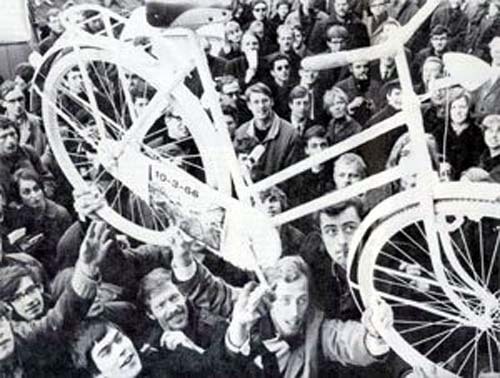
Il “Piano delle biciclette bianche” del 1965, lanciato ad Amsterdam dal movimento dei Provos, gruppo anarco-situazionista, che tra il 1965 e il 1967 ingaggiò una vera e propria guerriglia culturale non violenta contro le fondamenta del sistema di pensiero borghese di quegli anni, anticipando così alcune parole d’ordine del ’68.
Per me Joe Boyd è una leggenda. Che racconta un periodo secondo me leggendario. E lo fa con umiltà e understatement, minimizzandola, trasformandola in aneddoti e istantanee. Racconta un periodo in cui sembrava di poter cambiare le cose, e qualcosa è stato davvero cambiato. Un tempo in cui la speranza aveva senso spazio e sostanza, e il futuro era in diretta…
Folk Festival di Newport 1965, la storia della musica moderna sta per cambiare, tra poco Bob Dylan passerà a suonare da acustico a elettrico. Il 25 luglio. Questa è una foto del giorno prima, 24 luglio, ecco perché la corda che collega la chitarra acustica alla presa elettrica qui non compare.
Cresciuto sotto il pianoforte di sua nonna, passando ore ad ascoltarla suonare, si è impregnato di musica fin da bambino, e appena ha avuto l’occasione, ha iniziato a partecipare a quella del suo tempo, entrando nel processo artistico dell’epoca in una posizione che si potrebbe definire dietro le quinte, ma comunque essenziale creativa influente. È stato produttore, manager, promotor, discografico, animatore contro culturale… Newport Folk Festival, Muddy Waters, Incredible String Band, Fairport Convention, Sandy Denny, John Martyn, Maria Muldaur, Vashti Bunyan, Move, Soft Machine, il debutto dei Pink Floyd, tutto Nick Drake, mito e leggenda, la divina Nico, leggenda e mito…
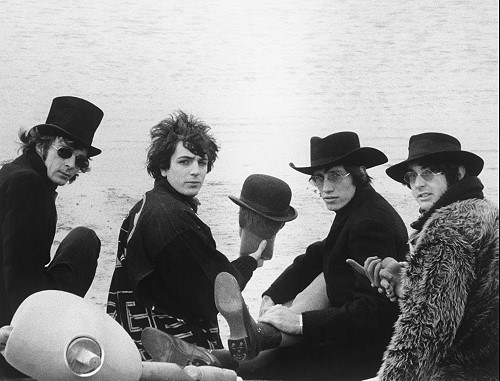
”Arnold Layne”, il primo singolo dei Pink Floyd.
E, ancora: consulente musicale per il cinema, (che spasso la telefonata di Kubrick da Londra a Los Angeles alle 6 del mattino, per dirgli che sulla copertina della colonna sonora di Arancia meccanica Rossini va indicato col nome per intero, Gioacchino, non con la semplice iniziale G.), autore e produttore cinematografico (il film ‘Scandal’, un doc su Hendrix, e a questo proposito imperdibile l’aneddoto su Pete Townshend) più altro ancora.
Quando Dylan compie la sua scelta elettrica (1965, proprio al Newport Folk Festival), Boyd è chi collega la sua chitarra alla presa. E non tutti la presero bene, a cominciare da Pete Seeger, capo dell’organizzazione del festival, che indignato abbandonò il campo. Quando Londra era swinging, Boyd aveva il locale più cool della città, l’UFO, pieno di pubblico e molto visitato dalla polizia. Quando iniziò la Summer of Love, Joe Boyd c’era, era al posto giusto insieme alla gente giusta a fare le cose che ancora si ricordano, anche quella volta che il rimorchio andò male, e la ragazza lo sorprese facendolo dormire sul divano, perché sotto la doccia c’era Bob Dylan.
Nick Drake, meravigliosa miscela di cantautore folk e jazz, un po’ come Tim Buckley dall’altra parte dell’oceano.
Joe Boyd non è uno scrittore: ma questo memoir è così fresco, intenso e pregnante che lo si gode a fondo nonostante la pessima edizione infarcita di refusi (e una traduzione non sempre accurata). Sa restituire intatto il fascino dei Favolosi Anni Sessanta, raccontandone l’anima, senza retorica, senza sussiego, senza appesantire, per accenni e pennellate più che declamando, sempre scorrevole fluido avvincente discreto sotto le righe.
Gli anni Sessanta iniziarono nell’estate 1956, finirono nell’ottobre del 1973 e raggiunsero il loro apice poco prima dell’alba del 1° luglio 1967, durante un’esibizione dei Tomorrow all’UFO Club di Londra.
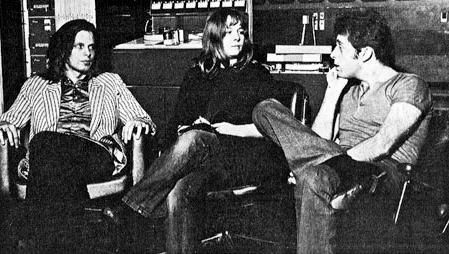
Joe Boyd a sinistra con Sandy Denny dei Fairport Convention intervistati dal giornalista radiofonico Eamonn Lenihan.
I Tomorrow scrissero un brano che si chiamava “My White Bycicle”. Le biciclette bianche erano quelle che i provos (provocatori), un gruppo di controcultura e contestazione olandese, misero gratuitamente a disposizione di tutti come scelta ecologica e risposta al consumismo. Una forma di socializzazione. L’iniziativa prese piede in varie parti d’Europa. Poi, la polizia ne sequestrò qualche decina con la giustificazione che, essendo senza lucchetto, erano un’istigazione al furto. Siccome non furono mai restituite, si può concludere che si evitarono furti con un altro furto legalizzato dallo Stato.
What happened was that i wrote a review of White Bicycles for my friend Raymond's English folk magazine called Stirrings. And then Joe Boyd himself read my review and wrote to the mag with a reply... how cool was that? So here's my review followed by Joe's reply.
**
Joe Boyd is a man it's hard not to resent. He's been tall, handsome and not obviously poor most of his life but, most particularly, during the 1960s, he developed an almost supernatural ability to be in the right place at the right time and then do the right thing while he was there. Like a countercultural Superman, he zap!s into Newport 1965 and arranges for Dylan to go electric with the members of a group Joe Boyd created; in 1966 kapoww! he's in London founding UFO, the white hot centre of the English underground, with John Hopkins; blamm! he's in Edinburgh discovering the ISB; shazam!! - he helps to create British folk rock with Fairport; kerrunch!!! he discovers Nick Drake and Vashti Bunyan. And so endlessly on. And now he writes about it all with effortless grace and humour. So here's a guy whose co-production of the brilliant album "Desertshore" by Nico in 1971 gets only a passing one-liner. It would be a great relief to find some kind of flaw in this paragon, but he was also blessed with perfect taste and produced most of my favourite albums. Too much, man. Too much.
Ten things I didn't know before reading "White Bicycles" :
1. The Even Dozen Jug Band (1964) included Maria Muldaur, John Sebastian, Joshua Rifkin, Steve Katz, Stefan Grossman and David Grisman. Wow!
2. White people clap on the wrong beat.
3. In the 60s blues acts could tour successfully in Britain and Europe but no one was interested in the USA..
4. Joe spent a fortnight in Brixton on a drugs possession charge (his time there sounds like an episode of Porridge)
5. Padstow, May Day 1965 was the high-water mark of the English traditional folk revival as
6. Around 9.30 on the night of 25 July 1965 was the moment 1960s youth exchanged idealism for hedonism as
7. The 1960s "peaked just before dawn on 1 July 1967 during a set by Tomorrow at the UFO Club in London" (Joe is nothing if not particular).
8. Michael Jackson's "Thriller" album on its own outsold the Beatles' entire catalogue
9. Joe and his pal Paul Rothchild put the Lovin' Spoonful together just like a folk-rock Monkees (a fact that's been airbrushed out of history)
10. Nick Drake was the greatest ever talent Joe produced.
Now, this last statement is, like No. 8, not true, but Joe thinks it is. Note the following Boyd on Drake :
there was something uniquely arresting in Nick’s composure. The music stayed within itself, not trying to attract the listener’s attention… His guitar technique was so clean it took a while to realise how complex it was… the heart of the music was mysteriously original.
up close the power of his fingers was astonishing with each note ringing out loud… I had listened closely to Robin Williamson, John Martyn, Bert Jansch and John Renbourn. Half-struck strings and blurred hammerings-on were an accepted part of their sound; none could match Nick’s mastery of the instrument. After finishing one song he would retune the guitar and proceed to play something equally complex in a totally different chord shape.
I had told him he was a genius and others had concurred.
the sale of Witchseason included a provision that Nick’s lps must never be deleted, although I didn’t need at argue the point with Blackwell, he loved Nick too.
It’s hard to disagree with Joe Boyd – he is the man after all – but imagining Nick Drake’s music to be in the same league as Richard Thompson or more especially Robin Williamson is just loopy. Modern advertisers, tv music finders and the younger generation seem to like Nick Drake a lot more than the Incredible String Band or RT but that don’t prove a thing except that “Time Has Told Me” is an awful lot more like elevator music than “The Mad Hatter’s Song” or “Genesis Hall”.
Joe’s main band – the one he produced and managed longest in the 60s – was the Incredible String Band and he now seems to regard them with something approaching embarrassment. They get as many putdowns as Nick Drake gets praise, and since they were hugely greater talents one must ask why.
It seems part of the answer is on page 186 :
History has deemed the ISB terminally unhip, forever identified with an incense-drenched, tripped out folkiness
And later, after they disastrously took up Scientology, soon the new compositions began to lose their wild melodic beauty… was this a natural decline after years of original output or was it Scientology? I resisted the thought that creativity might be linked to unhappiness or neurosis. Taking the first point, Joe seems not to have noticed the new psychedelic folk movement which has taken hold in the USA and consistently namechecks the ISB – for instance there’s Devendra Banhart, Joanna Newsom, Animal Collective, Wolf Parade, Sufjan Stevens, the Espers and Six Organs or Admittance. For these people the ISB are the very quintessence of hip. The second point is also telling : the ISB disappointed Joe badly (whereas Nick Drake didn’t live long enough) - firstly by joining a grisly cult, then by becoming happier people after having joined! That wasn’t the script Joe had in mind for them at all. Joe includes some fantastically sweeping generalisations on such topics as why the English hate their own folk music, why there wasn’t so much of a generation gap in Britain as there was in the USA, and why so many great 60s artists made terrible records in the 70s (in one word, cocaine). It’s all wonderfully contentious and you may wish to learn a few of these to start off a lively debate in your local. This book is never boring.
***
Dear Stirrings
Thanks for the review of White Bicycles and the words of praise. With so many plugs for my productions, I shouldn't complain about the odd brickbat here and there. But I would like to set the record straight on what seems like a some- what hurried reading by Paul Bryant. I never wrote, nor do I feel, that Nick Drake was the greatest talent I ever worked with. I do think he was as remarkable and wonderful a talent as Thompson or Williamson, however. Some people don't get him and Paul Bryant is clearly one of them, but let's not distort what I said in order to make a point. And while I plead guilty to airing my disappointment with the later years of the ISB, I spent huge chunks of prose recounting how stunning and exciting the music of their early years was – and remains today I was delighted that they became happier people as Scientologists (for a bit), but I don't think you'll find many fans who will argue that their later songs were the equal of their earlier efforts. My complaint that their music is not considered hip is directed at the folk-averse, not at Mike and Robin. When I wrote the book – and still, today- such cloth-eared people far out-numbered the fans of Devandra Banhardt etc.
When Thriller had completed a year or two at the top of the charts, a Billboard article pointed out that it had outsold the Beatle catalogue. Since then, of course, the cd revolution has pushed the Fab Four way in front, but my comment was about sales of records at the time of their release and about the way the business changed from the '60s to the '80s, and I stand by it. As to the English hating their own folk music, it's great that it doesn't clear as many rooms as it once did, but a journalist for a national newspaper began his piece about dancing with a Morris team the other day with the assumption that almost every reader would find such an endeavor ludicrous and embarrassing
White Bicycles is a look at the Sixties very much through my eyes. My nailing of dates and sweeping statements were not intended to be taken as historical or sociological truths, but are the thoughts that went through my head at the time, or soon thereafter. If I run into Paul Bryant in a pub, I'll buy him a drink and we can have that 'lively debate'.
One of the best books on music I've read and will ever read.
The anecdotes, the first row perspective on the 60s subcultures, views on making and producing music were all so compelling and insighful, while the writing itself is far better than to be expected from a 'non-writer'.
I was also pleasantly surprised to encounter so many jazz and blues legends beside the 60s rock gods and semigods. Because a lot of legendary artists really did cross Boyd's path, he never came across as a namedropping showoff. But beware: I adored this book mostly because I knew and loved all these artists already for long long time. It's like some of them finally came alive after all those years on my music shelves.
Here are some of the names you will encounter in this marvellous memoir:
Muddy Waters Otis Spann Duke Miles Ayler Brothers (jazz) Paul Butterfield Mike Bloomfield Al Kooper Bob Dylan The Blue Notes (South-African jazz) Fairport Convention Sandy Denny Pink Floyd Jimi, Zappa, Nick Drake Bert Jansch Davy Graham The Who Sister Rosetta Tharpe John Lee Hooker Danny Thompson Steve Winwood etc etc
It's a very clearheaded, sharply written and affectionate memoir of how several big moments in 1960s pop music happened almost by accident. The story of the 1965 Newport Folk Festival, where Dylan showed up with what to Folkies was an accursed electric guitar, should be turned into a movie. The accounts by author Joe Boyd, who wound up producing records in London, NYC and L.A., of working with forgotten blues legends in the early 1960s remind you how iffy the whole prospect of music and show biz as any kind of job was for Afro-American blues players and singers who outlived their temporary fame in the 1930s and 1940s, and then had to go back to minimum wage grunt work to stay alive. Fascinating stories abound about London during the Mod years, and the emotional and pharmaceutical dynamics of the Summer of Love in 1967. If 1960s music interests you, find this book. It's a quick read, full of keen insights about music as a business, then and now, and the U.S. social realities Rock and Roll reflected.
Joe Boyd writes from the rare perspective of someone who was not only there, but was also uniquely involved; how the 60’s began with playful optimism and came to a close with the wilting flowers of endless innovation. He spotted exciting new talent and nurtured it, toured with some of the greats, produced some landmark albums, watched protégés make unfortunate social – and in some cases, spritual – liaisons, and witnessed the acceleration of technology that would dilute the hidden soul inherent in earlier recordings. But he tells the story with unflinching honesty and tangible joy, as we get insights into the rapidly transforming lives of music legends, the truth about Pete Seeger and that axe when Dylan went electric at Newport, the kaleidoscopic firefly of the UFO club, the development of a new generation of folk music, and behind-the-scenes glimpses of the undeniable genius of Nick Drake. Through hippies turned scientologists, proto-Abba, and the unlikely success of duelling banjos . . . expect the unexpected.
I only wish Joe went on longer, and I hope that he writes another volume. When I went for a signing for the book I asked him about his experience producing the brilliant, crazed New Orleans piano player James Booker, which happened after the time-scope of the book - he obliged, but it would be nice to see him write about that in print.
Great, great memoir--tons of fascinating stories, a pile of laugh-out-loud moments, and I felt like Boyd kept himself out of the limelight for the most part as he told his tales.
I just found out there is a compilation CD of the bands discussed in this book, which I'll probably pick up as I am unfamiliar with a good bit of this stuff--Fairport Convention, Incredible String Band, etc.
Como suele ocurrir con estas memorias no escritas por un profesional del juntar letras, aunque valiosas por ser testimonios de primera mano, esta narración de las hazañas de Joe Boyd, hombre clave en el desarrollo del folk rock inglés de los sesenta, devienen en un aceleradísimo maremágnum de anécdotas y movidas personales carentes de interés donde se puede pescar alguna cosa interesante (la escena folk-rock y underground inglesa de finales de los sesenta, Nick Drake, Fairport Convention, la recuperación de venerables músicos de blues para públicos blancos, las giras de estrellas de jazz por Europa), aunque de forma demasiado superficial y acelerada. Sin ir más lejos, la producción de "Liege and Leaf" de Fairport Convention apenas se despacha en dos líneas, con lo que queda la sensación de ser una lectura escasamente nutritiva.
After having read only the opening chapters I am so excited to find a book that UNDERSTANDS what lay behind the so-called sixties music phenomenon: the discovery of what black music had to say about the way we felt about living in a world ruled by the pathologically normal. And why we wanted to reclaim and transform that message.
After nearly a year, I’ve finally finished this book. I put the book down initially about halfway through because I felt Joe Boyd’s writing style was sometimes pompous, to put it bluntly. He talked about one week being in London and the next being in Harvard Square; he didn’t seem concerned about time or money and spending both without worry. Idle time is valuable and feels, personally, rare at this point in time. To his credit, Boyd reconciles with this at the end of the book, pointing to this cheap, idle time as part of the fuel as to what made art in the sixties feel particularly important. He ends up coming off less as a trust funder and more like a boomer who appreciates his fortunate fate.
But his reconciliation came at the end of the book. I started reading after stopping nearly midway through because the heaps of anecdotes were undeniable. The crossing storylines compounded that interest and made it seem like some sort of valuable historical document of artists from the late ‘50s and into the early ‘70s.
Joe had his foot in many camps musically and the points where he brings some together are fascinating. He tells of laying down a viable UK touring circuit for US blues and jazz musicians in the late ‘50s/early ‘60s; helping coordinate the infamous Newport Folk Festival of ‘65 including taking the brunt of Pete Seeger pleas to turn Bob Dylan’s electric guitar down as one of the men behind the mixer; starting the UFO club in the UK which hosted many of the earliest Syd Barrett-Pink Floyd shows; producing Fairport Convention, Incredible String Band, Vashti Bunyan, Nick Drake, the “Dueling Banjo” theme for Deliverance, and many others; bringing South African jazz musicians Chris McGregor and the Blue Notes to the UK for regular shows. The list goes on.
He also gets into the logistics of figuring out touring circuits for certain artists and handing over the rights to Island Records as he decided to quit Witchseason Records, which offers a perspective into how the cross-pollination of these “backstage” actions were responsible for allowing certain artists time to grow and granted them access into other “markets.”
It’s a worthwhile read just to watch him make sense of the history he was a part of, sometimes personally and sometimes at a distance. The book essentially lays out a vignette each chapter, usually tracking one artist or event in particular. Joe’s writing is laced with references which can be irritating if you miss out on them but can be poignant if you do recognize them. He sets a scene quickly and often in conversational manner. If you’re interested in music of the sixties, especially folk music, this is definitely a worthwhile read.
I first found out about Joe Boyd when I bought R.E.M.'s Fables of the Reconstruction and discovered that he'd produced it. Little did I know that he either produced or worked with many of my heroes from the 1960s' underground scene in London. I have to thank R.E.M. for introducing me to Boyd and his work.
Here's the countdown. Boyd's worked with Syd Barrett-era Pink Floyd, The Move, Vashti Bunyan, The Incredible String Band, Fairport Convention, Richard Thompson, Linda Thompson, Sandy Denny, The Soft Machine, and, my personal favorite, Nick Drake.
Boyd structures his book nicely so that you don't have to read it in order. This is a good thing. If you're in the mood for The Move, you can read the chapter about them. If you want to read about Syd and Roger Waters performing at the UFO, you can do so. If you want to skip ahead to Nick Drake's beautiful music and harrowing final days, you can do so. You'll learn a lot along the way.
I applaud Boyd for writing about a scene that - let's face it - has never been very popular in America. Most Americans couldn't identify the musicians with whom he worked. This is a shame, but it's also a good thing. It means that a little bit of the London underground remains hidden, the domain of those who seek it out. It's no wonder that one of the key clubs was called Middle Earth.
And just think what Pink Floyd could have become had Syd remained healthy and they didn't become the world's biggest blues-prog band.
Listen to The Piper at the Gates of Dawn, Shazam, Just Another Diamond Day, The Hangman's Beautiful Daughter, Liege & Life, Unhalfbricking, Shoot Out the Lights, and anything by Denny and Drake. And I can't forget Robert Wyatt and The Soft Machine's first four albums.
Do you know where The Soft Machine got their name?
Great music read. Boyd traveled an interesting path from a Lomaxian obession with blues and other American artists, involvement in the Newport folkie shenanigans including Dylan's sacriligeous electrification, and eventually the British folk and psychedelic scene. He built a career that jumped from promoter to producer to record label guy, and touched some immeasurable classics (e.g., Pink Floyd, Fairport Convention, Sandy Denny, Richard Thompson, Nick Drake, The Incredible String Band). He sounds like a guy who identified/created fertile scenes of threshold-pushing rock music, never indulging too much in the pharmaceutical mileu of the time, a keen fly-on-the-wall observer who collected a huge cache of great stories. His written voice is humble, grateful, and appealing; the stories flow out like a river, with a sort of cohesive disorganization that makes sense. Character studies of cantankerous jazz cats, conservative folk old guard, britfolk luminaries, London acid casualties, '60s counterculture stalwarts giving way eventually to cocaine or scientology and ruining everything. Really entertaining read, never feels perfunctory like a lotta rock books.
slightly bland run through folk rock lynchpin's life.
short on insight and revelation - only new titbit to me was the role of Dave Robinson (co-founder of Stiff Records) in UFO : he was managing the Irish band who became Eire Apparent and supported Hendrix on a US tour when they came to London for their first gig at a try-out at UFO.
unusually for a music book, this didn't make me go and listen again to the records - which is the normal indication of a good music book
Very engaging and informative. Boyd is a rigorous thinker and a lot of his observations are more astringent than one has come to expect of 1960s memoirs. Good stuff.
Heerlijk boek! Als een soort Forest Gump blijkt deze Joe Boyd als boeker, producer, (road)manager, stagehand etc. betrokken bij tal van grote en minder grote artiesten, opnames, festivals en events in de vroege historie van de (Blues, Folk, Jazz en Rock) muziek. Hij ontdekt als blanke middenklasse kid in Amerika de zwarte muziek (American Bandstand!), organiseert als tiener huiskamerconcerten met later wereldberoemde bluesartiesten, wordt professional op tour door Europa met jazzartiesten, is als stagehand aanwezig als Dylan elektrisch gaat op Newport '65 en ziet daarmee naar eigen zeggen de (folk) muziek definitief veranderen en de Rock geboren worden. Hij is mede-uitbater van de legendarisch U.F.O. club in Swinging London '66 en produceert daar en passant de eerste single van Pink Floyd - Arnold Lane. Uiteraard is hij op Woodstock (als manager van de The Incredible String Band). Later produceert hij nog veel meer LP's en ontdekt hij o.a. Nick Drake. Hij ontmoet werkelijk iedereen die in er in de muziekindustrie toe doet - dwz de periode tussen 1 juli '67 en oktober '73, want dat zijn de sixties volgens Boyd. Heerlijk geschreven met smakelijke anekdotes en lekkere nieuwgierigheid-bevredigende inkijkjes backstage in de ontluikende R&R. En met Spotify en YouTube bij de hand weer veel prachtige muziek (her)ontdekt. Lezen, luisteren en kijken. Lezen in de breedte!
(en inderdaad, de titel refereert aan het witte fietsenplan van Provo in Amsterdam - de teloorgang daarvan als metafoor voor de verwording van de hippie-idealen)
Felt like when you randomly end up chatting to a nice guy hanging around the till of a record shop because you’re asking for the secret 45 boxes or something and then it turns out he has AWESOME STORIES about MANY MUSICIANS YOU LOVE! To be fair, that guy usually also has many stories about bands you don’t care about at all (sorry!! just because they were my first concert doesn’t mean I like pink floyd!! a lotta English folk stuff leaves me cold! the incredible string band aren’t my bag!) BUT he tells them so delightfully you can’t help enjoy them! The Nick Drake stuff is 🥰🥰🥰🥰🥰🥰🥰🥰🥰 and it’s SO WONDERFUL and SUPER INTERESTING to learn more about him and his recording process. I also liked learning that Bryter Layter is Boyd’s fave album of his, because it’s mine too!! I thought the conclusion also touched on a lot of stuff I’d been thinking about lately - I don’t think having access to everything makes people be any less into it, but it is harder for obsessives to find each other and have these sort of tight-knit scenes where everyone is able to live in a certain area and have enough time to make things. One star docked because even though he PRODUCED DESERTSHORE (?!?!!?!!?), Nico gets like two mentions. If this had been the Nico and Nick Drake only party?* Automatic five stars. As it is? Sorry, this is my subjective personal essay goodreads ranking scale - four ONLY.
*also an apt description of the contents of my iPod, the college years
It is very much of a memoir. Joe Boyd positions himself in some key moments of 1960s American & English musical culture. The early involvement with blues music was informative alternately a good deal of it could be little more than name dropping, like many folk in the arts in general and music in particular, obviously so as musicians often play with other musicians and the art fom is collaborative.
I enjoyed the section on the UFO club as that had become mythologized by my time in London. It was great to see who actually performed at the club and also what else was happening; it formed a template for many alternative venues and events throughout the period I was involved in London and regionally from the 1980s & 90s. I had some of what happened at the Roundhouse in the 1960s confirmed by a senior UK artist in the 1990s who was involved with the performances there.
Much of what is communicated by the author is a mixture of general overview and fragmentary moments, which I guess is about the best that could be expected from what was a time of great changes and shifts in cultural production. An important aspect is that Joe Boyd made those changes himself and was a sensitive and influential figure of the time.
Joe Boyd is a great producer, a lucid storyteller with a good memory, and one of those guys who, through a combination of luck and skill, was there for a LOT of important moments in rock history. His account of Bob Dylan’s first electric gig at Newport Folk Festival is one of the more accurate, and he was right there for it. He toured Europe with tons of jazz and blues greats, he produced albums for Incredible String Band, Fairport Convention, and Nick Drake (who he also managed). he ran the UFO club in London and produced Pink Floyd’s first single. He acted as middle man for a number of legendary record deals and collaborations. Those are some of his credentials but they wouldn’t matter much if he wasn’t also a good writer; this book shows how intelligent, funny, and modest he is, telling a story only he could tell with the proper respect (without pulling any punches) for the many other legends who appear within the pages. A really, really strong music memoir.
"Klaus Kinski meets Andy Rooney" is the impression of Joe Boyd that I was left with after reading this book, listening to some of the audiobook, and watching a few interviews.
Not only in personality (surly, arrogant, complaining) but there's also a bit of a physical resemblance. I don't want to attack this man who did so much to bring the wonderful music of Nick Drake, Fairport Convention, etc. to the world. But there was a smugness and self-righteousness I found overbearing at times.
Since I knew of Joe Boyd as a music producer, I was disappointed with how little of the book involved recording music or being in a studio. Instead, it's more of a social history with anecdotes about meeting this or that person, taking so-and-so on tour, negotiating deals, taking drugs, and so forth. Joe Boyd writes about himself mostly as a talent scout whose instincts and good taste allowed him to put the right people together to make the business of music happen. Apparently of less interest is the process of how music is written, arranged, rehearsed, and recorded. For example, Vashti Bunyan gets one paragraph. Joe Boyd produced her legendary album Just Another Diamond Day but its unclear if he was present in the studio when it was made. I was hoping for more details about making music in the 1960s... instead it's a lot of stories about jazz musicians missing trains or the times when Joe Boyd decided to try new foods.
He witnessed a lot of amazing music that has gone on to mythic status (Dylan at Newport, Pink Floyd w Syd, Miles, Monk, Coltrane) but I was glad when his book was over. Maybe good for a perusal and thankfully there's an index. Many influential music people (Brian Eno, Pete Townshend, Elton John) loved this book so maybe you will too. Unfortunately, me and Joe did not connect this time.
Joe Boyd was one of the great movers and shakers of sixties music. He discovered Nick Drake and produced his first two albums, and he also managed and produced both Fairport Convention and The Incredible String Band during their finest hours. This book is a great account of what he describes as the long 1960's - beginning roundabout 1957 and ending in 1974. Boyd's job was both to now people and to let other people know that he new people, and so names are dropped at a head spinning rate, but you have the consolation that he was there and he really did meet all these people (Miles Davies, Muddy Waters, Coleman Hawkins, Duke Ellington and Theolonious Monk as well as all the figures from the rock and folk rock worlds). He is good at roots (folk, jazz and blues) as well as at rock which adds a lot more depth to his observations. In general this is a book about what it might have been like to be there and be one of the few people not stoned. It does offer some strong insights into music (eg why the best analogue recordings are better than digital ones). It singularly fails to explain Drake's genius, although he does how good a guitar player he was, which can be overlooked. It is probably best to say that he arrived without precedent and has proved impossible to imitate as evidenced by the countless number who try and fail. If you like this period and its music you need to read this book but if you don't it will leave you cold.
(Incidentally this is one of Graham Crossley's favourite boos, not often you can say that).
Joe Boyd was a renowned producer in the '60s, right in the midst of the British Folk Revival, producing Fairport Convention, Incredible String Band, Sandy Denny, and most notoriously Nick Drake (who never scored a hit during his lifetime). He also co-founded the UFO club, the epicenter of Freaky London, where Pink Floyd and numerous others got their start. He also had a long and storied career in the Jazz and Blues worlds, helping organize the Newport Folk Festival where Dylan went electric, helped re-discover Rev. Gary Davis, and took that music overseas. Apart from his impressive career during an important musical era, the writing of this book is outstanding; conversational, lucid, moving. He tells personal anecdotes of many larger-than-life personalities. Also armed with his Producer's ears and experience, he sheds insight into the creative process and recording of many seminal albums. Hearing a first-hand, detailed account of Nick Drake performing 'Time Has Told Me' live with an orchestra, as well as the backstory of driving to some school friend of Nick's, to score the string arrangements, is worth its weight in plutonium. I cannot recommend this book enough, for anyone interested in late '60s music, production, or subcultural history.
I really enjoyed reading Joe Boyd's 'White bicycles', a book I've intended to read for a while, since it was published in 2005 in fact! Boyd kept his head on straight and level to be in all the right places at all the right times. Consequently his memoir largely recounts the decade when musical and social revolutions came and went with rapidity, and only a sharp intuitive operator like J.B. could emerge with so much integrity and such a monumental back catalogue. It's no surprise then to find his fingers on the mixing dials of so many recordings of the epoch. From early Pink Floyd and Eric Clapton, to the recordings of the Incredible String Band, Nick Drake, Fairport Convention, John Martyn and many more. Away from the recording studio he was at Newport in 65 to plug in the 'electric' Dylan. In London during the summer of love he ran his UFO club and hosted a glittering array of psychedelia from Floyd, The Move, Procol Harum to The Bonzo's. 'White bicycles' is not just a reminiscence of the counter culture of the swinging 60's. Boyd has written an insightful, thought provoking and funny social documentary.
I found this book on this list by Pitchfork. It was also recommended by a friend.
I found it a bit meandering at times and it does jump back and forth in time thought it is generally in chronological order.
I did discover some new artists to explore, if nothing else it gave me a new appreciation for early Fairport Convention. I jumped Spotify and listened to some of Boyd's Fairport productions and it really is amazing music, especially Liege and Lief.
I would recommend this to someone who is already pretty well versed in blues, jazz and late 60s English pop music. If you go in cold you will find a lot of names he drops to be just names. My jazz knowledge is minimal so a few times here I was resorting to Wikipedia just to see who the hell he was talking about.
But, it can also be challenging in a good way. Once you get into this book and appreciate Boyd's music knowledge you will find yourself on Youtube or Spotify discovering a lot of really good music with a better appreciation for where it came from.
I thought it was an excellent piece of writing. Joe Boyd has an endearing way of relating anecdotes of which he was a part without really getting in the way of the story. His ego never gets the better of him. He seems to have absorbed that modest British affect.
My biggest question throughout the book was "Why is it called WHITE BICYCLES?" Joe Boyd never addresses this question. (He actually does this quite a bit: he does not take many pains to explain who certain characters in his story are, probably assuming we are all intelligent enough to look them up ourselves!
My only point of reference for the term "white bicycle" is that (at least in my part of the country) when a bicyclist dies in a traffic accident, his or her friends erect a memorial on the spot with a white-painted bicycle upon which people pin flowers and whatever else they feel is appropriate.
Since so many of Boyd's favorite people in the 60s and 70s died, whether of drugs, suicide, or other reasons, perhaps this book his "white bicycle" to them.
This is perhaps the first time I have finished a book and immediately wanted to start reading it all over again out of shear joy!
Joe Boyd has lived an incredible and envious life. After finishing Harvard, he was a tour manager for blues and jazz legends, including Muddy Waters. Then moved to London he started the UFO club which gave birth to Syd-era Pink Floyd and the Soft Machine. He later produced the first two Nick Drake albums and Vashti Bunyan's amazing 'Just Another Diamond Day.' not to mention Incredible String Band, Fairport Convention, etc.
More importantly though, Boyd is a charming writer and the book moves quite quickly and joyfully. Several times I almost missed my stop on the subway. Despite his fantastic life, he is always in awe of the musicians and life he is leading.
I wish this book came with a soundtrack! Joe Boyd wanted to be in the music business and at times he was a great business man. But for the most part, Joe was just passionate about music and that was his reward and his burden. Never really becoming a suit, he was one of the first producers to really let the artist be the artist in the studio. He recounts the mythology around the 1965 Newport Festival, being integral to the underground with the UFO club, 14 hour technicolour dreams, london free school, and even admitting to letting some not so obscure bands slip through his fingers. You can see why he was more of a colleague to the Incredible String Band, Nick Drake, and early Pink Floyd because his sense of humor and cogent recollections are what really carry this book.