

What do you think?

In the Valley of the Kings
In the Valley of the Kings marks the extraordinary debut of Terrence Holt, who fifteen years ago abandoned a promising writing career to practice medicine. Moved by his patients’ valor in the face of death, seeking to comprehend the mysteries revealed at their bedside, Holt has taken up fiction again. He emerges now with this astonishing collection of one novella and seven short stories that explore the farthest reaches of the imagination in a style that recalls the nineteenth-century American masters.
Holt leaps across genres and millennia, from small-town America to deep space, daring his readers to journey with him into realms as mysterious as they are unforgettable. The opening story, “‘? ????s,” is a chilling account of the last days of the human race, as the hospitalization of a little girl in a New England town heralds a terrifying plague, transmitted not by a microbe but by a single word. The final story, “Apocalypse,” returns to small-town New England and another vision of the end, in an intimate account of how a couple struggles to live and love under the shadow of the Earth’s approaching doom. In between, these stories range from outer space, where—in “Charybdis”—an astronaut alone on a doomed NASA mission comes to terms with his fate, to the Egyptian desert of the title novella, where an archaeologist seeks a fabulous tomb that holds the secret of immortality. Painting with lurid colors and finely crafted prose, Holt offers his readers haunting visions of the reefs and abysses of the human imagination. In the Valley of the Kings redefines the art of the story, throwing aside the rules in search of the enduring truths that ultimately make stories worth reading.
Holt leaps across genres and millennia, from small-town America to deep space, daring his readers to journey with him into realms as mysterious as they are unforgettable. The opening story, “‘? ????s,” is a chilling account of the last days of the human race, as the hospitalization of a little girl in a New England town heralds a terrifying plague, transmitted not by a microbe but by a single word. The final story, “Apocalypse,” returns to small-town New England and another vision of the end, in an intimate account of how a couple struggles to live and love under the shadow of the Earth’s approaching doom. In between, these stories range from outer space, where—in “Charybdis”—an astronaut alone on a doomed NASA mission comes to terms with his fate, to the Egyptian desert of the title novella, where an archaeologist seeks a fabulous tomb that holds the secret of immortality. Painting with lurid colors and finely crafted prose, Holt offers his readers haunting visions of the reefs and abysses of the human imagination. In the Valley of the Kings redefines the art of the story, throwing aside the rules in search of the enduring truths that ultimately make stories worth reading.
224 pages, Hardcover
First published September 14, 2009
About the author
Terrence Holt
6 books34 followersTerrence Holt taught literature and writing at Rutgers University and Swarthmore College for a decade before attending medical school. Many of these stories have appeared in different forms in literary journals and prize anthologies, including the Kenyon Review, TriQuarterly, Zoetrope, Bookforum, and the O. Henry Prize Stories. A contributing editor for Men’s Health, Holt teaches and practices medicine at the University of North Carolina in Chapel Hill.
Ratings & Reviews
Friends & Following
Create a free account to discover what your friends think of this book!
Community Reviews
Displaying 1 - 30 of 36 reviews

January 1, 2010
Here is the main part of my FBC review; just outstanding and an A++ book, the first such I read in 2010.
*********************************************
"Ο Λογοσ" A+
"What claimed the attention of everyone who saw the child over the three days of her illness was the unmistakable pattern in those marks. They formed a word."
The collection starts with the one "medical" story - the author is currently a practicing MD after teaching literature for many years - very interesting premise and very sf-nal tone here, though of course all done in quite an original manner. I like much less the "plague apocalypse" storyline as opposed to the "cosmic event apocalypse" one - see below the last story - so while I enjoyed this one a lot, it did not rank as high as the three A++ stories. A great beginning to the collection though a slightly misleading one since the rest are quite different as content goes.
*********************************************
"My Father's Heart" A-
"My father’s heart beats in a glass jar on the mantel, a steady flickering at the edge of my eye. I try to avoid it, but by dinnertime each night I’m staring. Beneath my gaze it pulses, and perhaps it turns a richer purple. From the jar I hear a low, dull, quick sound, persistent as a muffled watch."
This story declares its intent from the first lines above; the "most horror-like" one and the shortest of the collection, it was my least favorite though the heart of the title makes a better "character" than the narrator. This story hits also the one different note as style goes from the rest, reading like your favorite horror story rather than the more original style of the rest.
*********************************************
"Charybdis" A++
"HERE IS A list of mission control’s euphemisms:
the burn
the event
the incident
the accident
the unfortunate [all of the above:]
the spontaneous ignition
the midcourse miscorrection
the transorbital overenhancement. This one was my favorite, but the one they prefer is “the accident.” I have started to ask them, “Which one?”
And they say I’ve lost my sense of humor."
A tour de force, this (near Jupiter) doomed astronaut's tale is my favorite piece of the collection alongside the title one; there is a lot of stuff packed and the back-story that slowly unfolds has some twists and turns that add to the intensity of the first person narration; I am sucker for this kind of stories and while I read quite a few in a hard sf context (William Barton has some of the most notable "doomed/endangered astronaut" stories I've ever read till his one), "Charybdis" stands easily at the top of the list.
*********************************************
"Aurora" A+
"And on the Ring I only do not break. I do not vanish: I ride the wheel of it, arms out against the fall. No glittering shards of me disperse. My heart is solid inside me, a steady turning.
I cannot remember when this was not so."
This story, while a companion piece with "Charybdis" (set near Saturn here) lacks the clarity/hard-sfnal focus of the previous one, so it did less for me, However it's a piece of lyrical writing that mesmerized me and arguably the best of the collection in style, reading almost like a long poem.
*********************************************
"Eurydike" A
"Something terrible has happened Ive looked everywhere but all the rooms are empty I see signs I cannot read not even this Is anyone here Can anyone read this?"
This story starts very interesting with the hook lines above, but it goes really nowhere as external reality goes, being mostly a "horror-like", almost solipsistic kind of tale; not my favorite kind, but I liked it quite well and of course the writing is still so compelling that you do not really need coherence.
*********************************************
In the Valley of the Kings A++
"That there were tombs, great tombs, left undiscovered in the Valley of the Kings, I could not doubt. Long study in the chronicles of Egypt, where history lapses, time and again, into silence, had convinced me: some gaps in the record were not accident. The singular lack of artifacts from a particular period—I will not tell you which—the hush of the chroniclers—the break in the lineage of the Kings: even from a time five thousand years ago when one might think the silences of history outweighed the words, this silence: it spoke to me, insistently, of something withheld. It haunted me, as if out of that silence came a voice I could not hear, and it spoke only to me. But each attempt I made to trace the lineage, each name, each face, each line of evidence I pursued, all, when I traced them back to a certain decade in the Upper Nile, all vanished—cut off, as if the earth itself had swallowed them down."
A novella that has a clear storyline, a mystery and the attraction of the exotic/fabled past, the title story is worth the price of the book by itself. A "doomed" archaeologist this time, trying to leave a mark on the world. Will he succeed? Is he really doomed or is it all in his imagination? Read and find out!
*********************************************
"Scylla" A
"It was a fair cruise, the seas calm, the winds and currents favoring, the skies so clear the evening star was visible by day. Mornings and evenings low clouds rolled, pink in the sunrise, orange in the west; always they vanished before us. The crew, off watch, hung in the shrouds, where they swung with the long surge of the sea; high in the foretop, Teofilo, the Portygee, sang in his languid tongue. This was in the days before the Law."
This story starts relatively conventionally as above, but then it moves into a very different narrative space, more a meditation on Fate, Change and Death than anything else; as with Eurydike, I prefer stories more grounded in reality than in solipsistic imagination, so I did not like this one as much either, but still very, very good and gripping to the end.
*********************************************
"Apocalypse" A++
"In the gorge the echoes faded. I found myself listening, hoping there would be no voices. For a minute or so—it may have been ten—we waited. I could hear the kitchen clock tick.
When the silence in the room became intolerable, we both stood to go."
As in Charybdis, this story concerns a subject I read quite a few great hard-sfnal stories about - here it is the end of the world due to an unpredictable cosmic event - Stephen Baxter and William Barton are notable sf authors of such short stories. Of course this collection being more "literature of the fantastic" than core-sf, the story does not explore the unnamed event that will soon extinguish life on Earth, but follows the narrator and his wife trying to cope with their inevitable doom.
*********************************************
"In the Valley of the Kings" is highly, highly recommended and an A++ for style and A+ for content. Anything remotely interesting for me written by Mr. Holt and is a get and read asap.
*********************************************
"Ο Λογοσ" A+
"What claimed the attention of everyone who saw the child over the three days of her illness was the unmistakable pattern in those marks. They formed a word."
The collection starts with the one "medical" story - the author is currently a practicing MD after teaching literature for many years - very interesting premise and very sf-nal tone here, though of course all done in quite an original manner. I like much less the "plague apocalypse" storyline as opposed to the "cosmic event apocalypse" one - see below the last story - so while I enjoyed this one a lot, it did not rank as high as the three A++ stories. A great beginning to the collection though a slightly misleading one since the rest are quite different as content goes.
*********************************************
"My Father's Heart" A-
"My father’s heart beats in a glass jar on the mantel, a steady flickering at the edge of my eye. I try to avoid it, but by dinnertime each night I’m staring. Beneath my gaze it pulses, and perhaps it turns a richer purple. From the jar I hear a low, dull, quick sound, persistent as a muffled watch."
This story declares its intent from the first lines above; the "most horror-like" one and the shortest of the collection, it was my least favorite though the heart of the title makes a better "character" than the narrator. This story hits also the one different note as style goes from the rest, reading like your favorite horror story rather than the more original style of the rest.
*********************************************
"Charybdis" A++
"HERE IS A list of mission control’s euphemisms:
the burn
the event
the incident
the accident
the unfortunate [all of the above:]
the spontaneous ignition
the midcourse miscorrection
the transorbital overenhancement. This one was my favorite, but the one they prefer is “the accident.” I have started to ask them, “Which one?”
And they say I’ve lost my sense of humor."
A tour de force, this (near Jupiter) doomed astronaut's tale is my favorite piece of the collection alongside the title one; there is a lot of stuff packed and the back-story that slowly unfolds has some twists and turns that add to the intensity of the first person narration; I am sucker for this kind of stories and while I read quite a few in a hard sf context (William Barton has some of the most notable "doomed/endangered astronaut" stories I've ever read till his one), "Charybdis" stands easily at the top of the list.
*********************************************
"Aurora" A+
"And on the Ring I only do not break. I do not vanish: I ride the wheel of it, arms out against the fall. No glittering shards of me disperse. My heart is solid inside me, a steady turning.
I cannot remember when this was not so."
This story, while a companion piece with "Charybdis" (set near Saturn here) lacks the clarity/hard-sfnal focus of the previous one, so it did less for me, However it's a piece of lyrical writing that mesmerized me and arguably the best of the collection in style, reading almost like a long poem.
*********************************************
"Eurydike" A
"Something terrible has happened Ive looked everywhere but all the rooms are empty I see signs I cannot read not even this Is anyone here Can anyone read this?"
This story starts very interesting with the hook lines above, but it goes really nowhere as external reality goes, being mostly a "horror-like", almost solipsistic kind of tale; not my favorite kind, but I liked it quite well and of course the writing is still so compelling that you do not really need coherence.
*********************************************
In the Valley of the Kings A++
"That there were tombs, great tombs, left undiscovered in the Valley of the Kings, I could not doubt. Long study in the chronicles of Egypt, where history lapses, time and again, into silence, had convinced me: some gaps in the record were not accident. The singular lack of artifacts from a particular period—I will not tell you which—the hush of the chroniclers—the break in the lineage of the Kings: even from a time five thousand years ago when one might think the silences of history outweighed the words, this silence: it spoke to me, insistently, of something withheld. It haunted me, as if out of that silence came a voice I could not hear, and it spoke only to me. But each attempt I made to trace the lineage, each name, each face, each line of evidence I pursued, all, when I traced them back to a certain decade in the Upper Nile, all vanished—cut off, as if the earth itself had swallowed them down."
A novella that has a clear storyline, a mystery and the attraction of the exotic/fabled past, the title story is worth the price of the book by itself. A "doomed" archaeologist this time, trying to leave a mark on the world. Will he succeed? Is he really doomed or is it all in his imagination? Read and find out!
*********************************************
"Scylla" A
"It was a fair cruise, the seas calm, the winds and currents favoring, the skies so clear the evening star was visible by day. Mornings and evenings low clouds rolled, pink in the sunrise, orange in the west; always they vanished before us. The crew, off watch, hung in the shrouds, where they swung with the long surge of the sea; high in the foretop, Teofilo, the Portygee, sang in his languid tongue. This was in the days before the Law."
This story starts relatively conventionally as above, but then it moves into a very different narrative space, more a meditation on Fate, Change and Death than anything else; as with Eurydike, I prefer stories more grounded in reality than in solipsistic imagination, so I did not like this one as much either, but still very, very good and gripping to the end.
*********************************************
"Apocalypse" A++
"In the gorge the echoes faded. I found myself listening, hoping there would be no voices. For a minute or so—it may have been ten—we waited. I could hear the kitchen clock tick.
When the silence in the room became intolerable, we both stood to go."
As in Charybdis, this story concerns a subject I read quite a few great hard-sfnal stories about - here it is the end of the world due to an unpredictable cosmic event - Stephen Baxter and William Barton are notable sf authors of such short stories. Of course this collection being more "literature of the fantastic" than core-sf, the story does not explore the unnamed event that will soon extinguish life on Earth, but follows the narrator and his wife trying to cope with their inevitable doom.
*********************************************
"In the Valley of the Kings" is highly, highly recommended and an A++ for style and A+ for content. Anything remotely interesting for me written by Mr. Holt and is a get and read asap.

June 29, 2015
“Words came to me out of the darkness. And although I cannot see what I write, these words will suffice. They will survive me, I know, just as the King’s monument survived him: as long as time requires, and the darkness of the pit endures. Out of that darkness, reader, I reach my hand to you” (192). So concludes Holt’s novella—the titular piece of the collection. There is something about language in Terrance Holt’s debut book In the Valley of the Kings. I don’t mean the precise and elegant way in which he infuses his stories with life and horror and death and radiance. I mean, rather, that Terrance Holt understands the significance of a word. The collection opens with the short story “ ‘O Λογοδ,” a haunting tale of the beginning of the end of the world. In the story, contagion spreads through a word, which manifests itself in bruise-like markings across first the face and hands of a young girl in New England and then on the bodies of everyone who reads the word. The girl dies after a long period of solemn silence, broken only at the moment of her death when she utters the deadly word three times. The world is taken over by the spread of this malady, with the narrator of the story left behind—through lucky circumstances never having read the killing word—to surmise for the reader the nature and origin of the plague. The story closes with this chilling conjecture: “I give you this, and then I must be gone. All you need is here before you—and the knowledge of what kills us now is any word at all, read in the belief that words can kill” (26).
What is the power of a word? Holt asks this question time and again with stories that are haunting, mysterious, and at times undecipherable. In “Eurydike” a man (a human?) awakes in a research station, alone and disoriented. Slowly language and memory return to him—although not in whole, enlightening way. The narrator quickly learns to tie language and sensation together, “With each day as more words return I see more clearly, sense distinctly—even as the chill across my skin is sharper, punctate, each hair rising on my skin and pricking me with cold. Punctate; pricking; the words and sensations drive each other on, crowding me toward some end I cannot see…” (90).
The words and the sensations drive each other on. This is an apt summary of my reading experience with Holt’s collection. In the Valley of the Kings is deeply unsettling, potent and lovely for its uncanny observations of human need and behavior. Holt is a son of Poe, a father whom he recognizes with overt gestures: the second story in the collection is titled “My Father’s Heart,” and features a disembodied heart which beats loudly and with menacing, emotional volume. “Eurydike” ends with another Poe-like pounding:
Beyond any doubt, beyond all imagining, at my back I hear a solid blow. And then another. And I do not need to imagine, because I know the sound. In a moment that teeters on the edge of eternity, I know: this is the sound of someone knocking, knocking, knocking at my door, the sound of one hand I know better than any in this world. (113)
Like Poe, Holt is interested in the strengths and weaknesses of the human psyche, the wide ranges of human imagination. Of course, Holt is more than a Poe copy-cat, and In the Valley of the Kings abounds with the innovation and curiosity of a modern, scientific mind. Holt is trained as a doctor and both practices and teaches medicine. His understanding of the physicality of our bodies—their limits and their sensitivities—breathes fine-edged empathy into his writing; In the Valley of the Kings is webbed with nerve endings.
Poe’s stories are not the only tales to which Holt’s writing harkens back. In the Valley of the Kings exists in conversation with Greek and Egyptian myth. “Eurydike” is in some ways a retelling of Orpheus’ journey to the underworld to reclaim his lover. “Charybdis”—the story of an astronaut stranded in space and staring down the red eye of Jupiter—reimagines the great whirlpooling danger of the mythic sea monster. In this story too, the storm is not only of wind and cloud and space, but also of language. The astronaut narrator is taunted and troubled by the delayed and seemingly-artificial messages sent from Mission Control, opting at the end to turn his satellite to broadcast the static language of Jupiter’s atmosphere. The feature novella of the collection, “In the Valley of the Kings,” circles Egyptian myth and tradition as the reader follows the narrator on the greatest and last discovery of his career as Egyptologist. Holt clearly finds sympathy with the Egyptian reverence for word and name, delving into the twisted ways in which our language defines, limits, haunts and survives us.
Holt’s stories are built in layers: myth on top of horror on top of physical duress on top of linguistic breakdown. The result are mysteries, Borgesian in their labyrinthine wanderings. This is a collection to be savored for its juices, for the leathery texture of skin that Holt reveals as he pulls at the mummy’s wraps. Readers seeking the resolution of clear definitions and clean endings are encouraged to look elsewhere. Holt writes for those of us who would stick our own eyes into the sockets of the dead, would slick our tongues to the surface of the frozen tundra. “And now, as words and time are joined, I begin to understand” (“Eurydike,” 109).
What is the power of a word? Holt asks this question time and again with stories that are haunting, mysterious, and at times undecipherable. In “Eurydike” a man (a human?) awakes in a research station, alone and disoriented. Slowly language and memory return to him—although not in whole, enlightening way. The narrator quickly learns to tie language and sensation together, “With each day as more words return I see more clearly, sense distinctly—even as the chill across my skin is sharper, punctate, each hair rising on my skin and pricking me with cold. Punctate; pricking; the words and sensations drive each other on, crowding me toward some end I cannot see…” (90).
The words and the sensations drive each other on. This is an apt summary of my reading experience with Holt’s collection. In the Valley of the Kings is deeply unsettling, potent and lovely for its uncanny observations of human need and behavior. Holt is a son of Poe, a father whom he recognizes with overt gestures: the second story in the collection is titled “My Father’s Heart,” and features a disembodied heart which beats loudly and with menacing, emotional volume. “Eurydike” ends with another Poe-like pounding:
Beyond any doubt, beyond all imagining, at my back I hear a solid blow. And then another. And I do not need to imagine, because I know the sound. In a moment that teeters on the edge of eternity, I know: this is the sound of someone knocking, knocking, knocking at my door, the sound of one hand I know better than any in this world. (113)
Like Poe, Holt is interested in the strengths and weaknesses of the human psyche, the wide ranges of human imagination. Of course, Holt is more than a Poe copy-cat, and In the Valley of the Kings abounds with the innovation and curiosity of a modern, scientific mind. Holt is trained as a doctor and both practices and teaches medicine. His understanding of the physicality of our bodies—their limits and their sensitivities—breathes fine-edged empathy into his writing; In the Valley of the Kings is webbed with nerve endings.
Poe’s stories are not the only tales to which Holt’s writing harkens back. In the Valley of the Kings exists in conversation with Greek and Egyptian myth. “Eurydike” is in some ways a retelling of Orpheus’ journey to the underworld to reclaim his lover. “Charybdis”—the story of an astronaut stranded in space and staring down the red eye of Jupiter—reimagines the great whirlpooling danger of the mythic sea monster. In this story too, the storm is not only of wind and cloud and space, but also of language. The astronaut narrator is taunted and troubled by the delayed and seemingly-artificial messages sent from Mission Control, opting at the end to turn his satellite to broadcast the static language of Jupiter’s atmosphere. The feature novella of the collection, “In the Valley of the Kings,” circles Egyptian myth and tradition as the reader follows the narrator on the greatest and last discovery of his career as Egyptologist. Holt clearly finds sympathy with the Egyptian reverence for word and name, delving into the twisted ways in which our language defines, limits, haunts and survives us.
Holt’s stories are built in layers: myth on top of horror on top of physical duress on top of linguistic breakdown. The result are mysteries, Borgesian in their labyrinthine wanderings. This is a collection to be savored for its juices, for the leathery texture of skin that Holt reveals as he pulls at the mummy’s wraps. Readers seeking the resolution of clear definitions and clean endings are encouraged to look elsewhere. Holt writes for those of us who would stick our own eyes into the sockets of the dead, would slick our tongues to the surface of the frozen tundra. “And now, as words and time are joined, I begin to understand” (“Eurydike,” 109).

April 10, 2010
Oh Lord, no. This is just not my cup of tea at all, thanks very much Doctor Holt. The eery detachment. Isolation and imminent apocalypse. The spooky Borgesian narrators, barely recognizable as human. The recurring failure of characters to connect.
Yes, yes. It's all very accomplished. But one feels that one is being told these stories by a robot and hearing them through layers of cotton wool. Terrence Holt is a practicing M.D. at UNC Chapel Hill -- given the preternatural detachment he shows in these stories, it makes you wonder about his bedside manner. Actually, given that rugged photo of him on the old yacht and the info that he's a contributing editor for Men's Health, I know he'll never be my doctor.
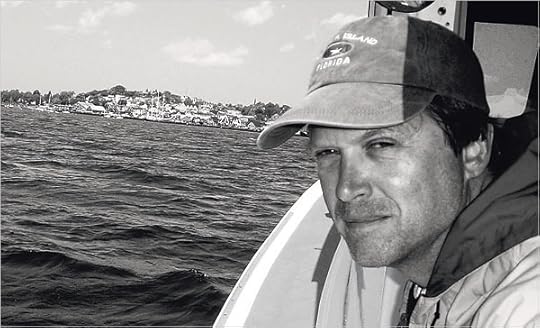
So what is it that I didn't like, besides the general eschatological tone, the apocalyptic foreshadowing, the portentous invocation of assorted Greek and Egyptian deities, the breakdown of human contact? Well, let's take a closer look:
O Λoγoς!:
It's just Poe's "Masque of the Red Death" updated with a Borgesian tic, and a title that manages to span two languages, neither of them English.
My Father's Heart:
Dude keeps Daddy's heart beating in a glass jar on the mantel. Didn't Roald Dahl already do this one, with considerably more wit and without overdosing on the doom and gloom? Unoriginal and boring.
Charybdis:
This is the "Major Tom" story. Dude trapped on a mission to Jupiter; accident nixes return. Serial ship's log entries, each with a complete lack of affect. The possibility that these entries are actually being generated by the ship's computer HAL cannot be ruled out. Either way, why should anyone possibly care?
A few more outer space episodes...
It will come as no surprise to find that the last story in the collection is called "Apocalypse".
It's possible that the 80-page novella that rounds out the collection and gives it its name will redeem the general pretentious bleakness of the remaining stories. But I seriously doubt it.
These stories are not what I look for in a good short story. Your mileage may vary.
Yes, yes. It's all very accomplished. But one feels that one is being told these stories by a robot and hearing them through layers of cotton wool. Terrence Holt is a practicing M.D. at UNC Chapel Hill -- given the preternatural detachment he shows in these stories, it makes you wonder about his bedside manner. Actually, given that rugged photo of him on the old yacht and the info that he's a contributing editor for Men's Health, I know he'll never be my doctor.
So what is it that I didn't like, besides the general eschatological tone, the apocalyptic foreshadowing, the portentous invocation of assorted Greek and Egyptian deities, the breakdown of human contact? Well, let's take a closer look:
O Λoγoς!:
It's just Poe's "Masque of the Red Death" updated with a Borgesian tic, and a title that manages to span two languages, neither of them English.
My Father's Heart:
Dude keeps Daddy's heart beating in a glass jar on the mantel. Didn't Roald Dahl already do this one, with considerably more wit and without overdosing on the doom and gloom? Unoriginal and boring.
Charybdis:
This is the "Major Tom" story. Dude trapped on a mission to Jupiter; accident nixes return. Serial ship's log entries, each with a complete lack of affect. The possibility that these entries are actually being generated by the ship's computer HAL cannot be ruled out. Either way, why should anyone possibly care?
A few more outer space episodes...
It will come as no surprise to find that the last story in the collection is called "Apocalypse".
It's possible that the 80-page novella that rounds out the collection and gives it its name will redeem the general pretentious bleakness of the remaining stories. But I seriously doubt it.
These stories are not what I look for in a good short story. Your mileage may vary.

December 9, 2021
Perfect book of short stories. Amazing.

October 9, 2009
A collection of confusing, wondrous and breathtaking stories.
Drawing from Greek mythology, Egyptian archaeology, science fiction and apocalyptic flights of fancy, Terrence Holt stories delve into the hearts and minds of what it means to be human. Among the eight stories, Holt weaves the threads of loss and fear and takes them from dusty and arid Egypt to the rings of Saturn. No matter where the stories lead, one thing is evident: humanity is a constant.
A viral plague born from a word begins the collected tales and shows the inadequacy and mystery of newspapers and the words that bring people to the brink of destruction and set them free.
Charybdis subjects an outbound spaceship crew to the dangers and uncertainties of space culminating in three men dealing with impending doom in three very different ways. In what could have been a maudlin tale, Holt makes each man’s choice not only logical, but also right.
I expected In the Valley of the Kings to be a straightforward archaeological mystery and was rewarded with obsession, immortality, and the price of intelligence. The story is infused with a subtle horror that thrills as it chills the blood.
There is nothing more unexpected than science fiction elevated to a search for the soul and the meaning of what it is to be human. Aurora and Eurydike are sublime in their exploration of death and resurrection. The writing transcends genre labeling with poetic precision and a sense of the macabre that is as fascinating as it is mesmerizing.
Of all the stories, my favorite was Apocalypse. Although the reason for the End isn’t clearly stated, the sense of impending doom and the indomitable capacity for hope had me riveted. The beginning of the story is slow and almost desultory, building to a climax that has nothing to do with catastrophe. Holt’s storytelling skills are magical, sounding a deep resonant chord that left me with tears and smiles.
The stories are complex and masterful, making use of repetitive phrases and swirling flights of lyrical prose that borders on poetry, windows into the psyche that exhibit the basics of storytelling—to fascinate and enlighten.
Drawing from Greek mythology, Egyptian archaeology, science fiction and apocalyptic flights of fancy, Terrence Holt stories delve into the hearts and minds of what it means to be human. Among the eight stories, Holt weaves the threads of loss and fear and takes them from dusty and arid Egypt to the rings of Saturn. No matter where the stories lead, one thing is evident: humanity is a constant.
A viral plague born from a word begins the collected tales and shows the inadequacy and mystery of newspapers and the words that bring people to the brink of destruction and set them free.
Charybdis subjects an outbound spaceship crew to the dangers and uncertainties of space culminating in three men dealing with impending doom in three very different ways. In what could have been a maudlin tale, Holt makes each man’s choice not only logical, but also right.
I expected In the Valley of the Kings to be a straightforward archaeological mystery and was rewarded with obsession, immortality, and the price of intelligence. The story is infused with a subtle horror that thrills as it chills the blood.
There is nothing more unexpected than science fiction elevated to a search for the soul and the meaning of what it is to be human. Aurora and Eurydike are sublime in their exploration of death and resurrection. The writing transcends genre labeling with poetic precision and a sense of the macabre that is as fascinating as it is mesmerizing.
Of all the stories, my favorite was Apocalypse. Although the reason for the End isn’t clearly stated, the sense of impending doom and the indomitable capacity for hope had me riveted. The beginning of the story is slow and almost desultory, building to a climax that has nothing to do with catastrophe. Holt’s storytelling skills are magical, sounding a deep resonant chord that left me with tears and smiles.
The stories are complex and masterful, making use of repetitive phrases and swirling flights of lyrical prose that borders on poetry, windows into the psyche that exhibit the basics of storytelling—to fascinate and enlighten.

February 19, 2011
After starting (but not finishing in The Complete John Silence Stories by Algernon Blackwood) I went for something way more modern: In the Valley of the Kings (2009) by Terrence Holt, a collection of six short stories and one novella. This was more like it. The stories were excellent, some with an almost Ray Bradbury-esque lyricism. Technically the stories are science fiction and the novel more of a horror story. But as with Bradbury the actual genre isn’t terribly important.
In most of the stories, what’s going in isn’t very clear at the beginning, but the stories drew me in almost immediately; I wanted, needed, to learn more. Generally this need was satisfied by the end.
There were two exceptions to this: the novella “In the Valley of the Kings” and the last story “Apocalypse”. In “Valley” the mystery is not so much “what’s going on” as it is the more normal “what will happen”. The story was fascinating and I enjoyed it thoroughly. Like any good work of fiction it left me wanting to learn more.
“Apocalypse” combines both mysteries. What’s going on and what will happen. Although by the end the exact details of neither seem terribly important. This story reminded me the most of Bradbury’s short fiction, specifically of the story stories that make up The Martian Chronicles. The events in the story are complete in themselves, but clearly part of a larger story we don’t know. Where the story is going and even the events of the story just aren’t as important as the story. Unusually satisfying. If I could find more books by Holt, I’d buy them in an instant.
In most of the stories, what’s going in isn’t very clear at the beginning, but the stories drew me in almost immediately; I wanted, needed, to learn more. Generally this need was satisfied by the end.
There were two exceptions to this: the novella “In the Valley of the Kings” and the last story “Apocalypse”. In “Valley” the mystery is not so much “what’s going on” as it is the more normal “what will happen”. The story was fascinating and I enjoyed it thoroughly. Like any good work of fiction it left me wanting to learn more.
“Apocalypse” combines both mysteries. What’s going on and what will happen. Although by the end the exact details of neither seem terribly important. This story reminded me the most of Bradbury’s short fiction, specifically of the story stories that make up The Martian Chronicles. The events in the story are complete in themselves, but clearly part of a larger story we don’t know. Where the story is going and even the events of the story just aren’t as important as the story. Unusually satisfying. If I could find more books by Holt, I’d buy them in an instant.
April 5, 2018
Here's an excerpt from my review of this book on my blog. You can check out the rest of the review here: http://humpdayhardbacks.blogspot.com/...
When I think of Terrence Holt’s one and only book, In the Valley of the Kings*, I think of someone abandoned at the bottom of a long well, echoing cries into a void. I mean that as a compliment.
In the Valley of the Kings is a short story collection fraught with enigma and elements of absurdist fiction (i.e., the inevitability of death towers over characters’ actions and renders them meaningless). Some of his stories retain a mystery throughout that requires the reader to rely on self-interpretation. For example, my favorite story, Aurora, involves a reincarnation of a former human’s soul, but the logistics are left to the reader’s imagination. I envision the soul as a semi-conscious satellite cruelly manipulated by earthling scientists. Who knows what Holt meant (but does that really matter?)?
Junot Díaz praises the work, saying, “There is no one in the wide sea of English who writes like Holt.” He’s correct. I don’t have the language to communicate how Holt uses language. His stories emphasize the power of voice; intonation is important and the manner in which speech is conveyed has a special, inherent power. Silence has its own unique weight. The process of naming things has a Genesis-feel in which letters and sounds wield prophetic meaning.
Common themes you can find in this bad boy: falling, forgetting/misremembering/re-remembering, darkness, attempts at describing an indescribable despair, chaos.
I like books that are experimental; they might not be perfect, but they’re different and thought-provoking. Holt brings that in spades. He’s really out there, and I’m into it. Like any collection, some stories are AMAZING, some are fine, and some are not that great. While I think that Holt has some preternatural talent, I understand that his work is not for everyone.
When I think of Terrence Holt’s one and only book, In the Valley of the Kings*, I think of someone abandoned at the bottom of a long well, echoing cries into a void. I mean that as a compliment.
In the Valley of the Kings is a short story collection fraught with enigma and elements of absurdist fiction (i.e., the inevitability of death towers over characters’ actions and renders them meaningless). Some of his stories retain a mystery throughout that requires the reader to rely on self-interpretation. For example, my favorite story, Aurora, involves a reincarnation of a former human’s soul, but the logistics are left to the reader’s imagination. I envision the soul as a semi-conscious satellite cruelly manipulated by earthling scientists. Who knows what Holt meant (but does that really matter?)?
Junot Díaz praises the work, saying, “There is no one in the wide sea of English who writes like Holt.” He’s correct. I don’t have the language to communicate how Holt uses language. His stories emphasize the power of voice; intonation is important and the manner in which speech is conveyed has a special, inherent power. Silence has its own unique weight. The process of naming things has a Genesis-feel in which letters and sounds wield prophetic meaning.
Common themes you can find in this bad boy: falling, forgetting/misremembering/re-remembering, darkness, attempts at describing an indescribable despair, chaos.
I like books that are experimental; they might not be perfect, but they’re different and thought-provoking. Holt brings that in spades. He’s really out there, and I’m into it. Like any collection, some stories are AMAZING, some are fine, and some are not that great. While I think that Holt has some preternatural talent, I understand that his work is not for everyone.
August 20, 2020
I was really blown away by this collection of sci-fi short stories. The tales get pretty deep psychologically, and the sequence of stories wafts back and forth between distantly melancholic and menacingly suspenseful. They all explore the borders of humanity. My favorite is "Aurora," a haunting one about a satellite orbiting Saturn. And I can't say anything else because, seriously, any detail would be a spoiler. But I give high marks to any writer who can effectively write from an object's point-of-view. Suffice to say, if you got really hooked into sci-fi like The Arrival or Annihilation (the books: by comparison the movies are awful) then give this one a shot.

April 17, 2019
I read this collection very fast, in perhaps a dozen sittings. The stories really captured my imagination. They are dark stories, the rambling narrators caught up in their disastrous experiences.
If you are into slightly bewildering, unusual, horrific, literary, 'strange event' stories, I would highly recommend.
If you are into slightly bewildering, unusual, horrific, literary, 'strange event' stories, I would highly recommend.

May 18, 2024
Some of the stories in this were cool, especially the first one about a plague sparked by a hidden, unreadable word written on people's bodies. But many of the stories were too abstract and confusing to follow. I didn't dislike it, as Holt is clearly a brilliant person and a good writer. But if you want somewhat sci-fi ish, slightly odd short stories, try Ted Chiang or George Saunders.

December 21, 2021
I wanted to like this more. The ideas at the core of each story were interesting. But each story was so obtuse, the story hidden behind the angsty ramblings of the other who described their immediate surroundings without addressing the why. It was frustrating.

December 23, 2012
With understated prose that reflects his clinical training Holt writes quietly terrifying stories. His narrative line of escape runs through language and its metaphysics: mythology, detachment, and death, and his narrators are aware of the grand powers of horror and awe but, more often, skirt horror's more unsettling and less easily comprehended double: the haunting power of ironic ambiguity.
As Holt understands, everything that is terrible (like everything humorous, terror's grotesque twin), is timing.
In the Valley of the Kings is a short story collection worth reading for sure.
Do you doubt me, reader? What more would you have? Letters of fire across the sky? A voice speaking prophecy in your sleep? A look in the mirror at your own forehead? A list, perhaps, of the ways death can come to you, even as you read here, safe in your home?
What is it you want? The word?
As Holt understands, everything that is terrible (like everything humorous, terror's grotesque twin), is timing.
In the Valley of the Kings is a short story collection worth reading for sure.

January 2, 2010
I wasn't sure what to make of some of these stories. It's been a long time since I read Borges, and I couldn't get comfortable. But the story of the title, In the Valley of the Kings, grabbed me. It's a wonderful story, told by a narrator archeologist who, finally, fails to get a grant to continue his work. But he is not honorable and seizes a chance to continue his work on his own, alone. Chance takes him; he is finally where he wants to be, a bedouin appears who knows too much about him. The professor hires him to do the digging. In the first night, the digging is done and the professor has his tomb. From there, it gets even better. I give this one story a 4. I can't classify the others.
January 3, 2010
Although I have not finished this book, I am haunted by it enough to want to tell others about it. If you value the writing of Junot Diaz or the existentialists, you might find this author interesting. The stories in this collection are somber,cold and completely devoid of feeling. They are stories of survival and confinement. In each story the protagonist(not people, but the 'suggestion' of people)faces the unknown by thinking into the past or into the future. There is no hope as they drift through their various empty lonely landscapes searching for memories or concepts to define their uncharted existence. I had to read two of the stories before I understood the poetry of his writing. I am now hooked. Back to the book...

May 26, 2012
Had some time to collect my thoughts after reading this over the course of last night and this morning. I've actually been trying to find a copy of this at the library for a while after seeing it recommended elsewhere and just recently tracked it down.
Very impressed, to say the least - I can't remember a short fiction collection I've enjoyed this much in a while. The often-surreal nature of the narrative ("My Father's Heart", "Aurora", the title novella, etc.) lends emphasis to the theme of obsession with the difference between truth and illusion that runs through it: Are we free? Do we dream? Do we truly live?
Very impressed, to say the least - I can't remember a short fiction collection I've enjoyed this much in a while. The often-surreal nature of the narrative ("My Father's Heart", "Aurora", the title novella, etc.) lends emphasis to the theme of obsession with the difference between truth and illusion that runs through it: Are we free? Do we dream? Do we truly live?
January 27, 2015
Starts well with Aoyos but quickly gets tiring with the following overly mad/delusional/plot-less stories. In those, the author tries too hard to present an "artistic" and "enigmatic" perspective. The style and inflexibility of view points also limits the quality of the stories told. Little attention to descriptions and a heavy focus on human rationale and train of thoughts mainly towards some way of madness.
The story that gives name to the book presents a refreshing read with a structured plot leading the reader into a journey to Egypt and mysteries. The following two short stories give a good end to the book with a "happy" end and a sincere love that holds against the lost of all hope.
The story that gives name to the book presents a refreshing read with a structured plot leading the reader into a journey to Egypt and mysteries. The following two short stories give a good end to the book with a "happy" end and a sincere love that holds against the lost of all hope.

October 10, 2009
A collection of stories, mostly dealing with doomed characters. Not quite science fiction sometimes, but variations on a theme of futility.
I found several of the stories to be needlessly opaque, but that's the author's style. There is a sort of beauty to these, if you just let the words wash over you, but don't expect to necessarily understand them. They reminded me a little of some of the more far-out stories of James Tiptree, Jr.
The last story, Apocalypse, is haunting.
I found several of the stories to be needlessly opaque, but that's the author's style. There is a sort of beauty to these, if you just let the words wash over you, but don't expect to necessarily understand them. They reminded me a little of some of the more far-out stories of James Tiptree, Jr.
The last story, Apocalypse, is haunting.

October 29, 2009
Perhaps claustrophobia is what most marks this book. The first five stories and the title novella are almost stringently "locked in the prisonhouse of the mind" of their narrators, an effect which, for me at least, makes them seem much longer than they are, ponderously moving, almost painful. The last two, "Scylla" and "Apocalypse," admit something of the fresh or frigid air of the real world and therefore, despite their disorienting and/or speculative fiction settings, seem rather to spring from the pages in comparison with the others.

June 27, 2011
Wow. A collection of ominous short stories, most with a sci-fi bent, almost all of them featuring first-person narrators who are hurtling toward some kind of doom. Holt seems to be obsessed with the ways that the mind and the heart react to the Holy-Crap-It's-All-Over realization. But each story finds a fresh take on the theme, the writing is ungodly beautiful, and the imagery lingers in the mind in unsettling ways.
By the way, Holt is a medical doctor, so he's been writing these stories IN HIS SPARE TIME. [Expletive deleted.]
By the way, Holt is a medical doctor, so he's been writing these stories IN HIS SPARE TIME. [Expletive deleted.]
February 24, 2010
There is no doubt that Terrence Holt is a superior writer. I found his prose and construction elegant....however, half the time I had no real grasp of the plot. I'm not a big fan of post modern deconstructed plot lines anyway....Was one story about the end of the world? Or did the character have Alzheimer's? In spite of the beauty of his writing, I finally became weary trying to figure out what was actually going on in the story....so I gave it up.
Life is too short.
Life is too short.
September 18, 2009
Lots of inscrutable menace in this collection. The stories are all unsettling; a few of them are genuinely scary. "Charybdis" is one of the best stories I've read in while. The blurbs compare Holt to Borges, Poe, and Lovecraft, which is pretty accurate. If you like those authors, you'll probably like Holt.

January 7, 2010
My favorites are Charybdis, Apocalypse; and the title story, In the Valley of the Kings. Though I have to say I kind of have a love/hate feeling about this guy. He's definitely got his finger on the pulse of something but much of the time his over stylized (and often over punctuated) prose just plain drove me up a wall.

January 19, 2010
I desperately needed some literate, imaginative fiction, served up in small doses, but I just couldn't get into this book. I read the first piece. Tried the second. Continued thusly like Ruby (bless her soul) going through a Whitman's sampler...just couldn't find one with the sweet chewy center whose flavour appealed.

Read
April 7, 2010My mom had picked this up at the library. Apparently the author is currently teaching at UNC medical school. (Wrote for 10 years, then became a physician, and was inspired to write again.) I'm about 1/2 way through it. The writing style is very surreal, sort of medical inspired sci-fi, although that description makes it sound campy--surreal is a better fit.

October 10, 2009
Haunting and abysmal. These stories ask strange questions of the reader, without them even knowing. Written with deep sincerity and absurdly well-honed skill, these stories are strange but reflective of the human condition in the face of our fragile mortality.

May 22, 2010
Don't even waste your time...this book sucks! I thought Manhood For Amateurs was bad until I read this one. Actually, I still can't decide which was worse. This one will be given away for a donation.

September 16, 2009
If this guy is as good a doctor as his is an author then he has some very lucky patients.

October 18, 2009
Really sophisticated stories. Makes me think of Richard Powers.
January 3, 2010
Not to be missed: "Charybdis" "In The Valley of Kings" and the chilliest story ever: "Apocalypse"
As you might infer from the titles, not particuarly cheery, but utterly original and brilliant.
As you might infer from the titles, not particuarly cheery, but utterly original and brilliant.

July 4, 2010
Interesting book.
Displaying 1 - 30 of 36 reviews