"Of creators of cosmic fear raised to its most artistic pitch, few can hope to equal Arthur Machen."--H. P. Lovecraft Arthur Machen (1863-1947), Welsh novelist and essayist, is considered one of the most important and influential writers of his time. While displaying a preoccupation with pagan themes and matters of the occult (an interest he shared with his close friend, the distinguished scholar A. E. Waite), his writing transcends the genre of supernatural horror. Oscar Wilde, W. B. Yeats, Sir Arthur Conan Doyle, as well as Paul Bowles and Jorge Luis Borges are just a few of the literary notables who are counted among his admirers. Machen is also a key figure in the development of pulp magazine fiction (e.g, Weird Tales), a line of ancestry that leads directly to today's popular graphic novels. Further, Machen's name often crops up in the writings of theorists and practitioners of psychogeography, a school of thought and literature which explores the hidden links between the landscape and the mind. In The Great God Pan, Arthur Machen delivers a tense atmospheric story about a string of mysterious suicides. With its suggestive visions of decadent sexuality, the work scandalized Victorian London. Lyrical and introspective, The Hill of Dreams established Machen as one of the great prose masters of the language. As a penetrating portrayal of the accursed artist, redolent with soulful longing and genteel decay, it ranks as a landmark work in English literature.
Arthur Machen was a leading Welsh author of the 1890s. He is best known for his influential supernatural, fantasy, and horror fiction. His long story The Great God Pan made him famous and controversial in his lifetime, but The Hill of Dreams is generally considered his masterpiece. He also is well known for his leading role in creating the legend of the Angels of Mons.
At the age of eleven, Machen boarded at Hereford Cathedral School, where he received an excellent classical education. Family poverty ruled out attendance at university, and Machen was sent to London, where he sat exams to attend medical school but failed to get in. Machen, however, showed literary promise, publishing in 1881 a long poem "Eleusinia" on the subject of the Eleusinian Mysteries. Returning to London, he lived in relative poverty, attempting to work as a journalist, as a publisher's clerk, and as a children's tutor while writing in the evening and going on long rambling walks across London.
In 1884 he published his second work, the pastiche The Anatomy of Tobacco, and secured work with the publisher and bookseller George Redway as a cataloguer and magazine editor. This led to further work as a translator from French, translating the Heptameron of Marguerite de Navarre, Le Moyen de Parvenir (Fantastic Tales) of Béroalde de Verville, and the Memoirs of Casanova. Machen's translations in a spirited English style became standard ones for many years.
Around 1890 Machen began to publish in literary magazines, writing stories influenced by the works of Robert Louis Stevenson, some of which used gothic or fantastic themes. This led to his first major success, The Great God Pan. It was published in 1894 by John Lane in the noted Keynotes Series, which was part of the growing aesthetic movement of the time. Machen's story was widely denounced for its sexual and horrific content and subsequently sold well, going into a second edition.
Machen next produced The Three Impostors, a novel composed of a number of interwoven tales, in 1895. The novel and the stories within it were eventually to be regarded as among Machen's best works. However, following the scandal surrounding Oscar Wilde later that year, Machen's association with works of decadent horror made it difficult for him to find a publisher for new works. Thus, though he would write some of his greatest works over the next few years, some were published much later. These included The Hill of Dreams, Hieroglyphics, A Fragment of Life, the story The White People, and the stories which make up Ornaments in Jade.
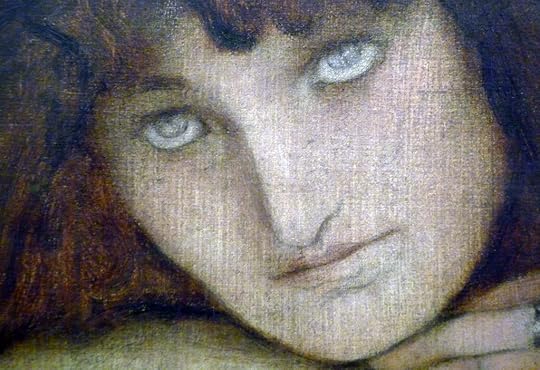
Detail of 'I lock my door upon myself', Fernand Khnopff, 1891
“Villiers, that woman, if I can call her woman, corrupted my soul. The night of the wedding I found myself sitting in her bedroom in the hotel, listening to her talk. She was sitting up in bed, and I listened to her as she spoke in her beautiful voice, spoke of things which even now I would not dare whisper in the blackest night, though I stood in the midst of a wilderness. You, Villiers, you may think you know life, and London, and what goes on day and night in this dreadful city; for all I can say you may have heard the talk of the vilest, but I tell you you can have no conception of what I know, not in your most fantastic, hideous dreams can you have imaged forth the faintest shadow of what I have heard—and seen. Yes, seen. I have seen the incredible, such horrors that even I myself sometimes stop in the middle of the street and ask whether it is possible for a man to behold such things and live. In a year, Villiers, I was a ruined man, in body and soul—in body and soul."
As first encounters go, Machen’s ‘The Great God Pan’, contained within the covers of that most glorious of horror anthologies Great Tales of Terror and the Supernatural was comparable to having an electric current coursing through my body. This, even as unseasoned a reader as me then knew, wasn’t just an ordinary “horror” tale, merely designed to thrill and chill its reader, but something infinitely more. It was my entry into that wonderful genre of “weird” fiction, of which ‘The Great God Pan’ is a foundational text, greatly influencing its most illustrious practitioner, H.P. Lovecraft. It started me on my path, soon seeking out more of Machen's oeuvre.
Even in this early tale of his, Machen shows himself to be truly sui generis, with a deeply personal vision to convey to us. Through his fiction, he hints at a -to most- veiled, seductively mystical pagan world, filled with iridescent splendour and awe-inspiring terror, often commingled. To tread into that realm is an enterprise not to be undertaken lightly, for the repercussions of this very act may be severe and, more often than not, lethal.
‘The Great God Pan’ distillates this inherent risk most clearly, in which an obsessed Dr. Raymond - in the presence of his hesitant friend Clarke - performs a surgical operation on a young girl he once rescued from destitution called Mary, in order to bridge the gap between our – according to him illusory -realm and the real one. Noticing his friend’s reasonable trepidation, Raymond attempts to set Clarke at ease before the great work that is to be done:
"Look about you, Clarke. You see the mountain, and hill following after hill, as wave on wave, you see the woods and orchard, the fields of ripe corn, and the meadows reaching to the reed-beds by the river. You see me standing here beside you, and hear my voice; but I tell you that all these things—yes, from that star that has just shone out in the sky to the solid ground beneath our feet—I say that all these are but dreams and shadows; the shadows that hide the real world from our eyes. There is a real world, but it is beyond this glamour and this vision, beyond these 'chases in Arras, dreams in a career,' beyond them all as beyond a veil. I do not know whether any human being has ever lifted that veil; but I do know, Clarke, that you and I shall see it lifted this very night from before another's eyes. You may think this all strange nonsense; it may be strange, but it is true, and the ancients knew what lifting the veil means. They called it seeing the god Pan."
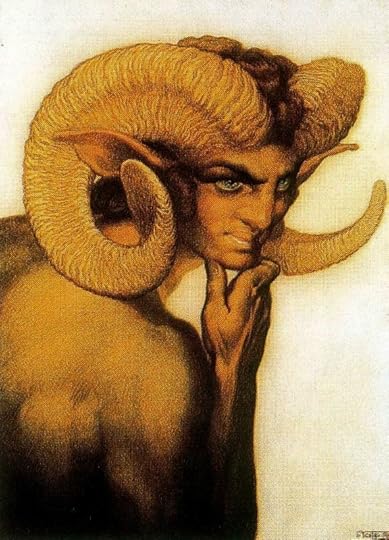
The Satyr of the Garden of the Hesperides, Nestór, 1922-23
Predictably, the experiment goes horribly wrong, turning the unforunate test subject into an imbecilic catatonic. A considerable time afterwards, strange incidents and suicides start occurring, those involved all apparently connected to a beautiful yet uncanny woman no one has known of or seen before..
While still a formidable tale and classic of the genre, on a second read ‘The Great God Pan’ reveals itself to be a rather disjointed, not wholly satisfying creation, as if Machen was still feeling around, honing his skill. His true masterpieces of craft were to come later, which is telling in and of itself, considering how accomplished it is already.
THE HILL OF DREAMS
“To Lucian, entranced in the garden of Avallaunius, it seemed very strange that he had once been so ignorant of all the exquisite meanings of life. Now, beneath the violet sky, looking through the brilliant trellis of the vines, he saw the picture; before, he had gazed in sad astonishment at the squalid rag which was wrapped about it.”
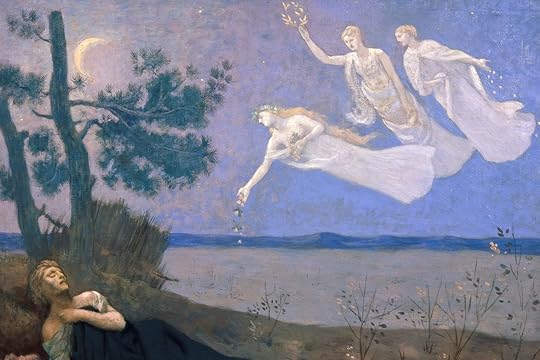
The Dream, Puvis de Chavannes, 1883
It is quite a task to classify a wondrous novella like ‘The Hill of Dreams’, it being neither horror, neither completely weird fiction as a modern audience would understand it. Its hero Lucian, a painfully maladjusted Welsh youth and aspiring writer (a distinctly autobiographical element here) seeks refuge in a dream world of his own concoction (or is it?), centred around an old Roman fort, which grounds Lucian often visits to satiate his need for mystical visions.
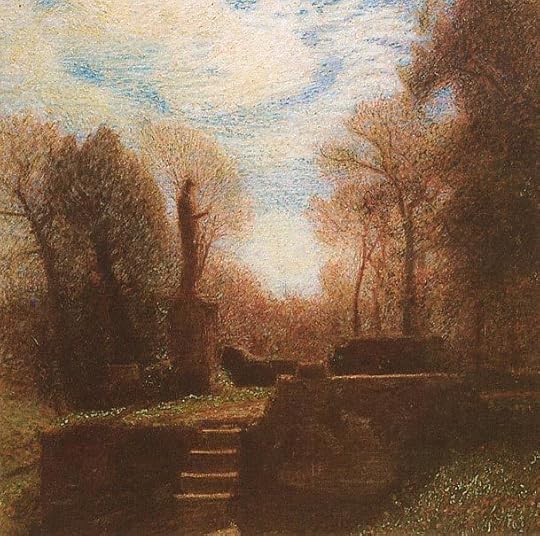
Statue at Villa Borghese, Giuseppe Pellizza da Volpedo, 1906
Pitied, even held in contempt for his gentle demeanour and high-minded proclivities by most of his fellow villagers, Lucian consciously choses a road of self-isolation and detachment, embarking on a journey as an intrepid explorer of the inner realm. It is a naive venture which further cuts him off from reality.
And so this artist is doomed to trudge ahead on a veritable trail of tears, with rare glimpses of true inspiration and spiritual fulfilment sustaining him along the way. The outcome, the reader soon realizes, is unavoidable. He is bound to let himself be taken over by this inner world, neglecting to remind himself that the one thing that allows him to seek refuge in the mystical, his mind contained in his corporeal self, still resides in the material world he so abhors.
The Temptations, Afterwards, Ljuba Popović, 1988-1989
"Lucian was not especially interested in this hatred of the barbarian for the maker, except from this point, that it confirmed him in his belief that the love of art dissociated the man from the race. One touch of art made the whole world alien, but surely miseries of the civilized man cast amongst savages were not so much caused by dread of their ferocity as by the terror of his own thoughts; he would perhaps in his last despair leave his retreat and go forth to perish at their hands, so that he might at least die in company, and hear the sound of speech before death. And Lucian felt most keenly that in his case there was a double curse; he was as isolated as Keats, and as inarticulate as his reviewers. The consolation of the work had failed him, and he was suspended in the void between two worlds.
It was no doubt the composite effect of his failures, his loneliness of soul, and solitude of life, that had made him invest those common streets with such grim and persistent terrors. He had perhaps yielded to a temptation without knowing that he had been tempted, and, in the manner of De Quincey, had chosen the subtle in exchange for the more tangible pains. Unconsciously, but still of free will, he had preferred the splendor and the gloom of a malignant vision before his corporal pains, before the hard reality of his own impotence. It was better to dwell in vague melancholy, to stray in the forsaken streets of a city doomed from ages, to wander amidst forlorn and desperate rocks than to awake to a gnawing and ignoble torment, to confess that a house of business would have been more suitable and more practical, that he had promised what he could never perform. Even as he struggled to beat back the phantasmagoria of the mist, and resolved that he would no longer make all the streets a stage of apparitions, he hardly realized what he had done, or that the ghosts he had called might depart and return again."
Here, Machen I find is in supreme control in terms of language, which more than makes up for the lack of any real plot. Poetic, strikingly vivid prose describing Lucian’s tortured insights and observations draws you into his fascinating mindscape, and make you care for his fate. If I had to try and define him, he’d be an odd, yet tantalising mixture of an idealistic romantic, an indulgent decadent aesthete, and a Shopenhauerian misanthrope. Quite an achievement to invest all these traits in one sole character.
Undefinable, niche works of literature of this ilk will always be able to entrance those attuned to it, even though the opportunities to share one's passion for them with others will be precious few.
Still, like Lucian, one can always hope for the existence of other, equally appreciative souls.
Look about you! You see the mountain, and hill following after hill, as wave on wave, you see the woods and orchard, the fields of ripe corn, and the meadows reaching to the reed-beds by the river. You see me standing here beside you, and hear my voice; but I tell you that all these things – yes, from that star that has just shone out in the sky to the solid ground beneath our feet – I say that all these are but dreams and shadows; the shadows that hide the real world from our eyes. There is a real world, but it is beyond this glamour and this vision, [...] beyond them all as beyond a veil. I do not know whether any human being has ever lifted that veil; but I do know that you and eye shall see it lifted this very night from before another’s eyes. You may think this all strange non-sense; it may be strange, but it is true, and the ancients knew what lifting the veil means. They called it seeing the god Pan.
There’s a reason why Arthur Machen is considered one of the founding fathers of modern horror. His words conjure a web of mystery and danger, of perversion and decadence festering under the staid, corsetted Victorian respectability. His eyes gaze at the abyss, and his tales bring up the horrors lurking there to chill the blood and to weaken the knees.
There is a region of knowledge which you will never know, which wise men seeing from afar off shun like the plague, as well they must, but into that region I have gone.
Our modern mind has been saturated with movies relying heavily on explicit gore and plenty of nudity to tittilate the viewer. To some, Machen’s stories may feel outdated and too fancyful, but I believe the most effective scares are still the ones where the monster is hidden, where his deeds are experienced at a remote, through the reactions of others, where the audience is left to imagine the worst instead of being explained everything in detail. Hitchcock knew this in ‘Psycho’ and elsewhere, Spielberg knew it when he made ‘Jaws’. If you search hard enough into the background of these modern stories, chances are, you will find out Machen was there before.
It’s a curious thing, Austin, to be alone in London at night, the gas-lamps stretching away in perspective, and the dead silence, and then perhaps the rush and clatter of a hansom on the stones, and the fire starting up under the horse’s hoofs.
We don’t actually see the Great God Pan. Machen convinces us that we don’t actually want to go there, that the experience is liable to destroy our sanity, that we will loose control of our minds and become puppets of twisted and malevolent entity. His arguments are supported by elegant prose, subtle irony and veiled allusions at the corruption of sex. Nothing definite, nothing vulgar, not even a slender ankle or a plunging neckline, yet his contemporaries were out in arms with cries of decadence and corruption of tender minds.
You and I, Salisbury, have heard in our time, as we sat in our seats in church in sober English fashion, of a lust that cannot be satiated and of a fire that is unquenchable, but few of us have any notion of what these words mean.
It is easy to mention Oscar Wilde in this context ( Lord Argentine, after some little consideration, came to the conclusion that dining, regarded as a fine art, was perhaps the most amusing pursuit open to fallen humanity.) , or Dr. Jekyll (in both novellas included here the veil of the occult is pulled back by doctors), Frankenstein, Jack the Ripper – all expressions of late Victorian fascination with gothic tales of horror. The French connection is also easy to spot. One of the character is named Villiers (de l’Isle-Adam?), and a conversation over lunch goes like this:
“I think you are misled by a too fervid imagination; the mystery of London exists only in your fancy. It seems to me a dull place enough. We seldom hear of a really artistic crime in London, whereas I believe Paris abounds in that sort of thing.”
But what makes Arthur Machen special? What turned the likes of Wilde, Lovecraft, Doyle and even Borges into fans of his work? Where did he get his ideas? I have not read enough of his stories to claim I know the answer. I have an inkling that it has something to do with an anti-science reaction, a belief that we cannot find all the answers to the working of a human mind in a research laboratory. And it has a lot to do with Machen’s upbringing in a place rich in myth and history. At the border of Wales, he absorbed and was fascinated by the heritage handed down by Celts, Romans, Saxons, early Christians. The countryside, much more that the metropolis, plays a major part in creating the mood and reflecting the inner turmoil of his personages, brings them closer to the ancient rituals and revelations, to the world where Gods used to walk among mortals. For Machen the world we live in is not a collection of molecules and electricity, but a place filled with wonder and mystery:
In every grain of wheat there lies hidden the soul of a star.
- - - -
Note : there are many editions available online of the first novella. In the one I found, instead of “Hill of Dreams” I got “The Inmost Light”. I didn’t go for details of the plot for either one, and I didn’t insist on this second story because it shares many similarities with “Pan”. By all means, I intend to read more from this author, and recommend it to all students of the genre.
I seem to remember first coming across the name of Arthur Machen from Henry Miller's big list of books he loved. The Machen book on the list was The Hill of Dreams, and (maybe 20?) years ago I read it and felt a great kinship with the book, the author, and the main character. It's a book about a young man struggling to be an author (much in the mode of Hamsun's Hunger, Fante's Ask the Dust, and others) but at the same time he's struggling with a sort of personal haunting after having a mysteriously powerful experience in an old Roman fort. After this experience he has some difficulty distinguishing the world of his phantasy from the "real" world, but he prefers his phantasy world more anyway. Scenes alternate between his countryside home where the fort is and his down and out life in London trying to be a writer, both of which are very evocatively portrayed.
But this time around... it's just boring me with too much unnecessary verbiage. This is the book where Machen "found his unique voice", and like a newly discovered watering hole on a hot August day he spends way too much time splashing around and swimming in this new voice for no purpose but his own enjoyment. I don't typically have a problem with this sort of indulgence, but given the magic I felt on my first reading, and lack of it this time, I simply have no patience for it. So I'll leave the last 20 pages unread and hope that next time it strikes a more resonant chord with me, because I actually still think it's a worthy book.
One somewhat interesting note for me regarding this book: I was thoroughly unfamiliar with the term psychogeography until Tosh recently brought it up, and then a few days later I finally pulled this book off the shelf for a reread and read on the back of this edition that Machen's name often crops up in the writings of psychogeography.
Great God Pan - Here's a crisp horror tale that right up until the end had me going, "Okay, that's interesting and all, but if you're never going to 'show the monster' then I really can't picture what's going on. In the last two pages, you finally get the big reveal which redeems the story - mostly.
Hill of Dreams - Oh boy. This is one of the hardest novels I've ever read, due to the continuing vivid descriptions the author mesmerizes you to envision. At some point, you realize there isn't so much of a plot as there are noticeable points in which the main character descends into madness further. On the very last page is the big reveal, and I can't say that I quite got it. Nonetheless, there are a lot of very interesting parts and musings in this story, particularly in chapters I-III which are basically autobiographical. After that, it mostly lost me and the repeated scenery depictions wore quite thin. If someone can explain the ending to me I'd appreciate it.
Yeah. Not all that great. Machen does a wonderful job of not telling you the unspeakable horrors. It might be a little perverse that I really want to know what's going on. I'm left having to decide for myself. Geeez, thanks Machen. You're the best!
The rating is actually an average -- five stars for The Great God Pan and three for The Hill of Dreams. I can see how the latter inspired the style of Clark Ashton Smith and the early Lovecraft, and I don't mean that in a good way. The book is bloated by about two-thirds by the extended passages of Lucian's reveries, imaginary worlds and memories. Any one such passage of a few paragraphs would have been a fine exercise in creating evocative imagery; but dozens of them strung together into an entire book is self-indulgent and tiresome to read.
This is not great. I expected to enjoy it, as it has serious cult appeal and I'm a fan of fin de siecle writers such as Wilde, Yeats, Stevenson and Huysmans, but this is nowhere near that level. Iain Sinclair and Mark E. Smith are also big fans, and their opinions count with me, but I'm just not digging it. This is one of those surprising disappointments, when you're sure your going to like a writer and feel that if yiou don't the fault must lie with you. I felt the same kind of disappointment when I read Lovecraft. I was sure I would love him, but I just thought he was a windbag. Poe, Chesterton and Borges do this kind of thing so much better.
I'm reading this again for atmosphere, particularly psychogeography, which seems to be my new interest.
Just finished the second read, and it's obvious to me know that Machen borrowed a bit from Stevenson's Jekyll and Hyde. The London atmosphere is similar, with crowded streets and late night walks. J&H was published in '86 and Pan in '90.
I like the Great God Pan well enough as a story although it is a bit dated, The Hill of Dreams is a disappointment for me as it starts off strong but then seems to just dither along for a bit before finally ending.
Вариация на тему "Не все двери должны быть открыты". Для не в меру любопытной молодой жены Синей Бороды желание узнать, что таится за запертой (и запретной) дверью всё закончилось личной трагедией. Любопытство одного ученого англичанина, не обремененного этическими "тормозами", приоткрыло дверь для древнего ужаса, и это стоило жизни многим людям.
Мейчен старательно избегает описаний того, что происходило с жертвами Великого Бога Пана, вся история рассказывается с точки зрения знакомых или друзей пострадавших. И в этом, в определенной степени, и заключается слабая сторона этой новеллы: ну что, в конце концов, могло быть такого страшного в жизни британского деревенского ребенка или аристократа конца 19-го века, о чем люди, живущие в начале 21 века не читали/видели бы каждый день в новостях (или в многочисленных "ужастиках"). Пожалуй, только эпизод с посещением пустой квартиры и тягостно-жуткое впечатление, которое она произвела на любопытствующего, проливают некий мрачный свет на механику происходящего: важно не что, а под воздействием какой силы.
The Hill of Dreams
В этой повести мистическую составляющую можно при желании списать на психическое состояние главного героя: всё мрачное и таинственное разворачивается перед его глазами, в его голове, хранится в его воспоминаниях. Окружающие видят лишь внешние признаки: нервозность, истощенность, нелюдимость и т. п. Симптомы, которые легко можно объяснить расстройством психики, а не паранормальными явлениями.
Именно психологическая составляющая и представляет здесь наибольший интерес. Главный герой, сын сельского священника, который из-за своего нежелания закрывать глаза на чужие грехи впадает в немилость у своего "начальства", не смог закончить учебу и вынужден вернуться в родной городок. Здесь на него выливаются потоки презрения (беден, не практичен, увлекается непопулярными книгами), он пытается писать, и даже отсылает свое произведение в Лондон, получает отказ, а потом узнает, что его сочинение использовал в своем "бестселлере" более проворный и известный автор.
Молодой человек сначала делает правильный ход: он отказывается принимать все эти удары судьбы близко к сердцу, но ему не удается вовремя остановиться в стремлении отстраниться от презирающего его (и презираемого им) мира - он уходит сначала в себя, а потом в новый, ирреальный мир, созданный, скорее всего, его собственным воображением.
В отличие от "The Great God Pan", эта повесть местами страдает от излишней авторской многословности: порой кажется, что Мейчен, как и его герой, заблудился в сотворенной им реальности и ходит по кругу среди сказочно красивых и одновременно мистически жутких пейзажей.
This is technically a DNF, for now, though I did read the entirety of The Great God Pan. I'm putting it aside because I don't feel ready to continue with The Hill of Dreams yet.
Thoughts on The Great God Pan:
This was interesting and I'm glad I read it to satisfy my own curiosity, as this is an example of one of the earlier weird stories. It opens very strong, with a creepy doctor performing an experiment on the young woman in his care - cutting up part of her brain to allow her to see the invisible world. After that, however, we abruptly switch gears into following London society, and some strange goings on. The story does eventually loop back to that chilling opening chapter in a way which is satisfying. Overall the story is a lot of what you find in early weird fiction - much hinting and talking about how scary/horrible something is without actually describing the thing. It's not without good points - it's very atmospheric, painting a portrait of fin de siècle London that I enjoyed.
I finished The Great Good Pan but dnf’ed The Hill of Dreams.
The Great God Pan by itself is 3 stars. The concept is interesting but the writing style did a disservice to the story. Most of the story is written in the past tense, featuring characters who largely did not experience the preternatural things that are going on themselves. It was like being told a story through hearsay; it’s kind of interesting but definitely missing something- the action. It was less thrilling than it should have been because we were so removed from the action. I will say the first chapter is phenomenal, mainly because it is the only chapter in which the narrator experiences something firsthand. 🤡
As for The Hill of Dreams, I got almost halfway through it but gave up. I wouldn’t say it’s a bad story, just not for me. It has almost zero plot; just vibes and descriptions. Reading it was becoming a chore so I decided to move on.
Reminiscent of Lovecraft, “The Great God Pan” deals with very similar topics and themes, with the unknown abyss of a world beyond ours being the focus. A dark novella, with a major focus on suicides, I found that I just could t quite get into this story as much as I get into Lovecraft’s work. It dragged a bit, and the characterization just wasn’t quite there. This was still a solid read, and as usual, I am in awe of just how dark writer writing over a hundred years ago can get (especially as, often, we hear of how corrupt and depraved literature is now).
In the prologue Machen included all these negative reviews as a GOTTEM, but joke's on you, dude, cuz those guys were right. It wants so badly to be psychosexual horror but it's boring and vague, and not in the "my imagination fills in the holes and it's scarier than anything he could write" way. Read Angela Carter instead tbh
This was interesting—The Hill of Dreams especially—and historically relevant, and beautifully written—but I think I fell asleep three different times trying to read it. Dense, descriptive prose like this is really hard for me to keep my focus on—had this problem with Proust too.
Worth the read but man was it a struggle to get through!
I'm not especially a horror fan plumbing the depths type, but so often this author is mentioned in reviews and other works that I thought I should read him. So far The Great God Pan in some 35 pages has much promise of horror, but little evidence. I'm assuming things will pick up? Well, near the end is a rather good description of what evil looks like in a person. What's the point? Man should not mess with creation; Mary Bysshe Shelley did it better.
Machen's character Lucien in the House of Dreams becomes more seduced by the dream than reality. The dream becomes his reality. His brief caresses of Annie set off in him, who was already seduced by nature's sehnsucht, a dream of building a celestial city and surrounds into which he could will his escape from the vicissitudes of his desperate and painful, lonely life. The news of her marriage to another frees Lucien from mere human passion. Like Dante's Beatrice she becomes not a person but a symbol. At first imbued with something like holiness, but increasingly a manic unholy obsession. Her humanity, and Lucien's, removed as a true physical relationship is no longer possible, Lucien welcomes a heightened creative power. As Lucien says, the "man possesses the gold which he has dug from the rock and purged ... its baseness." Such is the alchemy of that power which in fact devolves from humanity to absence of humanity: the very illustration of the Dark Power's chance to invade. Dante and his Beatrice is troublesome in like manner.
Page after scribbling page Lucien's personality, which he knew not, disintegrates and ultimately perishes in a hell of self absorption. Such us the fate of too many 'occultists'. It is said that HoD is autobiographical.
From a sunlit bucolic setting in the country to a dank, dreary London bedsit Lucien's decline is rightly set. He becomes ever more isolated, starving himself and manically writing page after page of nonsense while residing in a dream of the 'luxe, calme et volupte' of fame and fortune as a writer. The ruined Roman fort he found magical in his youth was a premonition of his own ruination.
I found the endless descriptions of Lucien's meanderings to be tiresome. However, viewed against a backdrop of the occult interest of his age (Yeats, Eliot, Waite, Farr, Mathers, Crowley and many more 'sholarly' occultists this book is a chronicle of how such pursuits go horribly wrong.
Two very different stories from Arthur Machen, an author whose name I kept stumbling across as I've been working through some old-school horror novels. This was my first brush with his stuff, and I'm guessing it's a good representation of his range.
The first story, "The Great God Pan," has become something of a classic in the horror field, and understandably so. Much like HP Lovecraft's work, there is a hint here--though only a hint--of something incomprehensible and terrifying lying just outside our own world. The story isn't shocking by today's (rather graphic) standards, but it develops an interesting sense of dread, of mystery, and of scandal. I admit to being to being ever-so-slightly unnerved by the end of this tale, and I also enjoyed the rather jigsaw puzzle-like approach to the different chapters, where the pieces seem to fall into place only toward the end.
And then came "The Hill of Dreams." Whoa.
For me, going from the first story to this second one was a bit like jumping from "Dubliners" to "Finnegan's Wake" (to use James Joyce as an analogy). Gone is the concise narration, nearly any dialogue, and a seemingly clear sense of direction. In its place are page upon dense page of lengthy descriptions, dreams, and meandering thoughts. "The Hill of Dreams" seems to be a mediation on the suffering (and, less frequently, the joy) that comes with its character's attempt to create great art--specifically, great literature. It also seems to be a warning against isolating yourself too much from humanity in order to achieve this goal.
Your appreciation of this work is going to depend on your patience level. For such a slim volume, it took me a surprisingly long time to get through, but there's no denying that the images the author creates here are stunning.
(3.5 Stars) I picked this up after reading the Penguin anthology "The White People and Other Stories", which I greatly enjoyed for the most part; Machen is a master at creating foreboding mood and atmosphere, and his tales evoke the dark side of ancient British folklore very effectively, with great fin de siecle decadent style. This volume contains two of his reputedly greatest works which were not contained in that anthology, and I eagerly anticipated reading them.
"The Great God Pan" is classic Machen, and ranks with some of his best work like "The White People" and "The Novel of the White Powder". It might be a bit subtle for some readers of modern fantasy/horror, but it delivers that familiar Machen chill. A mad scientist trying to 'pierce the veil' between this world and another he's convinced exists subjects a hapless, dependent girl to brain surgery, leading to a series of horrible events and mysterious deaths.
I was disappointed, however, with "The Hill of Dreams", an autobiographical novella which has also received high praise from Machen fans past and present. Chronicling a boy's sexual awakening and flights of imagination in England's mysterious west country, and then following him to London as he struggles to find his voice as a writer, it shares a certain, characteristic hallucinatory tone with his horror fiction/tales of the bizarre, but I found it self-indulgent and repetitive, and in the end, a rather heavy slog.
A note on this edition: it's certainly well priced, but appears to be from one of those 'printed to order' small presses, and is full of spelling errors and odd word substitutions which suggest the text was edited via spell check/autocorrect. One can usually suss out what was intended by the author but as these fairly frequent hiccups in the text are annoying and distracting, and would have been fixed by any competent proofreader.
The Great God Pan: Probably the best-known work of Arthur Machen, this novel consists of several short stories or anecdotes that interconnect to give a fragmentary picture of the life of Helen Vaughan. It is definitely worth reading for all fans of Weird Tales and cosmic horror. I also enjoyed the novel's rapport with fin-de-siècle decadence.
The Hill of Dreams: 90% of the novel consists in lengthy and tiresome descriptions of landscapes, in which real-world rural Wales mingles with feverish and phantasmagoric visions of an imaginary Roman antiquity. For the most part it's a story about writing and the anxieties of authorship. The ending comes as a bit of a surprise and connects the novel with Machen's more fantasy & horror oriented works. Still, I found it unsatisfying and arduous to read.
Both H.P. Lovecraft and Steven King cited Machen's "The Great God Pan" as an influence and model for their own stories, so I picked up this two-story volume. And "Pan" doesn't disappoint! Comparisons to Lovecraft are inevitable, but the British setting gives it a feel quite all-its-own. Machen has an enviable talent for setting out little terrifying hints of what's going on behind the scenes, a prop here or there that serves part of a monstrous picture that comes into view only later.
But holeee... I was not expecting "The Hill of Dreams." Later I found it described as Machen's masterpiece, which if anything seems understatement. The style is thoroughly polished and slighlty reminiscent of Fitzgerald (not quite so immaculate). It's an intoxicating read, and the surprise ending somehow actually quite satisfying.
There were so many negative reviews of the second novella that I stopped while I was ahead and can thus only speak to The Great God Pan. I picked it up because Wikipedia told me it had inspired Steven King's short story, "N." well, King's was a much better read, but The Great God Pan was still entertaining. It's fifty pages of stuffy British aristocrats trying to solve a mystery of contagious high-society suicides whose answer is, essentially, "The devil made me do it." As a full-length novel, the baroque language would have driven me to violence, but in this sort form, it just seems kind of funny and quaint. It was probably really scary in the 1890's when it first came out, and the mood is still creepy enough to fit in well with a rainy-afternoon pasttime.
"The Great God Pan" did nothing for me - ooo, amateur brain surgery, unforeseen consequences, people having sex, very sordid, very creepy, I'm sure. "The Hill of Dreams" I don't know what to make of at all. The prose is gorgeous, and at times a very dry and intelligent sense of humor shines through, but there is so very little happening that I found it hard to concentrate on. It is, I suppose, a convincing depiction of a writer guy slowly going insane from isolation, and it has some lovely unsettling atmosphere and descriptions of scenery. It's also the sort of thing where one reads five or six paragraphs only to realize at the end that one absorbed absolutely none of the meaning, which makes it too slow a read for my taste.
I really liked the great god pan: it managed to be quite creepy without ever actually depicting anything. All the horror was of 3rd or 4th person he-said-she-said accounts, yet the story still managed to send a chill down my spine. Brilliantly done. this book looses serious points, however, for including the hill of dreams. Now there's a book that's boring and unpleasant; reading it was like walking through a mosquito infested swamp! Lucian is an utterly passionless man who never does anything; an author who has nothing to say. Apparently he doesn't even care about his stories: when someone steals one, he's like "oh well, whatever" and drops the matter then and there. No wonder the guy was completely friendless. I sure wouldn't want to know him!!
Like most pre-Lovecraft horror, "The Great God Pan" is too slow, breathlessly reveals secrets that a modern reader has already seen coming long in advance, and frankly just isn't very creepy. There wasn't even any sexual content, shocking or otherwise; there are some things you could surmise from reading between the lines, but I have trouble understanding how even 100 years ago this would cause a fuss.
All in all a disappointment. Having stumbled upon Machen's novella "The White People" — which _is_ genuinely eerie and disturbing — and having read praiseful blurbs of this story, I was hoping for more. Go read "The White People" instead.
Two incredible stories that were a huge influence on H P Lovecraft, among others. Dark gods and demons, and a man trying to write about beauty. Hard to explain, better to be read and experienced. I'm glad I stumbled upon this in the library when I did, as is name seems to be getting thrown around a lot these days. But with or without the endorsements by Lovecraft and Stephen King, these are classics that are clearly written but beautiful to read.