When I was a kid, I had a long list of fears. A short summary would include: tornadoes; big dogs; bullies; the basement; fire; music class; swimming lessons; spiders; cat burglars; and girls. As I got a bit older, say around middle school and high school, that list changed. Some items remained (girls, the possibility of being forced to sing in public), some fell away (tornadoes, big dogs, swimming), and some new fears were added (school dances, acne, various other complex social interactions).
Now, as an adult, the list has changed entirely. I don’t fear the weather, or the water, or women (though I still do not understand them). And I’m not afraid of the many, many things that the local and national news tells us to fear. I’m not scared of airplane crashes, murderers, or terrorist attacks. This is not because I am brave, which I am certainly not, or because I am idiot, which is debatable; rather, my limited understanding of probabilities allows me to rest assured that I am far likelier to die in a car crash because I am texting, than I am to plummet earthward in a Boeing 747, and that the mounting nights of pizza and hard drinking are more lethal to my person than a sociopathic killer just escaped from the county asylum on a dark and stormy night.
The simple fact is that for most of us, all the terrorists and all the murderers and all the faultily-constructed planes in all the world are not nearly as likely to hurt us than uncontrolled cell growth within our own bodies. Sure, I get a little jittery when my plane hits turbulence; and yes, I sneak around my own house with a baseball bat every time I hear a bump in the night. But truthfully, the only thing that really scares me is cancer.
That kind of fear, though, based solidly in statistical reality, is almost too much to bear. It’s impossible to live your life constantly thinking about that possibility, that probability, lingering up ahead in the future.
We need distractions. So we distract ourselves with other fears. Not just terrorists, airplanes, and killers, but sex offenders and immigrants and razor-studded apples on Halloween and China’s emergence as an economic powerhouse. This is not to say that these fears are baseless (well, the fear of immigrants and China are), but we’re talking about probabilities. Can these things be dangerous? Yes. Are they statistically likely to be dangerous to you? No.
These fears, though, play an important psychological role by diverting our attention. And this is not a new phenomenon. Human beings have always been scaring each other. I venture that Neanderthals in their caves would gather round the fire and swap stories about a legendary wooly mammoth with a taste for blood, even though they were more likely to die from an infection caused by scraping a knee on a rock.
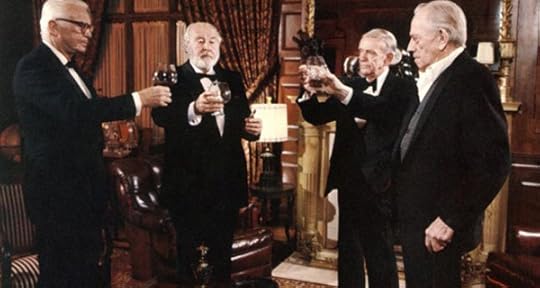
Peter Straub’s Ghost Story plays with this idea of spook stories. At its center are four old men – Lewis Benedikt, Sears James, Frederick Hawthorne and John Jaffrey – who have a haunted past; in order to cope with this past, they get together and tell ghost stories to each other. Scaring each other becomes cathartic.
I could go on with the plot, I suppose, but one of the pleasures (or frustrations, depending on your nature) of this book is how you gain understanding gradually, as the story unfolds. For instance, the novel opens with a brief prologue in which a man we do not know has apparently kidnapped a child we do not know. These scenes won’t pay off for many hundreds of pages, and to say anything more ventures into spoiler territory. Besides, the plot is relatively dense, and if I tried to explain it, I’d probably get it wrong anyway.
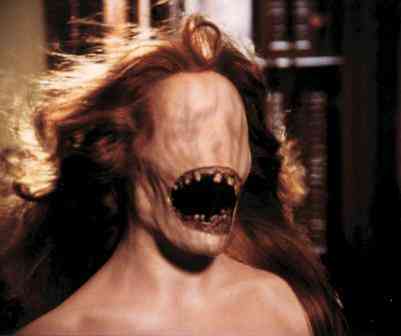
Suffice it to say, the thing or things that is haunting our four main characters has returned to the small town of Milburn, New York. And it didn’t come for the maple syrup festival.
I’ll leave it to you to discover the rest.
What I appreciated about Ghost Story was that it understood the nature of fear. Fear is that moment when you think something is about to happen; it is that part in a horror movie when the main character is about to open the closet door, and you, the viewer, start to duck your head beneath the blanket. When something finally jumps out of the closet, and the main character starts running, and you scream and spill popcorn, that’s not fear. That is the release of tension.
The reason I always liked the first Friday the 13th film is because it recognized this distinction. The whole movie was people being watched and stalked by something faceless and nameless and left to our imaginations. There is very little running through the woods, which is good, because chase scenes aren’t scary. In the 7,000 sequels that followed, the distinction was lost; the killer was known, was given shape and form, and all that was left was to run.
The most elegant metaphor I can think of to explain this is lovemaking. Please, bear with me. A good ghost story (like Ghost Story) is like that Spanish or Italian lover with the sensitive eyes and velvety voice, the one who drank wine from your navel and has nothing but time to devote to all manner of foreplay. This Spanish or Italian will taunt and tickle and tease and sing you a lilting love-song in Spanish or Italian that you can’t understand before finally bringing you to that place you want to go. A bad ghost story is like a drunk high-school student pawing at you in the backseat of a Honda Civic, concerned only with the end-release.
Oh, I’m sorry. Did I say the “most elegant” metaphor? Because I meant to say crass and vaguely disturbing.
Ghost Story takes its time reaching the climax, and this is a good thing. As long as things are still a bit unclear, as long as you can’t quite see around the next corner, the novel retains tension. I’m not saying it will scare you. It won’t make you scream aloud, for the simple reason that, unlike a movie, you can look away at any time and stop the action. However, there are parts that will give you the creeps; and there will be parts where your eyes will try to cheat by skipping ahead; and there is a chance, if you read this before bed and take a slug of Nyquill, you will have odd nightmares.
What I liked about Ghost Story, other than the fact it was like a Spanish or Italian lover, is that it made a real attempt to stay grounded in reality. Obviously, when you are dealing with ghosts, there is a paranormal or supernatural element involved. The more things tilt towards those elements, the less scared I become, for the simple fact that I can no longer relate to the world being described.
To that end, Peter Straub makes an enormous effort to give his characters backgrounds and back-stories and meaningful traits. He grounds the most fantastical elements by devoting equal time to the human element. I’m not saying that he achieves supreme psychological depth with each person, but he certainly surmounts the confines of his genre (and goes far beyond you might expect in a book titled Ghost Story).
One of my favorite aspects of Ghost Story is its sense of place. Straub spends a lot of time making the hamlet of Milburn into a character. You get to know its layout, its history, its local hangouts, and you meet dozens and dozens of its denizens. Indeed, you meet so many, you might want to keep a list (this will come in handy when attempting to recall who is sleeping with who, and who just died).
Ghost Story is horror with a literary bent. Sure, there are some lines of dialogue that land with all the grace of me dropping War and Peace on my toe. But that’s to be expected. For the most part, the level of the writing defies the primitiveness of its subject. You see this not only in the care taken with the characters (both main and supporting), but with the story’s complex structure, which involves numerous flashbacks and stories-within-stories.
Of course, as with any ghost story, there has to be a “Boo!” moment. At some point, the mysteries start to resolve themselves, the enemy takes shape, and our heroes must find a way to kill it. I’ll admit, my attention started to wane towards the end, once the explanatory dialogue started flying (and there is a lot of explaining to do). Eventually, there is a final battle between good and evil, human and not-human, and it is suitably over-the-top and gory, for those that expect that sort of thing, and when the dust settles all the puzzle pieces come together to form a whole.
It satisfies, I suppose, but is not nearly as interesting as the long, detailed, creepy road that led to that point.