

What do you think?

Magical Worlds of Fantasy #2
Witches: Isaac Asimov's Magical Worlds of Fantasy 2
Book by
304 pages, Mass Market Paperback
First published April 3, 1984
About the author
Isaac Asimov
4,430 books28.8k followersWorks of prolific Russian-American writer Isaac Asimov include popular explanations of scientific principles,
The Foundation Trilogy
(1951-1953), and other volumes of fiction.
Isaac Asimov, a professor of biochemistry, wrote as a highly successful author, best known for his books.
Asimov, professor, generally considered of all time, edited more than five hundred books and ninety thousand letters and postcards. He published in nine of the ten major categories of the Dewey decimal classification but lacked only an entry in the category of philosophy (100).
People widely considered Asimov, a master of the genre alongside Robert Anson Heinlein and Arthur Charles Clarke as the "big three" during his lifetime. He later tied Galactic Empire and the Robot into the same universe as his most famous series to create a unified "future history" for his stories much like those that Heinlein pioneered and Cordwainer Smith and Poul Anderson previously produced. He penned "Nightfall," voted in 1964 as the best short story of all time; many persons still honor this title. He also produced well mysteries, fantasy, and a great quantity of nonfiction. Asimov used Paul French, the pen name, for the Lucky Starr, series of juvenile novels.
Most books of Asimov in a historical way go as far back to a time with possible question or concept at its simplest stage. He often provides and mentions well nationalities, birth, and death dates for persons and etymologies and pronunciation guides for technical terms. Guide to Science, the tripartite set Understanding Physics, and Chronology of Science and Discovery exemplify these books.
Asimov, a long-time member, reluctantly served as vice president of Mensa international and described some members of that organization as "brain-proud and aggressive about their IQs." He took more pleasure as president of the humanist association. The asteroid 5020 Asimov, the magazine Asimov's Science Fiction, an elementary school in Brooklyn in New York, and two different awards honor his name.
http://en.wikipedia.org/wiki/Isaac_As...
Isaac Asimov, a professor of biochemistry, wrote as a highly successful author, best known for his books.
Asimov, professor, generally considered of all time, edited more than five hundred books and ninety thousand letters and postcards. He published in nine of the ten major categories of the Dewey decimal classification but lacked only an entry in the category of philosophy (100).
People widely considered Asimov, a master of the genre alongside Robert Anson Heinlein and Arthur Charles Clarke as the "big three" during his lifetime. He later tied Galactic Empire and the Robot into the same universe as his most famous series to create a unified "future history" for his stories much like those that Heinlein pioneered and Cordwainer Smith and Poul Anderson previously produced. He penned "Nightfall," voted in 1964 as the best short story of all time; many persons still honor this title. He also produced well mysteries, fantasy, and a great quantity of nonfiction. Asimov used Paul French, the pen name, for the Lucky Starr, series of juvenile novels.
Most books of Asimov in a historical way go as far back to a time with possible question or concept at its simplest stage. He often provides and mentions well nationalities, birth, and death dates for persons and etymologies and pronunciation guides for technical terms. Guide to Science, the tripartite set Understanding Physics, and Chronology of Science and Discovery exemplify these books.
Asimov, a long-time member, reluctantly served as vice president of Mensa international and described some members of that organization as "brain-proud and aggressive about their IQs." He took more pleasure as president of the humanist association. The asteroid 5020 Asimov, the magazine Asimov's Science Fiction, an elementary school in Brooklyn in New York, and two different awards honor his name.
http://en.wikipedia.org/wiki/Isaac_As...
Ratings & Reviews
Friends & Following
Create a free account to discover what your friends think of this book!
Community Reviews
Displaying 1 - 9 of 9 reviews

December 29, 2024
Generally anthologies are a mixed bag: a few good stand-outs, a bunch of mediocre stories, and a couple duds. These were uniformly better than I expected, and I enjoyed almost all of them, aside from a few dated instances of sexism or racism (fairly unavoidable in old scifi--in this case, one story relied heavily on several characters knowing that a father was abusing his daughter but not doing anything about it because "that's his business"). The genres ranged from fantasy to horror to science fiction, and all of the stories had something unique so this didn't feel like a predictable collection. Having Asimov's name in big letters on the cover is a bit misleading since he didn't write any of the stories himself, and two other editors worked on compiling the stories, but that was fine by me; the authors included all won various awards and were skilled in their areas of expertise.

January 31, 2025
Solid collection of the real Old Guard of sci fi/fantasy pulp zine contributors, with this collection being a witch theme.
September 9, 2020
I have just started this anthology of stories about Witches.
The 3rd story is so far my favorite. It stuck with me amongst the others. I still have to finish so that may be added to by others I read.
This one is called The Witch and its by A.E. van Vogt.
The impression it leaves with me is haunting to say the least. Could easily be scripted into a play or film. It does stretch the Witch to be something that can live from life to life extending its time. Also the sea being where it originated is maybe something stemming from a Lovecraft mythos?
The rest of the stories though good were not what I would have thought as picks for an anthology called Witches. Some were more scifi/magic adventure stories or just an ode to something barely witchy.
Why is it so hard to find a real witch story.
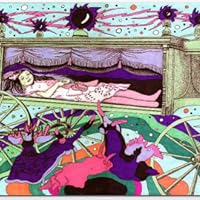
The cover is phenomenal though! Just a note.
The 3rd story is so far my favorite. It stuck with me amongst the others. I still have to finish so that may be added to by others I read.
This one is called The Witch and its by A.E. van Vogt.
The impression it leaves with me is haunting to say the least. Could easily be scripted into a play or film. It does stretch the Witch to be something that can live from life to life extending its time. Also the sea being where it originated is maybe something stemming from a Lovecraft mythos?
The rest of the stories though good were not what I would have thought as picks for an anthology called Witches. Some were more scifi/magic adventure stories or just an ode to something barely witchy.
Why is it so hard to find a real witch story.
The cover is phenomenal though! Just a note.

January 12, 2026
A collection of fair to good stories with a couple of gems, I wavered on the fourth star, and withheld it for two reasons.
One, this is a themed anthology, & I don't think the stories stuck very well to their theme.
Combined with that above, it's A reprint anthology reaching back to the 1920s, printed in 1984, which gives a wider field of, in some cases better choices that would also have struck within theme.
One, this is a themed anthology, & I don't think the stories stuck very well to their theme.
Combined with that above, it's A reprint anthology reaching back to the 1920s, printed in 1984, which gives a wider field of, in some cases better choices that would also have struck within theme.

December 24, 2021
-Gregory Kerkman

September 27, 2014
I'm not a big fan of magic but this one caught my eye because Isaac Asimov's name is real big on the cover. This collection is called Witches: Isaac Asimov's Magical Worlds of Fantasy #2. I recommend picking it up just for the Poul Anderson story Operation Salamander. It's a very fun story set in a world where magic is basically science and a fire elemental terrorizes a town.
There is also a very good Robert Bloch story called Sweets to the Sweet which is super creepy. It also contains stories by A. E. van Vogt, Andre Norton, and one of my particular favorites by Rufus King called Malice in Wonderland. Definitely check this collection out if you are a fan of magic or Asimov.
There is also a very good Robert Bloch story called Sweets to the Sweet which is super creepy. It also contains stories by A. E. van Vogt, Andre Norton, and one of my particular favorites by Rufus King called Malice in Wonderland. Definitely check this collection out if you are a fan of magic or Asimov.

February 1, 2008
I read this only two weeks ago and I can only remember two of the stories. I don't normally rate short story collections, but I've got to give a thumbs don't on this lot.

June 30, 2013
A collection of short stories by various authors.
September 19, 2014
Not what I though it would be..... A hard read indeed....
Displaying 1 - 9 of 9 reviews