

What do you think?

Classics of the Macabre
This illustrated collection includes six du Maurier tales--"Don't Look Now," "The Birds," "The Apple Tree," "The Alibi," "Not After Midnight," and "The Blue Lenses".
284 pages, Hardcover
First published January 1, 1987
About the author
Daphne du Maurier
440 books10.9k followersDaphne du Maurier was born on 13 May 1907 at 24 Cumberland Terrace, Regent's Park, London, the middle of three daughters of prominent actor-manager Sir Gerald du Maurier and actress Muriel, née Beaumont. In many ways her life resembles a fairy tale. Born into a family with a rich artistic and historical background, her paternal grandfather was author and Punch cartoonist George du Maurier, who created the character of Svengali in the 1894 novel Trilby, and her mother was a maternal niece of journalist, author, and lecturer Comyns Beaumont. She and her sisters were indulged as a children and grew up enjoying enormous freedom from financial and parental restraint. Her elder sister, Angela du Maurier, also became a writer, and her younger sister Jeanne was a painter.
She spent her youth sailing boats, travelling on the Continent with friends, and writing stories. Her family connections helped her establish her literary career, and she published some of her early work in Beaumont's Bystander magazine. A prestigious publishing house accepted her first novel when she was in her early twenties, and its publication brought her not only fame but the attentions of a handsome soldier, Major (later Lieutenant-General Sir) Frederick Browning, whom she married.
She continued writing under her maiden name, and her subsequent novels became bestsellers, earning her enormous wealth and fame. Many have been successfully adapted into films, including the novels Rebecca, Frenchman's Creek, My Cousin Rachel, and Jamaica Inn, and the short stories The Birds and Don't Look Now/Not After Midnight. While Alfred Hitchcock's films based upon her novels proceeded to make her one of the best-known authors in the world, she enjoyed the life of a fairy princess in a mansion in Cornwall called Menabilly, which served as the model for Manderley in Rebecca.
Daphne du Maurier was obsessed with the past. She intensively researched the lives of Francis and Anthony Bacon, the history of Cornwall, the Regency period, and nineteenth-century France and England. Above all, however, she was obsessed with her own family history, which she chronicled in Gerald: A Portrait, a biography of her father; The du Mauriers, a study of her family which focused on her grandfather, George du Maurier, the novelist and illustrator for Punch; The Glassblowers, a novel based upon the lives of her du Maurier ancestors; and Growing Pains, an autobiography that ignores nearly 50 years of her life in favour of the joyful and more romantic period of her youth. Daphne du Maurier can best be understood in terms of her remarkable and paradoxical family, the ghosts which haunted her life and fiction.
While contemporary writers were dealing critically with such subjects as the war, alienation, religion, poverty, Marxism, psychology and art, and experimenting with new techniques such as the stream of consciousness, du Maurier produced 'old-fashioned' novels with straightforward narratives that appealed to a popular audience's love of fantasy, adventure, sexuality and mystery. At an early age, she recognised that her readership was comprised principally of women, and she cultivated their loyal following through several decades by embodying their desires and dreams in her novels and short stories.
In some of her novels, however, she went beyond the technique of the formulaic romance to achieve a powerful psychological realism reflecting her intense feelings about her father, and to a lesser degree, her mother. This vision, which underlies Julius, Rebecca and The Parasites, is that of an author overwhelmed by the memory of her father's commanding presence. In Julius and The Parasites, for example, she introduces the image of a domineering but deadly father and the daring subject of incest.
In Rebecca, on the other hand, du Maurier fuses psychological realism with a sophisticated version of the Cinderella story.
She spent her youth sailing boats, travelling on the Continent with friends, and writing stories. Her family connections helped her establish her literary career, and she published some of her early work in Beaumont's Bystander magazine. A prestigious publishing house accepted her first novel when she was in her early twenties, and its publication brought her not only fame but the attentions of a handsome soldier, Major (later Lieutenant-General Sir) Frederick Browning, whom she married.
She continued writing under her maiden name, and her subsequent novels became bestsellers, earning her enormous wealth and fame. Many have been successfully adapted into films, including the novels Rebecca, Frenchman's Creek, My Cousin Rachel, and Jamaica Inn, and the short stories The Birds and Don't Look Now/Not After Midnight. While Alfred Hitchcock's films based upon her novels proceeded to make her one of the best-known authors in the world, she enjoyed the life of a fairy princess in a mansion in Cornwall called Menabilly, which served as the model for Manderley in Rebecca.
Daphne du Maurier was obsessed with the past. She intensively researched the lives of Francis and Anthony Bacon, the history of Cornwall, the Regency period, and nineteenth-century France and England. Above all, however, she was obsessed with her own family history, which she chronicled in Gerald: A Portrait, a biography of her father; The du Mauriers, a study of her family which focused on her grandfather, George du Maurier, the novelist and illustrator for Punch; The Glassblowers, a novel based upon the lives of her du Maurier ancestors; and Growing Pains, an autobiography that ignores nearly 50 years of her life in favour of the joyful and more romantic period of her youth. Daphne du Maurier can best be understood in terms of her remarkable and paradoxical family, the ghosts which haunted her life and fiction.
While contemporary writers were dealing critically with such subjects as the war, alienation, religion, poverty, Marxism, psychology and art, and experimenting with new techniques such as the stream of consciousness, du Maurier produced 'old-fashioned' novels with straightforward narratives that appealed to a popular audience's love of fantasy, adventure, sexuality and mystery. At an early age, she recognised that her readership was comprised principally of women, and she cultivated their loyal following through several decades by embodying their desires and dreams in her novels and short stories.
In some of her novels, however, she went beyond the technique of the formulaic romance to achieve a powerful psychological realism reflecting her intense feelings about her father, and to a lesser degree, her mother. This vision, which underlies Julius, Rebecca and The Parasites, is that of an author overwhelmed by the memory of her father's commanding presence. In Julius and The Parasites, for example, she introduces the image of a domineering but deadly father and the daring subject of incest.
In Rebecca, on the other hand, du Maurier fuses psychological realism with a sophisticated version of the Cinderella story.
Ratings & Reviews
Friends & Following
Create a free account to discover what your friends think of this book!
Community Reviews
Displaying 1 - 30 of 94 reviews

January 24, 2020
** Please note, this is a review of this particular edition of “Classics of the Macabre” by Daphne du Maurier, and the rating applies as such. Reviews of each individual story, and its rating, will be elsewhere on my shelves. **
“The element of the macabre which runs through many of my books has, I think, grown stronger over the years, especially in my short stories.”
So says the author Daphne du Maurier, in the introduction to this book, Classics of the Macabre.
She knew herself well. Her work changed immensely in mood over the years, from her first novel “The Loving Spirit” to the spine-chilling stories of later years. This collection of just six of Daphne du Maurier’s stories represent those which vary between unsettling at the least, and extremely disturbing. It was published to commemorate her 80th birthday.
The short stories of Daphne du Maurier were published in several collections during her lifetime. Confusingly, each might be in more than one collection, with a different title; either taken from one of the stories, or a title like this one, Classics of the Macabre. She may well have had a hand in selecting these half dozen, as they are among her most popular, although taken from different original collections. They are:
“Don’t Look Now” 1971 a classic story of the macabre, followed by
“The Apple Tree” 1952
“The Blue Lenses” 1959
“The Birds” 1952
“The Alibi” 1959 and
“Not After Midnight” 1971
Two of these have been filmed. Daphne du Maurier enjoyed the adaptation of her stories into films, and in turn she was one of Alfred Hitchcock’s favourite authors. His first foray into dramatising her stories was for her novel “Jamaica Inn”, but unfortunately Daphne du Maurier hated the film and Hitchcock all but disowned it. “Rebecca”, on the other hand, was a success for them both, and Hitchcock’s third and final adaptation of Daphne du Maurier’s work was of “The Birds”, the fourth story in this collection.
Other films were made of Daphne du Maurier’s novels. “Hungry Hill”, “My Cousin Rachel” and “The Scapegoat” all reached the cinema, with varying input from the author. She co-wrote the screenplay for “Hungry Hill” and she was an executive producer of “The Scapegoat”. But her favourite film of all was Nicolas Roeg’s version of the novella which begins this collection, “Don’t Look Now”. This is quite surprising, as the 1973 film deviates significantly from the long short story she wrote two years earlier, just as “The Birds 1952” is completely different, both in its setting (the USA rather than England) and characters. She must have felt that these films captured the essential mood of her stories, even though liberties had been taken with the source material.
This is what she feels about the illustrations in this volume, saying:
“Their mood is admirably captured here by Michael Foreman. I hope my readers will think so too.”
Not many volumes of short stories, with perhaps the exception of classics from the 19th century and earlier, are illustrated in quite such a lavish way as this one. As I looked through it, I thought, I’ll bet that the publisher describes this as “sumptuous”. And sure enough, on the flyleaf, the blurb begins:
“This sumptuous volume celebrates the 80th birthday of one of the best-known and most-loved storytellers in the English language today, Daphne du Maurier.”
It is a heavy volume using thick, high-grade paper, with a silk gloss finish. The book is larger than an average hardback, but not so large as to be called oversize. The print is good, normal print. Most of the illustrations take a whole page, with some being incorporated into the text.
If I am honest, Michael Foreman is not one of my favourite illustrators, although he is skilled, and his output is enormous. He is very popular, but I have always felt his illustrations lack something: for me they lack atmosphere. Here he works exclusively in watercolour, and uses a traditional technique, where the colour is put in in large wet swathes, or washes, and then bled or blotted off, leaving a watercolour outline, with a pale, tinted interior space. To me, this does not produce the type of images which suit disturbing or horrific tales. It is too … pretty. The one story which is the exception is “The Blue Lenses”:
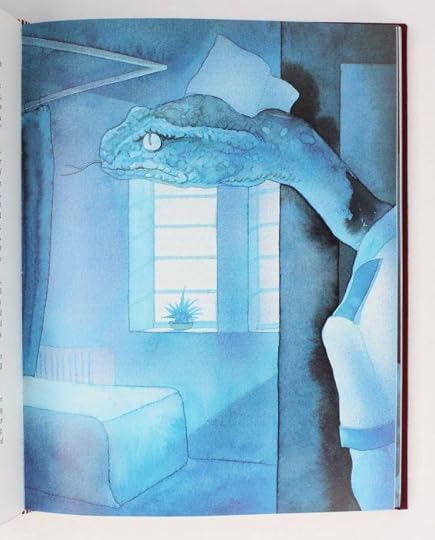
Here Michael Foreman has allowed his brush to be loaded with more saturated colour - and he has not syphoned it off, but allowed it to stay a dense blue. He has also painted in details, rather than leaving an impressionistic illustration. I liked these a lot, but to enjoy the illustrations to one story out of of six, is not really a good percentage. The addition of these illustrations did nothing to enhance the book for me. However, who am I to gainsay the author herself? It is always good to have the author’s input on adaptations of, or illustrations to, their work. Sometimes it is not what one would expect.
Of this particular story, Daphne du Maurier says:
“I remember once having to go into hospital to have my wisdom teeth extracted. Feeling wretched, my eyes closed to the ministrations of nurses and doctors, I would try to imagine how they looked, how their faces matched their voices; some soothing, some hectoring, some subtly menacing - and “The Blue Lenses” was born.”
She gives the inspiration, or trigger, for each of these stories. For “Don’t Look Now”, two completely separate incidents set her thinking. One was two old women, twins, sitting at a table in St. Mark’s Square “like a sinister Greek chorus”, and a child jumping from a cellar into a narrow boat after dark. She soaked up the atmosphere of Venice, and the eeriness of the back street at night, and says: “Ideas began to develop into a story”.
The idea behind “The Apple Tree” story lay dormant for a long time. During the Second World War, Daphne du Maurier, her husband and three children were billeted in a house near London. It had a large garden, and large apple orchard, the memories of which were to come back to her, many years later.
“The Birds”, as mentioned before, was set in England, and the trigger came in her beloved Cornwall. Every day, as she walked along the cliff top, she would see a farmer ploughing his fields:
“his tractor followed by flocks of gulls screaming and crying. As they dived for worms and insects, I thought: 'Supposing they stop being interested in worms?’”
Daphne du Maurier always hated being away from Cornwall, which she loved with a passion. “The Alibi” grew from some weeks she had to spend in London. Every afternoon she and her husband would walk along the Chelsea Embankment, watching the boats, yet still she longed to be home. The depressing view of the bombed-out buildings which surrounded them, led to the story.
“Not After Midnight” also stemmed from two incidents, this time in Crete. Once they saw a fat man, obviously worse for drink, throwing beer bottles into what is known as the “Bottomless Pool”, while the local fishermen jeered and egged him on. Daphne du Maurier was fascinated by Greek mythology, and the odd thing about this incident was that this bloated man reminded her of Silenus, the satyr tutor of Dionysus. This sowed the seeds for the story.
It is a good selection of bizarre stories ranging from obsession, to spirits and ghosts, to a psychological thriller. They are frightening and thought-provoking by turn. Whether it is haunting, horrific episodes, planned murder, or creatures with inexplicable uncanny powers, when reading a short story by Daphne du Maurier, things are never what they seem.
“Though not at all psychic - I have never seen a ghost or dabbled in spiritualism or the occult - I have always been fascinated by the unexplained, the darker side of life. I have a strong sense of the things that lie beyond our day-to-day perception and experience. It is perhaps an extension of this feeling, that makes me live through the characters that I create.”
“The element of the macabre which runs through many of my books has, I think, grown stronger over the years, especially in my short stories.”
So says the author Daphne du Maurier, in the introduction to this book, Classics of the Macabre.
She knew herself well. Her work changed immensely in mood over the years, from her first novel “The Loving Spirit” to the spine-chilling stories of later years. This collection of just six of Daphne du Maurier’s stories represent those which vary between unsettling at the least, and extremely disturbing. It was published to commemorate her 80th birthday.
The short stories of Daphne du Maurier were published in several collections during her lifetime. Confusingly, each might be in more than one collection, with a different title; either taken from one of the stories, or a title like this one, Classics of the Macabre. She may well have had a hand in selecting these half dozen, as they are among her most popular, although taken from different original collections. They are:
“Don’t Look Now” 1971 a classic story of the macabre, followed by
“The Apple Tree” 1952
“The Blue Lenses” 1959
“The Birds” 1952
“The Alibi” 1959 and
“Not After Midnight” 1971
Two of these have been filmed. Daphne du Maurier enjoyed the adaptation of her stories into films, and in turn she was one of Alfred Hitchcock’s favourite authors. His first foray into dramatising her stories was for her novel “Jamaica Inn”, but unfortunately Daphne du Maurier hated the film and Hitchcock all but disowned it. “Rebecca”, on the other hand, was a success for them both, and Hitchcock’s third and final adaptation of Daphne du Maurier’s work was of “The Birds”, the fourth story in this collection.
Other films were made of Daphne du Maurier’s novels. “Hungry Hill”, “My Cousin Rachel” and “The Scapegoat” all reached the cinema, with varying input from the author. She co-wrote the screenplay for “Hungry Hill” and she was an executive producer of “The Scapegoat”. But her favourite film of all was Nicolas Roeg’s version of the novella which begins this collection, “Don’t Look Now”. This is quite surprising, as the 1973 film deviates significantly from the long short story she wrote two years earlier, just as “The Birds 1952” is completely different, both in its setting (the USA rather than England) and characters. She must have felt that these films captured the essential mood of her stories, even though liberties had been taken with the source material.
This is what she feels about the illustrations in this volume, saying:
“Their mood is admirably captured here by Michael Foreman. I hope my readers will think so too.”
Not many volumes of short stories, with perhaps the exception of classics from the 19th century and earlier, are illustrated in quite such a lavish way as this one. As I looked through it, I thought, I’ll bet that the publisher describes this as “sumptuous”. And sure enough, on the flyleaf, the blurb begins:
“This sumptuous volume celebrates the 80th birthday of one of the best-known and most-loved storytellers in the English language today, Daphne du Maurier.”
It is a heavy volume using thick, high-grade paper, with a silk gloss finish. The book is larger than an average hardback, but not so large as to be called oversize. The print is good, normal print. Most of the illustrations take a whole page, with some being incorporated into the text.
If I am honest, Michael Foreman is not one of my favourite illustrators, although he is skilled, and his output is enormous. He is very popular, but I have always felt his illustrations lack something: for me they lack atmosphere. Here he works exclusively in watercolour, and uses a traditional technique, where the colour is put in in large wet swathes, or washes, and then bled or blotted off, leaving a watercolour outline, with a pale, tinted interior space. To me, this does not produce the type of images which suit disturbing or horrific tales. It is too … pretty. The one story which is the exception is “The Blue Lenses”:
Here Michael Foreman has allowed his brush to be loaded with more saturated colour - and he has not syphoned it off, but allowed it to stay a dense blue. He has also painted in details, rather than leaving an impressionistic illustration. I liked these a lot, but to enjoy the illustrations to one story out of of six, is not really a good percentage. The addition of these illustrations did nothing to enhance the book for me. However, who am I to gainsay the author herself? It is always good to have the author’s input on adaptations of, or illustrations to, their work. Sometimes it is not what one would expect.
Of this particular story, Daphne du Maurier says:
“I remember once having to go into hospital to have my wisdom teeth extracted. Feeling wretched, my eyes closed to the ministrations of nurses and doctors, I would try to imagine how they looked, how their faces matched their voices; some soothing, some hectoring, some subtly menacing - and “The Blue Lenses” was born.”
She gives the inspiration, or trigger, for each of these stories. For “Don’t Look Now”, two completely separate incidents set her thinking. One was two old women, twins, sitting at a table in St. Mark’s Square “like a sinister Greek chorus”, and a child jumping from a cellar into a narrow boat after dark. She soaked up the atmosphere of Venice, and the eeriness of the back street at night, and says: “Ideas began to develop into a story”.
The idea behind “The Apple Tree” story lay dormant for a long time. During the Second World War, Daphne du Maurier, her husband and three children were billeted in a house near London. It had a large garden, and large apple orchard, the memories of which were to come back to her, many years later.
“The Birds”, as mentioned before, was set in England, and the trigger came in her beloved Cornwall. Every day, as she walked along the cliff top, she would see a farmer ploughing his fields:
“his tractor followed by flocks of gulls screaming and crying. As they dived for worms and insects, I thought: 'Supposing they stop being interested in worms?’”
Daphne du Maurier always hated being away from Cornwall, which she loved with a passion. “The Alibi” grew from some weeks she had to spend in London. Every afternoon she and her husband would walk along the Chelsea Embankment, watching the boats, yet still she longed to be home. The depressing view of the bombed-out buildings which surrounded them, led to the story.
“Not After Midnight” also stemmed from two incidents, this time in Crete. Once they saw a fat man, obviously worse for drink, throwing beer bottles into what is known as the “Bottomless Pool”, while the local fishermen jeered and egged him on. Daphne du Maurier was fascinated by Greek mythology, and the odd thing about this incident was that this bloated man reminded her of Silenus, the satyr tutor of Dionysus. This sowed the seeds for the story.
It is a good selection of bizarre stories ranging from obsession, to spirits and ghosts, to a psychological thriller. They are frightening and thought-provoking by turn. Whether it is haunting, horrific episodes, planned murder, or creatures with inexplicable uncanny powers, when reading a short story by Daphne du Maurier, things are never what they seem.
“Though not at all psychic - I have never seen a ghost or dabbled in spiritualism or the occult - I have always been fascinated by the unexplained, the darker side of life. I have a strong sense of the things that lie beyond our day-to-day perception and experience. It is perhaps an extension of this feeling, that makes me live through the characters that I create.”

February 3, 2021
This was very disappointing in that I have really enjoyed reading du Maurier’s novels (Rebecca, My Cousin Rachel, The Scapegoat) and a short story collection (The Doll: The Lost Short Stories), and was expecting good things from this short story collection. I am glad that this was not my first introduction to Daphne du Maurier’s oeuvre. The collection of stories, overall, was boring. I just read the last story, Not After Midnight, that was 49 pages long. That one took the cake in regards to boring. After reading it I felt somewhat good when I came across this:
• Du Maurier's biographer Margaret Forster considered "Not After Midnight" to be a 'not very successful story', demonstrating how the author's liking for intricate plot could lead her into complications which made her writing tortuous.
At least it wasn’t just me! 🤨
The collection has 6 long (~40 pages) short stories:
• Don’t Look Now (1971), 2.5 stars—This was made into a movie in 1973 starting Donald Sutherland and Julie Christie. Roger Ebert gave it an extremely favorable review [https://www.rogerebert.com/reviews/gr...]. It appears they took some poetic license but that is normal. I must confess that I had to look up several other people’s reviews to understand what this story was all about. I don’t know if other people had this problem or not. When I read what I had missed, things were clearer but of course they would be clearer. I don’t know if this was my fault (missing it) or Du Maurier’s. I ‘m probably jus looking for excuses. This is not the first time the clue train passed me by at the station.
• The Apple Tree (1952), 2.5 stars—A woman who tends to be a complainer to her husband dies, and he is sort of glad, and it turns out an old apple tree in her yard bears a striking resemblance to his wife, and he eventually chops her down because the tree looks like crap. Well, there’s still the jagged stump left in the ground. 😲
• The Blue Lenses (1959), 3.5 stars—I actually liked this story. A woman has an operation on her eyes, and when she finally gets her sight back people don’t look right. Their heads are replicas of their personalities (for example, a snake or a cow).
• The Birds (1952), 2.5 stars—This was adapted by Alfred Hitchcock in his movie (1963) of the same name. After reading this, you might want to start worrying about more than just a bird taking a crap on your head. (I had that happen about 10 years ago while running….I have not exercised since.)
• The Alibi (1959), 3 stars—Mildly interesting. A husband bored with his humdrum life takes on another life unbeknownst to those around him and it has unforeseen consequences.
• Not After Midnight (1971), 1 star— Only good thing about the story was its ending (in that it finally ended). 😬
Notes:
• These stories all came from prior short story collections of hers either The Apple Tree (1952, Victor Gollancz), or The Breaking Point (1959, Victor Gollancz), or Not After Midnight, and other stories (1971, Victor Gollancz).
• I fibbed about stopping running after a bird took a poop on me. I am still running. 🙃
Review:
From a blogsite: https://grotesqueground.wordpress.com...
• Du Maurier's biographer Margaret Forster considered "Not After Midnight" to be a 'not very successful story', demonstrating how the author's liking for intricate plot could lead her into complications which made her writing tortuous.
At least it wasn’t just me! 🤨
The collection has 6 long (~40 pages) short stories:
• Don’t Look Now (1971), 2.5 stars—This was made into a movie in 1973 starting Donald Sutherland and Julie Christie. Roger Ebert gave it an extremely favorable review [https://www.rogerebert.com/reviews/gr...]. It appears they took some poetic license but that is normal. I must confess that I had to look up several other people’s reviews to understand what this story was all about. I don’t know if other people had this problem or not. When I read what I had missed, things were clearer but of course they would be clearer. I don’t know if this was my fault (missing it) or Du Maurier’s. I ‘m probably jus looking for excuses. This is not the first time the clue train passed me by at the station.
• The Apple Tree (1952), 2.5 stars—A woman who tends to be a complainer to her husband dies, and he is sort of glad, and it turns out an old apple tree in her yard bears a striking resemblance to his wife, and he eventually chops her down because the tree looks like crap. Well, there’s still the jagged stump left in the ground. 😲
• The Blue Lenses (1959), 3.5 stars—I actually liked this story. A woman has an operation on her eyes, and when she finally gets her sight back people don’t look right. Their heads are replicas of their personalities (for example, a snake or a cow).
• The Birds (1952), 2.5 stars—This was adapted by Alfred Hitchcock in his movie (1963) of the same name. After reading this, you might want to start worrying about more than just a bird taking a crap on your head. (I had that happen about 10 years ago while running….I have not exercised since.)
• The Alibi (1959), 3 stars—Mildly interesting. A husband bored with his humdrum life takes on another life unbeknownst to those around him and it has unforeseen consequences.
• Not After Midnight (1971), 1 star— Only good thing about the story was its ending (in that it finally ended). 😬
Notes:
• These stories all came from prior short story collections of hers either The Apple Tree (1952, Victor Gollancz), or The Breaking Point (1959, Victor Gollancz), or Not After Midnight, and other stories (1971, Victor Gollancz).
• I fibbed about stopping running after a bird took a poop on me. I am still running. 🙃
Review:
From a blogsite: https://grotesqueground.wordpress.com...

October 23, 2023
Two of the stories (“The Alibi” and “The Birds”) in this collection are very good, two others (“Don’t Look Now” and “The Blue Lenses”) are pretty good, and then the remaining two ("The Apple Tree” and “Not After Midnight”) are just okay. Summaries below, from best to worst:
The Alibi
A married man having a midlife crisis contemplates becoming a cold-blooded murderer simply to gain a sense of power. The story contains a scary realistic depiction of the thought processes that lay behind serial killing:
“Houses were closed, withdrawn. ‘They don’t know,’ he thought, ‘those people inside, how one gesture of mine, now, at this minute, might alter their world. A knock on the door, and someone answers—a woman yawning, an old man in carpet slippers, a child sent by its parents in irritation; and according to what I will, what I decide, their whole future will be decided. Faces smashed in, Sudden murder. Theft. Fire.’ It was as simple as that.” (pp. 196-197)
The Birds
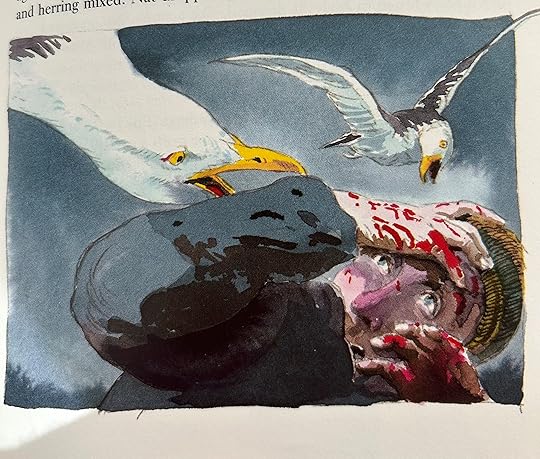
Bad weather and strong east winds drive aggravated, aggressive birds inland, where they come to attack in waves as the tide turns.
“They went for me. Tried to peck my eyes.” (p. 156)
Don’t Look Now
A husband and wife traveling in Venice encounter an unusual set of twins who may be able to see the future, and who may see dark things ahead for the married couple.
“Although she’s studied the occult all her life and been very psychic, it’s only since going blind that she has really seen things, like a medium.” (p. 24)
The Blue Lenses
A woman who has gone blind has surgery to restore her sight, revealing very strange things.
“One patient told me that it was as though she had been wearing spectacles all her life, and then, because of the operation, she realized she saw all her friends and her family as they really were.” (p. 144)
The Apple Tree
After being married for 25 years, a man loses the wife who he saw more as a burden or irritant than lover. But is she really gone?
“It was three months after she died that he first noticed the apple tree.” (p. 71)
Not After Midnight
A middle-aged schoolmaster and bachelor travels to Crete where there are smugglers and where the last person to rent his lodging died mysteriously.
“Hi, you there, chalet No. 62. You’re not superstitious?” (p. 245)
The Alibi
A married man having a midlife crisis contemplates becoming a cold-blooded murderer simply to gain a sense of power. The story contains a scary realistic depiction of the thought processes that lay behind serial killing:
“Houses were closed, withdrawn. ‘They don’t know,’ he thought, ‘those people inside, how one gesture of mine, now, at this minute, might alter their world. A knock on the door, and someone answers—a woman yawning, an old man in carpet slippers, a child sent by its parents in irritation; and according to what I will, what I decide, their whole future will be decided. Faces smashed in, Sudden murder. Theft. Fire.’ It was as simple as that.” (pp. 196-197)
The Birds
Bad weather and strong east winds drive aggravated, aggressive birds inland, where they come to attack in waves as the tide turns.
“They went for me. Tried to peck my eyes.” (p. 156)
Don’t Look Now
A husband and wife traveling in Venice encounter an unusual set of twins who may be able to see the future, and who may see dark things ahead for the married couple.
“Although she’s studied the occult all her life and been very psychic, it’s only since going blind that she has really seen things, like a medium.” (p. 24)
The Blue Lenses
A woman who has gone blind has surgery to restore her sight, revealing very strange things.
“One patient told me that it was as though she had been wearing spectacles all her life, and then, because of the operation, she realized she saw all her friends and her family as they really were.” (p. 144)
The Apple Tree
After being married for 25 years, a man loses the wife who he saw more as a burden or irritant than lover. But is she really gone?
“It was three months after she died that he first noticed the apple tree.” (p. 71)
Not After Midnight
A middle-aged schoolmaster and bachelor travels to Crete where there are smugglers and where the last person to rent his lodging died mysteriously.
“Hi, you there, chalet No. 62. You’re not superstitious?” (p. 245)

October 9, 2010
Classics of the Macabre is a collection of the (supposedly) Daphne du Maurier's best short stories packaged very nicely - multiple colored illustrations, gorgeous paper. As far as such collections go, it is very strong. Although the stories are satisfying to various degrees, all of them are equally spooky and suspenseful. I am amazed how well du Maurier laces her stories with so much thrill and foreboding.
My favorite in the bunch is definitely The Birds. Having never watched Hitchcock's movie adaptation, I do not know how the two mediums compare, but this apocalyptic story about birds suddenly turning on people is thrilling and scary in a Stephen King way.
Close second favorite is The Apple Tree about a man who one day sees an apple tree in his garden which strongly reminds him of his recently deceased nagging wife. Love how the perception of the dead wife changes throughout the book and how the apple tree embodies her essence.
Don't Look Now is very strong as well. A husband and wife are taking a vacation in Venice after the death of their daughter. They come across a couple of weird old ladies who tell them that their dead daughter wants them to leave Venice immediately or something bad is bound to happen. My favorite part of the story is that it raises an interesting question: can we actually change the course of our destinies?
The other three stories are a little weaker. In The Blue Lenses after an eye operation a patient suddenly starts seeing people around her as animals. In The Alibi a man decides to spice up his boring life by ... killing somebody. And finally, my least favorite story Not After Midnight about a man who acquires a mysterious malady after taking a vacation in Greece and encountering a strange American couple there. This story basically over-promises in terms of suspense but under-delivers in terms of resolution.
Even though the stories are not all equally good, they maintain a pretty consistent high quality. On the other hand, I was not at all impressed by the illustrations.
My favorite in the bunch is definitely The Birds. Having never watched Hitchcock's movie adaptation, I do not know how the two mediums compare, but this apocalyptic story about birds suddenly turning on people is thrilling and scary in a Stephen King way.
Close second favorite is The Apple Tree about a man who one day sees an apple tree in his garden which strongly reminds him of his recently deceased nagging wife. Love how the perception of the dead wife changes throughout the book and how the apple tree embodies her essence.
Don't Look Now is very strong as well. A husband and wife are taking a vacation in Venice after the death of their daughter. They come across a couple of weird old ladies who tell them that their dead daughter wants them to leave Venice immediately or something bad is bound to happen. My favorite part of the story is that it raises an interesting question: can we actually change the course of our destinies?
The other three stories are a little weaker. In The Blue Lenses after an eye operation a patient suddenly starts seeing people around her as animals. In The Alibi a man decides to spice up his boring life by ... killing somebody. And finally, my least favorite story Not After Midnight about a man who acquires a mysterious malady after taking a vacation in Greece and encountering a strange American couple there. This story basically over-promises in terms of suspense but under-delivers in terms of resolution.
Even though the stories are not all equally good, they maintain a pretty consistent high quality. On the other hand, I was not at all impressed by the illustrations.

June 17, 2019
Gorgeously written, truly creepy, entirely riveting. Du Maurier knows how to keep you reading, quickly turning the pages as she draws you into the lives of ordinary people under extraordinary circumstances.

July 31, 2018
Her short story "The Birds" is far different than the old movie.

August 17, 2018
Sześć opowiadań, które określić można jako thrillery psychologiczne. Każde z nich jest ciekawe na swój sposób, nie ma tu słabych pozycji. Wystarczy wspomnieć, że zbiór otwierają "Ptaki", na podstawie których powstał jeden z najsłynniejszych filmów Hitchcocka, a potem jest tylko lepiej.
"Ptaki" czyta się ciekawie w zestawieniu z filmem właśnie, bo Hitchcock nie miał zwyczaju wiernie adaptować twórczości du Maurier. Pod wieloma względami wolę opowiadanie, chociaż czemu właściwie tak jest to już temat na esej. "Ptaki" du Maurier to taka kameralna apokalipsa - rodzina mieszkająca w domu na uboczu nadmorskiej niewielkiej miejscowości. Pewnego dnia, wraz z nadejście zimy, ptaki zaczynają zachowywać się dziwnie, gromadząc się tysiącami i setkami tysięcy na linii brzegowej, na skałach, czujne i gotowe do ataku. Być może tylko rodzina głównego bohatera przeżyła pierwsze uderzenie i teraz muszą sobie radzić, zamknięci i odizolowani. To jest przejmująca wizja tych kilku godzin przed końcem świata i kolejnych dni po jego nadejściu, kiedy rozpaczliwie chwytamy się resztek cywilizacji ze wszystkich sił, wciąż czekając na komunikat radiowy chociażby. Ale cywilizacja nie wraca.
"Nie oglądaj się teraz" - małżeństwo po przejściach wybrało się w podróż po Włoszech, aby otrząsnąć się po stracie pięcioletniej córeczki. Przypadkiem (ale czy na pewno?) trafiają w jednej z restauracji na dwie stare Szkotki, rzekomo obdarzone zdolnością do widzenia zmarłych. Laura szuka u nich pocieszenia, John wietrzy podstęp. Przezabawnie jest widzieć, jak sam podejrzliwy mąż pada ofiarą manipulacji, przed którymi przestrzegał żonę. Opowiadanie jest ironiczne i niemal złośliwe w tym, jak sprytnie wytyka Johnowi wszystkie te słabości, które projektował na swoją żonę.
"Niebieskie soczewki" - to było wstrząsające. Marda przechodzi poważaną operację wzroku, dzięki której może odzyskać zdolność widzenia. Po zdjęciu bandaży musi jeszcze przez kilka dni nosić specjalne kolorowe soczewki filtrujące światło. Okazuje się, że operacja się udała i widzi aż za dobrze. Nie chcę zdradzać, o co chodzi, bo to warto przeczytać. Zasadniczo po operacji Marda widzi rzeczy takimi, jakimi są i jest to zdecydowanie zbyt przytłaczające. Zakończenie jest może nie zaskakujące, bo spodziewałam się czegoś w tym stylu, ale wciąż podane jest z taką precyzją, jak dobrze odmierzone gorzkie lekarstwo. Świetne napisane opowiadanie, chyba najbardziej zbliżone do fantastyki w tym tomie.
"Jabłoń" - impreza w stylu Edgara Allana Poe. Typowe polskie małżeństwo: samolubny dupek i cierpiąca w ostentacyjnym milczeniu żona, Midge. Midge umiera i jej małżonek wreszcie czuje się wolny, aby żyć bez niemych wyrzutów każdego dnia. Przynajmniej do czasu, gdy orientuje się, że stojąca na skraju sadu skarlała jabłonka zadziwiająco przypomina sylwetkę jego żony. Projektuje na nią całą swoją niechęć uzbieraną przez lata. W końcu postanawia ściąć drzewo w środku śnieżycy. To nie może się dobrze skończyć. Świetny portret psychologiczny człowieka popadającego w obłęd. Takie "Jabłonka oskarżycielem" :D Główny bohater cierpi na masę psychosomatycznych objawów, które powoli odbierają mu zdolność do racjonalnego zachowania.
"Alibi" - bohater opowiadania ma dość swojego życia, rutyny, obowiązków, pracy, życia towarzyskiego, całego tego miałkiego habitusu mieszczaństwa. Postanawia więc przypadkowo kogoś zabić, wejść do pierwszego lepszego domu i dokonać tam rzezi. To się nazywa kryzys wieku średniego. Kiedy już dobrał sobie ofiarę nie wszystko poszło zgodnie z planem. Warto przeczytać. Kolejny świetny portret psychologiczny. Podoba mi się to, że Maurier nie zostawia suchej nitki na mężczyznach z klasy średniej, opisując pełnię ich uprzedzeń i bigoterii. Obserwowanie, jak psychika głównego bohatera rozpada się z każdym dniem podwójnego życia, które zaczyna wieść to sporo frajdy.
"Nie po północy" - kolejne opowiadanie bliskie fantastyki, queercodowane, ale TW: pedofilia. Nauczyciel ze szkoły dla chłopców, malarz amator, wyjeżdża na Kretę na wakacje, głównie po to, aby malować. Wynajmuje domek, w którym wcześniej doszło do tragicznego wypadku i jego lokator utonął. Podejrzewa, że jest w to zamieszany lokator z domku obok, ekscentryczny i satyryczny bogacz, który całe dnie pije przyrządzony przez siebie samogon, zgodnie z recepturą sięgającą czasów Minotaura. Porozmawiajmy o demoralizującym wpływie greckiej kultury :D Po części to thriller, po części fantastyka, ponieważ można się kłócić, czy zakończenie ma coś wspólnego z magicznym napojem czy to efekt moralnej degrengolady głównego bohatera. Tak czy inaczej, sporo rozrywki.
"Ptaki" czyta się ciekawie w zestawieniu z filmem właśnie, bo Hitchcock nie miał zwyczaju wiernie adaptować twórczości du Maurier. Pod wieloma względami wolę opowiadanie, chociaż czemu właściwie tak jest to już temat na esej. "Ptaki" du Maurier to taka kameralna apokalipsa - rodzina mieszkająca w domu na uboczu nadmorskiej niewielkiej miejscowości. Pewnego dnia, wraz z nadejście zimy, ptaki zaczynają zachowywać się dziwnie, gromadząc się tysiącami i setkami tysięcy na linii brzegowej, na skałach, czujne i gotowe do ataku. Być może tylko rodzina głównego bohatera przeżyła pierwsze uderzenie i teraz muszą sobie radzić, zamknięci i odizolowani. To jest przejmująca wizja tych kilku godzin przed końcem świata i kolejnych dni po jego nadejściu, kiedy rozpaczliwie chwytamy się resztek cywilizacji ze wszystkich sił, wciąż czekając na komunikat radiowy chociażby. Ale cywilizacja nie wraca.
"Nie oglądaj się teraz" - małżeństwo po przejściach wybrało się w podróż po Włoszech, aby otrząsnąć się po stracie pięcioletniej córeczki. Przypadkiem (ale czy na pewno?) trafiają w jednej z restauracji na dwie stare Szkotki, rzekomo obdarzone zdolnością do widzenia zmarłych. Laura szuka u nich pocieszenia, John wietrzy podstęp. Przezabawnie jest widzieć, jak sam podejrzliwy mąż pada ofiarą manipulacji, przed którymi przestrzegał żonę. Opowiadanie jest ironiczne i niemal złośliwe w tym, jak sprytnie wytyka Johnowi wszystkie te słabości, które projektował na swoją żonę.
"Niebieskie soczewki" - to było wstrząsające. Marda przechodzi poważaną operację wzroku, dzięki której może odzyskać zdolność widzenia. Po zdjęciu bandaży musi jeszcze przez kilka dni nosić specjalne kolorowe soczewki filtrujące światło. Okazuje się, że operacja się udała i widzi aż za dobrze. Nie chcę zdradzać, o co chodzi, bo to warto przeczytać. Zasadniczo po operacji Marda widzi rzeczy takimi, jakimi są i jest to zdecydowanie zbyt przytłaczające. Zakończenie jest może nie zaskakujące, bo spodziewałam się czegoś w tym stylu, ale wciąż podane jest z taką precyzją, jak dobrze odmierzone gorzkie lekarstwo. Świetne napisane opowiadanie, chyba najbardziej zbliżone do fantastyki w tym tomie.
"Jabłoń" - impreza w stylu Edgara Allana Poe. Typowe polskie małżeństwo: samolubny dupek i cierpiąca w ostentacyjnym milczeniu żona, Midge. Midge umiera i jej małżonek wreszcie czuje się wolny, aby żyć bez niemych wyrzutów każdego dnia. Przynajmniej do czasu, gdy orientuje się, że stojąca na skraju sadu skarlała jabłonka zadziwiająco przypomina sylwetkę jego żony. Projektuje na nią całą swoją niechęć uzbieraną przez lata. W końcu postanawia ściąć drzewo w środku śnieżycy. To nie może się dobrze skończyć. Świetny portret psychologiczny człowieka popadającego w obłęd. Takie "Jabłonka oskarżycielem" :D Główny bohater cierpi na masę psychosomatycznych objawów, które powoli odbierają mu zdolność do racjonalnego zachowania.
"Alibi" - bohater opowiadania ma dość swojego życia, rutyny, obowiązków, pracy, życia towarzyskiego, całego tego miałkiego habitusu mieszczaństwa. Postanawia więc przypadkowo kogoś zabić, wejść do pierwszego lepszego domu i dokonać tam rzezi. To się nazywa kryzys wieku średniego. Kiedy już dobrał sobie ofiarę nie wszystko poszło zgodnie z planem. Warto przeczytać. Kolejny świetny portret psychologiczny. Podoba mi się to, że Maurier nie zostawia suchej nitki na mężczyznach z klasy średniej, opisując pełnię ich uprzedzeń i bigoterii. Obserwowanie, jak psychika głównego bohatera rozpada się z każdym dniem podwójnego życia, które zaczyna wieść to sporo frajdy.
"Nie po północy" - kolejne opowiadanie bliskie fantastyki, queercodowane, ale TW: pedofilia. Nauczyciel ze szkoły dla chłopców, malarz amator, wyjeżdża na Kretę na wakacje, głównie po to, aby malować. Wynajmuje domek, w którym wcześniej doszło do tragicznego wypadku i jego lokator utonął. Podejrzewa, że jest w to zamieszany lokator z domku obok, ekscentryczny i satyryczny bogacz, który całe dnie pije przyrządzony przez siebie samogon, zgodnie z recepturą sięgającą czasów Minotaura. Porozmawiajmy o demoralizującym wpływie greckiej kultury :D Po części to thriller, po części fantastyka, ponieważ można się kłócić, czy zakończenie ma coś wspólnego z magicznym napojem czy to efekt moralnej degrengolady głównego bohatera. Tak czy inaczej, sporo rozrywki.

January 28, 2024
Me pasan dos cosas con Daphne Du Maurier:
(1) En mi cabeza no puedo evitar encuadrarla más en el siglo XIX que en el siglo XX, a pesar de que nació en 1907.
(2) Los planteamientos de sus historias me parecen interesantes pero luego, en el desarrollo, lo noto todo un pelín demasiado alargado para mi gusto (los párrafos, las descripciones, las escenas, los pensamientos de los protagonistas) y me impaciento.
De esta antología, el cuento con el que menos me he impacientado, el que ha elevado la calificación del conjunto de 3 a 4 estrellas ha sido No mires ahora. Seguido de cerca por El manzano . Pero ninguno de los demás los considero malos en absoluto; solo un poco menos redondos.
(1) En mi cabeza no puedo evitar encuadrarla más en el siglo XIX que en el siglo XX, a pesar de que nació en 1907.
(2) Los planteamientos de sus historias me parecen interesantes pero luego, en el desarrollo, lo noto todo un pelín demasiado alargado para mi gusto (los párrafos, las descripciones, las escenas, los pensamientos de los protagonistas) y me impaciento.
De esta antología, el cuento con el que menos me he impacientado, el que ha elevado la calificación del conjunto de 3 a 4 estrellas ha sido No mires ahora. Seguido de cerca por El manzano . Pero ninguno de los demás los considero malos en absoluto; solo un poco menos redondos.

January 4, 2017
Classics of the Macabre is a collection of short stories by Daphne du Maurier. I had previously read another collection; The Blue Lenses and other books by du Maurier; The House on the Strand and Rebecca and the more I read, the more I've enjoyed her stories and writing style.
Classics of the Macabre contained a couple of stories I'd already read from The Blue Lenses, but I scrolled through them again to remind myself about how much I'd previously enjoyed them. This book contained 6 of her short stories; Don't Look Now, The Apple Tree, The Blue Lenses, The Birds, The Alibi and Not After Midnight. I was particularly interested reading The Birds as I've enjoyed the movie many times. It didn't disappoint and had a similar theme to the movie (obviously, I guess), but was more focused on one particularly family in England. The ending was also not quite so optimistic.
Each story was interesting, not scary really, just odd and strange. Don't Look Now is set in Venice and tells the story of a young couple getting over the loss of their daughter and people they meet who seem to have the ability to see spirits. The Apple Tree tells of a husband who ignores his wife even to her death and is haunted by an apple tree (his wife's spirit?????). The Blue Lenses (a favourite) tells of a woman who has an eye operation with interesting after effects. The Birds tells of an invasion of England by birds, birds and more birds. The Alibi is another tale of a husband is tired of his life and wants something more exciting... and finds it. Not After Midnight is the story of a man's visit to Crete on a solitary vacation who is caught up in a strange situation.
du Maurier is an excellent story teller and her tales are always unique. Well worth trying (4 stars)
Classics of the Macabre contained a couple of stories I'd already read from The Blue Lenses, but I scrolled through them again to remind myself about how much I'd previously enjoyed them. This book contained 6 of her short stories; Don't Look Now, The Apple Tree, The Blue Lenses, The Birds, The Alibi and Not After Midnight. I was particularly interested reading The Birds as I've enjoyed the movie many times. It didn't disappoint and had a similar theme to the movie (obviously, I guess), but was more focused on one particularly family in England. The ending was also not quite so optimistic.
Each story was interesting, not scary really, just odd and strange. Don't Look Now is set in Venice and tells the story of a young couple getting over the loss of their daughter and people they meet who seem to have the ability to see spirits. The Apple Tree tells of a husband who ignores his wife even to her death and is haunted by an apple tree (his wife's spirit?????). The Blue Lenses (a favourite) tells of a woman who has an eye operation with interesting after effects. The Birds tells of an invasion of England by birds, birds and more birds. The Alibi is another tale of a husband is tired of his life and wants something more exciting... and finds it. Not After Midnight is the story of a man's visit to Crete on a solitary vacation who is caught up in a strange situation.
du Maurier is an excellent story teller and her tales are always unique. Well worth trying (4 stars)
February 8, 2014
This book includes two of my favorite du Maurier stories -- "The Birds" and "The Blue Lenses." These are brilliant enough on their own, but Michael Foreman's gorgeous watercolor illustrations bring them vividly to life. "The Blue Lenses" especially benefits from pictures, since it's a terrifying story of how a woman's vision changes after what should have been a routine operation. Getting to see what she sees makes the story so much more gripping.
"The Alibi" also benefits quite directly from illustrations. The main character decides to take up art (and murder), and Foreman illustrates du Maurier's descriptions of this psychopath's clumsy attempts to paint.
I love du Maurier's short fiction anyway, but this illustrated collection is really worth looking out for. It doesn't seem to be in print any more, but it's the kind of book libraries tend to carry.
"The Alibi" also benefits quite directly from illustrations. The main character decides to take up art (and murder), and Foreman illustrates du Maurier's descriptions of this psychopath's clumsy attempts to paint.
I love du Maurier's short fiction anyway, but this illustrated collection is really worth looking out for. It doesn't seem to be in print any more, but it's the kind of book libraries tend to carry.

March 26, 2014
Speaking of the weird stories of du Maurier, read these if you haven't already. "The Birds" is much more disturbing as a short story. And as disturbing as it is, it doesn't come close to "Don't Look Now" which has a very Poe quality. And if Rod Serling never televised "The Blue Lenses" I can't imagine why not.
Anyway, highly recommended for October. And if anyone can't point me to a source of modern suspenseful/creepy stories of the Du Maurier/Dahl/Serling school, please do. I love this stuff that isn't exactly horror. The only similar collection I can remember reading recently was 20th Century Ghosts, which I loved.
Anyway, highly recommended for October. And if anyone can't point me to a source of modern suspenseful/creepy stories of the Du Maurier/Dahl/Serling school, please do. I love this stuff that isn't exactly horror. The only similar collection I can remember reading recently was 20th Century Ghosts, which I loved.

January 11, 2023
I found these short stories better than her longer works. Creepy and twist in the tail. And the illustrations by Michael Foreman are great, a very fine illustrator.

October 23, 2023
Daphne du Maurier nigdy nie zawodzi. Kolejny zbiór opowiadań, który mnie zachwycił!

November 4, 2020
,,Makabreski’’ to zbiór sześciu mini opowiastek osadzonych w nastrojowym klimacie. Nakreślone przez autorkę historie wypełnione są elementami charakterystycznymi dla powieści gotyckiej, literatury grozy, klasycznego kryminału, a nawet thrillera. Tytuł antologii (niezwykle trafny zresztą) wskazuje na makabryczną ucztę literacką. I owszem, namiastka owej jest stale obecna w utworach du Maurier, jednak zostaje ukazana dość łagodnie; z współczesnym ujęciem tematu ma naprawdę niewiele wspólnego, za to idealnie oddaje ducha typowej ‘strasznej opowieści’.
Z kolei pod względem fabularnym zbiór prezentuje się oryginalnie, choć wykorzystuje często spotykane motywy. Mamy więc do czynienia z morderczymi atakami zwierząt, nadnaturalnymi zjawiskami, tragicznym przeznaczeniem oraz zbrodnią. Trochę psychozy, odrobina dziwności, ciupka dramatu, szczypta zwyczajności. Świetny miks, prawda?
Prawda, zwłaszcza gdy dodać do tego tak dobrze wykreowany klimat. Daphne du Maurier jest mistrzynią budowania napięcia i dusznej atmosfery; otaczania prozaicznej codzienności niepokojącą aurą, opisywania rzeczy zwykłych w sposób niezwykły; ubierania rzeczywistości w ciemne barwy, malowania brzydkich, posępnych obrazów. A robi to tylko (lub aż) za pomocą kilku oszczędnych zdań.
I właśnie ten ostatni aspekt twórczości pisarki sprawia, że za każdym razem mam ochotę sięgać po więcej. ,,Rebeka’’, ,,Kozioł ofiarny’’, teraz ,,Makabreski’’… zachwyciły mnie absolutnie. Następnym razem biorę na warsztat ,,Moją kuzynkę Rachelę’’.
Z kolei pod względem fabularnym zbiór prezentuje się oryginalnie, choć wykorzystuje często spotykane motywy. Mamy więc do czynienia z morderczymi atakami zwierząt, nadnaturalnymi zjawiskami, tragicznym przeznaczeniem oraz zbrodnią. Trochę psychozy, odrobina dziwności, ciupka dramatu, szczypta zwyczajności. Świetny miks, prawda?
Prawda, zwłaszcza gdy dodać do tego tak dobrze wykreowany klimat. Daphne du Maurier jest mistrzynią budowania napięcia i dusznej atmosfery; otaczania prozaicznej codzienności niepokojącą aurą, opisywania rzeczy zwykłych w sposób niezwykły; ubierania rzeczywistości w ciemne barwy, malowania brzydkich, posępnych obrazów. A robi to tylko (lub aż) za pomocą kilku oszczędnych zdań.
I właśnie ten ostatni aspekt twórczości pisarki sprawia, że za każdym razem mam ochotę sięgać po więcej. ,,Rebeka’’, ,,Kozioł ofiarny’’, teraz ,,Makabreski’’… zachwyciły mnie absolutnie. Następnym razem biorę na warsztat ,,Moją kuzynkę Rachelę’’.
January 10, 2016
Altogether a 3.5
Story #1- Don't Look Now- 1 star- Boring
Story #2- The Apple Tree- 4.5 stars- Brilliant
" " #3- The Blue Lenses- 4 stars- Another brilliant little story
" " #4- The Birds- 2 stars- Huge let down, Hitchcock obviously only took inspiration from the general premise, it was no where near as awesome, just not comparable
" " #5- The Alibi- 4 stars- This one was probably the "coolest" one
" " #6- Not After Midnight- 3.5- So good, but the ending was a mess, kinda put a damper on the whole thing
Story #1- Don't Look Now- 1 star- Boring
Story #2- The Apple Tree- 4.5 stars- Brilliant
" " #3- The Blue Lenses- 4 stars- Another brilliant little story
" " #4- The Birds- 2 stars- Huge let down, Hitchcock obviously only took inspiration from the general premise, it was no where near as awesome, just not comparable
" " #5- The Alibi- 4 stars- This one was probably the "coolest" one
" " #6- Not After Midnight- 3.5- So good, but the ending was a mess, kinda put a damper on the whole thing
July 18, 2015
I could see why Alfred Hitchcock took an interest in Daphne du Maurier. Her stories are all creepy and weird. They are all dark and twisted, I don't think I have correctly guessed any of her endings because it's all like.. "what?! what just happened?"
Anyways, I think this is like a written version of The Twilight Zone, and I really like that show
-dundundundundundun-
Anyways, I think this is like a written version of The Twilight Zone, and I really like that show
-dundundundundundun-

January 3, 2011
A strong collection of creepy, suspenseful, psychologically compelling short stories.

December 20, 2016
Six stories total, three were 3 star, 3 were 4 star. I liked The Birds, The Apple Tree, and The Alibi the best. By far the best was The Birds.

October 10, 2024
4.5! I liked everything but the last story, Not After Midnight.

January 24, 2021
I really enjoyed how most of these stories dived into the psyche of the main character; and whether the existence of sinister forces is really happening or a figment of their imagination. Overall, this collection gives a feeling of unease without being outright scary. I loved every single story and look forward to reading more from Daphne du Maurier.
Here is a short review of the each of the stories included in this edition (all of these can be found in other collections since this one is out of print):
Don’t Look Now - Follows a couple dealing with a tragedy and trying to move on. The wife starts to believe in the supernatural and the husband begins the story critical of her feelings, then begins to see things that make him wonder if the supernatural is possible or if he is going mad. I found the look into grief and how it can lead to a change in your behavior and thoughts to be really interesting.
The Apple Tree - A widower is feeling free after the death of his overbearing wife, but then thinks that he might be seeing a reincarnation of his deceased wife. Once again this story focuses on grief and how it affects a person's mental state, even when the person who has died has caused strife during their life.
The Blue Lenses - A woman has surgery on her eyes and spends a while recovering in a hospital bed. She gets to know her nurses and doctors by their voice and is surprised by how that compares to their forms once the bandages come off. I found this story to have that slow unease feeling and loved the ending.
The Birds - This was my favorite story of the collection and was the origin for the famous Hitchcock film. It definitely makes me view birds a little more warily now. Really enjoyed the rising distress and creepy atmosphere of this story.
The Alibi - This was my second favorite story. It begins with an older couple going on a walk and the husband realizing his life is just the same series of events every day. He wants to do something different and starts a serious of events that changes not only his life, but those of several people around him. For a short story this had a great character arc and I found the ending very interesting and thought provoking.
Not After Midnight - This was my least favorite of the stories in this collection, but still had an interesting concept. It follows a teacher taking a vacation in Crete to paint the scenery. While on vacation he gets mixed up with a couple involved in some suspicious activity.
Here is a short review of the each of the stories included in this edition (all of these can be found in other collections since this one is out of print):
Don’t Look Now - Follows a couple dealing with a tragedy and trying to move on. The wife starts to believe in the supernatural and the husband begins the story critical of her feelings, then begins to see things that make him wonder if the supernatural is possible or if he is going mad. I found the look into grief and how it can lead to a change in your behavior and thoughts to be really interesting.
The Apple Tree - A widower is feeling free after the death of his overbearing wife, but then thinks that he might be seeing a reincarnation of his deceased wife. Once again this story focuses on grief and how it affects a person's mental state, even when the person who has died has caused strife during their life.
The Blue Lenses - A woman has surgery on her eyes and spends a while recovering in a hospital bed. She gets to know her nurses and doctors by their voice and is surprised by how that compares to their forms once the bandages come off. I found this story to have that slow unease feeling and loved the ending.
The Birds - This was my favorite story of the collection and was the origin for the famous Hitchcock film. It definitely makes me view birds a little more warily now. Really enjoyed the rising distress and creepy atmosphere of this story.
The Alibi - This was my second favorite story. It begins with an older couple going on a walk and the husband realizing his life is just the same series of events every day. He wants to do something different and starts a serious of events that changes not only his life, but those of several people around him. For a short story this had a great character arc and I found the ending very interesting and thought provoking.
Not After Midnight - This was my least favorite of the stories in this collection, but still had an interesting concept. It follows a teacher taking a vacation in Crete to paint the scenery. While on vacation he gets mixed up with a couple involved in some suspicious activity.

December 26, 2020
What could be better than the macabre stories of Daphne du Maurier?
Illustrated stories of Daphne du Maurier, that's what.
Read this for my annual "spook stories for Christmas" tradition after having earlier set aside an illustrated edition of M.R. James' ghost stories, then plumping for du Maurier. Although I love both authors, it's du Maurier than I can read again and not feel as if I'm depriving myself of a thrill or chill. Whereas, with all due respect to James, once you have gotten to the ending, well, there you have it.
Although I'd read two of the six stories in this book, I greatly enjoyed the illustrations for both. "Don't Look Now"'s illustrations practically drip the fog and damp of night-time Venice. And there are glimpses of that little figure in a red cloak.... even when you know what it is, it's still chilling.
What can I say of "The Birds"? It's much more an end-of-the-world tale than the Hitchcock film, and the illustrations are all Cornwall and not at all northern California. The birds in the illustrations (and on the cover) are more menacing than their film versions, too.
The four other tales are suspenseful, disturbing, and come armed with surprise endings even if, as I did, you look ahead at the illustrations. If I had to pick a favorite, I'd say "The Apple Tree" has a certain insidious fateful-ness that I found very appealing, while "The Alibi" has the most gratifying twist at the end, so it's a bit of a toss-up. The misanthropic protagonist of "Not After Midnight" deserves his fate, in my opinion, while the woman patient in "The Blue Lens" certainly does not. Both are studies in alienation, which really is one of du Maurier's specialities.
Got this from a used bookseller for $8 - a bargain - a nice, sturdy volume with heavy paper, print that doesn't tire the eyes, and dozens of those wonderful watercolor illustrations by Michael Foreman. To top it off, the introduction, written by du Maurier just a few years before her death, gives some interesting insights into the stories, their origins and inspirations, and the films that were made of two of them.
Illustrated stories of Daphne du Maurier, that's what.
Read this for my annual "spook stories for Christmas" tradition after having earlier set aside an illustrated edition of M.R. James' ghost stories, then plumping for du Maurier. Although I love both authors, it's du Maurier than I can read again and not feel as if I'm depriving myself of a thrill or chill. Whereas, with all due respect to James, once you have gotten to the ending, well, there you have it.
Although I'd read two of the six stories in this book, I greatly enjoyed the illustrations for both. "Don't Look Now"'s illustrations practically drip the fog and damp of night-time Venice. And there are glimpses of that little figure in a red cloak.... even when you know what it is, it's still chilling.
What can I say of "The Birds"? It's much more an end-of-the-world tale than the Hitchcock film, and the illustrations are all Cornwall and not at all northern California. The birds in the illustrations (and on the cover) are more menacing than their film versions, too.
The four other tales are suspenseful, disturbing, and come armed with surprise endings even if, as I did, you look ahead at the illustrations. If I had to pick a favorite, I'd say "The Apple Tree" has a certain insidious fateful-ness that I found very appealing, while "The Alibi" has the most gratifying twist at the end, so it's a bit of a toss-up. The misanthropic protagonist of "Not After Midnight" deserves his fate, in my opinion, while the woman patient in "The Blue Lens" certainly does not. Both are studies in alienation, which really is one of du Maurier's specialities.
Got this from a used bookseller for $8 - a bargain - a nice, sturdy volume with heavy paper, print that doesn't tire the eyes, and dozens of those wonderful watercolor illustrations by Michael Foreman. To top it off, the introduction, written by du Maurier just a few years before her death, gives some interesting insights into the stories, their origins and inspirations, and the films that were made of two of them.

November 13, 2012
I checked this out of the library for some creepy stories to read before bed around Halloween. I was surprised because I didn't know it had illustrations in it! They're lovely watercolors that are usually more impressionistic than literal, so they didn't take away from my own imagination very much. Except for one story, which spoiled a plot development a few paragraphs ahead, but then it was my least favorite story (Not After Midnight). I wouldn't buy this book for myself, but I might get a larger collection of Du Maurier short stories without illustrations. Everyone should read The Birds. It's a very effective chilling short story, and barely like the Hitchcock movie.

August 3, 2015
"Rebecca" is one of my all-time favorite books, so after having read it, I decided I needed to check out some more Daphne du Maurier stories. I was not disappointed!
Each of the stories in this collection are similar to a good film noir. There is plenty of suspense and foreshadowing, but not much gore. The interest lies in the suspense; there is rising action and the climax is at the very end. Often you are left wondering exactly what actually took place or is going to happen after the story ends; Du Maurier leaves it up to your imagination. I thoroughly enjoyed every story in this collection and look forward to reading more Daphne du Maurier books.
Each of the stories in this collection are similar to a good film noir. There is plenty of suspense and foreshadowing, but not much gore. The interest lies in the suspense; there is rising action and the climax is at the very end. Often you are left wondering exactly what actually took place or is going to happen after the story ends; Du Maurier leaves it up to your imagination. I thoroughly enjoyed every story in this collection and look forward to reading more Daphne du Maurier books.

October 20, 2018
A collection of six of her creepiest stories, including The Apple Tree, The Blue Lenses, The Alibi, and Not After Midnight. Also included is Don't Look Now, and who can forget the excellent movie made from this story with Julie Christie and Donald Sutherland?! The best one, though, in my opinion, is The Birds, much creepier than the Alfred Hitchcock movie. Every time I read this story it gets more and more frightening. She was definitely a master of the macabre!
September 20, 2026
(Recenzja dotyczy wyłącznie opowiadań "Nie oglądaj się teraz" oraz "Nie po północy")
Daphne du Maurier jest znaną i cenioną XX-wieczną pisarką angielską, kojarzoną przede wszystkim z trzymającymi w napięciu powieściami, nazywanymi protoplastami współczesnych thrillerów. Na tym jednak jej dorobek się nie kończy – du Maurier jest również autorką powieści historycznych, romansów, literatury grozy, a także licznych opowiadań. Zbiór "Makabreski" został wydany oryginalnie w 1987 roku i zawiera teksty z różnych okresów jej twórczości: "Jabłonka" (1952), "Ptaki" (1952), "Niebieskie soczewki" (1959), "Alibi" (1959), "Nie oglądaj się teraz" (1970) oraz "Nie po północy" (1971).
Bez przesady mogę nazwać siebie miłośnikiem tej pisarki; du Maurier raz za razem zaskakiwała mnie swoim wyśmienitym pisarstwem i przez sporą część mojej przygody z jej twórczością byłem przekonany, że nie jest w stanie mnie zawieść. Ten pogląd został nieco zweryfikowany półtora miesiąca temu, kiedy przeczytałem "Rodzinę Delaneyów", która była w najlepszym razie przyzwoita. Czy tym razem było lepiej? W zasadzie tak, ale nie do końca.
Oba teksty, które pojawiają się w zbiorze, a których nie znałem wcześniej, były przyjemne w odbiorze, ale nie zachwycające. "Nie oglądaj się teraz" jest dobrze skonstruowanym thrillerem z naprawdę zaskakującym zakończeniem. Świetnie radzi sobie z budowaniem niepokoju i gdybym czytał go w nocy, nie ukrywam, mógłbym mieć ciarki. Brakuje mi jednak w nim głębi, którą autorka niejednokrotnie potrafiła nadać swoim opowiadaniom – ot, po prostu udany dreszczowiec. "Nie po północy" wypada gorzej; brakuje w nim grozy, zakończenie jest średnio satysfakcjonujące, a ja już ledwie pamiętam tę historię, mimo że od jej przeczytania minęło zaledwie pół miesiąca.
"Nie oglądaj się teraz" oraz "Nie po północy" są przyzwoitymi opowiadaniami Daphne du Maurier, ale na pewno nie należą do jej najlepszych. Pozostałe teksty zawarte w zbiorze są zdecydowanie lepsze i to przede wszystkim dla nich warto po niego sięgnąć.
Daphne du Maurier jest znaną i cenioną XX-wieczną pisarką angielską, kojarzoną przede wszystkim z trzymającymi w napięciu powieściami, nazywanymi protoplastami współczesnych thrillerów. Na tym jednak jej dorobek się nie kończy – du Maurier jest również autorką powieści historycznych, romansów, literatury grozy, a także licznych opowiadań. Zbiór "Makabreski" został wydany oryginalnie w 1987 roku i zawiera teksty z różnych okresów jej twórczości: "Jabłonka" (1952), "Ptaki" (1952), "Niebieskie soczewki" (1959), "Alibi" (1959), "Nie oglądaj się teraz" (1970) oraz "Nie po północy" (1971).
Bez przesady mogę nazwać siebie miłośnikiem tej pisarki; du Maurier raz za razem zaskakiwała mnie swoim wyśmienitym pisarstwem i przez sporą część mojej przygody z jej twórczością byłem przekonany, że nie jest w stanie mnie zawieść. Ten pogląd został nieco zweryfikowany półtora miesiąca temu, kiedy przeczytałem "Rodzinę Delaneyów", która była w najlepszym razie przyzwoita. Czy tym razem było lepiej? W zasadzie tak, ale nie do końca.
Oba teksty, które pojawiają się w zbiorze, a których nie znałem wcześniej, były przyjemne w odbiorze, ale nie zachwycające. "Nie oglądaj się teraz" jest dobrze skonstruowanym thrillerem z naprawdę zaskakującym zakończeniem. Świetnie radzi sobie z budowaniem niepokoju i gdybym czytał go w nocy, nie ukrywam, mógłbym mieć ciarki. Brakuje mi jednak w nim głębi, którą autorka niejednokrotnie potrafiła nadać swoim opowiadaniom – ot, po prostu udany dreszczowiec. "Nie po północy" wypada gorzej; brakuje w nim grozy, zakończenie jest średnio satysfakcjonujące, a ja już ledwie pamiętam tę historię, mimo że od jej przeczytania minęło zaledwie pół miesiąca.
"Nie oglądaj się teraz" oraz "Nie po północy" są przyzwoitymi opowiadaniami Daphne du Maurier, ale na pewno nie należą do jej najlepszych. Pozostałe teksty zawarte w zbiorze są zdecydowanie lepsze i to przede wszystkim dla nich warto po niego sięgnąć.

September 7, 2022
This collection started strong with the beginning of "Don't Look Now." Great creeping dread and building ominousness, a sense of "am I losing it?" with our MC, and a great thickly described picture of the Venice streets. I didn't particularly like the characters, but didn't feel I had to. Then it ended with a thunk, not only killing all the tension, but doing it through a prejudiced trope.
"The Birds" was really solid. Much more apocalyptic and claustrophobic than the movie version, and with a different set of characters and setting (the Cornwall coast).
The other stories just felt like they blended into a mass of resentful men leaving their annoying wives, elements that were a bit odd but not very exciting, and too-long middles. The funny thing is that the men elements felt more like wish fulfillment than coming from any point of feminist rebellion: like "why couldn't I have the freedom of men?" (fair, given the mid-20th century time it was written) combined with "also women are content with small things." With that combined with a touch of all sorts of prejudices that touch almost every story - we get some ableism, transphobia, ethnic prejudices - it feels more like the author than the characters.
Though I really liked Rebecca, this wasn't for me. (Oh, the illustrations were a lovely addition though!)
"The Birds" was really solid. Much more apocalyptic and claustrophobic than the movie version, and with a different set of characters and setting (the Cornwall coast).
The other stories just felt like they blended into a mass of resentful men leaving their annoying wives, elements that were a bit odd but not very exciting, and too-long middles. The funny thing is that the men elements felt more like wish fulfillment than coming from any point of feminist rebellion: like "why couldn't I have the freedom of men?" (fair, given the mid-20th century time it was written) combined with "also women are content with small things." With that combined with a touch of all sorts of prejudices that touch almost every story - we get some ableism, transphobia, ethnic prejudices - it feels more like the author than the characters.
Though I really liked Rebecca, this wasn't for me. (Oh, the illustrations were a lovely addition though!)

December 18, 2023
Daphne du Maurier tworzyła opowiadania z dość subtelną nutą grozy. Najsłynniejsze z tego zbioru są oczywiście „Ptaki”, które były inspiracją dla Alfreda Hitchcocka , który w 1963 roku zrobił naprawdę niezły film z gatunku animal attack. Moja mama do dziś boi się go oglądać :)
Jeżeli chodzi o pozostałe opowiadania, też nie mam co narzekać. Może nie każde skradło moje serduszko, ale wszystkie mają swój klimat. Kobieta, która po operacji oczu zaczyna widzieć dziwne zjawiska. Para, która po śmierci dziecka próbuje rozpocząć życie na nowo. Mężczyzna, któremu praca biurowa przestała odpowiadać i postanowił poszukać czegoś bardziej emocjonującego – te historie rozkręcają się bardzo powoli, ale zakończenia nie rozczarowują.
7/10
Jeżeli chodzi o pozostałe opowiadania, też nie mam co narzekać. Może nie każde skradło moje serduszko, ale wszystkie mają swój klimat. Kobieta, która po operacji oczu zaczyna widzieć dziwne zjawiska. Para, która po śmierci dziecka próbuje rozpocząć życie na nowo. Mężczyzna, któremu praca biurowa przestała odpowiadać i postanowił poszukać czegoś bardziej emocjonującego – te historie rozkręcają się bardzo powoli, ale zakończenia nie rozczarowują.
7/10

December 25, 2023
This is my first du Maurier. My favorite from this collection is The Alibi. How she fit so much story in so few words I'll never know.
I also really enjoyed The Birds, which was very different than the Hitchcock film.
'Don't Look Now' was also really good. I had never heard of the movie by the same name, but am looking forward to seeing it soon.
I also really enjoyed The Birds, which was very different than the Hitchcock film.
'Don't Look Now' was also really good. I had never heard of the movie by the same name, but am looking forward to seeing it soon.
November 12, 2025
It’s now a tradition to read a Du Maurier in November
May 31, 2020
Years ago I checked out a large book from the library. The name of the book was "Tales of Terror and the Supernatural." This is what this book is about. Written by Daphne Du Maurier who does a good job of writing eerie, strange stories. This book contains six plus beautiful water colors throughout the book. It is a large, handsome book.
The first story, "Don't Look Now," starts off with a couple vacationing in Venice and ends up very chilling. I have read this story before when I lived in Florida and it frightened me as it frightened my friend who is also an avid reader. There are a pair of twin sisters who are creepy.
"The Apple Tree" starts off about a widower who is happy his wife is dead. He can be himself, do what he wants, stop being bossed. She was not fun. The apple tree in his yard reminds him of his wife, an unattractive loser. He wants it gone. This story also ends in a frightening way.
"The Blue Lense" tells about Marda West, who had extensive eye surgery. She as laid for weeks with her eyes bandaged. Now the bandages are removed. Exciting, looked forward to seeing again. But all the characters have faces of different kinds of animals. They talk and dress like people, but she feels as though she were in a jungle or zoo. There are no humans, she is alone.
"The Birds" is different from the Hollywood version. It takes place in Cornwall, Ms Du Maurier's favorite place in the world. The birds, all of a sudden, have gone wild. Why? Who knows. They keep coming and coming in crowds and masses. Nat is worried, he doesn't know what to think. Others around him don't believe him. Silly says they. Nat boards up his home, they laugh. So many are found dead, pecked to death.
"The Alibi," Mr Fenton is tired of being a law abiding citizen. He plans to do something terrible. See what it feels like. He rents a room in a bad area, sets himself up as an artist, buys paints, canvases, easels. He has other plans. But somebody beat him to it.
"Not After Midnight," A schoolmaster takes a vacation in Crete. He is tired of his job at a boys school. He wants to become a serious artist, the reason he has come here to paint. He rents a chalet, private, he wants quiet, to be close to the water where he can paint with being interrupted. His chalet is haunted. the man who rented it before drowned, partly eaten by sea creatures. He meets a loud, obnoxious man with a deaf wife who never speaks. He walks around in the dark, around the water. Someone, dressed all in black, swims quietly.
Good, chilling, frightening stories. I have always like this type of scary books. The pictures are great, a plus.
The first story, "Don't Look Now," starts off with a couple vacationing in Venice and ends up very chilling. I have read this story before when I lived in Florida and it frightened me as it frightened my friend who is also an avid reader. There are a pair of twin sisters who are creepy.
"The Apple Tree" starts off about a widower who is happy his wife is dead. He can be himself, do what he wants, stop being bossed. She was not fun. The apple tree in his yard reminds him of his wife, an unattractive loser. He wants it gone. This story also ends in a frightening way.
"The Blue Lense" tells about Marda West, who had extensive eye surgery. She as laid for weeks with her eyes bandaged. Now the bandages are removed. Exciting, looked forward to seeing again. But all the characters have faces of different kinds of animals. They talk and dress like people, but she feels as though she were in a jungle or zoo. There are no humans, she is alone.
"The Birds" is different from the Hollywood version. It takes place in Cornwall, Ms Du Maurier's favorite place in the world. The birds, all of a sudden, have gone wild. Why? Who knows. They keep coming and coming in crowds and masses. Nat is worried, he doesn't know what to think. Others around him don't believe him. Silly says they. Nat boards up his home, they laugh. So many are found dead, pecked to death.
"The Alibi," Mr Fenton is tired of being a law abiding citizen. He plans to do something terrible. See what it feels like. He rents a room in a bad area, sets himself up as an artist, buys paints, canvases, easels. He has other plans. But somebody beat him to it.
"Not After Midnight," A schoolmaster takes a vacation in Crete. He is tired of his job at a boys school. He wants to become a serious artist, the reason he has come here to paint. He rents a chalet, private, he wants quiet, to be close to the water where he can paint with being interrupted. His chalet is haunted. the man who rented it before drowned, partly eaten by sea creatures. He meets a loud, obnoxious man with a deaf wife who never speaks. He walks around in the dark, around the water. Someone, dressed all in black, swims quietly.
Good, chilling, frightening stories. I have always like this type of scary books. The pictures are great, a plus.
Displaying 1 - 30 of 94 reviews