I liked this book. It covers Alfred the Great and the Dark Ages and is billed as a very, very short history of England. Ed West writes in an entertaining fashion, so the book moves rather quickly. It is ten chapters long, and is only 144 pages in length.
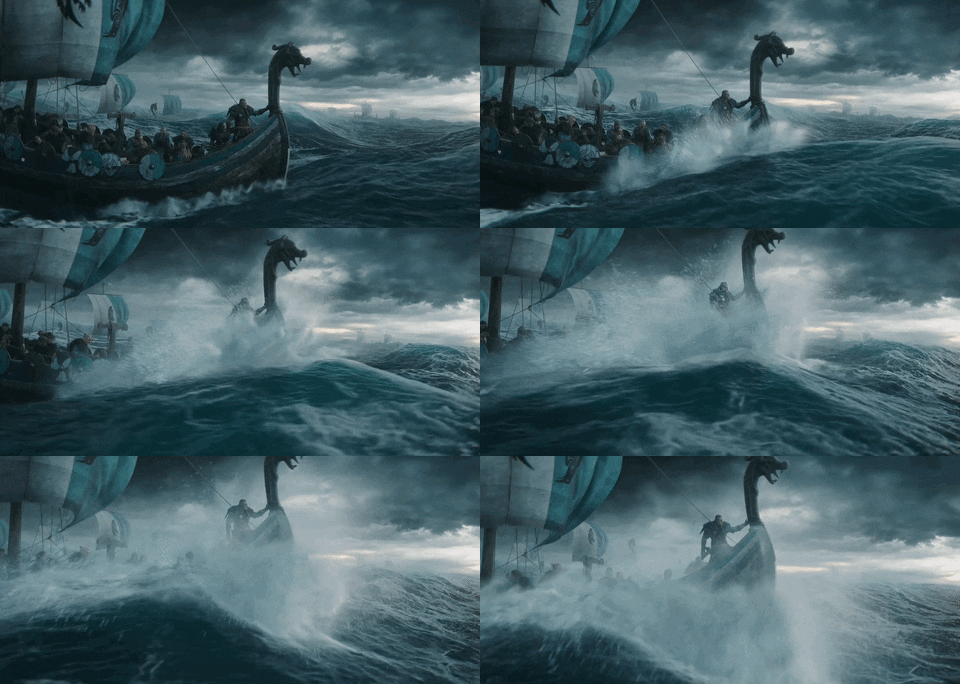
Mr. West is accurate with his facts but questions many of them as the sources are questionable. He is irreverent although witty in his expression. Consider this about the Vikings: “Vikings have traditionally got a bad press, being viewed in the popular imagination as a sort of ancient biker gang who went a bit overboard.”
The book spends the first few chapters talking about the Saxons and their coming to Britain; then the author brings in the Vikings, and he talks primarily about Alfred in the last three chapters.
It was a bloody and brutal time for England, but that was true for most of Europe during that period of history. Life was tough and generally short. There was lots of fighting, at times with armies of a few thousand, but mostly by groups of 50 to 75 men attacking one or another group or area. The Vikings fought the Saxons, and the Saxons fought among themselves. Most of it was among the aristocrats, but the farmers and merchants were drug into the conflicts often enough as well.
Alfred was the youngest of six children, all boys but one, so succession to the throne did not look to be much of an option since four older brothers had better claims. However, Alfred did become king after various mishaps befell his brothers. Alfred succeeded in defeating the Vikings and recovering much territory they had taken. While that was a great feat in itself, he also organized his realm into a political system that worked, strove to establish literacy at least among the noble class, developed a navy, made universal laws for the kingdom, and set up a system of fortified towns for defense. He is the only king of Britain ever to be called “the great.”
Alfred made two trips to Rome, but he went with his dad and was quite young at the time. He became a learned man and was generally more refined than the typical ruler in Britain of his era. He learned to read in his twenties and then both wrote and translated books. His exposure to Europe and Rome gave him ideas he implemented during his reign as king. His desire was to raise the level of life in England, and he was relatively successful.
As mentioned above, this book is a quick read. It is also a good introduction to English history from the 5th century up to the time of the Norman invasion.