"They were brightly dressed, but not in the peasant garb an older person might have associated with the Hollywood version of Gypsies in the thirties and forties. There were women in colorful sundresses, women in calf-length clamdigger pants, younger women in Jordache or Calvin Klein jeans. They looked bright, alive, somehow dangerous."
I would have read this book sooner, had I known what a dish it would turn out to be. I’m not sure if there’s a pun intended. I think I would have appreciated it even more if I had read it in calmer, more collected state, but I will probably re-read it anyway, so it’s alright. This book represents the two great bodily pleasures for the human race – food and sex – also as the two sources of all the woes that befall our protagonist/antagonist. I sympathize with Billy Halleck, because stress makes me eat as well. I haven’t yet been in a crazy accident caused by deviant sexual behaviour, but there’s a first time for everything. As for why I categorize Billy as both protagonist and antagonist, it is because he is both. Everybody in this book – with the exception of his young daughter – is. The characters, the situation, the culmination…the whole book is full of equivocation and it raises more questions than it gives answers. Right and wrong seem more like abstract concepts, old-fashioned und peculiar, belonging to a different time and place. Ultimately, even the best and most noble intents and purposes get eclipsed by the instinct for survival and the need to protect yourself, those dearest to you and also to avenge. The story begins with primal instincts – like the need of food and sex – as the cause for all the trouble and ultimately the characters seem to stay equally raw and led by primal instincts until the very end. Even the motives of our “hero” Ginelli seem questionable and his friend Billy Halleck wonders how much of it is a friendly loyalty and how much something quite different and a lot darker, lurking beneath the surface. The book raises topics as guilt and innocence and shows how the two are not always easily distinguishable and that right and wrong, good and evil, justice and revenge sometimes might be the biggest mysteries and the hardest truths one has to live with. They can be like identical twins, very different at the core, but very much alike on the outside. And you start questioning everything you have ever known.
Billy Halleck’s life changes one miserable evening, when his wife Heidi decides that it’s the perfect time for her to try spicing up their marriage, hence she decides to give him a hand job while they’re on the road. Billy loses concentration and the result is the death of Susanna Lemke, the daughter of very old and very powerful Gypsy man who doesn’t leave his daughter’s death unpunished. As Billy is let off the hook, because of who he is and because of who his victim is, he faces an entirely different kind of justice system.
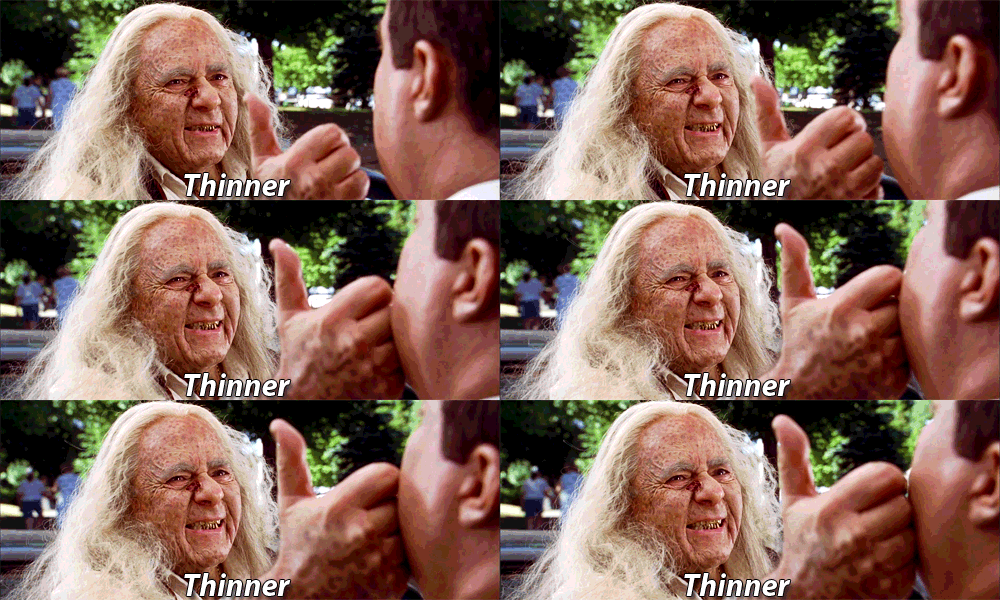
“Thinner” whispers Tamuz Lemke on that faithful day and everything for Billy Halleck changes drastically.
We see him losing not only his weight, but what also seems like his soul and his sanity. The guilt, the anger, the fear turn him into a different man, he becomes his worst enemy. A seed is sawn in his soul on that day and it spreads like a wild fire. The impossibility to believe what’s right in front of you, being torn by rational thinking and your senses that tell an entirely different story is also something that is well known to me.
“Some guys - a lot of guys - don't believe what they are seeing, especially if it gets in the way of what they eat or drink or think or believe. Me, I don't believe in God. But if I saw him, I would. I wouldn't just go around saying 'Jesus, that was a great special effect.' The definition of an asshole is a guy who doesn't believe what he's seeing. And you can quote me.”
And I do. Thank you, Me. Ginelli.
I think nothing is truly simple and perhaps there is no such thing as ultimate truth. Was Billy truly cursed or was it the power of suggestion that was doing away with him? Or a combination of the two? Who is the innocent one, who is the guilty one? No such creature in this book. Everyone has their own layers of innocence and guilt. Heidi chooses an unfortunate time to discover this new side of her. She should have known better than to distract someone on the road. Billy should have known better than to keep driving in this condition. Susanna Lemke should have known better than to cross the way she does. Tamuz Lemke should have known better than to initiate a blood vendetta that would not bring his daughter back, but would only entail more misery and loss.
'Did that bring your daughter back, Mr Lemke? Did she come back when Cary Rossington hit the ground out there in Minnesota?'
Lemke's lips twisted. 'I don't need her back. Justice ain't bringing the dead back, white man. Justice is justice.
And Gina Lemke should have known better than to follow in his footsteps. A series of wrong decisions and feelings stronger than reason lead to a wild chase and something that ultimately goes way beyond the case in point, as Gina Lemke points out:
'He cursed us,' she said, and there was a kind of wondering contempt in her voice. 'Tell him for me, mister, that God cursed us long before him or any of his tribe ever were,'
We plan our affairs carefully. Most of us would like to believe that we are good people. We are not. Each of us is guilty of something and in front of someone. It is a basic flaw and positive of the human condition. We all need a certain level of selfishness and ruthlessness in order to survive and be productive. It is the measure, the degree that has the final say. From Billy and Heidi’s point of view it was all just an accident, an unfortunate event, a case of “wrong place, wrong time”. They didn’t mean to hurt anybody. They just wanted to have some fun. From Taduz und Gina Lemke’s point of view they are cold-blooded, cruel monsters, ready to run over (figuratively and literally) anybody in their path in order to have what they want. Maybe the truth lies somewhere in between.
Ultimately Billy Halleck does strike back. They see to that by refusing to give him any benefit of the doubt whatsoever. And Billy fights his own demons, other demons than the scales – he loses weight progressively, to the point of being anorexic – and the old gypsy man with the rotten nose. There is a part of him that quietly, but definitely and persistently hates his wife for her choice of place and time.
It is hard for me to place a judgement on any of the characters and I don’t think I want or need to say who is right and who is wrong and decide who deserves what. What I want to do instead, what I can’t help doing, is seeing human beings in pain. Yet, I can’t help sympathizing with the Hallecks, the alleged murderers, more than I do with the alleged victims. Because I do feel that the Hallecks realize what they have done and the reasons behind it and are the kind of people who do learn from their mistakes. The Lemkes, on the other hand, seem permanently on the defensive and on the vengeful side, as Gina’s poignant words to Ginelli show. They are abused and mistreated and no one can deny that. But they fill their hearts with so much hatred and bloodlust that they don’t realize how alike they and those they fight against might be. They are people who fight, for all the wrong reasons and in all the wrong ways, because they feel that this is all they have left. And everything else in between is just a dream. And it goes on and on.
…he is crazy, this friend of yours, and he will never stop. Even my 'Gelina says she sees from his eyes he will never stop. “But we'll never stop, either” she says...
For a moment he stared at the festering hole in the middle his face, and then his eyes were drawn to the man's eyes. The eyes of age, had he thought? They were something more than that … and something less. It was emptiness he saw in them; it was emptiness which was their fundamental truth, not the surface awareness that gleamed on them like moonlight on dark water. Emptiness as deep and complete as the spaces which may lie between galaxies.
How much do we let ourselves being ruled by our primal instincts and how much do we rely on reason and compassion to lead us forward? We are all a combination of passion and rationality and I think that we need both and both balance each other out and feed off each other and make us equally weak and strong. I have been told that I am very emotional and that this hinders me and makes me lose control and sober judgement and while I believe it to be true, I also know those all those strong passions also incite me toward deep contemplations and soul-searching and that ultimately makes me turn toward serious thinking and evaluating, which is, after all, inherent in reason and rationality. There is little of the latter in this book. But there is a lot of heart. I couldn’t help liking and sympathizing with Billy Halleck and his attempts to protect himself and his family and take responsibility for what he had done, all the while wanting as little harm as possible to befall his enemies. Part of him didn’t want to go with it at all, even if it meant being lost forever. Hurting and/or killing another living being is not something that should come lightly to any of us, regardless of the reason. But it seems to come quite easily and naturally to the Lemkes, hence it is harder for me to sympathize with them, despite everything that happens to them.
So I couldn’t keep my word and not “take side”, but I didn’t do it lightly. I stand by my words that there is no completely guilty or completely innocent party in this situation. Or anywhere at all. There is only the aftermath and what you learn from it.
12.08.2019