Jump to ratings and reviews
Rate this book

The Lodger

Rate this book
In 1888, a series of prostitutes was brutally murdered in the East End of London. These gruesome crimes filled the press and shook England with fear and intrigue. Marie Belloc Lowndes established her considerable reputation as a crime writer through her fictional account of these murders.
Dealing with not only the psychology of "The Avenger"--her version of Jack the Ripper--but also with that of his landlady, Mrs. Bunting, who never gives away his secret, Lowndes creates an atmosphere of suspense, fear, and horror.

306 pages, Hardcover

First published January 1, 1913

372 people are currently reading
4520 people want to read

About the author

Marie Belloc Lowndes

232 books69 followers
Marie Adelaide Elizabeth Rayner Lowndes, née Belloc (5 August 1868 – 14 November 1947), was a prolific English novelist.

Active from 1898 until her death, she had a literary reputation for combining exciting incident with psychological interest. Two of her works were adapted for the screen.

Born in Marylebone, London and raised in La Celle-Saint-Cloud, France, Mrs Belloc Lowndes was the only daughter of French barrister Louis Belloc and English feminist Bessie Parkes. Her younger brother was Hilaire Belloc, whom she wrote of in her last work, The Young Hilaire Belloc (published posthumously in 1956). Her paternal grandfather was the French painter Jean-Hilaire Belloc, and her maternal great-great-grandfather was Joseph Priestley. In 1896, she married Frederick Sawrey A. Lowndes (1868–1940). Her mother died in 1925, 53 years after her father.

She published a biography, H.R.H. The Prince of Wales: An Account of His Career, in 1898. From then on, she published novels, reminiscences, and plays at the rate of one per year until 1946. In the memoir, I, too, Have Lived in Arcadia (1942), she told the story of her mother's life, compiled largely from old family letters and her own memories of her early life in France. A second autobiography Where love and friendship dwelt, appeared posthumously in 1948.

She died 14 November 1947 at the home of her elder daughter, Countess Iddesleigh (wife of the third Earl) in Eversley Cross, Hampshire, and was interred in France, in La Celle-Saint-Cloud near Versailles, where she spent her youth.

(from Wikipedia)

Ratings & Reviews

What do you think?
Rate this book

Friends & Following

Create a free account to discover what your friends think of this book!

Community Reviews

5 stars
691 (18%)
4 stars
1,464 (39%)
3 stars
1,207 (32%)
2 stars
247 (6%)
1 star
67 (1%)
Displaying 1 - 30 of 504 reviews
Profile Image for Jeffrey Keeten.
Author 5 books252k followers
October 22, 2018
”’Do you think to escape the consequences of your hideous treachery. I trusted you, Mrs. Bunting, and you betrayed me! But I am protected by a higher power, for I still have much to do.’ Then, his voice sinking to a whisper, he hissed out ‘Your end will be bitter as wormwood and sharp as a two-edged sword. Your feet shall go down to death, and your steps take hold on hell.’”

 photo TheLodgerArrives_zpsea840476.jpg

Mr. and Mrs. Bunting are on the verge of tightening their belts further than they have ever been tightened before when a knock comes at the door. It is a man, nay a gentleman, looking for lodging. It has all the nuances of a higher power providing a timely intervention.

He has a pile of gold sovereigns and wants to pay for his lodging a month in advance. His name is Sleuth, but generally he is thought of and referred to by the Buntings as The Lodger.

”As she walked down the stairs, the winter sun, a scarlet ball bringing in the smoky sky, glinted in on Mr. Sleuth’s landlady, and threw blood-red gleams, or so it seemed to her, on to the piece of gold she was holding in her hand.”

Mr. and Mrs. Bunting are both from domestic service and had retired to purchase this house in London and rent out lodging. When lodgers aren’t appearing as regular as they hoped Mr. Bunting makes himself available as extra help for birthday parties etc. Even those opportunities have been too few to keep them solvent. The Lodger has given them at least temporary respite from the necessity of giving up their dream and going back into domestic service.

A lady, well not a gentle lady, but a woman of ill repute has been found slashed to death. Mr. Bunting had been denying himself the newspaper, but with this new windfall he can devour them once again giving him much missed edification and exhilaration bordering on arousal.

More women are found dead, horribly disfigured, and the city trembles. These atrocities etch words of fear into every conversation.

The Lodger borrows a Bible. He reads this Bible out loud, but he is not reading passages that would offer comfort. His voice rings out with vengeance.

 photo Hitchcock-Lodger-4_zps067eeb4b.jpg

The Lodger is...well...strange.

He nearly goes into hysterics every time there is a knock at the door.

He stays in all day muttering over his Bible and only goes out at night.

The fascinating part of the book for me was that Mr. Bunting and Mrs. Bunting each were gathering droplets of information about their lodger that they were afraid to share with the other. They had been so close to disaster they were unwilling to give up the very providence that kept them from the brink of ruination.

”She wondered at her temerity, her--her hypocrisy, and that moment, those few words, marked an epoch in Ellen Bunting’s life. It was the first time she had told a bold and deliberate lie. She was one of those women--there are many, many such--to whom there is a whole world of difference between the suppression of the truth and the utterance of an untruth.”

The press begins to call the killer THE AVENGER.

As a mound of circumstantial evidence begins to accumulate in the minds of the Buntings each new revelation makes it more and more clear that their angel of providence might prove to be a devil in disguise.

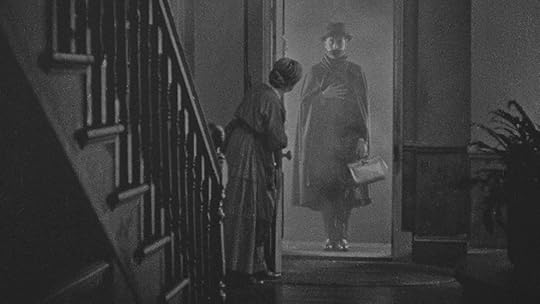
Alfred Hitchcock made a silent film about the The Lodger. It was made in 1927 and I’ve only seen bits of it, but I was struck by the expressions of horror that the director was able to achieve in his actors.
 photo TheLodger_zps78cec6fe.jpg
Four more movies based on Marie Belloc Lowndes’s book were made in 1932, 1944, 1953, and 2009. Lowndes is the sister of the prolific and celebrated writer Hilaire Belloc. Like her brother she also published several books a year. The Lodger is considered her masterpiece and obviously the film industry agrees.

I was completely caught up in the events of this book. I felt the stress of not only the circumstances surrounding The Lodger, but also the tug of war being waged in the Buntings’s consciousness between the shame of greed and the specter of returning poverty. Lowndes has a deft hand in how she reveals information. I found myself constantly reevaluating what I knew and was frequently baffled about what I really wanted to have happen. Highly recommended for those who have a desire to read some well written, creepy, Victorian horror.

If you wish to see more of my most recent book and movie reviews, visit http://www.jeffreykeeten.com
I also have a Facebook blogger page at: https://www.facebook.com/JeffreyKeeten
Profile Image for Florence (Lefty) MacIntosh.
167 reviews552 followers
January 14, 2014
A lost quality in modern psychological suspense - the key word is subtlety. An intriguing look at the infamous Jack The Ripper case told through the eyes of his landlady Mrs. Bunting, an impoverished women with her back to the wall. I won’t mislead, not much happens, zero gore. It’s a character study, a morality tale –brooding and melodramatic, in fact almost claustrophobic in it's intensity – thought it delicious.
Marie Lowndes resists spelling out the obvious, instead tension is provided by a feeling of dread as Mrs. Bunting’s suspicions (those midnight forays through London’s foggy streets a dead giveaway) turn to certainty, that the ‘unspeakable’ is reality With the rent money so desperately needed, to let on that she's privy to his secret would be sheer folly, but to say nothing? As they enter into an unspoken collusion Mrs. Bunting's feelings for her lodger seesaw between revulsion and attraction.

Cons: disagree with others, rather than slow thought this perfectly paced but then I’m maybe more patient than most - thoroughly enjoyed the build. The rushed conclusion though, it did disappoint...
For the genre of psychological suspense 4 ½ stars

For the first time in her life she visioned the infinite mystery, the sadness and strangeness of human life; “Poor Mr. Sleuth - poor unhappy, distraught Mr. Sleuth!” An overwhelming pity blotted out for a moment the fear, aye, and the loathing.
________________________________________
Meanderings on Hitchcock – not a spoiler:
Profile Image for Delee.
243 reviews1,325 followers
June 13, 2019
There have been many theories about who Jack the Ripper was...

There was The Royal Conspiracy Theory

 photo 28fdd026-ef5c-421e-a0ea-23a873466153_zpsa0194802.jpg

The Jack Was A Jill Theory

 photo f20f7805-50d5-456b-b595-80a18ee45eca_zps1e700f15.jpg

The Crazy Doctor With A Big Mustache Theory

 photo 15dba982-89c9-467c-830e-8255422fc5e3_zps3c2eefb1.jpg

Or the theory that Marie Belloc Lownde's novel is based on-

The Lodger Theory

 photo df12efa5-db59-4327-9aa5-ccd543b9de74_zps064dd262.jpg

Belloc Lowndes is supposed to have gotten the idea for her story after overhearing a dinner conversation- where a guest was telling another- that his mother's butler and cook claimed to have once rented rooms to Jack the Ripper, and after reading THE LODGER- this fictional account seems to be a mix of Walter Sickert (a German Artist), G. Wentworth Bell Smith (a Canadian religious fanatic), and Francis Tumblety (an Irish/American- physician/quack). All visiting London during the Ripper murders...all lodgers...

Ellen and Robert Bunting have fallen on hard times. After spending years in "service"- they sunk their life savings on a house and furnishings. They had hoped to rent out rooms to make a nice living in their old age, but now are within weeks of losing everything.

One night a stranger comes to the Bunting home looking for lodgings. His name -"Mr. Sleuth", and Ellen in particular takes to him. He seems a bit eccentric, but he pays her in advance- takes two rooms and settles in for the long haul. The Buntings breathe a sigh of relief and start to relax into their new good fortune...but not for long...

The arrival of Mr Sleuth coincides with crimes happening in the area. The London newspapers have been covering the story of a group of murders. The victims- women. The killer- a man calling himself- "The Avenger". With a slow building horror, Ellen Bunting realizes that her upstairs lodger could be the mysterious killer, and eventually- her husband Robert Bunting is having that feeling too.

 photo 3b93c5ec-e706-490f-826c-68065d2b1917_zps8761fef0.jpg

The Lodger is a story of psychological suspense as two people are faced with the sickening possibility that they may be harboring a murderer. The pace is very slow. There is no gore, but what it is...is quietly terrifying- if as you are reading it- you put yourself in the Bunting's place and think about what it would be like living with a serial killer upstairs.
Profile Image for Beverly.
950 reviews467 followers
July 16, 2021
Slowly creeping to its dreadful denouement, The Lodger is a wonderful progenitor of the psychological mystery which I adore. Decent, honorable, former-serving folk, Mr. and Mrs. Bunting are close to starvation when they are finally blessed with a wealthy lodger for their house. Mr Sleuth is strange acting, but undoubtedly a gentleman, which is what the couple were praying for as their other lodgers had been of the lower class.

Mrs. Bunting comes to know their guest and his eccentric ways best, as she is the only one who Mr. Sleuth will allow to wait on him. He slinks about at odd times of night and sleeps by day. He reads the bible aloud to himself, especially passages about the evilness of women. Mrs. Bunting doesn't mind that, because who wants a lodger that brings strange women into their abode? Mr. Sleuth knows no one and has no relatives or friends. He is shy and gentle and fragile. Mrs. Bunting feels sorry for him and somehow deathly afraid of him.
Profile Image for Bren fall in love with the sea..
1,955 reviews474 followers
March 26, 2023
“Absence does make the heart grow fonder—at first, at any rate".

The Lodger by Marie Belloc Lowndes


I just ordered this and realized I read it quite a long time ago. It happens.

Anyway..this book, which is beyond creepy, involves a an older couple on the brink of complete poverty, who take in a lodger.

At first things are fine. But the re is a serial killer running around and to the deepening horror of the couple they ever so slowly start to suspect it may in fact be their lodger.

If you like slow moving dark, Gothic stories that unfold with an ever slowly heightening feeling of doom, you will like the Lodger. Highly recommended.
Profile Image for Zain.
1,884 reviews286 followers
October 10, 2021
Another Classic Whodunnit!

Published in 1913, Marie Belloc Lowndes’ The Lodger, is filled with suspense and mystery.

Mrs. and Mr. Bunting are three seconds from the poor-house, when they get a new lodger.

He pays in sovereigns and he isn’t stingy. An answer to their unprayed prayers.

But his behavior is strange. Very eccentric. He talks to himself, doesn’t tolerate women and takes walks at night during the nasty, cold fog.

The Buntings barely have enough to think about him, with all the mutilated murders upstaging the usual London crimes.

Just who is this unnatural murderer who dares to leave a calling card? The answer is close to home 🏠
Profile Image for Peter.
4,071 reviews798 followers
July 9, 2018
Gosh, absolutely eerie. Compelling and disturbing read. Highly recommended!
Profile Image for Lars Jerlach.
Author 3 books174 followers
November 21, 2018
In Marie Belloc Lowndes brilliant novel the reader is introduced to Mr. and Mrs. Bunting, a middle-aged couple, both previously from domestic service who have retired to run a lodging house.
When we meet them they are in severe financial trouble and on the verge of giving up hope of ever renting out their rooms when a gentleman one evening, and in timely fashion knocks on their door looking for lodging.
The gentleman’s name is Sleuth, but is generally referred to as The Lodger. 

From the onset The Lodger, tall and gaunt and dressed in black is revealing a series of particular habits. He is beyond reserved, startles easily and doesn’t allow for Mrs Bunting to clean his room or for her to rent out any of the other rooms in the house, but as he brings with him a pile of gold sovereigns and wants to pay for his lodging a month in advance, she is beyond pleased with the arrangement that so fortuitously saves her and Mr. Bunting from the brink of starvation. Mr. Bunting has already pawned quite a few valuable things and as there aren’t many items left of any value, the fear of humiliating ruination has been hanging over the couple like a darkened shroud tearing at the seams of their already frayed relationship.

The Lodger borrows a bible from the Buntings and begins to read aloud in his room especially violent passages about vengeance. In fact he seems to be especially revolted by the lowly acts of loose women, that he attempts to purge himself from through the repeated readings of the Gospels.
He also immediately turns a series of framed lithographs of innocent young women against the wall of his new room, and he conducts strange unexplained experiments in one of the top floor rooms, both strange actions that initially disturbs his landlady, but that she early on dismisses as nothing but a gentleman's peculiarities.
However these rather benign acts instantly cast an eerie shadow over the following narrative, and clings to The Lodger like a second layer of skin, making every single action circumspect.

Before the appearance of The Lodger a woman of ill repute has been found brutally murdered and Mr. Bunting with his friend, a young policeman Mr. Chandler exhilarated and obsessively discuss the case as more women are found dead, sometimes slashed beyond recognition.
While everyone is waiting apprehensively, yet excitedly for the atrocities that cover London in a blanket of fear, The Lodger, who becomes visibly upset bordering on hysterics whenever there’s a knock at the door continues to read from his borrowed bible during the day. Only under the cover of darkness and when the city is enveloped in heavy fog does he leave his lodgings to go on his enigmatic wanderings to do whatever it is he does.

The most fascinating part of the book, besides the exquisite writing and the anxious tonality of the narrative, is the realization that Mr. and Mrs. Bunting each know that they might be harboring a killer and that they independently and collectively are unwilling to let go of the fortunate stroke of serendipity that has saved them from hunger and potentially from the poorhouse. The underlying knowledge of their circumstance is what drives this creepily eerie story forward, and even as the implicative evidence accumulates, and it becomes more and more clear to the Buntings that their savior might also prove to be the very thing they fear the most, they are incapable of the action that would release them from their terrifying constrain.

I will not ruin the reading experience by revealing too much more about the novel and it’s leaning on the famous Ripper murders, but I would however like to add that the stress of the events surrounding The Lodger only heightens throughout, and that the introduction of Daisy, Mr. Bunting’s daughter and Mrs. Bunting’s stepdaughter adds an entirely new level of baleful anxiety to the story.

It is a fabulously written and marvelously engrossing novel that has stood the test of time perfectly, and if you are fan of Victorian mystery and general eeriness this is a true gem.
Profile Image for Anne.
657 reviews115 followers
October 7, 2021
”Her lodger was given to creeping out of the house at a time when almost all living things prefer to sleep.”

The Lodger is a 1913 mystery-thriller that explores the psychology of guilt and paranoia in an elderly couple who take in lodgers for their means. This was a slow building story that focused on the interactions and secrets between this couple as they attended to their new lodger.

As this late nineteenth century story began, Mr.and Mrs. Bunting of London were in dire straits. They haven’t had any income from a lodger in so long that they have given up basic comforts. They shiver with cold and are nearly starving. No surprise that Mrs. Ellen Bunting was overjoyed to fine such a fine-looking gentleman on her doorstep wanting to see a room for let. Mr. Sleuth, a particular sort of man, had special requirements for the space he needed. Ellen thinks her prayers were answered when Mr. Sleuth decided to take rooms and pay her to not take other lodgers while he was there.

The reader will get an idea of what is coming early on. However, the way Mr. and Mrs. Bunting noticed things, kept secrets, and realized what the other knew held my attention. It was the best part; that they slowly became aware of something sinister about the lodger. I relished how Ellen Bunting’s character changed as her suspicions grew. And take notice of how Mr. Bunting’s interest in reading the newspaper differs as the story progresses. As if the Bunting’s are not under enough stress already, they have a house guest come stay with them that multiplied their worry. Then there’s Joe Chandler, a young police friend of Mr. Bunting’s who frequently stopped by.

It is a tense book, sans the gore but, hearty on irony, foreboding dread, and suspense. I’m relived the POVs remained with the Buntings and not the lodger. The ending couldn’t have been better in my opinion.

Some books are better on audio, and this is one of them. Narrator, Lorna Raver, did a fantastic job voicing the characters! The accents, emotions, and urgency rang out clearly. It was read at the perfect pacing. The newspaper boys’ call held the right cadence. And the voices Ellen Bunting heard in her dream were creepy! If I had read the text alone, I would not have rated it 5-stars. So, I highly recommend listening to the 2009 Blackstone publication.

And I’m so glad that the English Mysteries Club picked this for their October read or I might have missed this great book.

The Lodger would be perfect for readers who enjoy the excitement of a psychological thriller.

*You can find a free download of this book on Amazon or Project Gutenberg.
Profile Image for CarolG.
917 reviews544 followers
December 13, 2021
First of all I'd like to thank my Goodreads friend Anne for bringing The Lodger to my attention. Her review really piqued my interest and, even though I'm so far behind on my books, I ordered it from amazon for my Kindle. As the blurb states, "This book was converted from its physical edition to the digital format by a community of volunteers." and I say huzzah for them! (Sorry, I've been watching The Great on Prime!)

Marie Belloc Lowndes wrote The Lodger in 1913 and it was the first novelization of the Jack the Ripper murders of the late 1800s. The Buntings, an older couple now retired from service in grand houses, are destitute and wondering where their next meal will come from when Mr. Sleuth appears at their door enquiring about lodging and paying in advance. Meanwhile, women in London are being murdered by a man known only as “The Avenger”. Mrs. Bunting grows fearful that their lodger may be the murderer but she doesn't want to lose such a lucrative opportunity. Little does she know that Mr. Bunting has suspicions of his own. The story is well told with lots of fog and some creep factor, even a little old-fashioned romance between Mr. Bunting's daughter and a young policeman friend of his. Some stories certainly withstand the test of time.
Profile Image for Carol.
1,370 reviews2,351 followers
September 12, 2014
Set in a late nineteenth century foggy London, this dark psychological thriller slowly builds up clues (like an Agatha Christie novel) to identify the serial killer who signs his name The Avenger. This haunting tale begins when the Bunting's, a strange couple to say the least, take in a much needed lodger (Mr. Sleuth) for rent they so desperately need to survive. As the story progresses, the Buntings continue to ignore their suspicions of the lodger despite his mysterious experiments, late night walks and gruesome bible quotations. As it turns out, we find

Some last fearful words for Mrs. Bunting: "Your end will be bitter as wormwood and sharp as a two-edged sword. Your feet shall go down to death, and your steps take hold on hell".

Written in 1913, a great old eerie tale!
Profile Image for Hannah.
820 reviews
October 5, 2011
Rating Clarification: 3.5 Stars

The Lodger was written around 1914 by London-born Marie Belloc Lowndes, who lived in the city during the killing spree of serial killer Jack the Ripper some 20+ years previously. Surely Lowndes stored up many impressions of that time, and used them to craft this subtle tale that has since been adapted several times to screen.

As a modern reader, I have certainly read more suspenseful and gruesome novels, but taken in context with the time period it was written, the effect of Lowndes story can't be underestimated, IMO. It's really unfair to classify this as a true mystery/suspense or horror story, since there is very little of either to sustain those titles. Rather, this story is more of a psychological character study.

The first chapter of Lowndes novel presents the reader with a couple living at the edge of an abyss. Robert and Ellen Bunting are middle aged, lower middle class, and broke. They have sold almost everything they own in an attempt to survive, but face almost immediate starvation and homelessness within a few short weeks. Formerly of the servant class, the Buntings are upright, hard-working and decent people down on their luck, and Lowndes' writing makes the reader feel the deprivation and fear that accompanies the Buntings' at this time in their lives. The couple have nothing left except an overwhelming sense of hopelessness.

So when a mysterious young man (a "true gentleman" in Mrs. Bunting's words) knocks on their door one day seeking lodging, it's like the answer to a prayer. The lodger, Mr. Sleuth, is admittedly strange, but his mound of gold sovereigns and the promise of a huge monthly rental payment (and no more starvation) throws him in a kinder light then he might otherwise have been perceived by a more discerning couple.

As the days and weeks go by, Ellen Bunting in particular goes through a series of feelings for her lodger: curiosity, protectiveness, and a slow-simmering fear. Fear because the city of London is experiencing a wave of violent murders the likes of which haven't been seen in recent history. Little by little, Ellen has reason to suspect that her lodger might be more then he appears. After a long time, Robert Bunting begins to sense the same, although each keeps their growing suspicions to themselves. But can their fear of his possible dark deeds override their fear of being penniless, homeless and hopeless again? Do they have a duty to protect the city from further attacks, or is their duty to themselves and their wellbeing? How far will they go to keep from falling back into the abyss? And perhaps most important of all, are their fears and suspicions grounded in truth, or merely the result of an active imagination spurred on by a sensational press?

That's the real dark beauty of this novel, and what makes it such an intriguing character study and morality tale.
Profile Image for Nancy Oakes.
2,018 reviews918 followers
April 12, 2015
The Lodger has long been one of my favorite novels; reading it again a second time proved no less suspenseful than it did the first time through.

Marie Belloc Lowndes based her novel very loosely on the story of Jack the Ripper, and the novel is set in London at a time when a series of horrific murders blamed on a person known only as "The Avenger" is the big news on the streets. At the same time, the story is not really about these murders; it is actually the story of a husband and wife who find themselves in dire financial straits and who are quite literally pulled back from the edge of starvation and ruin when a gentleman takes a room in their home. Calling himself Mr. Sleuth, the man has strange habits, including walks in London's foggy streets and reading Bible verses about wicked women. But for the Buntings, especially for Mrs. Bunting, the lodger and his money is literally their salvation, and it is because of this that Mrs. Bunting is forced to carry a terrible burden, one that tears her up inside with both guilt and fear.

While some readers might be disappointed that the focus of the novel isn't on Jack the Ripper (or his Avenger persona here), I think Lowndes' intent was much more of an intense psychological study of a woman who is caught up in a horrible dilemma that offers her very little choice and leads her to a near breakdown. This may be why some people found it slow going, with very little happening vis a vis the Avenger and the crimes. However, my feeling is that it's possible that the book has often been misread -- to me it is very successful, highly atmospheric and downright claustrophobic. For me, it's a story where the tension and feeling of dread builds slowly as the novel progresses, and when the ending came around, I felt like I could actually breathe again. To me, if a book has that much impact on a reader, it's a damn good one.

Highly, highly recommended -- but it's a book best gone into with an open mind and no preconceived notions.
Profile Image for Dagio_maya .
1,106 reviews350 followers
November 10, 2023
“Il pensionante”(1913) è un romanzo di particolare scorrevolezza che si è ispirato ai famigerati delitti di Whitechapel, ossia gli efferati omicidi attribuiti allo storico serial killer che la stampa dell’epoca denominò Jack lo Squartatore.

description
"The Lodger: A Story of the London Fog " (1927) Alfred Hitchcock

Marie Belloc Lowndes, costruisce una storia dove protagonisti, Robert ed Ellen Bunting, sono una coppia di ex domestici in pensione.
Messi alle strette dai risparmi ormai agli sgoccioli decidono di affittare qualche stanza e non credono alla loro fortuna quando un giorno bussa alla porta un gentiluomo.
Il suo nome è Sleuth; un tipo eccentrico ma dopo aver lavorato per anni a casa di stravaganti nobili, i Bunting non ci fanno caso soprattutto se il nuovo pensionante paga subito un mese di affitto.

Sono giorni però di agitazione in città. Londra è infatti travolta dalla notizia di omicidi brutali che continuano a replicarsi notte dopo notte. Le vittime sono donne dedite all’alcool sui cui corpi viene ritrovata la firma dell’assassino scritta su un triangolo di carta: Il Vendicatore.

La morbosa curiosità attanaglia tutti e qualcuno in casa Bunting comincia ad avere dei sospetti.
Come mai il pensionante esce ad ore insolite?
Perché passa le sue giornate chino sulla Bibbia?

Un romanzo un po’ debole dal punto di vista della trama che, difatti, nel finale si sfilaccia facilmente.
Il suo punto di forza, tuttavia, regge benissimo e consiste nello scenario.

Leggere queste pagine trasporta completamente il lettore nelle sordide strade londinesi dove, avvolti nella nebbia, non si può che tremare sentendo le urla che echeggiano in lontananza…

Nel 1927 Hitchcock assistette allo spettacolo "Who Is He? "che era la trasposizione teatrale di "The Lodger" (Il pensionante) e volle ottenere i diritti per la realizzazione di un film, che divenne infatti uno dei suoi film muti più celebri.
★★★1/2
Profile Image for Jill H..
1,637 reviews100 followers
February 13, 2025
I have seen the classic 1927 British silent film of the same name several times. It was directed by Alfred Hitchcock (his third) and made his reputation. So I thought I would read the book to see if the story was changed, as so often happens, for the film. It was!

Written at the turn of the 20th century by Marie Belloc Lowndes, a popular author of the time and sister of French author/poet, Hillaire Belloc, it is more a psychological study than what we usually call a true thriller.

Mr. and Mrs Bunting are on their uppers and decide to advertise for a lodger to provide for some much needed income. A strange man appears at their door and asks to see the rooms. He takes them and offers much more money than they were asking. He appears to be a "gentleman" even though he has some odd requests which the Buntings are glad to oblige.

At this time there is a Jack the Ripper type murderer terrorizing London and the Buntings' policeman friend is keeping them updated on the unsuccessful efforts of Scotland Yard. Based on his information, Mrs. Bunting begins to have second thoughts about her lodger and his unusual habits. She becomes the main character of the story as the reader follows her thinking...............is she right or is she wrong?

This is very well written story which takes a little different approach and I would recommend it.
Profile Image for Dannii Elle.
2,331 reviews1,830 followers
December 7, 2018
Actual rating 3.5/5 stars.

A lodger arrives. Unbeknown to him, he has appeared just in time to save his new landlady and landlord, Ellen and Robert Bunting, from destitution. With the safety of coin in their pocket they welcome the new lodger into their home with open arms. But, just outside of the front door, is a London under threat. The headlines scream of mysterious murders and an unknown killer is on the loose. They can not risk losing their only source of income but the question of this lodger really is becoming the ever more pressing question they dare never ask him. This is Marie Belloc Lowndes fictional insight to the Jack the Ripper case.

Early on, this novel had me hooked. The miasma of mystery descended over all proceedings and there was an eerie quality to every interaction. Soon, however, I began to wish for something more. Whilst this still remained intriguing and grasped my attention throughout I finished it feeling underwhelmed by the lack of clarity ultimately delivered. I love me a good ambiguous ending but this one just felt flat and unstructured. It made all of the earlier mystery seem aimless and I left this on a slightly sour note, after originally deeming this probably a 4.5/5 stars read.
Profile Image for Dorcas.
676 reviews233 followers
May 15, 2014
A deliciously creepy thriller reminiscent of an old Vincent Price movie. Its the kind of book you read with black and white pictures forming in your mind. Very atmospheric and spooky.

IN A NUTSHELL :
A destitute couple who own a small lodging house (empty of guests) are gradually pawning their belongings to fill their bellies, when out of nowhere there's a knock on the door. A "gentleman" looking for secluded lodging...

Soon, the hackles of suspicion are raised in the mind of the missus. But what to do? If their lodger really is the deranged killer (think Jack the Ripper) then they lose their tenant. Their income. Their food. Better to keep quiet. Keep quiet and wait...

This was really good. (And free on kindle). Its very high in atmosphere but no gore whatsoever. I love how the London fog drifts into the houses, fills hallways and creeps up the stairs...eeeeek!

Why 4 stars?
The middle was a tad repetitive (what if he's the "Avenger"? What should I doooo..??), the motive for the killings was never really explained, and the author was overly fond of the word "deprecating " throughout.

But its a good story. Very good.

CONTENT:

SEX: None
PROFANITY: None
VIOLENCE: Virtually none
PARANORMAL ELEMENTS: None

MY RATING : G

If you'd like to listen to the Old Time Radio program's version of this book you can find it here: http://www.myoldradio.com/old-radio-e...
Profile Image for Dragana.
448 reviews46 followers
November 14, 2025
4.5 ⭐️
Mnogo sam uživala i rastezala čitanje da duže traje. Fenomenalan psihološki prikaz likova. Napetost i strah koji se polako grade. I kad je trebalo da se zakuca na kraju...ništa.
Kraj je mlak i baš mi se nije dopao. Nekako mi nije u skladu sa ostatkom knjige.
Ali uprkos tome od mene ogromna preporuka za knjigu, kraj mi nije umanjio uživanje.
I ovo izdanje Naratora je besprekorno
Profile Image for Classic reverie.
1,833 reviews
April 9, 2019
This version includes The End of Her Honeymoon & The Uttermost Farthing which I read but reviewed under their titles. I have known of this author, Marie Belloc Lowndes, but only for her Lodger story portrayed by Hitchcock in film & his introduction into radio with The Lodger being the first Suspense radio program & his brain child radio program. It is an uncertainty if Mr. Sleuth is the Avenger in both these venues as the director wants such to be but after reading the book first hand I know Lowndes makes that answer quite clear. The Story is about a Lodger renting from a poor English couple who have a young daughter. There is such a psychological element to the landlady Mrs. Bunting & her trying to determine if her Lodger is the serial killer called The Avenger. It had me asking many questions to what would you do if you were in her shoes. Wonderfully written.

Suspense radio link below _December 14, 1944
https://www.oldtimeradiodownloads.com...


Another radio version with Agnes Moorehead and Peter Lorre, and announcer Harry Morgan. Mystery in the Air _ August 13, 1947

https://www.oldtimeradiodownloads.com...
Profile Image for Chris St Laurent.
184 reviews18 followers
February 23, 2024

Well when I read this book was based on the Jack the Ripper murders count me in.
The Buntings are a couple living in London in late 1800’s who have retired from a life of service and take lodgers into their home to make ends meet but business is poor. They have resorted to selling off their belongings. During this time there is someone murdering women in London. Well luck would have it there is a new lodger offering enough money to be the answer to their prayers. Yet Mrs Bunting starts having suspicions when this new lodgers comings and goings late at night coincides with murder. What would you ignore or reason away to keep the money coming in and maintain your social status? This was an audiobook that was easy listening , I enjoyed the characters and the story.
This entire review has been hidden because of spoilers.
Profile Image for Indieflower.
474 reviews191 followers
December 30, 2023
This novel, written in 1913, still packs a punch. Atmospheric, creepy and claustrophobic, there's real tension and a sense of dread as you turn the pages. I loved the constant conflict going on in poor Mrs Bunting's mind, it was so well done, though I'm still curious and would've liked to have known more about the nature of Mr Sleuth's mysterious "experiments".
Profile Image for Amy H. Sturgis.
Author 42 books405 followers
August 16, 2012
What a dark and fascinating read! Marie Belloc-Lowndes wrote this work in 1913, after living through the Jack the Ripper phenomenon, and she captures the horror and morbid fascination of Londoners with chilling effect as she recounts the bloody crimes -- and the media sensation -- of "The Avenger." The novel is less about the killer, though, than about Robert and Ellen Bunting, a solid and hardworking lower-middle-class couple who both left service to try for an independent life running a boarding house. At the start of the novel, their entrepreneurial gamble seems to have failed. The middle-aged couple have pawned all they could and tightened their belts, but starvation is staring them in the face. The appearance of a young gentleman who wishes to be their lodger seems to be a godsend.

The author traces the complex and sympathetic descent of both Buntings as their self-interest wages war against their consciences -- for, although the lodger is all that stands between them and utter financial ruin, and they feel justly loyal and protective of him, Ellen first and later Robert gain good reason to suspect that the young gentleman is "The Avenger." This is a psychologically rich piece, fraught with internal tension and steeped in a sense of place and time. The changes in the Buntings are believably drawn as the weight of their secrets grows heavy on their shoulders. The ending is both satisfying and, in the long term, quite disturbing.

It's no wonder Alfred Hitchcock (who adapted this novel both for radio and film, the first of five filmmakers to do so) found inspiration in this haunting story. I recommend anyone interested in the Gothic, psychological horror, historical mystery, and/or the story of Jack the Ripper.
Profile Image for Algernon (Darth Anyan).
1,838 reviews1,163 followers
October 2, 2023
[7/10]

We don’t get the good old fogs we used to get – not what people used to call ‘London particulars.’

Mary Adelaide Belloc Lowndes must have done something right here for her story to be still mentioned reverently and adapted to the screen a hundred years after publication. I found out that even Hitchcock, the recognized master of suspense, choose it for his first thriller project, also mentioning the fog in the title: The Lodger: A Story of the London Fog. [1927]

So now that I’ve read it, and been captivated in turn, I try to identify how she did it? How did she turn this gruesome, horrible story of a serial killer into a subtle character study, into an atmospheric psychological horror, despite the fact that most of the novel takes place inside the house of an elderly couple?

The Buntings – former servants in big mansions - decide to pool their resources and invest them into a lodging house in the Whitechapel district of London, hoping to provide for their retirement years in their childless marriage and in an age when pension plans and safety nets for the needy were out of reach.
My first ‘hook’ into the story is this very introduction of the place and of the elderly couple, struggling to maintain their dignity, their gentile credentials, while they starve to death and have to cut down on every little pleasure, such as a newspaper or a pouch of tobacco. Because nobody has come to ask for room and board in a long time, and soon they will be forced to sell even the furnishings in the house.
So when a tall, strangle gentleman comes out of the fog and knocks on their door, the Buntings look on him as on a savior angel, even when faced with the queer demands for isolation, quietness and other strange things. After all, the man is clearly a gentleman and a lifetime of service has taught the Buntings that the rich and educated all have unusual habits.

The author is cleverly avoiding the true crime pitfalls of focusing on minute details of murders, on clue gathering and on police procedurals. She explores instead the atmosphere of a city under siege, a city where the darkness and the fog hides a monster, where newspapers rush to publication with wild rumors and sensational interviews .
We are treated to the slow awakening of the Buntings to the fact that something is not right with their lodger. Nothing you can put your finger on, at least not in the beginning, but an accumulation of dread and of spiritual torment as they struggle to maintain the illusion that the lodger’s midnight strolls, his wild quotes from the bible and his secretiveness must have a reasonable explanation.

It was intensely dark, intensely quiet – the darkest, quietest hour of the night, when suddenly Mrs. Bunting was awakened from a deep, dreamless sleep by sounds at once unexpected and familiar. She knew at once what those sounds were.

The moral dilemma of the Buntings is the core of the novel for me: to go or not go to the police with their suspicions, losing their financial lifeline, or to remain true to a lifetime servitude conditioning, in which the ruling class is dancing to a different tune than the commoner? Protect their lodger, or the innocents who die on the streets? How long can they turn a blind eye to the growing accumulation of evidence?
Two additional characters round up the dynamic of the psychological game underway in the Whitechapel lodging house: Daisy, Bunting’s niece [or daughter from a previous marriage?], a pretty girl who comes to visit, and Joe Chandler, a friend of the family and young constable for the Scotland Yard, who suddenly becomes a more frequent guest once Daisy arrives.
The need to protect the girl and to be careful of what they say around the detective takes the inner torment of the Buntings to new heights. It’s also interesting to note that Mrs. Buntings is given precedence over all the other characters, justifying the feminist credentials the author received for the nuanced and complex psychological profile.

... she had a morbid dislike of any betrayal of sentiment. To her such betrayal betokened ‘foolishness’, and so all she said was, “There’s no need to make a fuss! I only turned over a little queer. I never was right off, Daisy!”

For me, one of the most striking character traits of Mrs. Bunting is her resilience and her self-reliance, her reluctance to express emotion or weakness, her so British ‘stiff-upper-lip’ doggedness. This and her insistence on condemning the disgraceful appetite for blood and gore in the general public, as witnessed in the popularity of the scandal sheets selling like hot cakes on the street. Even her husband is caught in the feverish thirst to be up to date with the pursuits of the serial killer:

‘You can take a minute just to have a bite and a sup,’ said Bunting hospitably, ‘and then you can tell us any news there is, Joe. We’re right in the middle of everything now, ain’t we?’ He spoke with evident enjoyment, almost pride, in the gruesome fact.

Lowndes may have borrowed form several sources for her portrait of the lodger, but the way she integrated these theories into her novel could be called an early form of what modern crime theory calls ‘profiling’ : building an image of an unknown perpetrator based on clues left at the crime scene.
We learn about the case indirectly, through the press, through the minor details Joe Chandler leaks and in two key scenes that anchor the story for me much better than the modern style of chasing against the clock, of abusing one on one duels and plot twists.
One of those scenes takes place in a court room, where Mrs Bunting is suddenly forced to face the reality of the crimes and the impact they have on the families of the victims.
The other is a visit to the evidence museum at the Scotland Yard, where Mr. Bunting is forced to confront his morbid passion for serial killers.

>>><<<>>><<<

I believe the story has aged well, thanks mainly to its evocative, polished prose, its use of psychological tension instead of high-octane action and its strong characterization.
I would go so far as to claim that the portrait of Mr. and Mrs. Bunting was more striking and more interesting for me than the presentation of the lodger himself.
Profile Image for Shaun.
Author 4 books225 followers
January 25, 2014
I found this to be a delightful read.

First, I love memorable characters and Mrs. Bunting, the story's main protagonist, is indeed a memorable character. She reminded me of (or rather I pictured her as) Hyacinth Bucket from the British sitcom "Keeping Up Appearances."

Secondly, I enjoy psychological thrillers that manage to remain subtle...what some refer to as being "slow" or "drawn-out." Quite the contrary, I look forward to the gradual reveal as we delve into the immoral psyche. What makes this book so interesting or perhaps unlikely is that the immoral psyche we enter is not that of the killer (Jack-the-Ripper) but of his landlady.

Thirdly, I love when morality becomes complex, when an author can make us not only relate to but sympathize with immoral behavior, where we don't know where the good guy ends and the bad guy starts and don't care because we're rooting for the bad guy all the way.

All and all an entertaining read.

Would recommend this to the fan of the psychological thriller who enjoys emphasis on the psychological rather than the thriller.
Profile Image for aPriL does feral sometimes .
2,197 reviews541 followers
July 26, 2025
A quiet respectable English family takes in a gentleman.

The gentleman rents a room in their house upstairs. He says his name is Sleuth. The ex-butler and his wife, the Buntings, notice Sleuth hasn't any luggage. But the ten sovereigns he gives them for his room, paying in advance in expectation of staying more than a month, silences their tongues. The Buntings had been literally starving, even if genteely. Their money unexpectedly was running out. Saved! However, Ellen Bunting begins to notice Mr. Sleuth is very eccentric. He seems to be a religious fanatic. He talks in a strange high pitch, often to himself, repeating scriptures about the evil of women. He sneaks out at midnight every ten days. Oddly, the next day the newspapers are always excited about the discovery of a dead woman, brutally murdered.

Oh oh.

Most of the narration is spent inside of Ellen's terror-struck mind as she gamely soldiers on trying to deny to herself what she knows - the lodger is probably a murderer. If only her husband's daughter Daisy (previous marriage) would stay away...but they get word she is coming home after working for her aunt. Worse, Joe Chandler, Mr. Bunting's friend, who happens to be a policeman, keeps popping in hoping to see Daisy. Apparently, Joe is working night and day in the team trying to catch the maniac.

Omg, What are they to do? Their reputation will be ruined!

What a hoot! An atmospheric novel written in 1913. Non-graphic and off-screen violence, but dense with cute early 20th-century mystery conventions, such as fog and scary museums.
Profile Image for Tania.
1,039 reviews126 followers
September 27, 2021
Chilling. I'm surprised this isn't better known.

Mr and Mrs Bunting are near starvation and likely to be heading for the workhouse when, luckily for them, a stranger with plenty of cash knocks on the door wanting to rent some of their rooms. Some gruesome murders had been taking place and shortly after he moves in Mrs Bunting starts to suspect that he may be involved, but what can she do? if she reports him, her and her husband will be finished. A really interesting psychological thriller with a moral dilemma at its heart. It was inspired by the Jack the Ripper case.
Profile Image for Noella.
1,252 reviews77 followers
May 12, 2024
Net op het moment dat het echtpaar Bunting in een uiterst bedenkelijke financiële situatie zit, meldt zich een onderhuurder aan. Het lijkt een nette heer, die echter absolute privacy wil. Hij betaalt wel een maand op voorhand. Mevrouw Bunting is maar wàt blij met deze onverwachte meevaller en zij neemt de rare verzoeken van de huurder voor lief.
Het is ook de tijd dat de Wreker in Londen actief wordt, op korte tijd worden verschillende dames van licht allooi 's nachts vermoord.
Het duurt niet lang voor het mevrouw Bunting opvalt dat haar huurder dikwijls laat op de avond, of in de nacht, het huis verlaat, en dit lijkt steeds samen te vallen met het nieuws van een nachtelijke moord de volgende morgen. Mevrouw Bunting wordt er doodnerveus van. Want hoewel ze het een rare snuiter vindt, is Mevrouw Bunting zich op een of andere manier een beetje gaan hechten aan haar huurder, die zich altijd zeer beleefd voordoet en zeer netjes is.
Meneer Bunting daarentegen is is de ban van de moorden, en pluist elke dag de kranten uit naar nieuws. Hij kan zelfs dikwijls details ontfutselen aan Joe Chandler, een jonge politie-inspecteur die een vriend des huizes is.
Mevrouw Bunting vertelt niets van haar zorgen aan haar man, en als hij later toch ook verdenkingen begint te koesteren jegens de huurder, houdt hij het ook voor zichzelf.
Want het koppel staat in tweestrijd: eigenlijk zouden ze het eigenaardige gedrag van de huurder aan de politie moeten melden, maar aan de andere kant, zouden ze dan ook hun inkomen kwijt zijn, en ze zijn nog niet vergeten hoe ze een tijdje geleden op de rand van de hongerdood balanceerden...

Het verhaal lgaat eigenlijk traag vooruit, maar uiteindelijk volgt dan toch nog redelijk snel de climax.

Ik vind het altijd leuk een verhaal te lezen in een victoriaanse setting, en de geheimzinnige dingen die in de Londense mist gebeuren...Dit draagt veel bij aan de spanning vind ik.
Eigenlijk is dit een boek dat je niet wil wegleggen.
Profile Image for Simon.
548 reviews19 followers
April 29, 2025
“My tabernacle is spoiled, and all my cords are broken.... There is none to stretch forth my tent anymore and to set up my curtains.”

Creepy, atmospheric, psychological, ripperish thriller about a series of gruesome murders in Victorian London, and an old couple who take in a strange Lodger to help ease their financial woes. This isn��t a whodunnit, it’s pretty obvious who the guilty man is, I mean the title gives it away, and everything is laid out for you at the start of the book. What really is works is the way the author moves the story on towards its conclusion, as Mrs Bunting (one of the landlords) suddenly realises with horror what is happening right under her nose.

There are some issues with this edition. There are some spelling mistakes, and I found some of the dialogue really difficult to follow, but let's just marvel at the fact that this was written in 1911 and was probably way way ahead of its time.

Hitchcock made this into a silent film in 1926 with non-other that Ivor Novello starring as The Lodger.
Profile Image for Leah.
1,732 reviews289 followers
July 21, 2017
A deadly dilemma...

Mr and Mrs Bunting are becoming desperate. Having left domestic service to run their own lodging house, they've had a run of bad luck and are now down to their last few shillings with no way to earn more unless they can find a lodger for their empty rooms. So when a gentleman turns up at their door offering to pay a month's rent in advance, they are so relieved they overlook the odd facts that Mr Sleuth has no luggage and asks them not to take up references. He seems a kindly, quiet gentleman, if a little eccentric, and the Buntings are happy to meet his occasionally odd requests. Meantime, London is agog over a series of horrific murders, all of drunken women. The murderer leaves his calling card on the bodies – a triangular slip of paper pinned to their clothes with the words “The Avenger” written on it...

Well, what a little gem this one turned out to be! Written in 1913, it's clearly inspired by the Jack the Ripper murders but with enough changes to make it an original story in its own right. It's the perspective that makes it so unique – the Buntings are just an ordinary respectable little family struggling to keep their heads above water, who suddenly find themselves wondering if their lodger could possibly be living a double life as The Avenger. Lowndes does a brilliant job of keeping that question open right up to the end – I honestly couldn't decide. Like the Buntings, I felt that though his behaviour was deeply suspicious, it was still possible that he was simply what he seemed – an eccentric but harmless loner. With the constant hysteria being whipped up by the newspapers, were the Buntings (and I) reading things into his perfectly innocent actions? Of course, I won't tell you the answer to that!

The book isn't simply a question of whether Mr Sleuth is The Avenger or not, though. What Lowndes does so well is show the dilemma in which Mrs Bunting in particular finds herself. It's not long before she begins to suspect her lodger – his strange habit of taking occasional nocturnal walks, his reading aloud from the Bible when he's in his room alone, always the passages that are less than complimentary about women, the exceptionally weird and suspicious fact that he's a teetotal vegetarian (I've always been dubious myself about people who don't like bacon sandwiches...), the mysterious bag that he keeps carefully locked away from prying eyes. And then there are the “experiments” he conducts on the gas stove in his room, usually when he's just come back from one of his little walks...
Mrs Bunting returned to the kitchen. Again she lighted the stove; but she felt unnerved, afraid of she knew not what. As she was cooking the cheese, she tried to concentrate her mind on what she was doing, and on the whole she succeeded. But another part of her mind seemed to be working independently, asking her insistent questions.
The place seemed to her alive with alien presences, and once she caught herself listening – which was absurd, for, of course, she could not hope to hear what Mr Sleuth was doing two, if not three, flights upstairs. She wondered in what the lodger's experiments consisted. It was odd that she had never been able to discover what it was he really did with that big gas-stove. All she knew was that he used a very high degree of heat.

But, on the other hand, there's nothing definite to say he's the killer, and Mrs Bunting rather likes him, and feels sorry for him since he seems so vulnerable somehow. And, just as importantly, the Buntings rely totally on the rent he pays. Lowndes starts the book with a description of the extreme worry and stress the Buntings have been under over money, which makes their reluctance to report their suspicions so much more understandable. For what if they go to the police, and it turns out he's innocent? He'll leave, of course, and what will they do then? But what if he's guilty and they do nothing – does that make them guilty too? It really is brilliantly done – great characterisation and totally credible psychologically.

The other aspect Lowndes looks at is the role of the newspapers in whipping up a panic (perhaps not undeservedly in this instance), printing lurid details of the horrific murders, and giving out little bits of dodgy information as if they are facts. The Buntings have a young friend, Joe, who's on the police force, so they get access to more of the truth, though the police are thoroughly baffled. As the murders mount up, so does the tension, and we see both of the Buntings becoming more and more obsessed with reading every detail of the case, desperately hoping for something that will prove their suspicions wrong.

The story is dark and sinisterly creepy but the gore is all left to the imagination, and the tone is lightened in places by a nice little romance between Joe and Mr Bunting's daughter, Daisy. It's very well written and Lowndes, like so many writers of that era, has made great use of the notorious London fogs to provide cover for dark and dastardly deeds. One where I really did spend the entire time wondering what I would have done, and fearing for the poor Buntings – no wonder Hitchcock used this as the basis for his first big success back in the silent movie era. But will the movie live up to the book? I'll find out soon...

www.fictionfanblog.wordpress.com
Profile Image for Cynda.
1,435 reviews180 followers
October 9, 2021
The story was well imagined. The ending about right because it parallels well enough the real news story ending. But the story lacks closure. I would have much preferred an epilogue.
Displaying 1 - 30 of 504 reviews

Join the discussion

Can't find what you're looking for?

Get help and learn more about the design.