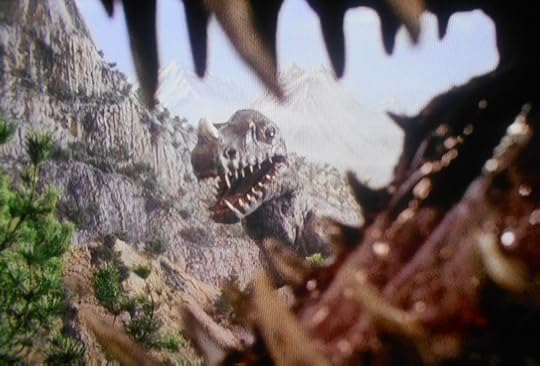
Picking up where the Burroughs classic adventure "The Land that Time Forgot" left off, this Radium-Age sci-fi sequel was first published in 1918 as an entry in "Blue Book Magazine," and then reappeared with its predecessor and a second sequel bound together as one giant novel in the 20s.
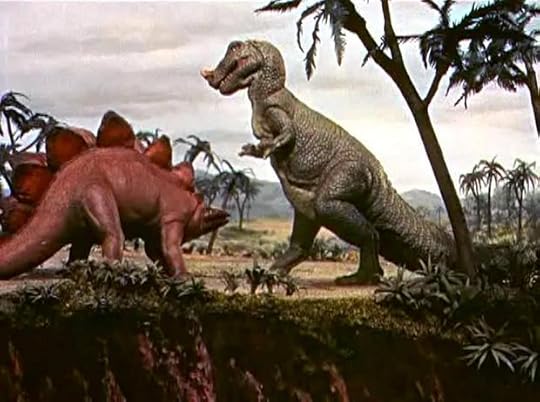
The first story concerned a ship-builder, Bowen Tyler, and his love interest, Lys La Rue, who are on a cruise ship bound for France that is sunk by a German U-boat, and after an exhausting string of action sequences, the couple and a faithful dog end up stranded on an unchartered land called Caprona, or Caspak by the natives. In a manuscript found in a thermos floating off the coast of Greenland, a man reads all about the adventures of these lost survivors in this exotic land inhabited by dinosaurs and several species of prehistoric humans in various states of evolution. In the sequel, the recovered manuscript sparks a rescue mission led by Billings, a former classmate of Tyler's, who sets out in search of the lost survivors on the yacht "Toreador."
Caspak is surrounded by impenetrable cliffs, and in Book One, the island had to be entered by a subterranean tunnel via a U-boat. So the crew of the Toreador bring along an amphibious plane upon which Billings intended to pilot each of the expedition two-by-two over the barrier. But on the inaugural flight, the author immediately begins his nonsensical and artificial means of creating drama and tension. He has the Billings character act like an idiot. Instead of carrying out his objective, he starts chasing down pterodactyls and doing some unauthorized sightseeing, resulting in him crashing his plane into a tree. Oh dear! How are the rescue crew ever going to cross the rocks into the island now, let alone hope to rescue Tyler and Ms. LaRue? Then we have to read a couple of pages of him bemoaning how he's stranded. Well, you had one job to do, you dope, and you blew it acting like a cowboy! So no one wants to hear your bitching.
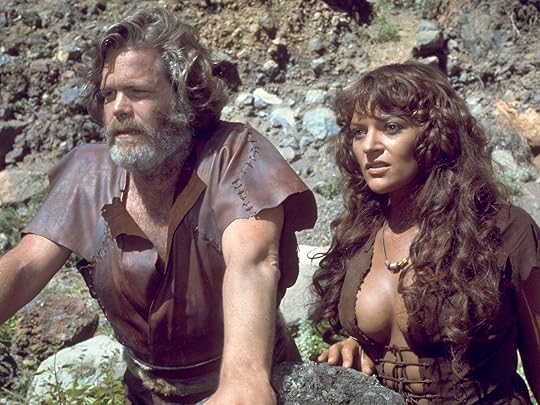
Well, there's our early introduction to the "hero" of this tale, who then goes about having to survive on the island, picking up a ragtag team of cave people as friends along the way, while still hoping to run into the survivors from the original story. We basically retread the same ground as the first book, only the discovery of all the prehistoric wonders is told through the fresh eyes of Billings. We learn a little more about the strange island, but not all the mysteries are revealed, which is a good thing.
Whereas Tyler was pretty casual and straightforward as a narrator in the first book, Billings is more bombastic and melodramatic. He's constantly breaking from the story to ramble on like a hyperventilating Tweet. And he says stupid things. For example, while finding a way to escape from a cave, he says he doesn't know if he'd been trapped in there a day or a week. Yeah, I think you'd know. If you were hiking uphill, which he claimed to have done, without food or water for a day, you'd walk out feeling pretty rough. If it was a week, you wouldn't be walking. But who can tell with Burroughs' writing? He has Billings crawling through the cave, saying "sleep... must SLEEP... forever..." and all that rubbish when suddenly, WATER! One sip and our man is back on his feet. So, which is it? Was the guy in the cave for a week and has remarkable powers of recuperation, or is he just a drama queen?
There are moments in Burroughs stories that really demonstrate his genius as a thinker, such as in parts of his epic "The Moon Maid" and select novels of the Tarzan saga. But so far, the Caspak series has been a demonstration of how Burroughs threw caution to the wind for the sake of prolific literary output. Not only does this novel continue the themes from "The Land that Time Forgot," but it feels like Burroughs only had a few main ideas for the majority of his bibliography, recycling the same elements to bring us romances in jungles full of monsters and cavemen, whether those jungles be in Tarzan's Africa, at the center of the Earth, on Mars or Venus or the Moon, or wherever.
But that doesn't mean I hate it. First of all, the way evolution works on this island is quite a fascinating idea, and I'd be curious how more modern writers might expand this material into a weird fiction format. The character of Billings, for all of his irritating qualities early in the novel, actually does start to grow on you towards the end. He has an arc. He despises Caspak at first for all of its savagery, where everything and everyone seems to be out to kill for their next meal, but then puts things in perspective in regards to his own culture in the midst of yet another war. And his epiphany comes from an unlikely source--one of the cave-dwelling villains of the story. The book has further things to say about the value of life, loyalty, and the responsible use of weaponry. In fact, on the whole, I may have liked this book a little more than its predecessor.
But the real strength of books like "The People that Time Forgot" is in the sheer energy of the narrative and the fantastic nature of the content. If you love the "Jurassic Park" and "Jurassic World" franchises, or enjoyed watching films of Raquel Welch clutching to the chest hair of cave men battling an allosaurus, or have fond memories of reading Jules Verne, or books like Doyle's "The Lost World" and Burroughs' own "Journey to the Center of the Earth," you shouldn't forgo this series.
This stuff is great for getting your kids off the YouTube videos of dopey teens playing Friday Night Funkin', and into reading. And it is perfect for the kid in all of us. It may not be the finest example of Radium-Age science fiction, or even the best of Burroughs, but I couldn't help but enjoy the thrill of this early literary equivalent to a summer blockbuster.