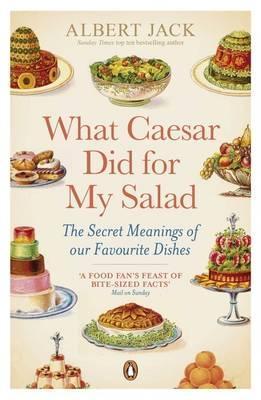
Book: What Caesar Did for My Salad: The Curious Stories Behind Our Favorite Foods
Author: Albert Jack
Publisher: Perigee Books; Reprint edition (6 September 2011)
Language: English
Hardcover: 304 pages
Item Weight: 386 g
Dimensions: 13.97 x 2.54 x 21.59 cm
Price: 2364/-
Food is just as entitled to an apposite history as castles, wars, kings, queens, art, literature, or the bubonic plague. As one of man’s most basic needs, it makes sense that food has had such a powerful influence on world history.
Early agrarian societies formed around the manufacture of food; they developed societal structures that allowed some people to center on farming and others to work outside of agriculture and which ultimately led to stratification of classes and the concentration of power around those who controlled access to food.
Food has also played a critical part in wars from prehistoric times to the last century.
The most effectual mace in the history of warfare isn't a sword, a gun or even the atom bomb; it's malnourishment.
Napoleon had remarked that, "An army marches on its stomach." The result of wars and revolutions, such as say, the the American Revolution, habitually hinged on which side had the better food supply.
This book by Albert Jack is not a cookbook.
As the reader makes his way through this book, he shall see how food has affected the route of history (the Boston Tea Party, for instance, or the Irish Potato Famine) and how it has, sequentially, been affected by history.
The reader shall see, for example, how Prohibition brought out the ingenuity of American chefs, in the form of a variety of dishes from Caesar salad to fruit cocktail; and how the rising price of pepper was the bona fide raison d'être behind Columbus’s voyage to America.
And interspersed among the entries on food the reader shall find daily phrases relating to the things we eat, and the stories behind them, from just desserts to humble pie.
The author divides his book into fifteen chapters, each chapter having numerous subsections. The chapters are :
Chapter 1 - Breakfast
Chapter 2 - Lunchbox
Chapter 3 - Fast Food
Chapter 4 - Aperitifs and Appetizers
Chapter 5 - Soups and Starters
Chapter 6 - Salads and Vegetables
Chapter 7 - The Fish Course
Chapter 8 - Sauces and Seasonings
Chapter 9 - The Meat Course
Chapter 10 - Indian Cuisine
Chapter 11 - Italian Cuisine
Chapter 12 - Chinese Cuisine
Chapter 13 - Christmas Dinner
Chapter 14 - The Dessert Cart
Chapter 15 - The Cheese Course
The author has structured this book around the eating day, starting with a chapter on breakfast and ending up with cheese as the final course for dinner.
The meals we eat and when we eat them have shifted over the years to reflect our increasing mobility and changing lifestyle.
But they can still be a reflection of who we are. For example, everybody knows what breakfast is and, in that sense, we are all the same. If you call it “brunch,” then you should probably get up earlier.
Does one call his midday meal “lunch”? If so, he is probably middle class, reasonably well off, and would spend all afternoon over it if he didn’t have to go back to work. If he calls it a “business lunch,” then he has clearly no intention of going back at all.
Interestingly, this is actually the meal with the longest pedigree.
At the beginning of the 16th century, the main meal of the day took place at around 11:00 a.m., for rich and poor alike, and was called “dinner,” thanks to the Old French word disner, deriving in turn from desjeuner and meaning “to break the fast” (as well as providing the modern French word for “breakfast”).
The day ended with “supper” or, as it came to be known in England, “tea,” which was a light snack eaten as the sun went down and just before everybody went to bed.
The introduction of artificial light meant that meals no longer had to take place in daylight hours: generally the richer you were, the more candles you could afford and the later you ate dinner (i.e., the main meal of the day). Incidentally, if one calls a meal with friends a “dinner party,” then he probably also calls lunch “lunch.”
Interesting and thought provoking questions and tidbits abound the book:
1) Who was Margherita, for instance, and why was the world’s most famous pizza named after her?
2) What about Suzette: why do pancakes flambéed in Grand Marnier bear her name?
3) Is any history of food complete without the tale of how that inveterate gambler the Earl of Sandwich? He was the man who came up with the snack that bears his ame and now forms the mainstay of every lunchbox and buffet.
4) Why do we call our favorite kinds of coffee espresso or cappuccino, for instance?
5) Did medieval Turkish soldiers really invent the shish kebab by threading bits of meat onto their swords and balancing them on top of their campfires?
6) What exactly does horseradish sauce have to do with our equine friends?
7) How do countless national dishes actually turn out to come from somewhere entirely different? Did you know that the all-American favourites the hamburger and the hot dog are, in fact, German?
8) Why is it that people traverse great lengths during times of war to rechristen a dish so that it isn’t associated with a particular country? Hence one gets “hot dog” instead of the German-sounding frankfurter, or Salisbury steak instead of “hamburger.”
9) Was the term "hot dog" really coined during a baseball game between the Yankees and the Giants in 1901?
10) Did you know that France’s beloved croissant, if truth be told hails from Austria?
Turn a few more pages and you’ll find the answers and explanations to all these questions and many more.
It is important to note from the start that this work is intended as an introduction for students to the food studies field. Arranged in an interesting format, it is easy to navigate and the entries receive equal treatment throughout.
Students from an assortment of disciplines would deem this a precious tool when beginning their research because the author has done an excellent job of balancing the dry factual information with the more attractive investigation of how the different foods helped shape different cultures as well as served as the catalyst for major change or discovery .
Overall, this work is an easy to use reference resource that provides an interesting historical overview and back story of a wide range of foods that have directly impacted the development of modern day civilization.
Grab a copy if you choose.