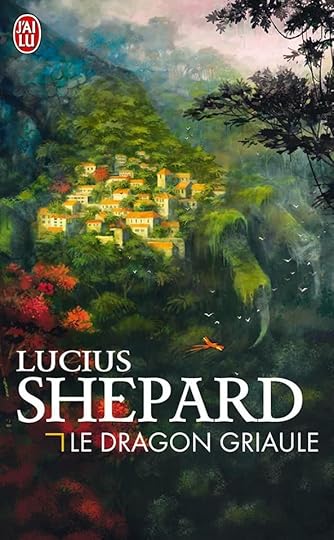
More than twenty-five years ago, Lucius Shepard introduced us to a remarkable fictional world, a world separated from our own “by the thinnest margin of possibility.” There, in the mythical Carbonales Valley, Shepard found the setting for “The Man Who Painted the Dragon Griaule,” the classic account of an artist—Meric Cattanay—and his decades long effort to paint—and kill—a dormant, not quite dead dragon measuring 6,000 feet from end to end. The story was nominated for multiple awards and is now recognized as one of its author’s signature accomplishments.
Over the years, Shepard has revisited this world in a number of brilliant, independent narratives that have illuminated the Dragon’s story from a variety of perspectives. This loosely connected series reached a dramatic crossroads in the astonishing novella, “The Taborin Scale”. The Dragon Griaule now gathers all of these hard to find stories into a single generous volume. The capstone of the book—and a particular treat for Shepard fans—is “The Skull,” a new 40,000 word novel that advances the story in unexpected ways, connecting the ongoing saga of an ancient and fabulous beast with the political realities of Central America in the 21st century. Augmented by a group of engaging, highly informative story notes, The Dragon Griaule is an indispensable volume, the work of a master stylist with a powerful—and always unpredictable—imagination.
Brief biographies are, like history texts, too organized to be other than orderly misrepresentations of the truth. So when it's written that Lucius Shepard was born in August of 1947 to Lucy and William Shepard in Lynchburg, Virginia, and raised thereafter in Daytona Beach, Florida, it provides a statistical hit and gives you nothing of the difficult childhood from which he frequently attempted to escape, eventually succeeding at the age of fifteen, when he traveled to Ireland aboard a freighter and thereafter spent several years in Europe, North Africa, and Asia, working in a cigarette factory in Germany, in the black market of Cairo's Khan al Khalili bazaar, as a night club bouncer in Spain, and in numerous other countries at numerous other occupations. On returning to the United States, Shepard entered the University of North Carolina, where for one semester he served as the co-editor of the Carolina Quarterly. Either he did not feel challenged by the curriculum, or else he found other pursuits more challenging. Whichever the case, he dropped out several times and traveled to Spain, Southeast Asia (at a time when tourism there was generally discouraged), and South and Central America. He ended his academic career as a tenth-semester sophomore with a heightened political sensibility, a fairly extensive knowledge of Latin American culture and some pleasant memories.
Toward the beginning of his stay at the university, Shepard met Joy Wolf, a fellow student, and they were married, a union that eventually produced one son, Gullivar, now an architect in New York City. While traveling cross-country to California, they had their car break down in Detroit and were forced to take jobs in order to pay for repairs. As fortune would have it, Shepard joined a band, and passed the better part of the 1970s playing rock and roll in the Midwest. When an opportunity presented itself, usually in the form of a band break-up, he would revisit Central America, developing a particular affection for the people of Honduras. He intermittently took odd jobs, working as a janitor, a laborer, a sealer of driveways, and, in a nearly soul-destroying few months, a correspondent for Blue Cross/Blue Shield, a position that compelled him to call the infirm and the terminally ill to inform them they had misfiled certain forms and so were being denied their benefits.
In 1980 Shepard attended the Clarion Writers’ Workshop at Michigan State University and thereafter embarked upon a writing career. He sold his first story, "Black Coral," in 1981 to New Dimensions, an anthology edited by Marta Randall. During a prolonged trip to Central America, covering a period from 1981-1982, he worked as a freelance journalist focusing on the civil war in El Salvador. Since that time he has mainly devoted himself to the writing of fiction. His novels and stories have earned numerous awards in both the genre and the mainstream.
Right now this is just a review for the first novella in this collection, The Man Who Painted The Dragon Griaule, though I fully intend to read this whole collection. This story is free online here at Baen.com (it's a sample from the Bestiary anthology). This story was nominated for the 1984 Nebula, 1985 Hugo, and 1985 World Fantasy awards. Review first posted here at Fantasy Literature, along with five other reviews of dragon-related fantasy short stories that are free online. <---seriously, go check these out; they're worth your time.
In 19th century South America, “in a world separated from this one by the thinnest margin of possibility,” a 6,000 foot long, 750 foot tall dragon named Griaule lays immobilized, paralyzed by a wizard’s slightly miscast spell that was meant to slay him. Over the millennia he is gradually covered with grass, earth and trees, but the dragon’s mind is still alive. It has an evil influence over the area, exuding dour vibrations that influence all who live under Griaule’s mental shadow.
Despite hundreds of plans and attempts, no one can figure out how to finally kill such an enormous dragon, until a painter named Meric Cattanay arrives, proposing “death by art”: he will enlist an army of workers to paint the dragon Griaule with poisonous paints. The city fathers are dubious but agree to give him a chance, even though Meric warns them it may take forty or fifty years to kill the dragon. Meric’s grand plan actually began as a con, a way for Meric to make money for a few years, doing the work he wanted without having to worry about finding commissions. But after he explores Griaule’s body and gazes into his mesmerizing eye, he becomes serious about his project, and it becomes his life’s work.
The story follows Meric Cattanay over the next forty years, while he undertakes this enormous work of covering Griaue with beautiful but poisonous paint. It’s a fanciful world, but filled with wondrous, lively details that make this novelette highly readable. Both the mysterious and the mundane, the good and the bad in human nature, are revealed through the events of the story. At the same time, Shepard has created a complex, layered story filled with ideas and symbols that are a delight to try to unpack. The faux-scholarly quotes that bookend the story shed an alternative light on motives and events. Highly recommended. I’m probably going to go buy the whole collection of Griaule stories now …
Not long after the Christlight of the world’s first morning faded, when birds still flew to heaven and back, and even the wickedest things shone like saints, so pure was their portion of evil, there was a village by the name of Hangtown that clung to the back of the dragon Griaule, a vast mile-long beast who had been struck immobile yet not lifeless by a wizard’s spell, and who ruled over the Carbonales Valley, controlling in every detail the lives of the inhabitants, making known his will by the ineffable radiations emanating from the cold tonnage of his brain.
The Dragon Griaule is a powerful reminder of why I love fantasy so much, and what the genre can achieve when it turns its focus not on generic warring kingdoms and evil magicians, but on capturing the wonder and the weirdness of the world, as seen through an unbound imagination. Lucius Shepard is both a stylist and an adventurer, a poet of metaphysical questions and a daring explorer of dangerous, unexplored territories. The first Griaule story started as a “what if …” inspirational moment at a convention, but the protagonist came to haunt Shepard career over the years and to demand that the writer return to it in ever more elaborate constructions. The present collection gathers in one place all the separate episodes of the Griaule epic, a story that mirrors the history of the world we know, still recognizable but in slightly distorted and fancy coloured reflections.
In 1853, in a country far to the south, in a world separated from this one by the thinnest margin of possibility, a dragon named Griaule dominated the region of the Carbonates Valley, a fertile area centering upon the town of Teocinte and renowned for its production of silver, mahogany, and indigo.
What makes Griaule special and different from all the other dragons in fantasy? First, it is his size – a mile long and about four hundred feet tall, the result of millennia of magical slumber, of time settling over his body like sediments on the bottom of the sea, making it bigger and bigger with each millennia that passes. Secondly, it is his telepathic power, the only means of influencing the surrounding world after the wizard’s attack put him to sleep. The author doesn’t miss the implications of this power on the societies that rise and fall around his hill like body:
He is an immortal, unfathomable creature who is as pervasive in our lives as the idea of God. And as with God, we do not have the wisdom to establish the limits to his capacities.
Before I start on the individual novellas included here, I would like to remark on the beauty of the prose, on the flowing long paragraphs and the joy of using the dictionary to the fullness of its abilities (“caliginous” for example), on the mythical powers of creation and on the sense of wonder that I always look for in my fantasy reads. Here’s an example:
In the eternal instant before the Beginning, before the Word was pronounced in fire, long before the tiny dust of history came to settle from the flames, something whose actions no verb can truly describe seemed to enfold possibility, to surround it in the manner of a cloud or an idea, and everything fashioned from the genesis fire came to express in some way the structure of that fundamental duality. It has been said that of all living creatures, this duality was best perceived in dragons, for they had flown fully formed from out of the mouth of the Uncreate, the first of Creation’s kings, and gone soaring through a conflagration that, eons hence, would coalesce into worlds and stars and all the dream of matter.
To quote one of the characters in the book, I think the next quote applies as well to the author, and to me as a reader:
Of course I’m a romantic! What the hell’s wrong with that?
If you feel the same way, maybe the dragon Griaule is just what the doctor ordered for your imagination.
- - -
It all started with a young artist who was dissatisfied with his prospects after finishing school, and who decided during a drunken evening to his friends to embark on a daring project.
Wouldn’t it be great if Dardano didn’t have to write articles, if we didn’t have to paint pictures that color-coordinated with people’s furniture or slave at getting the gooey smiles of little nieces and nephews just right?
As a result, this Meric Cattanay will be known in history as The Man Who Painted the Dragon Griaule , the artist who created the greatest living-dead mural in the world, engaging the whole population and the whole financial resources of the Carbonales Valley in the effort to paint over the scales of the huge dragon with poisonous colours that would hopefully put an end to his malefic influence, once and for all. Meric will be an old man before his mural is finished, but over the years he will know wonder, and love ( He had the classic malady and could find no fault with her), and dangers. Most of all, Meric will be overwhelmed by the majestic presence of the God-like beast:
It was a great hanging garden whose scope took Meric’s breath away – like looking around the curve of a fossil moon. The sense of all the centuries accreted in the scales made him dizzy, and he found he could not turn his head, but could only stare at the panorama, his soul shrivelling with a comprehension of the timelessness and bulk of this creature to which he clung like a fly.
In the author’s footnotes there is a surprising confession that the genesis of the novella is also political in inspiration, as a reaction to the demagogy of the Reagan era. I guess I need a re-read to be able to extract this from the text, and some context from the later Griaule stories.
The Scalehunter’s Beautiful Daughter starts with a personal drama and develops into an exploration of the wonders and dangers of the enormous dragon. If Meric Cattanay was impressed by the outside beauty of Griaule, the heroine of the second novella gets to live for decades inside the dragon, getting to know the tribe of outcasts that settled in the beasts’ innards, fighting parasites and telepathic sending from the vast brain of the alien creature. Again, the sense of wonder dominates the story, but there is also romance and personal development for the heroine.
Everything, she realized, even the happiest of occurrences, might be a cause for tears if you failed to see it in terms of the world that you inhabited; however, if you managed to achieve a balanced perspective, you saw that although sadness could result from every human action, that you had to seize the opportunities for effective action which came your way and not question them, no matter how unrealistic or futile they might appear.
The Father of Stones is a more subtle offering in a different format. Griaule does not make a direct appearance here, and his influence if doubtful, raising questions about freewill and predestination. The structure of the novella is a courtroom drama, with a conscientious attorney defending a criminal who killed a satanic cult leader in order to protect his daughter from becoming an adept. The satanic influence is attributed to Griaule, even if his valley is hundreds of miles distant.
In the afterword, Shepard attributes the story and its interest in the criminal underworld to the influence of his Staten Island residence at the time, underlining one of my pet theories that fantasy works deal in truth with real world problems and personal development issues.
Liar’s House is one of the wildest rides in the collection. It takes places earlier that the previous stories and romance is again in the air, but with a twist inspired by the desire of Griaule to have children. Anything more I say would be a spoiler.
The Taborin Scale showcases the supernatural powers of the dragon, including time travel to a prehistoric time when Griaule was young and still alive. He pulls into this timeline several humans, including a numismatist studying a blue dragon scale and his lover. The ending is spectacular in a Mega-Godzilla fashion.
The Skull is the last published novella, and the most overtly political one of the lot. Shepard channels a lot of his direct experiences of living for a time in Guatemala, among guerrilla factions and government repression. Griaule is still exerting his influence over events, and the sense of wonder is still as fresh as in the first novella. This time it touches on man’s perennial dream of flying. And of course, there’s a bit of romance among the ruins, because, as I mentioned before, the author is unapologetically romantic.
What more can I say at the end of a novel that jumped right into the ‘favourites’ shelf after the first lecture? As usual, the author has a better way with words than me, and I will shamelessly borrow from him”
Goodbye! Don’t be sad! You’re not leaving anything important behind, and you’re taking the best parts with you. Just walk fast and think about what you’re going to tell everyone. They’ll be amazed by all you’ve done! Flabbergasted! Tell them about Griaule! Tell them what he’s like, tell them all you’ve seen and all you’ve learned. Tell them what a grand adventure you’ve had.
I am not by nature a lover of short fiction, and when I do come across examples that appeal to me they tend to be part of a larger interconnected world or storyline as opposed to true standalones. _The Dragon Griaule_ by Lucius Shepard, which collects all of the tales written about the mighty Dragon of the Carbonales Valley, thus already had a leg up on other short fiction collections for me given the obvious titular link between all of the stories in the volume; add to that the fact that Shepard is an excellent writer who makes nary a misstep and you have the recipe for a very enjoyable collection indeed.
Shepard’s approach to making a dragon the focus of his stories is done in a rather creative and perhaps even unexpected way. It’s no spoiler to note that Griaule is, well not quite dead, but certainly static (physically at least) for the majority of these tales. You see, the stories take place “…in a world separated from this one by the thinnest margin of possibility” in which a mighty mile long drake has been made immobile as the result of a magical battle with an ancient wizard, though, as Miracle Max might say, he’s only mostly dead…which as we all know is slightly alive. Now before you jump to the conclusion that a torpid dragon is a boring centrepiece for a series of tales, let me stress that, as the stories make clear, whatever physical limitations the dragon may generally have, his vast mind more than makes up for them. Despite the fact that his body appears to be little more than another geological feature of the Carbonales Valley where it came to rest, rising in the distance like some weirdly shaped, overgrown mountain, Griaule’s mind, or perhaps his soul, has come to hold sway over the extent of the valley (and perhaps beyond). While we occasionally see Griaule actually intrude into a story physically, for the most part he is a brooding presence in the tales, letting his vast and labyrinthine influence direct the lives of all who live under his mighty shadow. The stories jump back and forth in time, covering various eras in the ‘life’ of Griaule and his influence on the world he inhabits and are each intimately concerned with the question of free will, as well as whether its existence (or absence) even matters when it comes to human ‘choice’.
‘The Man Who Painted the Dragon Griaule' sets the scene admirably as we are introduced into the world inhabited by the great beast through the story of the man who would finally kill him…with paint. Meric Cattanay is a down-on-his-luck artist who presents the city fathers of Teocinte (a town that lies in the very shadow of the dragon’s great bulk) with a plan to kill the creature and end his dire influence by painting a great mural upon his hide with toxic paints. It’s a death that will be long in coming, but then one can’t expect the great worm to be slain in a day. As the story progresses we come to see the relationship Cattanay develops with his ‘adversary’ and how his own plans are transformed by his experiences (and ultimately, perhaps, the dragon’s will), assuming they can even be called ‘his’ plans in the first place.
‘The Scalehunter’s Beautiful Daughter’ takes us deeper into the life (and death) of Griaule quite literally. Catherine is the daughter of a scalehunter, one of the human parasites that make a living off of the long, slow death-sleep of the dragon. She has been cultivated from birth to have a deep connection to Griaule and ultimately finds the vicissitudes of chance (if such a thing can exist in the vicinity of Griaule) leading her within the very depths of the dragon’s body. Here she finds not only an intriguing ecosystem of various flora and fauna, but even a barbaric society of sorts, all living under the sway of the dragon’s undead mind. Alas for Catherine her arrival is seen as the fulfillment of a prophecy by those that live within the dragon and regardless of her own wishes she must remain with them until she completes whatever strange and unknown purpose Griaule has set for her.
‘The Father of Stones’ is probably my favourite story in the collection. Since it takes place in a city miles from where his body resides Griaule is more physically distant here than he is in any other story, acting as little more than a rumour in the distance. Despite this fact he is still the overarching presence that informs everything that occurs, driving the story’s action forward. Given the only possible link between the protagonists of the tale and Griaule is the titular father of Stones we can perhaps most starkly see here the influence and power of the dragon, even at a remove. It is also something of a fantasy-noir tale with all of the elements one would expect from the seedy belly of the demi-monde. Our protagonist is Adam Korrogly, an idealistic lawyer teetering on the edge of cynicism who undertakes the defense of an impoverished gem cutter accused of murdering the lover of his daughter, the Svengali-like leader of a dark religion known as the Cult of the Dragon. All of the characters are well drawn, but the star of the story is likely the gem-cutter’s daughter Mirielle a femme fatale worthy of her place in a noir tale who is by turns both manipulator and manipulated displaying a seductive allure and power that exists alongside an inherent vulnerability and weakness.
‘Liar’s House’: It’s not surprising that Teocinte, the city living most closely under the malign influence of Griaule, was known in its early days as a magnet for murderers, thieves, and nearly any of the various cast-off miscreants of society…a real hive and scum and villainy. Thus it is that Hota Kotieb “a brooding stump of a man” chooses it as his final destination after he wreaks violent retribution for the death of his wife by ultimately killing “ten men in the space of less than an hour.” This is merely the prelude to the story as we see Hota become enmeshed in yet another of Griaule’s twisted plans. His meeting with the lovely changeling Magali, an event no doubt engineered by the dragon, will lead his life towards purposes he could never have fathomed and an end that is perhaps a gift as much as it is a punishment.
‘The Taborin Scale’: time travel facilitated by a dragon’s scale snatches a man from Teocinte to a far distant era where he and a group of similar refugees exist in primitive enclaves, waiting to serve some unknown purpose of Griaule. I personally found this to be the weakest story in the collection and am still not sure in which direction in time George Taborin travelled: I had assumed into the past, but the story seems to imply the future, which didn’t make sense to me; also, while the ways of Griaule may be nearly as unfathomable as those of a deity I couldn’t figure out what the dragon was trying to do, or what ultimate purpose the scheme actually served.
‘The Skull’: We come in this tale, my second favourite in the volume, to the final fruition of Griaule's millennia of planning and manipulation. Will his influence and mystical power allow the dragon to fulfill his ages-long plan? What has he in store for the parasite humans that have plagued him for so long, and yet also been his useful tools? This story is set firmly in the ‘here-and-now’ and as such is the most overtly political of Shepard’s stories, especially in the realm of first and third world relations (though it’s fair to say that all of this stories are informed to some extent by these concerns). By now Griaule’s body has been plundered and is no more than pieces spread across the world, the most noteworthy being his skull which now resides in a jungle located in the fictional South American country of Temalagua. It appears the great worm is truly dead and gone, but our main character Snow, an American expatriate slumming in Temalagua, comes to be entangled in the meshes of the dragon nonetheless. He finds himself attracted to Yara, a mysterious young woman with strange connections to both the underworld and Griaule who will lead him on a dark and dangerous journey that spans years and brings us to a long-awaited confrontation. In many ways this is a classic tale retold in an unorthodox way that makes it quite satisfying.
Finally my edition had notes on each of the stories at the end of the book which were both amusing and interesting, though they have much more to say about the colourful life and opinions of Lucius Shepard than they do about the stories themselves as such. This is, perhaps, the most appropriate commentary that one could want. All in all this is a great collection that spins its fantasy content on its head while still retaining all of the menace and power we would expect from tales about a dragon.
"His flesh has become one with the earth. He knows its every tremor and convulsion. His thoughts roam the plenum, his mind is a cloud that encompasses our world. His blood is the marrow of time. Centuries flow through him, leaving behind a residue that he incorporates into his being. Is it any wonder he controls our lives and knows our fates?"
The Dragon Griaule collects Lucius Shepard’s six stories and novellas about Griaule, the mile-long 750-foot-high dragon that has been in a spellbound sleep for thousands of years. He rests in a valley where his body composes much of the landscape, creating hills and forests and waterfalls. Trees and other vegetation have taken root on his body and animals and parasites live in the habitat he produces. Griaule overlooks the town of Teocinte and another shantytown rests on his back. He’s angry about his situation and his negative emotions (“a tonnage of hatred”) cast an oppressive pall over the towns that are under his purview. Or at least that’s what the people who live there say. They blame their disagreeable personalities, and the wicked deeds they do, on the angry dozing dragon. All attempts to kill Griaule and to free the people from his power have been unsuccessful.
Shepard’s first story, “The Man Who Painted the Dragon Griaule,” introduces Meric Cattanay, an uncelebrated young artist who proposes to kill Griaule by painting him (“I don’t believe Griaule will be able to perceive the menace in a process as subtle as art”). At first, his real goal is to swindle the town council, but after exploring the dragon he is struck by its majesty, and when the council agrees, Cattanay’s life’s work begins. For forty years he paints the dragon; it’s a time filled with beauty, wonder, love, loss, guilt, and disappointment.
I was enchanted by the imaginative world created atop and around the huge dragon’s body, but I was even more fascinated by the world of “The Scalehunter’s Beautiful Daughter” for in this story we get to explore inside the dragon. The girl referred to in the title is Catherine, a shallow flighty girl who escapes murderous pursuers by climbing into Griaule’s mouth. There she finds some amazing scenery, meets an entirely alien culture, and learns that Griaule has a job for her to do which requires her to live and work inside his body. This story has a beautiful ending which reminds us to honor those quietly suffering people who spend their lives caring for someone who may never thank them for their devotion.
“The Father of Stones” is an exciting murder mystery in which the priest of a dragon cult is murdered by a gemcutter with a huge gemstone that is alleged to be an artifact of Griaule’s body. The murderer admits his crime but claims that Griaule made him do it. This is an unprecedented defense strategy, but it could make the career of Adam Korrogly, the murderer’s attorney, if he’s successful. Knowing that he needs to be very careful with this case, he sets out to investigate the complicated crime and discovers that his client may not be the only one under Griaule’s control.
In “Liar’s House” Griaule is once again manipulating humans. This time he plans to sire an heir, so he coerces a strong, smart, uneducated man named Hota into doing all the dirty work. In return, Hota will learn how to fly. “Liar’s House” was my least favorite in this collection. It’s a long, deep and depressing character study of Hota, who I thought was inconsistently portrayed in places. I was also disappointed that “Liar’s House” lacked connection to the later stories, but maybe there are future plans for that.
“The Taborin Scale” is about a coin collector named George Taborin. When he polishes old coins, George sometimes experiences strange visions relating to the coin’s origin. When he finds a dragon scale in Teocinte and starts to rub it clean, he and a prostitute are transported back in time to the valley before Griaule was entrenched there. Apparently, the dragon wants them to witness some important event. Unlike the other stories in The Dragon Griaule, “The Taborin Scale” uses footnotes to explain some of the details of Griaule’s history. Here we learn, also, of the effects of Meric Cattanay’s paint. But this story, like the others, isn’t so much about the dragon as it is about some aspect of the human experience. In this case, Lucius Shepard considers what it means to be a family.
Many of Shepard’s readers probably thought that “The Taborin Scale” was the last of his stories about the dragon Griaule, but “The Skull” is a new novella which takes place in our modern world where, apparently, Griaule is able to exert some of his dark influence. This story has the dragon involved in Central American politics and features bored housewives who hang out in gay bars. In the author’s notes at the end of the book, Shepard explains that “The Skull” mirrors some of his own experiences in Guatemala. Parts of this story drag on too long, but the end is intensely exciting.
I greatly enjoyed The Dragon Griaule. All of the stories are beautifully written and subtly humorous, but the first two are my favorites because they allow us to explore the dragon inside and out. The world Lucius Shepard has created is unique and imaginative — a lush landscape fashioned from a huge predator whose hurt pride and seething anger oppress and threaten the populace. Shepard uses this premise to explore the negative aspects of human nature. His characters are deep and introspective, constantly exploring their desires and motives, always wondering whether their own corruption comes from inside themselves or from the dragon’s evil influence. I hope there will be more stories about the dragon Griaule.
Shepard creates a bizarrely captivating setting for these stories, in (literally) and around an enormous mile long dragon, dormant now for millennia but still seemingly capable of subtly exerting a degree of influence on people and events in its vicinity. His body and the ecologies it supports have become a source of wonder and divine mystery, but also danger as it slowly deteriorates and its hosts of incredibly bizarre symbiotic and parasitic life forms continue to thrive. Each story follows a character, living in the shadow of the dragon and tracing its influence, both overt and covert, on events in his/her life. Shepard uses the presence of the dragon to explore questions of free will, personal responsibility and faith in a largely bleak world bereft of joy. The stories take on a melancholic and bittersweet feel as one gets the sense that while the dragon may be superficially perceived as beneficent, its motives are in fact wholly obscure and likely self-serving.
I wasn't sure what to hope for from The Dragon Griaule. I mean, obviously it's received some critical acclaim to be considered a "Fantasy Masterwork" by Gollancz, but it purports to treat dragons in a very different way to traditional fantasy, and Lucius Shepard professes to hating the usual run of fantasy with elves, dwarves and halflings. I rather like my elves, dwarves and halflings, so I wasn't sure if I would get on with Shepard -- particularly as I like my dragons to be real and active, not any kind of allegory of human nature or morality as some commentary on this implied it would be.
But it's okay: I loved the world of Griaule. I couldn't point to one of the stories I liked best, really: I just loved the overall style and setting, the way Shepard set up his world. If I had to pick, it'd be 'The Scalehunter's Beautiful Daughter': the world of exploration there fascinated me. In general, though, I enjoyed this more for the unique take on dragons than for characters, most of whom were unpleasant or otherwise hard to root for.
I can see Griaule's influence on more recent books with dragons, I think. At least, something of Griaule seems to touch Robin Hobb's work, with her amoral, self-centered dragons.
What I wasn't entirely sure about: Shepard's portrayal of pretty much all the women in the book, while often sympathetic, generally cast them all in very similar roles with similar attributes. Even while the narrative didn't seem that judgemental about their antics -- sexual promiscuity, dissipation -- it seemed to consider them universal. I don't think there was an actual "virtuous" woman in the book. It seemed very one-note in that sense. Not that the male characters are much better, thinking about it.
This book is a collection of 6 stories/novellas that centre around the Dragon Griaule and his pervasive "miasma". With beautiful, flowing, descriptive prose that makes use of juicy words, and complex characters, Shepard has written imaginative stories about a unique dragon.
"In a country far to the south, in a world separated from this one by the thinnest margin of possibility, a dragon named Griaule dominated the region of the Carbonates Valley...
...There were other dragons in those days, most dwelling on the rocky islands west of Patagonia – tiny, irascible creatures, the largest of them no bigger than a swallow. But Griaule was one of the great Beasts who had ruled an age. Over the centuries he had grown to stand 750 feet high at the midback, and from the tip of his tail to his nose he was six thousand feet long. Had it not been for a miscast spell, Griaule would have died millennia before. The wizard entrusted with the task of slaying him – knowing his own life would be forfeited as a result of the magical backwash – had experienced a last-second twinge of fear, and, diminished by this ounce of courage, the spell had flown a mortal inch awry. Though the wizard’s whereabouts were unknown, Griaule had remained alive. His heart had stopped, his breath stilled, but his mind continued to seethe, to send forth the gloomy vibrations that enslaved all who stayed for long within range of his influence."
In "The Man Who Painted the Dragon Griaule", a foreign artist gains approval to paint a mural on the side of the dragon using paints containing lead and other chemicals in an attempt to slowly poison, and thus kill him.
"The Scalehunter's Beautiful Daughter" explores the strange inhabitants that have taken up residence inside the passages, crevices and vaults that make up Griaule's guts and the reason a young woman is taken deep inside.
"The Father of Stones" is a murder mystery, with the detective character a young lawyer who is defending the accused, who claimed the comatose dragon forced him to commit the murder.
"Liar's House" features another dragon and a brutish murderer who lives in the lawless city next to Griaule because that is the only place the forces of justice will not venture.
"The Taborin Scale" is something of a time-travel/portal fantasy in which a coin collector and a prostitute are transported to a primordial landscape before Griaule's defeat by the wizard, to witness something spectacular.
"The Skull" is the tale of a young American drifter whose interest is piqued by a striking girl. She turns out to be the leader of a cult that worships a giant skull that some say once belonged to a dragon but that’s just a fairy tale. Isn’t it? This story has a particularly political bent, influenced by Shepard's time spent in South America.
Shepard uses the presence of Griaule to explore questions of personal responsibility, faith and free will in a gritty and flawed world. I loved the overall style of the prose and the concept of Griaule more than the actual stories, but this still made for an entertaining and unique reading experience. Lucius Shepard can definitely write and I'm happy to have found this book.
A huge dragon lying slap-bang in the middle of a valley, overgrown and embedded and part of the landscape but very much alive, if unmoving, his malevolent will working on the creatures that come to live around him and within him. An artist tries to kill him with paint, a young woman is taken deep inside his for some strange purpose, a murderer in a far-off city blames the dragon for his actions, a woman appears in a tavern and claims that she, too is a dragon, a group of people are transported to a version of the valley to witness something terrible, and in a South America we can readily recognise as our own, the dragon's will is still at work. And then there are the notes which contain things more hair-raising than in any of the already fairly hair-rasing stories and novellas. Fantastic writing, strong psychological inner lives of his characters, astonishing descriptions of places and things fantastical and real, and at the end of it all it's a powerful and profound political allegory.
Recopilación de cinco relatos y una novela corta con el dragón Griaule como fondo, escritas por Lucius Shepard a lo largo de treinta años. Griaule es un dragón de una milla de largo y setecientos pies de alto, totalmente inmóvil debido al enfrentamiento con un hechicero. Descansa en un valle donde su cuerpo ha sido invadido por la naturaleza y por algunos pueblos humanos. Pero aún dormido, Griaule es capaz, sutilmente, mediante sus ondas mentales, de hacer que la gente haga lo que quiere.
Sin duda, mi relato favorito es ‘El hombre que pintó al dragón Griaule’, la historia de Meric Cattanay, un pintor que se ofrece a la aldea de Teocinte para matar definitivamente al dragón y así quedar libres de su maléfica influencia. La idea es ir pintando durante años sobre la piel del dragón, envenenándolo.
Otro buen relato es ‘The Scalehunter’s Beautiful Daughter’, donde la joven Catherine, huyendo de unos hombres, se introduce en el interior de Griaule, donde pasará años.
‘The Father of Stones’ también me ha gustado bastante. Trata sobre un abogado que debe defender a un asesino, utilizando como táctica que ha sido la influencia del dragón quién le ha hecho cometer el crimen. La historia tiene giros interesantes.
Los otros relatos no han sido de mi gusto:
-Liar’s House -The Taborin Scale -The Skull (novela corta).
DNF, it seems? Read the first two stories, and skimmed after that. Seems I enjoyed the idea of The Dragon Griaule more than the manifestation... Shepard can write with amazing detail and thesaurian vocabulary skills, and this book is clear evidence of that. He also has grand ideas, well, this one grand idea at least (don't recall reading anything else by him). A massive massive dragon. It is much more than just a large beast, mind you. More like a worldview, or a phenomenon, than a being. The writing is extremely florid, rather a bit too much at times. I love learning new words, but at times his choices left something to be desired. Like simplicity. Or clarity. Anyway. Grand idea, this otherworldly dragon that holds sway over people's lives in thoroughgoing but not-quite-understood ways. Mythological. Magical. Sadly, I couldn't keep my attention on the idea. I found I enjoyed looking up definitions for his word choices more than following the plot of the story I was inside. Not sure I would recommend this, I found the Epic Dragon Idea fully realized by the end of the first, maybe the second, story. Not quite what I expected. Huh.
I just finished “The Man Who Painted the Dragon Griaule” (in The Best Fantasy Stories from the Magazine of Fantasy & Science Fiction) and am floored. Gorgeous, moving, wise, clever, funny, tragic. Literature, not 'just' SFF. So of course I'll have to look for this book, and I'll have to investigate more by the author. --- Finally got this collection of stories & novellas from ILL (Illinois). The first story is by far the best. The next four basically explore the same themes from a slightly different perspective. The last is long and promised to be so ugly (they were progressively getting uglier) that I gave up on it. I think overall I'd give it two stars, despite the first being 4.9.
The only bit I bookdarted is from the last. "... sunglasses by Gucci and makeup by Sherwin Williams." Yeah, the earlier stories, set in 'the olden days,' were more subtle and worth reading.
This collection represents a truly idiosyncratic tale in the annals of Fantasy fiction. A series of short stories and novellas that comprise the imagined history of the titular Dragon Griaule. ...a beast so immense its body forms part of the landscape..., to quote the synopsis on the book's rear.
Griaule is massive, but paralyzed from doing battle with a wizard countless years before the earliest of the stories. While in this state, he exerts a mental force of will on seemingly all life within a certain radius of his body. It's not something that can be confirmed, but it is something those who come near him know. Spreading out from him is the ramshackle city of Teocinte. Atop him is the even more destitute Hangtown. But the inhabitants of these two settlements aren't his only subjects, for his influence is felt even in the far off Port of Chantay. He's a cause célèbre. A nightmarish wonder of the world. A reminder of unknowable darkness, mystery, and wonder. A being who attracts hucksters looking to strike it big with his name. Worshippers seeking purpose. And adventuresome types hoping for profit. Is he the God of this ...world separated from this one by the thinnest margin of possibility..., or merely another citizen of the Universe? Who's to say?
These stories are great. There's a lot in them that isn't pleasant. Griaule's world is one of selfish, harmful urges. Constant reminders of the organicism of life, of how bodies can break, and lust against their better judgment. They'll also leave you with far more questions than answers. Shepard strikes me as a master of the "What the fuck did I just read?!" type of short fiction. Finally, the stories are unquestionably political in ways you don't often see in the genre. Highest recommendation for lovers of the scaly and esoteric.
Znakomity zbiór opowiadań, bazujących na pomyśle wykorzystania nietypowego demiurga - przy czym autor w żadnej z zamieszczonych tu opowieści nie daje jednoznacznej odpowiedzi na pytanie, czy za poczynaniami bohaterów i ich losami zaiste stoi owa siła sprawcza w, symbolicznej wręcz, postaci przebiegłego i okrutnego smoga Griaule.
Każda z historii utrzymana jest w nieco odmiennej konwencji, i każde w pewnym stopniu nawiązuje do nieco innego gatunku literackiego - mamy tu i typową baśń, i "thriller sądowy" z nutką klimatu noire. Jeśli chodzi o styl, narrację i szukanie podobieństw, nasunęło mi nieodparte skojarzenie, że oto czytam melanż fantastyczny powstały w wyniku połączenia sił Jeffa VanderMeera - sporo tu typowych dlań "odlotów" - i Marcina Wolskiego (ze wskazaniem na opowieści o Amirandzie, zwłaszcza z tomu drugiego).
Wszystkie opowiadania trzymają równy, bardzo dobry poziom. Fabularnie nierzadko zaskakują a często bywa tak, że kończą się wielkim niedopowiedzeniem, dającym pole do popisu wyobraźni czytelnika i spekulacji odnośnie tego, co się wydarzyło i czy wydarzyło się naprawdę.
An absolute masterpiece. The stories within this volume constitute an epoch-spanning alternative history of several hundred years, centred round the ominous and possibly-sentient presence of a mile-long ancient dragon, turned to stone and built upon by generations of settlers, and the way they interact with it as landscape, obsession, and possibly, malign active influence in their lives. Shepard paints an epic historical landscape while never letting go of the small stories and personal interactions that drive the narrative. Shepard's narratives are driven by believable, human characters, and it is that strong verisimilitude that lifts these stories above the ordinary fantasy tale. Griaule may be a complex, unknowable force of nature that intrudes into every aspect of these characters' lives, but it is the people themselves we remember. Every one of the stories in this volume is a rich, tightly woven tapestry of superb narrative balance. Taken together, they comprise a tour de force of fantasy writing of the very highest order. A superb volume.
Wow!!! Już dawno, naprawdę bardzo bardzo dawno, nie czytałem czegoś co byłoby tak dobre i wciągające. Jest to zbiór opowiadań mało znanego w Polsce autora - Luciusa Sheparda. Wszystkie historie w zbiorze łączy jeden motyw, tytułowego smoka Griaule'a. Jest to bestia długa i wielka jak łańcuch górski. Smok żyje, ale jest uśpiony. Na jego grzbiecie ludzie budują wioski, w jego wnętrzu mieszkają różne istoty. Z pozoru mogłoby się wydawać, że bestia, której serce uderza raz na setki lat, która się nie rusza i nie daje żadnego znaku życia jest martwa. Jednak tak nie jest. Tak jak pisałem - opowiadania łączy motyw tytułowego smoka, a historie to raczej 'realizm magiczny' niż czysta 'fantasy'. Książka wydana w serii Ucztwa Wyobraźni i naprawdę jest to uczta jakich mało.
Lucius is a favorite author of mine for many reasons and Dragon Griaule is one of those reasons. The last story is the only new addition to the saga, and I found it to be the strongest story of the collection. I have enjoyed Griaule from the beginning, and I hope Lucius hasn't reached the end of this story. The last story "The Skull" gave me a real feel of place, much like "Jaguar Hunter." I give this a high recommendation as it makes re-reading the stories fun knowing there is a new story at the end, and Lucius concludes the book with notes on his life and/or thought process for each of the stories.
This was a very good book. I would go 5 stars but I suspect as good as this is it may not be his best. The first story for me was my favorite. It used a multiple viewpoint narrative that I found effective. Another positive is the size and quality of the publication. Subterranean's paper and binding quality are top notch. I got the limited edition but the trade would have been just as good.
Brilliant collection of short stories and novellas set in the same world as the author's famous "The Man Who Painted the Dragon Griaule." Full review soon on Tor.com and on www.farbeyondreality.com.
Weird, sharply written, unexpected, often bleak, and yet ending with a strange note of hope that I'm still on the fence about whether to consider earned or unearned.
The British Science Fiction Association listed the first of these stories, ‘The Man Who Painted the Dragon Griaule’ as one of the top ten genre novellas. It’s certainly worthy of the accolade, as the story redefines the fantasy genre with an extraordinary milieu and a dark, wholly human twist. This dragon is not the usual fire breathing menace; he has been paralysed in an ancient duel with a wizard and is now partially buried, his mile-long body forming part of the landscape as his unknowable will exerts its ambiguous influence over the surrounding countryside. The amazing physical details of the dragon are offset by the calm, scientific precision of their depiction: the vast, unmoving bulk lies unchanging as its human surroundings age and alter. Since all conventional military attempts to destroy Griaule have failed, the job falls to the creative sector. An artist from outside town decides to paint a mural on the side of the dragon using paints containing leads and other chemicals that will slowly poison him. However, is this plan part of Griaule’s overall design? Beneath the tale of the mural is the story of the artist’s relationship with two women: his original guide and the wife of one of the foremen running the huge industrial operation creating the artwork. This small and movingly believable drama is played out over many years; the artist arrives as a youth and is a lonely old man when the job is complete. As in a lot of the best fantasy, this sense of the epic is almost a character in itself. Likewise, in ‘The Scalehunter’s Beautiful Daughter’, the heroine begins as a lovely but callow young woman who is chased into the dragon’s body. Again, there is the suggestion that this situation has been slowly brought about by the dragon, a theory that gains traction when the girl encounters the strange inhabitants of the visceral inner world who see her as a messiah. Years pass and the girl discovers extraordinary resources both within the dragon and within herself. She gazes at the beast’s huge immobile heart, seeking meaning in its impenetrable patterns. She carries out endless research in Griaule’s passages and vaults. She has a doomed relationship with a man who is similarly trapped but who the dragon may have brought inside to keep his captive company. All along, the girl ponders the reason for her presence here; why is she being protected and from what? Such is the wonder of this situation and the skill of the writer that the inevitable sense of claustrophobia only really hits with hindsight. As in all the stories, the female character is strong and complex, while the male figures come across as restless, almost amoral; even the original wizard faltered at the crucial moment. However, they are redeemed by an overarching sense of decency or determination and it’s easy to imagine many of these characters being self-portraits of the author. Such is the richness of the Griaule concept that different narrative forms can be used to explore it. ‘The Father of Stones’ is a murder mystery, with the detective character a young lawyer who is defending the accused. Father/daughter relationships, or versions of them, underpin the narratives and here the motivation of the murderer is to save his fractious but desirable offspring from the head priest of a cult that worships Griaule. That the girl was a willing participant in the eroticised rites her father ‘saved’ her from renders the case that much harder to make. The lawyer slowly falls under the young woman’s spell and, by implication, that of Griaule. In the first two stories, the dragon’s will is ineffable, as hard to define as a deity’s; by the entirely unexpected conclusion of this story Griaule’s intentions are clearer and the characters worse off for it. Interestingly, the protagonist of ‘The Scalehunter’s Beautiful Daughter’ appears as an expert witness; one of a number of devices linking the stories to give this collection the feel of a novel. ‘Liar’s House’ starts with the least sympathetic of the protagonists; a brutish murderer who lives in the lawless city next to the dragon because that is the only place the forces of justice will not venture. In the first two stories the area around Griaule feels like a 19th century rustic landscape imagined by one of the Dutch Masters recovering from an acid trip; here it gives way to something more desperate, dark and creepingly modern. In the most intrusive example of Griaule’s influence, another dragon appears, this one mobile. She transmutes into a woman and in doing so brings about profound change in the protagonist. As the dragon becomes more human, so too does the man; to the extent that we yearn for an alternative to the inevitable tragic but fittingly ambiguous ending. In ‘The Taborin Scale’ a coin collector and a prostitute are transported to a harsh, primal landscape that turns out to be the valley of Griaule before the dragon’s incarceration. They are harried by a youthful version of Griaule towards a mysterious destination and the climax we’ve been waiting for, although as always with Griaule it turns out to be somewhat different than expected. The man and woman go from interestingly dislikeable to wholly sympathetic as they traverse the prehistoric terrain while trying to negotiate a commercial relationship that retains little meaning other than being the only one they have. Meanwhile, a father/daughter relationship develops between the man and an abused girl the couple rescue, and such is his desire to protect her that he almost loses his mind. These sequences are, for me, the most powerful in the whole collection. They are not only emotionally honest but also psychologically accurate, despite taking place on the outer limits of obsessive neurosis. That the relationship between the man and woman is doomed calls to mind the affair between the artist and the foreman’s wife in the first story; in both cases there is the sense that Griaule himself has forced the parting for his own reasons. Shepard uses a clever device to emphasise this distance; an account written at the end of the story by the woman of her years after she and the man part. At one point she meets them again and her description of them is unnerving. We sense that the man and the girl have become so changed by their encounter with Griaule that they are no longer the same people at all, and are perhaps no longer even fully human. Like an earthbound Moby Dick, Griaule embodies many possible meanings. As well as the neurosis described in ‘The Taborin Scale’, Griaule is a great metaphor for depression, both psychological and political. Shepard himself suggested that the dragon could represent the Ronald Raegan administration, in power when the first story was written in 1984. Certainly, that sensibility extends to ‘The Skull’, a contemporary tale set in Shepard’s beloved South America against a backdrop of narco politics and depressingly familiar right-wing political thuggery. A young American drifter arrives in town and bases himself in a gay bar, which despite its target clientele is frequented by the wealthy but sexually frustrated wives of ranking militiamen. These women soon become a source of both distraction and income, but the young man’s interest is piqued by a striking girl whose influence seems out of all proportion to her youth. She turns out to be the leader of a cult that worships a giant skull; some say it once belonged to a dragon but that’s just a fairy tale. Isn’t it? By this time, Shepard had been writing about Griaule on and off for thirty years and such is the author’s confidence with his material that he suggests events in the previous stories may not even have happened. Sure enough though, the nasty old beast makes his presence known, first through the skull itself, then via the cult whose members mysteriously vanish and finally in the person of the leader of the militia, whose sinister intent is filtered through a disarmingly chatty charisma. There are hints of the father/daughter dynamic as the drifter finds himself increasingly obsessed with saving the girl. However, in the same way the drifter is no Saint George, so the girl is no helpless princess. Her complexity, drive and intelligence make her the ideal vessel for the dragon’s vicious intentions. The girl is the only one who can perceive the dragon’s influence directly, via the sounding chamber of the giant skull. This chamber could be the one discovered by the Scalehunter’s Daughter, in which new versions of herself are created. The facility echoes Griaule’s inventive means of resurrecting his former glory, which find a suitably bizarre expression that is foreshadowed with strange hints that charge the narrative with the feel of a supernatural thriller. Lucius Shepard is a truly great writer. His grasp of mythology is so assured he can make it do what he wants and still have it feel timeless. The many styles of narrative so skilfully employed in this collection are underscored with a kind of righteous but mournful anger that lend Shepard’s language the resonance of poetry. If you read any of these stories not only will you not want to put it down, you will want to read them all.
This series of six stories about a mile long, paralysed dragon who exerts influence on the realm around it, conjured up certain expectations within the fantasy genre before I embarked upon it. Most of these went unrealised, as instead these became varied tales ranging from a plot to kill this god-like being with paint over half a century, through courtroom drama, tales of abuse and metaphysics, and finally ending in a violent and passionate political domination over a (fictional) Central American state set in the mid 2010s.
There's no epic questing here and yet the world was fascinating, even as a fictionalised reworking of our own world, just with magic thrown in. Griaule, despite its malevolent presence over everything, exuded power onto the page even when it was the background to everything and the focus put on the lives and societies of the people Griaule's aura affected. That these people were usually extremely flawed, repugnant characters never felt like it diminished any capacity to engage me.
Each story also acted as a discharge of the political and social frustrations Shepard saw in the world around him in the 30 years these stories were written. In the afterword, Shepard himself credited the first story (regarded as one of the finest novellas in fantasy) as a metaphor for the destruction wrought by the Reagan administration. Political discourse from there was found at the heart of every story (along with a lot of sex), and the dense final story was no doubt inspired by his own time spent in Central America. There was also plenty of contemplation over the power and worship over a being which essentially becomes the equivalent of God.
The writing evolved throughout the collection (unsurprising given he started in the 80s and finished the last story in 2012), becoming denser and more "wordy" (for want of a better term), but Shepard’s skill with prose becomes ever more powerful and lush with it. At times it grated to read whole paragraphs and even pages as run-on sentences, but when I stopped to examine why this was the case, it became clear these were carefully chosen choices, and the sum of it all built to a saga more epic than even the most hardened fantasy sometimes aims for.
A wonderful, but grim and bleak collection of adult stories that although feels slow and dense at times, rewards going in open minded.
An excellent beginning to this collection of stories and novellas about a giant nearly-dead dragon and his influence on the inhabitants of the valley he is interred in. Poetic and moving, this story explores the issues of free will and powerlessness in the face of an all consuming malevolent force. The prose is wonderful, the setting beautiful, and the characters realistic. 4 stars. Honestly, this is quite unlike anything I've ever read, and I can't wait to continue reading about this dragon and its influence over the people who live in the mythical Carbonales Valley. This one covers a man who decides to poison the dragon to death, to free the inhabitants from its malevolent influence, spending his entire life building a community around people who are going to kill this dragon. His life, his loves, his thoughts and dreams and ideas - his free will and his destiny are all called into question in the face of something so unknowable, something so beyond human reckoning - it's like a Lovecraft story with a fantasy tilt, landing somewhere between the fantastic imagination of a Lyonesse story and the existential horror and brutality of Lovecraft or Howard in terms of world building. It's a very promising start to what looks to be an amazing collection.
Cattanay as a character is a fascinating study, watching someone who has a goal to secure unlimited funding initially fall into the Dragon's influence, to become obsessed and entangled with the giant beast, devoting his life to the dragon - it's a great story told. The rest of the world is equally well populated and interesting, and the voice brings the rich world to life.
The first story is a slam dunk of fantasy, weird, rich, interesting, and different.
The Scalehunter's Beautiful Daughter The second in this so-far-excellent series of stories. We follow Catherine, a beautiful if flighty woman who is chased into Griaule's mouth, doomed to live out ten years for some purpose she can't divine among the denizens of the dark interior of the dead dragon. A story ultimately about one's purpose in life, it's another beautiful entry in the saga of Griaule. 4 stars. The thing that continues to impress me about this collection is the wondrous prose and the lyrical quality to the story in what is essentially a very simple tale of fantasy. Each description is made with absolute care, with the feel and mood of the piece held firmly in mind - everything is designed to transport you to Griaule, to the Carbonales Valley, to this fantastic strange world that's so much like our own, but so very very different. Birds, apes, and insects mix with intestinal worms and strange plants that have metaphysical properties. And everything, almost even the words you're reading, seem to be affected by the magic or influence of Griaule himself. His will is everything... or is it? People are guided and given choices, and a rumination of fate and destiny reveals more about the human condition than hundreds of other fantasy stories just like it. Humans are strange creatures, sometimes even more so than a mile long almost dead dragon named Griaule.
This time we follow Catherine, a beautiful woman who spends her youth in excess, moving from man to man, enjoying herself and the pleasures of existence, seemingly free from Griaule's influence, until a fateful day when she is forced into the dragon's mouth and forced to live among the Feelys - remnants of a mentally handicapped explorer who take care of Griaule's insides. She is held prisoner here for ten years, exploring the innards of the dragon, working under a single mentor, surrounded by proto-human creatures that remind me of the Basura in Father Dure's chapter of Dan Simmons' Hyperion. She spends a lifetime exploring the inside of the dragon, botany, zoology, cave diving, going through various ups and downs - in essence, living. She is given an ultimate purpose by Griaule, something most people spend their lives trying to find, then is set free - and given free reign. It's here that the story becomes its most poignant self. What do you do with your true free will? Unable to blame destiny or fate for your actions, indeed, Catherine is one of the only people in the Griaule saga who is able to claim this freedom. What does that say about us? What does that say about her? What does that say about you?
It's an immensely exnjoyable experience revisting this world bit by bit. I highly recommend both this story and the last to anyone who can read.
Lucius Shepard należy do autorów o pokaźnym i wielokrotnie nagradzanym dorobku. Amerykański pisarz odnajduje się bez trudu zarówno w konwencji fantasy, science fiction, jak i w realizmie magicznym. W Polsce ukazały się zaledwie dwa zbiory jego opowiadań – „Zielony kocur diabła” z 2000 roku, dziś dość zapomniany, oraz „Smok Griaule”, dzięki któremu proza Sheparda ma szansę na nieco szerszą niż dotychczas skalę trafić pod strzechy. Warto, by tak się stało.
Średniej grubości tom mieści sześć opowiadań, a wszystkie koncentrują się wokół tytułowego smoka Griaule’a. Długa na sześć tysięcy stóp bestia, której pochodzenia nikt nie jest do końca pewien, została niegdyś unieruchomiona zaklęciem potężnego czarownika. Z czasem ciało gadziny przeistoczyło się w naturalny element krajobrazu i ekosystemu; w cieniu ogromnego cielska wyrosły drzewa, zbudowano wioski, a o zamieszkujących ciało smoka pasożytach i porastających je niezwykłych roślinach opowiada się z trwogą i niepokojem. Griaule budzi wśród mieszkańców podziw, szacunek i lęk, a na życie niektórych z nich ma wpływ dużo większy, niż można by się spodziewać po uśpionej od wieków poczwarze.
Bohaterowie opowiadań są ludźmi, których los w szczególny sposób powiązany jest ze smokiem. Działają na jego chwałę, chronią się w jego wnętrzu lub wręcz przeciwnie – marzą o jego unicestwieniu. Na ile wszystkie te działania są wynikiem ich wyborów, na ile zaś większego planu, którego nie przeniknie umysł ludzki – trudno ocenić. Kim tak właściwie jest Griaule? Smokiem przybyłym z kosmosu, który ze względu na swą inność nurtuje szarych obywateli? A może demiurgiem, wpływającym siłą swego umysłu na nieświadome niczego marionetki? Czy wreszcie – Bogiem, zsyłającym wskazówki, ale pozostawiającym ludziom wolną wolę? Na te pytania każdy czytelnik będzie musiał odpowiedzieć sam.
Pięć pierwszych utworów wpisuje się w konwencję fantasy. Podejście Sheparda dalekie jest jednakże od takiego, jakie znamy z kart innych powieści czy opowiadań. W „Smoku Griaule’u” baśniowy nastrój i oniryczny klimat marzeń sennych wywoływanych przez tytułową bestię przeplatają się z prozą życia; życia odartego z optymizmu, wiecznej miłości i szczęśliwych zakończeń. Świat, który kreuje autor, jest boleśnie prawdziwy, wypełniają go czyny moralnie naganne, ludzkie okrucieństwo i pierwotna seksualność. W wykonaniu amerykańskiego pisarza taka mieszanka okazuje się nie tylko strawna, lecz wręcz pełna dobrego smaku.
Ostatni utwór, „Czaszka”, będący zarazem powrotem Sheparda do świata Griaule’a po latach przerwy, znacząco różni się od swoich poprzedników. To już nie fantasy, a realizm magiczny w czystej postaci, z akcją osadzoną w slumsach współczesnej Ameryki Środkowej, która zmaga się z problemami natury politycznej. Opowiadanie to jako jedyne budzi dość mieszane odczucia: z jednej strony jest brutalne, przenikliwe i zajmujące na równi z poprzednimi; z drugiej – ze względu na swą konwencję i ujęcie tematu wydaje się nie pasować do pozostałych, przez co jako zwieńczenie mitologii Griaule’a nieco rozczarowuje.
Po prozę Sheparda zdecydowanie opłaca się sięgnąć. Zbiór „Smok Griaule” to jedna z tych pozycji, które w przystępnej formie skrywają utwory o niejednoznacznej wymowie i stylistycznym uroku. Gdy dodać do tego wspaniały pomysł leżący u podstawy wszystkich opowiadań oraz wymieszanie konwencji baśni z okrutną rzeczywistością, z powodzeniem stosowane przez autora, otrzymujemy kolejną pozycję z serii Uczta Wyobraźni, z którą błędem byłoby się nie zapoznać.
--- Zarówno tę recenzję, jak i wiele innych tekstów znajdziecie na moim blogu: http://oceansoul.waw.pl/ Serdecznie zapraszam!
Nigdy nie lubiłem opowiadań. Człowiek zaczyna lubić bohaterów, zżywać się z nimi, wchodzić w przedstawiony świat i nagle wszystko się kończy pozostawiając spory niedosyt. Mając wszystko to na uwadze, przystąpiłem do lektury opowiadań Luciusa Sheparda pt. „Smok Griaule” z pewną nieśmiałością, pełen wątpliwości i niedowierzania. I muszę powiedzieć, że bardzo pozytywnie się rozczarowałem.
„Smok Griaule” to zebrane w jednym tomie i wydane przez wydawnictwo Mag w serii Uczta Wyobraźni opowiadania o smoku Griaule jakie ukazały się w różnych czasopismach, plus jedno nowe, nigdy wcześniej nie wydane pt. „Czaszka”. Wszystkie opowiadania łączy to samo miejsce, jakiś kraj gdzieś w Ameryce Środkowej oraz postać smoka Griaula, pokonanego kiedyś w pojedynku na magię przez pewnego czarownika. Czrownik jednak sfuszerował trochę swoją robotę lub też może w ostatniej chwili przestraszył się smoka, w każdym razie smok nie został zupełnie zabity i od tamtego czasu leży sparaliżowany zaklęciem, nadal żywy i poprzez emanację swojego mózgu wpływa na życie, myśli i postępowanie ludzi, którzy znajdują się w jego pobliżu. Nikt nie wie czy to co robi jest wynikiem jego woli czy może woli smoka, który wpłynął na jego umysł. Wielu z bohaterów przypisuje swoje złe uczynki wpływowi Griaula. Fantasy Sheparda to tzw. literary fantasy, w której nie znajdziemy szybkiej akcji, przygód, wielkich bitew, pojedynków na miecze czy też pogoni za trollami. Wszyscy, którzy szukają tego w czytanych przez siebie książkach niestety srogo się rozczarują. To nie jest prosta literatura. Shepard pisze bardzo dobrze, ładnym językiem, wciągając łatwo czytelnika w opowiadane historie i niczym smok Griaule oddziałując na jego umysł. Każde z opowiadań jest inne, pisane nieco odmiennym stylem i porusza odmienny aspekt ludzkiego życia. Mamy tu elementy horroru, pamiętnik, rodzaj legendy, baśń, współczesną powieść obyczajową, a nawet thriller prawniczy. Proza Sheparda jest wielopoziomowa. W swoich opowiadaniach często porusza on filozoficzne i etyczne tematy, takie jak wolna wola, przeznaczenie, dobro i zło, wpływ boga na życie jego wyznawców, mroczne zakamarki ludzkiej duszy. Czytając te opowiadania, człowiek zaczyna zastanawiać się nad własnym życiem, swoimi wyborami, a także nad czarnymi kartami w historii ludzkości, nad nasza wolną wolą. Czy nasze życiowe decyzje, które kiedyś podjęliśmy, wszystko co robimy, nie tłumaczymy, podobnie jak postacie z opowiadań Sheparda, wpływem jakiejś wyższej istoty? I czy wszystkie złe czyny, które ludzkość popełniła, nie usprawiedliwiamy wpływem jakiegoś złego boga?
Opowiadania Sheparda to rodzaj fantasy, który osobiście bardzo mi odpowiada, i inny sposób patrzenia na ten gatunek, gdzie liczy się wyobraźnia i piękno języka. Jego utwory nawiązują często do realizmu magicznego, a Lucius Shepard obok Johna Crowley‘a jest uznawany za amerykańskiego Gabriela Garcię Marqueza. Cieszę się, że gatunek fantasy jest tak obszerny i każdy może znaleźć w nim coś dla siebie. Zachęcony i zachwycony opowiadaniami, poszedłem za ciosem i obecnie czytam powieść Luciusa Sheparda „Piękna krew”, wydaną w magowskiej Uczcie Wyobraźni, której akcja rozgrywa się również w cieniu Griaula. Polecam przede wszystkim, tym którzy lubią dobrą literaturę.
The stories are written over a span of over 20 years, every so often the author revisiting the idea of Griaule, and adding to his legend. I enjoyed how the dragon was kept 'other' and 'inhuman', despite some of his more human desires - procreation, survival, control. I found many parallels between the horrors done in Giaule's name and those done in any god's name, with the distinction that Giaule and his worshipers do not aspire to an ulterior motive, countless rewards after death, etc. Yet, the dragon was still the usual excuse for any crime committed, humanity surrendering the ever-existing choice for betterment. Griaule is not the only common theme between the stories. Each one has a relatively young, beautiful and practical woman, a mature, clever and enduring man, both seeking their place in life, their happiness, struggling to find it alone and together, their relationships growing and changing, and this was the true beauty of Shepard's stories for me. In te final story the two humans find each other and attain the possibility for personal happiness. Still, I wished Yara's teachings would get through to Griaule thus allowing for something more than depravity in the world the author depicts.