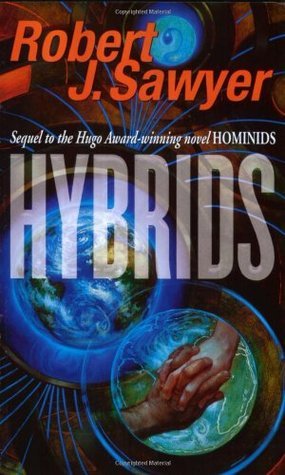
Hybrids (Neanderthal Parallax, #3)

Hybrids (Neanderthal Parallax #3)

3.76 of 5 stars 3.76  ·  rating details  ·  1,993 ratings  ·  90 reviews
In the Hugo-Award winning Hominids, Robert J. Sawyer introduced a character readers will never forget: Ponter Boddit, a Neanderthal physicist from a parallel Earth who was whisked from his reality into ours by a quantum-computing experiment gone awry - making him the ultimate stranger in a strange land.

In that book and in its sequel, Humans, Sawyer showed us the Neandertha
...more
Paperback, 400 pages
Published November 1st 2004 by Tor Science Fiction (first published 2003)
more details... edit details

Friend Reviews

To see what your friends thought of this book, please sign up.
Ready Player One by Ernest ClineOld Man's War by John ScalziAltered Carbon by Richard K. MorganAnathem by Neal StephensonRevelation Space by Alastair Reynolds
Best Science Fiction of the 21st Century
82nd out of 205 books — 1,328 voters
His Dark Materials by Philip PullmanCoraline by Neil GaimanOutrageous Fortunes by Steven W. WhiteSidhe's Call by Christy G. ThomasPerchance to Dream by Peter Lukes
Parallel Universes
10th out of 47 books — 34 voters


More lists with this book...

Community Reviews

(showing 1-30 of 2,791)
filter  |  sort: default (?)  |  rating details
Ian
I started my review of Hominids, the first book, by saying it was a pretty good start to the trilogy. Not great, but pretty good, and ultimately a little disappointing because a Hugo-winner should be better than, well, pretty good. Now I’ve finished the trilogy and Hybrids is solid ending. Not great, but, well, solid. Still I don’t feel the minor disappointment I felt with the first book because my expectations had been lowered from great to average, so reading a nice, solid ending was satisfyi...more
Leslie
The most cringe worthy book I have EVER read. This series started off with an interesting concept but proved to be totally repulsive. It's like the author crammed a bunch of- ill give him this- actual scientific theories together with awful plot lines and character dialogue making one huge awkward mess. This last one was by far the worst. I really don't see how an extremely uncomfortably graphic depiction of a woman's rape in the first book was remotely necessary, unless you count the ridiculous...more
Ward Bond

This is the climactic book of Robert J. Sawyer's Neanderthal Parallax trilogy. Torn between two worlds, geneticist Mary Vaughan and Neanderthal physicist Ponter Boddit struggle to find a way to make their relationship work. Aided by banned Neanderthal technology, they plan to conceive the first hybrid child, a symbol of hope for the peaceful coexistence of two versions of reality.But after an experiment shows that Mary's religious faith--something completely absent among Neanderthals--is a quirk

...more
Mei-Lu
Hybrids is the final volume in Robert J. Sawyer's Neanderthal Parallax Trilogy and I have to say... the series really degenerated from a promising start. While this book is better than the second book, it's not as good as the first. The problem is Sawyer's characters. I feel as though Sawyer writes his novels in the same way an academic writes a paper. He has done all of this research into paleoanthropology and primatology and now he's assigned each characters aspect of society that he wants to...more
D.L. Morrese
The third book in The Neanderthal Parallax series returns to the soft science fiction theme of two cultures colliding. This final book has a single antagonist, a racist (or would it be species-ist?) bigot who wants to take the unexploited and unpolluted Neanderthal world for Homo sapiens. Of course to do so will involve a minor case of genocide but he has the tools and he has the technology, kindly provided by the Neanderthals themselves. Mary, the geneticist heroine from the last book, has to s...more
Alaina
This review has been hidden because it contains spoilers. To view it, click here.
Bruce Kroeze
I could not finish this book. This book is literally the single worst SF book I have tried to read in a decade.

The characters? Abysmal, cardboard cutouts who go on rants which last pages. Worse than Ayn Rand, worse than Arthur C. Clark.

The ideas? Nothing new at all. Just more of the same. Neanderthals are smarter, nicer, more moral, and all-around-better than Homo Sapiens. Their world is unspoiled, ours is a hell hole.

The political ideas?

- Eugenics are great. It would benefit society to force-s...more
Shomeret
Well, I'm the reader who supposedly doesn't exist that started with the third book in the trilogy. I'm the sort of person who does that on a regular basis because I think that all novels ought to be able to stand on their own. So the repetition of events from the previous novels was valuable orientation. I think that authors should recapitulate. Even though most readers aren't like me, they will often forget what happened in the previous books and need the reminders.

I really like the premise of...more
Allison
Of the three, I enjoyed the first book the most, probably because of the freshness of the idea.

I really enjoy Sawyer as an author, and while the concepts of these books is really cool, I felt like I could see the cogs working here. Meaning that the story and characters seemed purely to be a conduit for social, religious, political, and moral discussion. Which is all well and good--I am a firm believer that science fiction challenges us to rethink our world and to reexamine it in the light of oth...more
Nepeta Thompson
Once again, there were some discrepancies between this and previous books in the series. At one point the main characters go down to an underground facility, and the author talks about them climbing down a long ladder. In book one they had a ladder, since the facility was only infrequently accessed by maintenance crews, but by beginning book two they had put in an elevator to accommodate the increased number of people coming and going. Apparently by book three he forgot about the elevator.

There...more
Merredith
Sep 02, 2011 Merredith rated it 4 of 5 stars Recommends it for: archaeology and anthropology lovers
This is the third and last book in the trilogy about modern time, where a portal opens up between this earth and a parallel dimension where neanderthals rule the world instead. Their world is way better than ours, there's no overpopulation, everything is clean and unpolluted. People all wear built in cell phones/computers/monitors in their arms that can't be taken out and they record everything that happens, cutting crime to almost zero. this last one brings everything to a head, of how the two...more
Cwilson466
I didn't hate this book as much as some people did. However, I did have some of the same issues. I read this book because I enjoyed the first two in the series. But, the story in this book was a little bit slower, so I think I had more opportunity to notice some of the author's biases. For example, it is clear that this author has a very low opinion of women. The main character is supposed to be a preeminent scientists, but she is overly emotional, incapable of remembering simple conversations f...more
James
Hybrids is the least likeable of the Neanderthal Parallax trilogy. The implications for Man of a doorway to another alternate Earth is put aside as a subplot in favor of Mary’s transformation.

Mary has fallen in love with Ponder, one of the Neanderthal scientists. The “Barasts” have their own code of ethics and Mary struggles with it as it interferes with her Catholic faith.

Much is made of Mary’s beliefs and her struggles, much more than she deserves. She’s a flighty character, who discovers th...more
Ben Babcock
This review has been hidden because it contains spoilers. To view it, click here.
John
Apr 23, 2012 John added it
Shelves: read-in-2010
A solid ending to an excellent trilogy, marred a bit by uneven pacing between action and exposition towards the end, a touch too much of deus ex, and a complex plot issues being resolved a bit too neatly. That noted, this is great biological sci-fi, and is recommended.
Fred Hughes
This is the third book in The Neanderthal Parallax trilogy. The other two being Hominids (book 1) and Humans (book 2).

In this book we find Dr Mary Vaughan (human geneticist) and Ponter Boddit (Neanderthal physicist) continuing their relationship that developed when they first met. Mary has gone over to the parallel Neanderthal world to learn more about their culture.

From the first books we have learned that in the Neanderthal world:

1) The population has been limited to 185 million
2) All the men...more
Beth Quittman
The conclusion to a bafflingly successful series. The author descends to new depths of misandry as he demonstrates how all the world's violence and problems are because of men and/or religion. Meanwhile the Neaderthal utopia is a Nazi's dream, with 24-hour surveillance, forced sterilization, and eugenics. I'm still not sure if this is tongue in cheek or obliviousness. I would assume it was commentary but the heavy-handedness of the rape subplots lead to believe it may very well be straight up.

E...more
Darren Vincent
An incredible read...personally disappointing.

As a conclusion to the trilogy, the book was incredible. Once again, it is a book (and series) that makes you think about the world you live in and the consequences of our actions. The author does a wonderful job of balancing multiple plots & subplots and revisiting them at just the perfect time and at just the perfect order to keep them active, relevant and interesting. His commentary on society is very aware and acute and whether I agree or not...more
R. Michael Litchfield
Is it accurate to consider a book disappointing when you really don't expect much from the writer? Hybrids was the most lame of the trilogy, actually that's not fair, hominids was actually pretty good and humans was better than most of the other Sawyer books I've read but this was just a mess. The characters were flat and lifeless, they seemed to stumble around on his stage with no real point or purpose and on the whole it was a struggle to give a damn about them. The only excitement was at the...more
Meghan R.
Tidy ending with a (view spoiler)[double wedding (hide spoiler)], but it's safe to say that Sawyer has thoroughly exhausted what he could offer based on this premise by the third volume in the trilogy.

Everyone in these novels seems to use extremely short and simple declarative sentences, even when they aren't trying to communicate across a language and species barrier. I have no idea if this is a deliberate stylistic choice and what if anything it means, but I suppose one might try them out on a...more
Simone
Overall I loved it: The entire Trilogy. I just couldn’t get enough of Mary trying to explain (justify) our society to Ponter, I thought that it brought up so many different and interesting issues: Religion, Crime and Punishment, The Right to Choose, Environment, Relationships, Science and Technology etc … I found it endlessly interesting!

Having said that, I didn’t like the Jock storyline and I won’t say more about it because I don’t want to spoil it for those who have not read it yet. The book s...more
Rob
...Despite its flaws I did enjoy reading the Neanderthal Parallax and its final volume Hybrids at some level but I very much doubt they represent Sawyer's best work. Hybrids is a fast paced novel rich in ideas and scientific concepts but with a rather unlikely plot. I guess it shows that it takes more than a good premise and fascinating ideas to write a really good science fiction novel. If you are like me, unable to put down a trilogy once you started, then this book is very readable but I woul...more
Eddy Allen
In Hominids, Robert J. Sawyer introduced a character listeners will never forget: Ponter Boddit, a Neanderthal physicist from a parallel Earth who was whisked from his reality into ours by a quantum-computing experiment gone awry ? making him the ultimate stranger in a strange land. In that book and in its sequel, Humans, Sawyer showed us the Neanderthal version of Earth in loving detail ? a tour de force of world-building; a masterpiece of alternate history. Now, in Hybrids, Ponter Boddit and h...more
Eddy Allen
In that book and in its sequel, Humans, Sawyer showed us the Neanderthal version of Earth in loving detail - a tour de force of world-building; a masterpiece of alternate history.

Now, in Hybrids, Ponter Boddit and his Homo sapiens lover, geneticist Mary Vaughan, are torn between two worlds, struggling to find a way to make their star-crossed relationship work. Aided by banned Neanderthal technology, they plan to conceive the first hybrid child, a symbol of hope for the joining of their two versi...more
Fred
I don't think that I liked it as much as the first book but it was quite a bit better than the second one. This series examines every social issue that we deal with on this planet. Rape, murder, homosexuality, bisexuality, eugenics, environmentalism, racism, sexism, genetic engineering and I'm sure that I'm missing a few.

I have to say that if a gateway opened up to "the other side" right now, I'd try to grab my family and make a run for it. It would be amazing to live in a world like that and l...more
mlady_rebecca
I can't give any higher marks to this, or the previous two books in this trilogy. There is nothing these books are missing. They make you think and feel. They make you laugh and cry. There is adventure and romance.

These books point out what is best and what is worst about humanity. Without preaching, the author highlights where we (as a global society) triumph, and where we've failed ourselves. Some of these failings are things we could correct here and now, while others are decisions made too l...more
Bill Purdy
Apr 01, 2008 Bill Purdy rated it 3 of 5 stars Recommends it for: Anyone who enjoys good, earthbound sci-fi
Backstory is important with sci-fi titles, since that's the foundation on which entire careers are launched. It seems the guiding principal of successfully writing SF (i.e., actually making a living doing it) is to develop and establish a compelling "universe," preferably one that resonates with the book-buying public, then milk that "universe" for all it's worth by first writing a trilogy, then (if you're really good) writing several more trilogies (e.g., "Volume 17 of the Ayy'k'brin Starquest"...more
Kip
A decent conclusion to the storyline. A couple interesting plot twists, but again I see why the first book won awards and the two sequels did not. Tied up all the loose ends and left us all with a warm fuzzy. Not as emotionally complex or realistic as the Steele Coyote stories in that regard.

* Couldn't finish
** I had nothing else to do
*** Passed the time, would be **** for genre / author fans
**** Everyone could enjoy this book
***** Everyone should read this book, I'll read it again
Eddie
I'm always wondering where Sawyer is going in his novels. The endings are a little too romantic for me. But I enjoyed the story anyway. As in many contemporary novels, there is a sense that something rotten is going to happen and that the US will use the new (technology, products, etc.) for bad ends. Though it wasn't done by the Pentagon, there was still a nefarious person at the core of the betrayal. This was an interesting trilogy and Sawyer is to be commended for his wanting a beautiful, peac...more
Francisco
So the story of neanderthals coming from a parallel universe trilogy ends?

I think there are a lot more issues that can be addressed. The comment of why continue to build a portal by the UN if males can no longer travel to the Barast world...Child rearing issues on both worlds...How to accuse a Barast of a crime and keep the rest of your family safe...

Ponter deals his own type of justice...a bomb is placed at the Barast world...Polution, over-population, crime & punishment.
« previous 1 3 4 5 6 7 8 9 93 94 next »
There are no discussion topics on this book yet. Be the first to start one »
Hybrids (Neanderthal Parallax, #3)
Híbridos (El paralaje Neanderthal, #3)
Hybrids (Audio CD)
Hybrids (Paperback)
Hybrids (Neanderthal Parallax, #3)

25883
Robert J. Sawyer is one of Canada's best known and most successful science fiction writers. He is the only Canadian (and one of only 7 writers in the world) to have won all three of the top international awards for science fiction: the 1995 Nebula Award for The Terminal Experiment, the 2003 Hugo Award for Hominids, and the 2006 John W. Campbell Memorial Award for Mindscan.
Robert Sawyer grew up in...more
More about Robert J. Sawyer...
Flashforward Hominids (Neanderthal Parallax, #1) Calculating God WWW: Wake (WWW, #1) Humans (Neanderthal Parallax, #2)

Share This Book

Your website

No trivia or quizzes yet. Add some now »