

What do you think?
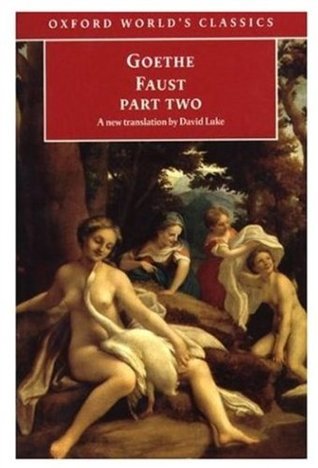
Goethe’s Faust #2 of 2
Faust, Part Two
This is a new translation of Faust, Part Two by David Luke, whose translation of Faust, Part I was the winner of the European Poetry Translation Prize. Here, Luke expertly imitates the varied verse-forms of the original, and provides a highly readable and actable translation which includes an
introduction, full notes, and an index of classical mythology.
introduction, full notes, and an index of classical mythology.
304 pages, Paperback
First published January 1, 1832
About the author
Johann Wolfgang von Goethe
13.6k books7,308 followersA master of poetry, drama, and the novel, German writer and scientist Johann Wolfgang von Goethe spent 50 years on his two-part dramatic poem
Faust
, published in 1808 and 1832, also conducted scientific research in various fields, notably botany, and held several governmental positions.
George Eliot called him "Germany's greatest man of letters... and the last true polymath to walk the earth." Works span the fields of literature, theology, and humanism.
People laud this magnum opus as one of the peaks of world literature. Other well-known literary works include his numerous poems, the Bildungsroman Wilhelm Meister's Apprenticeship and the epistolary novel The Sorrows of Young Werther .
With this key figure of German literature, the movement of Weimar classicism in the late 18th and early 19th centuries coincided with Enlightenment, sentimentality (Empfindsamkeit), Sturm und Drang, and Romanticism. The author of the scientific text Theory of Colours , he influenced Darwin with his focus on plant morphology. He also long served as the privy councilor ("Geheimrat") of the duchy of Weimar.
Goethe took great interest in the literatures of England, France, Italy, classical Greece, Persia, and Arabia and originated the concept of Weltliteratur ("world literature"). Despite his major, virtually immeasurable influence on German philosophy especially on the generation of Georg Wilhelm Friedrich Hegel and Friedrich Wilhelm Joseph von Schelling, he expressly and decidedly refrained from practicing philosophy in the rarefied sense.
Influence spread across Europe, and for the next century, his works inspired much music, drama, poetry and philosophy. Many persons consider Goethe the most important writer in the German language and one of the most important thinkers in western culture as well. Early in his career, however, he wondered about painting, perhaps his true vocation; late in his life, he expressed the expectation that people ultimately would remember his work in optics.
George Eliot called him "Germany's greatest man of letters... and the last true polymath to walk the earth." Works span the fields of literature, theology, and humanism.
People laud this magnum opus as one of the peaks of world literature. Other well-known literary works include his numerous poems, the Bildungsroman Wilhelm Meister's Apprenticeship and the epistolary novel The Sorrows of Young Werther .
With this key figure of German literature, the movement of Weimar classicism in the late 18th and early 19th centuries coincided with Enlightenment, sentimentality (Empfindsamkeit), Sturm und Drang, and Romanticism. The author of the scientific text Theory of Colours , he influenced Darwin with his focus on plant morphology. He also long served as the privy councilor ("Geheimrat") of the duchy of Weimar.
Goethe took great interest in the literatures of England, France, Italy, classical Greece, Persia, and Arabia and originated the concept of Weltliteratur ("world literature"). Despite his major, virtually immeasurable influence on German philosophy especially on the generation of Georg Wilhelm Friedrich Hegel and Friedrich Wilhelm Joseph von Schelling, he expressly and decidedly refrained from practicing philosophy in the rarefied sense.
Influence spread across Europe, and for the next century, his works inspired much music, drama, poetry and philosophy. Many persons consider Goethe the most important writer in the German language and one of the most important thinkers in western culture as well. Early in his career, however, he wondered about painting, perhaps his true vocation; late in his life, he expressed the expectation that people ultimately would remember his work in optics.
Ratings & Reviews
Friends & Following
Create a free account to discover what your friends think of this book!
Community Reviews
Displaying 1 - 1 of 1 review

April 28, 2020
E va’, bel tipo, nel tuo splendore…
Come questa evidenza ti farebbe penare:
chi può una sciocca o savia cosa mai pensare
che i nostri avi non l’abbiano pensata?
Come questa evidenza ti farebbe penare:
chi può una sciocca o savia cosa mai pensare
che i nostri avi non l’abbiano pensata?
Displaying 1 - 1 of 1 review