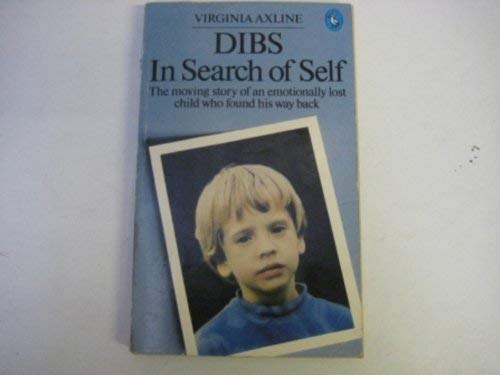
A child therapy classic. Dibs will not talk. He will not play. He has locked himself in a very special prison--and he is alone. This is the true story of how he learned to reach out for the sunshine, for life--how he came to the breathless discovery of himself that brought him back to the world of other children. Dibs in Search of Self is a true story by psychologist & author Virginia Mae Axline. It chronicles a year of play therapy sessions with an emotionally crippled boy from a wealthy, highly educated family. In spite of obvious signs he's gifted, his parents perceive him as mentally defective because he presents abnormal social behavior. He continuously isolates himself, shuns social contact, rarely speaks, physically lashes out at his sister & classmates, has homicidal ideation & displays anti-social behavior. He's misdiagnosed as autistic. To maintain anonymity, Axline gave him the Dibs pseudonym. She uses play therapy in order to communicate with him. Gradually, he's rehabilitated & brought back to normal social behaviors. Tested, he was a gifted child with a 168 IQ.
As an Asperger’s-type guy, I believe the title of this book contains an erroneous assumption. Dibs is NOT in search of his self, really.
He’s shocked into Catatonic Silence by the world’s Bad Faith.
What does that mean?
Sartre says it is a world - the adult world to this ingenuous kid - which is what it is not, and is not what it is. An enforced lie: bad faith.
And as adults we tend to talk DOWN to our kids.
Dibs is autistic. He KNOWS who he is, but most adults don’t know who they are, or PRETEND they don’t know who they are. The world isn’t HONEST.
He’s a lost little kid, like we are at heart. The world’s blind aggression leaves countless casualties in its wake. Like Dibs. And so many of us.
Like when “the world is too much with us,“ and we retreat into our books...
But with the help of a caring medical practitioner Dibs finds Hope again - and his own lost Sense of Play.
How to wake up someone with ASD: DON’T hit them with a sledgehammer, deal with them openly and caringly.
What’s the key to breaking the darkness of bleak isolation? It’s rediscovering our selves in their natural joyful interrelatedness within society.
And following in Dibs’ footsteps, we learn the secret to OUR Selves’ relationship to the world...
It’s Play. Fascination with the shapes our mind projects on the world.
It all becomes a fun game for him... but it’s not the game most folks prefer!
NOT the kind of aggressively mindless games we play on our handhelds on the LRT’s...
NOT the vacuously brain-numbing late-night scanning of Internet videos...
NOT the low-minded soulless flirting that we love to lose our selves in...
No.
Because those things lead straight back to our heartless alienation. And Bad Faith.
It’s the easy and comfortable back-and-forth movement of ordinary banter, ordinary horsing around - WITHOUT an awareness of isolated separateness or aggressive intent.
Want to continually get Lost in Angst and Emptiness again? The world’s aggression’ll get you there FAST, unless you hang on to your inner child.
And who cares what the world thinks, anyway - right, Dibs?
Start to think CREATIVELY and SYBARITICALLY - on your own.
No, what you have to do, as Julie Andrews told the von Trapp kids, is “start from the very beginning...”
For as she says in the cinematic version of the Classic Mary Poppins books, Life is simple if you turn every task you undertake into a GAME.
Cause if you can spell “supercalafragilisticexpialadoshus,” spelling anything less than that afterwords becomes a SNAP!
That’s how I learned as a kid. And that’s how Dibs does it. Through games.
And if you’re LUCKY enough to have been homeschooled by a loving Mom, as I was in part, YOU learned that way too.
You Turn Everything into a very Personal Game. Learning CAN be fun.
Homeschooled Aspie kids aren’t aggressively competitive, cause they see THE NONAGGRESSIVE BIG PICTURE... UNLESS you hammer them into place.
The Big Picture that Love and Patience has taught us can take us out of our little boxes - and teach the Whole World the meaning of love without aggression.
And if we trust the Big Teacher Upstairs to lead us back to our True Selves through our personally heartfelt and endlessly helpful self-challenging games, every step of our lives, day after day, He will.
That’s how I regained my sense of ease in the world -
By seeing that Real Objectivity doesn’t necessarily mean the Ego of Bad Faith.
And you know what else?
Learning from Dibs, and with his help, we can make our secret garden into an interpersonal oasis that the whole world can share.
this book seems to cause strong reactions, so let me first say what i think it is not:
* it is not a book that predicts how a generic child will improve when treated the way virginia axline treats dibs (how does she treat dibs? she mostly describes dibs’ behavior, not hers).
* it is not a book about diagnostics (dibs is given exactly zero labels).
* it is not a book about technique; it is not a manual even in the broadest sense of the word.
* finally, it is not a book about etiology or the genesis of children's pain, not even this particular child's, even though the author does give some sense of what happened to dibs prior to their encounter.
what i think this book is, is the story of a very unique encounter between two unique individuals who found each other, clicked in a tremendously effective way, and led each other to change and growth. for all of axline's emphasis on the self (the finding of the self, the building up of the self, the solidifying of the self, etc.), DSS is about relationship and love -- the specific relationship axline built with this specific child and the love story they created.
what struck me most about the book, what i keep thinking about, is that healing love, in whatever context you find it, has one defining feature: it makes room for the other. axline's behavior toward dibs may seem at a superficial level pretty empty. she echoes his words and provides affirmation for pretty much all of his wishes, desires, and behaviors. since she doesn't describe herself, we don't know anything about her body language and her own behavior, but after a bit i got the impression that she was warm and smiling, that she didn't move much (except when dibs asked her to), and that she kept her attention riveted on dibs.
as dibs himself observes (he is such an fabulous patient; he notices everything and gives constant feedback and, i am pretty sure, gratification), there is nothing he cannot do in the playroom. this is fantastic for him and seems to be exactly what he needs. the only thing he cannot do is stay past his time, and this is something axline and dibs return to over and over. it's hard for dibs to leave, especially at first, when his situation at home is still extremely tense and hostile. but it's hard for him later, too. this specific therapeutic moment, the time when the session is over, is an extremely important one, crucial really, and i think that in a good therapeutic couple the loss is felt by both therapist and patient.
one thing dibs learns from axline is that losses are not permanent. he also learns that losses are harbingers of new gains and joys, often in pretty short order and in great abundance. it's a bit like waiting until dinner when you want a snack half an hour before the food is ready. by the end of the treatment, dibs adores the thought of thursday.
the way in which axline makes room for dibs is truly wonderful and the most shining lesson of this small book. i have thought about this and i believe the heart of this "making room" is total emptiness and total fullness, combined. the therapist empties herself of expectations, demands, or judgments (except for the very broad judgment that the patient is immensely interesting and lovable). in this process of self-emptying, though, the therapist becomes an extremely strong presence. it is (one of) the greatest miracles of humanness -- the more room we make for others, the more we empty ourselves of our own needs with respect to others, the more we grow in presence and impact. we become as insubstantial and irresistible as pure light.
now, this self-emptying can take place in all sorts of ways and contexts and with all sorts of gradations. the therapeutic setting is one in which this happens very intensely and to a very high degree (this is one of the reasons why therapeutic sessions typically last 50 minutes). there are other settings that are similar -- healing settings in which the "therapist" is not someone with a degree and a job. the idea is the same.
i think that what dibs feels, what blows him away, what makes him giddy with joy, is the loving space, the bright presence, the full emptiness he experiences with his miss A. he has never had that. experiencing it for the first time is dizzying to him. you can see the life being poured into him, and him drinking at it till he's sated. it's wonderful.
so, ultimately, this seems a book about how two people can meet and fall in love, and then, because one of these two people is a sad and hurt little boy, how one of them pours everything she ‘s got into healing him. there is, by the way, as far as i can see, no judgment from axline about the parents. the mother's visit with axline is wonderful. axline treats the mother the same way she treats dibs: she listens, takes her in, gives her space, passes no judgment at all, honors her pain and confusion, gives no advice.
in a really lovely passage little five-year-old dibs goes up to miss A and asks her: what are you? you are not a mom because i have my mom; you are not a teacher because i have my teachers. what are you?
axline echoes dibs' puzzlement rather than providing an answer (what would that answer be anyway?) and dibs happily moves on. i think this book is an answer to this question. what is a therapist? a therapist, a good therapist, is someone who delves into the dark with you, comes with you wherever you take her, sticks with you, and loves you madly. and she does this while being and staying herself, and human, and normal.
A remarkable story of a child’s self-isolation and his eventual release from that self-imposed prison. It’s sad and poignant and ultimately exhilarating. I read it as a teen.
I read this for a psychology class and am interested in the commentary, as I know close to nothing about child psych. The book is an easy read and can be completed in a couple hours. It is totally devoid of commentary or technique or explanation as to why Dibs' personality radically shifts and changes in 6 months (it was later explained that this probably took place over years, which just served to confuse me-- why pretend that it took six months?). It is also devoid of any explanation of how the entire family is able to change without any input. There is also a puzzling insinuation that Dibs had to be "fixed" before his family was willing to love him and once he did, they all stepped in to line. This was super creepy and didn't make a lot of sense. I was able to follow the idea that Dibs' parents were crazy so he started acting out, but the idea that the therapist was able to "fix" Dibs so that he wasn't crazy-- and that made his parents no longer crazy -- was a logical road I wasn't able to travel down.
There is evidence that Dibs knew what his parents wanted but refused to give submit to them because they were pretty crazy and he wanted to punish them. Then, something in therapy helped him to change his ways and conform to his parents expectations (ironic since what they seem to be trying to do is get him to express and accept himself)- and so Dibs submits and his parents begin to love him and everyone lives happily ever after-- but how could Dibs not see or be plagued by the fact that his parents' love was clearly conditional and precarious? How much sense does this make as a reasonable goal of therapy? How dangerous is it to think that, with the help of a professional, you can indeed "fix" your child to do what you want? Why was it so important to the author that Dibs be a "genius"? Why were the therapy timeline and sessions presented in a totally unrealistic way?
I did not get the warm fuzzes that some of my classmates did from reading this book.
One of the earliest case studies of autism. However, it's very dated and, at this point, I think it may do more harm than good. Axline subscribed to the then-prevalent theory that autism was caused by emotionally distant parents, something that has proven to be false. This is useful in the sense that it shows the development of the field of child psychology, but no parent of an autistic child, or person trying to understand the causes of autism, would benefit from it.
This is the book that inspired my career choice, and later influenced my specialization as a play therapist/social worker, along with "Play Therapy" by Garry Landreth.
This is a beautiful story of a child who needed unconditional positive regard and a non-judgmental environment where he was allowed to call the shots in order to heal.
Read this, and you'll know exactly what it's like to be one of my child clients in a play therapy session.
It has been a few years since I read this book, but I recall thinking that several things did not ring true about it. The therapist claimed to "fix" a disturbed little boy through play therapy in six months. In fact, she said she treated the little boy, but "fixed" his whole family. I thought about Dibs and his situation many times after my own "disturbed" child was born in the 1980's, and I saw a lot of the same behaviors in him, and on closer examination in my husband, members of both his family and my family. My son became a little expert at manipulating therapeutic settings. Perhaps Dibs was, too. Turned out my son wasn't a manipulative little psychopath. He was, and is very high functioning autistic, as is my husband, myself, our daughter, Mr father(self diagnosed), two of my cousins . The list goes on. Was Dibs? Were members of his family? Was this whole book, besides being falsified in some areas, completely wrong?
I would have liked to give this book 5 stars. But I only gave it for for this reason, it didn’t go into the depth of the study as much as I would have liked it to. Then again you have to look at it this way, what audience was the author aiming for and also the year it was written. Play Therapy has come a long way since then.
So I see this book as a good introduction to what Play Therapy has the possibility to achieve.
Orijinali 1964 yılında yayınlanmış. Bence geçmişte kalması ve unutulması gereken bir kitap. O günden bu güne, çocuk psikolojisinde çok dereler aktı. Yazar, 'benliğini arayan çocuk' olarak tanıttığı Dibs'i mucize bir şekilde iyileştiriyor. Ona göre, çocuk ağır ihmalden muzdarip. Maalesef bir psikolog olan terapist, anne ve babayla ilgili yargıya, onlarla doğru düzgün konuşmadan varıyor. Ne büyük çelişki. Buna göre, anne soğuk; baba sert ve ilgisiz. İkisinin de kitap boyunca isimleri yok. Kimliklerini gizleme çabası değil, okuru manupüle etme çabası. Kitapta her ikisi de ruhsuz, ihtiraslı olarak tasvir ediliyorlar. Bana göre, tüm onlardan daha soğuk ve sert olan hikayedeki terapist. Neredeyse, tüm kitap boyunca, seansların 1 saat içinde bitecek olması stresi benim içimi daraltırken, çocuk kim bilir ne hale geliyor. Terapist sürekli çocuğa zamanlarının bitiyor olduğunu; 10 dk, 5 dk kaldığını, zamanın bittiğini hatırlatır durumda. Topu topu haftada 1 saatleri var zaten, onun da yarısı süre hatırlatmakla geçiyor. Çocuk 5 yaşında ve bu 1 saat içinde aradaki buzlar eriyor, güya. Hem de ne erime, daha ikinci seansta çocuk başlıyor dökülmeye. Romanda Dibs'in davranışları, anlatıldığı kadarı ile otistik davranışları hatırlatıyor ve bu yüzden pek çok okur için Dibs otistik. Ancak yazarın (veya terapistin) bu yönde bir ifadesi veya böyle bir teşhisi yok. Onun yargısı, ağır ihmal edilmiş çocuk olduğu. Oyun terapisi ile, çok kısa zamanda "iyileştiğine" şahit oluyoruz! Öte yandan , o yıllarda halen otistik çocukların 'soğuk anne' kurbanı olduğu yargısı yaygın olduğunu biliyoruz. Buna göre de kitapta tanımlanan anne-baba, bu tanıma çok güzel uydurulmuş. Bana göre, eğer otistik olsa, hiç iletişim kurmayan bir çocuk, 1'er saatlik seanslar ile, haftada bir görüşerek, bu kadar kısa zamanda değişim göstermezdi. Evet, iletişimi gelişir ve evet davranışları değişirdi ancak kitaptaki mucize olmazdı. Ağır ihmal olsa, yine şüpheli. Dolayısı ile, pek çok okur gibi, ben de kitaptaki hikayenin gerçek değil, umut dolu bir kurgu olduğunu düşünüyorum. Oyun terapisi denen ve yazar tarafından bolca kullanılan bir tekniğin reklamı için yazılmış bir kitap ve çok da iyi iş yapmış. Halen Amerika'da baskıları yapılıyor. Türkiye'de de öyle. Bu arada, sözlerimle oyun terapisine karşı olduğum izlenimi vermek istemiyorum. Oyun her zaman çocuklarla iletişimde önemli bir araç. Oyun terapisi de, çeşitli sebeplerle (travma, otizm vs) iletişim güçlüğü çeken çocuklar için bence iyi bir yöntem. Psikoloji, nöropsikoloji kitapları okumayı seviyorsanız, Oliver Sacks'ın, Bruce Perry'nin, Engin Geçtan'ın muhteşem kitapları var. Onları tavsiye ederim.
This is a work of fiction which is probably based on Axline's work with an emotionally neglected child. Most of the people I discussed the book with at university believed that Dibs was the son of B.F. Skinner. In any case, his identity has been carefully covered up, and no followup "where is he now" has ever been done.
If this book is to be believed, Dibs was not neurologically autistic in the modern sense of the word, but in the older sense of psychogenic withdrawal due in part to "refrigerator" parenting. (At that time, children who'd been locked in closets such as Genie were also called autistic.) Whatever their actual feelings toward Dibs, his research-psychologist parents behaved in a manner that was cold, unsupportive, and constantly testing his intelligence. This book probably contributed as much to public misunderstandings about autism as any of Bettelheim's work, and yet it is well worth an informed read. "Refrigerator" parents do exist, after all, and emotional neglect is one of the worst kinds of child abuse.
Axline condenses her sessions with Dibs into a few months; it was probably more like a couple of years. Dibs was also lucky that psychotherapy was available to him and considered a viable method of communication. Today, we simply drug such children into submission and lock them up.
If you want to know more about psychogenic "autism", read Mira Rothenberg's Children with Emerald Eyes. If you are interested in the World Test Set with which Axline experiments with Dibs to create his world, look up "Sandplay Therapy". Many world test/sandplay sets are available on eBay.
I have read this over and over and I will definitely read it again. It's a true story written by a therapist about a little boy who turns out to be autistic but this was when autism was a little known condition. I can't really say much more about it because I'll end up sounding American and all that jazz!! Just read it!
honestly I really enjoyed this book. very quick read, great perspective on play therapy. i felt like i could really see what was happening and it gave me excellent insight into what it would actually look like to conduct a play therapy session. this really helped me see how it would work and what could be gained from the experience of play therapy. i was in awe of the psychologist and definitely grew a soft spot for dibs
Dec.2021: reread this book this year for work. still as wonderful as ever!
"as i said i wanted it. as you said you wanted it. as we said we wanted it."
bruh, little Dibs is such a remarkable young boy!! He taught me so much about child development and their emotional needs than i could have ever known. i am in love with this book and with the brilliant work Ms. Virginia Axline did with play therapy. i truly love this profession i am going into and i hope to use play therapy with my future child clients. play therapy is a remarkable and effective way to allow children to expression feelings they do not yet understand themselves. it is so inspiring watching them hard at work in the playroom. that's what Dibs was doing in this book, working hard and came out so strong in the end.
everyone is so deserving of love, understanding, empathy, and connection, especially our children. Dibs in Search of Self taught me what it means to let a child take the lead of their own life, the importance of guiding a child to find their independence and self-acceptance and the necessary need to provide children an appropriate understanding of boundaries. it taught me how help a child understand they are in control of their own emotions and have the control to regulate and express themselves. even if you never go into the therapy/counseling profession, this is still a wondrous book to read through. encourage yourself to go on this emotional journey with little Dibs as he finds his voice.
ya'll, if you are going to come up with a fake name to protect this kid's identity, can you come up with something better than "Dibs"? like, what are you smoking?
sometimes Dibs want to throw paint on the floor and so he does that. sometimes Dibs wants to spray water everywhere and he definitely does that, on like ten different pages. often Dibs wants to kill his mom and dad but he doesn't do that because that is not what people do in uplifting psychological narratives.
A wonderful story of transformation. I learned of how to talk to children in a way that allows them to explore their own complex feelings and of the importance of simple, unstructured play and how revealing it can be.
After reading this book, I found myself googling the title and the author to get further information: specifically, I thought this story must be a fabricated account, or that Dibs must be a combination of several children. However, I couldn't find anything to support this theory. There were a number of factors that made me believe that this couldn't be a true account. Firstly, the therapy works very rapidly and very well, and I felt it slotted too nearly into the therapist's theories and plans. It seemed impossible that a child who is struggling so much would be so quick to recover. Secondly, the therapy works very rapidly: it seems to take less than six months, despite the child experiencing ongoing problems with both his parents, who have both been emotionally distant. How could it work so fast, particularly when the child was in such an emotionally deprived environment? And thirdly, though Axline claimed to have recorded all the sessions, I still felt that the child's language is not authentic. It is not that it is impossible for a child to have such a huge vocabulary, but that so much of what he says seems to be written to make the reader feel sentimental. For example, when Dibs thinks about God, he says, "But Papa and Mama are not God-believing people and so I am not. It makes me feel lonesome not knowing God."
I do not know a lot about play therapy or child therapy. This method seems to be about giving the child a space to play in which they can do whatever they wish, with no judgement from the therapist. It gives the child a safe space to simply be and do whatever is natural. Clearly, this is a fundamentally important thing, and I fully believe that providing such a space would be helpful. But at the beginning of the book, Dibs doesn't respond verbally, is quickly overwhelmed and lashes out at people, and, while clearly very smart, cannot control his emotions. Other reviewers here have mentioned that he might have autism, but Axline gives no insight into this, though she mentions the word autism a few times early in the book. I find it hard to credit that simply allowing the child to play in a supportive environment could be enough to utterly change his personality. Especially when his mother and father do not make any effort to change their behaviour until Dibs himself changes.
I also felt that Axline expects an awful lot of emotional maturity from a five-year-old. For example, early in the book she says, "In my opinion, the therapeutic value of this kind of psychotherapy is based upon the child's experiencing himself as a capable, responsible person in a relationship that tries to communicate to him two basic truths: that no one ever really knows as much about any human being's inner world as does the individual himself; and that responsible freedom grows and develops from inside the person. The child must first learn self-respect and a sense of dignity that grows out of his increasing self-understanding before he can learn to respect the personalities and rights and differences of others." Certainly for me, achieving this level of emotional maturity has been a lifelong journey.
She spends a lot of time making very clear that Dibs is not intellectually disabled. She claims to believe that Dibs should be respected and accepted no matter what, but it is also very important to her that Dibs is not intellectually disabled, and the narrative seems to present the idea that, had Dibs been intellectually disabled, there would have been no point in trying to help him. I found this very distressing.
5-year-old Dibs is a little boy with problems. His powers of speech are limited and he fights and scratches. His parents are convinced he is mentally defective.
Dibs’ father is a brilliant scientist and his mother is a cold intellectual.
Dibs attends an exclusive private school but they have not been able to help him. Finally, it is decided that the author, a psychologist, begin to see Dibs for play therapy sessions.
The book shows us how Miss A., as Dibs calls her, conducts these sessions, and how he begins to open up and find himself.
The basics of this therapy are that Miss A. never intrudes her personality on the boy but merely repeats what he says back to him, or rather comments what he says and does with his own words. All the sessions are held at Miss A’s place, where the playroom is fully equipped with interesting materials, and it is always Dibs that decides what to do with these. He is permitted to do what he wants and Miss A. does not command or instruct him to do anything, the only exception being that at the end of the hour-long session Dibs must be prepared to stop the play and be collected by his mother.
The only time Miss A. tells Dibs not to do something is when he is about to drink something harmful.
Miss A. realizes that Dibs is not retarded but on the contrary highly intelligent and creative and his problem stems rather from emotional neglect, his parents being overly intellectual, cold and distant.
Dibs begins to freely express his negative feelings, particularly towards his father, who ignores him, and frequently plays with burying a father doll in the sand pit in the play room.
Dibs gradually develops his speech and his teacher and mother report that his behaviour is improving; his father begins to speak to him.
This is a wonderfully formulated, edifying story that provides us with considerable insight as to how best to raise children, particularly those with emotional problems.
The little boy in this book, Dibs, clearly was autistic, although they kept saying he was retarded. They didn't know in the 60's what they know now about autism.
I found the boy endearing. I admit I'm biased. Dibs reminded me of my autistic son who has demonstrated several similar or identical behaviors.
Reading this wasn't all wonderful. Dibs was emotionally abused by his parents. I pity them. They didn't know what they were dealing with and were beyond overwhelmed. Despite their wealth and snobbery I give them the benefit of the doubt because I have been overwhelmed before and I KNOW a thing or two about autism. But I've digressed. Setting aside judgement of the parents, I want to say that reading about their abuse and Dibs' response is not always easy.
Those not affected by autism may not find this book worth their while, but I found it so.
I loved this book when I read it as an undergraduate, many years ago. I thought the story was captivating, and it provides insight into the development of a counseling relationship longitudinally. For anyone who works with young children, and particularly counselors/therapists, it is a very useful look at how such an experience might work in real life.
This case study about early child-centered play therapy is a fascinating insight into the origins of play therapy, and what the psychological discipline did and did not know about human development over 50 years ago. I am somewhat skeptical of the reported conversations in this case study, as they feel too perfectly precocious. Dr. Axline recorded every session and conversation, so it is probably just that this specific case is the one-in-a-million to perfectly illustrate the benefits of the type of therapy Dr. Axline developed and practiced. I definitely had concerns with the hands-off approach taken in this case, considering the neglect it seemed clear that Dibs was experiencing. But I also don't want to apply today's standards to a case from such a long time ago, considering all the changes that have been made as we make gains in our knowledge of human development. Dibs has never been identified as someone with autism, but that is also an interesting perspective to view the case study through, again in view of what we know now about autism. As this is a technical book I am not going to rate it. It was overly-detailed and very repetitive, which made it difficult to enjoy, even for me, the ideal audience – a social worker who works with children.
this book was recommended to me by a dear friend, and i have fallen in love.
It is a story with little hope, but within in the pages is found, a life and a sense of self. It was wonderful to watch this scared little boy grow up and fight his enemies. The pages flew by filled with discovery. In each moment I found myself wanting to find this child and hug them and make everything better.
my favorite: As I said I wanted it. As you said you wanted it. As we said we wanted it.
and a two other favorites: "... You said for me to go fight my enemies until they cried out and said they were sorry they hurt me."
"And did you do that?"
"Yes. I found out my enemies and I fought them. But then i found out that I was not afraid anymore. I found out that I am not unhappy when I feel love. Now I am big and strong and not afraid."
Perhaps there is more understanding and beauty in life when the glaring sunshine is softened by the patterns of shadows. Perhaps there is more depth in a relationship that has weathered some storms. experience that never disappoints or saddens or stirs up feeling is a bland experience with little challenge or variation in color. Perhaps when we experience confidence and faith and hope that we see materialize before our eyes this builds up within us a feeling of inner strength, courage and security.
I wish I could give this book 10 stars, a really illuminating story of a deeply troubled and emotionally neglected boy, who through play therapy finds his voice. The most impactful part for me was the way his mother also experienced an emotional breakthrough thanks to Dibs' growth, a challenge she absolutely did not expect to face.
I was also intrigued by the controlled simplicity of the play therapy itself, and the insights into what Axline was thinking about as she interacted with Dibs and her reflections. The way the chapters are structured are very pleasing. First concretely presenting the dialogue in order for the reader to digest it and perhaps analyse it themselves, following with some of Axline's conclusions, thoughts and hopes. Always presented in a very straightforward and honest way. She has a become a very inspiring woman to me due to her patience, ability to listen with a purpose yet without judgement and her delicate care and strength. However the strongest character in this book is certainly Dibs, his presence almost jumps off the page.
The book inspired me but also made me slightly sad knowing that there are so many children like Dibs who may never benefit from a situation like play therapy, knowing how common and easy to miss emotional neglect is. Everyone should read this book!! :)
A number of months ago, a friend of mine handed me this book and told me to read it. She said it was a quick read and really good, especially if you like happy endings.
Child psychology has never been a subject that I was likely to pursue. I work with children on a daily basis and I've often thought it would be beneficial to put some studying in but for the most part my readings in psychology center on self help. I was a little doubtful. The first two chapters were slow but after that it really took off.
Dibs is the son of a scientist and an ex-surgeon. His family has always values intellectualism. Dibs, however, is different. His parents have written him off as mentally retarded even though his teachers still have hope. He does not talk at school. He does not play with the other kids. No matter what is going on he is always on the outside.
Axline is put in contact with his parents and takes Dibs into her care. Using play therapy, Dibs begin to break down the walls that keep him so isolated from the rest of the world. I keep catching myself talking to people like Axline talks to Dibs!
I never thought that I would love this book but I did. It was wonderful to see a boy emerging so rapidly. I highly suggest this book.
A colleague lent me this book after I expressed some doubt about my ability to provide therapy for children (as a clinical counseling intern who has only worked with adults.) This case study shows the power of unconditional positive regard and allowing children safe spaces for expression through play therapy. The only thing I would add is that Dibs, the client in the case study, came from a wealthy background where he had access to resources like therapy as well as books/toys/technology. I can imagine that there would be more psychological and behavioral challenges if there were socioeconomic barriers present. This case study illustrates child neglect within the context of wealthy professional parents, whereas many children from low-income and working class families may feel neglected due to lack of access to resources (e.g. single parent who works full-time, few books and toys at home, etc.) I’m curious about case studies that touch on issues related to SES. However, I enjoyed this book and would still recommend it to others who are interested in child and play therapy.
Axline, the author said that, he was that boy that she ever met in the classroom who could teach her what it means to be a complete person.
My first impression when I looked at this book was it's a story about a boy who who has a mental problem. But when I read the prologue, then I changed my opinion tremendiously.
Dibs is about the experience of a little boy that has been justified as mentally retarded by his parents. However, his school teachers think different. In reality he was a brilliant, lonely child trapped in a prison of fear and rage, a prison from which only he could release himself. And through psychoterapy and love , he did.
From this story, I learnt from Miss A, who has devoted her energy and knowledge to help Dibs find himself, on see people and everything surround us in different perspectives.
I feel glad to had an opportunity to read this moving story.
I picked this book up at a conference several years ago and it sat on my shelf until it was recommended by a therapist who trained me in Sandtray. Once I picked it up, I wondered why I'd left it so long. This is a very interesting account of Axline's experience doing play therapy with a 5 year old boy and was a quick read. It details all of their sessions and really gives a clear look at Axline's technique of play therapy, which I have already found helpful with my own clients. As other reviews of this book point out, it shows the healing power of providing a safe space and a positive therapeutic relationship based on unconditional positive regard. Although it's an old book, the story of Dibs was timeless to me in many ways. This book would be helpful for any therapist considering their role in the therapeutic process.
This book sat on the bookshelf at home when I was a kid and I read it a few times. Lord knows where it came from as nobody in my family was especially interested in psychology that I'm aware of. It's about a form of play therapy meant to assist emotionally troubled children. The kid she describes (and gives the very weird alias "Dibs") is the child of affluent but apparently clueless and emotionally distant parents. The therapy seems to have a fairly dramatic effect on him in a short period of time (the length of a school year). It's satisfying in a way that the therapy I'm aware of is not: Dibs experiences beneficial changes that last. I'm not sure I believe this is nonfiction. Anyway, I ran into a copy at the used bookstore and felt the need to re-experience it.
Yönlendirmesiz oyun terapisi tekniği ile yürütülen gerçek oyun terapi seanslarının kaleme alındığı nefis bir kitap. İçinde bir tek psikolojik terim yok ancak psikolojideki en önemli kavramlardan olan 'koşulsuz olumlu kabul ', ebeveyn yaklaşımlarının önemi ve bu alanda çalışan uzmanlara -yine en ufak bir öğüt vermeden- uygun tekniği anlatıyor. Belirtilerinin otizm'i ya da zihinsel bir geriliği düşündürdüğü ( tahminimce temel bağlanma bozukluğu aslında gerçek sorunu ) Dibs isimli çocuğun terapi seanslarını hiçbir akademik kaygı hissetmeksizin ancak bir o kadarda mesleki bir disiplinle dile getiriyor ki Axline, etkilenmemek elde değil. Öğreten ve düşündüren akıcı bir kitap. Okurken çok keyif aldım. Umarım tekrar baskısı olur.
early 1970s When I first read this, I had no idea that people's personalities could vary so widely. Retardation. Schizophrenia. Those were probably the only two terms I'd heard. Dibs fascinated me ... and he still does. One of these days I'll have to read the book again.
2025 first 2/3: 5 last 1/3: 4
I kept thinking, "there's no way this little boy could change so much in a matter of weeks." That bothered me clear to the last chapter, but now that I've read a little more it seems that Axline condensed the timeline. Why?
p 120 Dibs was learning many things in school, at home, everywhere he went, even though he might not behave in such a way that his learning could be evaluated or tested.