

What do you think?

Race Against Time
A fast paced, exciting adventure as a young man discovers that he is a part of an elaborate charade to recreate a specific time and place in history.
256 pages, Paperback
First published January 1, 1973
About the author
Piers Anthony
487 books4,291 followersThough he spent the first four years of his life in England, Piers never returned to live in his country of birth after moving to Spain and immigrated to America at age six. After graduating with a B.A. from Goddard College, he married one of his fellow students and and spent fifteen years in an assortment of professions before he began writing fiction full-time.
Piers is a self-proclaimed environmentalist and lives on a tree farm in Florida with his wife. They have two grown daughters.
Piers is a self-proclaimed environmentalist and lives on a tree farm in Florida with his wife. They have two grown daughters.
Ratings & Reviews
Friends & Following
Create a free account to discover what your friends think of this book!
Community Reviews
Displaying 1 - 30 of 57 reviews

July 15, 2016
My experience of reading this novel (many years ago):
Stage 1: Wow, what a very strange 1950s America. I'll bet something's up!
Stage 2: Cool, teenagers race against vast conspiracy of adults breeding them for nefarious purposes!
Stage 3: How strange. The pinnacle of "white" culture is 1950s America, while the pinnacle of "Asian" culture is ancient China, and the pinnacle of "African" culture is a tribe on the savannah. Not, like, 1950s America vs. 1950s Shanghai and 1950s Nairobi. Hmm. And is it really just white/black/asian here? Is every other race on planet earth close enough to "standard brown" that they don't merit bringing back? And why is there only one of each? If this is worth the resources wouldn't you want to have a spare or two on hand in cases of accidents, injury, illness, infertility, death, whatever? What about inbreeding in generation two? Or are they going to build in some redundancies and clone spares for that generation?
Stage 4: Lots of happy interracial love stories between these kids when they meet up. How sweet!
Stage 5: What?
...
No.
...
So the happy ending of the story is that all of the kids agree that restoring racial purity is a goal so worthy that they're going to go back to their fake homes and their fake lives and marry their racial counterpart so they can successfully breed racially pure babies?
That is the most revoltingly racist thing I have ever read in fiction form.
I need to scrub my brain out with bleach.
~~~~~
After reading Race Against Time, I was never able to read another Piers Anthony book.
I don't think I've ever even tagged them on here as 'read.' I can't bring myself to admit that I ever brought my mind in close contact to the products of a mind able to construct such a narrative.
I'm shocked that anyone could give this thing more than a 1-star rating. It's the 21st century, people. Whatever excuses people had for praising this novel's "layered messages" in 1973 don't exist anymore. (The excuses were no good then either, but we like to praise ourselves for making progress on race relations--no?--and this novel is as close to a manual for white supremacy as I have ever had the displeasure of reading.)
If I could give this book negative stars, I would.
Stage 1: Wow, what a very strange 1950s America. I'll bet something's up!
Stage 2: Cool, teenagers race against vast conspiracy of adults breeding them for nefarious purposes!
Stage 3: How strange. The pinnacle of "white" culture is 1950s America, while the pinnacle of "Asian" culture is ancient China, and the pinnacle of "African" culture is a tribe on the savannah. Not, like, 1950s America vs. 1950s Shanghai and 1950s Nairobi. Hmm. And is it really just white/black/asian here? Is every other race on planet earth close enough to "standard brown" that they don't merit bringing back? And why is there only one of each? If this is worth the resources wouldn't you want to have a spare or two on hand in cases of accidents, injury, illness, infertility, death, whatever? What about inbreeding in generation two? Or are they going to build in some redundancies and clone spares for that generation?
Stage 4: Lots of happy interracial love stories between these kids when they meet up. How sweet!
Stage 5: What?
...
No.
...
So the happy ending of the story is that all of the kids agree that restoring racial purity is a goal so worthy that they're going to go back to their fake homes and their fake lives and marry their racial counterpart so they can successfully breed racially pure babies?
That is the most revoltingly racist thing I have ever read in fiction form.
I need to scrub my brain out with bleach.
~~~~~
After reading Race Against Time, I was never able to read another Piers Anthony book.
I don't think I've ever even tagged them on here as 'read.' I can't bring myself to admit that I ever brought my mind in close contact to the products of a mind able to construct such a narrative.
I'm shocked that anyone could give this thing more than a 1-star rating. It's the 21st century, people. Whatever excuses people had for praising this novel's "layered messages" in 1973 don't exist anymore. (The excuses were no good then either, but we like to praise ourselves for making progress on race relations--no?--and this novel is as close to a manual for white supremacy as I have ever had the displeasure of reading.)
If I could give this book negative stars, I would.

May 5, 2013
Er. Reasonably well constructed scifi, fairly simplistic interpersonal relations, and a breathtaking premise - that racial purity is necessary to save humanity. Yikes.
March 16, 2021
Piers Anthony's Race Against Time in five words:
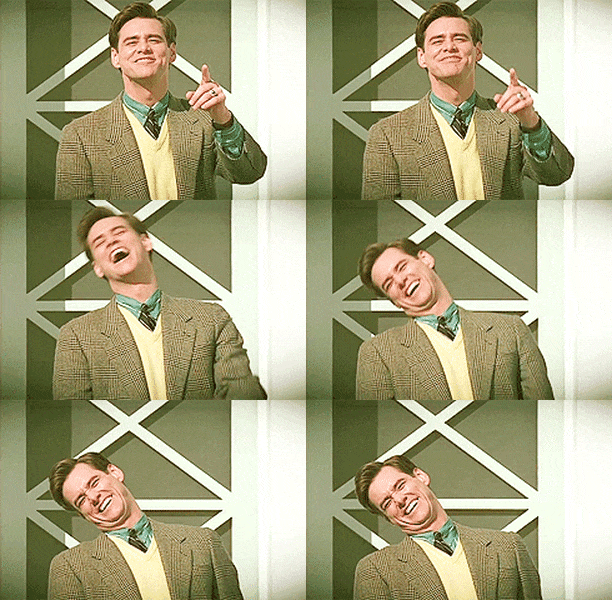
Truman Show but very racist.
I'm ashamed to admit that I read this entire book. I knew it was bad but it was like a bad car wreck that you can't look away from. I wasn't surprised that the random 1970's sci-fi I picked up at a used book store was racist, but I just wanted to see how far it would go. It went so far that I would never want to be in a room with anyone of the people that have given this 5 stars. Political correctness is a good thing, people, if only because pure shite like this can't get published anymore.
I was initially drawn in by the writing style. It was smooth and easy to read. I can see why Piers Anthony went on to become huge in the sci-fi realm, but I don't think I can give him another chance knowing he wrote...this.
Spoilers
Our story begins with John Smith, a teenager of white 1960's America. He figures out that he is actually a zoo specimen being raised by "the Standards" to gawk at. Soon after he meets people from other enclaves set in America, Tang dynasty China, and circa 700s Africa.
The Standards are not aliens as John and crew initially thought. Instead, they are what remains of humanity in the 25th century: mixed-race humans that were the only ones to survive a plague. John and his companions are the last "purebred" humans to exist. Blegh.
Besides the bizarre mystification of mixed-race people (John et al. even wonders if they are human), there are awful representations and stereotypes about Asian people and Africans, and some sexism. At one point, Ala, a woman from the Songhai, Africa-themed enclosure walks around naked and just thinks that's normal. When the group picks a leader, they immediately decide it can't be one of the women. John is constantly flip-flopping about which of the 3 girls he likes the most. I will say I was surprised that there was a set-up for a interracial relationship between him and Ala, but that ends abruptly when she discovers that the slave trade happened.
The book is full of plot holes. The Standards are hilariously incompetent at finding their escapees for being so advanced. They leave ID cards laying about that the escapees can find and use. John and crew believe that whenever they use Standard technology the Standards could be listening in on them, but they continue to openly discuss their escape plans and nothing comes of it.
I found it bizarre how the "purebreds" (blegh) continued to vehemently stick to the cultures they were raised in after finding out that it was all a hoax. They can't get along with each other because of their arguments about religion, politics, food, etc. It was so weird. Shouldn't they have gone into shock and doubt everything they've ever been told?
What was even weirder though was that the book ends with them deciding to go back and live in their respective cages and have "purebred" babies, even though they all seemed to have crushes on the other races and John even hated his white counterpart, Betsy. But I guess they decided for some reason that racial purity is a noble goal, even though it was mixed-race people who survived a goddamn plague.
And in the last paragraph John gives his dog away to one of the other "purebreds" without any explanation whatsoever.
WTF.
Truman Show but very racist.
I'm ashamed to admit that I read this entire book. I knew it was bad but it was like a bad car wreck that you can't look away from. I wasn't surprised that the random 1970's sci-fi I picked up at a used book store was racist, but I just wanted to see how far it would go. It went so far that I would never want to be in a room with anyone of the people that have given this 5 stars. Political correctness is a good thing, people, if only because pure shite like this can't get published anymore.
I was initially drawn in by the writing style. It was smooth and easy to read. I can see why Piers Anthony went on to become huge in the sci-fi realm, but I don't think I can give him another chance knowing he wrote...this.
Spoilers
Our story begins with John Smith, a teenager of white 1960's America. He figures out that he is actually a zoo specimen being raised by "the Standards" to gawk at. Soon after he meets people from other enclaves set in America, Tang dynasty China, and circa 700s Africa.
The Standards are not aliens as John and crew initially thought. Instead, they are what remains of humanity in the 25th century: mixed-race humans that were the only ones to survive a plague. John and his companions are the last "purebred" humans to exist. Blegh.
Besides the bizarre mystification of mixed-race people (John et al. even wonders if they are human), there are awful representations and stereotypes about Asian people and Africans, and some sexism. At one point, Ala, a woman from the Songhai, Africa-themed enclosure walks around naked and just thinks that's normal. When the group picks a leader, they immediately decide it can't be one of the women. John is constantly flip-flopping about which of the 3 girls he likes the most. I will say I was surprised that there was a set-up for a interracial relationship between him and Ala, but that ends abruptly when she discovers that the slave trade happened.
The book is full of plot holes. The Standards are hilariously incompetent at finding their escapees for being so advanced. They leave ID cards laying about that the escapees can find and use. John and crew believe that whenever they use Standard technology the Standards could be listening in on them, but they continue to openly discuss their escape plans and nothing comes of it.
I found it bizarre how the "purebreds" (blegh) continued to vehemently stick to the cultures they were raised in after finding out that it was all a hoax. They can't get along with each other because of their arguments about religion, politics, food, etc. It was so weird. Shouldn't they have gone into shock and doubt everything they've ever been told?
What was even weirder though was that the book ends with them deciding to go back and live in their respective cages and have "purebred" babies, even though they all seemed to have crushes on the other races and John even hated his white counterpart, Betsy. But I guess they decided for some reason that racial purity is a noble goal, even though it was mixed-race people who survived a goddamn plague.
And in the last paragraph John gives his dog away to one of the other "purebreds" without any explanation whatsoever.
WTF.

May 20, 2020
Leaning much more heavily towards sci-fi than fantasy, this relatively early Piers Anthony novel is a confounding mix of strengths and weaknesses. The premise of this stand-alone novel is provocative and engaging, and the reader is hardly aware of any flaws until somewhere around the halfway mark. The story centers around a teenage protagonist, the ludicrously-named John Smith, who discovers that he is actually the inhabitant of some sort of meticulously constructed zoological exhibit. His entire life has been engineered to appear normal (shades of "The Truman Show" here), but the anomalies keep piling up slowly until Smith can no longer ignore them. The body of the novel, thus, consists of his quest for the truth, starting with a bold escape from his confines. This seems like an auspicious start to a story in which layers of mystery are slowly pulled back to eventually reveal the ultimate truth.
However, the story becomes muddled and hopelessly convoluted along the way, and when the truth is finally revealed, it comes in the form of a muted anti-climax. To take just one example, there seems to be a sub-text about race relations -- a subject which would have had a lot of currency when this novel was first published in 1973 -- but the author doesn't seem to know exactly what he wants to say about it. It is as if Anthony did not have a clear ending in mind when he started writing and, in allowing his story to go wherever it might lead, it stumbles down dead ends and ultimately fizzles out. In addition, as with many of the author's early works in particular, his prose can be cringe-worthy and ham-fisted, and his characters all fall into caricature. Taken together, this detracts significantly from what might otherwise have been a strong entry in Anthony's bibliography. Fans of the author will find much to enjoy here, nonetheless, although more casual readers should probably look elsewhere in Anthony's body of work in order to avoid disappointment.
However, the story becomes muddled and hopelessly convoluted along the way, and when the truth is finally revealed, it comes in the form of a muted anti-climax. To take just one example, there seems to be a sub-text about race relations -- a subject which would have had a lot of currency when this novel was first published in 1973 -- but the author doesn't seem to know exactly what he wants to say about it. It is as if Anthony did not have a clear ending in mind when he started writing and, in allowing his story to go wherever it might lead, it stumbles down dead ends and ultimately fizzles out. In addition, as with many of the author's early works in particular, his prose can be cringe-worthy and ham-fisted, and his characters all fall into caricature. Taken together, this detracts significantly from what might otherwise have been a strong entry in Anthony's bibliography. Fans of the author will find much to enjoy here, nonetheless, although more casual readers should probably look elsewhere in Anthony's body of work in order to avoid disappointment.

June 19, 2011
Although somewhat controversial topics are raised on the subject of racial differences (the main character is one of only two "purebred Caucasians" left in the world and later finds there are only two "purebred Chinese" and two "purebred Africans," while the rest of the world is "Standard," apparently an amalgamation of all races who have apparently hunted down and killed all the other races for the most part), the book is nonetheless a very interesting bit of pulp fiction from the early 1970s. I much prefer Anthony's earlier works, such as this one and Shade of the Tree to his later efforts, where he enters into long series and the books become repetitive and silly. But hey, track down this book if you can and find out for yourself what you think. It may take a bit of work, but I think you will agree that it is worth the effort.
October 16, 2012
SF-John Smith is growing up as the all American boy in the 1960s except that little things don't match the way they are supposed to be, such as his dog with extendable claws and the ability to climb trees. His parents have him write letters to a girl he never met but was told he will marry. The two develop a rather obvious yet never broken code and John goes exploring (which is never discovered) and learns that he is really in a zoo in the future. When his bride-to-be is supposed to arrive there is a mix up and an Arab girl arrives instead. It seems that several young people are the last "purebreeds" of their races. This is a very race-centric book although done without prejudice, the reader cannot help but think such a book would have trouble being printed today instead of 1973. And the ending negates everything that happened previously.

May 3, 2010
Piers Anthony is a good story teller, and this book provides a decent yarn. However, one of his not uncommon failings is to use a good story to promote an ideological perspective (see also "Bio of a Space Tyrant"). That is the case in this novel. I think however that he missed his own point in this book: the author rather explicitly states his theme to be the importance of racial diversity for human development while the lessons drawn from the story would point more to the importance of cultural diversity. Overall, a mediocre book that was meant to make a point, but missed.

March 7, 2009
This was my first venture into Piers Anthony- and I was reading it as a break from Wuthering Heights- talk about extremes!
I have read various takes on this same idea- one of my son's favorite books was Running Out of Time, where a young girl finds that instead of living in 1840, she is living in 1996 in a reconstructed village that serves as a tourist site.
I liked the resourcefulness of the teens involved, but my favorite character was Canute the gomdog who can climb trees!
I have read various takes on this same idea- one of my son's favorite books was Running Out of Time, where a young girl finds that instead of living in 1840, she is living in 1996 in a reconstructed village that serves as a tourist site.
I liked the resourcefulness of the teens involved, but my favorite character was Canute the gomdog who can climb trees!

January 21, 2013
I felt unfulfilled with the ending of this book. My response was, "That's it?" and not in a good way. I was also unimpressed with the story in general from the storytelling element to the plot within itself, though I did enjoy the discussion on the octal counting system. Maybe if I was a younger teen, I'd have enjoyed this book more than I did.

July 31, 2015
meh.
Nothing impressive. Perhaps a bit dated as a 40-year old story, and the fantasy tech imagined in 1973 doesn't hold up in the 21st century. Plus, the story is shallow- thin, weakly developed, and if not full of holes, then at least riddled with cracks.
An easy read for an hour by the pool, and worth $1.80 used, but not a book you'd ever go back and read again.
UPDATE +5 YEARS: Just pulled this off the shelf and read it again. Unfortunately, I wouldn't change a thing from my first review, and sadly I didn't even remember having read it before. Time to recycle this one back to the used book store and see how much of my $1.80 I can recover. . .
Nothing impressive. Perhaps a bit dated as a 40-year old story, and the fantasy tech imagined in 1973 doesn't hold up in the 21st century. Plus, the story is shallow- thin, weakly developed, and if not full of holes, then at least riddled with cracks.
An easy read for an hour by the pool, and worth $1.80 used, but not a book you'd ever go back and read again.
UPDATE +5 YEARS: Just pulled this off the shelf and read it again. Unfortunately, I wouldn't change a thing from my first review, and sadly I didn't even remember having read it before. Time to recycle this one back to the used book store and see how much of my $1.80 I can recover. . .
March 25, 2015
Because I generally like Anthony's fantasy work, I picked this one up in Half Price. Starts out good, but fairly quickly loses steam, the characters are bland, the ending abrupt, and the message is really questionable.
It's pretty short but wasn't compelling enough for me to bother finishing in a reasonable time.
Anthony is a very prolific author but this feels like a first draft rush job. Read "A Spell For Chameleon" instead.
It's pretty short but wasn't compelling enough for me to bother finishing in a reasonable time.
Anthony is a very prolific author but this feels like a first draft rush job. Read "A Spell For Chameleon" instead.
October 8, 2016
An interesting premise totally tanked by the ending. Interracial relationships caused the apocalypse? The main characters must stay with their same-race partner and make same-race babies? Really? I'm pretty sure this was racist even when the book was written.

January 17, 2019
Even in the sixth grade I knew this was racist. Speaking of which, why the heck was this in my middle school library?!

May 31, 2026
This book is almost definitely when I started to realise Piers Anthony isn't as good a writer as I first thought. To be fair, I started on the Xanth series in my formative reader years when puns were the Best Thing Ever to me, and his non-Xanth works have been... less interesting.
Re-reading this has been a slight chore. Firstly, almost all I'd remembered of it was the basic premise and the ending, both of which made the idea of a re-read thoroughly unpalatable. But I "need" to re-read it for my bucket list goal of reviewing every book I've ever read (within reason)! So, while I *could* have written a placeholder review, I unfortunately did find a copy available, and here we are.
Unfortunately.
It's also vaguely confusing who is on the cover. John, the focal character, is obviously the white dude in the middle, but is that Betsy latching onto him? The Betsy who actively antagonised him from the instant they finally met in person? The same Betsy who seemed disgusted with everything about him? The third is the Chinese boy Pei? Doubt it's the Chinese GIRL Meilan or the African boy or girl... Frankly, the third person looks more American Indian than anything else. Disconnect between writer and artist again, I think.
Now, before my re-read, I did peek at someone else's review which admonishes anyone who hasn't given the book a one-star rating. I'm tempted to agree—particularly with Goodreads' "skews toward Good even for low ratings" rating scale—however:
- I try to reserve the rating for literal trash, books I find actively harmful with ZERO redeeming value.
- It's actually a faster read than I remembered, which is sort of refreshing with my diminished tolerance for long books (given my increasingly long To Read list).
- I don't HATE the book, even though I Did Not Like it.
- The "fish peddler" was a funny twist.
- The communicators seem to act in very A.I. (as we currently know it) fashion in , which is interesting from the perspective of this book was published in 1973.
Do I recommend it for... I don't know... masochists? It's really not a terribly compelling book in any sense, and the ending feels very "resigned" vs. anything like a Good or even Mediocre ending. Even the thrill of the chase feels incredibly contrived, given . Also, ain't no way .
Do I know how to fix it? Besides not writing it in the first place, nope.
So, while I do regret having had to pay money for it ("Did you pay money?" "Yes." "You got ripped off."), I don't regret having been able to inform my review rather than relying entirely on *mumble*-years-old memories of what I'd read before. Probably I will just pretend my money went instead to a book I love that I managed to re-acquire for free. Or, you know, since I did get it at a used bookstore, I've paid them for the service of not having to get a copy at retail price. I don't know. You know what I mean. No money went toward *positive* feedback for this book, anyway.
Re-reading this has been a slight chore. Firstly, almost all I'd remembered of it was the basic premise and the ending, both of which made the idea of a re-read thoroughly unpalatable. But I "need" to re-read it for my bucket list goal of reviewing every book I've ever read (within reason)! So, while I *could* have written a placeholder review, I unfortunately did find a copy available, and here we are.
Unfortunately.
It's also vaguely confusing who is on the cover. John, the focal character, is obviously the white dude in the middle, but is that Betsy latching onto him? The Betsy who actively antagonised him from the instant they finally met in person? The same Betsy who seemed disgusted with everything about him? The third is the Chinese boy Pei? Doubt it's the Chinese GIRL Meilan or the African boy or girl... Frankly, the third person looks more American Indian than anything else. Disconnect between writer and artist again, I think.
Now, before my re-read, I did peek at someone else's review which admonishes anyone who hasn't given the book a one-star rating. I'm tempted to agree—particularly with Goodreads' "skews toward Good even for low ratings" rating scale—however:
- I try to reserve the rating for literal trash, books I find actively harmful with ZERO redeeming value.
- It's actually a faster read than I remembered, which is sort of refreshing with my diminished tolerance for long books (given my increasingly long To Read list).
- I don't HATE the book, even though I Did Not Like it.
- The "fish peddler" was a funny twist.
- The communicators seem to act in very A.I. (as we currently know it) fashion in , which is interesting from the perspective of this book was published in 1973.
Do I recommend it for... I don't know... masochists? It's really not a terribly compelling book in any sense, and the ending feels very "resigned" vs. anything like a Good or even Mediocre ending. Even the thrill of the chase feels incredibly contrived, given . Also, ain't no way .
Do I know how to fix it? Besides not writing it in the first place, nope.
So, while I do regret having had to pay money for it ("Did you pay money?" "Yes." "You got ripped off."), I don't regret having been able to inform my review rather than relying entirely on *mumble*-years-old memories of what I'd read before. Probably I will just pretend my money went instead to a book I love that I managed to re-acquire for free. Or, you know, since I did get it at a used bookstore, I've paid them for the service of not having to get a copy at retail price. I don't know. You know what I mean. No money went toward *positive* feedback for this book, anyway.
January 8, 2021
It's 1960, in a typical American town. Or is it? John Smith is your typical high school aged teenager, but he's discovered some things about his life are a little odd. For instance, he has a dog that can climb trees, he has a girlfriend he's never met but whom he is required to write to each week, and has been told that he has to marry. To top this all off his parents always seem to be taking notes about what he's doing.
The above is generally what is on the back of the book, and what got me interested in this story when I first bought it many years ago. The story follows John Smith's explorations into why his life is a little odd, after all even he knows dogs shouldn't be able to climb trees. Is it ventures lead him to meet other people who are in the same situation as him, and what they discover is rather startling.
I had read some of Piers Anthony's stories before, and always found them to be quite intriguing as he definitely likes his plot twists. He likely is best known for his Xanth series of 44 books (which I haven't read), but he has many other novels and series in genres such as fantasy, thriller, urban fantasy, and children's fiction.
It was a very good book, that is well-suited for teens, young adults and so on.
Enjoy.
The above is generally what is on the back of the book, and what got me interested in this story when I first bought it many years ago. The story follows John Smith's explorations into why his life is a little odd, after all even he knows dogs shouldn't be able to climb trees. Is it ventures lead him to meet other people who are in the same situation as him, and what they discover is rather startling.
I had read some of Piers Anthony's stories before, and always found them to be quite intriguing as he definitely likes his plot twists. He likely is best known for his Xanth series of 44 books (which I haven't read), but he has many other novels and series in genres such as fantasy, thriller, urban fantasy, and children's fiction.
It was a very good book, that is well-suited for teens, young adults and so on.
Enjoy.
October 20, 2021
I read this when I was in middle school & I vaguely remembered thinking it was messed up but couldn’t recall why. I found a copy at a used book store and thought I’d read it again to see if I still found it “messed up” or if it was just something my younger self didn’t fully follow.
Well. My younger self was right. This book is very messed up. It’s probably the most racist book I’ve ever read and I’ve read Gone With the Wind!
This book is sort of like the Truman Show in that the MC is living in a “human zoo” where nothing is as it seems. It starts out fairly interesting trying to figure out why and how he’s in this situation and first gradually and then quite swiftly goes downhill.
Turns out our protagonist is the last “racially pure” white kid. At this point I’d had enough so I just skipped to the end to see if social commentary about how race is a construct took place instead of what I figured would be a huge mess…. Hahahahahhaa I was so hopeful but nope.
Huge racist mess. Now I know why I’ve never read any of Piers Anthony’s other books.
I’d give it zero stars if I could.
Well. My younger self was right. This book is very messed up. It’s probably the most racist book I’ve ever read and I’ve read Gone With the Wind!
This book is sort of like the Truman Show in that the MC is living in a “human zoo” where nothing is as it seems. It starts out fairly interesting trying to figure out why and how he’s in this situation and first gradually and then quite swiftly goes downhill.
Turns out our protagonist is the last “racially pure” white kid. At this point I’d had enough so I just skipped to the end to see if social commentary about how race is a construct took place instead of what I figured would be a huge mess…. Hahahahahhaa I was so hopeful but nope.
Huge racist mess. Now I know why I’ve never read any of Piers Anthony’s other books.
I’d give it zero stars if I could.
September 24, 2022
I read this book when I was in middle school. Got it from our school library. So traumatized that I still remember the details today. I'm 33. FYI My school was in Appalachia.
The premise sounded cool. I thought it'd be an escape the 'people zoo' concept a la 'Running Out of Time' by Margaret Haddix. It was... not. It's about a bunch of CHILDREN of different racial backgrounds that are in a literal breeding program.
(Which is zoo-like, I guess. Hey, Chicago, want my Latino kid and also this panda???)
But why? You may ask.
Because humanity, in its folly, thought interracial relationships are acceptable. Crazy, right? As a result, most humans are of mixed race. THE ABSOLUTE HORROR!!! So scientists have to breed teenagers with each other to create racially pure humans.
(Teens are at peak fertility so that's why it had to be kids, obvs.)
Yep. That's the story.
But wait. The kids escape, right? You may ask.
No. No, they do not. Because racial purity is necessary to SAVE HUMANITY for some reason. I don't even know the reason.
F*** this book. And f*** Piers Anthony. How does this have a 3-star average?! Come on, people!!!
The premise sounded cool. I thought it'd be an escape the 'people zoo' concept a la 'Running Out of Time' by Margaret Haddix. It was... not. It's about a bunch of CHILDREN of different racial backgrounds that are in a literal breeding program.
(Which is zoo-like, I guess. Hey, Chicago, want my Latino kid and also this panda???)
But why? You may ask.
Because humanity, in its folly, thought interracial relationships are acceptable. Crazy, right? As a result, most humans are of mixed race. THE ABSOLUTE HORROR!!! So scientists have to breed teenagers with each other to create racially pure humans.
(Teens are at peak fertility so that's why it had to be kids, obvs.)
Yep. That's the story.
But wait. The kids escape, right? You may ask.
No. No, they do not. Because racial purity is necessary to SAVE HUMANITY for some reason. I don't even know the reason.
F*** this book. And f*** Piers Anthony. How does this have a 3-star average?! Come on, people!!!

December 8, 2020
We have our protagonist John Smith, a teenager living in small town 1960s American. Sort of. Things do not seem quite right, and after a couple of chapters John begins to discover that his reality is not exactly the true reality. It is an interesting premise, but unfortunately the story goes downhill from there.
Race Against Time was a disappointment for me, despite my pretty low expectations going into it. First of all, the book has a very amateur feel to it. The interactions between the main characters are adequate, but many of their actions seemed very illogical or unrealistic. Some of the things they did which "worked" to advance the plot on its course were difficult to accept, and the nature of society around them was even more ludicrous at times. Then there is the topic of race. I would not go so far as to say that the book is overtly racist, but there is a lot in this book that feels pretty uncomfortable in today's context. Furthermore, following from a rather abrupt ending, the conclusions that Anthony appears to be drawing along the lines of race are pretty questionable as well.
This is a short book that can be read in a few short hours, but still not worth the time. It is a relic of the 1970s and at this point probably best forgotten.
Race Against Time was a disappointment for me, despite my pretty low expectations going into it. First of all, the book has a very amateur feel to it. The interactions between the main characters are adequate, but many of their actions seemed very illogical or unrealistic. Some of the things they did which "worked" to advance the plot on its course were difficult to accept, and the nature of society around them was even more ludicrous at times. Then there is the topic of race. I would not go so far as to say that the book is overtly racist, but there is a lot in this book that feels pretty uncomfortable in today's context. Furthermore, following from a rather abrupt ending, the conclusions that Anthony appears to be drawing along the lines of race are pretty questionable as well.
This is a short book that can be read in a few short hours, but still not worth the time. It is a relic of the 1970s and at this point probably best forgotten.
January 30, 2024
I don't usually stop a book only a handful of chapters in — but something was off about the way certain people and circumstances were described.
I came to Goodreads here and read a few reviews. They didn't calm me like I was hoping. My instincts were correct, and many others found the book to be incredibly racist for the way in which characters are written. The ending is the ultimate "yep, it's exactly how you thought it would end" about segregation and "pure bloodlines". 😬
Having only spent $1 for a paperback copy of this at a bookstore, I feel even that was too much. I have to start learning to come here while in store for a cursory glance just to make sure what I'm picking up is not being dubbed one of the most racist books of the last century.
I came to Goodreads here and read a few reviews. They didn't calm me like I was hoping. My instincts were correct, and many others found the book to be incredibly racist for the way in which characters are written. The ending is the ultimate "yep, it's exactly how you thought it would end" about segregation and "pure bloodlines". 😬
Having only spent $1 for a paperback copy of this at a bookstore, I feel even that was too much. I have to start learning to come here while in store for a cursory glance just to make sure what I'm picking up is not being dubbed one of the most racist books of the last century.
February 9, 2026
This book read more like a YA novel. It was interesting but not great in any way. To everyone saying the book was extremely racist. I don't think it was.
Spoilers:
The terms and dialogue were dated but everyone seems to think "purebreds" was the end goal. The kids discussed at the end that they understood their children having to breed with each other. That would mix all races. The standards were attempting to bring back racial diversity.
People seem to think being standard was the goal or something. That is just not true.
Spoilers:
The terms and dialogue were dated but everyone seems to think "purebreds" was the end goal. The kids discussed at the end that they understood their children having to breed with each other. That would mix all races. The standards were attempting to bring back racial diversity.
People seem to think being standard was the goal or something. That is just not true.

May 27, 2018
Somewhat interesting sci-fi lore. Starts much like The Truman Show, then becomes more of a Maze Runner cat and mouse chase, then kinda delves into a social commentary. If you broke the book into three acts, act one is excellent, act two is pretty good, and act three wasn't bad, but doesn't hold up to the rest of the book. Still interesting to read ideas that can and may still be of interest today.
March 21, 2021
I'm torn about criteria for rating this. I didn't really enjoy it, especially the ending that ultimately posits preserving racial purity as a solution (even if it is just temporary). However, being made uncomfortable by what I read/reading things that I viscerally disagree with ensures that my brain/thinking doesn't become stagnant or complacent too. I appreciate that.
This entire review has been hidden because of spoilers.

November 2, 2021
Piers Anthony is a pretty good story teller, usually with some neat ideas and entertaining prose. But when he starts using phrases like "racial purity" in a positive manner and confusing cultural differences like diet, language, and religion with racial differences...well... you can go fuck yourself Mr. Anthony.

February 27, 2026
Didn't hate it. Didn't love it. Didn't regret reading it. I guess I never caught on to all the racism like many other people did? I get the racial purity thing, but not sure that Piers had a racist agenda here. Who tf is the bald guy on the front cover?
April 17, 2022
This...Pretty much sucked. There was nothing at all to it, no story, no characters, it was just a bunch of words. Can't explain it any better than that, really.
Read
October 23, 2025A fast paced, exciting adventure as a young man discovers that he is a part of an elaborate charade to recreate a specific time and place in history.
February 21, 2026
OK... but Anthony is generally better than this....
August 28, 2021
Interesting premise but still very odd and unsatisfying at the end.
July 22, 2012
For years I have meant to read novels by Piers Anthony. I just did and I'm wondering why I waited so long. While Race is written for youth it has messages for adults as well.
The story is told by young John Smith, a white American boy becoming a man who is living in a small town supposedly located in Nebraska. Several inconsistencies have begun to trouble him. There is the peeling color of the skin of many of the inhabitants of Newton. Why cannot John go beyond certain environmental limits outside of Newton? Who is the young woman to whom he is supposedly to marry and is she real? As he questions his life in Newton he begins to explore to discover the answers for himself. The answers will surprise the reader as well as investigate environmental change and destruction which is interesting from the perspective of the time in which this novel was written - 1973.
What John discovers is unsettling to him. It seems that small villages are created to hold pure white Americans, Chinese, Arabs and Africans on a second world. Are all the purebreds trapped or imprisoned part of a zoo or observation experiment? His adventures are just beginning as he finds himself banded with other young people who are searching for the truth. Read this novel and discover the answers that John and his friends found. I assure you that the ending will surprise you.
The story is told by young John Smith, a white American boy becoming a man who is living in a small town supposedly located in Nebraska. Several inconsistencies have begun to trouble him. There is the peeling color of the skin of many of the inhabitants of Newton. Why cannot John go beyond certain environmental limits outside of Newton? Who is the young woman to whom he is supposedly to marry and is she real? As he questions his life in Newton he begins to explore to discover the answers for himself. The answers will surprise the reader as well as investigate environmental change and destruction which is interesting from the perspective of the time in which this novel was written - 1973.
What John discovers is unsettling to him. It seems that small villages are created to hold pure white Americans, Chinese, Arabs and Africans on a second world. Are all the purebreds trapped or imprisoned part of a zoo or observation experiment? His adventures are just beginning as he finds himself banded with other young people who are searching for the truth. Read this novel and discover the answers that John and his friends found. I assure you that the ending will surprise you.

April 4, 2013
I forgot about this book.
I read this many years ago when I was a young whipper-snapper. I remembered this book recently and have been trying to find it in stores, to no avail. I guess I will have to give in and order it online so I can have a copy for myself.
This book changed my life in many ways. It's probably my favorite sci-fi book. It really makes you think, what would happen if all the races intermingled and mixed so much that they no longer existed, just one 'standard' race? And what would happen if there were only a handful of people left on this planet that still had white, yellow, or black skin?
Well, here's the answer: these 'pure breds' would be put in 'zoos.' One couple, for instance, are teens, haven't met yet, but they live in the same town. They think they're living in the 1950's.
Definitely one to own. A fascinating idea.
I read this many years ago when I was a young whipper-snapper. I remembered this book recently and have been trying to find it in stores, to no avail. I guess I will have to give in and order it online so I can have a copy for myself.
This book changed my life in many ways. It's probably my favorite sci-fi book. It really makes you think, what would happen if all the races intermingled and mixed so much that they no longer existed, just one 'standard' race? And what would happen if there were only a handful of people left on this planet that still had white, yellow, or black skin?
Well, here's the answer: these 'pure breds' would be put in 'zoos.' One couple, for instance, are teens, haven't met yet, but they live in the same town. They think they're living in the 1950's.
Definitely one to own. A fascinating idea.
Displaying 1 - 30 of 57 reviews