Jump to ratings and reviews
Rate this book

The Food of the Gods

Rate this book
Professor Redwood and Mr Bensington were unprepossessing men, leading lives of eminent and studious obscurity, scientists working away from the public gaze. Then they discovered Herakleophorbia, a substance that could nourish a possible Hercules. And became responsible for the most important development in the evolution of man. For they had found the Food of the Gods, and a new kind of human, intellectually and physically superior, became a wonderful and terrifying possibility.

224 pages, Hardcover

First published January 1, 1904

511 people are currently reading
8513 people want to read

About the author

H.G. Wells

5,317 books11.1k followers
Herbert George Wells was born to a working class family in Kent, England. Young Wells received a spotty education, interrupted by several illnesses and family difficulties, and became a draper's apprentice as a teenager. The headmaster of Midhurst Grammar School, where he had spent a year, arranged for him to return as an "usher," or student teacher. Wells earned a government scholarship in 1884, to study biology under Thomas Henry Huxley at the Normal School of Science. Wells earned his bachelor of science and doctor of science degrees at the University of London. After marrying his cousin, Isabel, Wells began to supplement his teaching salary with short stories and freelance articles, then books, including The Time Machine (1895), The Island of Dr. Moreau (1896), The Invisible Man (1897), and The War of the Worlds (1898).

Wells created a mild scandal when he divorced his cousin to marry one of his best students, Amy Catherine Robbins. Although his second marriage was lasting and produced two sons, Wells was an unabashed advocate of free (as opposed to "indiscriminate") love. He continued to openly have extra-marital liaisons, most famously with Margaret Sanger, and a ten-year relationship with the author Rebecca West, who had one of his two out-of-wedlock children. A one-time member of the Fabian Society, Wells sought active change. His 100 books included many novels, as well as nonfiction, such as A Modern Utopia (1905), The Outline of History (1920), A Short History of the World (1922), The Shape of Things to Come (1933), and The Work, Wealth and Happiness of Mankind (1932). One of his booklets was Crux Ansata, An Indictment of the Roman Catholic Church. Although Wells toyed briefly with the idea of a "divine will" in his book, God the Invisible King (1917), it was a temporary aberration. Wells used his international fame to promote his favorite causes, including the prevention of war, and was received by government officials around the world. He is best-remembered as an early writer of science fiction and futurism.

He was also an outspoken socialist. Wells and Jules Verne are each sometimes referred to as "The Fathers of Science Fiction". D. 1946.

More: http://philosopedia.org/index.php/H._...

http://www.online-literature.com/well...

http://www.hgwellsusa.50megs.com/

http://www.britannica.com/EBchecked/t...

http://en.wikipedia.org/wiki/H._G._Wells

Ratings & Reviews

What do you think?
Rate this book

Friends & Following

Create a free account to discover what your friends think of this book!

Community Reviews

5 stars
777 (14%)
4 stars
1,662 (31%)
3 stars
2,129 (39%)
2 stars
637 (11%)
1 star
144 (2%)
Displaying 1 - 30 of 451 reviews
Profile Image for Glenn Russell.
1,511 reviews13.3k followers
Read
February 3, 2023


Originally published in 1904, The Food of the Gods by H. G. Wells is less well known than the author’s The Time Machine and The War of the Worlds but it is a highly philosophical and entertaining science fiction novel and one not to be missed. And I’d suggest the SF Masterworks edition since there's an informative, insightful Introduction by Adam Roberts.

The storyline is simple: two amateurish scientists, Mr. Bensington and Professor Redwood, create a miracle substance accelerating growth in both plants and animals. They carry out their experiment on a farm run by a Mr. and Mrs. Skinner, feeding their “Herakleophorbia IV” to chicks. The chicks grow to six times their normal adult size. Unfortunately, the slovenly Skinners are careless, spilling the substance all over the ground and very quickly thereafter other plants and animals grow to monstrous proportions - vines, grass and gulp! - wasps. Then even more alarming news: rats!

Newspapers run headlines about the monstrosities. Bensington and Redwood know something must be done forthwith. The scientists swing into action - here are my comments coupled with a number of direct quotes from Chapter 3 - The Giant Rats:

"The doctor, one gathers, stood up, shouted to his horse, and slashed with all his strength. The rat winced and swerved most reassuringly at his blow—in the glare of his lamp he could see the fur furrow under the lash—and he slashed again and again, heedless and unaware of the second pursuer that gained upon his off side."

Completely uninformed about recent developments with various animal life, a country doctor returns home on his horse-drawn carriage after delivering a baby only to be attacked in the early dawn by three giant rats. One of the most vivid scenes in all of literature. The way in which the narrator reports the unspeakable horror of such an occurrence passes over into humor.

"Go up the street to the gunsmith's, of course. Why? For guns. Yes—there's only one shop. Get eight guns! Rifles. Not elephant guns—no! Too big. Not army rifles—too small. Say it's to kill—kill a bull. Say it's to shoot buffalo! See? Eh? Rats? No! How the deuce are they to understand that? Because we want eight. Get a lot of ammunition. Don't get guns without ammunition—No!"

Bensington and Redwood lean on civil engineer Cossar, just the Action Jackson to organize a hunting party to kill the giant rats. Such an ugly turn of events. An to think, the two Brit scientists had no more evil intentions with their growth formula than Laurel and Hardy. Unfortunately, Bensington and Redwood had hardly more brains than those two famous film nitwits.

"By five o'clock that evening this amazing Cossar, with no appearance of hurry at all, had got all the stuff for his fight with insurgent Bigness."

What is so striking is the enormity of the change in nature, a change that will expand into global crisis, and the reaction from this small band of bumbling Brits. Hey, why get the government involved when we can organize our own hunting party? Perhaps H. G. Wells is making a statement on the general state of human intelligence - hardly above the level of the Three Stooges.

"They left the waggonette behind, and the men who were not driving went afoot. Over each shoulder sloped a gun. It was the oddest little expedition for an English country road, more like a Yankee party, trekking west in the good old Indian days."

I so much enjoy the British author's swipe at the American frontier mentality. I can clearly picture these eight men - Redwood, Bensington, Cossar and the five men Cossar rounded up - striding down the road on their rat hunt.

"Redwood had kept his gun in hand and let fly at something grey that leapt past him. He had a vision of the broad hind-quarters, the long scaly tail and long soles of the hind-feet of a rat, and fired his second barrel. He saw Bensington drop as the beast vanished round the corner."

This encounter with the giant rats (seven feet long from head to tail) has all the making of a blockbuster B film. Many are the movie posters featuring the attacking giant rats.

"When things were a little ship-shape again Redwood went and stared at the huge misshapen corpse. The brute lay on its side, with its body slightly bent. Its rodent teeth overhanging its receding lower jaw gave its face a look of colossal feebleness, of weak avidity. It seemed not in the least ferocious or terrible. Its fore-paws reminded him of lank emaciated hands. Except for one neat round hole with a scorched rim on either side of its neck, the creature was absolutely intact."

And what is Professor Redwood's reaction to such a event? He chimes: "This is like being a boy again." The immaturity of the current human population is one of the novel's abiding themes.

"Cossar was on all fours with two guns, one trailing on each side from a string under his chin, and his most trusted assistant, a little dark man with a grave face, was to go in stooping behind him, holding a lantern over his head. Everything had been made as sane and obvious and proper as a lunatic's dream."

Cossar crawling through the giant rat holes, shooting the giant rats, makes for a spectacularly harrowing scene in a B film. Oh, incidentally, the boy's adventure also includes dealing with giant wasps.

Alas, Redwood feeds the “Boomfood” to his own son. Likewise, there are other children raised on the miracle formula. Soon the world has to deal with baby giants and toddler giants and then, fully grown giants (forty feet tall, as tall as a four story building). With such sad giants inhabiting the planet, sad because the little people become increasingly intolerant of their presence, The Food of the Gods turns into a tale of pathos and high drama, a tale of political corruption and general ineptitude in humans dealing with anything outside their conventional framework and worldview.

Also added into the philosophic mix is a topic of particular relevance in today’s world – genetic modification and the so called Frankenstein foods. All in all, there is good reason why The Food of the Gods is published as part of the SF Masterworks. Highly recommended.


British author H. G. Wells (1866 - 1946)
Profile Image for Mark.
692 reviews176 followers
October 28, 2010
Of all the many books written by H G Wells, this is not one that usually springs to mind. However this is a good, if rather overlooked, scientific romance that is worthy of your attention.

The tale is fairly straightforward. Two scientists, Mr Bensington and Professor Redwood, create a miracle chemical that they call (rather unpronounceably) Herakleophorbia IV. This chemical element accelerates physical growth and creates animals that are much bigger than normal.

Thinking that they are Advancing Science and have created a solution to future world supplies, the two scientists test their compound by creating giant chicks and set up an experimental farm for their study. However, mismanagement by the Skinners, an inept couple given charge of the farm, leads to the giant poultry escaping.

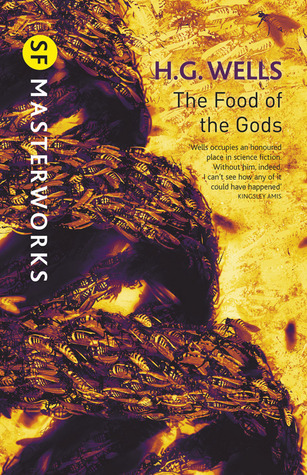
The problem is exacerbated when it is found that other animals have fed on the food and soon giant worms, earwigs, wasps (as shown on the cover) and rats are found across the countryside. The media publicise this with gusto. Consequently the scientists, with a civil engineer named Cossar, track the giant vermin down and to halt further problems the farm is burnt to the ground.

However most of the book is concerned with the humans who have eaten the food, now called Boomfood. Redwood’s own child, Edward (Teddy), is fed the food, as too Albert Caddles, the grandson of the couple given the farm to look after.

Unable to stop eating the food (as that would prove fatal) the giants created are seen as a boon yet ultimately lead a sad life. Intelligent and physically advanced, the super-sized innocents are shunned and reviled by human society, seen as freaks and treated with mistrust. Bensington is driven into hiding by the media. A politician, John 'The Giant Killer' Caterham , uses the public fear of the giants through the media to whip up feeling against them, which has tragic consequences.
In the end it seems clear that there is to be a war between the repressed giants, the Children of the Food, and the human Pygmies.

However, as this tale is not told here, the reader is left to wonder ‘what-if?’The last paragraph is an epic Stapledonian-type moment:

‘For one instant he shone, looking up fearlessly into the starry deeps, mail-clad, young and strong, resolute and still. Then the light had passed and he was no more than a great black outline against the starry sky, a great black outline that threatened with one mighty gesture the firmament of heaven and all its multitude of stars.’

For a book that is over a hundred years old, this book (as mentioned in the new introduction by Adam Roberts) is surprisingly relevant in these days of Frankenstein foods and genetic modification. The corrupt politician, the restrictions of a hierarchical class society, bureaucratic ineptitude, the gullibility of the masses and the influence of the media are surprisingly apt keystones, not just for the 20th but also for the 21st century. In this study of ‘Man versus Science’, though the technology in Wells’ tale may be different, the social consequences are both appropriate and thought-provoking. Wells manages to show the consequences of scientific progress, whilst warning of corruptible politicians and evoking the inequality of slavery.

Wells’ combination of both light humour (at the beginning) and darker pathos (towards the end) work surprisingly well here, though they are relatively simple in execution. The need for the giant Young Caddles who travels to London to determine the meaning of life is both amusing and affecting. Some of the scenes of the giant creatures attacking humans are quite horrific.

The characters are a little caricaturist, and show their age, though this is perhaps deliberate. It must be remembered that the book was written for the primary purpose of entertainment, though its sly commentary (if a little simplistic) is engaging and appropriate. It’s more readable than Swift’s Gulliver’s Travels, and in the best tradition of Wells’ scientific romances makes the reader consider alternative options to reality.

This is a good book for those who want to read more Wells, beyond the usual Time Machine and War of the Worlds. Recommended.

Profile Image for Patrick Gibson.
818 reviews79 followers
July 31, 2011
My misconceptions:

--Wells’ novels are for teenage boys.

--They are hopelessly antiquated.

--Every title I know has come from a movie adaptation and I have actually never read any of his books.
My reaction:

--I was having difficulty reading a new novel (‘2030, The Real Story of What Happens in America’) and searched my Kindle for some free titles for a diversion. There, I found all the H.G. Wells novels in public domain. What the hell… no price is the right price.
My revelation:

--This book is good! Not for kids—with surprising contemporary subject matter.

--About the dreadful movie which airs on Chiller at 2 AM once in a while: borrowed the title and has nothing to do with the book. Surprised?

You probably know the gist of the story: two chemists invent a food substance that accelerates growth. They figure this is the answer to feeding the world. More than just plants grow big.
What you may not know: how clever and witty the writing. Wells can draw a character as in-depth and enjoyable as say, Hardy. He never lets a character go. Even minor people get a full description—and a marvel of inventive language.

Holy shit. Wells didn’t know it, but long before the genome was discovered, he was talking about genetic engineering. As I read about the plants and animals affected by Wells ‘superfood’ I couldn’t help make comparisons to Monsanto’s genetic altered corn, wheat and soy. Practically everything we touch today has been genetically or chemically altered from its original state.

I had more ‘Ah-ha’ moments in this hundred year old book than anything contemporary I have read in a long time. Aside from horse-and-carriages, perambulators, and lack of phones, this has a very modern feel to it. And so much better use of language. And… it’s FUN! Wells can spin a great yarn.
Profile Image for A. Raca.
768 reviews171 followers
March 28, 2020
"Eğer hiç soru sormazsan sana yalan söyleyen de olmaz."

Neden 3 verdiğimi bilmiyorum... 🤔
Profile Image for George K..
2,758 reviews368 followers
March 17, 2021
Πέμπτο βιβλίο του συγγραφέα που διαβάζω, και ενώ με βάση τη βαθμολογία του βιβλίου στο Goodreads είχα κάπως χαμηλότερες προσδοκίες σε σχέση με προηγούμενα βιβλία του, εντούτοις αποδείχτηκε με τη σειρά του ένα άκρως ενδιαφέρον, καλογραμμένο και ψυχαγωγικό μυθιστόρημα επιστημονικής φαντασίας, με διακριτικό χιούμορ αλλά και φιλοσοφική διάθεση σε αρκετά σημεία. Αν μη τι άλλο ο Γουέλς ήξερε να γράφει, είχε φαντασία αλλά και μια λεπτή αίσθηση του χιούμορ, γενικά με τις ιδέες και τις περιγραφές του κατάφερνε να εξάπτει τη φαντασία των αναγνωστών του, και σε τούτο το βιβλίο ίσως και να μην έβαλε όλη του την τέχνη, αλλά νομίζω ότι έκανε πολύ καλή δουλειά με την κεντρική ιδέα του, που προσωπικά τη βρήκα αρκετά ιντριγκαδόρικη. Βέβαια, η αλήθεια είναι ότι η ιστορία έχει μια ιδιαίτερη δομή -άλλη αίσθηση αφήνει στους αναγνώστες το πρώτο μέρος και άλλη τα επόμενα δυο-, ενώ επίσης λείπει κάποιος πραγματικός πρωταγωνιστής για να οδηγήσει την ιστορία, όμως προσωπικά το ευχαριστήθηκα το βιβλίο, από την αρχή μέχρι το τέλος. Απόλαυσα κάποιες ωραίες και δυνατές σκηνές και εικόνες, χαμογέλασα και λίγο σε διάφορα σημεία (ειδικά στο πρώτο μέρος με τον τίτλο "Η εμφάνιση της Τροφής"), με έκανε να σκεφτώ και κάποια πράγματα για την ανθρώπινη φύση, γενικά πέρασα πολύ καλά. Είναι ένα βιβλίο που διασκεδάζει, αλλά που παράλληλα δίνει και λίγη... τροφή για σκέψη!
Profile Image for Amy.
3,050 reviews620 followers
July 13, 2018
Hey look! A book finally made it off the death-trap that is my 'To-Finish-Someday' list. I finally finished it!
Wells jumps right into the action with this story of growth-hormones gone amiss. Giant wasps, giant rats, giant chickens...no wonder the countryside is terrorized! However, his intrepid scientists decide 'NBD' and give the growth formula to children.
Because why not.
An interesting and yet disconcerting read. Wells's sympathy lies with the scientists and the giants they created. Mankind remains petty and political in the face of this next step in evolution. In this book, progress necessitates good. Sure, giant wasps now abound, but so do giants with massive brains!
It is an interesting contrast and certainly makes this worth reading and chewing over. However, I find my personal values and expectations about such a result diverge considerably from the author's.
Despite the exciting start, the book concludes on a more somber note, full of an old man's reflections about life and the next generation. Philosophically interesting but not likely to keep a reader hooked.
Profile Image for Lewis Woolston.
Author 3 books66 followers
August 3, 2025
When I was a teenager I was a massive SF nerd. One year I was gifted a complete set of HG Wells novels in paperback. It was one of the best gifts I ever got. I worked my through The War of the Worlds and The Time Machine and my imagination was never quite the same.
That to me is exactly what good SF and Fantasy does, especially to a kid, it opens their minds to strange worlds and new things. In short: it makes them use their imaginations.
For whatever reason I had no memory of this novel. Now that I have read it I suspect that may be because it's just not his best work.
Don't get me wrong, a less than average HG Wells novel is better than most people's best book. But compared to his better known classics this one doesn't rate much.
This is probably of interest only to HG Wells completists.
Profile Image for Matt.
221 reviews787 followers
July 11, 2008
I find the works of H.G. Wells to be remarkable in several ways. Although stories that bear the marks of the modern science fiction genera include Shelley's Frankenstein and the imaginative works of Jules Verne, its HG Wells that really set the stage for modern science fiction. Additionally, Wells is one of the first modern wargamers, and his publication of 'Floor Games' and 'Little Wars' sparked the wargaming movement that would eventually set the stage for both Role Playing Games and video games. So, in many ways, H.G. Wells is the 'Father of Modern Geekdom'.

The majority of the popular fiction of H.G. Wells for which he is usually remembered dates from a single 6 year period at the very cusp of the 20th century. From this period we get such well known classics as 'The Time Machine' (1895), 'The Island of Dr Moreau' (1896), 'The Invisible Man' (1897), 'The War of the Worlds' (1898), and 'The First Men on the Moon' (1901).

Slightly past the end of the prolific period is a much more obscure work - 'The Food of the Gods' (1904) - which is today best known for its inspiration of some very bad B-rate horror movies. The work, along with the similarly obscure 'In the Days of the Comet' (1906) marks an important transition point in Well's fiction, from the successful scientific romances of his early career to the much less readable and less well known political science fiction of his latter career.

In the esteem of readers and critics, 'The Food of the Gods' is generally lumped in with Wells later works, which in my opinion is a shame because this is I think Wells at his most powerful. 'The Food of the Gods' combines Wells best talents as a writer of adventure stories which he has honed over the course of several previous novellas, with his highest ambitions and seriousness of his later years in a way that I think is superior to either what comes before or what comes after. No other book by Wells covers quite the range of emotions as this book, from wry humor, to terrible pathos, horror, and elation. This is in my opinion the first great science fiction novel, and one that wasn't equalled until the post-WWII crop of giants created what's now called the Golden Age of Science Fiction.

The basic plot of the story follows a pair of eccentric scientists who, with the best of intentions, set out to create a treatment which will promote a healthy giantism in living things so as to create a world without scarcity or poverty. The niavity of the scientists and the fervor with which they pursue their work is alternately funny and terrifying.

I love just about everything about this novel: the easily readable early adventures against giant monsters grown from household animals before the book takes a decidedly dark turn, the pitiable character of Caddles, the episode of the man released from prison, and the soaring vision of the sons of Cossar and Redwood. The book touches on alot: debates about nurture vs. nature, feelings of isolation and technological alienation, invidual freedom vs. community safety, terrorism, politics, transhumanism, and pretty much anything that will come up later in science fiction. After reading the story you'll see echos of it in just about all modern science fiction - from the 'ecology strikes back' disaster movies of the 70's to mutant conflict in the X-Men to the 'future shock' style dystopian novels.
Profile Image for sologdin.
1,855 reviews874 followers
January 1, 2014
Nutshell: uppity scientists solve food distribution problem, which causes increase in proletarian demographic power, which induces proto-fascists to start a war of extermination.

First third is dominated by development of hypertrophying foods, their dissemination among animals, and the destruction of those animals. Lots of this early section is a creature thriller wherein people hunt down gargantuan rats that have terrorized the countryside, but I could be wrong, as I yawned my way through it.

Rest of volume concerns political problems caused by human infants fed hypertrophying foods, which “increased the amount of growth from six to seven times, and it did not go beyond that whatever amount of the Food was taken in excess” (105). Very plainly in a certain tradition with notes such as “he’ll only be one solitary Gulliver in a pigmy world” (59)—that makes the proto-fascists into Lilliputians, I suppose.

Socialist author makes his sympathies plain: “It spread beyond England very speedily. Soon in America, all over the continent of Europe, in Japan, in Australia, at last all over the world, the thing working towards its appointed end. Always it worked slowly, by indirect courses and against resistance. It was bigness insurgent. In spite of prejudice, in spite of law and regulation, in spite of all that obstinate conservatism that lies at the base of the formal order of mankind, the Food of the Gods, once it had been set going, pursued its subtle and invincible progress” (125). Giants similarly complain that “Your little people made all that before I was born. You and your law! What I must and what I musn’t. No food for me to eat unless I work a slave, no rest, no shelter” (216). Conclusion is appropriately stark.

Recommended for indefatigable lichenologists commenting on the work of other indefatigable lichenologists, those who want a nice straight road in the place of all these rutty little lanes, and readers who are for Reaction—unstinted and fearless Reaction.
Profile Image for Wally Flangers.
167 reviews5 followers
November 26, 2019
“And maybe in the next life, WE are the ants” has been an ongoing joke that I’ve used for several years now with my kids whenever I’ve seen them step on a pile of ants or crush an ant hill…. It’s a humorous warning to open their eyes (on a much smaller scale) that someday the tables MAY turn and you should respect all living things, even those of smaller stature…. “What goes around, comes around”, right? The thought of this notion gets their tiny little minds turning and help them understand that they wouldn’t think it was very funny if it was THEM who saw a big foot, blacking out the sun, falling down from the sky to mash their body into the ground…. Does it hinder any chance of future squashings or ant genocide? Absolutely not…. But, at least they get the idea. It was interesting for me to see how H.G. Wells could capitalize on that joke through science fiction.

“The Food of the Gods and How It Came to Earth” is a science fiction novel that was first published in 1904 by Macmillan. It is a very popular book among H.G. Wells’ fans…. In summary, the novel is about a couple of scientists who invent a new kind of food that accelerates the growth of anything that consumes it. This includes vegetable plants, fruit trees, and even children – resulting in reaching heights of forty feet tall, turning them into giants once they reach adulthood.

For a more descriptive plotline with some MINOR SPOILERS, “The Food of the Gods….” is split up into three different Books (or sections). Book I is titled, “The Discovery of the Food” and introduces a chemist named Mr. Bensington and a Professor named Mr. Redwood. These two men join forces and dedicate a year of their time on research and development for a substance that can accelerate the process of growth. After developing a substance for testing, they called it “Herakleophorbia IV” (named after Hercules) and would later be referred to by the locals as “Boom Food”. The mad scientists decide to test their new substance on chickens and are amazed at their findings. But, as with any experiment or finding of this magnitude, there will come great consequence….

Book II is titled, “The Food in the Village” and is about the development of the children who have been subjected to “Herakleophorbia IV”. As expected, eventually the children end up morphing into giants…. This obviously becomes a problem and soon the English population gets fed up with giants running around and are forced to make a collective decision.

Book III is titled, “The Harvest of the Food” and is about the struggle for survival for both parties, the giants and the English population. This section of the story was ultimately inevitable and contains the most action sequences.

Overall, this was a terrific book and full of innovative ideas, drama, and elements of war as the giants fight for their survival. It’s actually a pretty cool concept… It certainly made me ponder over what it would be having giants on earth with me. How would you react? Would you seek and destroy or embrace them with open arms?

I especially liked how the pace of the story progresses in each Book…. It ramps up in suspense rather quickly and ends on a high note. As usual, H.G. Wells does not provide a lot background on the characters, at least not enough to really get you connected to any of them, but the story itself is so good that I can give him a pass on that lack of development.

My only complaint with this book is that the story seemed a bit rushed…. It was written more like a novella in many ways. I would have preferred a lot more science behind understanding how “Herakleophorbia IV” was created and worked, along with more background on the scientists and their experiments on the farm. I think that would have helped build up the suspense.

“The Food of the Gods and How It Came to Earth” was adapted for film, more than once. The original adaptation was released in 1965, titled “Village of the Giants”. In 1976, the same director released another adaptation with the title “The Food of the Gods”. The novel was also adapted, multiple times, into a comic book but I have never read any of the comic versions.

FINAL VERDICT: I give this book 3 out of 5 stars. “The Food of the Gods and How It Came to Earth” is one of my favorite H.G. Wells books and among his most notable works of fiction…. I would highly recommend it to science fiction lovers or readers with big imaginations, especially If you are a “Twilight Zone” fan.
Profile Image for Sinem.
19 reviews45 followers
October 2, 2021
2,5'tan 3.

Bilimkurguyu çok seviyorum, fakat bu kitabı okurken baya zorlandım ve bir yerden sonra sadece yarım bırakmayayım diye okumayı sürdürdüm. Konu gayet ilgili çekici fakat anlatım tarzında, hikayenin akışında aksaklıklar var ve bu kitabın içine girmeyi zorlaştırıyor.

Wells'in diğer kitaplarıyla şansımı deneyeceğim.
Profile Image for Litzy Martinez.
202 reviews18 followers
January 18, 2023
Me ha encantado... Herbert George Wells era todo un genio, sin la menor duda. Todo un adelantado a su época. Es increíble lo que creó aquí, parece que su imaginación iba en crecimiento con cada libro, rompiendo los límites una y otra vez. Aquí hasta hay una pizca de romance que es la cereza de éste pastel, y eso me sorprendió, si soy sincera, porque después de andar entre los diferentes libros de éste genio, pensé que su talento tenía un punto culmine. Me alegra que no haya sido así.
Esto es formidable, es lógico, es congruente, es aterrador de tan bien hecho que está. Me asombra y me encanta.

Creo que veré mis gallinas de otra forma a partir de ahora, sinceramente. Y que tengo ahora más inquina contra las ratas que nunca. Yo no juzgaba a Wiston antes de leer éste libro cuando en "1984" decía que no se le podía ocurrir nada más horrible que una rata, ahora lo entiendo al completo. Pero si hay algo peor que una rata, miles de ratas gigantes, eso es peor.

No puedo expresar cuanto amé éste libro, empezamos de la mejor manera éste año, con uno de los mejores libros que han caído en mis manos.
Profile Image for Jim.
2,413 reviews800 followers
February 15, 2015
It all begins as humor. Two British scientists come up with a substance that causes flora, fauna, and people to become giants. At first, there are giant nettles, mushrooms -- but then it ramps up, with giant rats that can take down and eat horses and wasps so large one could hear them half a mile off. In the end it becomes a tragedy: several hundred children around the world had been given this "food of the gods" and grow to a height of around forty feet. And this is something that society cannot and will not take:
Don't you see the prospect before us clear as day? Everywhere the giants will increase and multiply; everywhere they will make and scatter the Food. The grass will grow gigantic in our fields, the weeds in our hedges, the vermin in the thickets, the rats in the drains. More and more and more. This is only a beginning. The insect world will rise on us, the plant world, the very fishes in the sea, will swamp and drown our ships. Tremendous growths will obscure and hide our houses, smother our churches, smash and destroy all the order of our cities, and we shall become no more than a feeble vermin under the heels of the new race. Mankind will be swamped and drowned in things of its own begetting! And all for nothing! Size! Mere size! Enlargement and da capo. Already we go picking our way among the first beginnings of the coming time.
An anti-Food of the Gods politician is elected, and war breaks out.

H.G. Wells in The Food Of The Gods has created an extraordinarily well thought out work of science fiction/fantasy. It is also an object lesson that from small beginnings giant problems grow. There is a particularly effective scene in the novel in which a prisoner who has been out of circulation for many years takes a train trip into the country with his brother and sees his world changed in strange ways.

When war does break out between the giants and the "Pygmies," the former come up with a weapon (which I will not divulge) that guarantees that, whatever happens to themselves, their cause will not die.
Profile Image for Aydan Yalçın.
Author 33 books144 followers
September 28, 2019
https://www.instagram.com/p/B0wBKtApnCW/

Tanrıların Tohumu’na büyük beklentilerle başladım çünkü tam da son yıllarda gündemde olan GDO’lu tarım konularına dair bir kehanet gibi gelmişti. Oysa ucundan bile geçmiyor.

İki biliminsanı Herakleophorbia adını verdikleri Devtohumu’nu keşfederek geleceğin seyrini değiştiriyor. Bu tohumu gizlice tavuklar üzerinde deneylerken kontrolü elden kaçırıyorlar ve dev bitkiler, dev sıçanlar ve dev arılar ortaya çıkmaya başlıyor. İşin daha da kötü yanı bu keşfettikleri tohumu kendi çocukları üzerinde de deniyorlar. Dev çocuklar yaratan bu iki biliminsanının tavrı o kadar cahilce ki, adeta gözleri dönmüş.

Hikaye yaklaşık 100 sayfa kadar sonra bilimle bağını koparıp bilimin neden olduğu dev çocukların dramını anlatmaya başlıyor. Evet belki bir açıdan bu gerekli ama yersizce uzun. Ben bu keşfin çocuklardan çok dünyaya vereceği zararları okumayı isterdim.

H. G. Wells çok şahane fikirler üretmiş ama kaleme alış tarzı etkili değil. Anlatım tarzı biraz tuhaf. Birbirini dinlemeden, kopuk cümlelerle konuşan karakterler, konudan sapan olaylar ve nihayetinde tatmin etmeyen bir son.
13 reviews
March 1, 2014
I am usually a huge fan of H.G. Wells and other classic science fiction in general but this particular story was somewhat of a disappointment. As with most of Wells' works the settings and people who populate them are all well characterised but the plot itself is jumbled and hard to follow, often switching between people, time periods, or both. What little I could grasp of the plot was this: buy some method, humans discover a substance that causes people (specifically children) to grow extremely quickly, causing a controversy over whether or not it should be used. H.G. Wells was a brilliant author who was lightyears ahead of his time, but I think that this book does not live up to the standard of his other works.
Profile Image for Becky.
126 reviews1 follower
May 6, 2023
I came across this randomly. It's definitely a lesser known work of Wells'. It felt like a strong precursor to Jurassic Park and I have to wonder if Chriton read this. It's a monster sci Fi story but it's also social satire. It considers ignorance and arrogance in its many different forms. It is slow in places (I kind of skimmed the last half) and you have to be used to the very Victorian British tone to enjoy it, but it was a fun read overall.
Profile Image for Bill Wellham.
52 reviews4 followers
June 13, 2011
Recently re-printed in a hardback on the S.F. Masterworks series, I was compelled to buy it. The other H.G. Wells which I have read are Time Machine, War of the Worlds, and Island of Dr Moreau. This is written in the same style, with a Victorian feel throughout the pages. I am starting to feel that H.G. Wells had a definate distrust for science (scientists), whilst having an imagination of science that far surpassed those of the scientific profession at the time. This story seems like a warning to meddling in nature, using a different method to Island of Dr. Moreau. The scientist in that novel was all out nasty and mad, whereas the scientists in this book are quite good chaps with an honest belief in improving the world.

So... a couple of scientists invent a food which makes everything grow to enormous sizes. We have giant plants, insects, and eventually giant children. The world doesn't want it, and effectively goes to war against the giants. How will it all end, eh?

The best way to read H.G. Wells is to do your best stuffy Victorian accent, and read aloud as if on stage! It is fun. Although, like me, you will stumble and struggle through the rural accents and yokel slangisms. Once you have the feel of the style of dialogue, it becomes quite witty and sharp. Or not, depending on your taste.

I have only given this two stars because it just bored me after a while. It didn't really conclude with any purpose. Maybe it is supposed to leave the reader with worrying questions about the future of science etc. The whole book feels a little too wooden and old fashioned for my tastes. Sometimes I felt like speed reading and page jumping, but I stuck with it.

I have to remind myself that the book is 100 years old, and should be read with that in mind. God bless the old genius of scientific adventure. War of the Worlds is better though.

Profile Image for Alexis.
211 reviews46 followers
January 5, 2018
H.G. Wells is a very well known science fiction writer, and many people will be aware of his most famous tales. I have read a few of his books, and was surprised to come across this one in the library as I have never heard of it. I'm not sure why this one has slipped into obscurity because, in my opinion, it's up there with his best.

This is a story about a couple of scientists who make a substance, the Food of the Gods, which can make things grow to extremely large sizes. As usual, they have no idea of the consequences of their actions and predictably things get out of hand quite quickly.

Although on the surface the idea is a good, solid premise in itself, Wells takes the book much deeper than surface level. What this book is really about is society, and what happens when people are faced with something new and scary, which they may not understand or know how to deal with. It confronts the problem on a personal level through various different characters, a political level and even in terms of class. Wells asks a very important question here and I think the series of events has insight into the human condition and our inability to deal with change, to adapt and to be accepting of those who are different to ourselves.

I enjoyed this book on many levels. It was entertaining, it was a good and interesting story, and it made me think. I particularly liked the ending - I felt it was very fitting and I was happy that I could leave the story there.

I would highly recommend this to anyone, not just sci-fi fans, because it is so much more than just another far-fetched imagining.
Profile Image for Ulkar J..
80 reviews5 followers
April 7, 2023
Yazıçının oxuduğum digər iki kitabına görə biraz daha sıxıcı gəldi. Amma ümumi mövzu çox maraqlı idi. Cəmiyyətin fərqli olan hər şeyə bir anda necə düşmən gözüylə baxdığını, prosesin necə yavaş yavaş getdiyini maraqlı təsvir edib. Amma kitabın dili Zaman makinesi ya da Dr. Moreunun adası qədər axıcı deyildi mənə görə.
Profile Image for Kuba ✌.
447 reviews86 followers
May 2, 2023
zamysl swietny, zawsze bede podkreslac jak bardzo imponuje mi kreatywnosc wellsa. jednak niestety ta powiesc nie przypadla mi do gustu, wynudzilem sie strasznie. byly ciekawe momenty, ale jednak bylo ich zdecydowanie zbyt malo.
Profile Image for Nick.
433 reviews6 followers
November 15, 2023
With the development of Herakleophobia, the genie is out of the bottle and things just keep getting bigger. Wells comments on science gone mad, genetic modification and utopian society. While this has a cosy Victorian Englishness to it, Wells is surprisingly modern in his ideas which are still relevant.
Profile Image for Alondra Miller.
1,089 reviews60 followers
January 30, 2022
1.5-2 Stars

IDC, IDC. I should have known, that after reading The War of the Worlds and not liking it, that I would not like this either; but no!! I just had to read this.

This is yet another time where the movie (b-movie at that!!) is better than the novel.

You can disagree, and that is fine, but I was bored the whole time I read this. The only reason it has more than 1-star, was due to the beginning. Which wasn't a total loss.

One of the reviewers I follow said to only read this if you like HG Wells. I should have listened.
Profile Image for Armin.
1,195 reviews35 followers
January 15, 2024
(Zeit)Reisende, die eine fremd (gewordene) Welt erkunden und dabei auch mal außer Atem geraten sind sonst das bekannteste Muster von H.G. Wells. Der Autor gestaltet aber auch das gegensätzliche Motiv, den Einbruch des Fortschritts oder einer überlegenen Zivilisation in die Gegenwart des spätviktorianischen oder Edwardischen England. Wie im Krieg der Welten. Bei den durch wissenschaftliche Experimente erzeugten Überwesen fügt er, durchaus Verständnis für die Außenseiter hinzu, so erscheint der unsichtbare Mann ein später Nachfahre von Frankensteins Monster. Aber, alles in allem ist die frühe Produktion Hechelware, an deren Ende alles seine übliche Ordnung haben muss, damit die Welt wieder ins Gleichgewicht kommt, schreckt der Autor vor nichts zurück, gerade das vollkommen verpatzte Ende des unsichtbaren Mannes ist da ein abschreckendes Beispiel.
In dieser als Satire auf ungebremsten Forscherdrang begonnenen Roman, gestaltet er den Einbruch von Riesenwesen in den Alltag, gönnt seiner Leserschaft aber auch Einblick in die traurige Kindheit von Riesenbabys ohne Protektion wie die Ansprüche der Boomfood-Elite auf ihren Platz in der Welt.
Der erste Teil ist reine Satire mit einer Prise Abenteuer. Zwei Forschern gelingt es das Geheimnis des Wachstums zu entschlüsseln und mittels eines Präparats die üblichen Pausen zugunsten einer absolut linearen Entwicklung auszuschalten.
Die eigenen Kinder werden dabei ebenso als Versuchsobjekt genutzt wie die Tiere auf einer Farm, die allerdings von denkbar ungeeignetem Personal betrieben wird. Leckagen führen zu Riesenwachstum beim Flora und Fauna, Ungeziefer wächst auf Raubtierdimensionen heran, das die Landbevölkerung verschlingt. Die Jagd auf das Monsterrudel im verlassenen Farmgelände ist der erste Spannungshöhepunkt, Anführer Cossack erweist sich beim Jagd auf Ratten im Nashornformat als Großwildexperte mit Genie. Seine drei Söhne bekommen alle ihr Boomfood.
Die Riesenbabys bzw. Einjährige mit 1,80 Meter Länge sind erst mal eine Attraktion, auch ein traditionell zu kurz gekommener Zweig des Königshauses greift auf das Wundermittel zu, während sich der konservative Politiker Caterham an die Spitze der Gegenbewegung stellt.
Im Mittelpunkt des zweiten Teils steht der Nachwuchs, weniger das Spielhaus für die Riesenbabys der Forscher, sondern das Enkele der mit einer Büchse Boomfood geflüchteten Farmbetreiberin Mrs. Skinner, dessen Wachstum wie der damit verbundene Appetit über eine vollkommen unvorbereitete Landgemeinde herein bricht. Ein durch zahlreiche Restriktionen und geringe Teilnahme am Dorfleben geprägte Existenz, die fromme Lehren fressen muss und Kalkbergwerk seine Riesenkräfte einsetzen darf. Doch auch die Söhne der Forscher stoßen mit ihrem Gestaltungs- oder Weltverbesserungswillen permanent an jene Grenzen, die ihnen der Paragraphendschungel der alten Ordnung der »Pygmies« steckt.
Wells, der sonst nur seinen Helden und eventuelle Begleiter oder Gegenspieler im Fokus hat,
versetzt sich hier in die Angehörigen aller Generationen und Konfliktparteien, nimmt auch die Perspektive eine frisch aus der Haft entlassenen ein. Einen Mann, den die frischen Eindrücke von einer durch mannshohe Grashalme und Brennnesselwälder veränderten Welt zur leichten Beute für den zum Heiland der Menschheit hochstilisierten Rattenfänger Caterham machen.
So weit die Konfliktlage, den dritten Teil will ich nicht spoilern, zumal Wells wirklich gute Überraschungen im Köcher hat. Nur eines sei verraten: der Autor ergreift dieses mal keine Zwangsmaßnahmen, um die alte Ordnung wiederherzustellen und ruft auch nicht Mutter Natur zu Hilfe, um die Achillesferse der überlegenen Naturen zu treffen. Sonst hätte ich keine fünf Sterne vergeben, jedenfalls nicht für den gesamten Roman. Wer aber den Jump-and-Run-Wells liebt, der wird an diesem figurenreichen Spektakel über die Auswirkungen ungebremsten Forscherdrangs nicht so auf seine Kosten kommen.
Profile Image for The Scribbling Man.
269 reviews12 followers
July 3, 2023
A mixed bag. Spoilers to come.

The The Food Of The Gods is split into four smaller "books" which in turn are split into chapters and they too are divided into mini-chapters. It begins with two scientists who stumble across a formula for a food that will make the consumer grow gigantic (they call it "Herakleophorbia 4", the public call it "Boom Food" and the narrator refers to it as "The Food of the Gods"). This has modest beginnings in the form of a chicken farm, but things soon go very wrong and poor management results in other creatures gaining access to the food, resulting in giant ants, wasps, rats ect. 

It's an interesting concept - or at least it would have been at the time of its writing, though in our day and age there's no shortage of gigantism in film, television and literature. There was certainly many a movie back in the day that involved the attack of some horrendously giant creature - "Them!" (giant ants), "Tarantula" (giant spider), "Attack of the 50 Foot Woman" (giant woman), "King Kong" (giant ape)... H.G. Wells, of course, wasn't the first to cover this idea. It was also briefly explored in Jonathan Swift's classic, Gulliver's Travels. Interestingly enough, both Wells and Swift used the concept not merely as a tool for fantasy storytelling but as a metaphor for the political happenings of the time.

The motive Wells lays out for creating the food is relatively noble, the goal being to increase the amount of food available to mankind by making animals and plants larger than normal. The focus on giant insects and animals soon completely withers away though and the majority of the book focuses on how the food inadvertently results in a race of giant people and their inability to function together in a society dominated chiefly by little people. This could have been interesting, but it's mostly quite dull. With a concept such as this, where a substance is loose, even airborne, and is resulting in the uncontrollable growth of anything it comes into contact with... There's a lot of potential. Why then, does Wells spend 50 pages on the dissatisfaction of a giant toddler? A further 30 pages on "giant lovers" and the rest of the book on politics? There was actually a moment in the book where I thought "Yes! Now we're getting somewhere!" as Wells introduces a new part of the story and propels our minds forward to a time when giant things and little things have become the norm and the world has never known anything different. There are giant plants, bugs, animals, people of various sizes all over the place due to an idea two scientists were unable to control. Good setting. Let's get on with it. Wells says:

"To tell fully of its (the food of the Gods) coming would be to write a great history, but everywhere there was a parallel chain of happenings. To tell therefore of the manner of it's coming in one place is to tell something of the whole."

No! No, Wells. You've told me the beginning. I'm already halfway through the book. Move on!

I would criticise the lack of character development and story, but I don't think that would be fair, as it's not what the real issue is here. It's not really that sort of book. The issue is that there is all the right amount of focus and detail put on the wrong aspects of the story. The concept needed further exploring. No harm would have been done in providing some decent character development but it probably would have been futile in as much as it would in Asimov's "Foundation". Both books of which are split into sections detailing different time periods and focusing on different scenarios of different characters.

I'm a big H.G. Wells fan, but he does sometimes have a tendency to gloss over the interesting aspects of his ideas and spend forever on things that most readers won't even care about. As a fan though, I thought it was worth the read.

The ending is quite good. The big people have been at war with the little people and the little people have given the big people terms for peace: they are to be given a region where they will live out the rest of their lives in seclusion, unable to spread the food of the gods and forbidden to reproduce. They are offered the opportunity to live provided they also allow their race to fall into extinction. 

So I will leave you with the closing moment in which the leader of the giants delivers an inspiring speech to his fellow beings in retaliation of the terms given (paraphrased):

"It is not that we would oust the little people from the world" he said, "in order that we, who are no more than one step upwards from littleness, may hold their world forever... For we are but the momentary hands and eyes of the life of the world... This earth is no resting place; this earth is no playing place, else indeed we put our throats to the little people's knife, having no greater right to live than they... We fight not for ourselves but for growth, growth that goes on forever. Tomorrow, whether we live or we die, growth will conquer through us. That is the law of the spirit for evermore... To grow at last into the fellowship and understanding of God. Growing... Till the earth is no more than a footstool... Till the spirit shall have driven fear into nothingness, and spread..." He swung his arms heavenward - "There!" His voice ceased. The white glare of one of the searchlights wheeled about, and for a moment fell upon him, standing out gigantic with hand upraised against the sky. 
For one instant he shone, looking up fearlessly into the starry depths, mail clad, young and strong, resolute and still. Then the light had passed and he was no more than a great black outline that threatened with one mighty gesture the firmament of heaven and all it's multitude of stars.
Profile Image for George.
3,256 reviews
March 20, 2024
3.5 stars. An interesting plot driven short science fiction novel about the accidental discovery of a food supplement, ‘Heraklephorbia’ which can allow anything that absorbs it to develop and grow until adulthood. Whilst giant crops seem beneficial for mankind, supersized animals cause problems. The scientist who discovers the food supplement tries to contain it, however accidents occur. For example, giant rats begin to pose a threat to other animals and humans.

When humans consume ‘Heraklephorbia’, a new problem arises, human giants, who cannot fit in within the confines of normal human society and expectations.

An entertaining book that H. G. Wells fans should find a satisfying read.

This book was first published in 1904.
Profile Image for Noel Coughlan.
Author 12 books42 followers
May 12, 2016
In The Food of the Gods and How It Came to Earth, two scientists (Redwood & Bensington) discover a ‘food’ which causes any creature that eats it to expand to gigantic proportions. Things go wrong at their experimental farm due to the incompetence of the couple charged with managing it. Exposed to the food, nature runs amok. However, one of the scientists commits a worse sin. Children are exposed to the Boomfood,either through error or deliberate experimentation creating a race of giants that ultimately comes in contact with disastrous results.

This book is at times satirical, whimsical, thrilling and tragic, but the transitions between these moods are sometimes jarring, and the jocularity sometimes undercuts the drama. It can be a little repetitive and drawn out, and the ending may not be to everyone’s tastes. From a modern perspective, it is hard to believe that Redwood would deliberately feed his son the Boomfood but it might have been believable to contemporary audiences given safety standards were less stringent back then.

I didn’t particularly enjoy Mr. Skinner’s lispy accent. It wath a bit thuffbcating at timeth to thtruggle through long paragraphth of ‘im thpeakin’. Fortunately, his dialogue is confined to the early part of the novel.

I was intrigued by the association of enormity with advancement. The idea had a certain quaintness about it. (It was written over a hundred years ago.) It certainly takes bigger and better to an (illogical) extreme. It puts me in mind of dinosaurs for some reason.

If you approach this book without too high expectations, you will find a lot to enjoy here despite its flaws.
1 review
February 5, 2015
I normally have very few issues reading any classics, but this book was very challenging for me. Seems like there was such a great departure in style from the other HG Wells novels I have read.

The book is littered with run-on sentences, what seemed like endless comma hyphenation in some sentences/paragraphs, and half-sentences where the sentence is cut off and the other party in the conversation is having to infer the rest of the sentence from the speaker. That got frustrating after a while. Worse yet was the constant attempts to mimic someone's specific dialect, especially one of the characters who had a lisp. Unfortunately, there were too many of these instances, and they occurred to frequently to enjoy the "novelty" of this.

As far as the plot goes, this was another disappointment for me. I was hoping there would've been a lot of war between gigantic animals, insects and the like…but this was not the case. The story seemed to jump around between several different plot lines, and none of them were really resolved satisfactorily (to me at least).

Although I have re-read many of Wells' novels several times, this book rates no more than a 2 for me, and will definitely be a one-and-out read.
Profile Image for David.
395 reviews4 followers
April 4, 2024
(1904). One of Wells' better paced novels. It's a real hodgepodge of genres. He tackles his subject from every angle, throws in the kitchen sink.

It starts off in the same vein as The Invisible Man, a concept mined for humor and then horror. Indeed the part where the science teacher is attacked by giant beetle larvae is the earliest example of a classic horror gross-out scene I can think of:

“'Look!' he cried, 'I can't get 'em off!'

"And with a qualm of horror the boy saw that, attached to Mr. Carrington's cheek, to his bare arm, and to his thigh, and lashing furiously with their lithe brown muscular bodies, were three of these horrible larvae, their great jaws buried deep in his flesh and sucking for dear life. They had the grip of bulldogs, and Mr. Carrington's efforts to detach the monsters from his face had only served to lacerate the flesh to which it had attached itself, and streak face and neck and coat with living scarlet.

"'I'll cut 'im,' cried the boy; ''old on, Sir.'

"And with the zest of his age in such proceedings, he severed one by one the heads from the bodies of Mr. Carrington's assailants. 'Yup,' said the boy with a wincing face as each one fell before him. Even then, so tough and determined was their grip that the severed heads remained for a space, still fiercely biting home and still sucking, with the blood streaming out of their necks behind.”

And the descriptions of the food of the gods breaking containment, leaking out into a ditch in the countryside, or carried into an unsuspecting town by an idiotic old lady, reminded me of every zombie/plague movie ever made.

“'The mischief's done,' Lady Wondershoot decided when they told her—with expurgations—what Redwood had said.

"'The mischief's done,' echoed the Vicar.

"Though indeed as a matter of fact the mischief was only beginning.”

Then there's the experiment-gone-haywire aspect, which reminded me of Crichton, with hens like dinosaurs, muscular plants smashing through windows as in The Day of the Triffids, battles against giant rats and wasps like in an Atom Age B-movie, a climax like King Kong and Frankenstein combined. Throw in a little subplot about stealing trade secrets, some progressive and reactionary politics, the rise of a charismatic demagogue, ethnic cleansing, and on and on, and you've got an unbelievably wide-ranging short novel. A little too wide-ranging.

Arching over all is a satire on scientists playing God while absolving themselves of the consequences to society. In many ways this book is Wells' most timely. Certainly prescient is this warning to those who like to proclaim the End of History:

"Just as many a stream will be at its smoothest, will look most tranquil, running deep and strong, at the very verge of a cataract, so all that is most conservative in man seemed settling quietly into a serene ascendency during these latter days. Reaction became popular: there was talk of the bankruptcy of science, of the dying of Progress, of the advent of the Mandarins,—talk of such things amidst the echoing footsteps of the Children of the Food. The fussy pointless Revolutions of the old time, a vast crowd of silly little people chasing some silly little monarch and the like, had indeed died out and passed away; but Change had not died out. It was only Change that had changed.”

Wells observes the way the future is often already present, but simply not evenly distributed, as the food at first revolutionizes the world in patchwork fashion. One emblem of the transition is the vicar. He's willfully blind to the change happening around him, insists nothing in his little parish will ever change, only for his tombstone to be swiftly swallowed up by monstrous vegetation.

While there aren't quite those moments where the novel suddenly deepens, or breaks out and gives glimpses into new, more poetic planes of existence, as in Wells' best stuff, there are still a couple of beautiful and mysterious moments characteristic of him. If the book doesn't reach the heights of earlier work, it lacks the tedious penchant for repetition.

I think except for the short stories I might be running out of Wells' scientific romances. Sad!

Ranking so far, favorite to least:

The First Men in the Moon
The War of the Worlds
Short stories like The Country of the Blind and The Lord of the Dynamos.
The Food of the Gods, tied with The Time Machine
The Invisible Man
The Island of Doctor Moreau
When the Sleeper Wakes


Marginalia:

*Early usage of the term "iron curtain."


Quotes:

“'Not go on with it!' he shrieked. 'But—! You can't help yourselves now. It's what you're for. It's what Winkles is for... Often wondered what Winkles was for. Now it's obvious. What's the trouble? Disturbance? Obviously. Upset things? Upset everything... Here you are, fearfully and wonderfully made, and all you think you're made for is just to sit about and take your vittles. D'you think this world was made for old women to mop about in?'" (Cossar is such a great foil, by the way. I like how Wells doesn't bother explaining his position. You intuitively grasp it, and what it says about his character).

“She declared she never wished to enter her nursery again, wished she was dead, wished the child was dead, wished everybody was dead, wished she had never married Redwood, wished no one ever married anybody..."

“And withal the reef of Science that these little 'scientists' built and are yet building is so wonderful, so portentous, so full of mysterious half-shapen promises for the mighty future of man! They do not seem to realise the things they are doing!”

“When at last Skinner followed the lonely footpath over the swelling field that separated Hickleybrow from the sombre pine-shaded hollow in whose black shadows the gigantic canary-creeper grappled silently with the Experimental Farm, he followed it alone.” (Lot of nice imagery like this in the novel).
Profile Image for David.
1,233 reviews35 followers
September 2, 2016
It was enjoyable, but I would have found it much more interesting were it written at greater length and in more detail. The food of the gods has aged much better than some of H. G. Wells' other works.
Profile Image for Kim.
712 reviews13 followers
May 14, 2023
The Food of the Gods is a science fiction novel by H. G. Wells, first published in 1904. Wells called it "a fantasia on the change of scale in human affairs. . . . I had hit upon [the idea] while working out the possibilities of the near future in a book of speculations called Anticipations (1901)." There have been various B-movie adaptations, whether any of them were any good I don't know. The novel is about a group of scientists who invent a food that accelerates the growth of anything it touches, chickens, rats, wasps, earwigs, plants, and children and turns them into giants. Some of the places I see this book it is called The Food of the Gods and How It Came to Earth, I thought they were two different books for awhile until I figured out that whoever printed the book I have decided to cut out half the title. Considering nothing "came" to earth, I don't blame them, it's a lot less to type anyway. This was one strange book. We start with this:

In the middle years of the nineteenth century there first became abundant in this strange world of ours a class of men, men tending for the most part to become elderly, who are called, and who are very properly called, but who dislike extremely to be called—“Scientists.” They dislike that word so much that from the columns of Nature, which was from the first their distinctive and characteristic paper, it is as carefully excluded as if it were—that other word which is the basis of all really bad language in this country. But the Great Public and its Press know better, and “Scientists” they are, and when they emerge to any sort of publicity, “distinguished scientists” and “eminent scientists” and “well-known scientists” is the very least we call them.

Scientists is what they are to me too. Especially the two guys we start the story with, Mr. Bensington and Professor Redwood. It is these two men who "happen upon" the food of the Gods. Remember, I told you this book was strange, so here we go, of our two scientists we are told:

Mr. Bensington won his spurs (if one may use such an expression of a gentleman in boots of slashed cloth) by his splendid researches upon the More Toxic Alkaloids, and Professor Redwood rose to eminence—I do not clearly remember how he rose to eminence! I know he was very eminent, and that’s all.

When our two scientists came upon this Food of the Gods, it wasn't the name they gave to it, Mr. Bensington in his enthusiasm for an hour or so called it that, then decided he was being absurd and they decided on a new name for it. They come up with Herakleophorbia, it can turn you into Hercules or some such thing. I'll stick to Food of the Gods. But now that they made the stuff they must try it out on something, somewhere. They decide to try it on tadpoles because "one always does try this sort of thing upon tadpoles". I'll take their word for it. They can't use Redwood's laboratory because:

Redwood’s laboratory was occupied with the ballistic apparatus and animals necessary for an investigation into the Diurnal Variation in the Butting Frequency of the Young Bull Calf, an investigation that was yielding curves of an abnormal and very perplexing sort, and the presence of glass globes of tadpoles was extremely undesirable while this particular research was in progress.

Think about that for a minute. When Mr. Bensington then tells his cousin Jane he will be bringing the tadpoles home she says absolutely not, alive they will be wriggly and dead they will be smelly. He says nothing ought to stand in the way of Science and she says the advancement of Science was one thing and tadpoles are another. When he says that in Germany it was an ascertained fact that a man with an idea would at once have twenty thousand properly-fitted cubic feet of laboratory placed at his disposal, she says she was glad and always had been glad she was not a German. And it turns out the tadpoles are never brought home.

Their next idea, I can't imagine why they come up with this, is to buy a chicken farm. Their first experimental success is with chickens and the chickens grow to about six times their normal size on an their new experimental farm at Hickleybrow, near Urshot in Kent (where H. G. Wells was born and grew up by the way).

Unfortunately Mr. and Mrs. Skinner, the slovenly couple hired to feed and monitor the chickens, aren't exactly the best people to run an experimental farm because they allow the Food to enter the local food chain, and the other creatures that get the food grow to six or seven times their normal size: not only plants, but also wasps, earwigs, and rats. I would think the scientists would have thought of this. If you are on a farm feeding chickens, you are sprinkling the feed around on the ground, so you are sprinkling the Food of the God around along with it. Apparently wasps and earwigs like chicken food - who knew that - and rats eat anything and they live on farms, around here anyway. Now, not only are there really big animals, but all this food being sprinkled and now dragged all over the place is making all the plants grow, and grow, and grow. As the book tells us "and then the wasps began their career":

It flew, he is convinced, within a yard of him, struck the ground, rose again, came down again perhaps thirty yards away, and rolled over with its body wriggling and its sting stabbing out and back in its last agony. He emptied both barrels into it again before he ventured to go near.

When he came to measure the thing, he found it was twenty-seven and a half inches across its open wings, and its sting was three inches long. The abdomen was blown clean off from its body, but he estimated the length of the creature from head to sting as eighteen inches—which is very nearly correct. Its compound eyes were the size of penny pieces.

That is the first authenticated appearance of these giant wasps. The day after, a cyclist riding, feet up, down the hill between Sevenoaks and Tonbridge, very narrowly missed running over a second of these giants that was crawling across the roadway. His passage seemed to alarm it, and it rose with a noise like a sawmill. His bicycle jumped the footpath in the emotion of the moment, and when he could look back, the wasp was soaring away above the woods towards Westerham.

After riding unsteadily for a little time, he put on his brake, dismounted—he was trembling so violently that he fell over his machine in doing so—and sat down by the roadside to recover. He had intended to ride to Ashford, but he did not get beyond Tonbridge that day....

How many big wasps came out that day it is impossible to guess. There are at least fifty accounts of their apparition. There was one victim, a grocer, who discovered one of these monsters in a sugar-cask and very rashly attacked it with a spade as it rose. He struck it to the ground for a moment, and it stung him through the boot as he struck at it again and cut its body in half. He was first dead of the two....

The most dramatic of the fifty appearances was certainly that of the wasp that visited the British Museum about midday, dropping out of the blue serene upon one of the innumerable pigeons that feed in the courtyard of that building, and flying up to the cornice to devour its victim at leisure. After that it crawled for a time over the museum roof, entered the dome of the reading-room by a skylight, buzzed about inside it for some little time—there was a stampede among the readers—and at last found another window and vanished again with a sudden silence from human observation.

Most of the other reports were of mere passings or descents. A picnic party was dispersed at Aldington Knoll and all its sweets and jam consumed, and a puppy was killed and torn to pieces near Whitstable under the very eyes of its mistress....


Around this time the Skinners abandon the farm, as Mr. Skinner says, it is not just the rats, or the wasps, but the earwigs are growing and look like lobsters, and the canary creeper came in through the window and winded itself around Mrs. Skinner's leg in the night. Skinner returns to the farm to get his wife and get out of there for good, but he is never seen again. He could have saved himself the trip, she left long ago. She wasn't going to wait in that house for him with all the giants around her. So off she goes, taking some of the Food of the Gods to give her grandson, I don't know why. Then again Redwood gave some to his son, I don't know why, and the man who helps them fight the wasps gives some to all his sons, I don't know why. What these people were thinking is beyond me. This "Food of the Gods" isn't just making things stronger, it's turning them into giants, and giant monsters while it's at it. It is sad when you find out that once you start giving this Food to the children you must keep giving it to them or they will die. They keep eating it, they keep growing. And none of it is their fault, but it is the giant "children" people will start to hate. I will leave you with what happened when the now giant chickens from the experimental farm escape:

So far as I can gather, the pullets came into Hickleybrow about three o’clock in the afternoon. Their coming must have been a brisk affair, though nobody was out in the street to see it. The violent bellowing of little Skelmersdale seems to have been the first announcement of anything out of the way. Miss Durgan of the Post Office was at the window as usual, and saw the hen that had caught the unhappy child, in violent flight up the street with its victim, closely pursued by two others. You know that swinging stride of the emancipated athletic latter-day pullet! You know the keen insistence of the hungry hen! There was Plymouth Rock in these birds, I am told, and even without Herakleophorbia that is a gaunt and striding strain.

Probably Miss Durgan was not altogether taken by surprise. In spite of Mr. Bensington’s insistence upon secrecy, rumours of the great chicken Mr. Skinner was producing had been about the village for some weeks. “Lor!” she cried, “it’s what I expected.”

She seems to have behaved with great presence of mind. She snatched up the sealed bag of letters that was waiting to go on to Urshot, and rushed out of the door at once. Almost simultaneously Mr. Skelmersdale himself appeared down the village, gripping a watering-pot by the spout, and very white in the face. And, of course, in a moment or so every one in the village was rushing to the door or window.

The spectacle of Miss Durgan all across the road, with the entire day’s correspondence of Hickleybrow in her hand, gave pause to the pullet in possession of Master Skelmersdale. She halted through one instant’s indecision and then turned for the open gates of Fulcher’s yard. That instant was fatal. The second pullet ran in neatly, got possession of the child by a well-directed peck, and went over the wall into the vicarage garden.

“Charawk, chawk, chawk, chawk, chawk, chawk!” shrieked the hindmost hen, hit smartly by the watering-can Mr. Skelmersdale had thrown, and fluttered wildly over Mrs. Glue’s cottage and so into the doctor’s field, while the rest of those Gargantuan birds pursued the pullet, in possession of the child across the vicarage lawn.

“Good heavens!” cried the Curate, or (as some say) something much more manly, and ran, whirling his croquet mallet and shouting, to head off the chase.

“Stop, you wretch!” cried the curate, as though giant hens were the commonest facts in life.

And then, finding he could not possibly intercept her, he hurled his mallet with all his might and main, and out it shot in a gracious curve within a foot or so of Master Skelmersdale’s head and through the glass lantern of the conservatory. Smash! The new conservatory! The Vicar’s wife’s beautiful new conservatory!

It frightened the hen. It might have frightened any one. She dropped her victim into a Portugal laurel (from which he was presently extracted, disordered but, save for his less delicate garments, uninjured), made a flapping leap for the roof of Fulcher’s stables, put her foot through a weak place in the tiles, and descended, so to speak, out of the infinite into the contemplative quiet of Mr. Bumps the paralytic—who, it is now proved beyond all cavil, did, on this one occasion in his life, get down the entire length of his garden and indoors without any assistance whatever, bolt the door after him, and immediately relapse again into Christian resignation and helpless dependence upon his wife....

The rest of the pullets were headed off by the other croquet players, and went through the vicar’s kitchen garden into the doctor’s field, to which rendezvous the fifth also came at last, clucking disconsolately after an unsuccessful attempt to walk on the cucumber frames in Mr. Witherspoon’s place.


Displaying 1 - 30 of 451 reviews

Can't find what you're looking for?

Get help and learn more about the design.