This carol, based on actual events that occurred in the tenth century, tells of a kind-hearted king and his page who set out to help a poor man on a cold winter's night and experience a miracle along the way.
Rev. John Mason Neale, DD (1818-1866) was an Anglican priest, scholar, and hymn-writer. In 1854, he co-founded the Society of Saint Margaret, an order of women in the Anglican Church dedicated to nursing the sick. He was strongly high church in his sympathies, and had to endure opposition, including a fourteen years' inhibition by his bishop. Neale translated the Eastern liturgies into English, and wrote a mystical and devotional commentary on the Psalms. However, he is best known as a hymn writer and, especially, translator, having enriched English hymnody with many ancient and medieval hymns translated from Latin and Greek. More than anyone else, he made English-speaking congregations aware of the centuries-old tradition of Latin, Greek, Russian, and Syrian hymns. His works include: Herbert Tresham: A Tale of the Great Rebellion (1843), The Unseen World: Communications With it, Real or Imaginary (1847), Theodora Phranza; or, The Fall of Constantinople (1857), Voices From the East: Documents on the Present State and Working of the Oriental Church (1859) and Lucia's Marriage; or, The Lions of Wady-Araba (1871). (source: Wikipedia)
This was an enjoyable look at the first verse of this well known carol. At a glance I liked the look of the illustrations and expected them to be in a style of an old German painting, they were nice but not quite right. I did enjoy the winter scenes and the depiction of this carol. The way this was illustrated does make you think that when the young page couldn't go any further, understable as he was carrying pine logs, flesh and wine that King Wenceslas would have helped him carry them, just letting him walk in his footprints didn't seem very saintly to me. I'm looking forward to reading some more versions of this carol, it is an interesting one to depict.
Originally written in the nineteenth century, the words to this beloved Christmas song were penned by English hymnwriter John Mason Neale, set to a thirteenth-century carol, Tempus adest floridum, and published in Neale's 1853 collection, Carols for Christmas-Tide. The story in the song - which sees the eponymous King Wenceslas setting out one bitter St. Stephen's Day (December 26th), to bring food and fuel to an impoverished peasant - was inspired by the historical figure of (Saint) Wenceslaus I, a tenth-century Bohemian king, and the patron saint of the Czech Republic.
This picture-book edition of the carol (there are several) was illustrated in watercolor, liquid acrylic and oil, by Tim Ladwig, and the result is just gorgeous! The wintry landscapes have a lovely, bluish-tone to them, that evokes a feeling of biting cold, and contrasts nicely with the indoor scenes, with their warmer, golden hues. I liked the fact that King Wenceslas' page (and his dog) bore such a strong resemblance to the young boy in the brief, two-page introduction to the story behind the carol, as this little visual detail invites young readers to imagine themselves into the story. I didn't like that some of the lyrics were adapted, to make the text more accessible for contemporary young readers, as the changes felt unnecessary to me.
Leaving that aside, I really enjoyed this picture-book presentation of the carol, which I read while also listening to a recording, done by the Deller Consort! I look forward to comparing it with the other picture-book editions that I currently have checked out of the library, including Geraldine McCaughrean's Wenceslas, and John Wallner's Good King Wenceslas.
An illustrated version of the Christmas song many of us know only the first verse of, "Good King Wenceslas" I appreciated having the full text of the song and learning the historical background about the real King Winceslas. A very nice story with an excellent message. Parents may wish to read the Historical Note first and relate it to their children (the real Winceslas meets with a rather unfortunate death at the hands of enemies and it might not be quite the thing for holiday read aloud--the text of the song mentions none of that.) Manson's woodcut illustrations are very nice and have a wonderful medieval feel.
Tim Ladwig's illustrations are neither sepia nor gorgeous. Instead, they are just a bit cartoonish, attractive & appealing. This is a good choice, imo, because they bring the story and characters to life - we feel like we know the king, we empathize with the page and the woodcutter. The scenes in the kitchen are downright humorous, but the 'bitter weather' is also drawn well enough to make us shiver. And the dog is so darling.
Author's note, lyrics, and sheet music included. Good message, for Christmas or any time. Recommended.
The classic Christmas carol, penned by English hymnist John M. Neale in the nineteenth century, and inspired by Wenceslaus I, a tenth-century king, and the patron saint of the Czech Republic, is presented here as a picture-book, with artwork by John Wallner. The simple narrative (the carol has four verses, which make up the text here) follows Wenceslas as he spies an impoverished peasant gathering firewood, calls for food and fuel, and, together with his page, sets out through the bitter cold of a St. Stephen's Day night, to bring them to his subject's humble home.
A brief dust-jacket blurb mentions that Wallner was inspired here by the works of the German Renaissance, and by Flemish master, Pieter Bruegel, which I found quite interesting, although I don't know that I was that impressed with the end result. This may have suffered, from being read so soon after the Tim Ladwig version, or even the one illustrated by Jamichael Henterly, but I found that I just wasn't as pleased, visually speaking, with this Good King Wenceslas. The color scheme just felt a little too pastel for me (especially the king's robe!), and even the wintry scenes - normally a favorite - weren't that thrilling. Still, I wouldn't say that I disliked this one, and think that those who love the carol, and are looking for illustrated editions, might want to take a look at it.
Good King Wenceslas, illustrated by Christopher Manson.
The beloved English Christmas carol of Good King Wenceslas, written in 1853 by John Mason Neale, is presented in picture-book form here by the immensely talented illustrator, Christopher Manson. The book pairs a gorgeous, large-scale calligraphic text on the left-hand side of each two-page spread, with a prompt as to whose part it is (the King, the Page, All), with beautiful woodcut illustrations on the right-hand side. The effect is absolutely lovely, with the feeling almost of an illuminated manuscript - the first letter of each phrase is larger than the rest of the text, and done in red ink, rather than black - and the impression of stained glass from the artwork. There is a musical arrangement at the end, done by Frank Metis, and a brief afterword about Wenceslas and John Mason Neale...
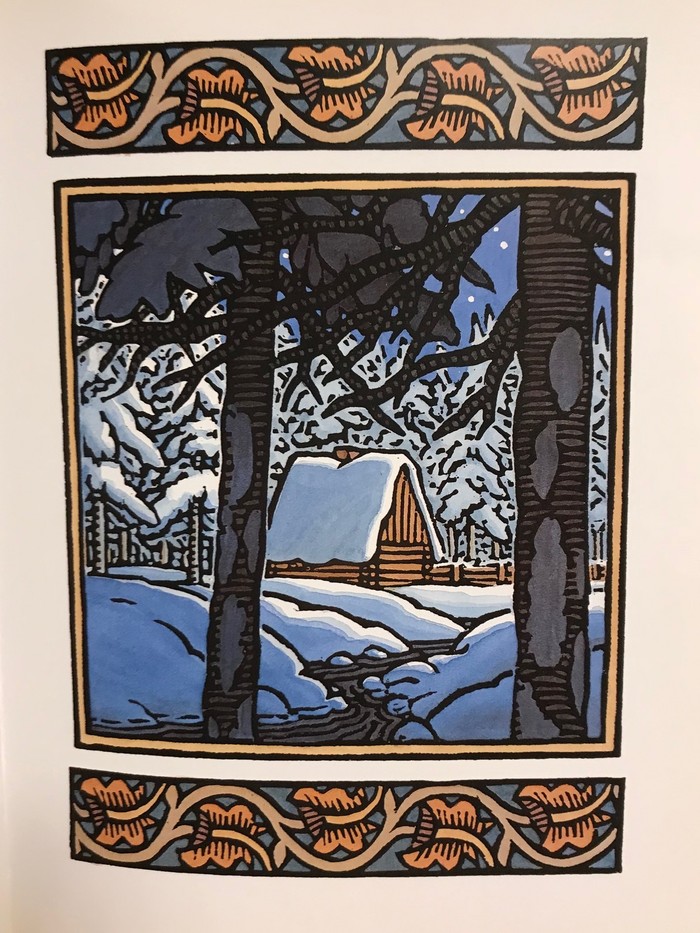
Having now read quite a few iterations of Good King Wenceslas - the picture-book versions done by Tim Ladwig, Jamichael Henterly, John Wallner, William Stobbs; as well as the novelized retelling done by Mildred Corell Luckhardt - I have to say that this edition from Manson is one of my favorites, visually speaking. I've admired this artist's work before, chiefly in his presentation of Lydia Maria Child's Thanksgiving poem, Over the River and Through the Wood, but this one is particularly lovely. There is just something so beautiful about the way everything is arranged on the page, with the large-sized text, so reminiscent of a manuscript, and the artwork, with its adept use of light and color. Here is Manson's depiction of the peasant's hut, almost buried in snow:
All in all, a wonderful presentation of this popular carol, one I would recommend to anyone looking for beautiful Christmas picture-books!
Good King Wenceslas, illustrated by Jamichael Henterly.
Taking the words of the beloved Christmas carol, Good King Wenceslas, as its text, this lovely holiday picture-book features the artwork of Jamichael Henterly, and sets out the story of a good deed done by the eponymous Wenceslas (a figure based upon tenth-century Czech king and saint, Wenceslaus I) and his page. Making their way through the bitter cold one St. Stephen's Day, they bring food and fuel to an impoverished peasant and his family, demonstrating that those who show generosity are rewarded in turn.
Unlike the other picture-book presentation of this carol that I have read, illustrated by Tim Ladwig, which features a brief introduction to the carol, and a historical afterword, this version is confined to the actual text of the song, with music included at the rear. I don't think the artwork is quite as accomplished here - it has less of the sweeping wintry feeling of the Ladwig - but it is still quite appealing, with its somewhat more intimate atmosphere. It also features a Wenceslas that, in his red cloak, looks suspiciously like another holiday gift giver. A deliberate choice, on Henterly's part? Hard to say. Although I think I prefer the Ladwig, I still recommend this edition to anyone who is a fan of the carol, and looking for illustrated editions!
"Good King Wenceslas looked out On the Feast of Stephen..."
And that's about all I could have recited of this song, except a mention of "Saint Agnes' fountain," and several archaic terms like "thither" and "hence." Though I had heard it sung before, I'd never actually looked up the lyrics until now. Fortunately, this picture book version of Good King Wenceslas has helped to give me a much fuller image of what the song is about.
The text is simply the words to the song, with wintery illustrations telling the story of the king who looked out and saw a peasant gathering wood for fuel, and decided to bring him food and wine to bless his family on that cold winter night (I can appreciate that this book changes the original word "flesh" to "food" to avoid any confusion).
While there is no specific mention of "Christmas" in this song, the image of a king leaving his safe and warm castle to help someone in need is extremely reminiscent of the Christmas story. Although I've never celebrated Saint Stephen's Day, it is observed on December 26 (27 for some) by Christians around the world, and therefore I found this song, as well as its admonition to "bless the poor" very fitting for a celebration of Christmas.
When I saw the lovely cover of this book in the public library, I knew I had to check it out. After all, this is the Christmas song that no one knows. Most people who can sing the first line get stuck right after. Good King Wenceslas looked out on the feast of Stephen...um...uh...that's it. I never knew what that song was really about until I read this picture book. And it's a nice little story. I probably still will never memorize those lyrics, but at least I understand the storyline now!
This is a unique story, not only because it is told through the verses of an ancient and beloved Christmas carol, but also because it is based on a true historical figure. Good King Wenceslas was one of history’s genuine servant leaders who was well known throughout his country for great acts of charity. This story recounts a miraculous occasion when the monarch set out in bitterest winter weather, accompanied by a young squire, to deliver food and warmth to a poor peasant and his family. Tim Ladwig's illustrations are rich toned blackline-and-watercolor paintings, but the clever twist is that the initial setting is the modern city of Prague, in the Czech Republic. A crowd is gathered around the famous statue of King Wenceslas mounted on his war horse. A poor minstrel begins to sing the old carol for the crowd standing in the snow and a little boy looks up at the saintly king and begins to imagine. Suddenly the illustrations transport the reader to the 10th century. You find yourself in a castle amidst firelight and the king himself as he gazes at a peasant struggling to pick up twigs in the snow. The decision is quickly made and the castle comes alive as King Wenceslas begins gathering his gifts for the family. The reader will soon realize that the young squire is the boy from the beginning of the story and that the poor peasant is the minstrel. At the end of the carol, we are taken back to the square in the heart of Prague. This creative twist in the illustrations is far more than a clever time transport effect. It is meant to give the tale a timelessness, to give the magnanimous act of charity an eternal context. It also communicates the deep and endless love the Czech people have for their dear king and national patron. The theme of this story (and song) is of heroic selfless charity in service to our fellow man, and the blessing that spills over to the sincere and compassionate giver. In the final illustration, the young boy, with eyes shining, offers food and warm coffee to the poor cold minstrel, all under the gaze of the king's statue. I have read this book many times to my children and the striking example of the high king, without a second thought, setting off to bring comfort to the lowly and forgotten has touched them deeply. King Wenceslas is in the front of their minds when they see the poor and homeless, especially in the harshness of winter. One son has been so moved by the story that he took Wenceslas as his personal patron, and so the legend and blessing lives on. I highly recommend this book as a holiday read aloud and hope it will inspire discussions about compassion and charity for those suffering and overlooked at that festive time of year.
Ok, so in all fairness I really am not crazy about this book, but it really is very well done, which is why I gave it five stars. I like the way it looks like a book from the middle ages, with the old hand lettering. The pictures are good and I like how it tells you who is saying what part of the song.
The illustrations make this Christmas carol come alive. I hadn't thought about the meaning of the verses until I read this book.
From the author information on the book jacket: "Wenceslas, king of Bohemia from 1378 to 1419, was a renowned lover of books—most especially illuminated manuscripts."
Good King Wenceslas, illustrated by Arthur Gaskin.
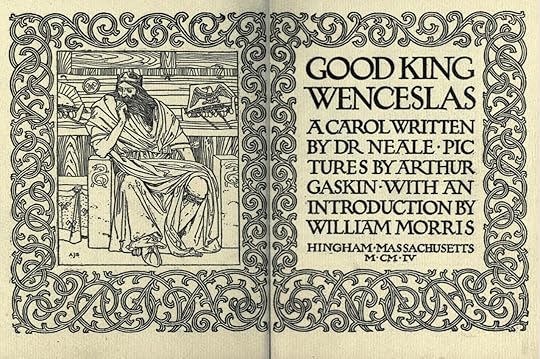
John Mason Neale's classic 19th-century Christmas carol relating the story of how Wenceslas, the tenth-century Bohemian king and saint, set out into a winter maelstrom to deliver firewood, food and good cheer to a poverty-stricken peasant, is paired in this gorgeous little book with the artwork of Arthur Gaskin. Gaskin was a member of the Birmingham Group, a collection of Birmingham artists associated with the Arts and Crafts Movement, and the book opens with an introduction from William Morris, a major force within that movement. The main part of the book is a brief ten pages, with text in bold print on one side of each two-page spread, and an engraving-style illustration on the other. Gaskin was known for his woodcuts, so I would assume that this is the medium used here. The book also contains a gorgeously ornate title page and accompanying illustration, complete with decorative borders:
This presentation of Good King Wenceslas is the fifteenth I have read, and it might be wondered what it brings to the table, that has not already have been encountered, in any of the foregoing titles. The answer to that, of course, is the artwork (and of course, the introduction by a famous figure such as William Morris). I love engravings, and the images here are just beautiful! The title page alone, reproduced above, makes it worthwhile to seek this one out. Recommended to fellow devotees of engraving-style artwork, as well as to those interested in the illustrative styles of the Arts and Crafts Movement.
Neale’s 1853 hymn was written to inspire Christians on the virtue of giving and hospitality on Boxing Day, the feast of Saint Stephen (December 26), because the song’s monarch treks a league out of his way braving harsh winter weather to provide food and drink to a peasant. Since the middle ages Boxing Day has been traditionally a day for people to take boxes of food and goods to those less fortunate who were in need. As Neal’s final verse emphasizes “Therefore Christian men, be sure, wealth or rank possessing; Ye who now will bless the poor shall yourselves find blessing.”
Ladwig’s vivid illustrations alternately contrast warmth and comfort of the King’s larder with the and freezing cold of “the rude wind’s wild lament and the bitter weather.” The picture book introduces the reader to Wenceslas I or Václav the Good the late tenth century Duke of Bohemia—he was later promoted to King by Holy Roman Emperor Otto the Great (Otto I, der Grosse, 912-973)—by a picture of his statue in Prague. Following the illustrated, slightly adapted lyrics to the song the book concludes with a historical note about the hymn noting that the tune is that of a 16th century spring carol followed by the music with the original lyrics.
This book is sung to the traditional Good King Wenceslas song of old. Typed in Old English font, this song follows the King who sees a poor man gathering wood in the freezing snow during the Feast of Stephen. He learns from his page where the man and his family live and decides to trod through the freezing weather to bring a feast to the family. We listened to the story through Alexa and it followed along perfectly telling the good tale of the King Wenceslas. In the back of the book, there is a short description of the King's life and his desire to spread Christianity and his good deeds of helping the poor.
Love this book that illustrates the Christmas Carol. The illustrations help overcome some of the difficulty that younger ones might have with the words. Also gives a little background, at the end of the book, about the history behind the story and Christmas Carol. About a 5 minute read aloud. I will be using it for 4th grade library party.
I love to sing this song and play it on the piano. It's a beautiful song that teaches us to be charitable in the spirit of Christianity. King Wenceslas went out of his way with his paige on the fest of Stephen to pay a poor man a visit and brought him a feast. The illustrations are so snowy and medieval, I love it.
I loved seeing pictures put with the verses of the song and that they have the music page at the end of the book. As an adult I appreciated the short biographies of Wenceslas and John Neale at the end of the book. The only thing I didn't really like was the artwork, it isn't a style that I particularly like.
After reading this picture book from the library we listened to the song. The book really made listening to the song more enjoyable. Had I heard the song 1st I would have thought nothing of it because it is not my style of music but knowing the words and how it was created made me appreciate it so much more...krb 12/17/20
An illustrated version of the song. The lyrics are printed in a gothic font, which might make reading for younger readers difficult, but the illustrations are lovely, in a sort of stained glass version of a woodcut.
A faithful illustration of the song. I've never heard the full song before. King Wenceslas and his page go to offer supplies to a poor man in the snow. The page has trouble in the snow and King Wenceslas helps him also.
Fascinating origin story to this pretty well known Christmas Carol that was written in 1853. The story is based on a generous and kind-hearted 10th century king, the patron saint of Prague. “Ye who now will bless the poor shall yourselves find blessing.”
All the verses of the familiar Christmas carol illustrated by woodcuts painted with water color. Includes historical information on the real Wenceslas, Duke of Bohemia.