

What do you think?
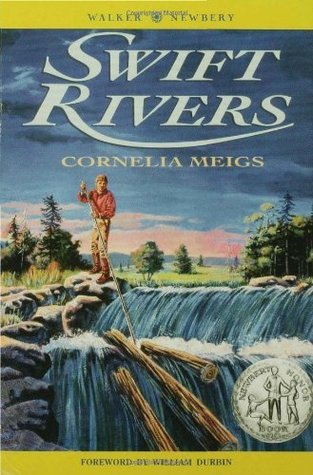
Swift Rivers
Barred from his family home- stead by his mean-spirited uncle, eighteen-year-old Chris weathers a Minnesota winter in a small cabin with his grandfather. Poverty and the tempting stories of a wandering Easterner convince Chris to harvest the trees on his grandfather’s land and float the logs down the spring floodwaters of the Mississippi to the lumber mills in Saint Louis. Filled with stories of raft hands and river pilots, this fast-paced novel has all the momentum of the great Mississippi.
269 pages, Paperback
First published September 1, 1932
Ratings & Reviews
Friends & Following
Create a free account to discover what your friends think of this book!
Community Reviews
Displaying 1 - 30 of 79 reviews

November 12, 2021
So. Boring.
By the end some serious skimming was going on. I could not care less about some logs going down a river.
I was reading this book concurrently with another Meigs' Newbery winner, Invincible Louisa, and I thought the same thing about both of them. There is something...heavy about the writing. It just drags. It's like she uses too many words to describe the simplest things.
I believe I still have one more Meigs' Newbery winner. It really is kind of appalling how many authors won a medal/honor 4-5 times.
By the end some serious skimming was going on. I could not care less about some logs going down a river.
I was reading this book concurrently with another Meigs' Newbery winner, Invincible Louisa, and I thought the same thing about both of them. There is something...heavy about the writing. It just drags. It's like she uses too many words to describe the simplest things.
I believe I still have one more Meigs' Newbery winner. It really is kind of appalling how many authors won a medal/honor 4-5 times.

March 8, 2017
The story line of this books flows as smoothly and enchantingly as the Mississippi River. In the same captivating style as Big Red, you meet stout-hearted, devoted Chris, who takes the dream his friend proposes, in running logs down small branches of inland water, to the greater branches of the Mississippi and Missouri, in the hopes of making money enough so that his aging grandfather can live in comfort. Scholarly and impatient but loyal Stuart, his first real friend, that started the idea but didn't have patience enough to work it himself, struggles constantly with learning to stick to a thing to the finish. Pierre Dumenille, the half-French, half indian river guide, who teaches the boys lessons to keep forever. This is a strong, feeling, book, one that you finish with satisfaction at the conclusion, yet regret you're leaving friends. I'd love to read more by this authoress!
April 10, 2019
Swift Rivers took me into a section of historical fiction new to me: the era of logging and rafting logs on the rivers. I found it quietly enjoyable and very interesting for its historical content, but also as an intriguing story of a young man with great character. The story line is woven together well, making it a gripping without being thrilling. It was particularly interesting for it's setting in the Mississippi River area, from St. Paul to St. Louis, and that the author actually grew up in Keokuk, IA! I especially appreciated the hero's good example to young men of hard work, perseverance, and integrity, as well as honoring of fellow men, elders, and authority; though I was disappointed that there is next to no mention of God, much discussion could be had to point the child to how God was honored. The author's style is to use more action than conversation in the story, so I think this might be a little slow as a read-aloud; nevertheless, it holds a lot of great topics for discussion. I highly recommend this book, especially for boys about 10-14 years old.

November 13, 2019
Newbery Challenge 182/415. I can’t believe how much I enjoyed this Newbery Honor book from 1933! The story follows 17 year old Chris as he runs logs from Minnesota to St. Louis on streams and the Mississippi River. It’s full of adventure and the pages fly by. I loved how Chris learned about hard work, honor, friendship, forgiveness, and honesty along the way. But the message never seemed preachy. This adventurous tale is fantastic. Appropriate for age 8+. Even though the main character is 17, there isn’t anything too adult or intense for younger kids. Highly recommend. It would pair well with Paddle to the Sea by Holling C. Holling.

September 2, 2021
I was pleasantly surprised, this looked like a long book and I read some slightly negative reviews, so I was prepared to cut this one off early if attention was waning, but actually everybody really liked it. You get to follow the protagonist as he works hard, meets fascinating people, has adventures, and looks out for others. The kids found it fun to listen to and I liked the message and the story. It's a little long-winded, so maybe younger kids would get bored, but it didn't bother us. And I read some reviews saying it disrespects Native Americans but I don't get that at all: actually the Chippewa near his home are described very positively, and the primary mentor figure that he looks up to and who is the main source of wisdom throughout the book is half-Indian, and is a terrific guy. Anyways, great book, we all liked it.
February 13, 2022
I read this book to my son. A moving beautiful story about one mans vision to ship logs down a river. Ultimately it is about moving logs from point A to point B and selling them....but in the midst of that they are beautiful side stories. The unforgiving uncle, the faithful grandfather, the feuding boats men, and above all a tale about the value of effort and perseverance. The friendship with a Stuart and Chris is also beautifully developed. Commended.
April 16, 2015
Read aloud to my kids. The story is interesting but the structure of the writing is awkward. I found myself paraphrasing constantly throughout this book so that my kids could follow what was happening. Hopefully they picked up a bit of American history--river life and logging during the presidency of Andrew Jackson.

May 16, 2018
I read this aloud as part of Sonlight Core D to my 11 year old. In his words, "That was one of the most boring books you've ever read." Well, I can't actually disagree. I enjoyed the story and we learned about river rafting, but it is cumbersome to read aloud and the detailed descriptions seemed to be told for their own sake rather than as a necessary part of the story line. Not our favorite, and not a great way for us to end the year, unfortunately.
January 31, 2021
There is a reason this is an awarding winning book. This is a look back at 1830's America, specifically from the upper edge of the Lousiana Territory to St. Louis. Those early settlers were tough. It was a wonderful book about a time and place so removed from our present times.

August 2, 2021
Bought this when I stumbled upon it with high hopes it could replace Minn of the Mississippi when we get to that in our curriculum b/c it too centers around the Mississippi River and I just can't muster much love for that one either. Maybe all books about the Mississippi River are destined to be unloved by me? While this is a Newberry Honor book, I just couldn't appreciate it. I think it really shows its age in the pacing and there is no way that any of us (myself included) could get excited about reading it. So, the search for a Mississippi River book continues...

May 28, 2021
I am SO GLAD to be done with this book. We had to read it for school, and while the story isn't bad, there is a horse-sized wheelbarrow of description on every page. Rounding up from 1.5 stars, because the writing quality is good.
It was written in 1932, back when there was a commonly held belief that people's personal traits came from their heritage - so there is some of what we now call racial profiling. It's skippable.
It was written in 1932, back when there was a commonly held belief that people's personal traits came from their heritage - so there is some of what we now call racial profiling. It's skippable.

April 23, 2015
This was a read aloud as part of Sonlight curriculum. Wow. This one was tough to get through. My kids, generally amicable to anything being read to them, had zero interest. I had to continually refocus all of us. Book felt about 50 pages too long, and had so many characters that only made brief appearances it was hard to keep them all straight. Maybe end of year fatigue?

November 9, 2016
Set in Minnesota around 1835 during the Jacksonian era, this is a story of the early history of the logging industry, when logs were floated down the Mississippi River to the markets at St. Louis, Missouri.

June 18, 2017
It was a little slow to get into and had longer chapters than we were used to. But my daughter really got into the story and wondered what was going to happen next. Enjoyable real life adventure.
Updated, my ds9 also enjoyed this book.
Updated, my ds9 also enjoyed this book.

May 30, 2021
Read aloud to my kids as part of their school curriculum. Worst book of the year by far. Boring beyond belief. Skip it!

April 27, 2023
I've had Swift Rivers on my to-read list for many years due to its setting my state of Minnesota. It's a work of historical fiction set in northern Minnesota and along the Mississippi River in 1835. Seventeen year old Chris Dahlberg, an orphan who has long lived with his mean-spirited uncle, finds himself thrown out of his uncle's home. His aged grandfather lives nearby, and is quickly becoming too old to continue living alone and supporting himself. Chris and his Grandfather come up with a plan - They will cut timber to float downriver and sell at a faraway Mississippi River port. Chris can bring back the proceeds for them to live on.
The plan seems impossible, and Chris' uncle is opposed (and tries to stop them). But when the logs are cut, Chris, with the help of friends, begins the journey down a fictional tributary of the Mississippi, and on to the Mississippi itself - but not without encountering various challenges along the way and new friendships along the way.
The overall premise of the story is fine - It makes for a nice coming-of-age sort of story as the main character Chris needs to work hard and overcome challenges. I would probably give it four stars if it weren't for the many glaring historical and geographic inaccuracies in the portrayal of Minnesota in 1835. As it is, I only rate it 3 stars.
First, there are multiple references to a mountain range in northern Minnesota. There are no mountains in Minnesota (some nice river bluffs and a few quite large hills near Lake Superior that could almost be mountains, but definitely no mountain range as is mentioned numerous times).
Second, the dates for settlement of the frontier areas of the state are way, way off. The valley in which Chris' extended family resides is supposed to be in the northernmost reaches of the Louisiana purchase territory. This area was not open to European settlers in 1835, much less nearly a century earlier when the valley was supposedly settled. Chris' family is of Swedish descent, but with a couple of isolated exceptions, Swedish settlers didn't begin coming to Minnesota until 1845, and much more so in the 1850s and beyond.
Finally, geographically speaking, the placement for the mouth of the fictional river into the Mississippi makes no sense. The mouth of the river is described as being about 100 miles north of Prairie Du Chien, which would put it in SE Minnesota, south of Red Wing and north of Winona. Given actual Mississippi river tributaries and drainage patterns, it is really hard to imagine any river could start in the north where this river is supposed to have started, and not flow either earlier into the Mississippi or flow first into the Minnesota river.
To be honest, I found these major historical inaccuracies to be very distracting, and caused me to doubt the historical accuracy of portions of the book set further south along the Mississippi river. I have less knowledge of either these areas or about the process of taking logs down the river, so I can't really comment on the accuracy here either way.
I realize this book was written 90 years ago, and perhaps historical accuracy was not as prized in that time period by historical fiction writers (nor was information as easily available). However I know that Maud Hart Lovelace was writing adult works of historical fiction during this very same time period (late 20s through the 1930s), and her books are a much more accurate portrayal of Minnesota life in the frontier era - so clearly, information was available to authors even in 1932 if they sought it out.
In general, I think readers interested in frontier life, logging, or the steamboat era on the Mississippi river will find this book to be of interest - as long as you aren't expecting to read it to get an accurate feel of Minnesota in the time it was set!
Content Considerations:
Stereotypical portrayal of Native Americans - Native Americans are referred to as "red men" and "savages" as well as childlike and easily distracted by gambling.
The plan seems impossible, and Chris' uncle is opposed (and tries to stop them). But when the logs are cut, Chris, with the help of friends, begins the journey down a fictional tributary of the Mississippi, and on to the Mississippi itself - but not without encountering various challenges along the way and new friendships along the way.
The overall premise of the story is fine - It makes for a nice coming-of-age sort of story as the main character Chris needs to work hard and overcome challenges. I would probably give it four stars if it weren't for the many glaring historical and geographic inaccuracies in the portrayal of Minnesota in 1835. As it is, I only rate it 3 stars.
First, there are multiple references to a mountain range in northern Minnesota. There are no mountains in Minnesota (some nice river bluffs and a few quite large hills near Lake Superior that could almost be mountains, but definitely no mountain range as is mentioned numerous times).
Second, the dates for settlement of the frontier areas of the state are way, way off. The valley in which Chris' extended family resides is supposed to be in the northernmost reaches of the Louisiana purchase territory. This area was not open to European settlers in 1835, much less nearly a century earlier when the valley was supposedly settled. Chris' family is of Swedish descent, but with a couple of isolated exceptions, Swedish settlers didn't begin coming to Minnesota until 1845, and much more so in the 1850s and beyond.
Finally, geographically speaking, the placement for the mouth of the fictional river into the Mississippi makes no sense. The mouth of the river is described as being about 100 miles north of Prairie Du Chien, which would put it in SE Minnesota, south of Red Wing and north of Winona. Given actual Mississippi river tributaries and drainage patterns, it is really hard to imagine any river could start in the north where this river is supposed to have started, and not flow either earlier into the Mississippi or flow first into the Minnesota river.
To be honest, I found these major historical inaccuracies to be very distracting, and caused me to doubt the historical accuracy of portions of the book set further south along the Mississippi river. I have less knowledge of either these areas or about the process of taking logs down the river, so I can't really comment on the accuracy here either way.
I realize this book was written 90 years ago, and perhaps historical accuracy was not as prized in that time period by historical fiction writers (nor was information as easily available). However I know that Maud Hart Lovelace was writing adult works of historical fiction during this very same time period (late 20s through the 1930s), and her books are a much more accurate portrayal of Minnesota life in the frontier era - so clearly, information was available to authors even in 1932 if they sought it out.
In general, I think readers interested in frontier life, logging, or the steamboat era on the Mississippi river will find this book to be of interest - as long as you aren't expecting to read it to get an accurate feel of Minnesota in the time it was set!
Content Considerations:
Stereotypical portrayal of Native Americans - Native Americans are referred to as "red men" and "savages" as well as childlike and easily distracted by gambling.

August 3, 2024
This is a difficult book to review. For the target audience of middle grade readers, the concept of orphans earning their keep through work, pioneer methods of farming, and 17 year olds not knowing anyone beyond the small valley (and being extremely naive) would seem boring. For adults interested in history, a quick read, or a light adventure story, this book satisfies a need.
I actually owned the 1994 edition with Pierre Dumenille (the Métis river pilot) on the cover, but I see the 2004 cover has been redone to have the white boy Chris Dahlberg on the cover.
There are plenty of stereotypes tossed about through the pages — exactly what you would expect from a book written in the 1930s. On the other hand, I recently read The River We Remember (also set in Minnesota) and encountered the same issues with racism against all people of color. We aren’t making any progress here.
I liked it. It’s a strong coming of age story, respect is given to the Grandfather, the Métis river pilot, and those who work for a living. The challenges are reasonable for the boys and play to their strengths. It’s a good one to read and discuss together as there is a lot to talk about.
I actually owned the 1994 edition with Pierre Dumenille (the Métis river pilot) on the cover, but I see the 2004 cover has been redone to have the white boy Chris Dahlberg on the cover.
There are plenty of stereotypes tossed about through the pages — exactly what you would expect from a book written in the 1930s. On the other hand, I recently read The River We Remember (also set in Minnesota) and encountered the same issues with racism against all people of color. We aren’t making any progress here.
I liked it. It’s a strong coming of age story, respect is given to the Grandfather, the Métis river pilot, and those who work for a living. The challenges are reasonable for the boys and play to their strengths. It’s a good one to read and discuss together as there is a lot to talk about.

August 16, 2018
The story is a simple one: young man has difficulties at home and sets out to make his fortune. Set in the 1830s when the President was Andrew Jackson, this is primarily a story of rivermen on the Mississippi and the way logs were floated to market. Young Chris Dahlberg from the upper Louisiana Purchase (Minnesota) acts on his friend Louis Hale's idea: he timbers some land and puts the logs in the local river and floats them to the Mississippi where they're joined to others to float to St. Louis. In the course of the adventure he meets a French/Indian (Chippewa) who is in charge of the log raft. This man, Pierre Dumenille, is the first problematic character. Meigs handles the dual ethnicity fairly well, but has some trouble getting past her era's attitudes concerning the First Nations. While it's only a bit patronizing towards Pierre, the attitude is far more racist toward a group who live along the Mississippi. Overall, I did enjoy reading about Chris's adventures. I read this for my 2018 Reading Challenge and my Newbery Challenge (Honor Book 1933).

November 10, 2017
This review is for school, and is only a synopsis on the book.
Chris Dahlberg lives with his uncle, a mean-spirited man. After a vicious temper flare when Chris' uncle was saying cruel things about his grandfather, Chris leaves his uncle's home and spends the winter with his grandfather. Chris is persuaded by the tempting idea of heading down the Mississippi and drive logs down the spring floodwaters to the markets of St. Louis. When Chris starts out, he is guided by a half Indian pilot. Halfway through their journey, their first pilot is exchanged for another pilot, an enemy of the first. Both pilots use different strategies and ideas. After fun, exciting, and some scary adventures, they finally reach their destination. Chris returns home, and tells his grandfather of his exciting adventures along the Mississippi river.
Chris Dahlberg lives with his uncle, a mean-spirited man. After a vicious temper flare when Chris' uncle was saying cruel things about his grandfather, Chris leaves his uncle's home and spends the winter with his grandfather. Chris is persuaded by the tempting idea of heading down the Mississippi and drive logs down the spring floodwaters to the markets of St. Louis. When Chris starts out, he is guided by a half Indian pilot. Halfway through their journey, their first pilot is exchanged for another pilot, an enemy of the first. Both pilots use different strategies and ideas. After fun, exciting, and some scary adventures, they finally reach their destination. Chris returns home, and tells his grandfather of his exciting adventures along the Mississippi river.

May 18, 2019
This book was published originally in 1932. My copy was copyrighted in 1937. This is really a story for young boys. One young man decided to cut down some of the trees on their land and float them down the Mississippi River, a thing which had never been done before from this location. This was a difficult and dangerous journey fraught with troubles and dishonest men. I enjoyed the story and it kept my interest all the way through. Cornelia Meigs was an award winning author whose books were popular with boys and girls. If you or your kids enjoy stories of pioneering in the mid-west, I would recommend that you read this book.

July 11, 2020
I really enjoyed the story. It was good, I enjoyed the logging journey with Chris. It was written in 1932, though the forward was written in 2004.
The “Forward” irritated me, contained spoilers and, in my opinion, was a detriment to the book. The author of the forward complained about the book’s author having a “tendency to stereotype native Americans. Though such attitude may have been common within cultural norms of the books 1830s setting...it should still not be excused.”
For the book to be authentic as a historical fiction, it needs its characters to portray the dress, speech and attitudes of the time period. I though the author did this well.
The “Forward” irritated me, contained spoilers and, in my opinion, was a detriment to the book. The author of the forward complained about the book’s author having a “tendency to stereotype native Americans. Though such attitude may have been common within cultural norms of the books 1830s setting...it should still not be excused.”
For the book to be authentic as a historical fiction, it needs its characters to portray the dress, speech and attitudes of the time period. I though the author did this well.

June 21, 2024
Swift Rivers is about a teenager, Chris Dahlberg, who was raised by an unloving uncle. He gets kicked out for disobeying him and goes to live with his grandfather. His grandfather is in need and with the idea of a stranger, they decide to harvest some trees and float the logs down the Missouri to the Mississippi to St. Louis. The rest of the novel is a travel adventure of the dangers of logging and sending the logs down rivers. Chris makes an unstable friend and gains a mentor from the French captain of the timber river enterprise. It is pretty exciting and I would recommend it for teen boys especially.

August 28, 2022
I was prepared to trudge through this book; the long chapters and the comments describing it as boring and man vs. nature got my guard up. I was pleasantly surprised. There is quite a bit of plot to this story of taking logs down the river, and the characters were pretty well-developed and engaging. But of course, in this frontier story, we have Chippewa and the accompanying racism. There is a main character who is half-Chippewa and half-French who falls into the noble savage category, but groups of indigenous people are derogatory caricatures.

January 22, 2023
This story had a strong start. I liked the hook with the contention between the protagonist and his uncle. I would have liked more of the story to be with the grandfather. Most of the logging trip down to St. Louis was extremely boring. I had trouble visualizing how the logging was done. Too bad Bill Durbin could not have helped edit since that author does a fantastic job in this regard. There were a few exciting scenes that kept me going, but it could have easily been a DNF. The ending was disappointing and quite anti-climatic. Just another 1930 Newbery dud.

December 9, 2025
Another homeschool read-aloud. Post Louisiana Purchase, this book details the story of a young man bringing logs downriver from a Scandinavian farming settlement at the northern edge of that new territory to St. Louis. The story has a quiet and steady tone, with lots of detailed descriptions of what is involved in the rafting process that can be on the drier side, but it never fully starts to drag, with explanations being skillful and fairly swift, and enough interesting characters and narrative to keep my 4th and 5th graders engaged even through the more technical bits.
May 27, 2019
Great story told in somewhat antiquated phrasing. The story is told passionately, but in a lot of words and all those words sometimes lost my boys a bit (I read this out loud to them, ages 8 & 10). As characters floated in and out, it was sometimes hard to keep them straight. A couple of times my boys asked, "Who is ___ again?" and I had to flip back in the book and look because even I couldn't remember.

April 27, 2020
This is the story of a grandson who decides that he will start clearing some land in Minnesota for his grandfather and then float the logs down the Mississippi to sell them in St. Louis. The book was written around 1930 and takes place about 100 years before that. It is clearly dated and I would expect that most kids today would find it rather boring.
September 19, 2025
I pulled this out as a summer read aloud for my 9yo and 7yo as I remember it from my childhood. The chapters were a bit too long for their age and we didn't end up finishing it together, but I enjoyed the end by myself. The author weaves valuable history into the narrative and reinforces the power of friendship and seeing hard things through until the end.
September 8, 2017
A somewhat simplistic kids' novel about an early, young, midwestern pioneer. Exciting, has the attitude that all people are either good or bad, with nothing in between or complex. Somewhat racist toward native Americans.

May 22, 2019
Fun adventure story my oldest and I read out loud. Great use of descriptive phrases that really made you think you could see the wilderness and beauty of the land. Fun story for anyone to read 3-4th grade and up
Displaying 1 - 30 of 79 reviews