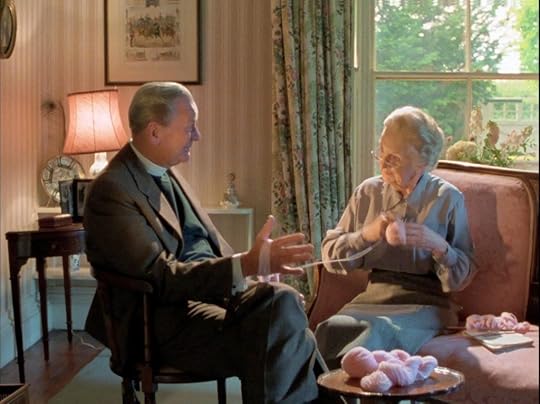
This book of short stories about our favorite fluffy old lady detective Miss Jane Marple of St. Mary Mead is the last of my reading on Miss Marple; I read this book in August 2010 and again in July 2022, so this is the third time I have read these stories. And I very much enjoyed reading them again and again.
Thirteen of these stories come from the short story collection The Thirteen Problems; one is from The Regatta Mystery and Other Stories, four are from Three Blind Mice and Other Stories, and the last two stories come from Double Sin and Other Stories. And in all of these stories Miss Marple shines to advantage, being able to cut to the quick in any mystery to find the solution, since her many years of living in a small English village made her aware of just about anything that could happen to any person in any relationship.
I do regret that I am done with my Miss Jane Marple reading, but I loved reading about her (one of my goals is to grow up to be just like her, even though I am not an English spinster). And I have plenty of Hercule Poirot books yet to read.
----------------------------------------------------------------
I read this book in 2010, and I was looking for a book to read before bed, and purchased this one from Amazon as a Kindle book; I did not mind at all reading it again, and will note that I love short stories and / or short chapters in my book. And I love reading Agatha Christi, and loved re-reading this book.
In the English village of St. Mary Mead lives Miss Jane Marple, a never-married old lady devoted to her knitting and to her numerous nieces, nephews, and godchildren. She is also a sharp observer of human nature, and maintains that every shade of human experience can be met with when one obverses one’s neighbors in a small village, where it would seem that everyone knows everyone else (and knows all about everyone else).
This book of short stories begins with a house party held by the novelist Raymond West, the novelist, who has invited several friends and his Aunt Jane. He proposes that each person relate a mystery that only that person knows the details of what happened, how, and why; on observing that there are only five people to play, his Aunt Jane notes that she is one of the company, and would like to participate (while she tends to her knitting in her chair). To everyone’s surprise, Miss Jane Marple turns out to be able to ferret out the answer each time. As the book progresses, the local police (not to mention current and retired personnel at Scotland Yard) learn that the sweet little old lady living in St. Mary Mead is someone valuable to consult in mysteries.
At some point I will look up more Miss Marple mysteries; for the present, I am very happy to have read (or re-read) this short story collection.
------------------------------------------------------------------------------
First Reading: August 2010
I do like a book with either short stories or short chapters (or both) for my nightly reading before I retire; and this book of all of the Miss Marple short stories fit my requirements quite well, as I was reading two or three of the twenty stories each night. In my misspent youth I read a lot of Agatha Christie, and my favorite character of hers was always Miss Marple, so I loved this book.
Miss Jane Marple is, without putting too fine a point on it, an old lady; never married, she has lived in the English village of St. Mary Mead for all of her life. She has a wide circle of friends, nephews, nieces, and god-children, and is usually seen tucked in the corner in an easy chair, knitting. She is dressed in the fashion of her bygone youth, in tweeds and white gloves. Her nephew is the well-known author Raymond West, who has a tendency to underestimate his aunt.
The outstanding fact about Miss Marple is that she has a lifetime of common sense, which she is called upon time and time again to use in the solving of murder mysteries. She often mystifies her listeners by recalling, after hearing the details of a particular instance, of an instance that she knows of personally that happened to someone in St. Mary Mead that seems to have no bearing on the current instance, and which leaves her listeners thinking she is becoming a dotty old woman; but invariably she is able to use her knowledge of life in a small English village to solve murder mysteries that have left everyone else baffled.
These stories were published originally between 1932 and 1979, but they age remarkably well (as does Miss Marple). I enjoyed them thoroughly (though one does wish, sometimes, that Miss Marple could be proved wrong), and hope that I age as well and as gracefully.




 and
and
 this book will be going on my "in hibernation" shelf for a while. If I don't jot down my thoughts on the stories I've read. My aging memory just won't retain the information until December.