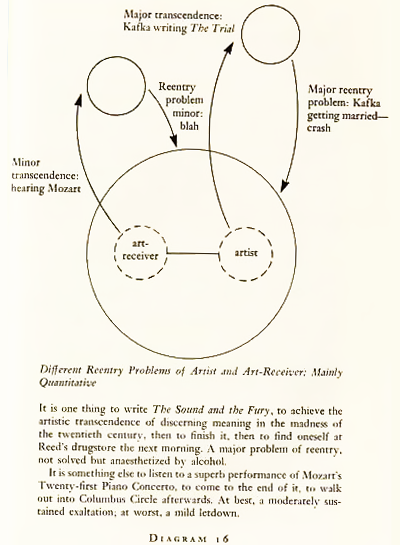
You have just finished Walker Percy's Lost in the Cosmos. You are prompted to give a brief review on the book. You describe the book as
1.) A unique and alternative way of storytelling, befitting roughly of your zeitgeist, with a tinge of satire and elbow ribbing, but ultimately a humorous book. Yes, it grapples with spiritual and metaphysical questions still unanswered in modern society, but it does not offer answers. Its primary function is to be funny, entertaining.
2.) It is a spiritually wholesome novel that must be taken seriously. It is an attack on the culture and the way we usually answer and grapple with questions. e.g. the ultimate shallowness of scientism, the fraudulence of self-help book genres and that the Self cannot ultimately help itself, the lack of understanding or even confronting of what the Self really is. This is a wakeup call and a dire one at that that has been largely ignored in the three decades even since its publication.
3.) It is a joke, but a joke in the most serious, Kafkaesque fashion. The joke ultimately being the reader itself and the book, much like the abyss, enjoying the last and everlasting laugh.
Choose one
A Robotics company out of Japan has just announced their launch of of new robotic dogs. The dogs are marketed and designed as companions, can be replicated to mimic any desirable pet (cat, dog, turtle &c) including hair, sounds, circadian cycles and even, to a degree movement of bodies. They are not service pets, they are meant to be companions.
An ambitious and popular marketing campaign is launched to try and appeal to the American consumer. No one is as fondly attached to pets as Americans, the research says. For instance, a dogbot is marketed as saving money on food, flea treatment, and waste management. The dog still walks and "wants" to play catch, can sleep on your bed at night, lick your toes, in short, do all the idiosyncratic, enjoyable things that a dog does.
Sales are not good. In fact they are bad, even though no one at the company wants to use that word. The robots are simply undesirable despite a popular TV commercial campaign. The following questionnaire is submitted to the company executives.
Of the following which option do you believe is the best description as to why the product failed.
1.) People know first and foremost that they are not pets. They are copies, replicas. They are therefore not the "original" or "real" and people want "originals" and "real" things especially when most pets are fairly affordable and not expensive to maintain, even factoring in food.
2.) People actually prefer the trouble of a dog peeing, pooping, carrying fleas and chewing up shoes. Not just from an authenticity issue, but people actually prefer flawed things and beings in their life. Every person sees themselves as flawed and sees all others around them as flawed. A Self is not a Self without flaw, sin.
3.) We live in an age and culture that celebrates the concept of "real" even though our definition of this word is tenuous at best. Real depends on perception, but also on the preconception that "real"ness a.) exists and b.) should be celebrated. It is not the product's fault, but instead we should seek to change the culture and attitude.
(Choose one).
You are writing a review for Lost in the Cosmos. You read the book in one sitting and are enthusiastic about sharing it with others. However, your internet goes out just as you sit down to the computer to type your review. In fact, the television says that the Internet is down for the foreseeable future all over the world. Your goal was to write a review that mimicked the form of Lost in the Cosmos and you knew that the only people that would appreciate it were the people that had already read it; that is, the people in the know about the format and style you are mimicking. None of your friends in real life have ever read the book. In fact, most of your friends don't read recreationally. Perhaps with the Internet down people will begin to read more but you can't be sure. Therefore without the Internet your review becomes unsharable.
Despite all this you write the review. Which of the following describes your feelings upon its completion?
1.) Disappointment. You can't share the review with anyone and the impetus of a review is that it shares criticism, thoughts, ideas about the book with another. Sharing is at least half of the nature of a review and without sharing it, it is not a review.
2.) Boredom. Overwhelmingly you miss the Internet. The review gave you something to do, but the Internet has engendered a What's Next syndrome in you in which you are always looking for the next thing to do. You are not really worried about the review itself so much as just being able to do something.
3.) Accomplishment. Despite the fact that no one is reading it besides yourself, you know that it is quite objectively a very good review, and you'd like to think that a good piece of work is good work and that whether or not people read it doesn't change the fact that what it is: a review, meaning the existence of an essence of sharing, the other essence present is that, at bare minimum, it is very good. You don't have anyone else to tell you it is good, you just know in a vague metaphysical way that it is.
(Choose one)