Jump to ratings and reviews
Rate this book

Horses of Heaven

Rate this book
British novelist Bradshaw (Imperial Purple) has created a richly detailed, absorbing historical novel of the ancient world, with strong, well-developed characters and all the right plot elements: love, war, courtly life and the magic of the gods. In 140 B.C., narrator Tomryis, age 18, is chosen by Saka King Mauakes of Ferghana (now Afghanistan), to attend his new wife, Heliokleia, a Greek from the kingdom of Bactra. The marriage is a political alliance, and Mauakes makes it clear that beautiful, intelligent Heliokleia is to have only limited powers. The aloof queen decides to seek her soul's release by being the perfect ruler. Mauakes's grown son Itaz, devoted to his father, is sensitive to both the king's isolation behind the mask of power and Heliokleia's emotional suffering. Eventually Mauakes falls in love with his wife, but he can't demand her affection, which has settled on Itaz. Aided by their sun god patron, Heliokleia and Itaz must confront the paranoid, embittered Mauakes and endure a horrible confrontation with a supernatural creature. Well-researched, interesting details on the cultural and religious customs of the period provide background for the noble characters, who fulfill the promise, good or evil, of their true natures. --Publisher's Weekly

448 pages, Hardcover

First published January 1, 1990

Loading...
Loading...

About the author

Gillian Bradshaw

53 books329 followers
Born in Arlington, Virgina, Gillian Bradshaw grew up in Washington, Santiago, Chile and Michigan. She is a Classics graduate from Newnham College, Cambridge, and published her first novel, Hawk of May, just before her final term. A highly acclaimed historical novelist, Gillian Bradshaw has won the Hopwood Award for Fiction, among other prizes. She lives in Cambridge with her husband and their four children.

Ratings & Reviews

What do you think?
Rate this book

Friends & Following

Create a free account to discover what your friends think of this book!

Community Reviews

5 stars
59 (20%)
4 stars
107 (37%)
3 stars
93 (32%)
2 stars
25 (8%)
1 star
2 (<1%)
Displaying 1 - 30 of 30 reviews
Profile Image for Ozymandias.
446 reviews210 followers
May 16, 2020
I really enjoyed this book. It's an unusual story told in an unusual setting.

The historical period is easy to define. It's set during the Hellenistic era in Bactria and the neighboring kingdoms. Bacria (modern day Afghanistan and Uzbekistan) was one of the Greek kingdoms set up by Alexander the Great during his conquest of the east. These kingdoms maintained Greek culture and a Greek way of life for well over a century and a half. Unfortunately, since their successor states didn’t regard them as worthy of record (and didn’t really keep records anyway) there’s not much left of them in the historical record beyond coins and a few mentions by western historians. And it’s a poorly documented period even in the west. Which means that this book is pretty much unique in terms of setting. A bit of Greek culture, a bit of Persian, a bit of Indian. All mixed together with some imagination. It’s a fun and unique setting.

The plot is a little bit harder to narrow down. I’d say its core is the romance. The Bactrian princess Heliokleia is sent to marry the non-Greek Mauakes, king of their traditional enemy the Saka, in order to create an alliance against dangerous barbarian hordes. It’s a loveless marriage, and the queen has far more interest in her husband’s son, the heroic Itaz. But naturally both are far too honorable to act on their feelings. That’s the broad gist of it, but the story is a whole lot more concerned with other matters. Like the character of Mauakes and his perennial suspicions, of Heliokleia and her stoic and clever Greek learning, of Itaz and his guilt-ridden and outsider nature. The novel is particularly interested in the religious beliefs and practices of all involved, from the Greek syncretism of the Bactrians to the Zoroastrianism of Itaz and the Buddhism of Heliokleia, the story gives plenty of opportunities to explore traditional religious beliefs and philosophies.

There is one major complaint I’d make though. The ending (really the last half of the final chapter) switches from what has been a compelling piece of historical fiction to a total fantasy, complete with monsters and magic flying horses. It comes out of nowhere too. I mean, there are religious visions and stuff before this so it’s not entirely unforeshadowed, but it’s still a major leap from relative realism to pure epic fantasy. And I don’t like it. It was entirely unnecessary. She could have solved her plot problems without it. It’s not like we know anything about any of these characters (even the real ones) so she could have given us anything for an ending and been keeping within known history. Or even the opposite: she could have introduced the mythic stuff earlier and made this a full Fantasy. As it stands it feels like a cheap trick.

I really liked this book. The story is well told (if long), the characters are compelling and well developed, and the setting is unique. It shows a side of the ancient world that’s rarely seen, not just the Bactrian setting but the nature of arranged marriages and Hellenistic and semi-nomadic Central Asian kingship. I was surprised how sympathetically they treated Mauakes, the man who could easily have been nothing more than a petty tyrant. It makes the characters seem more real that they all have their own private fears and foibles.
Profile Image for Jane.
1,692 reviews241 followers
November 28, 2013
Fascinating look into the author's concept of Seleucid Greek Bactria and Sakan steppe people [modern Afghanistan], the story takes place two centuries after Alexander the Great, in the remnants of his empire. The narrator, Tomyris, one of the queen's ladies-in-waiting, tells of the love between a Sakan prince, Itaz, and his stepmother, Heliokleia, a young princess married to Itaz's widower father, King Manaukes, for political reasons. This was a satisfying blend of historical fiction and fantasy. Bradshaw's country seems conjured from her imagination, pulling together what scanty information there is plus a large dose of imagination. The story reads almost like an extended folktale.

Manaukes' last-ditch attempt to destroy Itaz, who he thinks has undermined him, seemed more an act of desperation than real evil, to me. This story repeated a recurring theme in Bradshaw plots: that of the outsider, often misunderstood, who tries to fit into the prevailing culture and asks only acceptance. Each member of the 'triangle' was fully-rounded and sympathetic. I liked how the explanations of aspects of Buddhism and of Zoroastrianism were worked into the novel. For instance, I learned the significance of the Buddhist wheel, on the flag of the India of today.

'Horses of Heaven' were royal horses, descended from the divine horses who pull the chariot of the sun and raised by the Sakans. The herd on the queen's farmland, especially a certain white horse, was important to the plot. This novel read smoothly; I read it in a matter of hours, despite its length.

Very highly recommended for lovers of historical fantasy.
Profile Image for Kelly.
616 reviews166 followers
July 31, 2011
Gillian Bradshaw’s Horses of Heaven is a historical fantasy set in a place and time far from fantasy’s beaten path: central Asia in 140 B.C. It takes place in the kingdom of Ferghana, which was once on the eastern fringe of Alexander’s empire. Now, Alexander is long dead and Ferghana is an uneasy mix of Greeks and native Sakas. The widowed King Mauakes makes a political marriage with a Greco-Bactrian princess, Heliokleia, but he is abusive toward her and their marriage is a disaster from the start. When Heliokleia instead falls in love with Mauakes’ handsome son Itaz, and he with her, the situation becomes as incendiary as Greek fire.

It’s a time and place where many ideas and philosophies competed for dominance, and there are many debates within these pages: the merits of Buddhism vs. Zoroastrianism vs. the Greek pantheon vs. Saka sun worship, for example, and differing views of governance, warfare, and women’s rights.

The “talkiness” of Horses of Heaven is both a strength and a weakness. The religious and philosophical debates are fascinating and do a great job of defining the characters and their relationships to one another. On the other hand, the book is occasionally a bit dry and bogged down in bureaucratic process, particularly in the first half. Later, as the love story blooms more fully, it alleviates this issue. It’s a pretty archetypal triangle, but Bradshaw elevates it by fleshing out all three of the principals rather than making them stock figures.

Bradshaw’s decision regarding point of view is one of the most unusual I’ve seen. Horses of Heaven is ostensibly in first person, told by Tomyris, a young Saka who is chosen as a lady-in-waiting to Heliokleia. Yet Tomyris only talks about herself in brief and scattered moments, and narrates scenes from the three leads’ lives as though she were a third-person narrator: showing us their innermost thoughts and the precise details of events she only heard about secondhand. At times I wondered, why use Tomyris at all? Why not just use third person? Toward the end of the book, I think I figured it out. Tomyris is a microcosm of the people of Ferghana; we see how their opinions of their king and queen and prince changed over time by way of Tomyris’ own changing feelings.

Tomyris’ narration also raises the question of intended audience. Horses of Heaven is listed in some places as “young adult.” The story of Mauakes, Heliokleia, and Itaz deals with mature themes such as spousal abuse and adultery, and delves more deeply into philosophy than is usual in a YA novel. Tomyris’ story, on the other hand, is a classic YA journey in which a young person examines what her culture has taught her, decides what to accept and what to reject, and becomes an adult with her own considered opinions. As a result, I don’t know whether to classify this as a YA book or not.

The fantasy elements are subtle. Many of the magical occurrences are of the sort that could also be explained by mundane means, especially at first, but later it becomes clear that this is indeed a fantasy novel.

You’ll probably like Horses of Heaven if you enjoy historical fantasy such as that of Jo Graham. If you find it a little dry at first, keep going. In the end I found it thought-provoking and emotionally moving, and learned some interesting history along the way as Gillian Bradshaw brings to life a setting that almost nobody is writing about.
Profile Image for Peter Tillman.
4,143 reviews494 followers
August 3, 2020
A first-rate historical fantasy about Central Asia around 140 BC. This is a period and area with a sparse historical record. In Bradshaw's account, there was still a substantial Greek population in local kingdoms, descendants of subjects of Alexander the Great and successor kingdoms.

Rather than trying to do a detailed write-up, I'll refer you to Ozymandias' fine review, which is the one that led me to read the book:
https://www.goodreads.com/review/show...
I was less taken aback than he was by the swing to fantasy at the end (but I'm a fan of F/SF). I suspect that was Bradshaw's way of
An easy 4 stars for me. Excellent book.
Profile Image for Bryn Hammond.
Author 21 books422 followers
December 27, 2021
Set in Ferghana and Bactria, I'm putting this on my 'steppe-fiction' shelf although it's not nearly as steppe-sympathetic as her somewhat later novel Island of Ghosts. I like the way Gillian Bradshaw writes -- quiet and considered. The basic plot of this was love story (unlike Island of Ghosts), with ample slowly-told psychology.
Profile Image for Barb in Maryland.
2,119 reviews179 followers
February 28, 2017
Just finished my first re-read of this in 20+ years and loved just as much as before.
The blurb gives a nice summation of the major plot points, but can't begin to convey the tension that keeps increasing as the story unfolds.
At the heart of the book is the tragedy of major misunderstandings due to cultural differences. The kingdoms of Ferghana and its southern neighbor Bactria are remnants of Alexander the Great's far-flung empire. Ferghana's major city, Eskati, having the formal Greek name of Farthest Alexandria, is Greek in language and culture. However, its king and most citizens of the country are members of the Saka people-- former horse nomads who settled the area many years ago. They have their own language, religion, traditions. The tribal council and the city council are constantly vying with each other for the king's attention--each group distrustful (and somewhat disdainful) of the other.
King Mauakes, who had, years earlier, successfully wrestled Ferghana from the clutches of the Bactrians, now needs their assistance to defeat the approaching Tochari(who are looking to ravage, pillage and move on south to Bactria). The Bactrians agree to an alliance--sending 5 elephants, many catapults with a supply of 'Greek Fire', as well as the current ruler's young sister.
Heliokleia's beauty and poise are a pleasant surprise for the king but engender immediate distrust in young Itaz, the king's son. He assumes her carefully held poise indicates the typical Greek contempt for non-Greeks and acts accordingly. Heliokleia is intellectually brilliant but emotionally bewildered. The only one who loved her (her nursemaid) died when she was quite young; her attendants were too busy training her to be a princess to shower her with affection. As an older child she encountered the teaching of Buddha and adopted the philosophy--a world view totally at odds with the religious views of both the Greeks and the Sakans.
All of that is background to the main part of the story. The marriage is a disaster on many fronts.
The king is besotted with his bride's beauty and anticipates many happy nights in the marriage bed. She is not besotted at all with her husband, who is both older than her late father would have been and physically unattractive, and dreads each night. She tries to maintain an inner calm, while he keeps trying to elicit some sort of emotional response. When they finally have their big confrontation the result is dreadful.
Politically, Mauakes doesn't trust Heliokleia one bit. Our narrator, the charming Tomyris, is one of four young women chosen by the king to be his bride's ladies of the chamber. Their main duty, it is understood but not spoken of, is to spy on her. Read her letters, report to the king on who she talks to and what is said. The citizens of the city love her, seeing her as a fellow Greek; the king distrusts her for the same reason. Her efforts to be a real queen are met with suspicion. The king uses Itaz, who has been vocal in his dislike of Heliokleia, to further constrain her by making him the leader of her military guards. This backfires, with long term consequences.
The tension mounts as Mauekes becomes more paranoid--jealously suspecting anyone with a kind word about the queen of being disloyal to him. Everything Heliokleia does or says seems to be the wrong thing, no matter how good her intentions are. Adding to the sense of foreboding is Itaz's gradual change of heart and mind regarding the queen. Though nothing untoward has happened between Itaz and Heliokleia, the king's wrath falls on his son. Itaz is threatened with banishment and (later) death.
For all the tension driving the story there are a number of lighter moments that play off the cultural differences. The Sakans are proud horsemen; the ability to ride is highly valued in both men and women. The upper-crust Greek Bactrans don't ride at all; it is considered uncouth. Heliokleia's two Greek attendants (who have been with her since she was a small child) are shocked and appalled when she must get on a horse during the arrival ceremony in Eskati. But Heliokleia perseveres: Tomyris is appointed her teacher; Heliokleia becomes a good rider. When Itaz has occasion to visit the Bactran court, he brags about how loved the queen is among the Sakans. How they love that she rides so well. The court is shocked! Their princess! On a Horse!!
The climax lives up to the preceding drama. The clash of the human world and the Other plays out to a most satisfying conclusion.
This definitely goes back on the keeper shelf. I'm sure it won't take me another 20 years to get around to re-reading it.
Profile Image for J'aime.
812 reviews29 followers
August 3, 2011
This is the novel that made me a fan of Bradshaw's historical fiction. Set in the ancient world (present day Afghanistan), it has a rich tapestry of setting, well-developed characters and an exciting story. The author has obviously done her research as the book is filled with intricate details on clothing and locations, and the story comes alive because of it.

King Mauakes of Ferghana makes a political alliance by marrying Heliokleia, from the Greek kingdom of Bactra. The story is told by her new handmaiden, Tomryis. Heliokleia is almost completely isolated in this foreign land, until she begisn to fall in love with Mauakes' son, Itaz. Though both are loyal to the King and would not betray him, Mauakes is paranoid and begins a reign of terror against them. Though this is historical fiction, it does have a slight supernatural element often found in very ancient history (like the gods in the Illiad and Odyssey).

I have read a LOT of historical fiction over the years, and this is still one of my top five.
Profile Image for Bibliophile.
785 reviews52 followers
January 3, 2012
Although the setting of this Tristan-and-Isolde novel set in ancient Afghanistan was fascinating, the book could have done with some editing (the scenes of Heliokleia and Itaz battling their attraction to each other dragged on a bit, especially since I felt that they really weren't developed in depth.) Also the first person narration by a different character really didn't work as it was impossible for her to have witnessed so many of the scenes that she told the reader about and I just didn't believe that the characters had shared their most intimate thoughts with her years after the fact. Lastly, the introduction of the supernatural/fantasy element was a bit jarring. This is one of Bradshaw's earlier works, though, and as she is one of my favorite writers of historical fiction, I'm willing to be a bit lenient.
Profile Image for Clare O'Beara.
Author 22 books372 followers
July 26, 2014
This is a story of ancient times, after the death of Alexander.
King Mauakes of Ferghana decides to make a political alliance by marrying the lady Heliokleia. She comes from from the Greek kingdom of Bactra, whose customs differ greatly - she prefers the Greek style of a simple unadorned dress with a pin to hold it fastened, while the people of her new land are barbarously resplendent in all the finery and jewels they can wear.
While the king appoints guards for his queen, she decides that she needs her own troop, who are loyal to her. The fine white horses bring her happiness, but she doesn't find love until a younger relative of the king's enters her heart - a crazily dangerous situation.
The days are well described and culture clashes evoked. I enjoyed the storyline, romance and the writing. I had previously read Bradshaw's three Arthurian books and could see similarities.
Profile Image for Dani.
53 reviews1 follower
September 4, 2007
The author did her research and portrayed the Saka (and Bactrian) lifestyles well but the main characters did not hold my interest in the three-way love story and I would have rather learned more about the narrator's character.
Profile Image for Yune.
631 reviews22 followers
April 29, 2009
I can't think of a book that belongs so firmly in historical romance as this one. (Regency romances, on the other hand, are far more romance than history.) This almost edges into the territory of those romances of yore, like Tristan and Isolde, but it's more approachably written.

Somewhere in Central Asia, in a time when elephants were the terror of the warfield, a king marries a Greek princess. The story's very much driven by the princess's quest to understand her new people and her new husband, but it's draped gracefully by the details of the period and culture.

There are some breathtaking moments in this book, but in the end it didn't hold the same charm that some of other Bradshaw's works do for me.
Profile Image for Kat.
Author 1 book23 followers
January 24, 2014
What an odd book. The POV was a strange hybrid of first person and omniscient (the first person narrator was looking back on the events, recounting many which she learned about only after the fact), which had the effect of distancing the reader from the action for the first third or so of the book. And the poor characters' lives were such a horrible train wreck! I had no idea how Bradshaw was going to pull off any kind of a happy ending. (Spoilers: she did, but it felt a little abrupt and forced, after so much awfulness.) Not a bad book or one I regret reading, but Bradshaw has done much better.
40 reviews
May 15, 2011
This book definitly kept my attention. At the end I thought I knew what was going to happen and in my mind it was so predictable that I was extremely disappointed, but I kept reading and thank god I did. It took a totally different route and ended up drawing everything together. This was my first book from bradshaw and I was impressed. This was a good book.
Profile Image for Melissa.
150 reviews61 followers
May 11, 2010
If you like your historical romances heavy on the historical side, this would be a great book to check out. This time through I appreciated it for the depiction of real grownups in relationships that cause them to grow and change their minds about deeply held beliefs.
Profile Image for Cheri.
123 reviews5 followers
August 13, 2024
I can’t say anything more other than I love this book. Gillian Bradshaw’s Horses of Heaven is so fascinating, philosophical, and somehow the setting is so exotic. I’m aware that the author is a classicist so it’s not a surprise that her knowledge regarding all things Greek is impeccable. But when she chose a less-documented historical period in Central Asia for her fiction-fantasy, I’m in awe of how much research she has done on her own to present the story as authentic and heartfelt. Reading this book made me stop from time to time to do my own research too, to look up the places, customs, and historical figures that were mentioned in Horses of Heaven. The fantasy part isn’t the kind that transported you to another world but more along the line of mythological belief coming alive (just like ancient Greek mythology with its fantastical creatures).

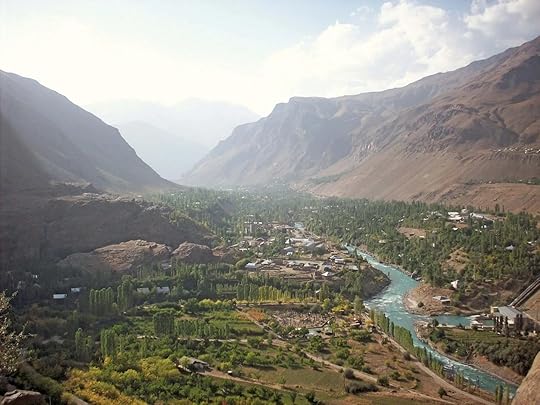
The city of Khorog in Gorno-Badakshan, Tajikistan. When Itaz and Heliokleia passed the Terek Pass with the intention of crossing the treacherous mountain range that separated the Saka and the East (the homeland of the Khotan), I would like to imagine that the place looks similar in this photo. Khorog itself was situated next to the Pamir mountains.


Set years after Alexander the Great’s death and I assume after the Diadochi wars, Central Asia was populated by Hellenistic states which historians usually referred to as the Greco-Bactrian kingdom. This particular period is fascinating because there’s also an Indo-Greek kingdom that was invaded by the Saka people (considered to be related to the Scythians). There’s the Iranian Parthian empire, the Tochari (whom I assumed as the Tocharians, a vanishing civilization around the Tarim Basin), and a passing mention of the Khotanese kingdom (they’re also related to the Saka and the Scythians).

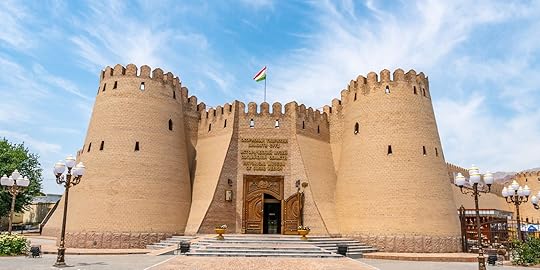
Khujand Historical Museum. The city of Khujand was the site of Alexandria Eschate (meaning: Alexandria the Furthest), one of the many cities founded by Alexander the Great. I would like to imagine that this building was perhaps similar to the royal palace of Eskati where King Mauakes isolate Heliokleia.


The story is narrated by Tomyris, a former royal attendant of Queen Heliokleia, written in such a way that as if we’re actually reading Tomyris’ diary regarding her former life in the royal palace of Eskati. Tomyris herself was painted, at best, as a supporting character who was initially distrustful towards Queen Heliokleia but gradually changed her mind and became a loyal supporter of the queen instead. It all began when King Mauakes of Ferghana established an alliance with King Heliokles of Bactria as part of his plan to drive off the Tochari (which intended to invade Ferghana) by obtaining Bactrian’s war elephants and catapults. The agreement between the two kings was sealed by a marriage between Mauakes and Heliokleia, the sister of Heliokles. Initially, the marriage pact was heavily opposed by Mauakes’ son, Itaz, as well as several of Mauakes’ councilors. But when Heliokleia arrived at Eskati, her presence struck both Mauakes and Itaz as she was beautiful and majestic. Since then, Heliokleia’s presence brings about an agonizing situation for the three of them and everyone beside them. Mauakes was madly in love with Heliokleia but unable to understand her, stripping her away from the real power attributed to a queen instead. Like a narcissistic king with a deep inferiority complex, he sexually abused her as he liked, spied on her, and isolated her. Itaz, though at first seems to dislike her, gradually comes to terms with his own heart and realizes that he too was also in love with Heliokleia. But Itaz also loved his father and he was a loyal son. He chose to love Heliokleia at a distance. Heliokleia herself, suffering as she was, tried to detach herself emotionally by relying on her Buddhist faith, accepting her unfortunate situation as part of her karma. However, when Itaz received a vision, made peace with his own inner turmoil, and changed his conduct completely towards Heliokleia, she began to blossom. Problems arise from there as Mauakes, jealous as he is, suspects both and does every arbitrary act that hurts Itaz and Heliokleia more.

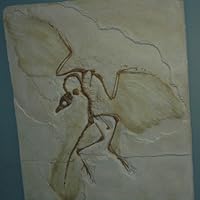
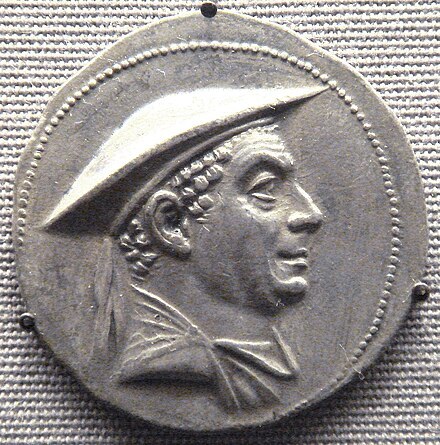
Portrait of Antimachos I as stamped on coin. Many times the book mentions that Heliokleia had a mocking smile similar to Antimachos as she was a descendant of Antimachos the God. When I look at the portrait, now I understand why Bradshaw explained the smile as mocking because it does look as if Antimachos was rather amused.


Bradshaw is an exceptional writer as three of the main characters were so fleshed out. I sympathised with the three of them equally though it is difficult to feel bad with Mauakes as his conduct truly leaned on abuse and possessiveness whatever his reason was. Heliokleia was probably the most abused heroine in Bradshaw’s book. There’s a lot of tension between two distinct cultural customs between the Sakas and the Greeks which I’m glad that Bradshaw put in her book. Really, prejudice can taint the way we judge others. We become irrational and try to rationalize the otherwise irrational judgment for everyone that’s completely different from us.

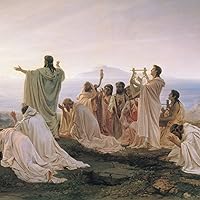
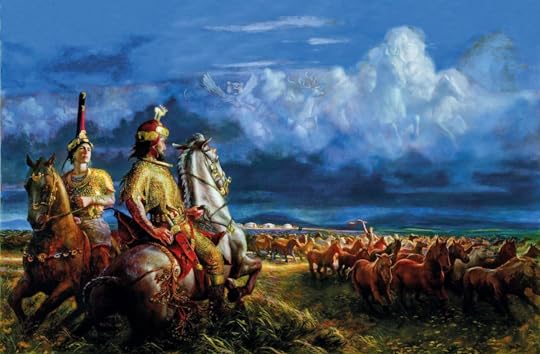
An illustration of Scythians and their horses of heaven. Perhaps, this could be a depiction of Itaz and Heliokleia when they were at Eagle Crag, the shape of the clouds above is the perfect representation of a white stallion that visited them out of nowhere.



Horses of Heaven is an old historical fiction gem. Slow-paced but full of philosophical discussion about prejudice, unmet longing, and the cost of power. Bradshaw is an incredible storyteller and historian (though she disagreed to call herself a historian).
753 reviews7 followers
November 23, 2023
This's the first Gillian Bradshaw book I didn't enjoy reading. But I think that could largely be due to me.

In Hellenistic Central Asia, on what was once the borders of Alexander's empire, the king of Ferghana has made a political marriage to a young Greek princess of Bactria. Unfortunately, she's a Buddhist repulsed by the physicality of marriage. Unfortunately, he doesn't care for philosophy, he doesn't want her to gain an independent power base among the Greeks of the kingdom, and he realizes he wants her to actually love him.

Even more unfortunately, she then falls in love with the king's son (from a previous marriage).

The book tells the story of the coming avalanche continually gathering more and more mass as everyone concerned clumsily tries to do their untutored best while not being able to make each other understand... until disaster strikes. I didn't enjoy it myself, but I imagine some other people could.
Profile Image for Meggie.
603 reviews89 followers
May 16, 2024
I read 25% of Horses of Heaven in the end of March, put the book down for a few weeks, then finally read the remaining 75% in May. It's more fantastical than Gillian Bradshaw's other historical novels I've read (divine horses, visions, and other supernatural goings-on) but the heart of the story is like a Tristan and Isolde retelling in Bactria and other kingdoms.

The book is ostensibly told from the viewpoint of Tomyris, one of Queen Heliokleia's ladies-in-waiting, which adds some distance to the narrative--but then we still get inside Heliokleia and Itaz and the king's heads at times, which was a little odd.
Profile Image for Tegan Mclane.
25 reviews
January 1, 2026
I found this to have a slow start with - as others have said - a disconcerting narrative voice that veers between first person perspective of a teenage royal attendant and omniscience. The deus ex machina fantasy ending also did not work for me. But the middle of the book was an engaging and well-researched exploration of historical culture clash, as characters from different ancient kingdoms meet and interact.
Profile Image for Lena.
74 reviews
Did Not Finish
May 6, 2024
I got this book at a used bookstore, based on the cover. I got halfway through before I put this book down. I enjoyed the world, but there was too much domestic violence and slaughter of horses for me.
Profile Image for Becca.
76 reviews
March 31, 2024
interesting time period/setting and compelling characters, but emotionally grueling
Profile Image for Mallory.
1,013 reviews
February 13, 2014
A young princess is married to an old king in ancient Afghanistan in order to strengthen an alliance between neighboring kingdoms. But Heliokleia’s culture and religion are vastly different, and she is reserved and cold toward King Maukes; she does not love him. A near-prisoner in her new palace, with every move she makes watched and reported, she falls in love with the king’s son. Telling the story from the point of view and memories of Tomyris, queen’s attendant, was somewhat limiting and didn’t always make sense, context-wise. She appears and disappears as the narrator at random. I did feel an understanding for all three main characters and their struggles and also felt that the king was portrayed in a more negative light than he should have been. I enjoy Bradshaw’s stories because they are always filled with strong female characters. This one was a fascinating mix of both historical fiction and mythology.

Favorite quotes: “That’s the advantage to being a tall girl: you always stand at the back.” – Tomyris

“There is a simplicity to animals that all of us long for, sometimes: to live wholly in the present, aware of nothing but the world of the senses. Our own worlds are so complicated that we ourselves don’t understand them.”

“One can’t help falling in love, and these things happen whether we want them to or not.” – Yavana traveler
Profile Image for Meghan Emery.
38 reviews36 followers
August 1, 2014
This is probably one of the best books I have ever read. The language was lyrical and elegant, the story stirring and emotional, and the character growth is phenomenal. The story takes place in approximately 140 BC in central Asia. The main character works as a lady in waiting to the new wife of the King, while at the same time works as a spy for the King. She slowly comes to befriend the new Queen. At the same time, the King's son starts out hating the new Queen for being young and beautiful and Greek and begins to gain a sullen respect for her. This is a historical fiction that feels like it could take place in a fantastical fantasy world, even though it takes place in the "real" world.
This novel is also a romance. It is a romance in the epic scale of something like Tristan and Isolde or Arthur and Guinevere. This book feels so philosophical to me, that whenever I get in a contemplative mood I tend to read this book. I would definitely recommend this book.

Voice: A
Writing: A
Grammar: A
Characters: A
World: A
Overall: A
Recommendation: DEFINITELY YES!
Profile Image for Emiley.
131 reviews
June 14, 2007
A tragic tale of two star-crossed lovers, through and through. Set in Central Asia, the aging King Mauakes enters into a political marriage with the Greek beauty Heliokleia. His son Itaz, however, immediately despises her foreign ways and her self-sacrificing attitude. Of course, they say that love and hate are practically overlapping emotions, and you can guess what happens.
254 reviews1 follower
December 19, 2008
An entertaining story, good characters. A good fictionalized version of history.
Profile Image for Neil.
47 reviews
June 22, 2012
An historical novel with the unusual setting of ancient Bactria.
Displaying 1 - 30 of 30 reviews