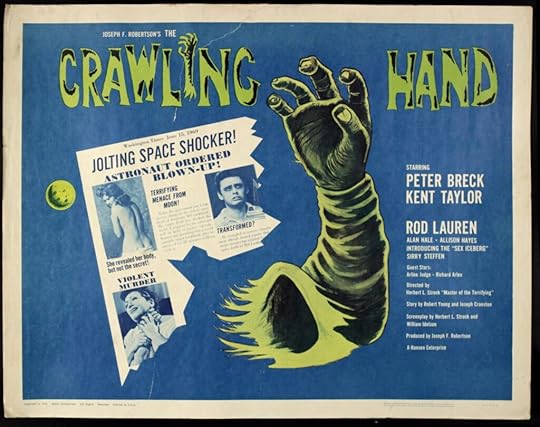
Montese Crandall is a downtrodden writer whose rare collection of baseball cards won't sustain him, financially or emotionally, through the grave illness of his wife. Luckily, he swindles himself a job churning out a novelization of the 2025 remake of a 1963 horror classic, "The Crawling Hand." Crandall tells therein of the United States, in a bid to regain global eminence, launching at last its doomed manned mission to the desolation of Mars. Three space pods with nine Americans on board travel three months, expecting to spend three years as the planet's first colonists. When a secret mission to retrieve a flesh-eating bacterium for use in bio-warfare is uncovered, mayhem ensues.
Only a lonely human arm (missing its middle finger) returns to earth, crash-landing in the vast Sonoran Desert of Arizona. The arm may hold the secret to reanimation or it may simply be an infectious killing machine. In the ensuing days, it crawls through the heartbroken wasteland of a civilization at its breaking point, economically and culturally--a dystopia of lowlife, emigration from America, and laughable lifestyle alternatives.
The Four Fingers of Death is a stunningly inventive, sometimes hilarious, monumental novel. It will delight admirers of comic masterpieces like Slaughterhouse-Five, The Crying of Lot 49 , and Catch-22.
Hiram Frederick Moody III is an American novelist and short story writer best known for the 1994 novel The Ice Storm, a chronicle of the dissolution of two suburban Connecticut families over Thanksgiving weekend in 1973, which brought him widespread acclaim, became a bestseller, and was made into the film The Ice Storm. Many of his works have been praised by fellow writers and critics alike.
In 1955, eight years before Thomas Pynchon's V., and two years after Bellow's The Adventures of Augie March, a young writer by the name of William Gaddis unleashed a nine-hundred and fifty-six page novel upon the scene of mid-twentieth century literature entitled The Recognitions. The novel itself dealt with the curious theme of artistic forgery, and concerned a young artist by the name of Wyatt Gwyon and his Mephistophelean contract with an American art dealer by the name of Recktall Brown. Also added to this monolithic satire of modern art was a rag-tag bunch of Greenwich Village bohemians desperately seeking artistic purity. The writing was chalk full of literary and religious allusions that would make even the most attentive Joyce scholar reel with admiration, and its style and structure was reminiscent of some of the more urbane examples of modernist literature. However, many critics ignored the work, an esoteric handful applauded Gaddis's ambition and erudition, and some rose to its defense, heralding it as a masterpiece. The most stalwart admirer of The Recognitions was a journalist by the name of Jack Green, who wrote a seventy-nine page response to all of the negative reviews of the book, excoriating what he thought was lazy criticism and hack journalism. A common critique of Green's was that most of the critics had not actually finished the book. He was probably right; many of the reviews were utterly dismissive, if not far too brief, and Gaddis's first novel remained relatively obscure until 1975, when his second novel, JR won the National Book Award. Up until that time Gaddis had been writing film scripts for the U.S Army, and executive speeches for IBM and Eastman Kodak. JR was even more bitter than The Recognitions. This was a true indictment of the forces that kept the pure artist whiling away their time at thoughtless jobs, in their free time occupying themselves with "work worth doing". Gaddis clearly had this in mind when creating JR's Edward Bast; a budding composer who teaches music to grade school students in order to eke out a living; a disengaged dayjob that Gaddis had modelled after his similiar experiences. Around the time of Carpenter's Gothic - a literary chamber piece in which secular humanism battles evangelical conservatism - readers and critics alike were beginning to pay attention to this reclusive novelist from Massapequa, NY. He would win the National Book Award again for A Frolic of His Own; a satirical look at the American legal system. He died three years after this, at the same time that his contemporary John Hawkes did, who was a fellow writer of "difficult" novels. Four years after that, Gaddis became the focus of an argument put forth by another New York (Chicago born) writer by the name of Jonathan Franzen - who had won the National Book Award in 2001 for his novel, The Corrections -suggesting that the novels of William Gaddis were simply not worth the tremendous effort required in order to understand them.
The piece originally appeared in the September 30, 2002 issue of the New Yorker, and was entitled Mr. Difficult: William Gaddis and the Problem of Hard-to-Read Books. Franzen begins the essay by regaling readers with a letter that was addressed to him by an upset reader who, upon finishing The Corrections, assumed Franzen to be a bit of a literary elitist; one who had no problem condescending the average reader with phrases such as "electro-pointillist Santa Claus faces" and words such as "diurnality" and "antipodes". Torn between his apparent admiration for scholastic types and his sincere desire to please the "average reader", Franzen addressed the works of one of his literary heroes, none other than William Gaddis. The Corrections was titled as an homage to The Recognitions; the first and only book of Gaddis's that Franzen truly appreciated. After attempting to tackle JR (he remained stuck on page 469), Franzen had apparently given up on Gaddis. His essay profiles Gaddis as something of an insane misanthrope whose writing continued to sound more laughable as his bitterness toward society increased over the years. The essay is equally concerned with the trademark names of American postmodern fiction; i.e. Thomas Pynchon, Don Dellilo, John Hawkes, Robert Coover, John Barth, et al. In his opinion, these writers wrote incredibly complex "status novels", which are full of unsympathetic characters, deal with concepts such as entropy, are imbued with dense allusions to esoteric pieces of art, and basically, are full of a lot of big words. His solution is what he calls the "contract novel", which creates a bond of intellectual trust between both reader and writer. One can only assume that by this he is referring to immensely accesible, linear, third-person narratives that avoid obfuscatory prose, fragmented narratives, and various other experimental fiction tropes. Which is fine, but aside from the aforementioned letter from a confused reader, why did Franzen suddenly feel compelled to call forth the death blow to "difficult" fiction? Possibly because he felt that he had failed to grow as a writer in that particular capacity, or that JR had in some way dominated his intellect. Although, the latter certainly could not have been the case, as he shows so little respect for the later works of William Gaddis, or the man himself for that matter.
Ben Marcus, an experimental fiction writer whose work fits snugly into what Franzen's concept of difficulty is, wrote a response to his Mr. Difficult essay in the October 25, 2005 issue of Harper's magazine entitled Why experimental fiction threatens to destroy publishing, Jonathan Franzen, and life as we know it: A correction . Early in the piece, Marcus quotes Franzen from an online conversation with New Yorker editor Ben Greenman, in which Franzen basically paraphrases his argument in the Mr. Difficult essay by expressing his feelings about James Joyce's Ulysses being frequently placed on top-ten lists of greatest books of all time throughout the country, which in his words "sends this message to the common reader: Literature is horribly hard to read. And this message to the aspiring writer: Extreme difficulty is the way to earn respect. This is fucked up. It's particularly fucked up when the printed word is fighting other media for its very life." The essay is a delightful piece of writing, and Marcus takes his time playing with this ridiculous, professional obsession that Franzen has. It's maybe sarcastic to the point of being somewhat petty, but what Marcus basically want to understand is why Franzen aims to suggest - to a popular reading audience - that all experimental fiction is not worth the time or effort. In other words, those postmoderns are all anarchic, literary terrorists with an intellectual allegiance and sense of loyalty to no one but themselves; don't read their books. Interesting that Franzen feels that way, considering his notorious rejection of an endorsement from the Oprah Book Club, but according to him that was because it was his work, and as he said "I see this as my book, my creation, and I didn't want that logo of corporate ownership on it,". Still, if The Corrections had an Oprah Book Club sticker on it, it could draw the attention of numerous "average readers". That is more or less irrelevant though. In Marcus's opinion, the real problem is that "In the process he has also managed to gaslight writing's alien artisans, those poorly named experimental writers with no sales, little review coverage, a small readership, and the collective cultural pull of an ant." Sure the type of "status" fiction that Franzen agonizes over might be over the heads of a large group of readers, but is this a good enough reason to suggest that there is not a soul on this earth who might derive some sincere pleasure from it? It's certainly debatable, not to mentioned a bit one-sided. More importantly, this is just critically fascistic, aside from sounding like too much of a personal struggle of his to be capable of translating the thought into an objective assessment.
In one of the most notorious acts of literary criticism seen over the last century, Dale Peck employed a similar disdain for "status" fiction in his review of Rick Moody's The Black Veil: A Memoir With Digressions. The review began "Rick Moody is the worst writer of his generation." From there it only gets worse. Peck criticizes everything about Moody's writing, from his seemingly illogical grammar, to his obscurantist prose style. The review is a polemical attack, not only on the book in question, but on Moody's entire ouevre. Once again, it's a bit too much of a personal blow, for Peck to make on Moody to be taken too seriously as civilized literary criticism, but it is interesting to note that part of Peck's motivation here is that in his opinion, Moody is the contemporary epitome of everything that is wrong with postmodern fiction in the vein of Don Dellilo, David Foster Wallace, Robert Coover, and Thomas Pynchon. In other words, Peck considers Moody a sort of Mr. Difficult for Franzen’s generation of writers.
Rick Moody, who studied under John Hawkes at Brown University, has always been an avowed fan and supporter of experimental fiction. He wrote a glowing review for Pynchon’s Mason & Dixon upon its release, has composed eloquent commentary on the works of William Gaddis (a favorite of his), and has dedicated his latest novel The Four Fingers of Death to the memory of Kurt Vonnegut Jr., a black humorist who seems to fit somewhere in the middle of the two diametrically opposed sides of fiction listed by Franzen. Since his debut novel Garden State came out in 1992, Moody began as a chronicler of disaffected adolescence; often considered the Updike of his generation. His early novels dealt with the WASP culture of his east coast upbringing, focusing on the distance between the parents of these families and their aimless, disaffected children. Not so far from the territory of suburban drama that Franzen covered in The Corrections. Yet Moody’s sensibilities as a writer changed rapidly. After the success of The Ice Storm and the subsequent film adaptation of the book, Moody steered the direction of his style from Updike to Hawkes, and with that came more experimentation and loftier, grandiloquent prose. Most notably, his writing focused on capturing the language of human consciousness as Joyce did, and his dialogue between characters attempted to rival Gaddis's writing in its frenetic, real-time immediacy. He wrote a novel about a stuttering alcoholic and his dying mother entitled Purple America. After the success of that novel he wrote his memoir The Black Veil, which tied in genealogical research of a member of the Moody clan who apparently was the inspiration for Nathaniel Hawthorne’s The Minister’s Black Veil, with the anguish and personal loss caused by his alcoholism in his late twenties. And in his last novelThe Diviners,he shifted the scope of his familiar themes, covering myriad characters, L.A., and the film industry. It’s in the sprawling, black humor tradition of this novel that The Four Fingers of Death continues.
Montese Crandall is a writer of fiction pieces that are condensed into the length of a sentence; an egomaniacal experimentalist who is delusional enough to brag of a work such as, “Go get some eggs, you dwarf.” The introduction portion of Moody’s ostensible meta-novel consists of Crandall lamenting his wife’s sickness and gambling problem on the Futures Betting Syndicate (one of many metaphorically dystopian, yet seemingly inane acronyms scattered throughout the story). Crandall plays chess with someone by the name of Tyrannosaurus D. for the chance to win an opportunity to write a novelization of the 1963 B movie The Crawling Hand. In a rather uninspired, McSweeney’sesque stroke of structural nuance, Moody follows this introduction with the actual novel; a dramatic departure from Crandall’s trademark, sentence-long fiction. So it’s clearly a bit different from your standard film novelization.
Book One follows the Mars mission of a group of quirky astronauts. They’re sent up to Mars, each and every one of them with a different agenda about space travel, what it means to explore Mars, and what the government wants them to go there for. According to Moody, NASA wants to obtain a flesh-eating bacterium that goes by the name of M. Thanatobaccilus, with the intention of using it in a military capacity. This section is composed entirely of first-person journal entries from the astronauts, mostly from Jed Richards, the owner of the eponymous hand. It’s somewhat apparent that Moody did quite a bit of research for the story, as he takes enough time to explain every technical detail of the space mission, albeit there is a dubious aspect to how accurate most of the information sounds. The writing seems to carry a tone that assumes that the reader believes that Moody actually knows what he is writing about here; similiar in ways to Lethem's sci-fi literary explorations. Anyway, the mission goes awry; a few astronauts are murdered, a couple of them raise a child on Mars, and the rest basically lose their minds. Richards attempts to make it back, however failing to do so in one piece. His capsule explodes, and his bacteria-infected hand lands somewhere in the desert of southern Arizona.
For Book Two, the latter half of the novelization, Moody returns to his traditional storytelling tendencies; a third person narrative, occasionally digressing into internal, subconscious dialogue, which occasionally digresses into political rants, etc. NASA is demonized, and of course a few noble staff members want to try to save Richards’ life and avoid killing as many innocent people as possible. A few new characters are introduced; a South Korean stem-cell research scientist by the name of Woo Lee Koo who has his wife cryogenically frozen in the garage, his half-Korean, half-French son Jean-Paul Koo, Noelle his assistant, a talking chimpanzee by the name of Morton, and a rich tapestry of Vonnegutesque, Arizona locals who come into contact with the four-fingered hand. A lot of genre bending occurs throughout Book Two, and Moody takes his time dancing around the story with rants from sociobiology, to cloning, to Burning Man-type desert countercultures. The melodrama is balanced between that of Koo and his son concerning the reality of his mother’s state of life and his father’s lies, and Morton’s confusing unrequited love for Noelle. All the while the search for the homicidal hand continues. Eventually, all of these arbitrary characters meet up at a party in the desert, and the story reaches a hyperbolic genre-type ending straight out of a Stephen King epic. Of course, this is followed by the meta-novel closure of Montese Crandall's story, and the reader can now connect the grief of the writer of The Four Fingers of Death and the content of the actual novel.
Everything about The Four Fingers of Death, from its playful postmodern architecture, to the actual dedication to Kurt Vonnegut seems designed to excuse Moody’s verbosity. Assuming that his readers are so hermeneutically inclined, the decision to paint Crandall as the sort of laughable hack that he is makes it easy for Moody to stretch the quality of the novelization. This is a self-defensive, lazy gimmick, seemingly used to explain away the actual faults of the story because after all, it’s a novelization of a B movie, written by a grief-stricken, out of work writer who spends most of his time collecting baseball cards of players with cybernetic throwing arms. This book is wordy, but wordy in the most indulgent sense. Moody belabors, not only the thematic points that he is emphasizing, but every single motivation that any one of his characters has, as well as the symbolical significance of said motive; the speeches of Morton, the talking chimpanzee are particularly embarrassing. If Moody has been attacked for his seemingly pretentious eloquence before, then critics have a veritable buffet of overindulgent writing to choose from here.
Maybe one can chalk Moody's failures up to a certain lack of tactfulness, or tasteless experimentation. Forget about Franzen's complaints about outright overwhelming erudition and complexity. He is just off when he suggests that the large book in your hands simply not worth the effort. What he overlooked about The Recognitions, was that, good or bad, it was the genuine article. Hell, the novel itself was all about the insanity that an artist goes through in order to achieve purity. Moody clearly hasn’t accomplished this, at least not in the sort of way that might leave behind any sort of literary legacy, and he stands as a great example of what is wrong with difficult books, or what is wrong with poorly executed artistic ideas in general. His difficult book is not homage or genre-bending on the level of Jonathan Lethem. He’ll never write comical, descriptive prose with the gracefulness that David Foster Wallace did. He just isn’t enough of a whimsical storyteller to hold the readers’ attention for over five-hundred pages as his idol Thomas Pynchon did. The intentional irony of his characters often comes off as sincere, but these characters are nowhere near as effective within the context of their stories as Delillo’s characters were. Most importantly, he simply doesn’t possess the sort of insanely driven conviction that William Gaddis did. Difficult fiction can be executed well, and whether or not this appeals to everyone is hardly the issue because this would be according to the same sort of logic that suggested that readers of “difficult” fiction or postmodern fiction will always feel comfortable gazing at the lines of a romance narrative. To immediately focus attention on the complicated structure of a given novel, or its experimental tone is the move of a literary fascist who merely wants to see a specific type of writer eliminated. The works of basically every writer mentioned in this essay should be judged, not on assumptions about how much the writer intends to browbeat a popular audience into giving up, but on how well their intentions are executed within the context of the given piece work.
Rick Moody admits, in his afterword, that he was raised on a steady diet of grade-B sci-fi/horror movies and the novels of Kurt Vonnegut as a young man. This is quite evident in his epic satirical sci-fi novel "The Four Fingers of Death", a surprisingly superb science fiction/horror thriller with some scathingly funny social commentary.
The structure of the novel is basically a novel-within-a-novel, a novelization of a (fictional) 2024 movie entitled "The Four Fingers of Death", which is itself a remake of a 1963 sci-fi/horror film called "The Crawling Hand".
The novelization is written by Montese Crandall, who, in his lengthy Introduction, explains how he was talked into writing the book by a friend as a way to make some quick money to help pay for his wife's extensive medical costs. (She has a serious respiratory ailment that necessitates a lung transplant, which is extremely expensive.) Apparently, in the near future, Hollywood has pretty much given up making anything original and basically makes nothing but updated remakes of older movies. Print media is basically a dead media, and online novelizations of these movies are about the only thing that people read anymore.
While the Intro is enjoyable and humorous and, in many ways, a nod to Vonnegut's literary alter-ego Kilgore Trout, I personally found it to be ultimately superfluous. The novel (rather, novelization of a movie that doesn't exist) works extremely well on its own.
The first part of the novel involves the trials and tribulations of the first manned mission to Mars, written as a series of blog entries by Colonel Jed Richards. Nine members in a convoy of three NASA spaceships attempt to land on Mars and set up a terra-forming station, live there for six months, and then return home.
Bad things start to happen immediately after their successful launch. One crew member succumbs to what is commonly referred to as "space panic" by fellow astronauts, a kind of cabin fever that gradually results in insanity. Before her violent death at the hands of another crew member, she tells the crew that she is privy to some top-secret information regarding a Martian bacteria that was inadvertently brought back during an unmanned flight years before, a bacteria that the military wants to use as a bacteriological weapon. She lets on, before she dies, that NASA is secretly working with the military, and that the Mars mission is not one of innocent terraforming---as the crew has been led to believe---but one of bacteria-gathering. She also alludes to the suggestion that one or more of the other eight crew members has been secretly placed on-board by the military.
The mission quickly goes from bad to worse from there.
Moody's strength is that he has obvious respect for the genre while blatantly satirizing it. The events and characters in the story are real and believable, even when Moody has fun with some memorable scenes, like the graphic homosexual zero-g sex scene, which manages to be both somewhat tongue-in-cheek and strangely erotic at the same time.
There is also the issue of the bacteria itself, which Moody even gives a lengthy Latin name and a brief, but extremely plausible, history. Similar to the Marburg and Ebola terran viruses and the flesh-eating bacteria, the Martian bacteria has a tendency to "disassemble" the human body in rather gruesome and bloody ways. It also has the unexpected effect of keeping dead tissue in a semi-"alive" state. Long after the heart and brain are dead, muscles are still active. Those of you who watch "The Walking Dead" know exactly where this is going: space zombies.
That's just Part 1 of the book. Part 2 brings the fun and the horror back to Earth, as an infected Colonel Jed Richards (the lone survivor, kind of, of the mission to Mars) attempts re-entry into Earth's atmosphere, unsuccessfully. The ship explodes over the Arizona desert. Pieces of the ship crash everywhere. Pieces of Col. Richard crash-land as well. Specifically, Richard's arm, which is still quite active and grabby. Two amorous teenagers find the arm and bring it back to a sad and lonely mad scientist, grieving over the recent death of his wife, the body of whom is resting comfortably in a freezer in his garage. Oh, and did I mention the talking chimpanzee?
If all this sounds ridiculous, it's because it is, but it is also an incredibly fun and suspenseful homage to cheesy classic horror movies. It's also Moody's unabashed love letter to the writers of the Absurd---such as Tom Robbins, Thomas Pynchon, and Vonnegut---that he is clearly trying to emulate.
(Reprinted from the Chicago Center for Literature and Photography [cclapcenter.com]. I am the original author of this essay, as well as the owner of CCLaP; it is not being reprinted illegally.)
So to understand why I found Rick Moody's newest novel so f-cking deplorable, it's important to understand that buried right in the middle of it is a really great, non-ironic science-fiction novel -- set in 2025, it's about a fully downfalling America trying for one last grab at greatness, by finally launching a fabled manned mission to Mars like George W. Bush announced in the years following 9/11; but the same things that have caused America's downfall also turn the mission into a complete disaster (badly designed hardware, ill-trained astronauts, corrupt supervisors, and a corporate mindset overseeing it all), making it a brilliant metaphorical look at what exactly is wrong with the US here in the 21st century, a short but powerful wallop of a book that would've easily garnered a Hugo win if released on its own. But unfortunately, Moody also includes an entire other half, an entire other 300-page cheesy horror tale about how the disconnected but fully alive arm of one of these astronauts (infected with alien bacteria!) makes it back to Earth and goes on a killing spree in the Arizona desert; then he adds this whole bit about how the entire story is supposed to be a novelization of a witty late-21st-century remake of a cheesy 1963 drive-in horror flick; and then he adds this ridiculously pointless introduction, intermission and coda about the guy actually writing this supposed novelization of the witty horror-flick remake, making the whole thing a snotty meta-meta-metafictional project about stories within stories within stories; and then on top of everything else, he writes the entire 700-page trainwreck in this overly cutesy, rambling academic style, a bad attempt at mimicking Kurt Vonnegut (in fact, the book is dedicated to him) that just utterly and completely fails, and that presents to us on a regular basis such unpleasantly postmodernist details as two-page-long single sentences and the like.
F-cking CHR-ST, Moody! Couldn't you have just written the admittedly great sci-fi tale in the middle and left well enough alone? Why is it that every big literary star of the 1990s has felt this uncontrollable urge in the 2000s to write giant, pointless, rambling, pretentious, genre-twisting pomo pieces of f-cking sh-t, of complete f-cking sh-t? (And yes, Jonathan Franzen and Jonathan Lethem and Michael Chabon, I'm looking at all of you too. J'accuse!) Is someone slipping something into the Brooklyn water supply that turns all formerly great writers into endlessly digressing hacks? Whatever the case, I can't even begin to describe what a profound and monumental disappointment this book was; although like I said, I still recommend the tight and disturbing science-fiction novel that's buried in the middle of it, a great symbolic look at post-9/11 America that is unfortunately surrounded by 400 other pages of unreadable horsesh-t.
I’ve seen in negative reviews for this book that there are complaints of pointless dialogs and tangents. But I realized early on in Book Two that the author is treating each character and aspect of the story as it’s own little novel. So from the homeless guy who you know is going to be dead in mere seconds because he just disrupted the arm’s resting place, to the retarded boy who will laughingly witness his loving brother’s brutal death, to the history of the founding of a strange and seemingly aimless but popular new religion, you will get life stories, explanations of theology, intimate insights into character’s personalities, etc. There are many mini stories inside the main story. Perhaps people become frustrated because we will never hear of the homeless man and the retarded boy again and it seems pointless but what the author is doing is drawing a picture of a town, a broken society, and the individuals that live in it. The main story isn’t the entire point in this book. What you’re experiencing is many little books inside of a larger one, each having it’s own purpose, just as we have our own complete stories inside the stories of the places and societies we live in - hell, the world we live in. I really enjoy this writing style and hope it is appreciated by future readers and not so misunderstood.
AUTHOR WRITES ENTIRE NEW BOOK OVERNIGHT, SAYS HE DOESN'T NEED EDITORS
Author Rick Moody wrote more than 725 pages last night, completing his novel one hour before his last deadline this morning. Moody heralded the work as a victory for procrastinators everywhere.
“This has been a really long time coming,” said Moody. “I’m so glad I could eventually get around to meeting my publisher’s deadline. I totally forgot that was supposed to hit the presses today, so I paused Rock Band, just knocked back about six red-eyes and started hitting the keyboard.”
Moody’s furious typing woke up neighbors, the clattering achieving new land speed records for total amount of wordy, dense pages of pure blocks of unwieldy text per hour. The experience was a burst floodgate of creativity totally unrestrained by editing he said.
“I had to make a 700-page count, so I just followed my oldest creative writing exercise that I used in college, the one where you just freewrite at first and then follow every possible single thought or emotion experienced by a character back to its root whether it’s relevant or not. I did at least remember to inject about two pages of interesting plot and character interaction for every 10 of aimless wandering to make sure people remembered there was a story.”
Moody’s characters billowed under pounds of paper of backstories and useless rhetorical questioning of the story and motivations through the night. Where once there was blank white, characters grew from a pulpy reiteration of a 1960ish B horror movie “The Crawling Hand,” which happened to be on TV at the time. They were unsteady and routinely contradicted themselves in both personality and wandering style.
“I made it a point to mention when they did that usually, because if they’re aware that they’re not adhering to much continuity it makes them more ‘real’ I’ve been told,” said Moody. “Though some of them professed to be quiet and/or simple, almost all of them managed to be verbose enough to explain a sad past story about a sad memory over at least two pages of difficult, oblique copy.
“About 200 pages in, I decided it was going to be a farce, because the character development kept ending up in dark comedy funny predicaments, and I kept making up things about the future world that were darkly comedic, though maybe the commentary ran a little wild, too. I’m not really certain. I think I had a couple nosebleeds about that time.”
Near the breaking of dawn, Moody was left almost 200 pages short with a tepid thriller dystopian future sci-fi story with characters that went everywhere and achieved little, if not forgetting entirely what they had a page ago expressed a life-defining fervency to do. There were a few dozen page-long arcs of poetic and literary brilliance, but on the whole, the story would be entirely unusable, he said.
“But then I had a flash of genius,” he said. “I hammered out a framework story about an egomaniacal, ineffective writer in the future writing this novel in the future, where, in this alternate future, he had a sad story too, and would go on at length about this, so the whole thing itself was the joke, and the joke within the joke, and sometimes there was the dark comedy on top of the stereotype on top of the joke – Did I already do the joke within the joke part?”
Moody’s publisher had called repeatedly for the better part of the morning, and around the fifth left voicemail at 11:37 a.m., Moody picked up. The book was barely on time, and had no time to be edited at all before being sent out for printing.
“I knew this didn’t need any editing, especially with this brilliant new ‘bad writer’ framework, so we’d be totally fine,” he said. “I mean, I had a page count to hit, and who wants to read more than 700 pages of that? Now, if you’ll excuse me, I need to go unpause Rock Band and five-star this song before my caffeine buzz wears off.”
A novelist who boasts of an ability to distill the entirety of his novels into a sentence of six or seven words who writes an introduction the the size of a novella.
An astronaut on a mission to Mars copes with the disintegrating morale and sanity of fellow crew members by writing blog posts with utter candor and something approaching a sort of naivete.
A Korean scientist who stores his French wife in a refrigerator whose relationship with his son is strained. The son has dreams of becoming a cosmetic surgery entrepreneur often goes out to the desert to have sex with his ridiculously hot girlfriend.
A orangutan is the subject of a radical and unethical medical experiment; he discovers himself through a strained relationship between an attractive lab assistant at his facility.
A cult that germinated within one man's interest in the apocalyptic religions of the world is a mixture of hippie sentimentalism and anarchic values.
A publicity nightmare is afoot at NASA when the sole survivor of the Mars mission comes to Earth in pieces that carry a potentially virulent strain of extraterrestrial disease
And in the middle of all this is an arm that moves of its own volition through the City of Rio Blanco in the Southwest, infecting many of the people it comes across.
Now, what a novel! Each of these strands of narrative contain their own voice, themes, and prejudices. It reminds me of an Alfonso Cuarón movie where the economic, political, and social situation is explained by meandering camerawork; in this novel, the narrative does not only follow the character, but includes historical background and consequences by way of long, detailed, interesting digression that transforms this setting into a character in its own right.
I enjoyed this so much I am afraid of reading other Rick Moody novels lest they don't match up to the virtuosity of Four Fingers of Death.
4.5/5 Longer review to come, but I must say I really enjoyed this book. More than most, judging by the ratings here on GoodReads. It's moving and funny and odd and exquisitely written. Hell....I may even love this book.
First Part of Longer Review 2/10/15 Jed Richards seems earnest and forthright and overall a good guy. That's what makes part 2 of this book so devastating as it tracks the mission to Mars, and ultimately the descent into madness by our narrator Col. Richards. Moody, writing as Montrese Crandall, writes this in first person diary form and it is simply brilliant. Even the digressions are masterful in their wordplay and syntax. Taken on its own, Part 2 could have been a serious sci-fi thriller. Ultimately, though it is a piece of a greater whole.
4/25/15 And Part 3 makes the whole story complete as it takes us back to Arizona and introduced us to an entire new cast of characters. Moody (as Crandall) adds incredible depth to characters like Koo the chemist, and his son Jean Paul. The shifting povs present a true grasp of the characters.
I guess the bad reviews were looking for something different, but I really enjoyed this book and have other Moody books on my tbr shelf.
You are not prepared for this book. With its multilayered structure, page-long paragraphs and fevered prose, Rick Moody seems to be channeling the late David Foster Wallace, Tom Wolfe and Philip K. Dick, all at the same time. The result is a disquieting novel-within-a-novel that goes there... unafraid to trawl the depths of lunacy and depravity, at least on the printed page. If there isn't at least one scene in The Four Fingers of Death that gets your back up, that's more than a little bit hard to read, then you, my friend, are just too damned jaded.
Ostensibly, The Four Fingers of Death is—as explained to some extent in a brief and rather confusing framing narrative—a novelization, written for hire by narrator Montese Crandall, or possibly by Crandall's chess partner Tyrone, also known as D. Tyrannosaurus—I'm not sure, of a very bad black-and-white sci-fi (and I use this term advisedly) horror film called The Crawling Hand.
The Crawling Hand does actually exist. It was originally released in 1963 (making it just about as old as I am, for whatever that's worth). The film stars (inter alia) a young Alan Hale (better-known as "the Skipper" from Gilligan's Island) as the sheriff of the sleepy Southwestern town of Palms, California, population 2,306 (renamed, for the novel, to Rio Blanco, but still an out-of-the-way place no matter how you look at it)—a town whose unsuspecting inhabitants are becoming victims of that eponymous lost little limb, the murderous severed arm and hand of a returning astronaut, animate and horrible due to a contagion picked up in the darkness... Out There.
The Crawling Hand (akaThe Creeping Hand, which would be upon consideration a much more euphonious title), is available for viewing online at this site among other places. The film serves as nothing more than the jumping-off point for Crandall's frenetic imagination, though. Which is good, because the movie really isn't all that wonderful (and yes, I did feel it incumbent upon me to watch the film in its entirety, after having finished the novel). And while The Four Fingers of Death does retain slender ties to its cinematic source, including some pretty weak science (liquid carbon dioxide [p. 250] does not form under Martian temperatures and pressures, for example), Moody (or Crandall, or Tyrone, that is) exfoliates from that starting point a multi-threaded excursion into madness, near-future dystopia, cynicism and philosophy.
I myself would love to see more books like this—instead of ham-handed remakes of the classics and endless sequels of declining quality, instead of great works of literature with zombies in, I'd much rather see authors who have the guts to take the neglected and badly-executed detritus of pop culture, the stuff that wasn't very good to begin with, and recycle it—improve it—flesh it out (heh, flesh), into something more worthwhile than its hack originators ever thought it could become.
It's for that gonzo prose, for the ruminations on death, taxes and loves that last beyond the grave, that you should read this book. And you should, even though you are not ready to do so...
A tale of two books. The story of the Mars mission is the best part of the novel. The rest is too distant and we can't find a character to help us navigate the cavalcade of words and images from Moody. Line by line it's great. As a whole it cannot hold its center.
EDIT: No, you know what? I was wrong. I woke up this morning thinking about this book and realized I missed the fuckin' point. I hope you'll permit this reexamination, as the faults and failings in my initial approach toward the book are those of a certain self-guardedness and this problem is alone mine, and the reconsideration of this book is important to exactly: me, but in the super-wide-set view of all things I would prefer that my tiny little not-even-a-blip is an accurate tiny little not-even-a-blip; that the things I have said and felt about this book and about not this book are shoulder-to-shoulder with something resembling the truth, and I hope you also have a Happy New Year, and I hope you also read this book.
HERE IS MAYBE SOMETHING A LITTLE BIT MORE ACCURATE: The Four Fingers of Death is ostensibly a book about: a doomed last-resort attempt by the North American government to reclaim economic superiority over its Indian and Chinese rivals and a rushed trip to Mars and a rapid disintegration of human civility and the question of what it means to be human and one astronaut's quest to come back to Earth to see his daughter and an insidious and lethal virus which threatens to fuck up everyone's shit and a talking chimpanzee and a post-apocalyptic southwestern America and a gradual disintegration of human civility and another take on what it means to be human and and &c and.
The Four Fingers of Death is also a book about: a Montese Crandall whose wife is dying and whose life has been crunched and exhausted and spit out and who falls desperately upon an opportunity to pick up some extra cash by churning out the novelization of a remade cult science fiction movie, the text of which makes up the bulk of the book you the reader hold in your hand(s).
But maybe really--and I am not good at literary theory, and it generally does not appeal to me when I am using it on something I've felt personally invested in reading in the same way that breaking down and applying color theory to the cupcake you've baked for me for my birthday does not appeal to me, so i hope this doesn't ring of it--the real meat of The Four Fingers of Death; the real karate chop of it that leaves you emotional and breathless sitting on a chair looking at your feet is the story which is not written. May I attempt to not spoil the ending, or dampen the emotional "whoah, oh god" of the afterword (it is so good; it is too good; it made me sorry for things i've never done and wistful for people i've never met and the relationships we've never built) when I say that it post-establishes all of the preceding text in the context of a work by Montese Crandall. The excesses of the text and its curious emphases are thus made relevant by the reason of the previously-hyperconcise Crandall's concern for them, and an enthusiastic reader is led to play detective and extrapolate the character of the "fake" author and, maybe, care about him a whole bunch--and this is, I think, the real strength of the story. Not the science fiction behemoth, which is entertaining and fun and features occasional moments of extraordinary "oomph," (c.f. a certain passage about a one-winged whooping crane; a certain passage about stars; a certain passage about a talking chimpanzee; a certain missive from a scientist to his wife; among others) but its luckless slouching fictional author and how much we learn about him without learning about him.
This is probably too verbose but, okay, it's too verbose. Please let the bloat of this little text box substitute for a more eloquent display of my enthusiasm for this book I have just recently misread and, upon finishing the afterword of which, I took a long quiet shower.
ALSO HERE ARE SOME OTHER NOTES THAT ARE EVEN LESS ORGANIZED: - My original comment of "not enough meat flopping around in too large a space" is still accurate. The last third of the novelization feels kind of preachy--really most of the anything that Morton says--in a sense that I think it's Moody being preachy and not Crandall and that's a damn shame. - There is an argument that Moody's writing is indulgent. Maybe? I don't care. If the writing is supposed to convey a personal emotion and make me feel something, too, then perhaps indulgence rides shotgun. I am okay with this.
HERE IS WHAT I ORIGINALLY WROTE (IT IS KIND OF FUNNY BUT IT IS MOSTLY INACCURATE) Long, messy, fun; took a while to get into, but I enjoyed the ride. Not enough meat flopping around in too large a space, sometimes, but occasional moments of sublime brilliance and hard "oomph!" made this a great choice.
Probably better in concept than in execution, at 700+ pages, there's a lot of room for annoyance in the sometimes precious prose. That said, I found the idea of this novel irresistible, adapting one of the worst SF films ever made (THE CRAWLING HAND) into a rambling postmodern novel set in a (sometimes) comically dystopian near future. Moody dedicates the book to Kurt Vonnegut but the SF here is a little harder wired than Vonnegut's playful speculations. Without giving too much away, the core of this book is a two-part novel within a novel, featuring the first crewed expedition to Mars and its disastrous outcome. The second part of the novel takes place on Earth, where the film's titular appendage terrorizes a desert town. As a twisted take on old escapist cinema, its success is fairly described as "mixed." The narrative level that aims deeper than this -- meditations on what it means to be human, for instance -- suffer from sometimes grotesque over-explication. It's occasionally excessive enough to make this reader wonder if Moody was emulating old-time pulp fiction that paid by the word and that exploited every possible, feasible, likely adjective the author could find. Not at all sorry I read it, but I would have liked it considerably better at half the length.
Rick Moody wrote the book, but he wrote it as Montese Crandall writing a novelization of a remake of a campy 1960’s horror movie. And actually, it’s not one book, but two plus a rather substantial pro-slash-epi logue. If you were to read in the inside jacket of the book, you’d get a description of a murderous, severed arm; a mission to Mars gone horribly awry; and probably something about wit and/ or humor.
When I heard about this book about a year ago on the internet, it sounded right up my alley. I do like funny books, horror, missions to mars and arms. I finally got my hands on this book two months ago for a discounted price at the Borders near my work that was going under. I dove into the book as soon as I freed up some room in the ol’ reading queue and was pummeled in the face by an extravagant excess of words. Now, now, I know that books *usually* have words, but this one had a lot of them. Weighing in at over 700 pages this thing is a beast.
Okay, no problem. Let me just slog through this 60-page introduction and get into Book One. The introduction was appropriately snappy, and succeeded in introducing the fictional author and the rather dystopic version of our not-too-distant future. A little bit of literary wit, a heaping of sardonic jabs at society, and a character named D. Tyrannosaurus served to set the scene wherein Montese Crandall gets the gig writing the novelization for the remake of the movie The Crawling Hand.
Book One begins on a spaceship. It’s written in blog form and every entry is by one character. Great, so now it’s Rick Moody writing as Montese Crandall writing as astronaut Jed Richards. After some time to settle in to the story, I really start to dig it. The blog posts describe in detail important events on the mission to Mars, the landing and what it’s like living there. To add a bit of intrigue, a couple of the nine astronauts on the team have a second, more sinister, mission that is secret to all but a few of NASA’s most clandestine personnel. Up on Mars, shit just gets worse and worse and worse. People die, lose limbs, become infected with some infection that alters their sanity, have babby, and come across Mars rovers that have gone off grid and become sentient during their stay at the Mars Inn. Overall, the first book is sufficiently enthralling. There is a tremendous amount of wit on display, though the only humor is of the extremely black variety that may be misconstrued as just, you know, story.
Book Two begins after a brief interlude and jumps to a NASA boardroom, tracking the sole-surviving astronaut’s return home. No more blog form. This is the adaptation of the movie--we find out previously that the first book was but a prequel of sorts, completely extraneous to understanding the plot of the movie-book.
I don’t want to give too much away, but the four fingers of death belong to the severed hand of Colonel Jed Richards. The hand is undead and carries an infection on it that can spread to other people. But never mind that, this book is hardly about the hand.
Book Two really grated on me. There was just too much fucking exposition. Pages and pages of words with little to no effect on the actual story. I’m a fan of the occasional expository word vomit, but over three hundred pages of it is just too much--you have to draw the line somewhere. Sadly, there was too much pomp and pontificating for any humor to shine through, and it just felt that the author (whoever the hell it is) was just trying to write in a complicated manner simply for the sake of writing in a complicated manner. If there was subtext it passed me right on by because I had no patience for the text.
The problem is: there is a good story behind all the crap. If about 50% of the words in this tome of words were carved out, what is left would be a very entertaining book. Who knows, maybe one day they’ll make a movie of it.
As the spread of stars associated with this book's reviews might indicate, readers seem to be polarized by this farcical, absurdist romp through the near-future--this is a book that either fits the reader like a four-fingered glove, or else one would like to poke out her eyeballs with the missing digit rather than read one more page. I liked it, but that doesn't necessarily mean it's any good.
This is a book that's difficult to summarize, and even if one tries, it probably would only diminish any charm the book holds in the first place. Slightly reminiscent of David Foster Wallace's Infinite Jest, Mr. Moody's book could be seen as a critique of our society and the direction it's headed, as well as a slap to the face of a vapid, passive populace of consumers whose expectations of entitlement have rocketed out of bounds. It's also often poignant, with a strong undercurrent of the difficulty people experience with love and loneliness. A few times, I found it laugh-out-loud funny, other times over-indulgent.
Essentially, there are two stories in one, or three, or maybe four, depending on how you construct the book. Montese Crandall is given an opportunity to write the novelization of a screen-play, a remake of the old black-and-white film The Crawling Hand. Thus the introduction and the afterward have to do with Crandall's story of how he got the novelization job and what happened afterward, while book one goes into detail describing the backstory of the movie and book two tells the story of the remake. Does all of this work? Not hardly, though there was enough madcap absurdism within to keep me entertained. (I could have done without the explicit sex scenes though.)
This may be the sort of book one checks out from the library first, in order to gauge the interest level. My guess is that those who typically enjoy one madcap event after another in their fiction will be more favorable toward The Four Fingers, while those who normally enjoy a serious cant or revelatory insight in their novels will probably see it as a waste of time. From the same tradition as Kurt Vonnegut and Michael Chabon, with, perhaps, a splash of Barry Malzberg as well.
THE FOUR FINGERS OF DEATH will remind you that storytelling is supposed to be fun. It's supposed to stretch the imagination. It's supposed to make you laugh and cringe and cry and smirk and push yourself forward to find out what happens next.
Put simply, I have not had this much fun reading a book -- on nearly every page -- in a long, long time. The second half, especially, feels like a farcical look at contemporary America while the first half has the more gritty suggestion of life during wartime. Truly, this is a book about today and how we got here and what we think we're going as a nation that wants to be optimistic but does pessimistic things. but it's also just a crazy story about the desolation of space travel, paling booths, talking chimps, and a killer bacteria from Mars. And even with all the hilarious, quirky, imaginative chunks, there are some deeply emotional relationships -- some that are variations on the core love affair that helps initiate the whole novelization-within-a-novel plot.
It can be read deeply or not. It can be read slowly or not. But i cannot imagine someone failing to enjoy themselves! I cannot recommend this book enough and yet I hesitate, briefly, because I want everyone I talk to about this book to find it as bizarre and addictive as I do. it's not going to happen, of course, because we all have different needs and interests as readers.
Read it. Let it take its time. It will turn inside out, surprise you, impress you. And you won't have more fun reading anything else. ever.
I finished Rick Moody's "The Four Fingers of Death" last night, and thank God, because I'm not sure I've ever been so impatient with a book. Look, I love long books. I generally prefer to read long books. I read quickly, and I love to read, so the more time I get to spend with a book, the better. And the description of this book is totally up my alley - a postmodern literary sci-fi novelization of a schlocky monster movie from the 50s? YES PLEASE. And yet it was beyond tedious. He does this thing, when he gets into the inner monologues of his characters, where everything is just one long sentence, with lots of commas, and he dwells on the tiniest minutia of insignificant thoughts, as if that somehow makes what's happening somehow more meaningful, and he does this on almost every page, and I'm getting tired just trying to copy that style right now, and this is only one paragraph, and meanwhile his book is 736 pages of this shit, and meanwhile there's a sort-of interesting story taking place, which you (as the reader) are wanting him (the author) to get back to, but there's all these meaningless digressions, and there's a meta-reason for all these meaningless digressions, which is funny the first time you realize what he's doing, but, again, there's over 700 pages of this kind of thing, and it's ridiculous, and I'm glad it's over.
Over-indulged and over-written, not as funny as it wants to be, nor as profound as it strives to be. Which is too bad, because nobody writes a book this looooong unless it's in earnest, and Rick Moody, if nothing else, clearly earnestly means it.
Was it that no editors were available, or did Moody make a deal with somebody that precluded the ignominy of being edited? By the time something like the 5th character is shocked (shocked, I tell you) to discover that the (not mad enough) scientist is keeping his cryogenically frozen wife in a freezer in the garage, reading about that shock has become excruciating. Why the same thing again and again and again if you're not adding anything new? And that happens not only with the story of the refrigerated spouse. In this book, any situation worth writing about apparently has been deemed worth writing about repeatedly.
The book is dedicated to Kurt Vonnegut, who knew something about brevity being the soul of wit. Moody doesn't meet the standard set by his dedication, and he combines what he does do with the most stultifying excesses of Thomas Pynchon (and really, wasn't one Gravity's Rainbow enough?).
there’s something uniquely frustrating about reading a book that has so many small moments of beauty and gorgeous empathy only to find them wedged in between monstrous sections of utterly self-indulgent and boring prose that made reading this feel like a chore. I couldn’t bring myself to care about the rest enough not to skim my way through the second half. if it was maybe 500 pages shorter I probably would have hated it way less
tl;dr it starts with “in memory of kurt vonnegut” and does not get better from there
I read this in part because of the upcoming conversation I'm moderating with Rick Moody, in part because it sounded interesting, and in part because it fits the "contemporary writers doing dystopia" bender I was on not too long ago. (Although that bender is *so* 2010.)
This is a strange, enjoyable book. It's actually more like 3 (or 4) books: there's Montese Crandall's story of how he came to write the novelization of The Four Fingers of Death; there's Book I, which chronicles all the Mars-based horrors that precede the FFoD "movie"; there's the novelization of the movies; and there's Crandalls's afterword, which is also one of the most emotional parts of the book.
In a way, the real "joke" of this novel is its excessive length, seeing that Crandall is writing this to be "palatable to a logophobic online audience" . . . As his explains in his long-winded introduction, Crandall is more of a minimialist writer . . . witness his first story: "Go get some eggs, you dwarf."
(And BTW, this isn't the only dwarf reference in the book--thank god--there's also this line from a section near the end: "It's not a festival if you don't have a proper dwarf." Word.)
What's really worth noting is that Crandall admits in the intro that he wants to write this to "inspire pride in his wife," but as we find out in the afterword, she dies shortly before he starts his 650-page novelization. (A novelization that includes a "bonus" book that's essentially a prequel . . .)
Moody's jokes sometimes work, sometimes don't (like with almost everyone, especially writers setting out to write a comic novel), but he's remarkably good at creating genre-fiction tension. The first book about the failed Mars mission is fucking claustrophobic in a creepy way, and the culmination of the book about the actual "four fingers of death" is somewhat unexpected and well-structured.
In addition to the dwarf line, I really liked the section about the advent of jet packs and this almost-Pynchonian bit:
"It was a self-fulfilling line of reasoning, or maybe that was just the drugs talking, but the conspiratorial reasoning, once it fell on her with the suddenness of a Somali pirate ship, was indisputable, though she knew that when large numbers of people came to believe in government conspiracy, government conspiracy appeared, as if summoned, and thus if it was not true yet, it would be, because the one thing the government would not tolerate without police or military presence was a breakdown in belief in government."
And this quasi-Ulysses-like ending about Crandall's recently passed wife:
"Tara was a young woman who didn't have a chance in the world, really, unless her chance was to die ahead of schedule, and much of our relationship we were mainly hooked up to various devices, or at least Tara was, but we were always something, we were always trying, always fucking up, always regretting, always laughing, always in debt, always looking for another place to live, always there, always elsewhere, always giving up, always complaining, always celebrating, always jumping for joy, always forgetting, always saying never again . . ."
I really wanted to like Four Fingers of Death a lot more than I did. There were stretches of the book that I found myself really enjoying (book one, surprisingly - the most straightforward of the sections), but most of the book had me pressing forward, reading at the edge of the speed at which I can comprehend.
I'm actually a big fan of well-executed wordiness. My problem with this book comes in the way the wordiness is carried out. While Pynchon or DeLillo might exhaustively describe an object for several pages, every word used shines additional light on the picture they are attempting to paint. Often times with Moody, he seemed to just describe the object again using different words, increasing the volume of text employed in his description without really adding anything other than the additional words. Perhaps that was the feel he was going for, but it didn't really do it for me.
Which is not to say it was a bad book. I really liked a lot of it. I just feel it would have been better had he pared it down to the essentials and let the story be told without weighing it down by telling it several times at once.
A "brick-thick, rock-‘n'-roll-dystopian, fast-and-loose-and-ambitious-as-Pynchon novel" (New York Times Book Review), Moody's latest boldly exhibits its author's talents, including his cheeky creativity, linguistic acrobatics, and eccentric characters. However, this unwieldy fusion of SF satire and postmodern metafiction fell short of the critics' expectations. Nearly all agreed that the novel, at nearly 750 pages, is too long, and they also complained that it is too calculated, too repetitive, too self-indulgent, too rambling, and too clever for its own good. Strained attempts at humor and intentionally poor writing rounded out the collective protest. Though Moody's admirers will likely overlook these weaknesses and enjoy this "grab bag of sardonic fun" (Dallas Morning News), other readers may want to steer clear. This is an excerpt from a review published in Bookmarks magazine.
This book took me a long time to read for some reason. However, it was one of the most inventive and creative books I've ever read. It is split into two parts. The first part I read very quickly - this is the section that focuses on the trip to Mars and what happens there. The second part is centered on earth and took me quite a bit longer to read. I might actually buy the audible edition.
The speculative future (near future I think) is not as dark and dismal as some portray it. However, I did find it very realistic. People don't change. In some ways, it read as what would happen if we don't reform our economic system.
I really liked the first section. I think that's because I really like old B&W "B" movies from the 50's and 60's. It was a lot of fun, with some very interesting interludes.
This was, by a long stretch, the most meandering, random, dithering thing I have ever read, and it was absolutely wonderful. Moody creates volumes of characterization and motivation for even the smallest bit-player. He delves deeply into their psyches, and he makes every action seem reasonable, placed into the full context of that character's history, longings, and foibles.
I can see this being a very difficult book for many people to stay with, since, due to the aforementioned volumes of characterization, the plot of the book progresses rather slowly. It is verbose, esoteric, and strays long and hard from the sort of narrative that most of us are conditioned to respond to. I maintain that those who stay with the book will find it an immensely rewarding experience, and I wholeheartedly recommend it to the advanced reader.
This book is divided into 4 parts. The first part is a fake forward from the author and I found it super boring. The next part is super awesome. Next comes a fake interlude by the author which is equally boring. Then comes a book adapted from a screenplay (?) which was really bad. The premise is that the story is really bad, but I don't know why the author forced me to actually read it. Actually, he did not, book club did. And it didn't really force that hard, I skimmed most of it.
The whole book is almost 800 pages, but the 400 that make up part two are the only ones you should read. The four stars are for this section Feel free to tear out the rest of the pages and use them for food or kindling. The other sections get 2 stars.
This is the best writing of Moody's that I've ever read. It is absolutely wild, this character Moody invents and makes totally reimagine "The Crawling Hand" in such a bizarre way. I mean, he took a piece of absolute crap and turned it into the vehicle of explanation and exposition for the heart and soul of someone that was only in his mind. It is really in a class by itself and has to be read to be believed, though readers really should check out the old fifties movie to see what the character does with it. Makes the reading more fun, in my opinion.
I had to have it done. I needed it to be done. I needed to be done with it. I read six hundred and fifty or so pages. And then I did what it deserved all along, and glossed over its ridiculous gibberish. And so ended The Four Fingers of Death. Finally.
I bought Four Fingers a decade ago. I don’t know if it was actually in 2010, when it was published, or in 2011, when I was still working at Borders as it burned down to ashes around me. That’s how I discovered it at all, because it had a great title, and the description sounded just as interesting. I thought, “This book can’t possibly not be interesting!” And it was interesting, as I found out. But not in a good way.
I didn’t know Rick Moody from Judy Moody, when I bought it. I knew of The Ice Storm, the movie, which as I eventually learned more about Rick Moody was based on an early book of his. Never saw the movie, will never read the book. I’m pretty much done with Rick Moody. I see no value in his work. At all. Occasionally I will endorse something like this as an example of morbid fascination with how spectacularly wrong something can turn out, the perils of literary ambition. But no. Not at all. Not this time.
Moody dedicates the book to the late Kurt Vonnegut. Maybe that’s part of why I loathe the results so much, as over the years I’ve soured quite a bit on Vonnegut himself. I thought Vonnegut’s attempt to deconstruct his war experiences in the form of Billy Pilgrim in the pages of Slaughterhouse-Five were cathartic. But later I thought Vonnegut was instead an act of cynical indulgence, in the way all treasured bad writers are. Someone once told them they had talent, and so they keep plaguing books with their inability to actually do something worth something, and readers still flock to their mystique. I read Murakami last year, for the first time. He’s a Vonnegut; he’s a Moody.
Moody fancies his styling to resemble Pynchon. I have read Pynchon, and Rick Moody is no Pynchon. Pynchon has the ability to mystify and elucidate at the same time. He presents a madcap tableau not as he thinks other people understand it, but as he sees it, and as a result you either see it the way he does or fail entirely to comprehend it, as Moody clearly has, as perhaps most readers of Pynchon have.
The most glaring failure of Four Fingers is perhaps most visible to a reader in 2020 reading a book published in 2010 that seeks to envision what life in 2024 (or thereabouts; Moody frequently plays fast and loose with the concept of time, which for him is as fluid as narrative logic or integrity) would surely be like. Simply put, Moody seems most capable of fever dream, brought on by an acute subscription to an incredibly narrow worldview, which strangely enough is entirely consistent with 2020, and therefore less tolerable, and more visible, than it would perhaps have been to readers in 2010.
In the early years of the millennium I read through Clarke’s complete Space Odyssey suite, his sterile example of epic hard science grandeur, his...incredibly boring concept of what awaited our great NASA ambitions. Moody’s vision is exactly like that. One of the needless concepts of his book is that he’s adapting an adaptation of an actual b-movie, so half the book is Moody trying to envision what an actual disastrous mission to Mars would look like. Needless to say, but of course it’s a complete disaster, an attempt by a failing United States, now all but absorbed into NAFTA because empire didn’t turn out too well, just as baseball players made the leap from PEDs to actually using ridiculously advanced cybernetic limbs (every detail of this book is an extrapolation of a barely-digested view of the world that many people take for granted as a valid interpretation of events that have developed since roughly the 1990s, with many developments ignored, omitted, distorted, as necessary)...
Moody’s vision ignores actual realities of NASA history as convenient, fails to associate relevant exploration history, and generally plays as fast and loose as he has to in order to keep the story going. It’s been argued that the results are deliberate, that he intended to produce a b-movie book. But it seems mostly an exercise in getting away with it because at that point in his career it was going to be published anyway, and besides his writer pals were probably amused, and that was all that really mattered. Moody is a writer in love with writing, or its history, his place in it, and not much else, as he understands, or fails to, all of the above. I don’t know who would read this and not think Moody were suffering from advanced some DSM-described psychoses, but I surely would not want to take recommendations, of any kind, from them, much less read their social media feeds.
The general idea is that Moody thought he was giving readers a delightfully outrageous literary riff on b-movies, perhaps a knowing lampoon, the idea-stuffed reverse of the cheap thrills they thrive on. Listen, buddy, I count David Maine as one of the best writers of the past fifty years. I adore Peter Ackroyd. I don’t know if the people who enjoy Rick Moody have ever even heard of David Maine or Peter Ackroyd. But believe me, it shows. If Crichton were somehow reanimated, he would kill himself before enduring six hundred let alone six pages of this crap. Let the patient die.
Or at least, stop writing such drivel. Or perhaps I was just in a mood. Pandemic, you know. Just without such an amusing carrier. Supposedly.
Described below by other reviewers as "messy", I would characterize the book as "confus(ed)(ing)" and way too over-written. After almost 2 weeks of working through 300 pages with 300 to go, I gave up. Everything that goes through the mind of the writer does not need to appear on the page--where is an editor when you need one? Vonnegut and Heller used every word effectively and knew when to stop; this guy doesn't.
When I wish upon the astronauts, how I wonder of their heart sacrificed in the name of exploration upon the world so high like a SO2 diamond in Mars' sky
Mon frere, I write this to you in loneliness. I am living in a desert. What makes this moment notable? What makes this landscape memorable? The effect time has on it or lack thereof. In its vast emptiness, we are reminded of the ineffectual efforts of life to manifest here.
Is there life on Mars? Can life exist on this barren, cold, dry, extraterrestrial, foreign, grainy-pictured, inhuman landscape. The most abundant animalae in our ecostystem is that which we cannot see - the opportunistic aerobic nitrogen-fixing spore. This phenomenon cannot be unique to our fusion of space dust Earth. More research needed to confirm this hypothetical conjecture.
The astronaut is our modern cowboy. The lone ranger travels interminable distances to exact revenge. A revenge against those who doubt him and his country pride. In his ebullient machismo, he is exalted. ---------------------- Mars proper, 2117.
"The concept of feeings...is simply a way of discussing a number of results that occur in systems that are either very large and complicated or, at the other extreme, unimaginably small"(257). In other words, feelings are self-concepts of where we stand in the infinite possibilities available to a person in life, Moody expounds -in Mankind's 1st manned exploration of Mars, The Four Fingers of Death- of many facets of perfect feeling explored, the above definition is but a glimpse.
Book 2 of TFFD, in its science-based diatribes, seemed as though it were prose of a habitual marijuana user, enraptured in its early addling phase. Much like these mindless, outlandish plot lines and character conflicts, I too, was immersed in catatonia.
Interspecies love was explored in all its variety. Man to machine. Threesome to machine. (He beleived we should let our machines be intimate with us. They turned us on and satisfied our sexual urge, but we did not reciprocate...sad) Threesome to severed arm. Man to man. Married man to married woman. Gorilla to man. Such depravities should not be allowed to enter one's conscious. My simple impressionable, recalcitrant prefontal cortex fell into a stupor imagining "love". Damned recalcitrant youth!!!
As I feverishly consumed this book nearing its completion, I noticed 1. my fever was getting worse. Flu shots are a doozy. I hope I don't fall ill with attenuated autism spectrum disorder. 2. What to do w/ myself once this task is removed from me?- omnia gathered -was my most frequent thought. 3. TFFD is, in reality, an aggravated explanation for a zombie apocalypse. In detail, this apocalypse uniquely receives the necrotic parasite from Martian space refuse bacteria contamination. Beware of bacterial crust covering foreign strata! M. Thanatobacillus slowly regresses man to a "prephylogenetic", instinct-driven, being w/o self-concept, a victory of quiet competence for the unspoken opposition of the inhuman. Man is zombified by this bacteria. He loses speech, capacity for impulse control, and most importantly, the ability to operate his computer wrist implant.
"'Do you think it's the sickness?' Jim sighed a sigh of romantic anomie, and then he added, 'Yes, Space Panic'"
TFFD's whimsical narrative and contemplation of darker technocratic future glued me to the book this October 2019. Throughout, parallel story-lines around apotheosis explored possible perceptions beyond those of typical writing styles.
since this wasn't on Kindle, I am compelled to add in some notable quotes and examples of the writing style (____) "And there was that bottle of hard cider that I'd been given the okay to bring on the mission, and I'd been waiting these many weeks to drink that bottle of hard cider. You know, cider was one of the political issues of early American history. American farmers began growing their own apple trees; this symbolized a resistance to tyranny. We mean to effect a similar revolution on the Mars mission"(106). "Because I know that there are a lot of problems in a relationship like this. I am certain that many human relationships have problems associated with them, and that is the conventional shape of the human relationship. There's the constant pressure that you would feel as a human being, because you are not accepting of your primatological origins, on, for example the subject of sexual relations with multiple partners. Probably you are in an almost constant state of desire for multiple partners and are just fighting this off because you don't understand your primate essence" (538) the essence for murderous justice and gallant promiscuity! "what the dream of space travel means. The dream of space travel. The dream of the voyage into the heavens. It really isn't terribly different from our narrative of westward expansion when you think about. Manifest Destiny is a blot on our national reputation. How we conducted the westward expansion doesn't make us any nobler in the eyes of history, and yet the dream of expansion does represent some kind of fervent hope, some kind of very human wish. The movement outward from the past brings with it the capacity to renew and restore belief in a common purpose. It celebrates our ingenuity , and our capacity to start over. That's what the dream of space travel is all about. That's what Mars was all about"(607).
A mindless, manic (and occasionally very funny) romp but.... when you take a look back you notice fairly profound statements on urgent matters of the day including teenage angst and ennui, homelessness, the (latest) conspiracy of the military/industrial complex, chronic unemployment, survivalism and much more. Well worth the read, but requires some effort.
I liked this author's humorous and inventive writing style. The main story is a sort of pulp Space Western, framed by another story about a desperate writer hired to write a cheap novelization of a science fiction screenplay.