Evocative, funny and full of life, this is a beautifully observed childhood memoir of growing up in colonial Hong Kong in the 1950s.
As an inquisitive seven-year-old, Martin Booth found himself with the whole of Hong Kong at his feet when his father was posted there in the early 1950s. Unrestricted by parental control, he had free access to hidden corners of the colony normally closed to a Gweilo, a “pale fellow” like him. Befriending rickshaw coolies and local stallholders, he learned Cantonese, sampled delicacies such as boiled water beetles and one-hundred-year-old eggs, and participated in colourful festivals. He even entered the forbidden Kowloon Walled City, wandered into the secret lair of the Triads and visited an opium den. Along the way he encountered a colourful array of people, from the plink plonk man with his dancing monkey to Nagasaki Jim, a drunken child molester, and the Queen of Kowloon, the crazed tramp who may have been a member of the Romanov family.
Shadowed by the unhappiness of his warring parents, a broad-minded mother who, like her son, was keen to embrace all things Chinese, and a bigoted father who was enraged by his family’s interest in “going native,” Martin Booth’s compelling memoir is a journey into Chinese culture and an extinct colonial way of life that glows with infectious curiosity and humour.
From the ages of seven until ten, Martin Booth, with his parents lived in Hong Kong. His father, a civilian clerk attached to the Royal Navy in charge of the provisioning of ships, was posted there for this period from 1952 until 1955.
As a seven year old, landing in Hong Kong after a fairly standard six years in Britain, Martin was let loose into a city of mixed culture, where there was always something exciting happening. The highlight of this book for me were the adventures the blonde-headed boy undertook - the street-food restaurants, the shops selling fireworks, the rickshaw pullers smoking opium, the Kowloon Walled City (which he was strictly forbidden to visit). He was inquisitive, pushing boundaries and yet made friends easily with adults from all walks of life from the American servicemen and the British Colonial staff to the Chinese - whether they were hotel boys, shopkeepers or triad gangsters!
Hong Kong at his time is described as an amazing place for an adventurous boy, blessed with his blonde hair, constantly touched for good luck by the superstitious Chinese. Without much knowledge at the time he visited brothels, opium dens, saw Japanese skeletons; with his parents visited a mountain monastery and a leper colony.
Much of the book is wrapped around the uncomfortable relationship of his parents. The two are clearly quite different personalities, and they clash (verbally), with Martin witness to most of this conflict, he without exception takes his mothers side. In the book Booth portrays his father quite poorly as a joyless man, whose life revolves around organisation and structure - who does little but work and sleep, but takes time to belittle and discipline Martin. He is disinterested in learning or becoming involved in the non-British culture of Hong Kong. His mother however, is quite the opposite, making friends with the Chinese she comes in contact with, becoming god-mother to countess children born to these friends.
Perhaps too much of the book takes on the relationship of his parents, but this is the authors memoir of his childhood, and this is obviously where many of his memories are entangled. It is unfortunate I think, that his mother is made to look bad by the author recording all her snide comments towards her husband, which was no doubt not Booths intention in writing this book.
There is no doubt this is very readable, at 370 pages is moves quickly, but cleverly wraps anecdotes around activities, not all on a linear time frame, but often dropping a side story within an anecdote, jumping forward or backward in time to add a detail relevant to the narrative. I was in no way familiar with the author, who is a prolific novelist, and am not sure that his other works hold much appeal, but this was a most enjoyable memoir which captures the essence of Hong Kong in the 1950s with all it colour, atmosphere and vibrancy, but also shares the some-time squalor, deprivation and suffering of the refugee Chinese in the squatter camps.
Booth wrote this book after being diagnosed with incurable brain tumour. He wrote it for his children, so share his childhood experiences with them. After leaving Hong Kong in 1955 he returned, with his parents, four years later to live. It is a shame he was not able to record those further experiences.
This book grabbed me "big time" and will stay with me "long time". I have lived in Hong Kong for 16+ years and have always wondered what it was really like before WW II and in the immediate post war years before it exploded.
How Booth remembered everything is beyond me but he manages to recall names and places with startling accuracy.
It is also the story of a boy taking advantage of an opportunity to explore a different culture and growing up quickly in the process. In its way it also portrays a basic conflict when it contrasts the viewpoints of Martin's father, an arrogant, closed minded, bureaucrat and his mother who was open to learning and becoming a part of the Chinese Community.
Having been here for so many years, I can almost immediately spot the "ex-pat ghetto inhabitants" as opposed to the folks with an open mind and an adventurous and exploratory spirit. It mostly has to do with basic respect for individuals. Respect for others will get you a long way.
Booth's descriptions are wonderful and I can almost feel Hong Kong as it was when he lived here. In some ways it reminds me of my first trips here when I would just walk the streets until I got lost.
His writing gave me the same sense I have, that this is a Chinese City and always has been. It's easy to think it is totally Westernized but just as it was never a British city, it is not a Western city. To paraphrase ex-Governor Patten paraphrasing Deng Xiao Peng, "It's a Chinese City with Western characteristics."
I wish Booth had lived long enough to write the next chapter in his love affair with Hong Kong. This book ends in 1955 when he leaves for England at age 10 but four years later he returned for good.
I feel blessed that he was, at least able to write this book.
Gweilo: Memories Of A Hong Kong Childhood is the memoir of Martin Booth's time as a child in colonial Hong Kong. His father is in the Navy and gets posted to the country after the war. In typical 1950s fashion, Martin is left to explore the place on his own. Booth wrote this book for his children when he was diagnosed with brain cancer, so that they would have a record of the best years of his life after he dies. It is certain that he did love Hong Kong.
The book is delightful in places. I really enjoyed the time that little Martin went out exploring on his own, making friends with Chinese, Europeans, and Americans alike. He gained experiences that he never would have in today's world. Because of his golden hair, he was also able to get entry into private Chinese spaces. The Chinese person would touch his golden hair for luck, and bless him with a nugget of culture.
Along with Martin, I too learned about the vanished world of old-time Hong Kong. Together, we visited the dai pai dongs and ate hundred year old duck eggs, we played mah jong and visited rickshaw pullers smoking opium. We also visited forbidden areas like Kowloon Walled City and made friends with triad members. Today, the dai pai dongs are modernised, there is no opium anywhere, and Kowloon Walled city has given way to a large garden. You can see why this book is so important!
I liked the author's voice as a child. Though he displayed some colonist tendencies (why wouldn't he?), it was not so marked that it affected the experience of the book. He did not appear to have many friends, but he made friends with everyone. He was a bit of a brat, but this didn't really irritate me. Because if he had been an obedient child, this book would have been boring. His inquisitiveness leads him to very intriguing places and I only wish he could have prolonged the book, writing about his time in Kenya, and then his experiences of life back in Hong Kong. He might have achieved it if he had cut out his parents and their problems from this book.
Both mother and father are unpleasant and annoying. While Martin's father was grumpy, joyless, and borderline abusive at times, he was the better 'character' to read about. His mother constantly snarked at her husband, belittling him in front of everyone all the time. She also lied and cheated to get her own way, for example, while purchasing crockery and telling Martin not to tell his dad about it. But what I found the worst is that she was the one who dragged Martin into the fight and would keep snarking to him about his own dad. It is no wonder that he hated his father. I was horrified that she even belittled him for being concerned about Martin's well-being by telling him not to go into the water at high tide. She sounds like a real horrible, self-centred person. Whenever this woman showed up on the page, I really wanted to turn the page. She is the sole reason I am removing a star from this otherwise delightful memoir.
Overall, a wonderful read into a very different Hong Kong!
Martin Booth was an author of whom I was unfamiliar. A few years ago, on a plane back to the states, he was recommended to me by the gentleman in the next seat, so when I happened upon this volume, it was quickly added to my collection. Lucky me. From the very first page to the very last page, I was an involved reader, thanks to the literary skills of the late Mr. Booth.
Hong Kong, in the early 1950s, was not yet one of the economic Asian Tigers. After the end of WWII, it once again was a British-governed colony where colonial civil servants were posted, such as Martin Booth's father. Young Martin, a typical English lad, found himself uplifted to an alien world but one which became both playground and school populated with strange foods and stranger people. Stuck between warring parents, he quickly discovered that his blond hair and pale face made him a lucky boy among the Chinese population. Inquisitive and strong-minded, he roamed the entire area, including the nefarious Walled Kowloon City. Opium fiends. Demented Russian emigres. Hustling Communist refugees. All of these played a part in young Booth's childhood, and thankfully he wrote it all down for the rest of us to read.
I think what I liked most about this volume was the ability of the author to take me into a world that no longer exists. Greed and environmental destruction had not yet destroyed the soul of the colony, and it comes through very strongly here. Indeed, Hong Kong had never appealed to me previously, but I longed to be with Booth in his golden childhood of 1952 when it all seemed simpler.
I came to realize that the Chinese were a nation of spectators.
My only issue with the book was the hatred exhibited by the author toward his own father. I always feel there are two sides to every story, but the father is portrayed as a rigid imperialist, which I'm sure was a child's way of dealing with the strife within his family. His mother, a free spirit, comes across as the heroine, but I didn't feel much respect for her. Her constant put-downs of her civil service husband made me uncomfortable as a reader, and I got the impression she wanted to have her cake-and-eat-it, too. Well, it was Booth's story so he could tell it whichever way he wanted. The fact that he wrote this after being diagnosed with a fatal brain tumor is amazing. I am thankful he did, for it opened a new world to me.
I love this book, but probably because I spent 10 years of my life living in Hong Kong. While in Hong Kong, I lived between the world of white, colonial "expat", and Chinese local. This book is about a rich, white, expat, European, colonial boy that crosses over to the mysterious side of the local (often poor) Chinese. He can cross over and experience the other side of his world because he is a little boy and can make friends with Chinese children and Chinese servants. I loved reading this book because I know all the localities he visited. I also was a teacher at the British school that he attended and I think the children even today still wear the same uniform he wore: brown jacket, white shirt, brown trousers. The girls wore brown gingham dresses. I was also a "cross-over" child in many ways. I was not a local, but I was Chinese. I was born overseas and spoke perfect English. I was not poor, like the poor locals of Hong Kong. I taught alongside colleagues that were white, rich, European colonists in the pre 1997 era of Hong Kong. I was one of the first that system ever hired of teachers that were not UK expats and a sign of the changing times as Hong Kong was returning to China. So, I lived an interesting life living in both worlds. Just like the Golden Boy of this autobiography.
Autobiography of an English boy of aged 7 - 9 growing up in Hong Kong in the 50s. Exploring on his own (infamous Kowloon walled city; wild bits of The Peak etc), and also the contrast in the way his parents adapted to the life of expats, and their new "home". His father was a mean-spirited man with chips on his shoulder and a drink problem, but in describing all his mother's little asides to him (Martin) about his father, it actually makes her look vindictive and underhand - probably the opposite of his intention.
In my formative years, I was at boarding school (in England), where my best friend was an expat from Hong Kong, and there were many Hong Kong Chinese girls as well. I was captivated by everything I heard about HK, and longed to go. I first went between school and university to stay with my friend and her family, and it exceeded everything I'd hoped for. Part of the appeal of this was learning a little of what her childhood might have been like were she ten years older.
Very much resonated with me. My family and I spent three years in Hong Kong from January 1956 to December 1959 on both Hong Kong side and Kowloon. I swam at Repulse Bay, Stonecutters, Shek-O and other beaches, visited Tiger Balm gardens, walked Happy Valley cemetery and rode the Peak Tram many times. I was nine years old when my father was posted with the army to Hong Kong and Martin's life was almost an exact copy of my life except perhaps for some of the seedier visits he made and which as a girl I was unable to see. But Martin did not mention the many visits to the shopping alleys on Hong Kong side where my mother, sister and I spent many hours happily purchasing fabric and things like glittery party slippers. He did not mention the food hanging outside shops (frequented by flies and other bugs) and which my mother, sister and I would not eat under any circumstance. So many memories, many forgotten events such as the happy arrival of the comics from Britain in brown surface mail wrappers complete with string pulls, the wooden ramps on and off the Star Ferry which swayed dangerously in the tides and yes, one often saw things in the water that one would rather not see including raw sewage, baby corpses and loads of dead cats and dogs. I even ran the halls of the Peninsula Hotel tracking down celebrities of the day for autographs. Hong Kong in the 50ies was a wonderful place to be but Martin portrayed it as mostly idyllic at least for a boy who was pretty much left to his own resources. Life for a girl was a little more restrictive. Rain flooding down those nullahs (which I played in when the water was a trickle) took the life of a British boy when he fell in and his body washed out miles away into the Bay. A school friend of mine fell out of a Bedford truck on the way home from school when the driver had to slam on the brakes for someone crossing the road carelessly. She died. But the people of Hong Kong were lovely to children and you were often on the receiving end of generosity never experienced in the UK.
I am sure that Martin's path and mine could have possibly crossed when he returned to Hong Kong in 1959 but he was three years older than me and when one is only 11/12 and he would have been 14/15, we would not have had a lot in common save for the military background. But I am sure that as adults, had he survived, we would have had a wonderful time chatting about life in Hong Kong. Thank you Martin for re-opening the doors for me.
This memoir gives a picture of Hong Kong 1952-54. The author, Martin Booth, lived there as a child aged 7-9. He wrote it for his children upon a cancer diagnosis. His memory was aided by scrap books and photo albums. The title refers to his blond hair which the Chinese often touched believing it would impart good luck.
Martin loved to explore. He pushed the boundaries of where his parents permitted him to go. He hiked on trails, had cokes with American and Australian soldiers, visited shanty towns, saw opium dens and brothels run by gangsters, saw a place where (illegal) dog meat was butchered, found a skeleton of a Japanese soldier and played games with coolies. His mother also had an adventurous soul. She pushed her alcoholic and travel-averse husband to explore an island where they helped mainland China refugees farm the land, to visit a leper colony, to hike to and camp at a Buddhist monastery and more.
I particularly liked the sketches of people whom history had brought to Hong Kong such as the guide who walked Martin to school with perfect English, a deposed Russian aristocrat, those who suffered through the Japanese occupation and the many, like Martin’s father, whom were sent by their countries for a post-war or Korean War assignment.
There are festivals and parades, tea at unusual cafes and glimpses of how one shops for gifts, clothes and jewelry.
There are sad domestic stories of an ill suited husband and wife. Alcohol never makes things better and Martin’s father had an authoritarian bent. He never spared the rod nor a caustic remark. His mother is not cowed and gives back.
There is a glimpse of the domestic help’s situation. They wash the clothes and silently prepare meals and seem to know when to appear with a tray of tea or a cold drink.. They sleep on what seems like a fire escape. You see Martin’s mother fighting for them, and winning.
Once you wade through the first chapters describing the trip to Hong Kong, the adventure begins. The personal touch makes this book and distinguishes it from other travel narratives. It captures Hong Kong as it most likely was as the world emerged from war and trauma with a child’s spirit of adventure with an adult’s perspective.
Great for the Hong Kong nostalgia, less great (terrible) for colonial overtones and the way he used awful pidgin English for all of the dialogue for HK locals/non native speakers.
This was a wonderful read edging into five-star territory, evocative and compelling about a place and a time long gone, and yet. I can’t ignore two overarching issues. The first is the author’s age especially at the start of the memoir, seven going on thirty-seven it seems, as he was a tiny man-about-town where he didn’t even speak the language at first. I’m not sure how much is memory and how much is later projection, especially given that the author returned to Hong Kong in a few years for good and it seems likely later experiences overlaid his earliest memories. I’m willing to give that a pass, but more troubling is his account of his parents’ relationship, where while the author is on his mother’s side and portrays his father as a vicious buffoon, it’s entirely obvious that she actively sought to undermine his relationship with his father to the point of cozening reactions that resulted in physical punishment. His father was a Colonel Blimp, but, unintentionally on the author’s part, his mother comes off equally badly. There’s not always two sides to every story, but it seems clear there were in this case.
Superb memoir of growing up in Hong Kong.I lived in Hong Kong for seven years and this very successfully captures the excitement ,noise,smells and thrills of the far east.Great characters leap from the pages and propel you back to the days of "empire" I recall that Martin Booth wrote the book to provide his grandchildren with an understanding of what it was like to grow up in a different era in an exotic location-he succeeded
A fascinating adventure indeed! This book sheds curious lights to the on-going 'occupy central' demonstrations in HK right now. I was marvelled at martin's dexterity of recounting his childhood happenings. Joyce is such a wonderful individual: loving, compassionate, and righteous... I am intrigued to find out Martin's other masterpieces!
After spending some time in Hong Kong, I really enjoyed his descriptions of the city and how they helped me recount my own time there. Man Mo Temple, Kowloon Walled City, the Star Ferry...all the greats are included along with a host of back alleys and busy streets that make up the pulse of Hong Kong. Sometime I'll go back, and the next time it'll be more than a vacation.
That said, Booth is a marginal writer and his unending focus on his alcoholic, distant father started to take its toll on the book. By the end, you knew that any family outing would end with his unflattering pile-ons written at length about his dad. Yes Martin, we get it, you two didn't get along. He's dead, you're dead, maybe it's time to forgive, forget, and move on. His contribution to the literary canon seems part Hong Kong memoir, part eternal tarnishing of his father's memory. A shame.
I wonder. I found it extraordinary that a 7/9-year-old boy would be allowed solitary free range in a foreign city of a couple of million people even if it was the early 50's. The Walled City, really? Do not know any mother worthy of the name that would have gone along with such a thing even in a blind eye sort of way. Also troubling was the way he constantly belittled his father. No honoring there. That aside, he presented himself as an egalitarian, adventurous and curious fellow, and I enjoyed his colorful depictions of persons and place.
Less interesting as a personal memoir than as a record of an expat child's life in post-WWII Hong Kong. Booth explores widely.
> The proliferation of mosquitoes demanded we sleep under mosquito nets: the bungalow was above the Wong Nei Chong valley, an infamously malarial area in the early days of the colony. One could pick up the high-pitched whine of these minuscule insect fighter bombers approaching only to hear it abruptly halt when they hit the netting. This would then agitate as a gecko ran down the muslin to consume the insect, returning to the top of the net to await the next one. My mother wondered aloud that if evolution moved any faster, geckoes would soon learn to weave webs as spiders did.
> Apart from the tailors' window displays of lengths of cloth and suits hanging off mannequins, every shop window was a glittering tableau of expensive watches, men's and women's jewellery, pens, cameras, lenses and binoculars. I knew I could not just walk into one of these shops so I worked the obvious ploy, waiting until a tourist couple entered and tagging along camouflaged as their child
> In the end someone fitted a shorter cord to the telephone so that, when he flung it, it reached the extent of its flex and fell harmlessly on to the carpet. The Chinese staff called him mok tau (blockhead) and worse. They often used these names to his face but as he spoke no Cantonese, they were safe. I once heard a clerk call him gai lun jai (chicken penis boy): the clerk must have assumed that, as I was my father's son, I spoke no Cantonese either.
> My father's left hand struck quicker than a cobra. Grabbing me by the back of the neck, he forced me to bend over, then, with all his might, he hit me four times in quick succession on the buttocks. I did not cry: I would not give him the satisfaction. 'Now get into bloody bed.' He was grinding his teeth with rage. It was from that moment that I hated my father, truly abhorred him with a loathing that deepened as time went by and was to sour the rest of both our lives.
> The low buildings, most well over a century old, looked out across a valley of rice paddies, banyan, paper bark and lychee trees. Behind every house or farmstead was a stand of huge yellow, green-striped bamboos, some of the stems as thick as my thigh. These, I discovered, had been deliberately planted in times past to attract snakes. When I first heard it, this information astounded me. I asked if the snakes were there to be caught for the pot, but was told that the occupants of the houses were farmers who stored their rice in the settlement. And rats ate rice. And snakes ate rats.
> The tram company paid for the damage. They also accepted liability for the next two, identical accidents. On the fourth, they sued for remuneration of income lost due to delayed services. They did not win the case. As a result, however, my father – like my mother before him – was the cause of a change in the law. It was henceforth illegal to stop a vehicle on the tram lines.
I really enjoyed this book. I connected with it on several levels. As a junior in high school, I spent a year living with a Hong Kong family and attending a local Chinese school. I also visited HKG many times in the 1990s. While my experience was decades later than Booth's there was so much that was familiar- the Cantonese terms, the neighborhoods, being called Gweipor, the overall energy of the city itself. Like Booth, I also did a lot of exploring in the city. I lived in Pok Fulam, on the island, and often would take the MTR or ferries to random far-off neighborhoodsor outlying islands to wander. His descriptions really resonated and I felt like I was back in "Honkers."
I also found the story of his parents' dynamic interesting. I would have liked to know more about his mother and her story.
When reading this, keepin mind that Booth's experience in HKG and perspective is, of course, as a gweilo, but he was clearly a gweilo that had great respect for the people and culture of Hong Kong. He paints an intriguing picture of HKG at a certain point in time from his specific perspective.
The sights, smells and sounds of Hong Kong were brought to life by Booth in this descriptive novel. My heart aches for a Hong Kong that likely doesn’t exist anymore, but which we experienced as expats in the early 2000s. A deeply sentimental read, with HK as the main character.
Two and a half stars because it took a great deal longer to finish this book than expected. I kept putting it down and reading other things, which is never a good sign. It always surprises me when the main character of a memoir written by that person is less than sympathetic to the reader. I enjoyed the first half, but then it started to bog down.
For all Martin's dislike of his father, the irony that his own personality is very, very similar to Dear Old Dad's is lost on him. True, his father was a lazy, fussy little man with delusions of his own superiority, whose idea of a pleasant weekend was laying around snoozing, drinking and listening to the radio (today it would be television, but this is 1950s Hong Kong). However, from all I have read of the time and observed over the past few decades, Mr Booth senior was not and is not an anomaly--neither in the UK nor anywhere else. There are plenty of people like that the world over. Martin himself is a lazy, dreamy boy who refuses to take part in social activities for English kids his age, preferring to wander about on his own, all the while being oh so very conscious of his innate superiority (or whatever) to the Chinese people who so fascinate him (as well as the other English colonists, and everyone else). He would have us believe that he wandered the dangerous areas of Kowloon all alone at about age 11, supposedly charmed because he was blonde and "good luck", yet he says had no idea what his mother meant when she told him, "If it weren't for you I'd leave (your father)." Either he led a very sheltered existence indeed, or he's kidding himself. Or perhaps he was just so self-absorbed he wasn't paying attention. The later development of the story, particularly the final scene where he and Mummy go off to their favourite tea shop, reveals the author's stonking great OEdipal complex and smells strongly of wish-fulfillment fantasy. I got very, very tired of the author's need to bash his father on every occasion, making him the butt of every scene. We get it, dude, you wanted him to vanish away so you could have lovely Mummy to your lovely self. Geh.
I really enjoyed this book. Part of its appeal, of course, is that we lived in Hong Kong for four years so the streets, landmarks, beaches, temples Booth mentions are familiar to me. But he has also captured a time gone by - HK in the 50s - many places that are no longer there or weren't accessible to us a few decades later. He helps us see the good, bad and ugly of colonial HK through the innocent eyes of a child. His mom was a woman I would have wanted to be friends with. His attention to detail makes this a thoroughly enjoyable read. The only thing it was lacking was an "Afterward." He mentions that his family did return to HK a few years later (and his parents were, surprisingly, still married), but for how long? Did his parents divorce? Did his mom become the Sinophile she aspired to?
I really enjoyed this book. I don't think anyone living in colonial, old Hong Kong can recognize the Hong Kong of today, but the places still have the same names and most people still do the same things (celebrating the same festivals, going hiking, going to the beach, dim sum). I also thought it was very brave of Martin to reveal his parent's marriage problems from the perspective of a child. Overall, a lovely book!
Martin Booth moved to Hong Kong with his parents in 1952, when he was eight years old. His family lived in three different places within Hong Kong, and Martin explored it all. He was amazingly independent for such a small child and visited cemeteries, temples, and an opium den. He grew to love Hong Kong as it was. So many interesting details, especially for someone like me who knows nothing of Hong Kong.
British novelist and historian, Martin Booth, tells of the 3 years he spent in Hong Kong as a child and of his love for that city. He began the book after he was diagnosed with brain cancer and died shortly after completing it. Fascinating and very readable.
I’ve been reading a lot of memoirs recently to live vicariously through the eyes of people who have grown up under circumstances I can’t even begin to imagine. Gweilo, on the other hand, is a book that not only makes you nostalgic for an often glorified childhood under the former British Empire, but a journey and reflection upon my own childhood here 50 years later. Hong Kong has since become a vibrant jungle of skyscrapers, high-end shopping malls, and luxurious high-rise apartment buildings, yet the heart and energy that Booth described in his memoir is as deeply woven into the fabric of HK as the humidity, geography, and incomparable views across the islands.
This is my last year in Hong Kong. I’ve lived here for 14 years but can probably count the number of times I’ve left HK island on my fingers. I’ll never be able to forgive myself if I don’t eat at a ‘dai pai dong’ (open food stall), venture past districts more than 2 MTR stops away from Central, or take the time to really understand and appreciate this city for all it’s given me, and for all its glory.
Booth’s childhood was truly such an adventure. At 17, I’m only just starting to re-embark on mine.
One of my favourite memoirs. The writing is crisp and lively, giving a portrait of both the setting (Hong Kong in the ’40s) and the author’s not so enchanted life. I loved how he described all the elements of living in Hong Kong and his portrayal of his father. The man was a prig and a jerk. His mother comes off as a wonderfully adventurous woman, open to the culture and the people of Hong Kong.
What I liked the most was how much I learned about China, Hong Kong and the Chinese culture. Especially pertinent right now as the Hong Kong people fight for their rights to remain an independent state of China.
It was a delight to read. And knowing this was Martin Booth’s last book (he started it when he found out he had terminal cancer) made it all the more poignant. Never once did he even mention his illness or get maudlin or betray the intent of the memoir—to express his love for Hong Kong, the culture, the people, and his mother.
Cons: covers only a few years in the author’s childhood
Bottom Line: A young boy’s evocative account of his eventful childhood in Hong Kong during the 1950s. Beautifully written. Highly memorable.
In 1952, 7-year-old Martin Booth and his parents leave England behind as they set sail for far-off Hong Kong where his father, a civil servant attached to the Royal Navy, is about to start a new job on a naval supply ship. The month-long journey, with seven ports of call en route, sets the tone for the family dynamics that will swirl like a tempest around young Martin.
His father, pompous and self-important, shows little affection towards either his son or his wife. Narrow-minded and fearful of the exotic, he’s the polar opposite to Martin’s mother. Poised, articulate, and with a steely streak of determination that belies her frail exterior, she stands up to her husband and imbues in her son a sense of adventure and discovery as well as respect for different cultures. She herself falls headlong in love with the colony almost as soon as she arrives, an abiding love that would last a lifetime. While she makes friends quickly and easily among both the expatriate and local residents, Martin ventures forth, with her blessing, to partake of the exotic glories of 50’s Hong Kong streetlife.
He soon learns to speak some basic Cantonese and this, together with his decision not to reject any offer of food, however peculiar, as well as his blond hair (a propitious shade of gold), endear him to the local populace. From Fourseas Hotel in Kowloon where the family first stay upon arrival, he would range as far as his feet will carry him, and have run-ins with assorted characters including the half-mad White Russian ‘Queen of Kowloon’, and even gangsters within the infamous Kowloon Walled City. When the whole family moves to an upscale apartment on the Peak, Martin would roam the hills and come to know them like his own backyard. He accompanies his parents on occasional outings to various outlying islands, where there’s no shortage of adventures for the bright young boy.
By the time they are due to return ‘home’ to England, neither Martin nor his mom is prepared to leave. What are the chances that they’ll ever return to the place they both feel they belong?
Gweilo is very much Martin’s story and it is impossible not to feel tenderly towards this young narrator. Apart from the occasional abuse and general lack of affection from his father, his mother, though loving, open-minded, and greatly beloved by him, seemed to have left him, for the most part, pretty much to his own devices. Streetwise and savvy, he roamed the streets of Kowloon and later the hills of Hong Kong on his own, with a complete autonomy that would be unthinkable nowadays.
His adventures and discoveries among the locals are many and delightful, and the reader experiences the delight almost first-hand, as the sights, sounds and smells of the growing colony are evoked in vivid, dynamic prose. The people (the locals, his parents, himself) are masterfully recreated, so that we seem to know them, on occasion, better than they do themselves. There are also flashes of humour, some arising from a young boy’s mischief, some from his very innocence.
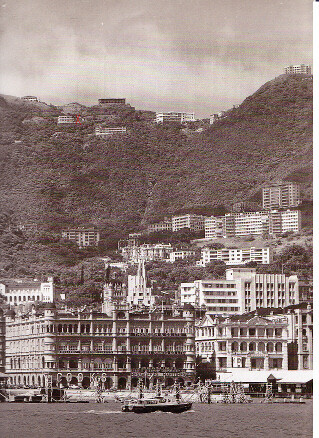
Not only does Gweilo recount the events of a few short years in the life of Martin Booth, it also serves as an enchanting record of a Hong Kong that no longer exists. Seen through the eyes of such a young and privileged child, Hong Kong in the 50s has never looked so idyllic. Perhaps the nostalgia would be greater for those of similar background, but anyone with more than a passing interest in the Far East would find this a remarkable read.
As a memoir of a few years out of a young boy’s life, Gweilo is not only sharply-observed, it is recounted with zest, with a passion for life, with a deep and abiding curiosity that only a spunky, street-wise and adventurous 8-year-old could possess. As a re-telling of a childhood lived to the fullest, Gweilo must rank as one of the most engaging ever told.
Critics have voiced their doubts as to the veracity of what appears to be total recall of day-to-day minutiae from across several decades. The author himself has this to say: “Once I had set out upon the task, the past began to unfold—perhaps it is better to say unravel—before me…..forever repeating itself in the recesses of my mind, like films in wartime cartoon cinemas, showing over and over again as if on an endless loop.”
With the help of a scrapbook and photographic albums compiled by his mother, he had been able to re-create the years of his childhood. If, reaching back through the years, he felt that certain details of, say, conversations, needed to be fleshed out, how could the reader find fault? And if poetic licence is taken here or there to offer a more telling, more dramatic, version of the truth, surely that is within the autobiographer’s rights. After all, how can one look back through the filter of time without gleaning some enlightenment, some perspective?
Written after he was diagnosed with a virulent form of brain tumour, and at the behest of his children who begged him to recount for them his childhood, Gweilo is part of the author’s literary legacy (which includes several novels, non-fiction works as well as children’s books). Sadly, it is also part of his epitaph— he succumbed to the cancer soon after Gweilo was completed.
I often dream of my own childhood in Hong Kong. Lately, I could almost swear that, out of the corner of my dreamsake’s eye, I catch a glimpse of a small, spunky, tow-headed boy sauntering along the alleyways, stopping for a thousand-year egg at a dai-pai-dong, exchanging pleasantries with the stall-holders, sipping a Coke through a straw in the sub-tropical heat. But when I try to stroke his fair head for luck, he’s gone like a will-o’-the-wisp.
This is Martin Booth's last book and undoubtedly is a perfect memoir of one's childhood.Hong Kong of 1950's,(eventhough I know nothing much about the city's streets) just comes alive though I think it would have been better if he had included photographs. The book was a great reading experience. I recommend it to all readers.
How Booth remembers his childhood is so impressive. I can't even remember what I did today to that level of detail.
I am on some nostalgia trip with Hong Kong and this book is part of that now. I was walking around HK island and I saw Hong Kong from his perspective, all the streets and locations he mentioned to such precise detail that it's not hard to visualize what Hong Kong once was.
It was truly a treat to read this book and it also gave me an idea for my photography portfolio so thank you.
A lovey memoir. A prerequisite read before my homecoming. Hong Kong in the 50s from a perspective of an 8 year old British boy. A determined mother and unconditional love. The magic of Hong Kong transforming two lives.