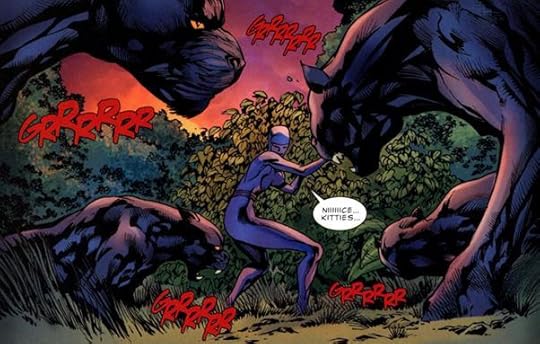
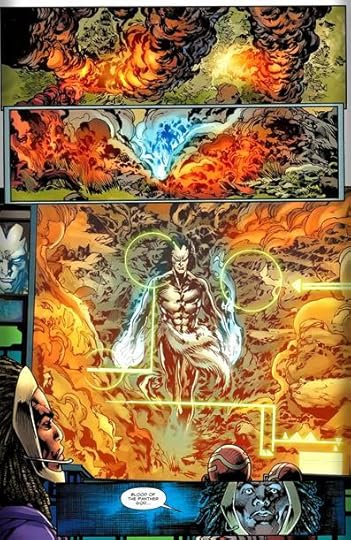
Six issues of the series written by Reginald Hudlin, and illustrated by Ken Lashley, this new volume of ‘The Black Panther’ title has king T’Challa severely wounded after returning from a trip no one was aware of, now, Queen Ororo– X-Men’s Storm–, has to take the leadership of the secret nation of Wakanda while T’Challa recovers, but the mantle of the Black Panther cannot be passed but to one individual, who is no other than Shuri, T’Challa’s sister, and the only one aside from him that has taken the training to become Wakanda’s protector. First, she has to pass the tests required to obtain Black Panther’s powers, and also, the encounter with the Panther Goddess herself, in order to receive her blessing, but time is running out, since after news of T’Challa’s are spread, one of Wakanda’s rivals at the other side of the continent, performs a ritual that brings back to life the villain Morlun who, until now, was known for being a villain exclusive of the Spider-man comics, this time on a quest to consume the African totems of Wakanda, basically attempting to end the royal lineage. In the meantime, T’Challa is found, and fighting for his life, trapped on an astral world that has an African entity, similar to the Death, as the ruler, and the one with the power to either letting him go, or keep him there for all eternity. The story is divided between these two separate arcs, the first one being Shuri trying to obtain the Black Panther powers. The second one having storm trying to rescue his husband from the spiritual limbo. At first, I thought that this title would solely have Shuri as the main protagonist, but I was surprised to realize that T’Challa has an important role in the plot, and in reality, the majority of the weight in the story lays on Storm’s quest to bring his husband back in order to stop Morlun. The events leading to incapacitating T’Challa connects directly to the event, ‘Dark Avengers’, in which Norman Osborne became director of S.H.I.E.L.D., creating a new lineup of the superhero team, which causes Namor, and Doom, to consider joining Osborne, which culminates with a fight between Black Panther, his royal guard– The Dora Milaje–, and Doom.
This was an intense reading, and a surprising one.
I enjoyed Hudlin’s take on this world, and how he approached the characters, specially the three principal ones: Shuri, Ororo, and T’Challa. Even if the story was all about Shuri, I was glad that the plot still focuses on T’Challa, never diminishing his role as the absolute incarnation of the Black Panther, although, Shuri wasn’t a bad replacement. To see her owning the power with specific effort, specially around the clock was generally well-executed. The art was truly engaging, and a great addition for these characters; the overall design of the Wakandians is great, and the familiar faces, such as Doom, Namor, and Morlun they all look terrific, and quite imposing. But I’d say the best part of Lashley’s style was the way he draws women. Both, Shuri, and Ororo look stunning; Shuri truly has a unique style on her own as a female version of the Black Panther, and Ororo definitely owns the appearance of a goddess. Also, I never knew his name, but that Death entity from the astral plane in which T’Challa is trapped was a stunning and intimidating character.
Again, I liked this title. I expected less, but had a pleasant surprise to see how many characters executed the roles of main ones. I always enjoy the stories regarding any members of the X-Men, and to see Storm in a different title, but with a heavy and considerably important role, is always a delight. Even though my favorite romantic interest of hers was Forge during the Fabian Nicieza run of the “Uncanny X-Men”, I admit I did like T’Challa as her ultimate partner; the idea of the Black Panther, and king of Wakanda to marry a mutant that is essentially considered a Goddess in her own nation is quite cool, and it feels right.
My only complain falls for the pacing in which the panels are presented; some events jump randomly to a different staging, and it kind of feels all over the place, and random. Also, I still don’t see why Morlun should be the main villain in this story, considering he does kill plenty of important characters from the Black Panther franchise, but otherwise, the title was intense, and highly entertaining. It treats its characters with respect, and it does expand upon the mythology of this specific character, and his world. I’d recommend this, but only after reading some prior material from this Marvel Comics hero, in order to fully enjoy the title.
Also, plus for having the entirety of its six main covers illustrated by J. Scott Campbell. That always is a good sign on any comic book.