Montague Rhodes James, who used the publication name M.R. James, was a noted English mediaeval scholar & provost of King's College, Cambridge (1905–18) & of Eton College (1918–36). He's best remembered for his ghost stories which are widely regarded as among the finest in English literature. One of James' most important achievements was to redefine the ghost story for the new century by dispensing with many of the formal Gothic trappings of his predecessors, replacing them with more realistic contemporary settings.
Librarian note: There is more than one author in the Goodreads database with this name.
Mr. Williams collects art pieces for his museum in Cambridge. A particular item catches his undivided attention, something very innocent, or very disturbing.
I’ve read a collection of M.R. James and found several hits and misses with him, but this short was absolutely the best by far; so exceptional that whenever I think examples of the best short stories, this one always comes to mind. I don’t think I’ll ever be able to innocently stare at a painting again; and for that, this tiny gem deserves a place of honor in my shelf for shorts. This little masterpiece of mere 12 pages that you can read in a flash is eeriness perfection.
El Sr. Williams colecciona piezas de arte para su museo en Cambridge. Un objeto particular capta completamente su atención, algo muy inocente, o muy perturbador.
Leí una colección de M.R. James y tuve varios aciertos y desaciertos con él, pero este corto fue absolutamente lo mejor por lejos; tan excepcional que cuando pienso en ejemplos de los mejores cuentos cortos, este siempre viene a la mente. No creo que nunca más pueda volver a ver una pintura inocentemente; y por eso, esta pequeña joya merece un lugar de honor en mi estante de cortos. Esta pequeña obra maestra de 12 páginas que se puede leer en un santiamén es perturbadora perfección.
The Mezzotint is a short story by the medievalist scholar and provost of King’s College, Cambridge M.R. James. M.R. James used to write a chilling atmospheric ghost story each Winter. At the end of each year, he would invite a group of colleagues and friends to his rooms at College, sit them around the fire and read his latest story to them. It became quite a tradition, and the stories were collected and published later.
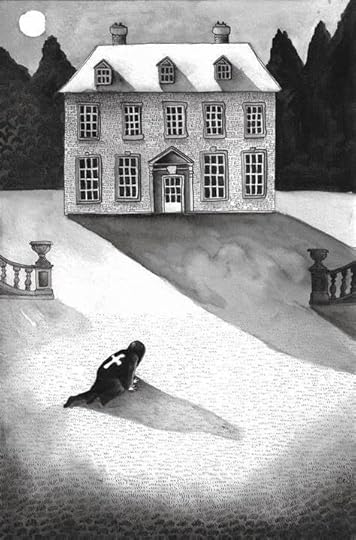
The Mezzotint was first published in 1904, as part of the anthology “Ghost Stories of an Antiquary”. The latest collection to include this story is “Ghostly”, edited and illustrated by Audrey Niffenneger. The line drawing to accompany the story is not very atmospheric, however, and I do not believe it adds anything to the read.
We start with a familiar setting, and a familiar type of main character for M.R. James: Mr. Williams, the curator of a university art collection, who lives in rooms at his college. It is his responsibility to acquire drawings and engravings of buildings and towns for the university library. J.W. Britnell, a London art dealer, sends Williams a catalogue along with a letter. In the letter, Mr. Britnell says that he thinks Williams will be interested in item 978 in the catalogue, adding that he would be happy to send the picture to Williams to examine. However, when he sees it Mr. Williams is not impressed, and thinks it ridiculously overpriced at two guineas. It is an unremarkable early 19th century mezzotint of a large country house, by an unknown artist. Nevertheless he is curious as to why Mr. Britnell has selected this particular picture for him, so he asks for the mezzotint to be sent along.
When the picture arrives, Williams is even less impressed with it. The mezzotint shows an 18th-century manor house with three rows of windows, trees on either side, and a large lawn in front of the house. It is clearly the work of an amateur artist. It is signed “A.W.F.” and on the back are the remains of a paper label, on which are written “-ngley Hall” and “-ssex”. Deducing that the house must be in either Essex or Sussex, Williams sets about looking up where this might be, although he finds that there are a great many large houses in those counties with names that end in “-ngley Hall”.
Later that afternoon, when it is beginning to get dark, Williams is visited by one of his colleagues, Professor Brink. Professor Brink is curious about the mezzotint, so Williams tells him all he knows. He complains that there are not even any figures in it. Professor Brink agrees that the mezzotint is not worth two guineas but he thinks that it is not a bad picture.
There is a further change, and the three academics spend most of the night trying to find out which house is depicted in the picture. From a guidebook to Essex, Williams finds out that it is Anningley Hall. Anningley Hall had been owned by the Francis family, no members of whom now survive. The last surviving member of the family, Arthur Francis, a talented amateur engraver in mezzotints, died in 1805,
But the mezzotint suggested another horrifyingly gruesome possibility, from beyond the grave.
The Mezzotint is a typical understated but very unnerving ghost story by M.R. James. As usual, the protagonist Mr. Williams, and the plot reflects the author's own antiquarian interests. We see a solitary scholar, living in a university which is heavily implied to be Oxford. We read of an ancient paper with an unexplained history, see the Fellows’ academic curiosity, and how Mr. Williams sets himself to decipher the mysterious puzzle, despite the inexplicable supernatural element. The Mezzotint has an undercurrent of malevolence, and the story conjures up a feeling of menace, which is very effective.
The Mezzotint is one of M.R. James’s most popular stories, and has been dramatised for television and radio several times. The first adaptation in 1954 is sadly lost, but others are from 1969, 1978, 1980, 1986, and 2018. The most recent one was an adaptation by Mark Gatiss, which was broadcast on Christmas Eve 2021.
I remember the fear and excitement I felt when I first read “The Mezzotint” more than fifty years ago. And I still experienced a thrill (though more subdued, I admit) when I re-read it—for the fifth or sixth time—earlier this month.
This tale—about how a criminal act is revealed in stages by successive viewings of an old print of a 17th century English manor house (the mezzotint of the title)—is a triumph of effective narration and judicious description. The way James manipulates his reader, moving him from casual interest to absorption and then to horror, shows his masterful command of the form. Equally interesting, though, is what comes after the horror: the antiquarian search of the facts that lie behind the crime recorded on the mezzotint.
This time I was struck by the humor of the story, something I missed completely the first time around. The narrator makes it clear that the “scholarly” university types who inhabit this tale have only one topic of conversation: golf.
Here’s a little taste of the delights that await you:
The picture lay face upwards on the table where the last man who looked at it had put it, and it caught his eye as he turned the lamp down. What he saw made him very nearly drop the candle on the floor, and he declares now if he had been left in the dark at that moment he would have had a fit. But, as that did not happen, he was able to put down the light on the table and take a good look at the picture. It was indubitable — rankly impossible, no doubt, but absolutely certain. In the middle of the lawn in front of the unknown house there was a figure where no figure had been at five o’clock that afternoon. It was crawling on all fours towards the house, and it was muffled in a strange black garment with a white cross on the back. . .
A short story about a mezzotint print that is more than meets the eye at first glance. I loved this because print making was one of my favorite things in college. I turned out to be good at it and kept at it over four years and would still do it today with access to a press, etc. If I ever saw what happened in this story happen in one of my prints, I’d exit the situation. The type of exposure to light and acid vs ink makes me wonder though... read it. Especially if you have done printmaking. Actually if I think about multiple exposures ... deeper etchings and light ...
A print curator comes across an 'interesting' picture on offer. At first it seems to be an unremarkable, amateur work - but something about it is strange: it seems to be slightly different each time it's viewed. The image may hold the clue to a terrible crime... Classically old-fashioned - and wonderfully spooky! (a re-read)
A wonderfully creepy short story written over a 100 years ago. When a man obtains what he thinks is a rather dull picture he soon discovers that it is something quite sinister.
A print curator gets a deal on a mezzotint, the dealer says it's worth two guineas, when the curator takes it for inspection, strange things happen, seems the paint is giving them clues of a tragedy that happened long ago. The material was good but no spooky mood
If I were editing a collection of the one hundred greatest ghost stories of all time, The Mezzotint would be in it. The same if it was a collection of the ten greatest ghost stories. Ditto if it collected just the five best. You get the idea. The Mezzotint is an ideal example of everything that a ghost story should be. It does it with style and leaves lingering chills.
The story has a simple plot. The curator of a university art museum receives a mezzotint from an art dealer. Initially, he feels that its price was too high, for though it is skillfully done, it depicts a nondescript nighttime scene of a house without even any figure. But as he and colleagues continue to observe it, the curator reconsiders its uniqueness and value. Impossibly, its scene changes as night falls. It depicts a moonrise where once there was no moon. Then a partially concealed figure appears at the very edge of the print. The next night the figure can be seen crouched and menacingly crawling toward the house in full view. The mezzotint does not change by day, but each night a new change depicts a sinister scenario playing out. Now the figure is gone, but a house window, originally closed stands open. Just describing the eerie and unexplainable process happening on the print creates a menacing sense of dread and doom.
The tale’s ending is seeming anti-climax. It reveals discovered history of the mezzotint’s artisan and his personal tragedy, and the eventual fate of the work — hanging in a gallery and never again displaying the changes that played out the chilling drama the curator observed over several nights. Yet even this just serves to center the uncanny and disturbing events played out within the mezzotint’s frame, and leaves the reader with tingling, long lasting, and long remembered fear-flesh.
My M.R. James ghost story readings continue, this time with one of his most famous tales. A picture may tell more than what one initially sees. I shall be paying more attention when I visit art galleries again.
Catalogue item #978 is the designation given to a nondescript mezzotint held by a London art dealer. He has offered it to a university library, although once received, the library curator doesn't think much of it. But this is M.R. James so you know something is GOING TO HAPPEN.
That something is a change in the artwork itself. When he first looks at it, the librarian only sees a manor house. But after some invited guests look at it, a figure is now showing in the picture. As the librarian and his friends spend more time with the picture, the mysterious figure eventually gets closer to the engraved house, bit by bit, step by step. Is it really happening or is it a figment of everyone's imagination? The librarian and his group decide to do a little research to discover what is really happening with the mysterious artwork.
This is a fairly quick read, even shorter than other short stories. M.R. James usually fills me with dread, as there is always a sense of foreboding or otherness which creeps me out enough to keep the lights on after midnight. While this story is well-written (of course), I didn't have that same uncomfortable-ness, perhaps because I anticipated the ending. Or maybe it's because I remember an old TV series called THE NIGHT GALLERY, where there was an episode based upon this tale, and that has stayed with me for a long time. Still, a good read and yes, I have ghoul-proof shutters on my windows.
How does he do it? How does Mr. James write such fantastic tales of terror? This story starts so benignly, I had this false sense of security. I was fooled but good. The conversational tone, and the dry, academic characters had me wondering where this story was going. Soon, I came to realize exactly what was going on. Our narrator collects pictures of homes. He gets a lead on a mezzotint (a metal engraving with a great deal of distinction between shades of light and dark) that he considers rather substandard for the two guineas the dealer is asking for. Only this is a special picture. It changes, you see. As the narrator becomes aware that this photo has some unlikely qualities, the unease builds. The narrator asks others to look at the picture, and they see something changing as well. What is one to think of this mezzotint?
It’s amazing that this story can be so eerie and disarming, even without knowing exactly what the nature of the mezzotint’s ability is. Is this a ghost story? Dark fantasy? What’s the nature of the figure in the picture? Mr. James doesn’t reveal that. It doesn’t matter. The story has served its purpose. The mood, setting, and plot deliver one heck of a read.
এই থিম নিয়ে আরো গল্প লেখা হয়েছে এরপর, ভবিষ্যতেও হবে। কিন্তু এই জিনিস? ভূতের নয়, বরং অশুভের গল্প এটি, যেমনটি আর কখনও লেখা হয়নি, হবেও না। যদি না পড়ে থাকেন, তাহলে সত্বর ত্রুটি সংশোধন করুন। তবে হ্যাঁ, পুরোনো পেইন্টিং বা কাঠখোদাই জাতীয় কিছুর কাছে যাবেন না এরপর বেশ কিছুদিন। তাতে কিছু খুঁজে পেয়ে আপনি যদি আর্তনাদ করে ওঠেন, গৃহস্বামিনী কী ভাববেন বলুন তো?
A short but creepy tale of a man who collects art for a museum and stumbles across a painting of a manor house. At first, he doesn't see the worth of such a piece but after showing it to a friend, he notices the painting has changed. After a fitful nights sleep, he asks another friend only to find that the painting has again changed and is becoming more gruesome.
Although there is no death, per se, in this story, it does have the creepy factor that it's not something you want to have in your home or near your family. There is a sense of atmosphere and dread, if not from the environment, from the anxiety of the reader. James was a captivating writer.
Wow, so many modern horror films echo The Mezzotint. The first example that came into my head as of recent recollection was The Conjuring 2, featuring that awfully creepy painting that Ed Warren paints of the Nun (Valek). I'm sure there are many other modern texts (movies, shows, books...) that echo The Mezzotint. Any recommendations would be amazing! As a painter myself, the concept is very out of this world.
A mysterious print reveals a tragic tale of rural revenge. MR James' short story read by Robin Bailey. Found out that I've read this before but it really is rather good.
This entire review has been hidden because of spoilers.
Maybe even the best story of this author that I have read. I am not sure because I can not remember exactly all the stories that I have read. The narrator is autodiagetic (meaning he is the protagonist of the novella). The language is vivid, nocturnal, strong and so atmospheric that you have a sense that you also are part of the novella. The content itself has a vibe from the romantistic period, a mezzotint that has a live character on it who changes his position on it, it reminds me of tales written by E.T. Hoffmann, especially the one in which a human fels in love with an automata, I am not sure if that story is named "Der Sandmann" or is it another story. Yes, the first "robot story" was written in romanticism at the very beginning of the nineteen century. "The Mezzotint" should have been a Universal horror movie in the 1930s, imagine Bela Lugosi and Boris Karloff in a story like this... A wonderful fantastic piece of work. I sincerely recommend this one. ¡Hasta luego!
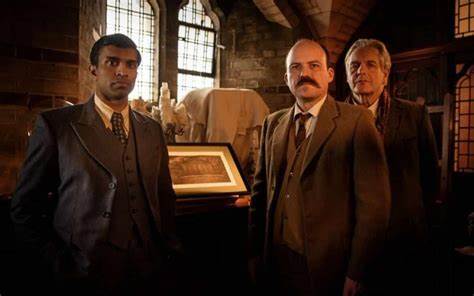
I recently saw the TV adaptation with Rory Kinnear playing Williams on the BBC's series A Ghost Story for Christmas and sought out the source text - to find the adaptation really was just that, with characters that didn't appear in the original and a completely different ending.
The source material manages to be compact, spooky and humorous all at once. Putting it simply, Williams, a museum curator, becomes in possession of a mezzotint that has a story to tell. Quite how he was 'meant' to get hold of it isn't clear; were there supernatural forces at work? This is supposed in the TV adaptation whilst the original holds no such link.
Through watching the changes in the print over the course of a few days, a disturbing story is revealed, but never fully explained. But spooky for all that.
The Mezzotint is a short story by M. R. James of an unusual engraving depicting a view of a manor-house. The story centers around the very disturbing engraving changing each time Mr. Williams, the curator of a university art museum and his colleagues he enlists look at it.
In the end, it is suggested that the changing engraving depicts a poacher called Gawdy who is hung by the squire a Mr. Arthur Francis for killing the gamekeeper of his estate. A vengeful Gawdy returns from the grave to kidnap and murder the infant heir of the squire, effectively ending his familial line. Quite a hauntingly disturbing story for its time.
Audio version, narrated by Derek Jacobi, who is always great. What a terrific uncanny story about a mezzotint. An atmospheric weird tale that must have been quite spectacularly creepy when it first came out. James' writing sucks the reader right into the Cambridge rooms of a Mr. Williams who is looking to enhance the university's art collection of topological pictures. It's not uncommon for James' characters to like to play golf. But what was surprisingly refreshing in this story was the humor at golfing's expense. I don't think I've ever laughed at something in one of his stories before. A really nicely told eerie story that holds one's interest.
I guess the last time I read this, it was in a collection. It's one of James's better stories, with a nice plot progression and satisfyingly dreadful resolution (his endings often make no sense to me, but this one really works).
The titular mezzotint seems unremarkable at first: a drawing of a manor house. But as people look at it, it has always changed just a bit from how it appeared before. A story unfolds in the image, filled in with researched details later. Of course, there's a twist...
Amazon has a live-action version of this up at the moment, and it is quite, quite well done.
Both it and the original story are highly recommended.
A short story that is simple, but does a nice job evoking a dark mood. It lulls you in with its mundane descriptions early on, but then things get going and you find yourself haunted as you experience the unexpected shifts alongside the protagonist.
The narration is a little bloated, wordy at the beginning as it tries to set the tone. But a chilling story that is enjoyable, and well worth the few minutes it takes to experience.