As the Duchy of Burgundy has not survived as such, it is easy to forget what a formidable political unit it was. It lasted for about 400 years, but its glorious phase, the one usually identified as the Duchy of Burgundy proper, lasted over a century. And yet, had things turned out somewhat differently, it could have become the country that France became.
Joseph Calmette (1873-1951) was an outstanding French scholar who published his work during the first half of the 20Century. His research began with his thesis on the French King Louis XI (1423-1483), and the relations with the Kingdom of Aragón, but his scholarship grew quickly and richly to cover other European regions during the 14 & 15 Centuries. Unfortunately, most of his works are now out of print, except for this one from 1956, which can be purchased on Kindle. I got my copy second hand, cheaply.
And a great investment it has been. This book has provided me with a very clear introductory overview of the history and significance of this grand Duchy. What I was looking for.
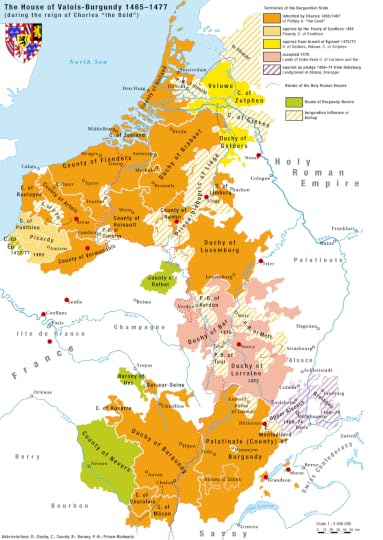
The Duchy was composed of a complex geography difficult to map mentally, not only because it had more the structure of a set of crossroads than the shape of an extended land, but also because its borders moved continually during the glorious 120 years. Those territories are now dismembered and annexed by various modern countries. Two current kingdoms of somewhat late creation, Belgium and the Netherlands, were just parts of it. Indeed, Calmette identifies its diversity and mosaic-like quality as one of the strengths of Burgundy. If it ceased to exist as such it was by a series of events, which he qualifies as errors, and not by any inherent instability in its composition.
Calmette starts with a couple of introductory chapters tracing how a medieval kingdom evolved into a Duchy. During the early Middle Ages Burgundy was a kingdom, and a considerable one since then it had a port in the Mediterranean (Marseilles) but it was incorporated into the Frank and then the Carolingian world. The kingdom was demoted to it Duchy status during the Capetians in the later Middle Ages and was constituted by three major areas (Arles or lower Burgundy, the Duchy or Burgundy proper, and Franche-Comté or upper Burgundy). During the 14C both the Kingdom of France and the Duchy came to a sort of dead-end in their dynasties. In 1328 the Valois succeeded the Capetians in the Crown , and a few decades later the Duchy also finished its line. As the result of complex knot of marriages and mixed lineages, the Duchy also passed to the Valois, but to the youngest brother of the then King of France, Charles V.
And so the family saga of the Four Grand Dukes begins and it is to them that Calmette devotes his study.
At the end of the read, soaked with information, it seemed to me that there was a couple of patterns in Calmette’s evaluation of these four Dukes. One was the way the relationship of the Duchy to the French crown evolved: from being friends, to being rivals, to befriending again, to becoming enemies and finally to the one eliminating the other. The other is that Calmette showed more empathy to the Odd Number Dukes, who both also happened to be the two Philips (the Bold and the Good).
Philip the Bold / Jean le Hardi (1342-1404; Duke from 1360). He begins the line when his father King John II, the Good/le Bon, gives him the Duchy. The most pivotal event in his life was marrying Marguerite of Flanders, whereby the incorporated the wealthy lands of his wife to his Burgundy. That was a majorcoup de force or coup de marriage. Philip was a good politician, a brave soldier, and an outstanding patron of the arts and literature. He earned with ease his epithet The Bold/le Hardi: he fought alongside his father the King in the Poitiers battle in 1356 during the earliest phase of the Hundred Years war. They were both captured and taken prisoners to London, where they stayed four years. When his father died, his eldest brother became King of France. He was Charles V the Wise/le Sage. Philip outlived his brother the King and became one of the Regents over his successor, Charles VI.
During this phase of the Hundred Years war then, Burgundy was on the side of its related France.
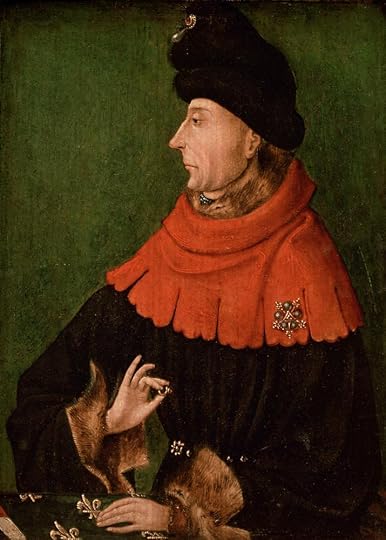
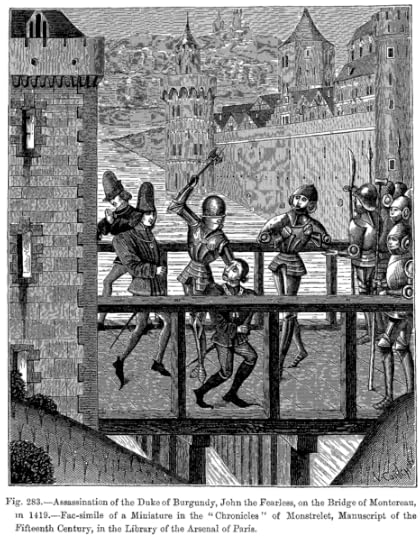
When Philip died he was succeeded in the Duchy by his son John the Fearless /Jean sans Peur (1371-1419; Duke from 1405). As a Duke of the Even Number, he was a troublesome figure. At first he continued the close relationship with France arranging the double betrothal of his daughter to the heir to the French crown and of his son to the sister of the future King. But as the King began to lose his senses and his brother Louis of Orléans began to call the shots, Jean the Fearless entered into an impossible rivalry with the King’s brother, and his own first cousin, bringing about a full civil war between the bands supporting the two sides (the Burgundians versus the Armagnacs). It became so impossible that Jean, paying honour to his sobriquet, the Fearless, just had to murder Louis in 1407. And as blood calls for more blood, this murder brought his own assassination twelve years later by his enemies and to the satisfaction of the future French King, Charles VII.
A fierce rift opened between the Duchy and the Kingdom.
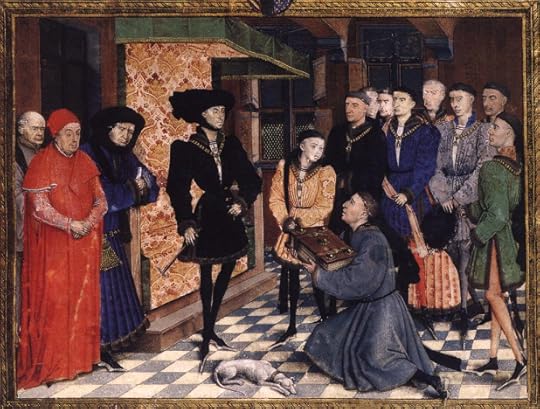
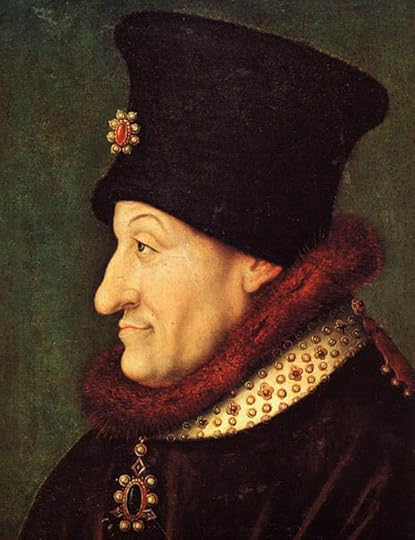
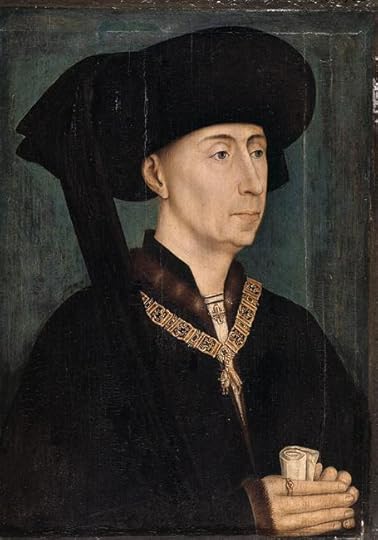
John was succeeded by his son: Philip the Good / Philippe le Bon (1396-1467; Duke from 1419). As an Odd Number, he was a good king. May be not just good, he was the Best. Certainly he is Calmette’s favourite, even if it was Philip the Good who changed the allegiance of Burgundy and sided with the English in what became the second phase of the Hundred Years War. Calmette’s love for his own country can be felt in his study, but he acknowledges the historical significance of Philip the Good’s decision when after the death of his father, he openly supported the plan of giving the French crown to the English King Henry V. It was during these troubled times that Joan of Arc stood up in her messianic and military stance. But even if it was the Duke who captured her and delivered her to the English, he soon changed his mind and switched sides. In signing the treaty of Arras of 1435, he reconciled himself with the French crown, and helped in recovering Paris, occupied by the English. And so Calmette reconciled himself with the Duke too.
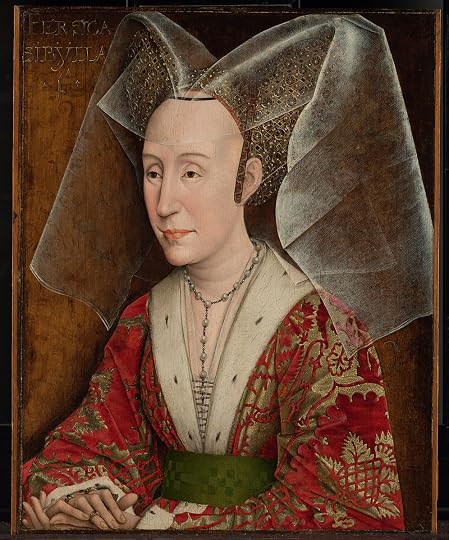
Philip the Good married three times but his first two wives died young without giving him an heir and it was with Isabel de Portugal, who also descended from the House of Lancaster (which contributed to his closeness with the English), that he finally begot a heir. Isabel’s portrait by the school of Roger van der Weyden, normally at the Getty, visited Madrid in an exhibition at the Prado recently.
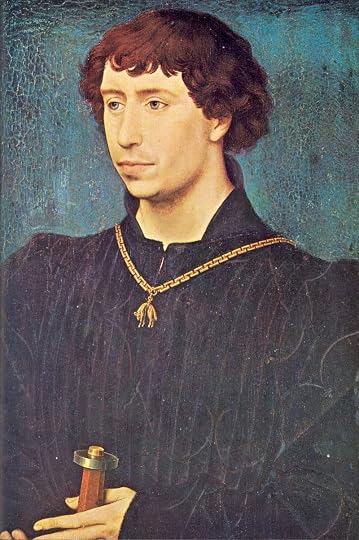
Charles the Bold /Charles le Téméraire (1433-1477; Duke from 1467) succeeded his father and his life seems somewhat of a parallel to that of his grandfather, Jean the Fearless--the other Even Number Duke. His life and politics were also marked by a rivalry with the French crown, but the cleavage had becoming wider, since this time the conflict was not with the King’s brother, but with the King himself, Louis XI, known as ‘the Universal Spider/Universelle Aragne’ (!! – and on which Calmette began his expertise). Calmette blames Charles’ impetuosity and impatience for the disaster that came rather suddenly to a Burgundy that had reached its apogee during the 1470s. For even if it was with him that the Duchy occupied its greatest territory, at the expense of France, eventually the Spider managed to cast his web around the Duke and defeated and slaughtered him at the battle of Nancy in 1477.
At his death Charles left a daughter, Marie de Bourgogne, who became the bride that everyone in Europe wanted to marry. After a plethora of suitors, she finally married Maximilian, the son of the Emperor Frederick III, and the Duchy itself lost its separate sovereign status.
But that is another story.
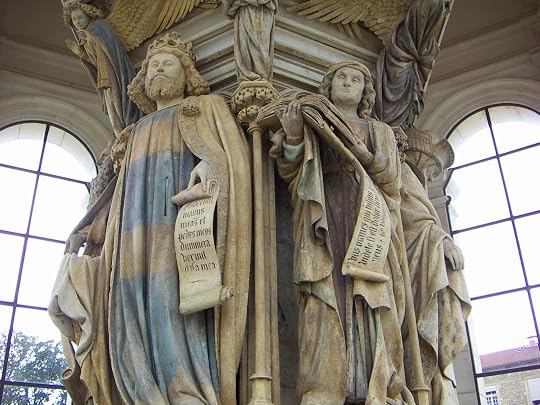
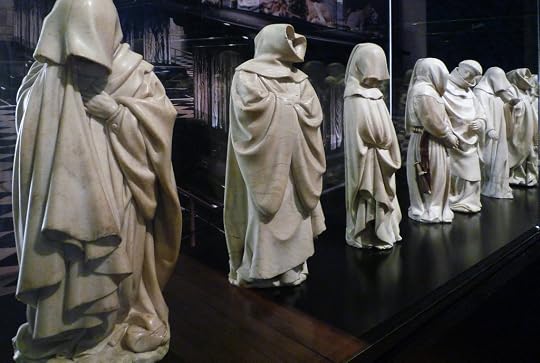
The Burgundian court has also gone down in history for their outstanding court life, of sublime splendour and for their patronage of the arts and literature. As said above, the first Duke began this interest but his descendants maintained the activity. Calmette devotes a long chapter to this, but given the more political focus of his book it remains introductory. Nonetheless, he is clearly fascinated by the sculpture by Claus Sluter from Haarlem, and the extraordinary tombs that the Dukes commissioned.
Sluter's The Well of Moses
And the 'Weepers/Pleurants'" from the Tomb of John the Fearless.
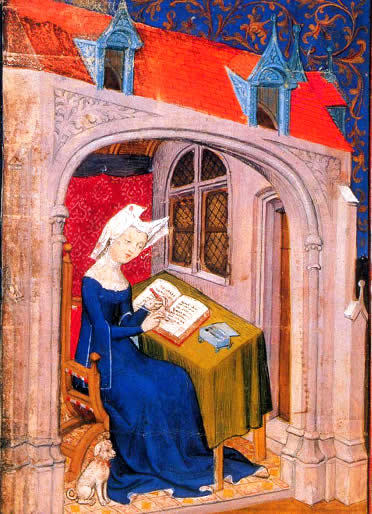
Flanders provided many of their artists, with Van Eyck and Van der Weyden shining brightly, as well as the extraordinary and unrivalled production of tapestries. I wish Calmette had devoted more attention to this often forgotten but supreme art. Finally, it was in the courts of the First and Second Dukes that Christine of Pizan wrote several of her works.
At the end Calmette offers a fascinating chapter with a broad evaluation of the geopolitical significance of the Duchy, which almost became a Kingdom, and which could have evolved further as a great country in the detriment of France. For if it was the last Duke who almost got the Emperor to elevate the Duchy into a Kingdom, and it had been Philip the Good who played a highly sophisticated and cosmopolitan role in the European politics, pushing for a campaign against the Turks following their conquest of Constantinople in 1453, but also getting involved in the emerging complications between the various Italian domains, as well as with the Aragonese and Castilian intrigues.
When Calmette contemplates how history could have turned otherwise he insists on the inexistence of historical determinism. Instead, character is of all importance to him. And he just see that it was the series of unfortunate errors incurred by the last Duke that offered the direct entrance to posterity of France, even if Burgundy entered through a backdoor in the Empire which commanded large tracts of Europe the following century.
Now I just have to plan a trip to Dijon and its alentours.
The 14th and 15th centuries saw the dramatic rise and fall of a major political power in Europe: that of the varied lands of the great Burgundian Dukes. Thus, the history of these four scions of the Valois dynasty—Philip the Bold, John the Fearless, Philip the Good, and Charles the Bold (or the Rash)—not only makes for an interesting story in and of itself but is also quite significant in terms of the wider development of Late Medieval Europe. As I have continued to read more about this time period, I have wanted to learn more about the dukes and their curious patchwork of territories that have no modern equivalent. Discovering a copy of The Golden Age of Burgundy by Joseph Calmette at my local library then, was quite a pleasant surprise.
The Golden Age of Burgundy is first and foremost a political history of the realm of the four dukes. After a brief introductory chapter summarizing Burgundy’s history, the narrative begins in earnest with the succession crisis in Burgundy in the mid 14th century. With the sudden death of the young, heirless duke in 1361, the question of who would become the next duke was a not insignificant one in the midst of the Hundred Years War. As it happened, it went to the King of France, John II, and upon his death, the dukedom went to his youngest son, Philip. From this point onwards, the narrative closely follows the careers of the dukes in a chronological fashion until it reaches the last duke. There, the author interrupts the narrative to include a few chapters addressing art, culture, and government. With these general observations dealt with beforehand, he is able to fluidly close the book with the disastrous end to Charles the Bold’s reign and a brief but poignant conclusion. The text is supplemented by a large number of genealogical tables, which were of great help to this reader. There are also over fifty pages of end notes. Clearly, this is a well-researched book by an expert author on this subject.
If what I’ve written in the previous paragraph makes the book sound dry and dull, then I have done it a disservice. The narrative has a lively and authoritative voice which makes the enjoyable to read—typical, I have found, in older history books. The translator, Doreen Weightman, is also responsible for the book’s engaging nature and I must give her credit for this in addition to the author himself. Because of the active narrative voice and tone, I initially thought that this book would be a little partisan in its treatment of the dukes. However, these worries were dissipated not long after. Joseph Calmette remains impartial throughout the book, willing to praise and criticize in equal measure. The one area in which he tends to lapse into uninhibited admiration is in his treatment of Burgundian art; for which I can forgive him as there were many magnificent pieces of art made in both Burgundy proper and its wider lands.
One of the main flaws in this book is the lack of good maps. There is one, but it is rather cluttered and in itself, insufficient to cover the growth of such a geographically varied dominion as Burgundy was. I flatter myself that I have a solid understanding of western European political geography. Even so, I struggled at times in trying to place all the locations that are mentioned in the text.
There are also a number of odd errors or misprints. For example, there are incorrect dates throughout the book: Prince Lionel’s date of death in the genealogical tables on the end boards, the marriage date of 1490 on page 112, and the date of 1477 on the first page of the conclusion. There was also the anachronistic use of the word British part way through the chapter on John the Fearless, when the rest of the book uses English, as is proper. Finally, there were some puzzling errors in the genealogical tables. For instance, on page 83, King Charles VI of France is said to be the son of the Duke of Anjou, not Charles V.
I enjoyed reading The Golden Age of Burgundy and I learned a lot from it. More importantly, this book filled in a gap in my understanding of Late Medieval Europe. I have tried to limit my usage of the phrase “the four dukes” or variations thereof in this review to avoid being repetitive. Yet, they were so closely linked with the fortunes of their state and its extraordinary rise and fall, that there is a reason they are referred to as the magnificent dukes in the subtitle. They were great men—in the sense that they changed history (definitely not in the sense of them being men to aspire to). Over the course of a century, they created for themselves one of the most powerful political entities in Europe. As Calmette writes in the conclusion, “the successive mistakes committed by Charles the Bold were not historically inevitable” (288). When reading through this book, there were many instances where I could not help but pause reading and wonder, “how would the world be different now, if such and such had happened differently.” Of course, this sort of thinking is a slippery slope. But, there were several occasions where Burgundy was poised to take a leading role in European affairs, at the great expense of France.
As it happened, Charles the Bold’s rashness led to his own demise and history turned out as we know it: his daughter became married to the future Emperor Maximilian, thus leading to the centuries-long rivalry between the Kings of France and the Habsburg dynasty. For a dynasty which ruled over a varied mixture of peoples and principalities—often acquired through opportunistic marriage—it is challenging to imagine a more ironic end to the great Burgundian state than being annexed by the Habsburgs.
A very decent history of Burgundy prior to and during the time of the Valois Dukes, Calmette's book succeeds in placing the achievements and failures of those dukes in the historical context of the kingdoms around them. He plots the course that each of the dukes took and is not afraid to point out their mistakes, particularly the last Duke. Charles the Rash certainly made enough mistakes and the picture that Calmette paints of the unravelling of the Burgundian state is quite vivid. Yet, he points out that this outcome was not inevitable and that, with wiser and more strategic vision the last Duke might well have survived and began creating a nation rather than ruling a collection of states bound together by little more than sharing the same sovereign. The author is a little less successful when addressing the cultural and sociological aspects of Burgundy. While the court is described and the noted writers of the era noted the Burgundian School of composers passes without mention. Yet Busnois, Binchois, de la Rue and Dufay are figures of great importance in the evolution of Renaissance music. Still, all-in-all, this is a solid book and, unlike many, illustrates the continuity of the Burgundian state from the old Burgundian kings of the 6th century through the Hapsburgs.
The duchy of Burgundy in the 14th and 15th centuries was remarkable — and very fortunate — in having a dynasty of four Valois dukes, one after another, who were superior to most of their peers in intelligence, charisma, political perspicacity, and sheer magnificence. Philip "the Bold" was shrewd and a patron of the arts, John "the Fearless" was almost too ambitious for his own good, Philip "the Good" almost took the throne of France, and Charles "the Rash" went toe-to-toe with Louis XI, the first modern ruler in terms of cold-blooded nationalism. Calmette was a leading authority on this period and here he spends some time specifically on the evolution of Burgundy from a weak kingdom to a more powerful duchy and on the problems of dynastic succession. This is arguably the best general study of ducal Burgundy available in English. Be aware, though, that several egregious errors were made in drawing the genealogical charts.
L'histoire de la Bourgogne des Valois est indispensable à connaître lorsqu'on s'intéresse à l'histoire de l'Europe médiévale, et ce livre en est un compte-rendu excellent. Un essai historique qui se lit comme un roman, tellement les personnages sur lesquels il est centré sont captivants. Les quatre grands ducs de Bourgogne étaient des acteurs centraux dans l'Europe du XIV-XV siècles et égalaient, voire surpassaient, leurs voisins royaux. Leur règnes étaient une quête de la puissance, de la "nouvelle Lotharingie". Lorsque, avec le dernier des ducs Valois, meurt la possibilité de cet avènement, on ne peut pas s'empêcher de ressentir une tristesse, comme face au dénouement d'une tragédie, et un désespoir face aux derniers choix de Charles le Téméraire entraîné dans l'aveuglément de colère vengeresse.
Joseph Calmette has written a detailed and informative one volume history of the Duchy of Burgundy, mainly focused on the four great Valois dukes - Philip the Bold, John the Fearless, Philip the Good and Charles the Bold.
Calmette follows the history of the dukes, but also provides useful informative chapters on the art of the period, the life of the ducal court and the structure of the Burgundian state.
As he says, the state of Burgundy “... appeared like a blinding flash across the horizon of history...” and this book is essential reading for anyone with an interest in Medieval European history, as it explores the significant role played by Burgundy and its Dukes in the period from 1364-1477.
Acheté au château de Germolles près de Chalon sur Saône sur les conseils du guide à l'enthousiasme très communicatif. Un livre très complet sur le règne des 4 grands ducs de Bourgogne ainsi que sur le contexte géopolitique de l'époque, j'ai appris plein de choses ! J'ai notamment découvert l'ampleur des tractations, des alliances et des trahisons entre puissants de l'époque en Europe occidentale, je ne me rendais pas compte à quel point les jeux d'influence évoluaient rapidement et pesaient sur le devenir des différents territoires. Ça m'a donné envie d'en savoir plus sur cette période médiévale, et ça tombe bien, j'ai acheté un autre livre ce jour-là !