The Jolly Corner was first published in 1908 in The English Review. Henry James describes the adventures of Spencer Brydon as he explores the empty New York house where he grew up. He encounters a "sensation more complex than had ever before found itself consistent with sanity." The Jolly Corner is the nickname he gave to his childhood home. Brydon begins to believe that his alter ego-the ghost of the man he might have been is haunting the house. The theme of unlived lives runs throughout the story.
Excerpt: "Every one asks me what I 'think' of everything," said Spencer Brydon; "and I make answer as I can-begging or dodging the question, putting them off with any nonsense. It wouldn't matter to any of them really," he went on, "for, even were it possible to meet in that stand-and-deliver way so silly a demand on so big a subject, my 'thoughts' would still be almost altogether about something that concerns only myself." He was talking to Miss Staverton, with whom for a couple of months now he had availed himself of every possible occasion to talk; this disposition and this resource, this comfort and support, as the situation in fact presented itself, having promptly enough taken the first place in the considerable array of rather unattenuated surprises attending his so strangely belated return to America.
Henry James was an American-British author. He is regarded as a key transitional figure between literary realism and literary modernism, and is considered by many to be among the greatest novelists in the English language. He was the son of Henry James Sr. and the brother of philosopher and psychologist William James and diarist Alice James. He is best known for his novels dealing with the social and marital interplay between émigré Americans, the English, and continental Europeans, such as The Portrait of a Lady. His later works, such as The Ambassadors, The Wings of the Dove and The Golden Bowl were increasingly experimental. In describing the internal states of mind and social dynamics of his characters, James often wrote in a style in which ambiguous or contradictory motives and impressions were overlaid or juxtaposed in the discussion of a character's psyche. For their unique ambiguity, as well as for other aspects of their composition, his late works have been compared to Impressionist painting. His novella The Turn of the Screw has garnered a reputation as the most analysed and ambiguous ghost story in the English language and remains his most widely adapted work in other media. He wrote other highly regarded ghost stories, such as "The Jolly Corner". James published articles and books of criticism, travel, biography, autobiography, and plays. Born in the United States, James largely relocated to Europe as a young man, and eventually settled in England, becoming a British citizen in 1915, a year before his death. James was nominated for the Nobel Prize in Literature in 1911, 1912, and 1916. Jorge Luis Borges said "I have visited some literatures of East and West; I have compiled an encyclopedic compendium of fantastic literature; I have translated Kafka, Melville, and Bloy; I know of no stranger work than that of Henry James."
After 30 years abroad, Spencer Brydon returns to his "Jolly" corner in NY. Yet it's not so jolly anymore, and it may or may not be haunted. Spoiler Alert:
Man, this was as dull as a concrete ball!
Even reading after a full night's sleep I had a real tough time trying to stay awake and focused, I lost track of how many times I actually dozed off. Literally almost nothing happens, not even skimming like crazy. A lot of descriptions, a lot of suppositions, and infinity of ifs and maybes.
Dear old Henry, James, seems, the kind of author that, says a lot, without saying, anything, in a boring, and unnecessarily convoluted, and, longwinded, kind of way; I may have counted, as much as 10-20 commas, per sentence, sometimes, none of which, were relevant; you get the idea, right?
I was really looking forward to reading 'The Turn of the Screw' one of these days, but now not so much. Meh. Still plan to. I never learn; and expectations certainly can't be lower.
----------------------------------------------- PERSONAL NOTE: [1908] [48p] [Horror] [Highly Not Recommendable] -----------------------------------------------
Después de 30 años en el extranjero, Spencer Brydon regresa a su rincón "Feliz" en NY. Aunque ahora ya no es tan feliz, y puede que esté o no embrujado. Alerta de spoiler:
Hombre, esto fue tan aburrido como una bola de cemento!
Incluso leyendo después de una noche completa de sueño me costó muchísimo trabajo tratar de mantenerme despierto y enfocado, perdí la cuenta de cuántas veces dormité. Literalmente no pasa casi nada, ni siquiera salteando como loco. Muchas descripciones, muchas suposiciones e infinidades de si y tal vez.
El querido, y viejo, Henry, James, parece ser el tipo de autor que, dice mucho, sin decir nada, de una manera aburrida, e innecesariamente enrevesada, y alargada; es posible, que haya contado, entre 10 y 20 comas, por oración, a veces ninguna, de ellas, relevante; se entiende la idea, ¿no?
Tenía muchas ganas de leer 'La Vuelta de Tuerca' algún día de estos, pero ahora no tanto. Igual todavía pienso hacerlo. Nunca aprendo; y las expectativas ciertamente no pueden estar más bajas.
----------------------------------------------- NOTA PERSONAL: [1908] [48p] [Horror] [Altamente No Recomendable] -----------------------------------------------
Μια υπέροχη γωνιά, ένα σκοτεινό διήγημα, ένα λογοτεχνικό κομψοτέχνημα. Ο Χένρι Τζέημς μεγαλουργεί και μεις απλά κοιτάζουμε με δέος και θαυμασμό. Ένα τόσο μικρό διήγημα που όμως εμπεριέχει όλα τα "συστατικά" ενός αριστουργήματος. Ο Σπένσερ Μπράιντον στα πενήντα έξη του χρόνια επιστρέφει στο πατρικό του σπίτι μετά από σχεδόν 30 χρόνια απουσία και καλοπέρασης στην Ευρώπη. Τα φαντάσματα του παρελθόντος όμως βρίσκονται εκεί για να στοιχειώσουν το είναι του αλλά και να τον οδηγήσουν σε μια εκ βαθέων εξομολόγηση... Με σχεδόν μαγικό τρόπο ο Τζέημς φτιάχνει δυο κόσμους και τοποθετεί τον ήρωα του στο ενδιάμεσο αυτών. Ένα σκοτεινό, αθέατο και τρομακτικό και έναν άλλο φωτεινό και αισιόδοξο. Θέλει λοιπόν, αναγνωστική τόλμη από πλευρά μας για να ακολουθήσουμε τον κο. Μπράιντον σε αυτό το τρομακτικό του ταξίδι χωρίς (;;;) γυρισμό. Το μεταφυσικό στοιχείο πλανάται σαν σκιά σε όλο το διήγημα, όπως στα περισσότερα έργα του συγγραφέα και μας υπενθυμίζει διαρκώς πως ο υπαινικτικός τρόμος μπορεί να είναι ανατριχιαστικός... 5/5 ΥΓ: Το οπισθόφυλλο να μην διαβαστεί, διότι περιέχει ένα σπόιλερ ΝΑ με το συμπάθιο :)
Η ανόθευτη και γοητευτική γητειά του Χένρυ Τζαίημς ξορκίζει πάντα το φάντασμα της ζωής που φανερώνεται μόνο στον εξωπραγματικό κόσμο μιας άλλης δημιουργίας, του στοιχειωμένου ταυτόσημου, διπλού εαυτού.
Είναι το πλάσμα της ζωής που ενεδρεύει μέσα μας αλλά ποτέ δεν ζει, ποτέ δεν αποκτά υπόσταση, ίσως επειδή δεν γίνεται να αποδειχθεί με την κοινή λογική πως κάποτε, συναντάμε το πλασματικό φάντασμα που ποτέ δεν ήμασταν. Έτσι απλά και με την σαλεμένη ευφυΐα των αιρετικά βαθυστόχαστων,καταραμένων πνευματικών βιωμάτων, αξιώνει κάποια στιγμή εμμονής, μια έντονη ψυχολογική μελέτη, σοβαρή, τρομακτική, ανυπεράσπιστη, και οπλισμένη με τα κατάλληλα σκοτάδια του φοβισμένου εγκλεισμού στο εσωτερικό της αυτονόησης, όταν ανακαλύπτει πως κάτι λείπει.
Μια άλλη παρουσία, μια δεύτερη προσωπικότητα με παρελθοντικές προσλαμβάνουσες χαμένων για πάντα ευκαιριών, μια μορφή, μια τόσο έντονη και κραυγαλέα μορφή που πλησιάζει για να επιστρέψει σε άλλες ηλικίες του κατεχώμενου εαυτού και να αντιμετωπίσει παράλληλους κόσμους. Παράνομες υποθετικά βιωματικές στιγμές από αυτές που διαρκούν ελάχιστα ή για πάντα, αναλόγως τον βαθμό δυνατότητας επιβολής που θα χρίσει ένα στοιχειό, ταϊσμένο απο την παράνοια, τις υποθετικές ανεκπλήρωτες ευκαιρίες και τις χαμένες δυνατότητες, μια ψυχαναγκαστική θέληση ουσίας, ισχυρής και αόριστης, αυτή, της αβίωτης ζωής, να εισβάλει σε μια ζωή που δεν υπήρχε πριν.
Ξέρω, είναι περίπλοκο το έργο του Χένρυ Τζαιημς. Ξέρω επίσης πόσο βαθιά τον αγαπώ που καταφ��ρνει να κρυφτεί πίσω απο την ψυχή μου και να μου χαρίσει την ικανότητα να δω, μέσα απο τα δημιουργήματα του μυαλού του, τα δικά μου τέρατα ή τις προσωπικές μου αβίωτες υπάρξεις, χωρις να αισθανθώ ποτέ πως παραπαίει το ταξίδι μας, ανάμεσα στη φθορά και την αφθαρσία της ψυχαναγκαστικής μάστιγας ή της κρυμμένης πνευματικής βλάβης.
Η συμβατική σοφία και η τρέλα της απίστευτης εξωπραγματικής αίσθησης λανθασμένων ή αναχρονιστικών αποτελεσμάτων καταλήγουν σχεδόν πάντα σε απόψεις που διίστανται.
Μα μπροστά σε έναν καθρέφτη που δεν υπάρχει, είμαστε πάντα δυο, οι υπόλοιποι περιμένουν το σινιάλο.
Uno de los mejores relatos de Henry James que he leído al día de hoy, y quizá, mi favorito. En esta historia nuestro protagonista, Spencer Brydon, regresa a Nueva York, la ciudad de su infancia, tras más de tres décadas de ausencia. Ahí, siendo testigo de cambios que quizá no esperaba, se dirige a la casa —aún de su propiedad— en la que vivió durante su niñez, y cuyo recuerdo le hará preguntarse qué habría sido de él de haber tomado un rumbo diferente en su vida.
Una obra que sentí muy íntima del autor, al ver reflejada su propia historia en él (así lo he percibido yo), con una atmósfera ligeramente inquietante, una prosa que me dejó sin aliento (literalmente si lo hubiese leído en voz alta me habría quitado el aliento al ser los párrafos tan extensos que parecen no tener fin, típico de James), y un desenlace que me ha dejado mirando el techo por un buen rato. Sencillamente maravilloso. Recomendable como tu siguiente lectura del autor; ‘¿cómo primera?’ Mm… no pongo las manos al fuego, pero adelante.
“… uno no sabía realmente si se trataba de una mujer joven que parecía mayor a causa de una vida problemática o de una elegante mujer madura que aún parecía joven gracias a una inteligente indiferencia a todo cuanto la rodeaba.“
This is supposed to be horror y/n? Does something creepy eventually happen? I read 2/3 and it was so boring. A boring trust-fund-baby-turned older man maundering on and on to his poor spinster recently-acquired friend who puts up with him for some reason about his property. Which is described, and seems neither especially jolly nor haunted.
Sometimes you take a bite out of literature, and sometimes literature takes a bite out of you. Reading The Jolly Corner exhausted me; Henry James's prose, while apt and detailed, felt drawn-out and extended in ways that served only to fulfill the "intellectual for the sake of sounding intellectual" type of writing I come across often while reading classics. I found the story itself intriguing - a man who traveled abroad in Europe comes back to New York after 30 years, and the ghost of his possible self haunts him in his old apartment complex - but the long paragraphs and superfluous language distracted me from the key elements of the story, such as the narrator's complex relationship with himself and his neighbor and how his apartment's physical location alters his self-perception. Recommended for those interested in Henry James, in particular those who would sacrifice some of their precious time to wade through his difficult prose in this piece.
Henry James’ last ghost story, and his finest since The Turn of the Screw, is also his final meditation on some of his most personal concerns, such as the international theme; in this case the American returning after a long period spent in the Old World and his impressions of a rapidly changing country on the brink of becoming a world power.
Spencer Brydon, 56, a New Yorker, returns home after living in “Europe” [sic] for 33 years, in order to look after his property: two NY buildings, whose leases constitute his income and which are now to be subjected to “reconstruction as a tall mass of flats”. He accordingly finds himself willing to supervise the works –something he would never have dreamed of doing in his long European years– and in the process discovers a dormant talent. Spencer Brydon is therefore a late assessment of the Jamesian theme of the life not lived, already featured through the so-called major phase of his career (i.e. the first years of the new century), often in the guise of what could have been of a character had s/he (not) gone abroad. The theme, however, takes a peculiar turn in this case. Brydon, who has acquiesced to the conversion of one of the buildings, is reluctant about the other one: the house on the corner (the jolly corner) of street and avenue, where he and his family used to live. He secretly enjoys nightly visits to the place, now utterly devoid of furniture but still full of his memories. In the course of such visits, he develops the belief that his own sense of wonder for the New York he has found upon his return inhabits the house, and that the very life he has not lived is impersonated in a human figure, his alter-ego. He grows more and more obsessed with the idea, to the point of overcoming his fear and of actually hunting the ghost. James therefore collapses the traditional ghost story trope. Leon Edel has shown that this idea was based on a personal experience: while both his father and his elder brother (Henry senior and William junior) had at some point in their lives hallucinatory experiences of evil and invisible presences, Henry James dreamed a similar situation but was able, in his unconscious, to react and confront the ghost, eventually driving it away. As in The Turn of the Screw, the terror of a haunted person can be scary as well.
The Jolly Corner then revises themes that had already surfaced in James’ canon, and is in fact a reworking of the aborted novel The Sense of the Past. It also runs parallel to another, earlier story, The Beast in the Jungle. John Marcher, the protagonist, is obsessed quite like Spencer Brydon; except for the fact that the Beast, the event he believes will make his life exceptional, lies in the future (constantly in the future), while Brydon is haunted by his past—or better, by the ghost of the past he has never lived. The two tales build on a similar concept of the untrodden path, Robert Ford's “The Road Not Taken”, of which TJC is considered a narrative rendering. Both men, moreover, are middle-aged egocentrics, and yet both have the caring attentions of a sensitive, altruistic woman, whose love is their redeeming factor. Curiously, moreover, in both cases a reading influenced by queer theory is possible, again based on James’ closeted homosexuality: the mysterious thing that haunts the two protagonists can be interpreted as an unconfessed homoerotic drive. Spencer Brydon self-obsession (who would ever dream of being haunted by his own ghost?!) may then be read in narcissistic terms. And before you label this as far-fetched, remember that both Henry James Sr. and Alice James were probably closeted homosexual as well.
As I said earlier, TJC, especially in its opening pages, is a profound meditation on the rapid changes of early 20th century USA. The theme had strong autobiographical elements, since James himself had returned to the States in 1904-5 after twenty years spent abroad. Passages show his fiction questioned how he might himself have changed under different circumstances. James’ re-evaluation of his country is complex and multi-faceted. But for all this, TJC remains James’ most haunting and thrilling ghost story after The Turn of the Screw (which should at this point be the next logical step in my Jamesian Re-read), full suspense and psychological subtleties. And my favourite amongst his short stories, so far.
Spencer Brydon has returned to New York City after thirty-three years of absence in order to renovate his ancestral house. After a while he begins to wonder who he would have been if he had never traveled? What would he have become?
I'm not a fan of James - his prose is way too flowery and longwinded for my taste, and there doesn't ever seem to be much of a plot - so the only reason I read this is because it figures prominently in Domenico Starnone's 'Trick', which I wanted to read, and which translator Jhumpa Lahiri strongly suggested was advisable to know in order to glean the most pleasure from the Italian book. About halfway through, I almost abandoned the idea of reading either, since the James is just a plodding story of a man returning to America from Europe and scaring himself into seeing the apparition of the man he COULD have been, had he stayed, in his old childhood house. That's the extent of the story, and it could have easily been stated in half the length. Hopefully the Starnone will be worth wading through this for.
"The Jolly Corner", in Henry James short story, the protagonist, Spencer Brydon, is returning to his childhood home after decades abroad, becomes ensnared in a web of regret and possibility. He prowls the empty rooms, he is haunted by the life he never lived.
He projected himself all day, in thought, straight over the bristling line of hard unconscious heads and into the other, the real, the waiting life; the life that, as soon as he had heard behind him the click of his great house-door, began for him, on the jolly corner, as beguilingly as the slow opening bars of some rich music follows the tap of the conductor’s wand.
He sees his current life to be more like the slow opening bars of music, and that there is amazing beauty and adventure waiting for him once he gets past it, haunted about what could have been, if he'd of been happier for it.
4/5 I turned 35 this year. I've had adventures in my life, but still have regrets. Becoming this haunts me, it's the first horror short story this year to legitimately unsettle me.
Minus a point for the perverse verbosity of the verbiage.
I had to read this for one of my university classes and I hate to admit that I didn't particularly enjoy it. I think it was trying to do something, but I'm very uncertain what that something is. For the most part, I found the entire story quite boring and even though it was a short read it took me quite some time just because I was not very interested in the book.
It would seem that many readers have polar reactions to James, especially his writing style, which I would characterize as dense, bordering on baroque. His stories almost all fold in upon themselves with the tension, complexity, and sometimes plot taking place inside the minds of his characters. A series of internal dialogues and fraught deliberations that often threaten to unravel a person. The horror of the mind itself.
In this story, Spencer Brydon returns from Europe to America where he owns two properties, must deal with changing times through renovations, and is so obsessed with what kind of man he might have been had he stayed in New York, he must confront his own ghost, an alter-ego who did stay in New York. Uncharacteristically, Brydon embraces renovating one property with a kind of gusto and business savvy that surprises him, opting to go all in on modernizing to a high-rise. The architectural and psychological counterpoint is Brydon’s second property, James’s childhood home, whose affectionate real life nickname the story’s title shares. Brydon is unwilling to change this property and wants to preserve the past despite doing so possibly being against his own self-interest. It is here where he must confront himself, or, at least, the apparition of himself as he might have been.
I count myself among the readers who enjoy fiction for many reasons, but one of them is the manner in which it lets you inside of another person’s head in ways not possible in real life. James escorts you you into the anxiety, fear, and subconscious labyrinths of his characters like few other writers. On the surface, frequently, nothing has happened, but internally, tectonic shifts have taken place. Brydon is literally horrified by himself.
(I stumbled on to this story because I read the intro to Starnone’s Trick which borrows from this tale. You can read “The Jolly Corner” online free here: https://www.gutenberg.org/files/1190/... )
This classic "doppelganger" story sheds new light on Henry James' use of the Gothic. The "Ghost" here is the imagined version of the protagonist as what he might have been if his life had gone a different direction. At first this spectre is dreamed up by a female friend of the protagonist, then the protagonist confronts the ghost. "Is it real, or is it not?" becomes less important than "to whom is the ghost real?" and what does the doppelganger's appearance mean? Is the lonely, repressed female the one who "created" the ghost, or not? -- and even if she did, the "ghost" here only really haunts the man he is doubling. This and "The Beast in the Jungle" both deal with doppelgangers, and were among the last stories to be written by James. In many ways they are "flip sides" of each other, the doppelganger of one being the protagonist of the other. I prefer "The Jolly Corner" as a short read, possibly because the protagonist seems happier with his decisions.
"The Jolly Corner" is more a long short story than a novel, but since I read it in a Kindle stand-alone version as a follow-up to Domenico Starnone's "Trick," which plays off James' story, I will briefly review it here. The central character, Spencer Brydon, has returned from Europe to America after thirty years in Europe and renews an acquaintance with a former woman friend. Both of them wonder what he would have become had he remained in America and continued to occupy the impressive family apartment, pursuing a more materialistic American life. He begins to wander the now empty family apartment during the night almost stalking some vision, however illusive, of his alter-ego, the American-him who never went away. And, yes, there is a confrontation (nuff said). As one who wonders about certain "roads not taken" and even lays awake at night imagining where those roads might have led, I was fascinated with this story. After all, perhaps the most intriguing ghosts are just imagined glimpses of ourselves as we might have become.
Cosa sarebbe stato se…? Ad una prima parte introduttiva e ad un’ultima di chiusura, abbastanza scontate, si aggiunge un solido corpo centrale che vale tutto questo “corto romanzo”. In esso appare coinvolgente l’aspetto psicologico; risultano accurate le sfumature, le descrizioni delle ansie, delle fantasticherie, delle ombre del passato; è accattivante la ‘vicenda’, se vicenda si può chiamare un viaggio alla ricerca di se stessi o, meglio, dell’altro se stesso, di quello che sarebbe stato se invece di… Tuttavia la mia lettura è proceduta a… ostacoli! In una continua gimcana tra lunghi periodi persi tra coordinate e subordinate, incisi e deviazioni. E non mi ha aiutato il testo originale a fronte, in cui la mia già faticosa traduzione si perdeva tra le innumerevoli frantumazioni; e con il quale Raffaele Guazzone, da parte sua, doveva già aver fatto i conti, come lui stesso esprime nella prefazione, quasi a giustificazione: …quello che non si può tradurre davvero di Henry James, è il vocabolario: personale, idiosincratico, immaginifico, dall’aggettivazione dettagliata e quasi materica. Sospettiamo perché abbia preferito quella precisa parola e non un’altra, ma possiamo star certi che solo lui avrebbe potuto operare una selezione simile. Credo che la scrittura di H.J. rappresenti uno di quei casi eclatanti in cui una qualunque traduzione non riesce a restituire lo stesso respiro e gli stessi colori dell’originale; e sicuramente io non sono riuscita a cogliervi quel ritmo di cui parla il traduttore stesso, ancora nella prefazione (chiunque presto o tardi attiverà i collegamenti sinaptici della propria memoria musicale fino ad approdare alla categoria del valzer interiore che anima le pagine di questo romanzo); peccato! Peccato non averli potuti cogliere nella traduzione di R.G.; e peccato non essere io in grado di coglierli nella lingua originale, per inadeguatezza mia alla traduzione.
P.S. Mi sembra significativo che di The jolly corner esistano, oltre a questa, numerose altre traduzioni italiane, singole o in raccolte, con altrettanti titoli diversi, per cui quell’angol(ett)o è diventato alternativamente ameno, prediletto, allegro, bello, felice...
I expected too much from this edition after I saw that it was listed as "Illustrated." I had just finished reading Domenico Starnone's Trick in which a senior-aged illustrator is himself actually working on illustrations for The Jolly Corner (1908) while revisiting his own childhood home in order to babysit his grandson.
Unfortunately the illustrations in this specific edition of "The Jolly Corner" are mostly a random selection of landscape paintings that have nothing to do with the actual story. The story itself is rather obscure and primarily in an experimental stream of consciousness style (it is late Henry James) and it isn't that impactful.
There was a nice unadvertised bonus though with the addition of Thomas Hardy's The Three Strangers (1883) which didn't seem to have anything in common with the Henry James.
Henry JAmes is damn-near unreadable. This "Ghost-story" is a man visiting his childhood home and confronting the man he could have been. Waste of a tree for this to be printed.
It’s okay, some comments about this book lead me to believe it’s going to be much more interesting and informative than it was, but it is what It is lol. Happy reading
Mr. James is no stranger to the ghost story (“The Turn of the Screw,” which I read in my adolescence, is one of his most popular works). So herein we present another, this one from 1918. In this one, Spencer Bryden, age 56, has returned to his hometown of New York after 33 years in Europe, during which he was leading, it is implied, a rakish, irresponsible lifestyle. He has two properties, the family home, to which he refers as “The Jolly Corner,” and another building which he wants to refurbish into an apartment building. He makes contact with an old friend from his childhood, Alice Staverton, who has remained in town. Over the course of the story, it becomes obvious that their relationship has more than pure friendship in it. Both Sencer and Alice note that Spencer displays a talent for architecture and renovation, leading them to wonder what would have happened to him had he remained in New York and plied such a trade.
Spencer chooses to reside in the Jolly Corner, and while there he senses a presence, a phantom, if you will, which may or may not be his “alter ego,” the embodiment of the person he might have become. Rather than poo-poohing Spencer’s descriptions of this phenomenon, Alice accepts that this may well be a reality for him. Of course, a “face-to-face” meeting is inevitable, but I’ll let you read its nature and denouement for yourself, “wouldn’t be prudent, not at this juncture” (those of you who remember the first President George Bush will relate).
While I did enjoy this tale, I must admit that Mr. James’s narrative style consists mostly of long, run-on sentences which frankly bored me and reminded me of some of the pages-long paragraphs in C. S. Lewis’s S-F trilogy, “Out of the Silent Planet.” So I would give this story four stars, and indeed I plan to read another of his supernatural stories, “The Beast in the Jungle.”
This is another of the episodes of the mid-1970’s PBS series, “The American Short Story,” this one introduced by Henry Fonda. It stars veteran actor Friz Weaver as Spencer and Salome Jens (best known for her role as a “female changeling” in the 1990’s S-F series “Star Trek: Deep Space Nine”). The video follows the story fairly well, but adds some scenes, such as an extended conversation between the principals at the Jolly Corner, and a séance. They do help move the action along, and fill up some minutes. Really, so far, the only problems with this series are the grainy film quality and at times muddled sound (plus, frustrating for us old folks, no closed captions). Four stars for the video also.
This short story is undoubtedly unique once you learn how beautifully it was crafted but the experience of reading it is too exhausting for me to like it.
The Jolly Corner is what I might call a “typical” Henry James story, one told in somewhat convoluted prose that explores some psychological horror the protagonist is experiencing (not to be confused with a story that would actually frighten the reader). While there is some food for thought in it, it can take some muddling through to get there, and I think the main points could be conveyed much more succinctly.
The general premise is that the main character returns from abroad to New York City, where he holds some property that he could have inhabited but never did. He meets with a young lady who prompts him to think about this “possible life” and subsequently becomes obsessed with visiting the empty property and looking for the ghost of his alternate self, the person he would have been if he’d chosen to liven in New York. There’s a bit of Poe’s “The Tell-tale Heart” about the story, as the protagonist is consumed by thoughts and perhaps visions only he can access and descends into a bit of madness because of it.
The idea that our choices determine who we are is, I think, inherently interesting. I’d wager that most readers have taken a moment to ponder how their lives might have been different if they’d chosen to go to College B instead of College A or if they had accepted Job Y instead of Job X or if they had pursued art lessons instead of piano lessons. Would our personalities be different? Our incomes? Our families and friends? James’s protagonist is simply different in that he can inhabit the space he believes would have led to a different life, roaming the empty rooms and looking for his alternate self behind corners and closed doors. It’s unlikely readers visit college campuses they never attended and intensely ponder what it would have been like to go there, after all. So James takes the basic “What if?” idea and brings it to a dramatic depth, building the “horror” of the story.
But that was basically it for me. James could have, like me, asked the basic question of, “How would life be different if I had made this specific choice?” in the space of a single paragraph, but to make it a whole story involves drawing out, something James is good at (if you’re into that). Personally, I often think most of his prose is “atmospheric.” He builds that setting and the mental state of his characters with complex sentences, but ultimately little more is happening than the protagonist roaming the halls and having an existential crisis, which is a let-down if you’re looking for more of a plot.
The Jolly Corner is worth reading in the sense that it’s short and raises some thought-provoking questions, but it ultimately is a Henry James story written in Henry James prose, which is something some readers like and others don’t.
Below are spoilers. I am not going to hide spoilers because as I have said before, when you are reviewing books that are very old, it is hard to imagine someone not being at least partially familiar with such a book. Most that would like to read these do so because they have a familiarity with them, either through school or words they have read from critics.
The Jolly Corner is in many ways a pretty straightforward ghost story, or I would say not a ghost story, but a tale of someone having a peek into a possible world that never existed. Spenser Brydon is the protagonist and the only other people we really meet are Alice Staverton, an old friend that takes an interest in Spenser, and Mrs. Muldoon, a woman working as a cleaner and caretaker of Spenser’s birth home. Brydon has returned to New York, the place of his birth and childhood after 33 years abroad living in Europe. His family, we are told was fairly wealthy, but never incredibly so. They had many real estate holdings in New York, and in Europe as well, but never cracked their way into the truly big business world of New York, that grew around them. Brydon ran away to Europe to escape the family curse that has shortened many a life in his family. It seems however that the thing he was running from more, was his family’s expectations of him. They thought he would be the one to carry his family name to the stratosphere of New York business and power, and he ran away not to make his fortune, but to live off the crumbs of his family’s wealth abroad. It is hinted that he lived his personal life in an, at times, disreputable fashion. We find in his backstory that at times he would turn his considerable intellect toward making money, but only enough to comfort himself. He returns to New York after the last of his family members as passed away, and this return seems to be a permanent one. Brydon reacquaints himself with Alice Staverton, an old friend who he immediately (interestingly) begins to confide in about his life as a semi-good-for-nothing, as well as his feelings about his family and what might have been if he had stayed in New York. He wonders out loud if he might have become rich and powerful if he had stayed at home rather than running abroad. Spenser wonders out loud to Alice, whether he could have used his talent for making money, to become financially powerful. She answers part of that question, in way that tells exactly what she means: “What you feel – and what I feel for you – is that you’d have had power.” Brydon become more and more obsessed with this notion of an “alternate,” Spenser Brydon, a man that never was because he ran away from his family responsibilities. He speaks of him as real, and as he does this, that alternate man seems to take shape and become real. Alice has had dreams of him twice, and Mrs. Muldoon who is caretaker at Brydon’s childhood home says she has seen a man there, lurking around in spiritual form. Spenser spends more and more nights at his family home, trying to meet this apparition, though he only barely admits to himself that this is his reason for his nocturnal visits to the house. Finally one night he finds himself trapped in this house that seems haunted by a man that never existed in our world. When he finally cannot avoid an encounter with this being, at first Brydon doesn’t believe this could possibly be some version of himself. This creature doesn’t look like him at all, he is missing two fingers, and his visage holds many hard scars of life. How can this be the other Brydon he believes to exist in some other version of our world? The answer comes to him that this is indeed what he would have been, after a life of accumulating power and wealth. When he is confronted by this other Spenser as he tries to escape the house, he is overwhelmed by the “power” radiated by this man. (Notice the word power, a word that Alice used to describe what Spenser would have accumulated had he remained in New York and devoted himself to the acquiring of such). Brydon is overwhelmed and faints away falling down the stairs onto the black and white marble tiles near the entranceway. When he awakes he finds himself pillowed in the soft lap Alice, with Mrs. Muldoon nearby worrying about his health. He asks how she knew to come to him here, and she tells him that she had another dream about the other Spenser Brydon and him, and knew he was in danger. Spenser seems to have reconciled his real life with that life not lived and now sees the caring and affection Alice has for him, and has always had. The ending leaves us at first glance to think he will be a better man, happy in the life he still has ahead of him. But is this right? First off, there are several ways to look at the bones of the story. This story seems more a straightforward fantastic tale than does, The Turn of the Screw, but second thoughts allow us to see many different ways to interpret this story. It is possible that none of the obvious fantasy elements happened. It is possible that Brydon’s guilt about his abandonment of his family’s life and business future, has caused him to manifest these visions out of his mind. I don’t think that’s the case, but then I don’t think we are far off here. Brydon’s vision of his other self has very specific things added – such as the missing fingers – for this to be in his mind. But it could be that his obsessiveness toward this possible life he might have lived, and his guilt at abandoning his family to their fate without his help at home, are what cause the breakdown and bleeding into our world, of this person from an alternate now. To conclude, there is one interpretation of the ending of this story, that when I reread the ending I find myself thinking is the case. We are shown at the end that the sun is shining into Spenser’s life, both literally, and in the form of the soft lap and loving gaze of Alice Staverton. But we also ask ourselves, isn’t this a little too easy? Will this man that has lived just for himself all these years, suddenly become a changed man, who knows all the problems of his life, and how to fix them? Also, where is the actual evidence that Alice has held a torch for him all these years, seeing him now and then a handful of times over the course of 33 years? I think we can see that in this situation he would slip back to his old life easily. But why doesn’t it feel like that will happen? Some critics have said, and I think I am in agreement, that the clues are there that Spenser is either dying, or already dead. Notice the light streaming into his newly conscious world; the almost religiously posed picture of Brydon’s head pillowed in the lap of a nurturing woman; someone that isn’t the Virgin Mary, or Brydon’s mother, but cares for him in his time of absolute need, after this horrifying experience. Notice his thought that the black and white tiles were cold, but he wasn’t. Brydon is comfortable and comforted in these last moments, or in his newly awakened state in the afterlife. Both possibilities work with this theory. It could be that one isn’t permitted to see one of your might have been’s, and live. It might simply be that Brydon doesn’t have the strength of character to face that possibility head on, and can’t survive this encounter.
This was a nice collection. Certainly a good one to jump off into reading the work of Henry James. I enjoyed it and think you will also
“The Jolly Corner” by Henry James is an examination of the poetics of personalized space, a meditation on how our old haunts can be so psychologically charged that they possess a sort of daemonic force. Maybe you can’t go home again, but even if you can, this tale warns, you probably should not. This short story also muses on the misgivings we all feel about whether or not we are the person we were “meant to be.” What about the better version of ourself that didn’t make it through, that fell through the metaphysical cracks? Is “The Jolly Corner” actually a ghost story, as it is often described? Well, it’s a sideways ghost story. That is, if we can count the tale of a doppelganger’s emergence as a bona fide ectoplasmic thriller, then yes, it is.
The theme, the crux of the tale, is the contingency of identity itself. The narrator of “The Jolly Corner” is haunted not by any “ordinary ghost” but rather a version of himself that he comes to believe exists in some parallel universe. [SPOILER ALERT] The protagonist ultimately experiences a strong sense of depersonalization which may or may not be attributable to a supernatural occurrence. Perhaps this is actually what brings his doppelganger into “existence.” I use scare quotes because one is ultimately unsure of the reality of the double’s manifestation in the old house. The story leaves open the question of whether or not anything supernatural has actually occurred. Readers familiar with James’ The Turn of the Screw will remember the author used the same approach in that novella. Nothing which is related to us is certain veracity, since the narrator of “The Jolly Corner” is demonstrably unreliable. He admits as much, and even tells us that he is deliberately cultivating an alternate sort of perceptual schema by spending nearly half his earthly hours wandering nocturnally through the expanse of a vacant mansion. He goes on a strange diet of the liminal, teaching himself to see shadows within shadows in the darkened house. He is, one senses, on a ghost diet.
Spencer Brydon has retained his family home while living abroad, an ersatz European for decades, but has not rented it. Indeed, it is wholly empty, sans furnishings, a shell of a mansion. Now that he has returned to New York, he starts to haunt this former home, visiting it alone, preferring the twilight hours and late nights. All of the members of his immediate family, including his siblings, are dead and long buried. He is a solitary figure who doesn’t seem to overmuch mind his solitariness. He spends long hours moving through the darkness of his familial estate, its fertile emptiness. He carries a small source of light. Brydon has begun to be haunted by an image of a man he might have been, had he lived a different sort of life. This alter ego begins to take on the force of a possession. He searches constantly for this other man throughout the house. Many nights he walks his rounds like a security guard, hoping to catch a glimpse of this doppelganger he is sure will materialize. An inner obsession is projected into an outer haunting. The house lying in abeyance seems to be complicit in this fantasy, a weird abettor.
This work of fiction is yet another example of a tale wherein James successfully redefines the very concept of the ghost. He was after the quintessence. The flower is nice, but how much more so is the attar. James was fascinated by how we manufacture ghosts, how we give them substance and how we texturize them. What sort of nourishment are they, really? His methodology is not that far afield of phenomenological analysis. Henry James, William James. They really are two sides of a coin.
Here the protagonist enters the empty mansion on one of his many nocturnal visits:
He always caught the first effect of the steel point of his stick on the old marble of the hall pavement, large black-and-white squares that he remembered as the admiration of his childhood and that had then made in him, as he now saw, for the growth of an early conception of style. This effect was the dim reverberating tinkle as of some far-off bell hung who should say where? — in the depths of the house, of the past, of that mystical other world that might have flourished for him had he not, for weal or woe, abandoned it. On this impression he did ever the same thing; he put his stick noiselessly away in a corner — feeling the place once more in the likeness of some great glass bowl, all precious concave crystal, set delicately humming by the play of a moist finger round its edge. The concave crystal held, as it were, this mystical other world, and the indescribably fine murmur of its rim was the sigh there, the scarce audible pathetic wail to his strained ear, of all the old baffled forsworn possibilities. What he did therefore by this appeal of his hushed presence was to wake them into such measure of ghostly life as they might still enjoy. They were shy, all but unappeasably shy, but they weren’t really sinister; at least they weren’t as he had hitherto felt them — before they had taken the Form he so yearned to make them take, the Form he at moments saw himself in the light of fairly hunting on tiptoe, the points of his evening shoes, from room to room and from storey to storey.
One has to wonder to what degree this particular ghost story is autobiographical excoriation. Here, the facts of the author’s life roughly correlate with those of the expatriate protagonist. One wonders whether or not this is the punctilious Mr. James questioning his lifelong vocation as author.
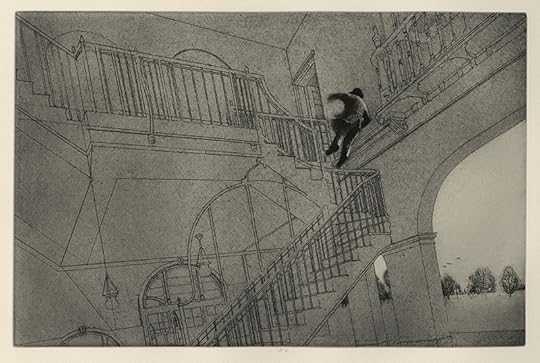
Jamesian Ekphrasis Dept.: A really beautiful series of etchings-engravings by American artist Peter Milton, inspired by this short story, was released in a very limited edition in 1971. You can see Milton’s stunning portfolio here: https://www.davidsongalleries.com/art...
It is heartening to see the surreal liberties Milton took with his elaborations of James’ prose into new imagery. The fantastic scenes in the etchings are often wild exaggerations of quite pedestrian metaphors employed by James. I wish the house in the tale had been haunted to the degree that Milton’s etchings are. Or do I? I appreciate the subtle things James has done with this meditative tale. Maybe I mean I like the tale Milton’s work suggests and wish someone would write that one too. But there is a concinnity to Milton’s ekphrasis. His artwork is true to the feeling of the baleful house and the disorienting influence it exerts over the narrator (and the reader).
It's a story about a man who haunts himself. There is a long tradition of stories about doppelgangers, but I have never encountered one that is quite like this one. In this case the ghostly double is the image of what our protagonist would have been if he had applied himself to business instead of running off to a life of leisure in Europe as a young man, only returning to New York in his fifties to supervise turning one of the family's pieces of prime Manhattan real estate into an apartment building and discovering that he has an aptitude for this business. When Brydon finally encounters his alter ego, he is horrified to the point of denying that this creature is actually himself. It takes the calm female perspective of his friend Alice Staverton, to show him that the ghost really is his twin and is a sad character deserving of their compassion. In the end, though it is never explicitly stated, I thought that the two Brydon's had perhaps been fused together, again becoming a single whole person so that the haunting of the ironically named Jolly Corner could end.
The style of this book is dense even for Henry James. I found myself having to reread sentences and sometimes whole paragraphs to be sure that I got the sense of the words. It was a bit like reading Joyce or Musil - difficult, but rewarding if you have the patience to reread and keep slogging through. I remember having the same sense when I first tried to read James' more famous ghost story, The Turn of the Screw, in high school. It put me off James for a few years, but I'm glad I came back to him because he's one of our greatest writers, even when he's difficult.
Henry James continues to transport the reader from reality in this short story. The dream-like narrative which worked so well in The Turn Of The Screw also works magnificently again here. However, there was a LOT of punctuation which made it difficult, particularly on the first few pages, to get into the writing style. I really enjoyed the imagery, the focus on Freudian psychoanalysis and the figure of the haunted house. A spooky and bizarre read! 3.5/5
Μυστήριο ,αινιγματικό ,με εικόνες. Σε μια εποχή που επικρατούσαν άλλα είδη λογοτεχνίας ,ο Henry James φλερτάρει και γράφει για τον υπαρξισμό, για τα αινίγματα του ανθρώπινου μυαλού και παράλληλα απευθύνεται στον αναγνώστη για ερωτήσεις και απαντήσεις. Έτσι το ένιωσα. Σίγουρα θα το διαβάσω και άλλη φορά στο μέλλον. Να εξετάσω ισως μια άλλη οπτική 😊
Όλοι έχουμε μια υπέροχη γωνία και την κουβαλάμε μαζί μας. Με τα φαντάσματα ,τις αναμνήσεις και τις προσδοκίες μας.